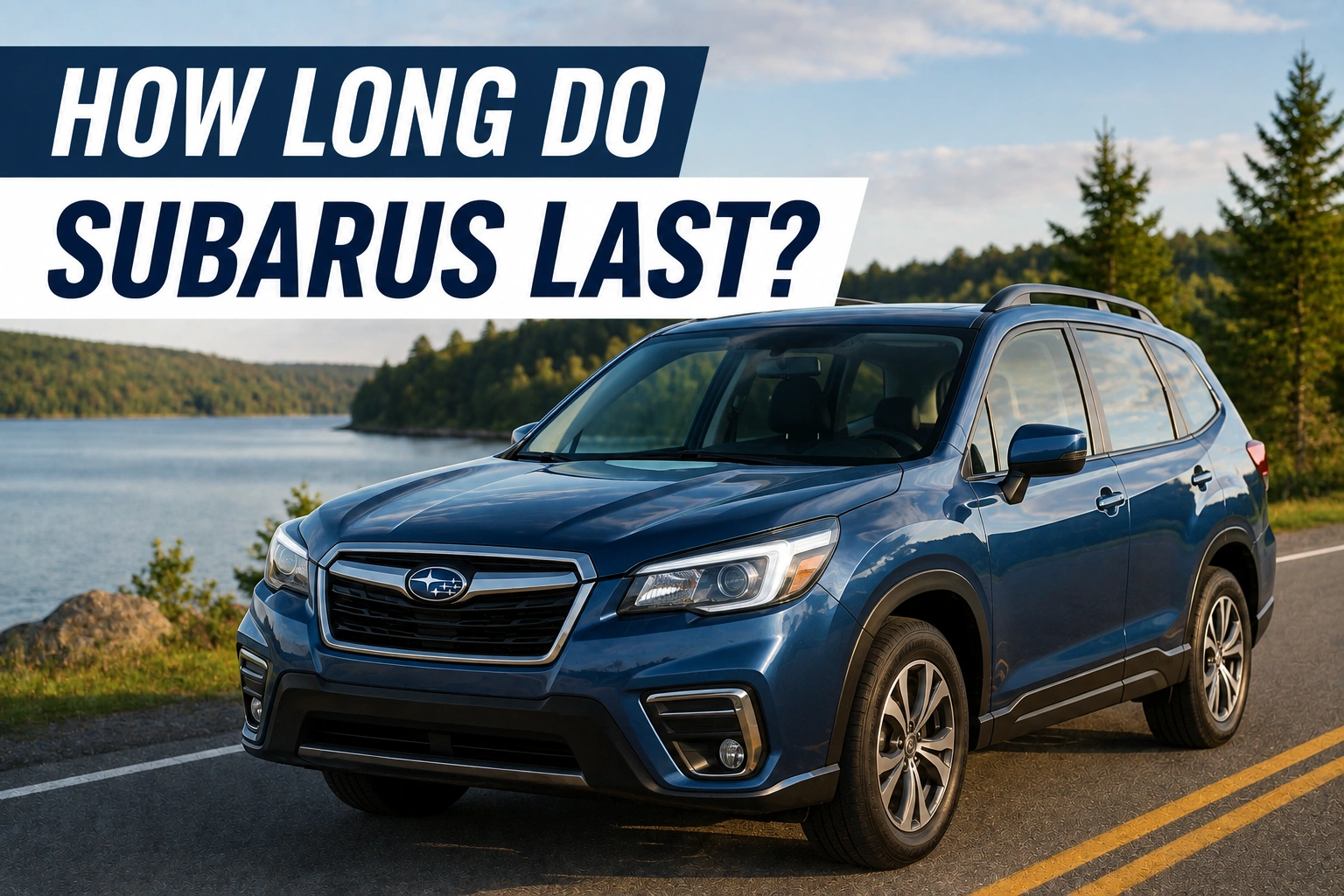
Subaru says 96 percent of the vehicles it sold in the last decade are still driving somewhere in America today. That number sounds like marketing, yet independent data from J.D. Power, Consumer Reports, and iSeeCars backs up more of it than skeptics expect.
The real answer to how long a Subaru lasts depends heavily on which model, which engine, and which decade it rolled off the line. A 2013 Outback and a 2026 Outback share a badge but not a repair history.
Head gaskets and CVT transmissions earned Subaru a rough reputation in online forums for years. Recent reliability studies tell a noticeably different story about current models.
The real difference between a Subaru that dies at 120,000 miles and one still running at 280,000 usually comes down to which engine generation it has and how it was maintained in the first five years.
How Many Miles Does A Subaru Actually Last
Most Subarus reach 200,000 to 250,000 miles with routine maintenance, and plenty of owners push well past 300,000 without ever rebuilding the engine.
That translates to roughly 13 to 20 years on the road for someone driving the national average of 12,000 to 15,000 miles annually.
Subaru itself claims 96 percent of vehicles sold over the last ten years remain registered and on the road today, based on Experian vehicle registration data rather than an internal survey.
RepairPal rates the brand 3.5 out of 5.0 for reliability, placing it 14th out of 32 tracked brands, with an average annual repair bill of $617 against a $652 industry average.
Consumer Reports painted an even stronger picture recently, naming Subaru the top brand on its 2026 Brand Report Card for the second year running, a score blending reliability, owner satisfaction, and road test results.
iSeeCars data adds more texture. The current Outback carries a 22.3 percent chance of reaching 250,000 miles, nearly double the likelihood of the average vehicle on today’s roads.
None of these figures guarantee any single Subaru will hit a specific number. They describe averages across millions of vehicles, and individual results swing heavily based on model year and how it was cared for.
The honest takeaway: a Subaru bought new today, serviced on schedule, has a genuinely strong shot at outliving its auto loan by a decade or more.
Lifespan also means different things to different owners. A Subaru that still starts every morning but needs a new head gasket, a CVT service, and fresh suspension bushings by 180,000 miles hasn’t technically died, but the cost of keeping it running climbs steeply from that point forward.
Resale value follows a similar curve. Subaru models with strong longevity reputations, especially the Outback and Forester, tend to hold value better on the used market than the brand’s less mileage-tested nameplates like the Ascent.
Which Subaru Models Go The Distance
Not every Subaru ages the same way. Body style, engine generation, and how a specific nameplate weathered the brand’s mid-2010s reliability dip all factor into which models hold up best.
Outback And Legacy Lead The Pack
The Outback consistently ranks as Subaru’s longevity champion, and it isn’t particularly close. iSeeCars puts its odds of reaching 250,000 miles at 22.3 percent, landing it among the top 25 vehicles of any type sold in America.
The Legacy shares most of its mechanical structure with the Outback, and it has appeared on iSeeCars’ longest-lasting vehicle list in multiple study years, occasionally outperforming its wagon-bodied sibling.
Both benefit from Subaru’s more conservative engineering choices: naturally aspirated engines in most trims, all-wheel drive without excessive added complexity, and a simpler cooling system layout than the brand’s turbocharged models use.
High-mileage Outbacks and Legacys from the 2013 through 2019 range commonly need head gasket attention by 150,000 miles, a cost worth budgeting separately from routine oil changes and tire rotations.
Owners who bought either model new and followed the maintenance schedule closely often report reaching 200,000 miles with nothing more than normal wear items replaced along the way.
Forester And Crosstrek Bring Everyday Durability
The Forester didn’t make iSeeCars’ most recent top-tier ranking, but it remains one of the brand’s most commonly cited high-mileage survivors among independent repair shops and owner forums.
TrueDelta’s owner-reported reliability survey shows wheel bearings, head gaskets, and oil consumption as the Forester’s most frequent complaints, though most issues surface well past 100,000 miles rather than early in ownership.
The Crosstrek, essentially a lifted Impreza, inherited a cleaner reliability record from its newer shared platform. Consumer Reports currently ranks it third among all models for reliability, ahead of both the Forester and Outback.
A 2025 Forester Hybrid introduced Toyota-derived hybrid hardware to the lineup, and Consumer Reports rated its early reliability as just above average, a reasonable start for a first-generation powertrain pairing between the two brands.
Neither the Outback nor the Crosstrek currently offers a hybrid option, so buyers wanting electrified efficiency in a smaller, more affordable package are limited to the Forester for now.
Ascent, Impreza And The Performance Models
The three-row Ascent remains a relatively young nameplate, launched for 2019, so long-term mileage data stays thinner than what exists for older Subaru models.
Early Ascent owners reported turbocharged-engine issues, including carbon buildup and, on some 2019 and 2020 examples, failures serious enough to prompt extended warranty coverage from Subaru directly.
The Impreza, by contrast, currently holds the title of Subaru’s most reliable model according to Consumer Reports’ latest brand breakdown, aided by its simpler naturally aspirated four-cylinder engine.
Performance models like the WRX and BRZ face different wear patterns entirely. Their engines get driven harder and modified more often, so mileage alone tells less about remaining life than service records and evidence of prior track use. Buyers cross-shopping a used WRX should weigh ownership history as heavily as the number on the odometer.
Common Problems That Can Cut A Subaru Short
Three mechanical issues dominate almost every conversation about Subaru longevity. All three trace back to specific engine generations rather than the brand as a whole.
Head Gasket Failures On Older Boxer Engines
Subaru’s EJ-series engines, used broadly from the late 1990s through the mid-2010s, relied on a multi-layer steel gasket with a graphite coating that degraded with age and heat cycles.
Once that coating broke down, coolant could seep into the combustion chamber while exhaust gases entered the cooling system, typically surfacing between 120,000 and 150,000 miles.
Repair costs run at least $1,000 for parts and labor, since most shops pull the engine entirely to properly resurface the cylinder heads before installing new gaskets.
The redesigned FB-series engines, phased in starting around 2011, largely resolved this weakness through revised cylinder heads and gasket material. A pre-purchase inspection that includes a combustion leak test remains the best way to catch a failing gasket before it strands you on the highway.
Spark plug tube seals sit close to this same story. On aging FA and FB engines, the rubber seals stiffen over time and lose their ability to expand with the valve cover, creating a separate, smaller oil leak that gets misdiagnosed as a head gasket issue more often than it should.
Oil Consumption Issues From 2011 Through Roughly 2018
A 2016 class action lawsuit alleged that certain FB-series engines burned through oil at an abnormal rate, with piston ring design identified as the likely underlying cause.
Subaru ultimately settled, agreeing to extend powertrain warranties to 8 years or 100,000 miles on affected vehicles and reimburse owners for related repairs and interim oil top-offs.
Consuming roughly a quart of oil every 5,000 miles is considered normal for many Subaru boxer engines. Needing a quart every 1,000 miles, as some affected owners reported, signals a real mechanical problem rather than routine engine character.
Checking oil level manually every few fill-ups matters more on a Subaru than on many competing brands, since low oil combined with this consumption tendency can cause serious engine damage in a surprisingly short window.
CVT Transmission Concerns Since 2010
Subaru introduced continuously variable transmissions across most of its lineup starting around 2010, replacing traditional automatics on everything except a handful of performance models.
Early CVT units earned a reputation for expensive failures, particularly when contaminated by coolant leaking in from a failing head gasket, since the transmission cooler shares coolant circulation with the engine on many models.
Owners and independent Subaru specialists generally describe the 2019-and-newer CVT, paired with the direct-injection 2.5-liter engine, as substantially more durable than earlier versions of the same basic design.
Regular CVT fluid changes, roughly every 30,000 miles even though some owner’s manuals suggest longer intervals, appear to meaningfully extend transmission life based on independent shop experience. Skipping this service to save money upfront remains one of the most common ways owners shorten a Subaru’s usable life.
Simple Habits That Add Years To Any Subaru
Following Subaru’s factory maintenance schedule closely matters more than it does with many competing brands, largely because of the head gasket and CVT history covered above.
Oil changes every 6,000 miles or six months, whichever comes first, keep the boxer engine’s tighter internal tolerances protected against the sludge buildup that accelerates wear.
Coolant deserves particular attention. Simply topping off a low reservoir without investigating why the level dropped ignores the most common early warning sign of head gasket trouble.
CVT fluid changes around every 30,000 miles cost a few hundred dollars but can prevent a transmission replacement running well over $3,000 on models outside any active recall coverage.
Timing belt service, relevant only on pre-2011 models with the older EJ engine, needs attention around 105,000 miles. Skipping it risks catastrophic engine damage if the belt fails while driving.
Rust prevention matters most for owners in snowy, salted-road climates. Underbody and suspension components can corrode faster than the engine wears out in these regions, so annual undercoating or a simple rinse after winter driving genuinely extends usable life.
Gentle warm-up habits help too. Boxer engines reach proper operating temperature slightly slower than inline engines, so avoiding hard acceleration in the first few minutes after a cold start reduces long-term wear on internal components.
Annual mileage matters less than consistency. A Subaru driven 8,000 highway miles a year generally outlasts one driven the same distance through stop-and-go city traffic, since sustained highway speeds keep oil and coolant temperatures more stable.
Tire rotation and alignment checks matter more on a Subaru than on a front-wheel-drive competitor. Symmetrical all-wheel drive ties all four wheels together mechanically, and uneven tire wear from a skipped rotation can strain the drivetrain components that normally last the life of the vehicle.
Finding an independent mechanic who specifically knows Subaru’s boxer engine layout pays off over time. The horizontally opposed cylinders sit in a spot that makes certain jobs, like spark plug replacement, more labor-intensive than on a typical inline engine, and shop familiarity keeps labor costs predictable.
How Subaru Compares To Toyota And Honda
Toyota’s reputation for longevity remains the industry benchmark, but recent data shows a smaller gap than most car shoppers assume going in.
Consumer Reports’ most recent detailed reliability breakdown found Subaru posting 181 problems per 100 vehicles against Toyota’s 185, a genuinely close result that surprised several industry analysts.
J.D. Power’s Initial Quality Study placed Subaru at exactly the industry average of 187 problems per 100 vehicles, while its longer-term Vehicle Dependability Study still favors Toyota and Lexus at the very top of the rankings.
Where Subaru pulls ahead is standard equipment. Every Subaru comes with all-wheel drive as standard, a feature Toyota and Honda usually reserve for optional packages, adding mechanical complexity that Subaru has spent decades refining into a strength.
Brand loyalty tells its own part of this story. Subaru owners historically return to the brand for their next purchase at rates that rival Toyota, according to IHS Markit and Experian loyalty data, suggesting real-world satisfaction tracks closer to Toyota than raw defect counts alone would suggest.
| Brand | RepairPal Score | Avg Annual Repair Cost | Brand Rank (Of 32) |
| Subaru | 3.5 / 5.0 | $617 | 14th |
| Toyota | 4.0 / 5.0 | $441 | 8th |
| Honda | 4.0 / 5.0 | $428 | 1st |
Honda edges out both rivals on raw repair cost data, while Toyota holds a narrow long-term dependability edge over Subaru once vehicles pass the three-year mark. All three brands sit comfortably below the $652 industry average, which matters more in practice than the small point-scale gaps separating them.
A few quick questions worth answering before you buy:
What is considered high mileage for a Subaru?
Most mechanics consider 100,000 miles moderate and treat 150,000 miles as the point where major components like head gaskets start needing attention on older engines. Anything past 200,000 miles counts as genuinely high mileage, though service history matters more than the odometer alone.
Do all Subaru engines have head gasket problems?
No. Head gasket failures mainly affected EJ-series engines built from the late 1990s through roughly 2010. Subaru’s FB-series engines, standard since around 2011, use a revised design that largely resolved the issue, so newer Outbacks, Foresters, and Legacys rarely see this specific failure.
Is the Subaru CVT reliable long term?
Early Subaru CVTs, introduced around 2010, developed a reputation for costly failures, often linked to coolant contamination from head gasket leaks. Units paired with the 2019-and-newer direct-injection engine are widely considered far more durable, especially with fluid changes every 30,000 miles.
How much does it cost to maintain a Subaru past 100,000 miles?
RepairPal estimates $617 per year on average across all Subaru models and ownership periods, though costs typically rise once a vehicle passes 100,000 miles and starts needing gasket work, CVT service, or suspension repairs. Budgeting $800 to $1,200 annually for a high-mileage example is reasonable.
Which Subaru model is the most reliable to buy used?
The Impreza and Crosstrek currently rank as Subaru’s most reliable models according to Consumer Reports, thanks to simpler naturally aspirated engines and newer shared platforms. The Outback holds the strongest long-term mileage track record of any Subaru in independent longevity studies.
Does driving in snow shorten a Subaru’s lifespan?
Snow and road salt accelerate rust on the underbody and suspension far more than they wear out the engine or transmission. Regular undercoating, or at least rinsing salt off after winter drives, protects a Subaru’s structural lifespan in cold climates more effectively than any engine-related maintenance step.