
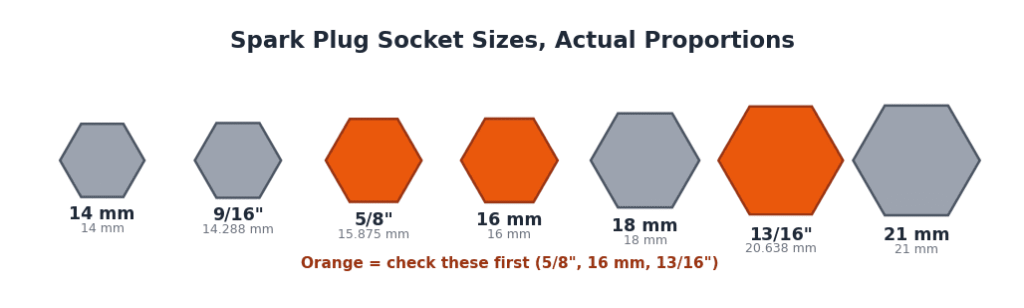
Spark plugs may look similar from the outside, but the socket needed to remove one is not universal. The most common spark plug socket sizes are 5/8 inch (16 mm) and 13/16 inch (21 mm), while some engines use 14 mm, 18 mm, 9/16 inch, or other less common sizes.
The correct size depends on the hex section built into the spark plug and, in some cases, the design of the engine. Modern engines often use smaller spark plugs than older engines because manufacturers have changed combustion-chamber layouts and ignition designs.
Choosing the right socket is more important than simply finding one that appears to fit. A socket that is slightly too large can slip and damage the plug’s hex. A poorly fitting tool can also make removal difficult when the plug is deeply recessed inside the cylinder head.
There is another important detail: a spark plug socket is not just an ordinary deep socket. Many are designed with a rubber insert or magnet to hold the plug during removal and installation. The right size, depth, and design all matter.
Common Spark Plug Socket Sizes And How To Identify The Right One
The size of a spark plug socket refers to the width across the hex portion of the spark plug. It does not refer to the spark plug’s thread diameter, electrode gap, or overall length.
This distinction causes a lot of confusion.
For example, a spark plug can have a 14 mm thread diameter while requiring a 16 mm socket across its hex. Another plug can use a completely different thread specification but still have a similar hex size.
The socket should therefore be selected based on the plug’s hex specification.
For many passenger vehicles, 5/8 inch and 16 mm are the sizes people encounter most often. However, they should not be treated as interchangeable in every situation.
A 5/8-inch socket measures approximately 15.875 mm, while a 16 mm socket measures exactly 16 mm. The difference is small, but spark-plug hexes and tool tolerances can make proper fit important.
The Most Common Spark Plug Socket Sizes
The following sizes cover many automotive applications, but the vehicle manufacturer’s specification or the spark-plug manufacturer’s catalog should be used when the exact size is important.
| Spark Plug Socket Size | Approximate Metric Equivalent | Common Use |
| 5/8 Inch | 15.875 mm | Very Common On Cars And Trucks |
| 16 mm | 0.630 Inch | Very Common On Modern Engines |
| 13/16 Inch | 20.638 mm | Common On Older And Larger Applications |
| 21 mm | 0.827 Inch | Used On Some Larger Spark Plugs |
| 14 mm | 0.551 Inch | Common In Certain Modern Applications |
| 18 mm | 0.709 Inch | Less Common, Application Dependent |
| 9/16 Inch | 14.288 mm | Found On Some Specialized Applications |
The two sizes most people associate with spark plugs are 5/8 inch and 13/16 inch.
However, modern engines have increased the variety of plug designs.
Some manufacturers use smaller hex sizes to accommodate compact cylinder-head designs. This is one reason it is better to identify the exact spark plug rather than buying a socket based solely on the vehicle’s age or engine size.
5/8-Inch Vs 16 mm Spark Plug Sockets
A 5/8-inch socket is extremely common in automotive spark-plug work.
Because 5/8 inch is approximately 15.875 mm, it is very close to 16 mm. That leads some people to assume that either socket can be used interchangeably.
In practice, the correct choice depends on the actual plug hex and the fit of the tool.
If a plug is specified for a 16 mm socket, use a properly fitting 16 mm spark plug socket whenever possible. Likewise, if the plug is designed around a 5/8-inch hex, a 5/8-inch socket is the appropriate choice.
The small difference between the two measurements may not cause an obvious problem on a clean, undamaged plug. But when a plug is tight, corroded, or made from a relatively soft metal, even a small amount of looseness can damage the hex.
A damaged spark-plug hex can turn a straightforward maintenance job into a much more difficult repair.
13/16-Inch Spark Plug Sockets
The 13/16-inch size is another familiar spark plug socket.
It measures approximately 20.64 mm across the socket opening.
This size is particularly common on older vehicles and certain engines using larger spark plug designs.
Some lawn equipment, motorcycles, older cars, trucks, and other gasoline-powered engines can also use larger hex sizes.
A 13/16-inch socket is visibly larger than a 5/8-inch socket, so the two are not interchangeable.
If the socket is too large, it may not engage the spark-plug hex correctly. If it is too small, it simply will not fit over the plug.
The best approach is to check the plug specification or physically measure the hex with suitable measuring equipment.
Avoid forcing a socket onto a plug simply because it appears close in size.
Why Modern Engines Often Use Smaller Spark Plug Hexes
Spark plug design has changed significantly over the years.
Modern engines often have tightly packaged cylinder heads, smaller combustion chambers, coil-on-plug ignition systems, and more complex valve arrangements.
A smaller spark plug hex can help manufacturers create a more compact plug design.
The reduction in external hex size does not necessarily mean the spark plug is weaker or less capable. The plug’s thread, electrode arrangement, insulator, heat range, and construction are all engineered for the particular engine.
This is why newer vehicles can surprise people who are accustomed to older 13/16-inch or 5/8-inch spark plug sockets.
A vehicle that looks similar to an older model can use an entirely different plug design.
Spark Plug Socket Size Vs Spark Plug Thread Size
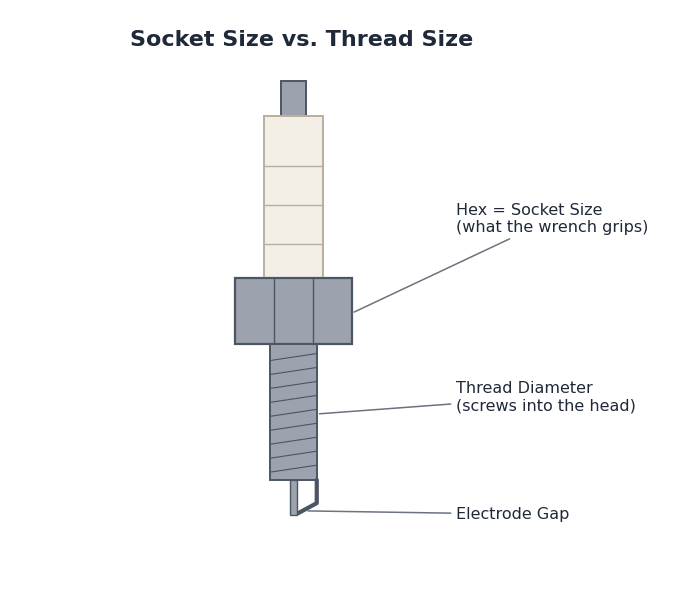
These are two completely different measurements.
The spark plug socket size describes the hex that the socket grips.
The spark plug thread size describes the threaded section that screws into the cylinder head.
For example:
| Specification | What It Describes |
| Socket Size | Hex Size Used By The Removal Tool |
| Thread Diameter | Diameter Of The Spark Plug Threads |
| Thread Reach | Length Of The Threaded Section |
| Electrode Gap | Distance Between The Electrodes |
| Heat Range | Plug’s Thermal Operating Characteristics |
| Seat Type | How The Plug Seals Against The Cylinder Head |
A plug’s thread diameter cannot be used to determine the socket size.
This is particularly important when buying replacement spark plugs. Two plugs may have different thread dimensions but use similar socket sizes, or they may have similar threads but different hex designs.
The plug specification should always be treated as a complete set of dimensions rather than selecting a socket based on one measurement.
How To Find The Exact Spark Plug Socket Size For Your Vehicle
The easiest way to determine the correct socket is to identify the spark plug specification for the exact engine.
Vehicle make and model alone may not always be enough.
The same model can be sold with several engine options, and different engines can use different spark plugs.
Even within the same engine family, changes between model years can sometimes affect the plug specification.
A reliable approach is to identify the engine, obtain the correct spark plug part number, and check the manufacturer’s specification for the hex size.
If the spark plugs have already been installed, the existing plug can also be inspected.
The hex portion is the part that the socket must fit.
Check The Spark Plug Part Number
Spark plugs normally have a manufacturer’s part number printed on the box and often marked on the plug itself.
That number can be used to identify the plug’s dimensions and application.
The part number is more useful than guessing based on appearance because two spark plugs can look almost identical while having different thread reach, seat design, heat range, electrode configuration, and hex dimensions.
When purchasing plugs, check the manufacturer’s catalog for the exact vehicle and engine.
A good parts catalog should identify the correct application and specifications.
If a replacement plug has a different hex size from the original, do not assume that it is incorrect immediately. Manufacturers sometimes supersede one design with another, but the replacement should still be confirmed as compatible with the engine.
The important thing is that the replacement plug matches the required specifications, not merely that it physically screws into the cylinder head.
Measure The Existing Spark Plug
If the plug has already been removed, its hex can be measured with a vernier caliper.
Measure across two opposite flat surfaces of the hex.
This gives the approximate socket size required.
A caliper is more reliable than trying random sockets, especially when the plug is an unusual size.
If a caliper is unavailable, placing correctly sized sockets over the plug can also help identify the closest fit.
The correct socket should slide fully over the hex and engage the flats without excessive movement.
Do not use an adjustable wrench to remove a recessed spark plug.
The hex is designed for a socket, and spark plugs can be damaged if the tool does not engage all of the available flats.
Check The Vehicle Service Information
Vehicle-specific service information is the best reference when there is uncertainty.
It can identify the recommended spark plug, thread specification, torque specification, installation procedure, and sometimes the required tool.
This becomes particularly important on engines where access is restricted.
Some spark plugs sit deep inside the cylinder head and require a long, thin-wall socket.
A normal deep socket may be the correct hex size but still be too large externally to fit down the spark-plug tube.
That is an important difference between socket size and socket design.
Getting the hex measurement right is only half of the job.
Spark Plug Socket Size By Engine Type
There is no reliable rule that says a particular engine configuration always uses one specific socket.
Four-cylinder engines can use 14 mm, 16 mm, 5/8-inch, or other sizes.
Six-cylinder engines can use different sizes between manufacturers.
V8 engines can also vary.
Even engines from the same manufacturer may use different plug designs.
| Engine Type | Typical Possibilities |
| Four-Cylinder Gasoline | 14 mm, 16 mm, 5/8 Inch And Others |
| Six-Cylinder Gasoline | 14 mm, 16 mm, 5/8 Inch And Others |
| V8 Gasoline | 16 mm, 5/8 Inch, 13/16 Inch And Others |
| Motorcycle Engine | Highly Application Dependent |
| Small Engine | Often Smaller Specialized Sizes |
| Older Engines | 13/16 Inch And Other Larger Sizes Common |
These are general patterns, not fitment rules.
Engine design, manufacturer, model year, cylinder-head construction, and spark-plug specification all influence the required socket.
Choosing The Right Spark Plug Socket And Using It Correctly
Once the size is known, the next consideration is the type of socket.
A spark plug sits in a narrow, often deep hole, so ordinary sockets are not always ideal.
A purpose-built spark plug socket typically has a thin profile and a mechanism for holding the plug during removal.
Many use a rubber insert.
Others use a magnetic retention system.
Both designs can work well when correctly matched to the plug and engine.
Rubber Insert Vs Magnetic Spark Plug Socket
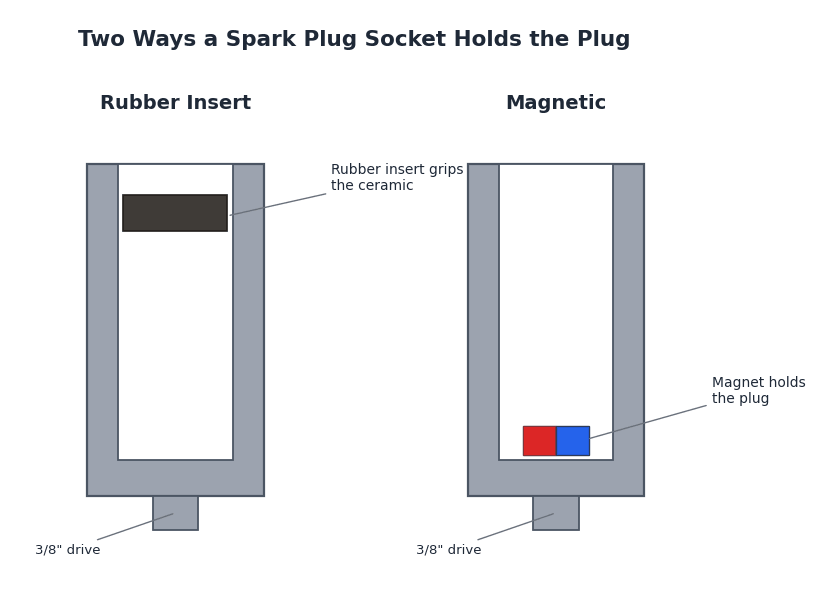
A rubber insert grips the porcelain portion of the spark plug.
When the plug is removed, the insert helps hold it inside the socket so it can be lifted out of the cylinder head.
A magnetic socket uses a magnet to retain the spark plug.
Neither design is automatically better for every application.
Rubber inserts can become worn or loose over time. A worn insert may allow the plug to fall out when the socket is withdrawn.
Magnetic sockets can be convenient and durable, but their effectiveness depends on the plug construction and the socket design.
The most important feature is a secure fit that allows the plug to be installed and removed without damaging the ceramic insulator or metal hex.
For deep spark-plug wells, socket dimensions beyond the basic hex size also matter.
Why A Thin-Wall Socket Can Be Important
Some cylinder heads have narrow spark-plug tubes.
A standard socket may have the correct 16 mm or 5/8-inch opening but still be too thick around the outside to enter the plug well.
This is where a thin-wall spark plug socket becomes useful.
The outside diameter of the socket must be small enough to pass through the available opening.
This issue is common on tightly packaged modern engines.
If a socket will not reach the spark plug, do not assume the socket size is wrong immediately.
Measure the opening and compare it with the outside diameter of the tool.
A properly designed spark plug socket solves this problem while retaining enough material around the hex to provide secure engagement.
What Drive Size Should A Spark Plug Socket Have?
The drive size refers to the square connection used to attach the socket to a ratchet or extension.
Common drive sizes include:
- 1/4 inch
- 3/8 inch
- 1/2 inch
For most passenger-car spark plug work, 3/8-inch drive is a common and versatile choice.
However, 1/4-inch and 1/2-inch drive spark plug sockets are also available.
The drive size does not determine the spark plug hex size.
For example, you can have a 3/8-inch-drive socket designed for a 16 mm spark plug.
You can also have a 3/8-inch-drive socket designed for a 5/8-inch spark plug.
These are separate specifications.
A smaller drive can be useful when access is tight, while a larger drive may provide greater strength. Excessive force should not normally be necessary when removing a correctly installed spark plug.
Do You Need An Extension?
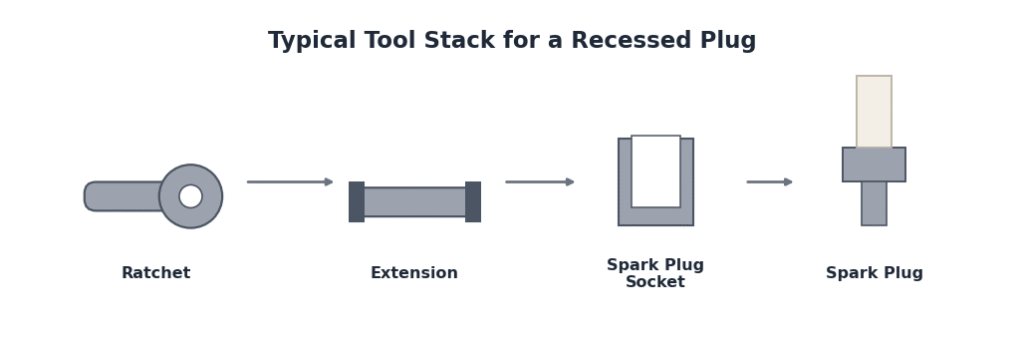
Many engines require an extension because the spark plugs are recessed deep inside the cylinder head.
A common setup is:
Ratchet → Extension → Spark Plug Socket
The correct extension length depends on the engine.
A universal joint or wobble extension may sometimes help with difficult access, but care is needed. Too much angle can place uneven force on the spark plug.
Ideally, the socket should sit squarely on the plug.
Keeping the tool aligned with the spark plug reduces the risk of damaging the hex or placing side loads on the ceramic insulator.
A long extension can also make it harder to feel what is happening at the plug.
For that reason, use enough extension to reach the plug without adding unnecessary components.
Why A Torque Wrench Matters During Installation
Removing a spark plug and installing one are different tasks.
Removal often involves loosening the old plug.
Installation requires the correct seating and tightening torque.
Spark plugs should be tightened according to the manufacturer’s specification.
Under-tightening can prevent proper sealing and heat transfer.
Over-tightening can damage the spark plug, cylinder-head threads, or sealing surface.
This is particularly important with aluminum cylinder heads.
A torque wrench provides a more controlled installation than simply tightening the plug by feel.
The specified torque depends on the spark plug design, thread size, seat type, and cylinder-head application.
Do not use one universal torque value for every spark plug.
Spark Plug Socket Vs Standard Deep Socket
A standard deep socket can sometimes fit the hex of a spark plug, but it may not be the best tool for the job.
The major difference is spark-plug retention.
A spark plug socket is designed to hold the plug during removal and installation.
A regular deep socket may allow the plug to fall into the cylinder-head tube.
A standard socket may also have an outside diameter that is too large for the spark-plug well.
Another issue is depth.
Spark plug sockets are generally designed around the dimensions of common plug bodies and ceramic insulators.
A regular socket can work in some accessible applications, but a purpose-built spark plug socket is usually the more practical choice.
Spark Plug Removal And Installation: The Right Technique
Having the correct socket does not guarantee a successful spark plug replacement.
The engine should be cool unless the vehicle manufacturer’s service procedure specifies otherwise.
The area around each spark plug should be kept clean before the plug is removed.
Dirt or debris around the plug can fall into the cylinder once the plug is removed.
Compressed air can be useful for cleaning the area, provided it is used safely and does not blow contaminants into sensitive components.
The ignition coil or plug wire must then be removed according to the engine’s design.
The spark plug socket should be placed squarely onto the plug.
Once the socket is fully engaged, the plug can be loosened carefully.
What To Do If The Spark Plug Is Very Tight
A spark plug that is difficult to remove should not automatically be attacked with excessive force.
First confirm that the socket is the correct size and fully seated.
Check whether the socket is straight.
If the plug has been installed for a long time, carbon buildup, corrosion, or thread-related issues may increase resistance.
Excessive force can break the ceramic insulator or damage the cylinder-head threads.
A controlled approach is preferable.
If the plug begins to move, work it out gradually rather than applying continuous extreme force.
If a plug feels seized or the hex starts to deform, stop and reassess.
A damaged spark-plug hex can make extraction much more difficult.
Why The Spark Plug Well Should Be Clean
The spark plug sits at the end of a narrow tube in many engines.
Dirt, sand, rust particles, or other debris can collect around the top of the plug.
If that material falls into the combustion chamber after removal, it can create unnecessary problems.
Cleaning the area before removing the plug is therefore good practice.
The ignition coil sealing boot should also be inspected for oil contamination, cracking, or damage where applicable.
Oil inside a spark-plug well can indicate a valve-cover gasket or tube-seal problem rather than a spark-plug problem.
That issue should not be ignored because oil contamination can eventually affect ignition performance.
Installing The New Spark Plug
Before installation, verify that the replacement plug is the correct part.
Check the thread specification, reach, seat type, heat range, and electrode design.
Do not modify the electrode gap unless the plug manufacturer or vehicle manufacturer specifies that adjustment is appropriate.
Modern plugs can use delicate electrode designs that can be damaged by improper handling.
Start the spark plug by hand using the spark plug socket and extension.
This is an important step.
The plug should thread smoothly into the cylinder head.
If it immediately feels cross-threaded or unusually tight, remove it and investigate rather than forcing it.
Once the plug is properly seated, tighten it to the specified torque.
The ignition coil or plug wire can then be reinstalled.
Why Starting The Plug By Hand Matters
Cross-threading is one of the most expensive mistakes that can happen during spark plug installation.
The cylinder head may be made from aluminum, while the spark plug has steel threads.
If the plug enters at an angle and is forced with a ratchet, the softer cylinder-head threads can be damaged.
Using a long extension with the ratchet removed is one way to reduce the chance of applying excessive force during initial threading.
The socket and extension can be turned gently by hand.
If the plug does not thread smoothly, stop.
A spark plug should not require significant force during the initial hand-threading stage.
Once several threads are properly engaged, the correct tool can be used for final tightening.
Do Not Use The Socket To Guess Spark Plug Torque
The resistance you feel through a ratchet is not a reliable measurement of torque.
A plug may feel tight while still being below specification, or it may feel secure while being significantly over-tightened.
The correct torque depends on the plug and engine.
Some spark plugs use a gasket seat, while others use a tapered seat.
Those designs do not necessarily use the same tightening procedure.
A new gasket-style plug may also require the manufacturer’s specified initial tightening method if torque specifications are not provided.
The safest approach is to use the specification supplied for the exact spark plug and engine.
Spark Plug Socket Sizes And Tool Selection At A Glance
| Requirement | Recommended Approach |
| Most Common Size | Check 5/8 Inch Or 16 mm First |
| Larger Common Size | Check 13/16 Inch |
| Unusual Modern Plug | Verify Exact Part Specification |
| Deep Plug Well | Use Long Spark Plug Socket |
| Narrow Plug Well | Use Thin-Wall Socket |
| Plug Retention | Rubber Insert Or Magnetic Design |
| Typical Passenger-Car Drive | 3/8 Inch |
| Installation | Use Manufacturer-Specified Torque |
| Tight Plug | Confirm Fit Before Applying More Force |
| Difficult Access | Use Correct Extension Without Excessive Angle |
Common Mistakes When Choosing Or Using A Spark Plug Socket
One of the easiest mistakes is assuming every spark plug uses the same socket size.
They do not.
Another mistake is confusing metric and SAE measurements.
A 16 mm socket is extremely close to 5/8 inch, but “close” is not the same as “correct.”
A socket that fits loosely may damage the hex, especially if the plug is tight.
Another problem is using an ordinary deep socket without considering the plug well.
The socket may fit the hex but fail to reach the plug or fail to hold it securely.
There is also a tendency to use excessive force when a spark plug does not move.
That can break the ceramic insulator, round the hex, or damage cylinder-head threads.
Good spark plug work is mostly about using the correct tool and applying controlled force.
Can A Wrong-Size Socket Damage A Spark Plug?
Yes.
If the socket is too large, it may not grip the flats securely.
When torque is applied, the socket can slip over the hex and round its corners.
Once the hex is damaged, normal spark plug sockets may no longer work.
Using a slightly smaller socket is not a safe solution either. If it does not fully fit over the hex, it can damage the plug.
The socket should fit completely and squarely.
This is particularly important when removing a spark plug that has been installed for many years.
A properly fitting socket distributes force across the available flats.
A poor-fitting tool concentrates force on smaller areas and increases the chance of damage.
Why You Should Not Use An Impact Gun Automatically
An impact tool can make removal fast, but spark plugs are not components that should automatically be attacked with high-speed power tools.
The cylinder head and plug threads are relatively delicate compared with many other engine fasteners.
An impact tool can also make it harder to detect unusual resistance.
If a spark plug is cross-threaded, seized, or damaged, excessive impact force can make the problem worse.
For normal maintenance, a hand ratchet provides better control.
If specialized power equipment is used by a professional, it should be appropriate for the application and used with the correct technique.
The goal is controlled removal and installation, not maximum force.
Why The Socket Must Sit Straight
A spark plug socket should ideally be aligned with the plug.
If the socket is at an angle, the force applied through the ratchet can be transferred unevenly to the spark plug.
This increases the risk of damaging the hex or ceramic insulator.
The problem is more noticeable in engines where spark plugs sit at an angle or deep inside narrow wells.
An extension can help keep the ratchet away from surrounding components while allowing the socket to remain aligned with the plug.
If the socket feels loose or rocks noticeably on the plug, stop and verify the size.
The correct socket should feel secure before torque is applied.
What If The Spark Plug Socket Gets Stuck?
A spark plug socket can occasionally remain attached to the plug or become difficult to remove from a deep plug well.
If the socket is stuck to the spark plug, carefully withdraw the socket and plug together if possible.
Avoid pulling aggressively on the ignition coil or nearby wiring.
If a rubber insert has become lodged on the spark plug, the socket may need to be separated carefully after the plug is removed.
Magnetic sockets generally avoid some of the retention problems associated with worn rubber inserts, but they can still become stuck in narrow wells.
Having the correct extension length and socket design for the engine can prevent many access problems.
The Most Important Detail Is Not The Socket Size
The socket size is important, but it is only one part of proper spark plug service.
The replacement plug must have the correct thread diameter, thread reach, seat design, heat range, electrode configuration, and specification for the engine.
A socket can remove a plug without difficulty even when the replacement part is completely wrong for the engine.
That is why spark plug maintenance should begin with identifying the correct plug rather than starting with the tool.
Once the correct plug is known, its required socket size can be confirmed.
This approach also helps avoid another common mistake: buying a complete set of sockets and assuming one of them will fit.
The exact plug specification provides a much more reliable starting point.
Final Takeaway
For many vehicles, the answer to “what size socket is a spark plug?” will be 5/8 inch or 16 mm, but there is no universal spark plug socket size.
Older and larger spark plugs frequently use 13/16 inch, while many modern engines use smaller 14 mm or 16 mm designs.
The correct size is determined by the spark plug’s hex, not by the thread diameter.
Before removing a plug, confirm the exact spark plug specification for the engine. If the plug is already installed, measure the hex or test the fit with the correct socket.
A purpose-built spark plug socket is usually preferable because it can provide the required depth, thin-wall construction, and plug retention.
During installation, start the plug by hand, avoid cross-threading, and use the specified tightening torque.
The deeper lesson is that spark plug service is not simply about finding a socket that fits. The socket, extension, plug design, cylinder-head access, installation torque, and correct replacement part all work together.
Using the right tool prevents unnecessary damage and makes routine ignition-system maintenance considerably easier.
FAQs
What Size Socket Is Most Common For Spark Plugs?
The most common sizes are 5/8 inch (15.875 mm) and 16 mm. However, 13/16 inch is also widely encountered, particularly on older applications. Some modern engines use 14 mm or other sizes. The exact spark plug specification should always be checked because there is no universal socket size for every engine.
Is A 5/8-Inch Spark Plug Socket The Same As A 16 mm Socket?
They are extremely close in size, but they are not exactly the same. A 5/8-inch socket is approximately 15.875 mm, while a 16 mm socket is exactly 16 mm. The difference is small, but using the socket specified for the spark plug provides the best fit and reduces the risk of damaging the plug’s hex.
Can I Use A Regular Deep Socket For A Spark Plug?
Sometimes, but a dedicated spark plug socket is generally more suitable. Spark plug sockets are designed to fit into deep and sometimes narrow plug wells, and many include a rubber insert or magnet to retain the plug. A regular deep socket may fit the hex but can be too large externally or may not hold the plug securely.
What Size Socket Is A 13/16 Spark Plug?
A spark plug requiring a 13/16-inch socket has a hex that measures approximately 20.64 mm across the flats. This size is common on some older engines, larger spark plug designs, and certain small-engine or specialty applications. It should not be confused with the plug’s thread diameter.
How Do I Know What Spark Plug Socket My Car Needs?
Find the exact spark plug part number recommended for your engine and check its specifications. You can also measure the hex of an existing plug with a caliper. Vehicle make and model alone may not always be sufficient because different engine options can use different spark plug designs and socket sizes.
Do Spark Plugs Need A Special Socket?
A special spark plug socket is not always technically required, but it is usually the best choice. A dedicated socket typically has the correct depth and profile and may include a rubber insert or magnetic retainer. For recessed spark plugs, a thin-wall design can also be necessary to fit through the cylinder-head opening.
Can The Wrong Spark Plug Socket Damage The Plug?
Yes. A socket that is too large can slip and round the spark plug’s hex, particularly when the plug is tight. A socket that is too small may not fully engage the hex and can also cause damage. The correct socket should fit completely and squarely over the plug before force is applied.
What Drive Size Is Best For A Spark Plug Socket?
A 3/8-inch drive is common for passenger vehicles, although 1/4-inch and 1/2-inch drive spark plug sockets are also available. Drive size and spark plug hex size are separate specifications. For example, a 3/8-inch-drive socket can be made for a 16 mm spark plug or a 5/8-inch spark plug.
Should I Use A Torque Wrench On Spark Plugs?
Yes, when possible. Spark plugs should be tightened according to the manufacturer’s specification. Over-tightening can damage the plug or cylinder-head threads, while under-tightening can affect sealing and heat transfer. The correct torque varies by spark plug design and engine, so there is no single torque value suitable for every application.