A car that makes a clicking noise when you turn the key or press the start button is giving you an important clue about its starting system. The engine needs enough electrical power to turn over, and even a small problem with the battery, cables, starter motor, or electrical connections can prevent that process from happening. Sometimes the repair is as simple as cleaning a battery terminal, while other cases require a new starter or further electrical diagnosis.
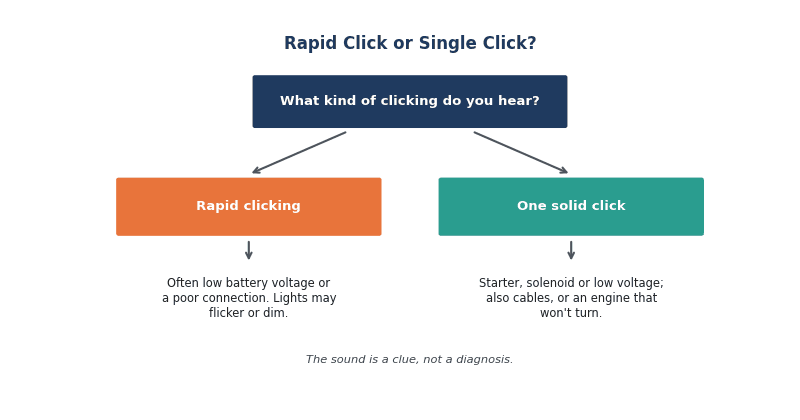
If your car is just clicking when trying to start, pay attention to the type of sound, whether the dashboard lights remain bright, and whether the engine attempts to turn over. Rapid clicking often points toward low battery voltage or a poor electrical connection, while a single solid click can indicate a starter problem or another fault in the starting circuit.
Finding the cause before replacing parts can save money and prevent unnecessary repairs. The following guide covers the most likely reasons, practical checks, repair costs, and warning signs that indicate when professional help is needed.
Why Is Your Car Just Clicking When Trying To Start?
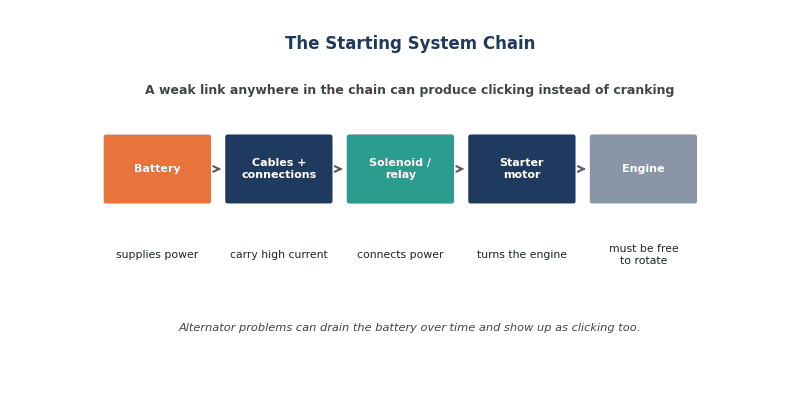
The starting system depends on several components working together. The battery supplies electrical power, the starter solenoid helps connect that power to the starter motor, and the starter motor turns the engine until combustion can begin.
If any part of this process fails, you may hear clicking without the engine actually starting.
The sound itself provides a useful starting point, but it cannot confirm the failed component by itself. Battery condition, electrical connections, starter operation, and engine condition may need to be checked before a reliable diagnosis can be made.
Rapid Clicking When You Turn The Key
Rapid clicking is commonly associated with insufficient electrical power reaching the starter motor.
When you attempt to start the engine, the starter solenoid may engage briefly, but the battery voltage drops too low to keep the system operating correctly. The solenoid disengages, voltage recovers slightly, and the process repeats. This creates a fast series of clicks.
A weak or discharged battery is a common reason for this behavior. However, loose battery terminals, corroded connections, damaged cables, or a charging-system problem can produce similar symptoms.
You may also notice that the dashboard lights flicker, the headlights dim, or the instrument cluster resets when you try to start the car.
These signs suggest that the electrical system is struggling under the heavy load required by the starter motor.
One Click When Trying To Start The Car
A single click usually means the starting circuit is receiving at least some electrical power, but the engine is not turning over.
The sound may come from the starter solenoid, which is responsible for engaging the starter mechanism and connecting electrical power to the motor.
Possible causes include a failing starter motor, a weak battery, a poor electrical connection, a defective solenoid, or a problem inside the engine that prevents it from turning.
A single click does not automatically mean the starter needs replacement. A battery can still operate the dashboard and headlights while lacking enough power to turn the engine.
The location of the sound can also help. A click near the engine compartment may come from the starter area, while a sound from inside the cabin may originate from a relay or another electrical component.
Clicking With No Dashboard Lights
If the car clicks and the dashboard lights are completely off or very weak, start by checking the battery and its connections.
A severely discharged battery may not have enough energy to operate the vehicle’s electrical systems. A loose or heavily corroded terminal can also interrupt the electrical supply.
If the battery connections appear secure but the vehicle remains completely unresponsive, a damaged main power cable, battery ground, blown high-current fuse, or other electrical fault may be responsible.
Do not assume the battery is dead simply because the dashboard is dark. A battery can be healthy while a connection between the battery and the vehicle is defective.
Clicking Even With A New Battery
Installing a new battery does not guarantee that the starting problem will disappear.
The battery may not be fully charged, the terminals may not be tightened correctly, or the wrong battery specification may have been installed. A poor engine ground, damaged starter cable, faulty starter motor, or charging-system issue can also cause clicking.
If the problem started immediately after battery replacement, check whether the battery terminals are secure and whether the battery is appropriate for the vehicle.
Modern vehicles with battery monitoring systems may also require specific battery registration or configuration procedures after replacement, depending on the model.
Avoid repeatedly replacing batteries without testing the electrical system. A proper voltage and connection test can often identify the real cause more quickly.
Common Causes Of A Clicking Car And How To Fix Them
Several faults can produce similar sounds, which is why replacing the first suspected component is not always the best approach.
Start with the simplest possibilities and move toward more involved repairs. If you are unsure about electrical testing or working around the starter circuit, a qualified technician can perform the checks safely.
Weak Or Dead Car Battery
The battery is one of the first components to investigate because starting an engine requires substantially more current than operating small accessories.
A battery can lose charge after the headlights are left on, the vehicle sits unused for weeks, or an electrical accessory continues drawing power after the car is switched off. Batteries also lose capacity as they age, and extreme temperatures can make starting more difficult.
A typical fully charged 12-volt lead-acid battery measures approximately 12.6 volts at rest, although the exact reading depends on battery chemistry, temperature, and recent charging activity. A reading near 12.2 volts often indicates partial discharge, while a much lower reading suggests significant discharge.
These figures are useful screening references, not a complete battery health test. A battery can show reasonable resting voltage and still fail when the starter draws a large current.
How To Fix It
- Check whether the battery terminals are tight and free of significant corrosion.
- Test the battery with a suitable battery tester.
- Recharge a discharged battery using the correct charger.
- Replace the battery if testing confirms that it can no longer perform adequately.
If a jump-start makes the engine turn over normally, the battery or its electrical connections deserve attention. However, the charging system should also be tested if the battery keeps going flat.
Corroded Or Loose Battery Terminals
Battery terminals carry the current needed to operate the starter. Corrosion or a loose connection can increase electrical resistance, preventing enough current from reaching the starter motor.
Corrosion may appear as white, bluish, or greenish deposits around a terminal. A connection can also be loose without obvious corrosion.
The engine may click repeatedly, the dashboard may flicker, or the electrical system may appear to lose power when you turn the key.
How To Fix It
Turn the vehicle off and follow the manufacturer’s battery safety instructions before inspecting the terminals. If the connections are loose, corroded, or damaged, they should be cleaned and secured appropriately.
On conventional negative-ground vehicles, disconnecting the negative terminal first and reconnecting it last is the usual procedure. Some vehicles have additional battery-management requirements, so consult the owner’s manual.
Never allow a metal tool to bridge the battery’s positive terminal and the vehicle body. That can cause a dangerous short circuit.
If a terminal is cracked, badly corroded, or unable to tighten properly, replacement may be necessary.
Faulty Starter Motor
The starter motor turns the engine until it can run independently.
Over time, internal electrical contacts, brushes, bearings, and other components can wear. A starter may also fail because of heat damage, contamination, or excessive electrical resistance.
A failing starter can produce one click without rotating the engine. In some cases, it works intermittently, meaning the vehicle starts normally on one occasion but clicks on the next.
A starter that operates after the engine compartment cools down may have a heat-related problem, although other faults can create similar patterns.
How To Fix It
A technician can test the voltage reaching the starter, the condition of the ground circuit, and the starter’s electrical operation.
If the starter receives the required power and ground but does not operate correctly, replacement or specialist repair may be necessary.
Do not replace the starter solely because one click is audible. A weak battery or damaged cable can prevent a perfectly functional starter from working.
Bad Starter Solenoid Or Relay
The starter solenoid helps engage the starter mechanism and connect the motor to the battery’s high-current supply.
A starter relay, where fitted, controls the electrical signal that activates the solenoid. Problems with either component can interrupt the starting process.
A defective solenoid may click without allowing the starter motor to spin. A faulty relay may click but fail to deliver the required electrical signal.
Other possibilities include damaged wiring, poor connections, or a problem with the ignition switch or start-button circuit.
How To Fix It
The correct approach is to test the starting circuit using the vehicle’s wiring information and appropriate diagnostic equipment.
A relay may be inexpensive to replace, but the diagnosis should confirm that it is actually faulty. Swapping relays is only appropriate when the manufacturer’s instructions confirm that the relays are compatible and the procedure is safe.
If the solenoid is integrated into the starter assembly, replacing the complete starter may be the practical repair.
Bad Ground Cable Or Damaged Starter Wiring
Electrical current must travel through both the positive and ground sides of the starting circuit.
The negative battery connection normally links to the vehicle body, and an additional ground path connects the engine or transmission to the chassis. If one of these connections becomes loose, corroded, or damaged, the starter may not receive enough current.
A damaged positive cable can produce similar symptoms.
These faults are sometimes overlooked because the battery itself may test well and the starter may be functional.
How To Fix It
A technician can perform voltage-drop testing while the starting circuit is under load. This measures the voltage lost across a cable or connection and can identify excessive resistance that a simple visual inspection might miss.
If the cable, terminal, or ground strap is damaged, it should be repaired or replaced with the correct component.
Avoid using improvised cables or undersized wiring to bypass a suspected fault. The starter circuit carries high current and requires appropriately rated components.
Alternator Or Charging-System Failure
The alternator generally replenishes the battery while a conventional gasoline or diesel engine is running.
If it fails to charge properly, the battery gradually loses its stored energy. The vehicle may start normally at first, then develop clicking or fail to start after additional driving or repeated attempts.
Clues include a battery warning light, dimming electrical accessories, repeated battery discharge, or a vehicle that stops running after the battery becomes depleted.
A weak battery can also be the original problem, so alternator failure should not be assumed without testing.
How To Fix It
Have the battery and charging system tested together. The inspection may include alternator output, voltage regulation, belt condition where applicable, wiring, grounds, and electrical connections.
Replacing a battery without correcting an underlying charging fault may only provide a temporary solution.
Likewise, installing an alternator will not solve a problem caused by a defective battery cable or excessive electrical drain while the vehicle is parked.
Engine Mechanical Problem
Although less common than battery or starter faults, a mechanical engine problem can prevent the crankshaft from turning.
Possible causes include internal engine damage, a seized engine, or liquid inside a cylinder that prevents the piston from moving normally. The latter condition is called hydrolock and can occur in certain circumstances involving water or other liquid entering a cylinder.
If the starter clicks once and the engine does not rotate, a mechanical obstruction is one possibility among several.
Do not repeatedly attempt to start an engine suspected of being seized or hydrolocked. Continued attempts can cause additional damage.
A technician may need to inspect the engine mechanically and determine whether the crankshaft can rotate safely.
Immobilizer Or Starting-System Security Fault
Some vehicles use an immobilizer or electronic security system that prevents the engine from starting without the correct key or authorization.
A security fault more commonly produces a no-crank condition without the classic rapid clicking associated with low voltage. However, electrical issues or relay behavior can sometimes create confusing symptoms.
If the security indicator flashes unusually, the dashboard displays a key warning, or the problem began after replacing a key fob battery, consult the owner’s manual.
Try a spare programmed key if one is available and follow the manufacturer’s instructions. If the warning remains, diagnostic testing may be necessary.
How To Diagnose A Car That Clicks But Won’t Start
The most effective diagnosis begins with the symptoms rather than a guess about which component has failed.
Listen carefully to the clicking sound and observe what happens to the dashboard lights. Consider whether the engine turns at all, whether the vehicle starts after a jump, and whether the problem occurs only after the car has been parked for a long time.
These details help distinguish a power-supply problem from a starter or mechanical fault.
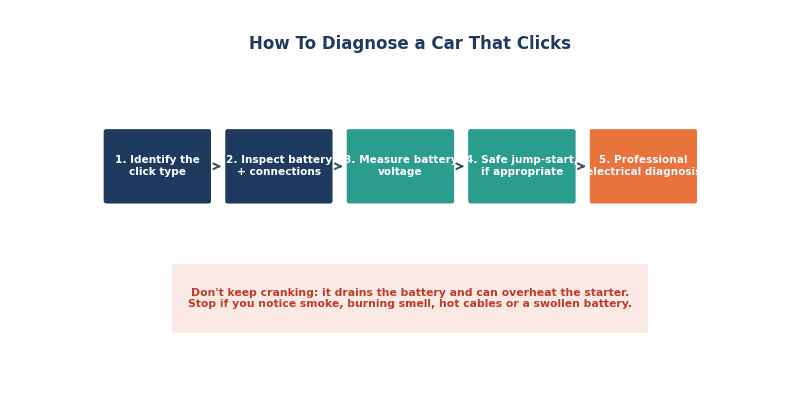
Step 1: Identify The Type Of Clicking
Start by determining whether the vehicle produces rapid clicking or a single click.
Rapid clicking often points toward low voltage or a poor connection. A single click can indicate a starter or solenoid fault, but a weak battery or damaged cable can produce the same result.
Also note whether the headlights become significantly dimmer when you try to start the engine. A dramatic change suggests the battery voltage is dropping under load or the electrical connection is unstable.
Do not keep cranking repeatedly to reproduce the sound. Repeated attempts can discharge the battery further and overheat the starter.
Step 2: Inspect The Battery And Connections
With the ignition off, look for obvious damage, loose connections, corrosion, or a battery case that appears swollen or leaking.
A damaged or leaking battery should not be handled casually. Avoid sparks, flames, and contact with battery fluid, and arrange professional assistance if necessary.
If the battery terminals look normal, remember that a visual inspection cannot confirm battery health. A proper battery test is more reliable.
Step 3: Measure Battery Voltage
A digital multimeter can provide useful information if you know how to use it safely.
Measure the battery voltage with the vehicle off and electrical loads minimized. Then, if appropriate, observe the voltage while attempting to start the engine.
A significant voltage drop may indicate a weak battery, excessive starter current, or another electrical problem. The correct interpretation depends on temperature, battery type, test conditions, and manufacturer specifications.
A resting-voltage reading alone cannot confirm that a battery is healthy.
Step 4: Try A Safe Jump-Start If Appropriate
If the battery appears discharged and there are no signs of physical battery damage, a correctly performed jump-start may help determine whether low battery power is involved.
Follow the vehicle manufacturer’s jump-start instructions exactly. Modern vehicles may have designated jump-start terminals, and incorrect connections can damage electronics or cause injury.
If the car starts after a jump, the next step is not necessarily to buy a new battery. Have the battery, charging system, and electrical connections tested.
If the engine still only clicks, stop repeated attempts and investigate the starter circuit or seek professional diagnosis.
Step 5: Get A Proper Electrical Diagnosis
If the simple checks do not reveal the cause, a technician can perform more detailed tests.
These may include a battery load test, voltage-drop testing, starter current measurement, relay testing, diagnostic trouble-code scanning, and inspection of the engine’s ability to rotate.
The following table summarizes the main clues.
| Symptom | Possible Cause | Recommended Check |
|---|---|---|
| Rapid clicking | Weak battery or poor connection | Battery and terminal test |
| One strong click | Starter, solenoid, or low voltage | Starter circuit testing |
| Dashboard goes dark | Battery connection or main power fault | Terminals and main cables |
| Starts after a jump | Discharged battery or charging fault | Battery and alternator test |
| New battery but still clicking | Cables, ground, starter, or installation issue | Voltage-drop test |
| Click with suspected engine seizure | Mechanical obstruction | Professional mechanical inspection |
These patterns narrow the possibilities but are not definitive diagnoses.
How Much Does It Cost To Fix A Clicking Car?
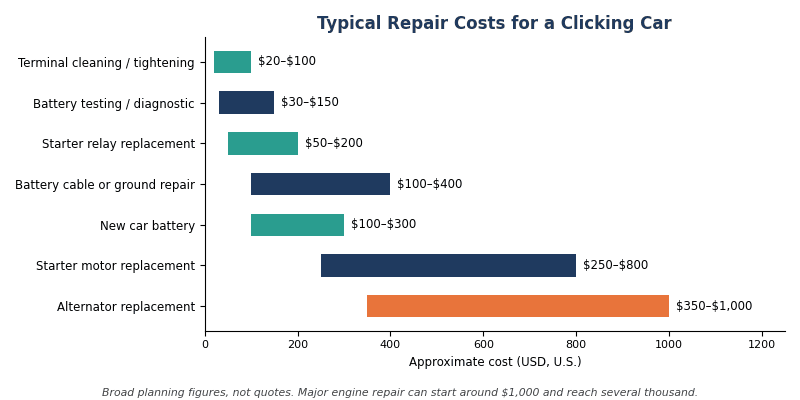
The repair cost depends on the cause, vehicle, parts availability, and labor rates.
A battery-terminal repair may cost much less than replacing a starter motor. A charging-system repair or difficult wiring fault can also increase the bill.
The following ranges are broad estimates for the United States and should be treated as general planning figures rather than a quote for a particular vehicle.
| Repair | Approximate Cost |
|---|---|
| Battery terminal cleaning or tightening | $20–$100 |
| New car battery | $100–$300 |
| Battery testing or diagnostic service | $30–$150 |
| Starter relay replacement | $50–$200 |
| Starter motor replacement | $250–$800 |
| Alternator replacement | $350–$1,000 |
| Battery cable or ground repair | $100–$400 |
| Major engine mechanical repair | $1,000–Several thousand dollars |
Prices can fall outside these ranges, particularly for luxury vehicles, difficult starter installations, and vehicles with specialized electrical systems.
Is It Worth Replacing The Starter?
A starter replacement makes sense when testing confirms that the starter has failed and the battery, cables, and control circuit are functioning correctly.
Before authorizing the repair, ask the shop whether the quote includes the starter, labor, diagnostic charges, and warranty.
Some vehicles have starters that are easy to access, while others require substantial disassembly. This can make labor costs vary significantly even when the replacement part is similar.
If the starter is expensive or difficult to access, accurate diagnosis becomes even more important.
When Should You Call A Mechanic?
Professional assistance is appropriate when the battery and connections appear normal but the car continues to click.
It is also wise to seek help if the vehicle has repeated starting failures, damaged electrical cables, a battery that keeps going flat, or signs of a mechanical problem.
Stop trying to start the vehicle if you notice smoke, a burning electrical smell, unusually hot cables, a swollen battery, or severe grinding noises.
If the car is stranded somewhere unsafe, prioritize personal safety and arrange roadside assistance rather than troubleshooting beside moving traffic.
Final Thoughts
A car just clicking when trying to start usually indicates that the starting system is not receiving or using electrical power correctly, but the sound alone cannot identify the failed component.
Rapid clicking often points toward a weak battery or poor connection, while a single click may involve the starter motor, solenoid, cables, or even a mechanical problem. An alternator fault can also be responsible when the battery repeatedly loses charge.
Start with the battery and connections, then move toward more detailed electrical testing if necessary. Avoid replacing expensive components based on sound alone, and do not repeatedly attempt to start a vehicle that shows signs of electrical overheating or mechanical damage.
The best repair is the one that identifies the actual cause, corrects it, and confirms that the car starts reliably afterward.
Why Is My Car Just Clicking But The Battery Is Good?
A battery can show a reasonable resting voltage but still fail under load. Other possibilities include loose terminals, damaged cables, a poor engine ground, a faulty starter solenoid, or a failing starter motor. A load test and voltage-drop test can help identify the cause.
Can A Bad Alternator Cause A Car To Click When Starting?
Yes. An alternator that does not charge correctly can gradually discharge the battery. When the battery no longer has enough power to operate the starter, the car may click instead of starting. Battery and charging-system testing can confirm whether this is the problem.
Will Jump-Starting Fix A Car That Only Clicks?
A jump-start may help if the battery is discharged and the starting circuit is otherwise working properly. If the car continues clicking after a correct jump-start, the problem may involve the starter, cables, connections, or another component.
How Do I Know If My Starter Or Battery Is Bad?
Rapid clicking and dimming dashboard lights often suggest low voltage or a poor connection, while one click can indicate a starter problem. However, these symptoms overlap. Battery testing, starter current testing, and voltage-drop measurements provide a more reliable answer than sound alone.
Can A Car Click When Trying To Start Because Of A Loose Battery Cable?
Yes. A loose or corroded battery cable can restrict the high current required by the starter motor. The vehicle may click, lose dashboard power, or start intermittently. Damaged connections should be cleaned, secured, or replaced as appropriate.
Is It Safe To Keep Trying To Start A Clicking Car?
Repeated attempts can drain the battery and overheat the starter or cables. Stop if you notice smoke, a burning smell, hot wiring, unusual grinding, or battery damage. If a few reasonable attempts fail, diagnose the problem rather than continuing to crank the engine.