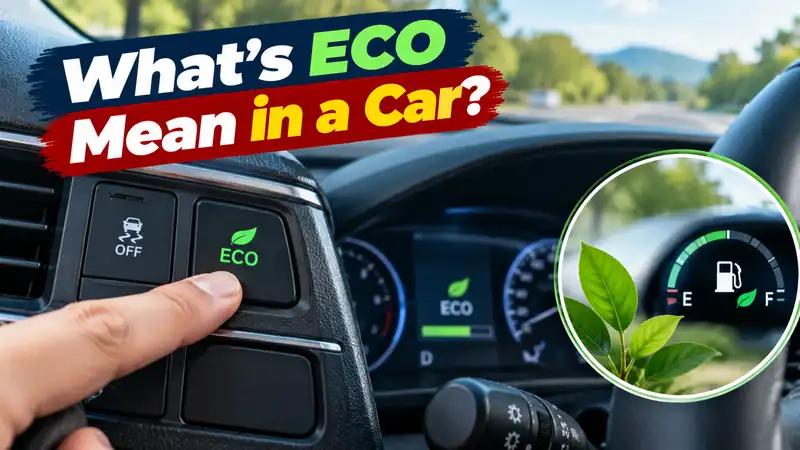
Modern cars use electronic systems to make everyday driving more efficient, and one of the most visible features is the ECO setting. You may see ECO on the dashboard, notice an ECO button near the gear selector, or see an ECO indicator appear while driving. Although the name is similar across many vehicles, the exact function can differ from one manufacturer and model to another.
So, what does ECO mean in a car? In most vehicles, ECO refers to an efficiency-focused driving mode or indicator designed to encourage lower fuel consumption. Depending on the vehicle, it may change throttle response, transmission behavior, air-conditioning operation, cruise-control strategy, or other systems. Some cars also use ECO as a simple indicator showing that current driving conditions are relatively efficient.
ECO mode does not usually create additional engine power or improve acceleration. Its purpose is almost the opposite: it encourages smoother responses and operating conditions that can reduce unnecessary fuel use. Knowing when to use it, what changes it makes, and what its limitations are can help you get the most from the feature without expecting unrealistic fuel savings.
What Does ECO Mean In A Car?
ECO generally means economy or economical operation in an automobile. It is commonly associated with systems designed to reduce fuel consumption and, in some vehicles, lower energy use from other components.
The important detail is that ECO does not have exactly the same meaning in every car. Manufacturers program their systems differently. In one vehicle, pressing an ECO button may soften accelerator response and encourage earlier transmission upshifts. In another, ECO mode may also modify air-conditioning behavior, cruise-control operation, hybrid energy management, or other electronic systems.
Some cars use the word ECO as a driving indicator rather than a selectable mode. The dashboard may illuminate an ECO symbol when the vehicle is being operated in a fuel-efficient manner. In that situation, the car is not necessarily changing its mechanical behavior. It is simply providing feedback about how efficiently the vehicle is currently being driven.
This distinction is important because drivers sometimes assume that every ECO light means the engine has entered a special low-power operating mode. That is not always true.
ECO Mode And The ECO Indicator Are Not Always The Same
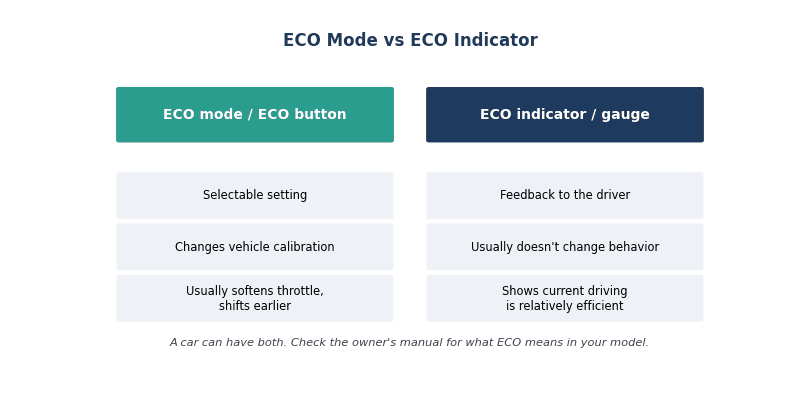
There are two common uses of ECO terminology in modern vehicles.
An ECO mode is generally a selectable setting. The driver presses a button or chooses a mode through the vehicle’s controls, and the engine-control or transmission-control systems change their calibration. The exact changes depend on the manufacturer’s design.
An ECO indicator is often a feedback system. It may appear when the vehicle detects relatively economical acceleration, steady cruising, low engine load, or other conditions associated with efficient operation.
These systems can coexist in the same vehicle. A car might have an ECO button and also display an ECO symbol when conditions are favorable.
| ECO Feature | Main Purpose | Does It Change Vehicle Behavior? |
|---|---|---|
| ECO Driving Mode | Encourage efficient operation | Usually yes |
| ECO Dashboard Indicator | Show efficient driving conditions | Usually no |
| ECO Gauge | Provide efficiency feedback | Usually no |
| Hybrid ECO Mode | Optimize energy consumption | Often yes |
| ECO Button | Activate economy-focused calibration | Usually yes |
Always check the owner’s manual for the specific vehicle because manufacturers can use similar terminology for different functions.
How ECO Mode Changes The Way A Car Behaves
The most common change involves accelerator response.
In an ordinary driving mode, pressing the accelerator pedal may produce a relatively immediate throttle response. In ECO mode, the electronic throttle system can be calibrated to provide a more gradual response. The engine is still capable of producing the same basic power, but the pedal may feel less aggressive.
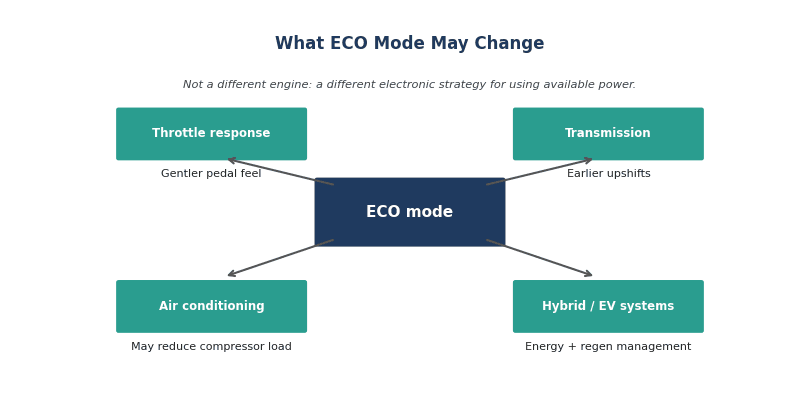
Automatic transmissions can also change their shift strategy. The transmission may upshift earlier and avoid unnecessary high engine speeds. Some vehicles may also reduce the tendency to hold a lower gear during mild acceleration.
Air conditioning can be another area affected by ECO mode. Depending on the vehicle, the system may reduce compressor demand, alter blower behavior, or change climate-control strategy to reduce the energy required to maintain cabin temperature.
Hybrid vehicles can take the concept further. Their ECO settings may coordinate the gasoline engine, electric motor, regenerative braking, battery management, and climate-control systems.
The result is not a completely different engine. It is a different electronic strategy for using the available power and energy.
ECO Does Not Mean The Engine Is Running At Its Lowest Possible Speed
It is easy to assume that ECO simply means “low RPM.” That is not necessarily correct.
Engine efficiency depends on many variables, including load, speed, throttle position, combustion conditions, transmission gearing, temperature, and engine design. Running an engine at very low RPM while demanding substantial acceleration can actually be undesirable.
A well-designed automatic transmission selects gears according to many factors. ECO calibration generally tries to avoid unnecessary engine speed and aggressive acceleration while keeping the engine operating appropriately for the conditions.
The same principle applies to manual transmissions. A driver can operate at a low RPM but still use excessive throttle and place the engine under unnecessary load. Efficient driving is about finding a sensible balance rather than chasing the lowest possible tachometer reading.
How ECO Mode Saves Fuel And Changes Driving Behavior
The basic idea behind ECO mode is simple: reduce unnecessary energy use.
A vehicle requires energy to accelerate, overcome aerodynamic drag, overcome rolling resistance, operate accessories, and maintain speed. The engine also loses some energy through heat and internal friction.
ECO systems cannot eliminate these losses, but they can influence how the vehicle is operated. Smooth acceleration, earlier upshifts, reduced aggressive throttle response, and efficient accessory operation can help lower fuel consumption under suitable conditions.
The savings are usually more noticeable when ECO mode changes behavior that would otherwise consume extra fuel. If a driver already accelerates gently and anticipates traffic well, the difference between normal and ECO mode may be relatively small.
That is an important point. ECO mode is not a magic fuel-saving device. It works best as part of an efficient driving strategy.
Throttle Response Is Often The Biggest Difference
Electronic throttle control gives manufacturers significant flexibility in how the accelerator pedal feels.
In many vehicles, the accelerator pedal does not mechanically pull a throttle cable. Instead, sensors monitor pedal position and communicate with the engine-control computer. The computer determines how much throttle opening and engine response are appropriate.
ECO mode can modify that relationship.
For example, the first half of the accelerator pedal’s travel may produce a gentler engine response than it does in the normal mode. This makes it easier to avoid unnecessary bursts of acceleration.
The engine itself has not necessarily become weaker. Instead, the control system makes aggressive power requests less immediate.
This can be especially useful in urban traffic where drivers repeatedly accelerate from stops. Small changes in throttle behavior can help prevent unnecessary bursts of fuel consumption.
However, when the driver presses the accelerator deeply, most vehicles can still provide stronger acceleration when required. ECO mode is generally designed around normal driving rather than preventing the vehicle from responding when more power is necessary.
Transmission Behavior Can Improve Efficiency
Automatic transmissions are closely connected to fuel economy.
At a given road speed, a higher gear generally allows the engine to operate at a lower RPM than a lower gear. When conditions permit, ECO programming may encourage earlier upshifts and reduce unnecessary downshifts.
Suppose a vehicle is cruising gently on a level road. There may be little reason for the transmission to keep the engine at a high RPM. An efficiency-focused shift strategy can move into a higher gear sooner.
During acceleration, however, the transmission still needs to respond to the driver’s demand. If the vehicle needs additional power for a hill or passing maneuver, it can downshift.
This illustrates why ECO mode should not be confused with a permanently restricted transmission. It is usually a different set of operating priorities rather than a fixed gear limitation.
Continuously variable transmissions can behave differently. Instead of selecting traditional fixed gears, a CVT can alter its effective ratio continuously. ECO calibration may adjust engine RPM and throttle response to keep the powertrain operating in a more efficiency-focused range.
Air Conditioning Can Affect Fuel Consumption
The climate-control system is another factor that can influence efficiency.
An automotive air-conditioning compressor requires energy. In vehicles with conventional gasoline engines, that energy ultimately comes from the engine. In hybrids and electric vehicles, climate control can also draw electrical energy from the battery.
Some ECO modes therefore modify climate-control operation.
The changes may include a lower compressor load, modified blower behavior, different temperature-management strategies, or reduced maximum cooling performance. The exact behavior varies considerably between vehicles.
This can create an interesting trade-off. On a mild day, the difference may be difficult to notice. On an extremely hot day, the driver may prefer stronger cooling even if it consumes more energy.
ECO mode should therefore be viewed as a priority setting rather than a requirement. Comfort and safety remain important. If the windshield needs rapid defogging or the cabin requires substantial cooling, use the climate-control settings appropriate for the conditions.
ECO Mode Can Encourage Better Driving Habits
One of the less obvious benefits of ECO systems is behavioral.
An ECO indicator can show drivers when their acceleration or cruising style is relatively efficient. Over time, this feedback can encourage smoother pedal inputs, greater anticipation of traffic, and fewer unnecessary bursts of acceleration.
These habits can matter more than the button itself.
A driver who accelerates aggressively in ECO mode may still use more fuel than a driver who uses normal mode but accelerates smoothly. Similarly, maintaining correct tire pressure, reducing unnecessary vehicle weight, avoiding prolonged idling, and anticipating traffic can have a meaningful effect on fuel use.
ECO mode is therefore most useful when it supports good driving habits rather than replacing them.
When Should You Use ECO Mode?
For many everyday situations, ECO mode can be left on without causing problems. It is particularly well suited to steady urban driving, commuting, moderate-speed cruising, and situations where rapid acceleration is not frequently required.
The setting can be useful when traffic is moving smoothly and the driver wants the powertrain to prioritize efficiency.
It may be less appealing when immediate throttle response is desirable. Mountain roads, heavy loads, towing, merging into fast traffic, or situations requiring quick acceleration may feel better in a normal or sport-oriented mode.
That does not mean ECO mode is unsafe in those situations. The vehicle can generally still respond when additional power is requested. The issue is primarily response characteristics and driver preference.
ECO Mode For City Driving
Urban traffic can involve frequent acceleration and deceleration. Every time a vehicle accelerates, energy is required to increase its speed.
ECO mode can be helpful in this environment because its softer accelerator response encourages gradual starts. Automatic transmissions may also shift earlier when conditions permit.
However, traffic conditions matter more than the dashboard mode.
Repeated hard acceleration followed by hard braking wastes energy because much of the energy used to accelerate is converted into heat during braking. Looking farther ahead and allowing the vehicle to slow naturally when appropriate can reduce unnecessary energy use.
This does not mean driving unusually slowly or obstructing traffic. Efficient driving should remain compatible with normal traffic flow and safe following distances.
In stop-and-go conditions, a hybrid vehicle may benefit particularly from its regenerative braking and electric operation. The exact advantage depends on the vehicle’s hybrid system, battery state, temperature, and traffic pattern.
ECO Mode On Highways
Highway driving is often efficient already because the vehicle can maintain a relatively steady speed.
At moderate speeds, the engine and transmission can operate efficiently with relatively little acceleration. ECO mode may encourage higher gearing and smooth throttle response.
However, aerodynamic drag rises significantly as speed increases. This means that speed itself can have a greater effect on highway fuel consumption than the difference between ECO and normal modes.
A driver traveling at a sensible steady speed in normal mode may use less fuel than a driver traveling much faster in ECO mode.
Cruise control can also help maintain a steady speed on suitable roads, although some vehicles use ECO-specific cruise-control strategies that prioritize gradual acceleration.
Terrain is another factor. On a long downhill section, the vehicle may coast or use engine braking depending on its transmission and control strategy. On an uphill section, the engine must produce additional power regardless of the selected mode.
Situations Where Normal Or Sport Mode May Be Better
ECO mode is not intended to be the best choice for every driving situation.
When merging onto a busy highway, a driver may prefer a more immediate accelerator response. When climbing a steep hill with passengers or cargo, normal operation may feel more natural. When towing, the vehicle manufacturer’s towing recommendations should take priority over assumptions about ECO mode.
Sport mode, where available, generally does the opposite of ECO mode. It can provide sharper throttle response, hold lower gears longer, increase engine RPM, or modify other systems to make the vehicle feel more responsive.
Neither mode is inherently “better.” They serve different purposes.
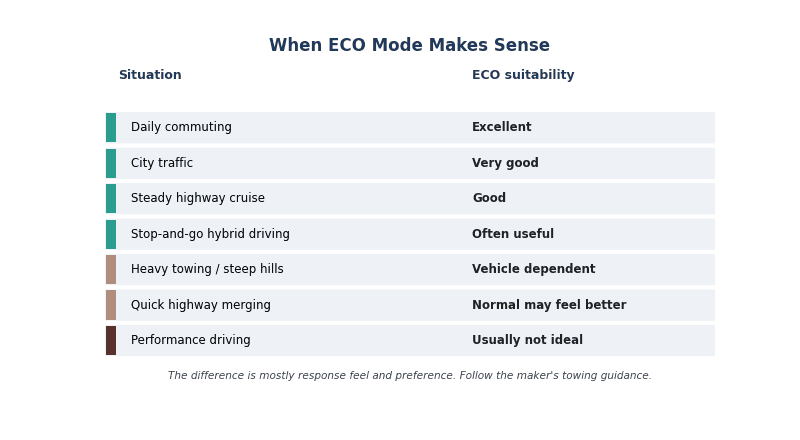
| Driving Situation | ECO Mode Suitability | Reason |
|---|---|---|
| Daily Commuting | Excellent | Smooth response and efficiency |
| City Traffic | Very Good | Helps moderate acceleration |
| Steady Highway Cruise | Good | Can encourage efficient gearing |
| Heavy Towing | Vehicle Dependent | Follow manufacturer guidance |
| Steep Hills | Vehicle Dependent | More power may be useful |
| Quick Highway Merging | Normal May Feel Better | More immediate response |
| Performance Driving | Usually Not Ideal | Sport mode may suit the task |
| Stop-And-Go Hybrid Driving | Often Useful | Can support efficient energy management |
Does ECO Mode Reduce Engine Power?
ECO mode can make a vehicle feel less powerful because the accelerator response is often softer. That does not necessarily mean the engine’s maximum mechanical output has been permanently reduced.
Many vehicles can still provide substantial acceleration when the accelerator is pressed firmly. The control system simply makes normal pedal inputs less aggressive.
This distinction is useful when diagnosing a vehicle that feels unusually slow.
If a car suddenly has very little power in both ECO and normal modes, the issue may not be the selected driving mode. A clogged air filter, ignition problem, fuel-delivery issue, transmission fault, turbocharger problem, restricted exhaust, or engine-control issue can cause genuine power loss.
A normal ECO mode should not be used to explain a sudden and severe change in vehicle performance.
ECO Symbols, Dashboard Messages And Common Misunderstandings
Dashboard ECO indicators can look different from one vehicle to another.
Some vehicles display a green ECO icon when the current driving conditions are considered economical. Others show an ECO gauge that moves according to throttle input or energy consumption. Hybrid models may display information about electric operation, regenerative braking, battery charge, and gasoline-engine use.
Because these displays are manufacturer-specific, the owner’s manual is the best source for interpreting the exact symbol.
An ECO light generally does not indicate a mechanical fault. It is usually an efficiency-related status indicator.
However, it should not be confused with other warning symbols. A green or blue efficiency indicator is fundamentally different from red oil-pressure, brake-system, coolant-temperature, or charging-system warnings.
ECO Light On The Dashboard
When an ECO indicator appears during ordinary driving, it often means the vehicle’s computer has detected operating conditions associated with economical use.
This might occur during gentle acceleration, steady cruising, or light engine load.
The indicator may disappear when the driver accelerates harder. That is normally expected behavior.
Some vehicles use the indicator as a coaching tool. Instead of measuring exact fuel economy, it gives the driver a general signal that current inputs are efficient.
This means the light should not be interpreted as proof that the engine is using a specific amount of fuel at that exact moment.
Real fuel consumption depends on many factors, including vehicle speed, road grade, wind, temperature, tire pressure, cargo, engine temperature, traffic, and accessory use.
The ECO symbol is therefore best considered an efficiency guide rather than a laboratory measurement.
ECO Button Stays On
If the vehicle is equipped with a physical ECO button, it may remain active until the driver turns it off or the vehicle is restarted.
Some cars automatically return to a default mode after the ignition is switched off. Others remember the previous selection.
This behavior is manufacturer-specific.
If you press the ECO button and nothing obvious changes, that does not necessarily mean the feature is broken. The system may be making subtle adjustments to throttle mapping, transmission logic, climate control, or other systems that are difficult to notice during gentle driving.
The best way to identify the changes is to consult the vehicle’s owner’s manual.
ECO Mode Does Not Mean Zero Emissions
The word ECO can sometimes create confusion about emissions.
In a conventional gasoline or diesel vehicle, ECO mode does not turn the car into a zero-emission vehicle. It is still using fuel and producing exhaust emissions.
The term generally refers to improved efficiency rather than elimination of emissions.
Hybrid vehicles can operate electrically under certain conditions, but even then, the vehicle’s total environmental impact involves energy production, manufacturing, battery production, and other factors.
ECO is therefore primarily an operational term. It tells you that the vehicle is prioritizing efficiency, not that it has stopped consuming energy or producing emissions altogether.
ECO Mode And Auto Start-Stop Are Different Features
Another common misunderstanding is assuming ECO mode and engine start-stop are the same system.
They are separate functions, although they can work together.
An automatic start-stop system shuts the engine off when certain conditions are met, such as stopping at a traffic light. It restarts the engine when the driver is ready to move.
ECO mode may encourage conditions that support efficiency, but whether start-stop operates depends on the vehicle’s specific programming.
The system may also temporarily disable itself when the battery state, cabin temperature, engine temperature, steering demand, or other conditions do not meet its operating requirements.
That does not necessarily indicate a problem.
How Much Fuel Can ECO Mode Actually Save?
There is no universal percentage that applies to every vehicle.
A manufacturer’s ECO mode may produce a measurable reduction in fuel consumption under particular test conditions, but real-world results depend heavily on the driver and environment.
Consider two drivers in the same vehicle. One accelerates gently, anticipates traffic, maintains appropriate tire pressure, and travels at moderate speeds. The other frequently accelerates hard, brakes heavily, carries unnecessary weight, and travels at high speeds.
The second driver may see a larger benefit from ECO mode because there is more inefficient behavior for the system to moderate.
For the first driver, the difference may be much smaller because their normal driving style is already relatively efficient.
This is one reason fuel-economy claims should be treated carefully. A specific percentage cannot be promised for every car or every trip.
The Driver Still Controls Most Of The Important Variables
ECO mode changes how the vehicle responds, but it does not control the entire driving environment.
Speed has a major effect on fuel consumption, particularly at higher highway speeds because aerodynamic drag increases rapidly with speed.
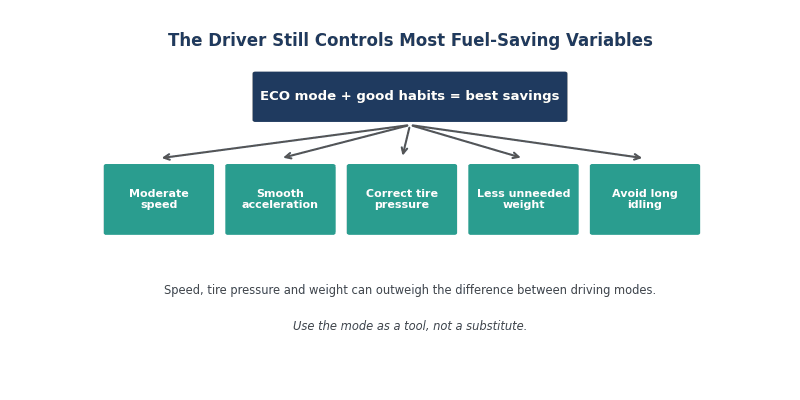
Tire pressure also matters. Underinflated tires increase rolling resistance. The correct pressure should be taken from the vehicle’s tire-information label or owner’s manual rather than the maximum pressure printed on the tire sidewall.
Vehicle weight matters as well, especially during repeated acceleration. Removing unnecessary heavy items from the cargo area can help reduce energy demand.
Idling also consumes fuel without moving the vehicle. Modern engines generally do not need long warm-up periods while stationary under normal conditions.
These factors can easily outweigh a modest difference between driving modes.
ECO Mode Works Best As Part Of A Larger Efficiency Strategy
A sensible efficiency routine combines several habits.
Accelerate smoothly without being unnecessarily slow. Maintain a reasonable following distance so traffic changes do not require constant hard braking. Keep tires properly inflated. Follow the maintenance schedule. Avoid unnecessary idling. Remove cargo that does not need to stay in the vehicle.
Use the vehicle’s ECO feedback as a learning tool rather than obsessing over the symbol.
If the ECO indicator disappears every time you accelerate, that does not mean you are doing something wrong. A vehicle sometimes needs more power. Efficient driving does not mean avoiding the accelerator entirely.
Likewise, using ECO mode should never interfere with safe acceleration when traffic conditions require it.
The most effective efficiency strategy is the one that balances fuel consumption with appropriate vehicle control.
Hybrid And Electric Cars Use ECO Differently
ECO modes become particularly interesting in hybrid and electric vehicles because there are more energy sources and control systems to coordinate.
A hybrid can use a gasoline engine, electric motor, regenerative braking, and battery energy. ECO programming may influence when the engine starts, how aggressively the accelerator requests power, how regenerative braking is managed, and how climate control consumes energy.
Electric vehicles do not use gasoline, but they still have an ECO mode in many models. In an EV, ECO can reduce accelerator sensitivity, limit peak power, modify regenerative braking behavior, or prioritize battery efficiency.
Therefore, the meaning of ECO depends strongly on the powertrain.
A gasoline car may primarily use ECO to reduce fuel consumption. A hybrid may coordinate multiple energy sources. An electric vehicle may focus on battery energy consumption and range.
The common idea is efficient energy use, but the method is different.
Final Thoughts On What ECO Means In A Car
So, what does ECO mean in a car? In simple terms, it usually means that the vehicle is prioritizing economical operation. Depending on the model, ECO may soften accelerator response, encourage earlier transmission shifts, adjust climate-control behavior, modify cruise-control operation, or coordinate energy use in hybrid and electric vehicles.
An ECO indicator can also simply tell you that your current driving conditions are relatively efficient. It does not necessarily mean the car has entered a special mechanical mode.
The biggest mistake is expecting ECO mode to deliver dramatic fuel savings by itself. The feature is most effective when combined with sensible speed, smooth acceleration, correct tire pressure, proper maintenance, reduced unnecessary weight, and anticipation of traffic.
ECO mode is best viewed as a tool for managing energy, not a substitute for good vehicle maintenance or safe driving. Use it when its softer response suits the conditions, switch to another mode when the situation calls for different vehicle behavior, and use the owner’s manual to determine exactly what ECO changes in your particular model.
What Does ECO Mean On A Car Dashboard?
ECO usually indicates economical operation. Depending on the vehicle, it can either show that the current driving style is relatively fuel-efficient or indicate that an economy-focused driving mode is active. The exact meaning varies by manufacturer and model.
Does ECO Mode Save Gas?
Yes, ECO mode can reduce fuel consumption in some driving conditions by changing throttle response, transmission behavior, climate-control operation, or other systems. However, the amount saved varies considerably. Driving habits, vehicle speed, traffic, terrain, tire pressure, and maintenance can have a larger influence on overall fuel economy.
Is It Better To Leave ECO Mode On All The Time?
For many everyday driving situations, leaving ECO mode on is perfectly reasonable. It may be useful during commuting and normal city or highway driving. However, some drivers may prefer normal mode when they want a more immediate accelerator response. Follow the vehicle manufacturer’s recommendations, especially when towing or operating under demanding conditions.
Does ECO Mode Make A Car Slower?
It can make the car feel slower because accelerator response is often softened and the transmission may prioritize higher gears. This does not necessarily mean the engine has permanently lost power. Many vehicles can still accelerate strongly when the accelerator is pressed firmly.
Does ECO Mode Hurt The Engine Or Transmission?
ECO mode is generally designed by the manufacturer as a normal operating mode and should not harm the engine or transmission when used as intended. The system’s calibration is designed around the vehicle’s powertrain. If the vehicle is towing, carrying heavy loads, or operating in unusually demanding conditions, follow the manufacturer’s guidance regarding drive modes.
Can I Use ECO Mode On The Highway?
Yes. ECO mode can be useful on highways, particularly during steady cruising. It may encourage efficient transmission gearing and smoother throttle inputs. However, maintaining an appropriate speed is still important because aerodynamic drag can have a substantial effect on fuel consumption at higher speeds.
Does ECO Mode Mean The Car Is Emission-Free?
No. In a gasoline or diesel vehicle, ECO mode does not eliminate exhaust emissions. It is primarily intended to improve energy efficiency and reduce unnecessary fuel consumption. Hybrid and electric vehicles can operate with lower or zero tailpipe emissions under certain conditions, but the ECO label itself does not mean a vehicle is completely emission-free.