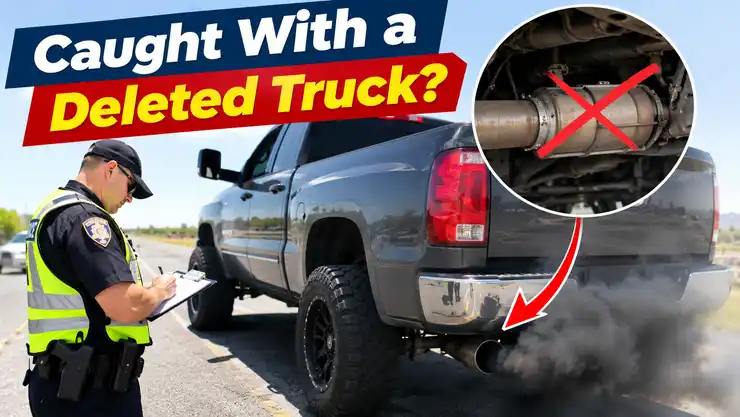
A deleted truck sounds like a simple upgrade to plenty of diesel owners. Pull the particulate filter, ditch the EGR, flash a tune, and the engine seems to breathe easier. Then the rulebook catches up.
Federal law treats those changes as tampering, and the consequences reach owners, shops, and sellers alike. In January 2026, the Justice Department stepped back from criminal prosecution of diesel deletes. Many people read that as a green light. It was not.
Civil fines, roadside inspections, failed state tests, refused registrations, and a truck nobody wants to buy are all still in play. Some of those hit faster than any letter from Washington.
Here is what really happens when a deleted truck gets flagged, who does the flagging, what it costs, and how to fix the problem before it grows. The details shift by state and by how the truck is used, so each step is laid out plainly.
What A Deleted Truck Means Under Federal Law
What Counts As A Delete
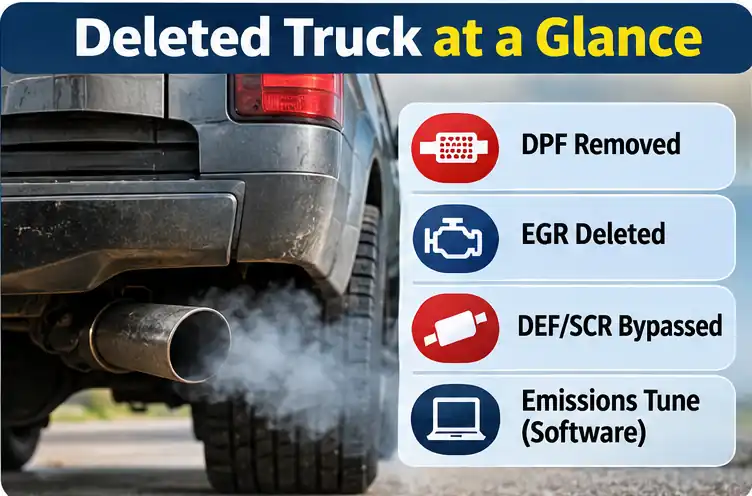
A delete is any change that removes, disables, or bypasses a factory emissions part. On a modern diesel, that usually means the diesel particulate filter (DPF), the exhaust gas recirculation (EGR) system, or the selective catalytic reduction (SCR) setup that runs on diesel exhaust fluid.
Software counts too. A tune that switches off the DEF system or tells the computer to ignore a missing filter is treated the same as pulling the hardware.
Even a straight pipe with the sensors left plugged in and a tuner faking the readings is still a delete. The truck no longer works the way it was certified.
The Clean Air Act does not care whether you, a friend, or a shop did the work. It also does not matter if you bought the truck already deleted. The rule attaches to the vehicle, so everyone who modifies, sells, or operates it can end up in the conversation.
Why Off-Road Labels Do Not Protect You
Labels like “off-road use only” or “for competition” show up on plenty of delete kits. They sound like a legal shield. They are not one.
EPA’s long-standing position is that a vehicle built and certified for road use stays covered by the rules for life. Taking it to a track on weekends does not change that. If the truck has a plate, a title, or can legally reach a public road, the exemption is very hard to claim.
Aftermarket sellers who leaned on those labels have still paid large settlements. That tells you how little weight the wording carries.
The practical takeaway is simple. If your truck started life with a VIN and an emissions certificate, those rules follow it into the barn, onto the farm, and across state lines.
Federal Penalties: What EPA Can Actually Do
Civil Fines And How They Are Calculated
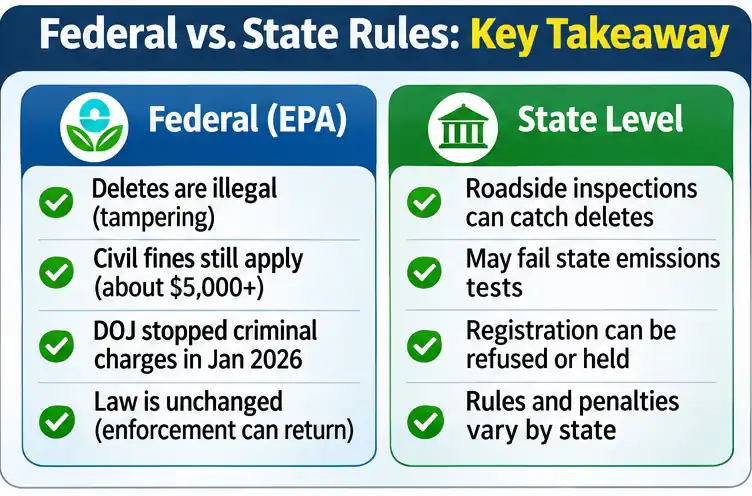
The Clean Air Act sets the penalty ceiling, and the figure is adjusted for inflation every year. For an individual owner or installer, the recent adjusted amount has sat in the mid-$5,000s per vehicle. For businesses and anyone selling defeat devices, the number jumps above $50,000 per violation.
Those are ceilings, not price tags. EPA’s penalty policy weighs the money saved by skipping compliance, the size of the violator, past history, and how fast the person cooperates.
Most owner cases end in a settlement. The usual terms are a smaller negotiated payment, a promise to restore the truck to its certified setup, and proof the work was done.
Because amounts are updated each year, check EPA’s current penalty table before relying on any figure, including these.
| Who Is Involved | What Triggers The Penalty | Rough Federal Exposure |
|---|---|---|
| Individual Owner | Operating or keeping a tampered truck | Mid-$5,000s per violation |
| Repair Shop Or Installer | Performing deletes or installing tunes | Per-vehicle tampering fines, often stacked |
| Parts And Tune Sellers | Selling defeat devices | Above $50,000 per violation, large settlements |
| Fleet Or Business | Running deleted commercial trucks | Higher business-level figure per truck |
The January 2026 DOJ Shift And What It Leaves Untouched
On January 21, 2026, the Justice Department’s Environment and Natural Resources Division announced it would stop bringing criminal charges for diesel emissions tampering. Jail time for deletes is off the table for now.
Civil enforcement was not touched. DOJ said it will still pursue civil cases with EPA when appropriate, and a distributor of delete products settled for $7.4 million just weeks earlier.
Here is the part most forum posts miss. This is a change in enforcement priority, not a change in the law. A bill to shield owners from lawsuits was introduced in the Senate in late 2025, and the latest reporting I found showed it still stuck in committee.
A future administration can reverse course. Civil claims also generally carry a five-year window, so a delete done today can still be a problem long after the headlines fade.
Roadside Stops, State Inspections, And Registration Trouble
What Happens At A Roadside Inspection
Federal policy is only one layer. Roadside officers work under state and commercial vehicle rules, and they know what a stock exhaust looks like.
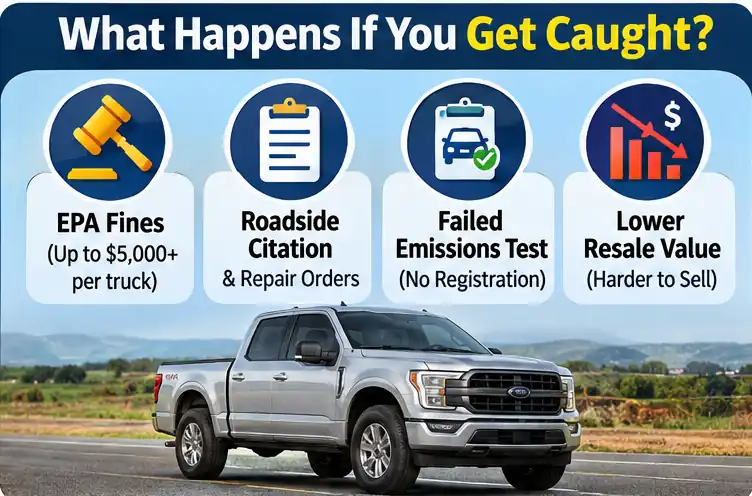
If your truck runs commercially, inspectors can look at the aftertreatment system during a standard check. A missing DPF, an empty DEF tank, or a pipe where the filter used to sit can lead to a citation, a repair order, or an out-of-service decision.
Pickups used for hauling freight or towing a work trailer can fall into commercial territory once combined weights pass certain limits. Many owners of heavy-duty pickups do not realize they crossed that line.
Even without a formal inspection, thick smoke, a loud open exhaust, or dashboard warning lights give officers a reason to look closer.
State Emissions Tests And Registration Holds
State programs are where many owners get caught first. Plenty of states never test diesels, but the ones that do plug into the onboard computer. A deleted truck often shows missing readiness monitors, odd sensor data, or a tuned calibration that does not match the factory file.
Failing the test usually means no registration renewal until the truck is repaired. In stricter states, such as California, fines for tampering can be much steeper and visual checks are common.
An important point: a state that skips diesel tests does not make the truck legal. It only lowers the odds of a stop.
| Where You Get Caught | Likely Outcome |
|---|---|
| Roadside Inspection | Citation, repair order, possible out-of-service order |
| State Emissions Test | Failed test, blocked registration renewal |
| Shop Visit Or Dealer Service | Service refusal, reflash request, possible report |
| Private Sale Or Trade-In | Offer withdrawn, lower price, buyer disputes |
| EPA Investigation | Notice of violation, penalty, restoration order |
Hidden Costs That Follow The Truck
Warranty, Insurance, And Resale Value
The quiet damage often hits the wallet first. Manufacturers can deny powertrain or emissions claims when a delete or tune is found, and the burden then shifts to you to prove the change did not cause the failure.
Insurance can get tricky as well. If an adjuster finds an undisclosed modification after a claim, the insurer may dispute payment. Check your policy wording before you assume you are covered.
Resale is where the pain gets real. Dealers often refuse deleted trucks on trade, and many lenders and online marketplaces will not touch them. Private buyers who learn about the delete later can come back with claims against the seller.
A truck with a clean emissions history is simply easier to sell, finance, and insure.
The Real Cost Of Returning A Truck To Stock
Undoing a delete costs more than most owners expect. A new DPF, EGR cooler, SCR catalyst, DEF pump and tank, sensors, wiring, and an ECM reflash all add up. On newer trucks, a full aftertreatment rebuild can reach into five figures.
Labor is a big piece too. Shops need diagnostic time, parts sourcing, and often a regeneration and test cycle before the truck leaves.
Ask for an itemized quote and ask which parts are new, remanufactured, or used. Used filters with unknown history can fail early and put you right back in the shop.
If EPA sends a notice, restoration is usually part of the settlement anyway. Doing the repair on your own schedule often beats doing it under a deadline.
A Practical Plan For Owners And Buyers
Steps To Take If You Already Own A Deleted Truck
Start by pausing any plans to sell the truck as is. Selling a tampered vehicle can create fresh liability for you.
Then work through these steps:
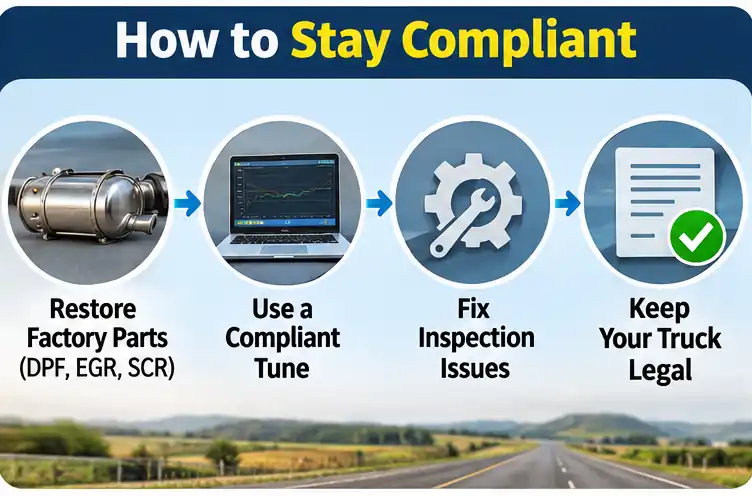
- Get a written inspection from a diesel shop that does emissions work.
- Request an itemized quote to restore every removed or disabled part.
- Keep every receipt, photo, and calibration record.
- Restore the truck to its certified configuration, including software.
- If you receive a notice from EPA or a state agency, speak with an environmental attorney before replying.
There is no standing amnesty program for individual owners that I could find, so do not assume fixing the truck erases the past. Still, a documented repair shows good faith and puts you in a far better spot if questions come up.
Buying A Used Diesel Without Inheriting The Problem
Used diesel buyers are the group most likely to get burned. A delete history rarely shows up on a standard vehicle report, so you have to look for it yourself.
Walk around the truck and check underneath. Look for the DPF canister, the DEF tank, and factory sensors in the exhaust. Scan the onboard computer for readiness monitors and ask what tuner device was installed.
Red flags include a price far below market, a seller who dodges emissions questions, a loud exhaust with no filter housing, and a dashboard that behaves oddly.
Pay for a pre-purchase inspection at a shop that works on that engine, and get any claim about stock emissions written into the bill of sale.
Questions people ask most often:
Is it illegal to own a deleted truck?
Federal law targets the act of tampering and the sale or use of defeat devices. Owning or operating a truck that was deleted can still bring civil penalties, state test failures, and repair orders, so owners should not treat it as a gray area.
Can I still go to jail for a diesel delete?
The Justice Department said in January 2026 that it will no longer bring criminal charges for diesel emissions tampering. Civil penalties remain, and policy can change, so the shift is not a permanent shield.
Can police pull me over just because my truck is deleted?
Officers need a reason, but smoke, exhaust noise, missing equipment, or a commercial inspection can all give one. Once the truck is stopped, an obvious missing filter or DEF system is hard to hide.
Is it okay to delete a truck I only use on the farm or at the track?
If the truck was built and certified for road use, the exemption is very narrow. Labels like “off-road only” do not change how EPA treats a road-certified vehicle, so the safer move is to keep it stock.
Can I sell a deleted truck to someone else?
Selling one is risky. You may face buyer claims, and a dealer or lender will likely refuse it. Restoring the truck before listing it protects you and widens your pool of buyers.
How much does it cost to put a deleted truck back to stock?
The range is wide. A single component may cost a few thousand dollars, while a full aftertreatment rebuild on a newer truck can climb much higher. A written, itemized shop quote is the only reliable number.