Most oil filters get ignored until the day they fail. Mobil 1 filters are built for owners who want to ignore them for a long time, and that promise sits at the center of the brand.
The flagship Extended Performance line is rated for up to one year or 20,000 miles. That is double what many carmakers ask for between changes. It only works if the filter stays strong, keeps flowing, and holds dirt without clogging.
So what is really inside that black canister? How do the spin-on and cartridge versions differ? And does a longer rating mean you should skip your usual service schedule?
Here is a clear, practical look at the lineup, the numbers behind the claims, the right way to match a part number, and the install steps that protect your engine. You will also find an honest comparison with rival premium filters, so you can decide if the extra money makes sense for your car.
What Sets A Mobil 1 Filter Apart From A Basic Spin-On
Inside The Canister: Media, Valve, And Gasket
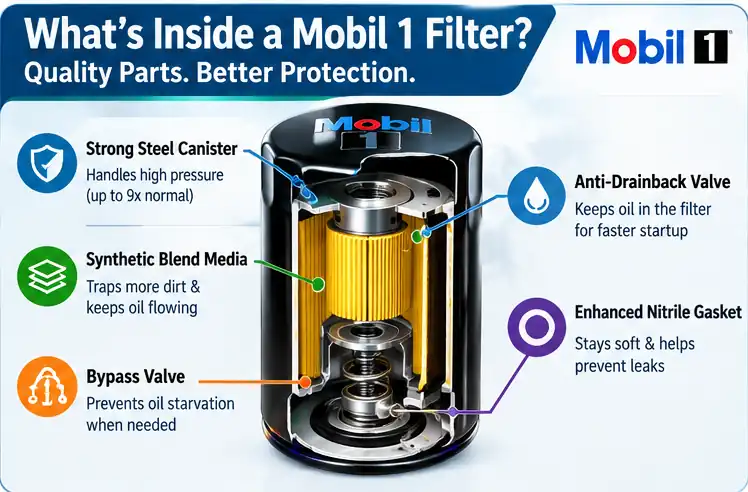
Cut open any oil filter and you find the same basic parts. A canister, a pleated media pack, a bypass valve, an anti-drainback valve, and a rubber gasket. The difference is in how well each piece is made.
Mobil 1 uses a synthetic blend media. It is designed to catch more dirt than economy media and keep oil flowing as the filter loads up. Fine pleats give it extra surface area to work with.
The steel canister is built heavy. Mobil says it handles about nine times the normal oil system pressure, which gives a safety margin during cold starts and hard revs.
An anti-drainback valve keeps oil in the filter when the engine is off, so parts get lubricated faster at startup. An enhanced nitrile gasket stays soft over time and helps prevent weeping around the seal.
What The 99 Percent Number Really Tells You
Mobil lists efficiency of 99 percent or better at 30 microns on its Extended Performance filters. Some retailers quote slightly different figures, so always read the exact micron size.
A micron is one-millionth of a meter. A human hair is about 70 microns wide. Catching particles at 30 microns is good, but wear metals and soot can be much smaller.
Here is the catch. Efficiency numbers only compare fairly when brands use the same test standard and the same micron point. A filter claiming 99.9 percent at 40 microns is not clearly better than one at 99 percent at 30.
Dirt holding capacity matters just as much. A filter that traps well but clogs early forces oil through the bypass valve. Long-interval filters have to balance both, and that is where good media design shows up.
The Mobil 1 Filter Lineup Explained Simply
Extended Performance Spin-On Filters
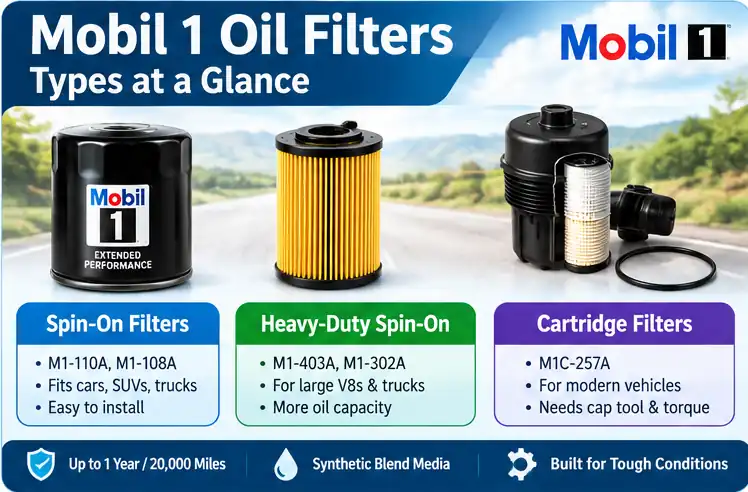
The M1 series is the one most owners meet. Part numbers look like M1-110A, M1-108A, or M1-403A, and each one is matched to specific engines through thread size, height, gasket diameter, and bypass valve settings.
These are the filters rated for up to one year or 20,000 miles, whichever comes first. They are made for use with any engine oil brand, though they also meet the requirements of the Mobil 1 annual protection limited warranty.
They are easy to spot on the shelf. A black steel canister with the Mobil 1 label, and a threaded base that screws onto the engine block or adapter.
Size varies a lot. Compact versions near 3.4 inches tall fit many small cars. Taller filters, over six inches, fit diesel pickups and large V8 engines that hold more oil.
Cartridge Filters For Modern Housings
Many newer engines dropped the metal can in favor of a plastic housing with a replaceable paper-style element inside. Mobil 1 covers these with the M1C series, such as the M1C-257A.
A cartridge is just the filter media, an end cap, and an O-ring. The housing stays on the car. That cuts waste, but it also changes how you service it.
You need the right cap tool and a torque wrench for the housing. Over-tightening can crack the plastic, and under-tightening can leak.
Fit matters more than ever here. Cartridge elements have tiny differences in height and seal design between engines, so match by vehicle, not by a similar-looking part.
| Filter Type | Typical Part Number | Best For | Service Notes |
|---|---|---|---|
| Extended Performance Spin-On | M1-110A, M1-108A | Cars, SUVs, light trucks | Hand-tighten after gasket contact |
| Heavy-Duty Spin-On | M1-403A, M1-302A | Large V8s, full-size trucks | Taller canister, more oil capacity |
| Cartridge Element | M1C-257A | Newer cars with plastic housings | Needs cap tool and torque spec |
| Shorter-Interval Option | Varies by model | Owners changing oil often | Check the label for rated mileage |
How To Find The Right Part Number For Your Vehicle
Three Reliable Ways To Match A Filter
The safest route starts with your owner’s manual. It lists the filter specification or the original part number, and that number can be cross-referenced to Mobil 1.
Second, use the lookup tool on Mobil’s website or a trusted parts retailer. Enter year, make, model, and engine size. The engine matters, because the same model can use different filters across engine options.
Third, pull the old filter and compare. Check thread size, gasket diameter, and height. A match on all three is a good sign, but still confirm with the lookup.
If you drive a diesel or a European model, double-check twice. Those engines often use unusual filters with special valve settings that look the same on the outside.
Mistakes That Lead To Wrong Fits
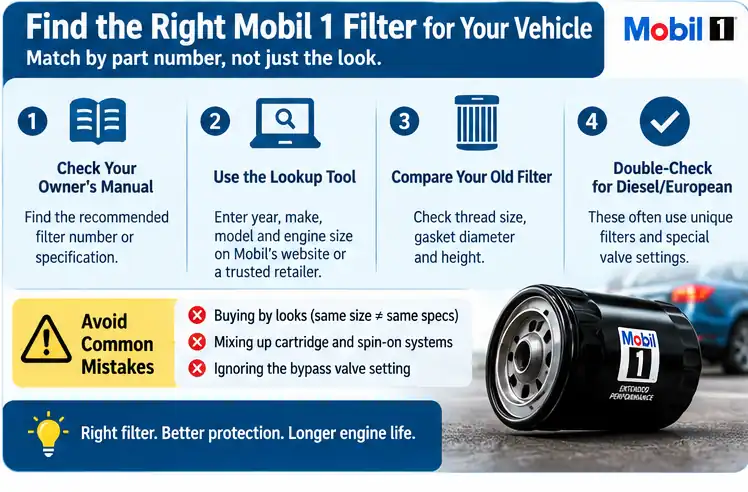
The most common mistake is buying by looks. Two filters can share the same height and thread but have different bypass valve pressures. That can starve the engine or let dirty oil flow too soon.
Another slip is mixing up cartridge and spin-on systems on the same model line. Some engines changed between years, so a 2014 and a 2016 version can need completely different parts.
Leftover gaskets cause real damage. If the old rubber ring sticks to the engine and the new one goes on top, you get a double gasket and a fast leak.
Finally, avoid over-sized universal filters. They may thread on, but they can hit brackets, block hoses, or sit too close to the exhaust. Stick with an application-specific part number for your engine.
Installing And Timing Your Filter Change The Right Way
Spin-On Installation, Step By Step
Warm the engine for a minute or two, then shut it off. Drain the oil and let the old filter empty before you remove it.
Then follow these steps:
- Loosen the old filter with a strap or cap wrench and keep a drain pan under it.
- Wipe the mounting surface clean and confirm the old gasket came off.
- Rub a thin film of fresh oil on the new gasket.
- Spin the filter on by hand until the gasket just touches the base.
- Tighten about three-quarters to one full turn, or follow the instructions printed on the filter.
- Add fresh oil, start the engine, and check for leaks.
Do not use a wrench to crank it down. A filter that is too tight is hard to remove later and can damage the gasket.
Cartridge Changes And Torque Details
Cartridge systems use the same logic but demand more care. Remove the cap with the correct tool, and watch how the O-ring sits in its groove before you pull it out.
Clean the cap and housing carefully. Lubricate the new O-ring and the cap seat with clean motor oil, and set the O-ring so it does not touch the threads.
Thread the cap on by hand first. Then use a torque wrench set to the number in your service manual.
Some housings drain automatically when you open the cap, and some need a separate drain plug. Skipping that detail can cause a messy spill.
After the first start, check the housing for seepage and recheck the oil level once the engine has rested.
How Long Can The Filter Really Stay On?
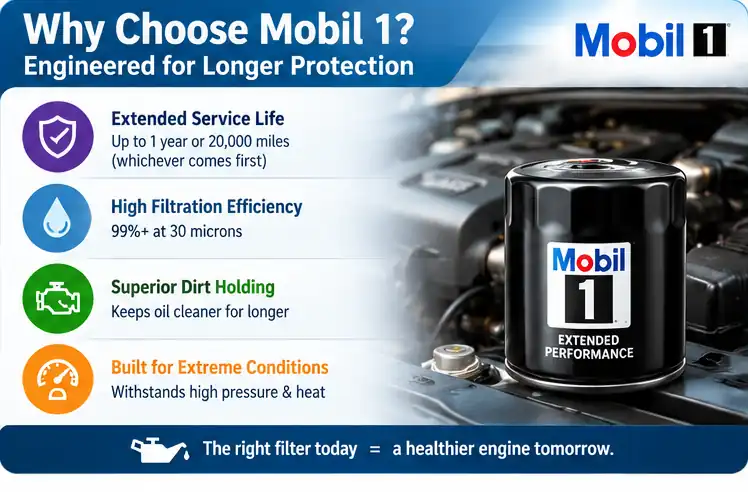
The 20,000-mile rating belongs to the Extended Performance filter. It does not override your owner’s manual, your oil’s rating, or your driving conditions.
Short trips, dusty roads, towing, and stop-and-go traffic all load the oil faster. Under those conditions, changing sooner is smart.
The rule of thumb is simple. Never stretch the filter past the interval it is rated for, and never stretch the oil past what the engine maker allows.
| Use Case | Practical Approach |
|---|---|
| Mixed highway and city, full synthetic oil | Follow the manual, up to the filter’s rated limit |
| Towing, dust, or frequent short trips | Change on the shorter severe-service schedule |
| Turbocharged or direct-injection engines | Follow the maker’s interval, filter included |
| Warranty-backed long interval | Use the matching oil and read the program terms |
Mobil 1 Versus Other Premium Filters
Where It Wins And Where Rivals Pull Ahead
Mobil 1’s big strength is its long-interval rating. Few mainstream filters carry a one-year or 20,000-mile claim backed by a brand that also makes the oil.
The canister build is another plus. Strong steel and a flexible gasket reduce the odds of leaks and bursts.
Rivals from Purolator, Wix, Bosch, and Fram play in the same space. Some publish higher efficiency numbers, and some use full synthetic media. Fair comparison depends on the test standard, not the headline number.
Where Mobil 1 can lag is availability. A few engine applications are covered by only a handful of part numbers, and cartridge options can be limited for certain European models.
Prices are also a bit higher than economy picks. In recent listings, many spin-on models sit in the low-to-mid teens at retail, with some higher.
Who Should And Should Not Pay Extra
The best candidates run full synthetic oil, drive long distances between services, or simply want fewer visits to the garage. A premium filter pairs well with that habit.
It also suits owners of newer engines that run tight tolerances and high temperatures. Cleaner oil is good insurance there.
If you change oil every 3,000 to 5,000 miles, the long-life rating does little for you. A solid mid-priced filter changed on schedule can protect an engine just as well.
Older engines with plenty of sludge may also need a different approach. Switching oils and filters can free deposits, so watch the oil level and pressure after a changeover.
In short, pay for the extra rating only if you will actually use it.
Questions people ask most often:
How long does a Mobil 1 oil filter last?
The Extended Performance line is rated for up to one year or 20,000 miles, whichever comes first. That only holds when your engine maker approves the interval and driving conditions are normal. Severe use calls for a shorter schedule.
Can I use a Mobil 1 filter with other oil brands?
Yes. Mobil says the filters are designed for use with all engine oil types and brands. For warranty programs tied to the Mobil 1 oil, read the terms to confirm what is required.
Is a Mobil 1 filter worth the extra cost over a basic filter?
It depends on how you use the car. If you run full synthetic oil and stretch your intervals, it makes sense. If you change oil often, a basic filter changed on time protects well too.
What does the efficiency percentage on the box mean?
It shows how much of a certain particle size the filter captures. Mobil lists 99 percent or better at 30 microns. Compare the micron size and test method before comparing percentages between brands.
How tight should I install a Mobil 1 spin-on filter?
Hand-tighten until the gasket touches, then turn about three-quarters to one full turn, or follow the label. Never use a wrench. Over-tightening can damage the gasket and make removal difficult.
How do I know which Mobil 1 filter fits my car?
Use the lookup tool on Mobil’s site or a trusted parts retailer, and enter your year, make, model, and engine. Cross-check with the owner’s manual before buying. Do not rely on looks or thread size alone.