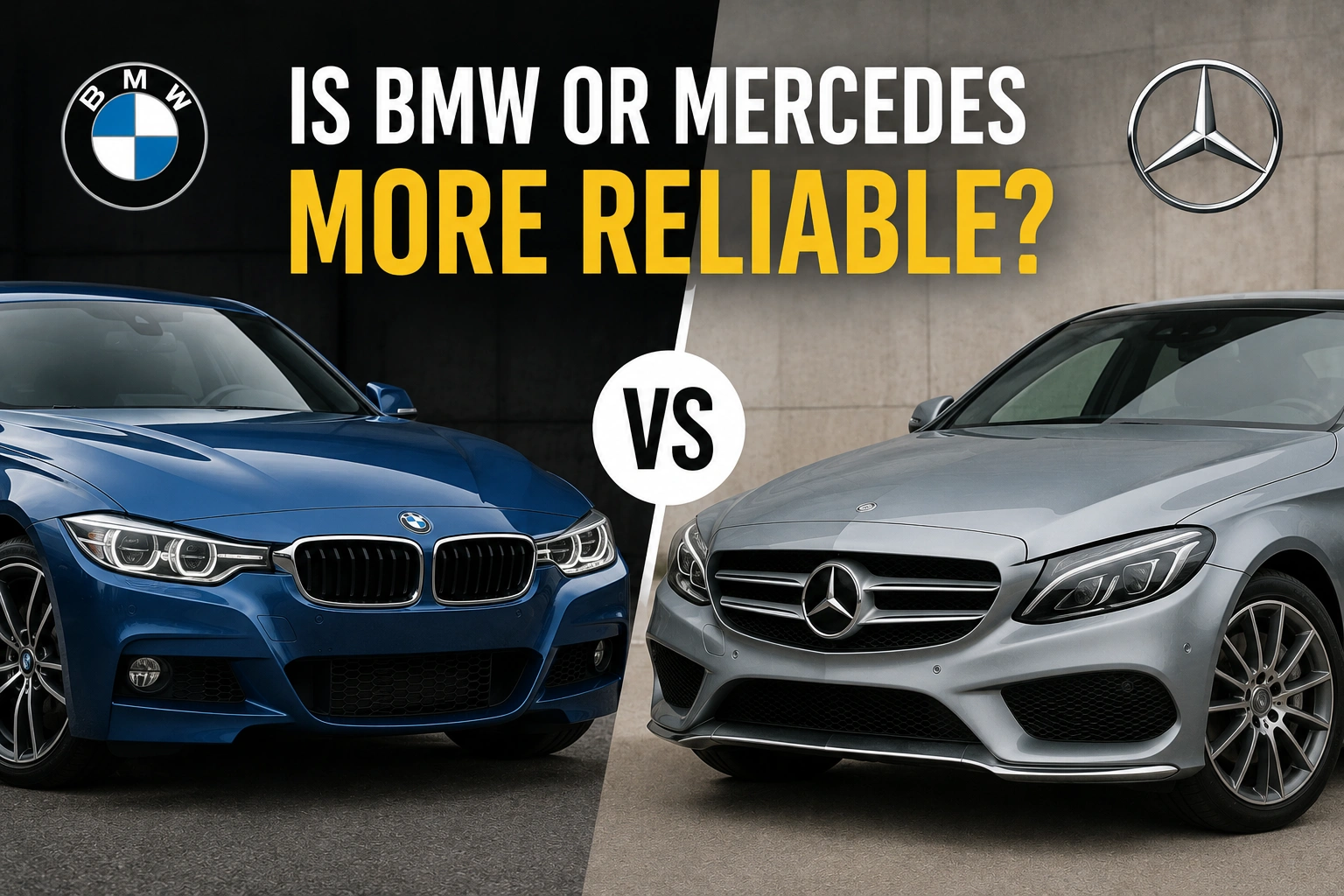
Two badges, one long-running argument, and a dinner-table debate that never seems to settle. Ask ten owners which German brand holds up better, and you will likely get ten confident, contradictory answers.
The truth sits inside spreadsheets most shoppers never open. J.D. Power surveys new owners after ninety days, Consumer Reports tracks vehicles across several years, and NHTSA logs which recalls actually get fixed. Each source tells a slightly different story.
Numbers from 2025 and 2026 studies now paint a clearer picture than the usual internet arguments ever could. BMW pulls ahead in nearly every major metric, though the gap tells a more interesting story than a simple win-or-lose scoreboard.
Ownership costs, common failure points, and even how quickly owners respond to recalls all factor into real-world dependability. Ahead is a full breakdown of what the data says about is bmw or mercedes more reliable, where each brand struggles, and which one fits which kind of driver.
Why Reliability Comparisons Between BMW And Mercedes Are Not So Simple
Reliability sounds like a single, measurable fact, yet three respected sources rarely agree on rankings. That disagreement comes down to what each one actually measures.
J.D. Power surveys brand-new owners about problems within the first ninety days of ownership. Consumer Reports instead tracks vehicles over multiple years using member-submitted data, weighted by how serious each issue actually is.
Two Studies, Two Different Definitions
A car that scores well in initial quality can still fall apart by year five, and that exact pattern shows up clearly in recent Mercedes data. Several Mercedes models topped their categories in early ownership studies, only to land near the bottom of long-term dependability rankings from the same model year.
That gap is not a contradiction; it reflects two very different questions. Initial quality studies ask what breaks in the first few months, while dependability studies ask what breaks after years of real-world wear. Someone leasing a car for three years cares about one number, while someone planning to keep a car for a decade should weigh the other far more heavily.
What The Latest Reliability Data Actually Shows
Numbers from 2025 place BMW ahead of Mercedes in both initial quality and long-term dependability studies. The margin grows wider the longer a vehicle stays on the road.
J.D. Power’s Initial Quality Study measures problems per 100 vehicles, abbreviated as PP100, within the first ninety days of ownership. Lower scores mean fewer reported issues and better early build quality.
Initial Quality Numbers For Both Brands
| Brand | Initial Quality (PP100) | Industry Average |
| BMW | 196 | 192 |
| Mercedes-Benz | 210 | 192 |
Both brands sit slightly above the industry average here, meaning neither one leads the entire market on fresh-off-the-lot quality. BMW still edges out Mercedes by fourteen points, a gap large enough to matter across a full model lineup.
Long Term Dependability After Three Years
The real separation shows up once vehicles reach three years old, which is where Vehicle Dependability Study data becomes far more revealing than early ownership numbers.
| Brand | 3-Year Dependability (PP100) | Consumer Reports Rank |
| BMW | 189 | 5th overall, top European brand |
| Mercedes-Benz | 243 | Near bottom among rank-eligible brands |
A fifty-four point gap between these two brands is substantial in dependability terms. BMW owners report noticeably fewer issues after three years of ownership compared to Mercedes owners driving similarly aged vehicles.
Common Problem Areas For Each Brand
Aggregate scores only tell part of the story, since specific systems tend to cause repeated headaches within each brand. Knowing which components fail most often helps buyers judge risk more precisely than a single overall number ever could.
Complex electronics, turbocharged engines, and air suspension systems introduce more failure points than older, simpler mechanical designs. Both German brands lean heavily into these technologies, which partly explains why neither one matches simpler, more conservative rivals like Toyota or Lexus.
Where BMW Owners Report Issues
Turbocharged four and six-cylinder engines, timing chain wear, and electronic water pump failures show up repeatedly across BMW ownership forums and service records. These issues tend to surface gradually rather than causing sudden breakdowns.
Infotainment glitches and software-related quirks also appear frequently, particularly on models running BMW’s iDrive system through multiple update cycles. Despite these recurring complaints, BMW’s overall dependability numbers stay lower than Mercedes across nearly every recent study, suggesting these issues rarely escalate into severe, drivetrain-level failures.
Where Mercedes Owners Report Issues
Air suspension components, particularly on E-Class, S-Class, and GLE models, rank among the most frequently cited repair items in Mercedes ownership data. These systems ride beautifully when functioning correctly, but replacement costs run high once air struts start leaking.
Electrical gremlins involving sensors, wiring harnesses, and infotainment modules also surface often in longer-term ownership reports. Combined with pricier parts and labor-intensive repairs, these recurring issues help explain why Mercedes dependability scores drop more sharply after the three-year mark compared to BMW’s steadier trend line.
Maintenance Cost And Ownership Experience
Reliability numbers matter, but out-of-pocket cost often shapes an owner’s actual satisfaction more than a PP100 score ever could. Repair frequency and repair cost do not always move together.
Both brands carry premium parts pricing and specialized labor rates well above mainstream manufacturers like Honda or Hyundai. Neither one qualifies as a budget-friendly choice once factory warranty coverage runs out.
Average Repair Costs Compared
| Brand | Average Annual Repair Cost (Post-Warranty) | Severe Repair Frequency |
| BMW | Around $968 per year | Roughly 15% of repairs classified severe |
| Mercedes-Benz | Comparable or slightly higher, varies by model | Higher due to air suspension and electronics |
Routine service intervals for both brands typically run between $150 and $400 per visit, covering oil changes, brake service, and diagnostic checks. Costs climb sharply once major components like turbochargers, air suspension struts, or electronic modules require replacement.
Warranty Coverage And Recall Handling
Both manufacturers offer similar new-vehicle warranty structures, typically covering four years or 50,000 miles on most models. Certified pre-owned programs from each brand extend that protection further, which matters heavily for anyone buying used.
Recall completion rates reveal a separate concern specific to BMW, which carries the lowest weighted-average recall completion rate among major manufacturers according to NHTSA’s January 2025 analysis. That figure does not reflect worse build quality; it reflects how slowly BMW owners tend to act once a recall notice arrives. Mercedes owners, by comparison, complete recall repairs at a notably higher rate across the same reporting period.
Which Brand Fits Which Type Of Owner
Numbers aside, the right choice often comes down to ownership length, driving style, and how much patience someone has for dealership visits. Neither brand suits every type of buyer equally well.
Someone planning to lease for two or three years and hand the car back faces a very different risk profile than someone planning to own the same vehicle for a decade.
Short Term Ownership Or Lease Buyers
Mercedes performs competitively, sometimes even better than BMW, within the first few years of ownership according to initial quality data. Several current Mercedes models, including the CLE and E-Class, ranked near the top of their categories in early ownership studies.
Buyers planning a typical three-year lease cycle rarely encounter the long-term issues that show up in dependability studies, since those problems tend to surface later. For this specific ownership pattern, Mercedes remains a genuinely competitive, sometimes preferable, choice over BMW.
Long Term Ownership Buyers
Anyone planning to keep a vehicle past the five-year mark should weigh BMW’s stronger dependability trend far more heavily. The gap between brands widens specifically in the years where lease buyers have already moved on.
BMW’s steadier performance after three years, combined with a narrower spread between its best and worst-performing models, makes it the safer long-term bet based on current data. Mercedes buyers planning extended ownership should budget realistically for air suspension and electrical repairs once the vehicle passes typical warranty coverage.
Frequently Asked Questions
Is BMW more reliable than Mercedes overall?
Current data from J.D. Power and Consumer Reports both place BMW ahead of Mercedes in initial quality and long-term dependability. The gap widens significantly in three-year ownership studies.
Which brand costs less to maintain long term?
Both brands carry premium repair costs above mainstream manufacturers, though Mercedes often faces higher expenses tied to air suspension and electrical component failures. BMW owners report an average annual repair cost near $968 after warranty coverage ends.
Do BMW models have common recurring problems?
Yes. Timing chain wear, electronic water pump failures, and iDrive software glitches appear frequently in BMW ownership data, though these rarely escalate into severe drivetrain failures based on dependability scores.
What problems are most common in Mercedes vehicles?
Air suspension failures on E-Class, S-Class, and GLE models rank among the most reported issues, alongside electrical sensor and wiring problems that tend to surface after the three-year mark.
Is Mercedes better for someone leasing instead of buying?
Yes, based on initial quality data. Several Mercedes models score competitively or better than BMW within the first few years, making a short lease term a lower-risk ownership path.
Why does BMW have a low recall completion rate despite good reliability scores?
A low recall completion rate reflects how slowly owners respond to recall notices, not how often problems occur. NHTSA data shows BMW owners complete recall repairs less often than Mercedes owners, separate from overall build quality.