The Buick Enclave has been powered by one engine family across its entire production run — GM’s High Feature 3.6-liter V6. Different engine codes arrived with each generation, power outputs climbed from 275 horsepower to 310, and the engineering behind direct injection, variable valve timing, and cylinder deactivation grew more sophisticated with every update.
Yet underneath all those changes, one number stayed fixed: the firing order. Every Enclave built from 2008 to 2026 fires its cylinders in exactly the same sequence.
That consistency is useful information — not just for the mechanics who service these engines but for any owner who wants to understand what their scanner is reporting when a P0302 code appears, or who wants to know which cylinder they are looking at when the rear bank valve cover comes off. This guide covers the complete engine history and the firing sequence in full technical detail.
The Core Answer: Buick Enclave Firing Order For Every Year
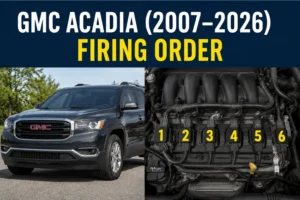
Every Buick Enclave produced from the 2008 model year through the current 2026 model uses the firing order 1-2-3-4-5-6.
This applies to the LY7 engine (2008–2012), the LLT (2013–2017 models with the revised spec), the LFX (used in select variants), and the LFY (2018–present). All four are members of GM’s High Feature V6 family, all displace 3.6 liters, and all share the same cylinder numbering convention and ignition sequence.
The 1-2-3-4-5-6 firing order is notably different from the 1-4-2-5-3-6 sequence used in Honda’s J-series V6 and the 1-2-3-4-5-6 pattern is less common than it might appear at first glance.
GM’s High Feature V6 achieves smooth power delivery through this sequential pattern because the 60-degree bank angle of the engine creates natural crankshaft journal phasing that makes consecutive cylinder firing work without the vibration penalties it would cause in a 90-degree V6.
Why The 1-2-3-4-5-6 Sequence Works In This Engine
The Role Of Bank Angle In Firing Order Selection
The GM High Feature V6 uses a 60-degree bank angle between its two cylinder banks — the same specification used by Honda’s J-series V6 and many modern European V6 engines.
This narrow angle is specifically what allows consecutive cylinder numbering to work as a firing order without the rough running that would result in a wider-angle V6.
In a 90-degree V6, consecutive firing would produce uneven power pulses spaced at irregular intervals because of how the crank journal positions interact with the bank angle.
In a 60-degree V6, the crankshaft geometry produces equal power intervals of 120 degrees of crank rotation between each firing event, which is the ideal theoretical spacing for six-cylinder smoothness.
And this works correctly with the 1-2-3-4-5-6 sequence when the cylinders are numbered across alternating banks as they are in the GM High Feature layout.
How It Differs From The Common Misconception
Many owners who search for the Buick Enclave’s firing order encounter conflicting information online because the 3.6L High Feature engine appears in dozens of GM vehicles, some of which are rear-wheel drive or longitudinal installations where the cylinder numbering convention differs from the Enclave’s transverse crossover layout.
In longitudinal installations — rear-wheel-drive Cadillac CTS or ATS applications using the same LFX block — the same physical engine sits differently relative to the front of the vehicle, which changes how cylinders are referenced in some service documentation.
The firing order itself remains 1-2-3-4-5-6 regardless of installation orientation, but which cylinder is physically on which side changes with the layout. Knowing that the Enclave uses a transverse installation is the key to correctly interpreting the cylinder layout described in this guide.
Buick Enclave Engine History And Specifications By Generation
First Generation Enclave (2008–2017) — LY7 And LLT V6 Engines
LY7 Engine (2008–2012):
- Engine Code: LY7
- Displacement: 3.6 liters (3,564 cc)
- Configuration: DOHC, 24-valve, 60-degree V6
- Firing Order: 1-2-3-4-5-6
- Power Output: 275 hp @ 6,200 rpm (2008–2010); upgraded specs varied by model year
- Torque: 251 lb-ft @ 3,400 rpm
- Bore × Stroke: 94.0 mm × 85.6 mm
- Compression Ratio: 11.3:1
- Fuel System: Sequential multiport fuel injection (non-direct injection)
- Cam Drive: Timing chain (three-chain system on early LY7)
- Variable Valve Timing: Four-cam phasing (intake and exhaust on both banks)
- Transmission: Hydra-Matic 6T75 six-speed automatic
- Assembly Plants: St. Catharines, Ontario; Flint, Michigan; Ramos Arizpe, Mexico
- Original MSRP (2008): $33,990 (base CX)
The LY7 was the initial engine in the first Enclave and introduced GM’s dual overhead cam, four-valves-per-cylinder High Feature V6 architecture to the Lambda crossover platform. It was a technically advanced engine for its time — four-cam phasing (variable valve timing on both intake and exhaust cams on both banks) was something few V6 engines offered at that price point, and it contributed to the LY7’s broad, accessible torque band that made the Enclave feel effortless in daily use.
The LY7’s most significant engineering weakness was its three-chain timing system. Early production engines — particularly those built before mid-2009 — used a cam drive system with three separate timing chains and a PCV (positive crankcase ventilation) system that, when combined with extended oil change intervals, could cause premature chain wear and chain tensioner failure.
GM addressed this progressively through revised PCV calibration, updated chain tensioner designs, and enhanced owner guidance on oil change intervals. Owners of high-mileage 2008–2010 Enclaves should be aware of timing chain stretch as a potential fault that can cause rough running symptoms that superficially resemble ignition misfires.
LLT Engine (2013–2017):
- Engine Code: LLT
- Displacement: 3.6 liters (3,564 cc)
- Configuration: DOHC, 24-valve, 60-degree V6
- Firing Order: 1-2-3-4-5-6
- Power Output: 288 hp @ 6,300 rpm (with dual exhaust); 281 hp (single exhaust)
- Torque: 270 lb-ft @ 3,400 rpm (dual exhaust); 266 lb-ft (single exhaust)
- Bore × Stroke: 94.0 mm × 85.6 mm (unchanged from LY7)
- Compression Ratio: 11.3:1
- Fuel System: Gasoline Direct Injection (GDI) — the primary upgrade over LY7
- Cam Drive: Revised timing chain system with improved tensioner design
- Variable Valve Timing: Four-cam phasing retained
- Transmission: 6T75 six-speed automatic (revised calibration)
- Original MSRP (2013 refreshed model): Approximately $38,990 (base)
The LLT represented a meaningful step forward from the LY7. The most consequential change was the addition of gasoline direct injection — the fuel injectors moved from the intake port to the combustion chamber itself, allowing more precise fuel metering, higher compression ratios under load, and significantly improved fuel efficiency per unit of power produced.
The LLT also addressed the timing chain concerns that had affected early LY7 engines. The three-chain system was retained, but the PCV system was revised to reduce oil vapor contamination of the chain tensioner hydraulics, and the tensioners themselves were redesigned with improved check valve function.
GM Authority confirmed that the Lambda-based crossovers — Enclave, Traverse, and Acadia — were the last vehicles to use the LLT before it was phased out in favor of the LFX.
The 2013 Enclave refresh that introduced the LLT also brought exterior styling changes including a new waterfall grille, LED running lights, and revised rear fascia, plus an industry-first front center airbag between the driver and front passenger positions.
| Spec | LY7 (2008–2012) | LLT (2013–2017) |
| Firing Order | 1-2-3-4-5-6 | 1-2-3-4-5-6 |
| Power | 275 hp @ 6,200 rpm | 288 hp @ 6,300 rpm |
| Torque | 251 lb-ft @ 3,400 rpm | 270 lb-ft @ 3,400 rpm |
| Fuel System | Port injection | Direct injection |
| Compression | 11.3:1 | 11.3:1 |
| Cam Drive | Three-chain | Revised three-chain |
| Transmission | 6T75 6-speed | 6T75 6-speed |
| Base MSRP | $33,990 (2008) | ~$38,990 (2013) |
Second Generation Enclave (2018–2026) — LFY Engine
- Engine Code: LFY
- Displacement: 3.6 liters (3,564 cc)
- Configuration: DOHC, 24-valve, 60-degree V6
- Firing Order: 1-2-3-4-5-6
- Power Output: 305 hp @ 6,800 rpm (2018–2019); 310 hp @ 6,800 rpm (2020–2026)
- Torque: 260 lb-ft @ 2,800 rpm (2018–2019); 266 lb-ft @ 2,800 rpm (2020–2026)
- Bore × Stroke: 94.0 mm × 85.6 mm (same as LY7 and LLT)
- Compression Ratio: 11.5:1 (increased from predecessors)
- Fuel System: Gasoline Direct Injection (GDI)
- Cylinder Deactivation: No (LFY does not include Active Fuel Management)
- Stop-Start Technology: Yes — a key difference between LFY and its LFX predecessor
- Cam Drive: Inverted-tooth timing chain with redesigned tensioners
- Variable Valve Timing: Four-cam phasing with improved cam profiles
- Transmission: GM 9T65 nine-speed automatic (2018–2019); M3W nine-speed (2020–2026)
- Platform: GM C1 (second-gen Enclave, second-gen Traverse)
- Assembly: Spring Hill Manufacturing, Spring Hill, Tennessee
- Base MSRP (2018): $40,990 (Preferred); top trim Avenir: approximately $58,000
- 2026 MSRP Range: $48,100 (Essence) to approximately $62,000 (Avenir)
The second-generation Enclave arrived for the 2018 model year with the most significant platform change in the nameplate’s history. Built on GM’s new C1 platform rather than the Lambda architecture of the first generation, the second-gen Enclave grew in interior volume while shrinking in exterior dimensions — a packaging efficiency improvement that came from the C1 platform’s more compact structural architecture.
The LFY engine that powers every second-gen Enclave is essentially the LFX (which had replaced the LLT in most other GM applications) adapted specifically for the full-size crossover application, with the addition of an engine stop-start system.
GM Authority describes the relationship directly: “The 3.6 liter V6 LGY is identical to the 3.6L LFX. The biggest difference is that the LFY receives the engine Stop/Start capability, which the LFX does not have.”
The stop-start system shuts the engine off when the Enclave comes to a complete stop — at a traffic light or in stop-and-go traffic — and restarts it when the driver lifts their foot from the brake pedal.
This reduces fuel consumption in city driving by eliminating idle fuel burn during stationary periods. The system is smooth in operation, and the inverted-tooth timing chain with redesigned tensioners handles the increased number of start-stop cycles without accelerating wear.
The 2020 power increase — from 305 to 310 horsepower — came from revised intake and exhaust camshaft profiles that improved volumetric efficiency without any changes to displacement, bore, or stroke. The 2022 refresh brought updated exterior styling and expanded standard safety equipment rather than engine specification changes.
Second-Generation Cylinder Layout In Detail:
The LFY is mounted transversely in the Enclave’s engine bay. Standing in front of the vehicle and looking at the engine:
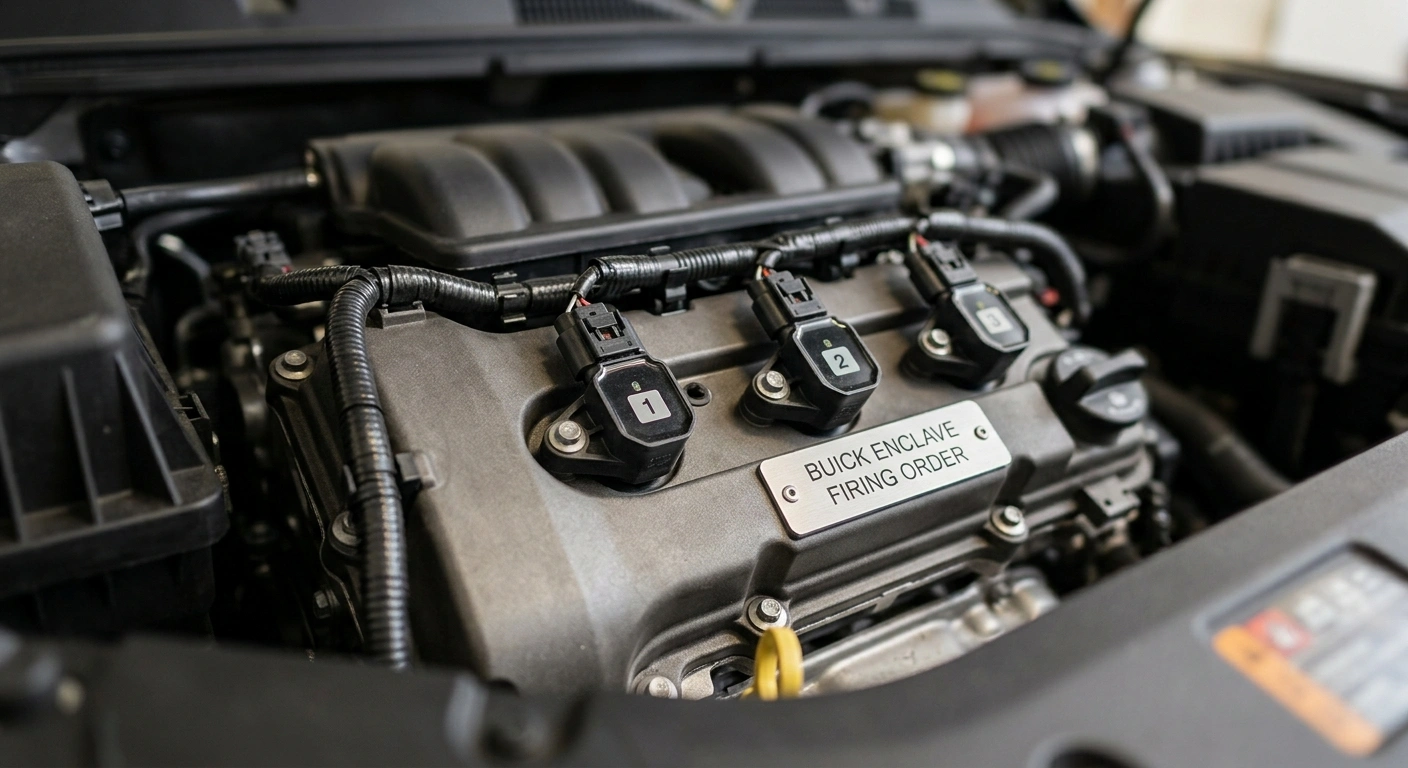
- Upper Bank (rear of engine bay, toward firewall): Cylinders 1, 3, 5 — numbered left to right
- Lower Bank (front of engine bay, toward radiator): Cylinders 2, 4, 6 — numbered left to right
This means odd-numbered cylinders (1, 3, 5) share the upper bank and even-numbered cylinders (2, 4, 6) share the lower bank. The firing sequence 1-2-3-4-5-6 therefore alternates between the upper and lower bank with every firing event — cylinder 1 fires (upper bank), then cylinder 2 fires (lower bank), then 3 (upper), then 4 (lower), continuing through 5 and 6.
This alternating bank pattern distributes combustion forces evenly across both cylinder banks and is what allows the sequential 1-2-3-4-5-6 sequence to run smoothly in this 60-degree V6 architecture.
Cylinder Layout: The Full Diagram Explained
How The Cylinders Are Numbered In The Enclave
The GM High Feature V6 in the Enclave uses a numbering convention that differs from the majority of American V6 engines, where odd cylinders typically occupy one bank and even cylinders the other.
In most domestic V6s, the firing order alternates between banks as you move through the sequence. The Enclave’s engine does alternate banks in the firing sequence, but the cylinders are arranged so that consecutive numbers sit on alternating banks rather than grouping 1-3-5 on one side.
Looking at the engine from the front of the vehicle with the hood open:
Upper Bank (closer to firewall, rear of engine bay):
- Cylinder 1 — leftmost position
- Cylinder 3 — center position
- Cylinder 5 — rightmost position
Lower Bank (closer to radiator, front of engine bay):
- Cylinder 2 — leftmost position
- Cylinder 4 — center position
- Cylinder 6 — rightmost position
Cylinder 1 is in the upper bank on the far left when viewed from the front. This is the starting point for any cylinder identification work on the Enclave engine. The term “upper” and “lower” rather than “front” and “rear” reflects the transverse mounting — because the engine sits sideways relative to the vehicle’s direction of travel, the conventional “front of engine” (accessory drive end, near the timing chain cover) actually faces toward the right side of the vehicle from the driver’s perspective.
| Cylinder Number | Bank Position | Position Within Bank | OBD-II Misfire Code |
| 1 | Upper (firewall side) | Left | P0301 |
| 2 | Lower (radiator side) | Left | P0302 |
| 3 | Upper (firewall side) | Center | P0303 |
| 4 | Lower (radiator side) | Center | P0304 |
| 5 | Upper (firewall side) | Right | P0305 |
| 6 | Lower (radiator side) | Right | P0306 |
Practical Diagnostic Applications
Reading Misfire Codes With The Firing Order
When an OBD-II scanner reports a misfire code on any Buick Enclave, the cylinder number in the fault code maps directly to the layout above. A P0301 indicates cylinder 1 — upper bank, far left. A P0304 means cylinder 4 — lower bank, center position.
For single-cylinder misfires, the standard diagnostic process is to swap the ignition coil from the misfiring cylinder to an adjacent cylinder and re-scan after clearing the fault.
If the P0300X code moves to the new cylinder number, the coil was at fault. If the same cylinder number codes again, the spark plug or fuel injector becomes the next focus.
On second-generation Enclaves with the LFY and its stop-start system, cold-start misfires are worth noting separately. The increased frequency of start events means ignition coils and spark plugs on these engines cycle through more thermal stress cycles per mile than on first-gen LY7 or LLT engines that idle through the same period.
Some LFY owners report slightly earlier coil wear than expected — tracking specific cylinder numbers across multiple misfire events helps identify whether a pattern is developing across the firing sequence or whether it is isolated to a single component.
Checking Spark Plugs On The GM 3.6L V6 In The Enclave
The upper bank plugs (cylinders 1, 3, 5) on the Enclave are significantly more accessible than the lower bank plugs (cylinders 2, 4, 6). The lower bank sits against the firewall in the Enclave’s engine bay, and removing those plugs typically requires removal of the intake manifold or careful maneuvering of extension bars.
The labor difference is worth factoring into maintenance planning — if lower bank plugs are hard to reach, changing all six simultaneously is more cost-effective than returning for the others.
The GM specification for spark plug replacement interval on the LFY is 97,500 miles for the iridium-tipped OE plugs. Owners of higher-mileage first-generation Enclaves using the LY7 or LLT should treat 60,000 miles as the practical upper limit given the age of those engines and the fact that many were not always maintained precisely to specification.
Timing Chain Warning Signs On LY7 And LLT Engines
First-generation Enclave owners with higher-mileage LY7 and early-LLT engines should be aware that timing chain issues can produce symptoms that look like misfires on an OBD-II scanner.
A stretched timing chain causes cam timing error, which affects when each cylinder’s valves open and close relative to piston position. The engine’s cam position sensors will detect this deviation and the ECM may log P034X (camshaft position) fault codes alongside P030X misfire codes.
If a first-gen Enclave logs misfire codes that do not resolve after coil and plug replacement, and particularly if the codes involve multiple cylinders simultaneously, cam phasing codes should be checked before parts replacement continues.
A timing chain diagnosis — typically involving a timing light or cam timing check with the valve covers removed — distinguishes a chain issue from an ignition system fault definitively.
Full Engine Specification Comparison: All Enclave Engines
| Specification | LY7 (2008–2012) | LLT (2013–2017) | LFY (2018–2026) |
| Firing Order | 1-2-3-4-5-6 | 1-2-3-4-5-6 | 1-2-3-4-5-6 |
| Displacement | 3,564 cc | 3,564 cc | 3,564 cc |
| Bore × Stroke | 94 × 85.6 mm | 94 × 85.6 mm | 94 × 85.6 mm |
| Compression | 11.3:1 | 11.3:1 | 11.5:1 |
| Power | 275 hp | 288 hp | 305–310 hp |
| Torque | 251 lb-ft | 270 lb-ft | 260–266 lb-ft |
| Fuel System | Port injection | Direct injection | Direct injection |
| Cam Drive | Three-chain | Revised three-chain | Inverted-tooth chain |
| Stop-Start | No | No | Yes |
| Cylinder Deact. | No | No | No |
| Transmission | 6-speed 6T75 | 6-speed 6T75 | 9-speed 9T65/M3W |
| VVT Banks | 4-cam phasing | 4-cam phasing | 4-cam phasing |
| Spark Plug Gap | 0.043–0.047 in | 0.043–0.047 in | Pre-set iridium |
| Base MSRP | $33,990 | ~$38,990 | $40,990–$62,000 |
| Platform | Lambda | Lambda | C1 |
| Assembly | Spring Hill / Ontario | Spring Hill / Ontario | Spring Hill, TN |
FAQs
What is the firing order for the Buick Enclave?
The firing order for every Buick Enclave produced from 2008 through 2026 is 1-2-3-4-5-6. This applies to all three engine variants used across the nameplate’s production history — the LY7 (2008–2012), the LLT (2013–2017), and the LFY (2018–present). All three are 3.6-liter 60-degree V6 engines from GM’s High Feature V6 family and share the same cylinder layout and ignition sequence.
Where is cylinder 1 on the Buick Enclave engine?
In the Buick Enclave’s transversely mounted 3.6L V6, cylinder 1 is located in the upper bank (the bank closest to the firewall at the rear of the engine bay) on the far left side when viewed from in front of the vehicle with the hood open. The upper bank houses cylinders 1, 3, and 5 from left to right. The lower bank (toward the radiator) houses cylinders 2, 4, and 6, also left to right.
What engine does the Buick Enclave use?
Every Buick Enclave has been powered by a naturally aspirated 3.6-liter DOHC V6 from GM’s High Feature V6 engine family. The specific engine codes are the LY7 (2008–2012 first-gen models), the LLT (2013–2017 first-gen models with direct injection), and the LFY (2018–2026 second-gen models with direct injection and stop-start technology). Power output has grown from 275 hp in the original 2008 LY7 to 310 hp in the current 2020–2026 LFY.
What does the 1-2-3-4-5-6 firing order mean?
The firing order 1-2-3-4-5-6 describes the sequence in which each cylinder in the engine completes its combustion (power) stroke. In the Enclave’s 60-degree V6, this sequence fires cylinders alternating between the upper and lower banks: cylinder 1 (upper bank) fires, then cylinder 2 (lower bank), then 3 (upper), then 4 (lower), then 5 (upper), then 6 (lower), and the cycle repeats. The 60-degree bank angle allows this sequential pattern to produce equal 120-degree crankshaft rotation intervals between each firing event, which is what makes the engine run smoothly.
Why does the Buick Enclave fire 1-2-3-4-5-6 instead of a more complex order?
The sequential 1-2-3-4-5-6 pattern works in the GM High Feature V6 because of the engine’s 60-degree bank angle and the specific crankshaft journal arrangement GM used in its design. In a 90-degree V6, consecutive cylinder firing would create uneven power pulse timing. In a 60-degree V6 with GM’s crankshaft design, consecutive firing produces equal 120-degree intervals between combustion events — the theoretical optimum for smooth six-cylinder operation. This is the same reason Honda’s 60-degree J-series V6 also achieves smooth operation, though Honda uses a different firing sequence (1-4-2-5-3-6) because their cylinder numbering convention differs.
What are the most common causes of misfire codes on the Buick Enclave?
For all three Enclave engine variants, the most frequent misfire causes are failed ignition coils (coil-on-plug failures are common after 80,000–100,000 miles), worn spark plugs past their replacement interval, and on first-generation LY7 and early LLT engines, timing chain stretch causing cam timing deviation. On the LFY in second-generation Enclaves, the stop-start system increases ignition component cycle frequency, which can accelerate coil wear on higher-mileage examples. Cam position sensor faults (P034X codes) alongside misfire codes on first-gen engines typically indicate a timing chain issue rather than an ignition fault.
How often should spark plugs be replaced on the Buick Enclave?
GM specifies an iridium spark plug replacement interval of approximately 97,500 miles for the LFY engine in second-generation Enclaves. For first-generation Enclaves with the LY7 or LLT, 60,000–75,000 miles is a practical service interval given the age of those engines and their port or early direct-injection fuel systems. Lower bank plugs (cylinders 2, 4, 6) on all Enclave engines are more labor-intensive to access due to the firewall proximity of that bank in the transverse installation, so replacing all six plugs simultaneously maximizes value from the labor time required.
Is the LFY engine in the 2026 Buick Enclave the same as earlier generations?
The LFY shares the same 3.6-liter displacement, 94mm bore, 85.6mm stroke, and basic DOHC architecture as the LY7 and LLT that preceded it, but it is a substantially updated engine. The LFY adds stop-start capability (which the LLT lacked), features revised camshaft profiles for improved airflow, uses an inverted-tooth timing chain system with improved tensioner design, and achieves a higher compression ratio of 11.5:1 versus the 11.3:1 of earlier engines. The 2020 power increase from 305 to 310 hp came from further camshaft profile refinement rather than any mechanical displacement or bore change.
Does the Buick Enclave have cylinder deactivation?
No. Unlike the 3.6L LGX engine used in Cadillac models, which features Active Fuel Management (cylinder deactivation of cylinders 2 and 5 under light load), the LFY engine used in all second-generation Enclaves does not include cylinder deactivation. The LFY’s fuel economy benefit comes from the stop-start system alone. This distinction matters for diagnostics — LFY Enclave owners do not need to consider VCM-related solenoid or rocker arm oil control valve faults as potential misfire sources, which simplifies diagnosis compared to Cadillac models using the LGX.
What transmission is paired with the Enclave’s 3.6L V6?
First-generation Enclaves (2008–2017) used GM’s Hydra-Matic 6T75 six-speed automatic transmission. Second-generation Enclaves (2018–present) use a nine-speed automatic — the 9T65 in 2018 and 2019 models, and the revised M3W nine-speed from 2020 onward. The additional gear ratios in the nine-speed allow the LFY engine to operate closer to its efficiency window during highway cruising, contributing to the improved fuel economy figures the second-generation achieves compared to the first.