
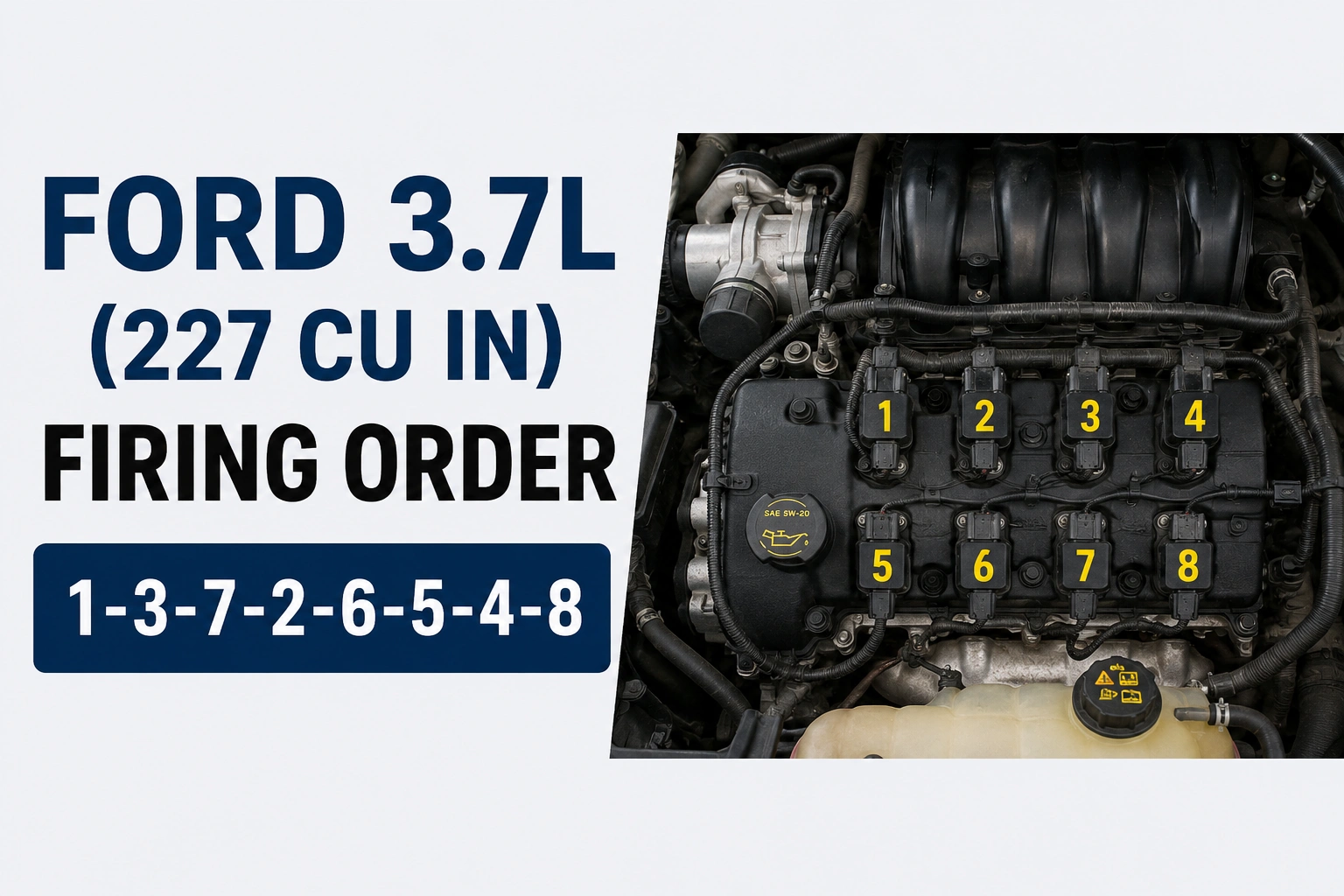
Ford’s 3.7-liter V6 has powered more vehicles across more segments than most owners ever realize. It went into the Mustang, the F-150, the Edge Sport, the Lincoln MKS, the Lincoln MKT, the Ford Flex, the Ranger, and several Lincoln and Mazda applications.
Each installation had slightly different engine mounting — some longitudinal, some transverse — and each created a different physical picture of where each cylinder sits relative to the driver and the engine bay.
For anyone servicing this engine, that difference matters immediately. The firing order itself does not change, but how you physically locate cylinder 1 in a Mustang versus how you find it in a Police Interceptor Sedan are two completely different exercises.
This guide settles every piece of that picture, from the confirmed firing sequence to the bank assignments, ignition hardware, and spark plug specs.
The Confirmed Firing Order And Why It Never Changed Between Versions
The Ford 3.7L Duratec 37 firing order is 1-4-2-5-3-6 — and that sequence applies to every version of this engine without exception. The early non-VCT version, the later Ti-VCT update introduced in 2011, and the Mazda MZI 3.7 variant all share this same sequence.
Some sources create confusion by suggesting the Ti-VCT update might have altered the firing order because it changed how the camshafts phase. It did not. Ti-VCT (Twin Independent Variable Cam Timing) affects when the valves open and close relative to piston position — it adjusts timing dynamically based on load and RPM.
The fundamental combustion sequence, which cylinder fires first and in what rotation, is determined by the crankshaft geometry and does not change with valve timing hardware. The 1-4-2-5-3-6 sequence was baked into the crankshaft’s pin arrangement when the engine was first designed and is permanent.
Why 1-4-2-5-3-6 Is The Right Sequence For This 60-Degree V6
The 3.7L belongs to Ford’s Cyclone engine family, which uses a 60-degree angle between the two cylinder banks. At 60 degrees, the crankshaft throws must be arranged to produce equally spaced combustion events — one firing every 120 degrees of crankshaft rotation — to achieve smooth power delivery without an imbalance that would require heavy counterweights or balance shafts to suppress.
The 1-4-2-5-3-6 sequence achieves those 120-degree intervals by alternating between the two cylinder banks in a specific pattern. Cylinders 1 and 4 are on opposite banks and are connected to crankshaft throws that are phased 180 degrees apart.
The sequence moves from cylinder 1 to cylinder 4 — crossing banks — then to cylinder 2, then back across to 5, then 3, then 6. Each crossing prevents consecutive firings in adjacent cylinders on the same bank, which would create the torque pulse irregularity that produces vibration at idle.
This same 1-4-2-5-3-6 pattern appears across many modern V6 engines from multiple manufacturers, all using similar 60-degree bank geometry. What varies between them is which cylinder carries the number 1 designation and where it sits in the engine bay — and that is where the 3.7L has a detail worth paying close attention to.
Cylinder Numbering And Bank Identification — The Detail That Changes By Installation
The firing sequence is fixed. The physical location of each numbered cylinder depends on how the engine is mounted in the specific vehicle, and the 3.7L was used in both longitudinal and transverse installations across its production life.
Longitudinally Mounted 3.7L — Mustang, F-150, Ranger, Lincoln Variants
On the 2011–2017 Mustang, the 2011–2014 F-150, and Lincoln applications where the engine runs front-to-rear in the vehicle, the cylinder numbering follows Ford’s standard longitudinal V6 convention.
Standing at the front of the vehicle and looking directly at the engine:
- Bank 1 (passenger side / right side): Cylinders 1, 2, 3 — front to rear
- Bank 2 (driver’s side / left side): Cylinders 4, 5, 6 — front to rear
Cylinder 1 is the frontmost cylinder on the passenger side. This is Ford’s consistent convention for rear-wheel-drive and front-engine, rear-wheel-drive vehicles — confirmed both by official Ford service documentation and by the forum technical thread posted by 3.7L Mustang owners who verified this against their specific engines.
A visual grid helps lock this in:
| Position In Engine (Front To Rear) | Passenger Side (Bank 1) | Driver’s Side (Bank 2) |
| Front | 1 | 4 |
| Middle | 2 | 5 |
| Rear | 3 | 6 |
In the Mustang, the passenger side bank (1, 2, 3) faces toward the open right side of the engine bay, which makes those cylinders relatively accessible. The driver’s side bank (4, 5, 6) sits closer to the firewall in certain configurations and is slightly less accessible, though the Mustang’s longitudinal layout keeps all six plugs serviceable without major disassembly.
On the F-150 application, upper intake manifold removal is required to access the rear cylinder bank plugs — a job that Ford’s own service data estimates at 1.5 to 2 hours of labor time. This is not unusual for a V6 in a full-size truck where the engine bay is filled by the larger block and its accessories.
Transversely Mounted 3.7L — Ford Edge Sport, Police Interceptor Sedan, Flex, Taurus SHO Adjacent Applications
On transversely mounted installations, the engine sits sideways in the bay. The “front” of the engine — the side with the accessory belt and pulleys — faces the passenger side of the vehicle. This rotates the entire cylinder layout 90 degrees relative to the vehicle.
In the transverse configuration:
- Bank 1 (rear of engine bay, firewall side): Cylinders 1, 2, 3
- Bank 2 (front of engine bay, accessible from above): Cylinders 4, 5, 6
The firing order remains 1-4-2-5-3-6. What changes is where each number sits in three-dimensional space within the car.
This distinction matters most for oxygen sensor replacement. A P0131 code on a longitudinal 3.7L F-150 (Bank 1 sensor 1) sends a technician to the upstream oxygen sensor on the passenger-side exhaust manifold.
A P0131 code on a transverse 3.7L Police Interceptor sends them to the upstream sensor on the rear bank manifold, close to the firewall — a completely different physical location even though the code and cylinder number are identical.
The Ford Truck Enthusiasts technical thread confirmed this explicitly: on a transverse engine, Bank 1 moves to the rear of the engine bay but the cylinder numbering system itself remains consistent.
Ignition System — Coil-On-Plug With No Distributor
Every version of the 3.7L Duratec uses coil-on-plug (COP) ignition. There are no spark plug wires to misroute and no distributor cap to position incorrectly. Each cylinder has a dedicated ignition coil mounted directly on its spark plug, and the ECM fires each coil in the 1-4-2-5-3-6 sequence based on signals from the crankshaft position sensor and camshaft position sensor.
This architecture has a direct consequence for misfire diagnosis: an incorrect firing order cannot result from a maintenance error on the ignition hardware. There is no physical way to install a coil on the wrong cylinder and produce a firing sequence error, because the coil for cylinder 1 is physically bolted above cylinder 1’s spark plug hole. The ECM drives the sequence in software.
What does produce cylinder-specific misfires on this engine is coil failure, spark plug fouling or wear, fuel injector issues, or — in more serious cases — compression loss in a specific cylinder. An OBD-II misfire code (P0301 through P0306) identifies the exact cylinder, and the coil swap test — moving the suspect coil to a different cylinder and confirming whether the misfire code moves with it — isolates coil failure cleanly.
The Ti-VCT Cam Phaser Failure And Why It Mimics A Firing Order Problem
The Ti-VCT system introduced in 2011 and later 3.7L engines uses cam torque actuated phasers on both intake and exhaust camshafts. These phasers advance or retard camshaft timing in response to oil pressure, allowing the ECM to optimize combustion timing across different load and RPM conditions.
When these phasers fail — a documented failure mode on higher-mileage 3.7L Ti-VCT engines — the cam timing drifts out of specification. The crankshaft-to-camshaft relationship that the ECM uses to precisely time each ignition event becomes inaccurate.
The result is rough idle, power loss under load, and cylinder-specific or random misfire codes (P0300, P0301–P0306) that look exactly like ignition coil failures or spark plug problems.
The key diagnostic distinction: if swapping a coil does not move the misfire code, and the spark plugs are in good condition, the cam phasers deserve investigation. Codes P0011, P0012, P0021, and P0022 (cam timing over-advanced or over-retarded on Bank 1 or Bank 2) appearing alongside misfire codes strongly suggest phaser failure rather than ignition system failure.
This is a deeper repair than coil replacement and typically requires oil pressure testing of the phaser solenoid circuit and, in confirmed failure cases, mechanical replacement of the phaser assembly.
All Vehicles That Used The Ford 3.7L V6
Knowing which platform your specific vehicle uses — longitudinal or transverse — determines how you physically locate each cylinder. Here is the full list by vehicle:
| Vehicle | Years | Engine Mount | Cylinder 1 Location |
| Mazda CX-9 (MZI 3.7) | 2008–2015 | Transverse | Rear bank, belt end |
| Lincoln MKS | 2009–2016 | Transverse | Rear bank, belt end |
| Lincoln MKT | 2010–2019 | Transverse | Rear bank, belt end |
| Ford Flex | 2010–2019 | Transverse | Rear bank, belt end |
| Ford F-150 | 2011–2014 | Longitudinal | Front, passenger side |
| Ford Mustang | 2011–2017 | Longitudinal | Front, passenger side |
| Ford Edge Sport | 2011–2014 | Transverse | Rear bank, belt end |
| Ford Police Interceptor Sedan | 2013–2019 | Transverse | Rear bank, belt end |
| Ford Ranger | 2019–present* | Longitudinal | Front, passenger side |
*The 3.7L was used in the international Ranger and select configurations; North American 2019+ Rangers use the 2.3L EcoBoost as the primary engine.
Spark Plug Specifications And Service Notes
| Specification | Value |
| Plug socket size | 5/8 inch (16 mm) |
| OEM plug type | Motorcraft SP-534 (iridium) |
| Aftermarket alternatives | Autolite XP5364 iridium, NGK LTR6AP-13G |
| Plug gap (factory spec) | 0.051 – 0.055 inches (1.30 – 1.40 mm) |
| Plug torque (aluminum head) | 133 in-lb (11 ft-lb) |
| Service interval | 100,000 miles (iridium OEM plugs) |
| Cylinder access difficulty | Rear bank: moderate to high (F-150 requires intake removal) |
Experienced 3.7L Mustang owners in the AllFordMustangs technical thread noted that a plug gap of 0.054 inches tends to produce slightly better combustion quality than the tighter end of the factory range.
This is a minor tuning observation rather than a factory specification change — the OEM range of 0.051 to 0.055 inches is correct and applies to all variants.
The iridium plugs used in the 3.7L should not be manually regapped. The iridium center electrode is extremely fine and brittle — bending it to adjust the gap can fracture the tip or produce micro-cracks that fail catastrophically inside the combustion chamber at high RPM. If a plug appears out of spec from the box, return it rather than adjusting it.
The Chain-Driven Water Pump — The Most Important Service Risk On This Engine
No guide on the 3.7L Cyclone is complete without addressing the chain-driven internal water pump, which is the most dangerous failure mode this engine carries.
Unlike most engines where the water pump sits externally and is driven by the serpentine belt, the 3.7L’s water pump is positioned inside the engine’s front cover and is driven by the timing chain.
When it fails — and it can fail without any external warning signs — antifreeze dumps directly into the crankcase and mixes with the engine oil. The result is rapid, catastrophic damage to bearings, cylinder walls, and head gasket sealing surfaces. The repair requires engine removal and can cost thousands of dollars. In severe cases, the engine must be replaced entirely.
This is not a theoretical risk. Ford faced a class-action lawsuit over the issue across the Cyclone engine family. The 2011 and later Ti-VCT engines received a revised timing chain and sprocket design that reduced the failure rate compared to pre-2011 engines, but the architecture of an internally mounted chain-driven water pump remains present throughout the engine’s production life.
The practical maintenance advice is straightforward: at the first sign of any coolant odor inside the car, milky or discolored oil on the dipstick, any unexplained coolant loss with no visible external leak, or an oil-in-coolant milky emulsion in the reservoir, stop driving immediately and have the engine inspected.
Early detection of water pump failure before significant oil contamination occurs can sometimes allow pump replacement without engine replacement. Waiting until the symptoms become obvious often means the contamination has already reached critical levels.
Frequently Asked Questions
What is the firing order for the Ford 3.7L V6?
The firing order for the Ford 3.7L V6 Duratec / Cyclone engine is 1-4-2-5-3-6. This applies to every version of the engine, including the original Duratec 37 and the later Ti-VCT update introduced in 2011. The firing sequence is determined by the crankshaft geometry and does not change between versions.
Where is cylinder 1 on a Ford 3.7L V6 in the Mustang or F-150?
On longitudinally mounted applications including the Ford Mustang (2011–2017) and Ford F-150 (2011–2014), cylinder 1 is the frontmost cylinder on the passenger side (right side when standing at the front of the vehicle). Bank 1 runs front-to-rear on the passenger side as cylinders 1, 2, 3. Bank 2 runs front-to-rear on the driver’s side as cylinders 4, 5, 6.
Does the Ti-VCT update change the firing order of the 3.7L?
No. Ti-VCT (Twin Independent Variable Cam Timing) adjusts how the intake and exhaust camshafts phase relative to the crankshaft under different conditions, but it does not alter the combustion sequence between cylinders. The firing order of 1-4-2-5-3-6 remains identical on both non-VCT and Ti-VCT versions of this engine.
What OBD-II codes indicate a problem with the 3.7L firing sequence or misfires?
Codes P0301 through P0306 indicate cylinder-specific misfires corresponding to cylinders 1 through 6. A P0300 code indicates random or multiple cylinder misfires, often pointing to a fuel delivery or cam timing issue rather than a single coil or plug failure. Codes P0011, P0012, P0021, and P0022 indicate cam timing issues on Bank 1 or Bank 2 respectively, which can produce misfire-like symptoms on Ti-VCT engines with failing cam phasers.
What spark plug should I use in the Ford 3.7L V6?
The OEM specification is Motorcraft SP-534 iridium plug. Common aftermarket equivalents include the Autolite XP5364 and NGK LTR6AP-13G, both iridium-tipped. The correct gap is 0.051 to 0.055 inches. Do not regap iridium plugs — the fragile electrode tip can be damaged by the adjustment attempt. Torque to 133 inch-pounds (11 foot-pounds) in the aluminum cylinder head.
Why does my 3.7L F-150 show a misfire code after I replaced the spark plugs?
If a misfire code appears immediately after a plug change on the 3.7L F-150, the most likely causes are a plug that was cross-threaded in the aluminum cylinder head, a coil connector that was not fully reseated after plug installation, or a coil that failed during the service (not uncommon if the coils were left in place while the plugs were swapped and reconnecting them disturbed a coil that was already marginal). Perform the coil swap test by moving the coil from the misfiring cylinder to a confirmed-good cylinder and checking whether the code moves with it. If the code moves, the coil needs replacement. If the code stays on the same cylinder, inspect the new plug’s installation and check for compression on that cylinder.