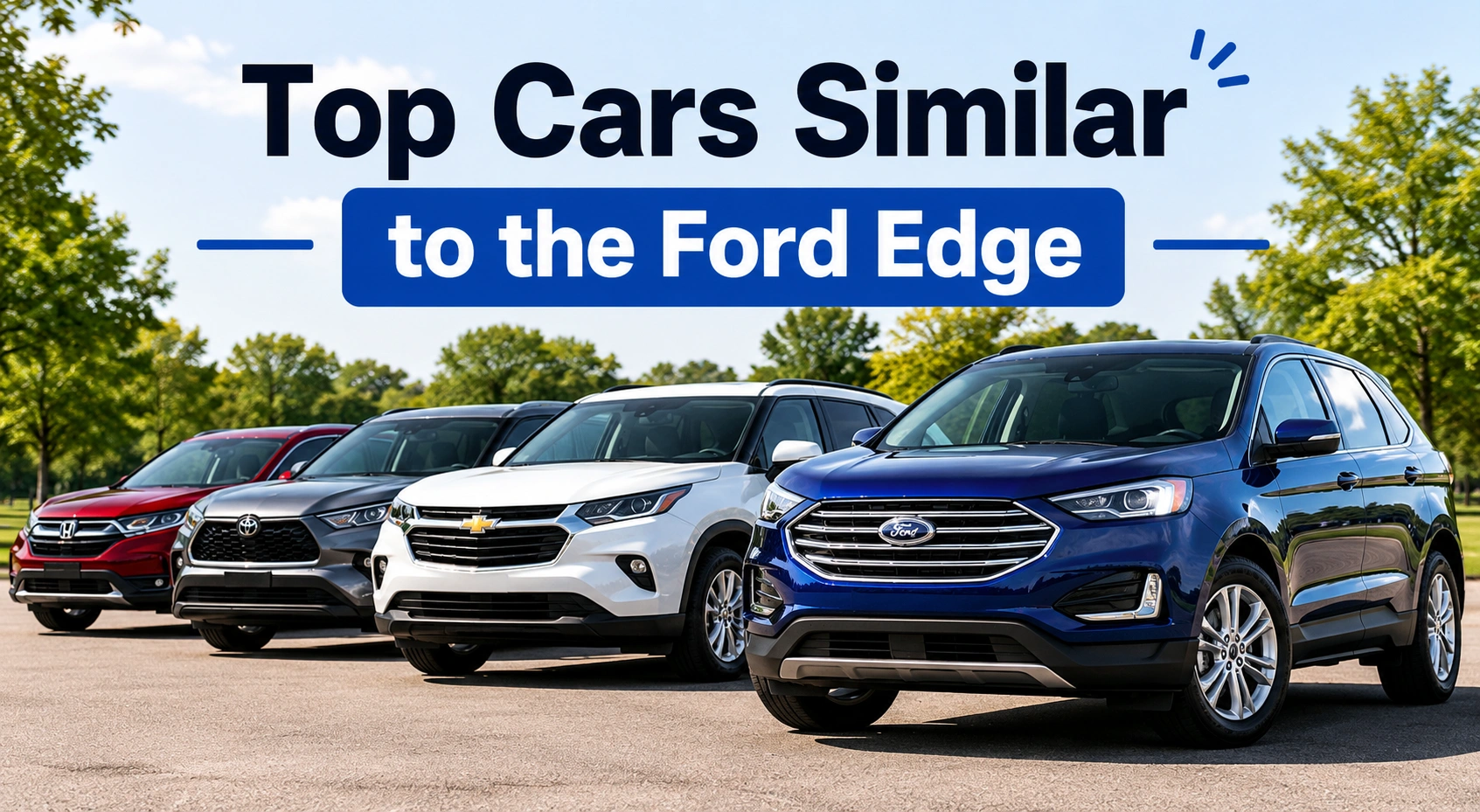
The Ford Edge was, for many buyers, the perfect SUV. Not too big. Not too small. Quiet on the highway, capable enough in bad weather, comfortable enough for long drives, and priced without the pretension of a luxury badge. It occupied that rare, underappreciated sweet spot in the American SUV market — and Ford quietly discontinued it.
So where do you go from here? The SUV segment has evolved significantly, and the good news is that the formula the Edge perfected — a two-row midsize footprint, a composed ride, a turbocharged engine, and practical cargo space — is very much alive in 2026. Several manufacturers have either refined or completely redesigned their offerings in this space, giving today’s buyer more credible options than at any point in recent memory.
This guide doesn’t just list alternatives. It digs into each vehicle’s real-world character, the ownership trade-offs that don’t show up on spec sheets, and the specific buyer profiles each model suits best. Whether you prioritize efficiency, driving refinement, cargo space, or pure value, there is a strong Edge successor here for you.
Sources & Research Note
Specifications, pricing, and expert assessments in this guide based on current data from Edmunds, Kelley Blue Book, Cars.com, TrueCar, Autoblog, Consumer Reports, Motor Trend, and official manufacturer documentation from Ford, Hyundai, Subaru, Chevrolet, Honda, Nissan, Kia, Volkswagen, and Mazda.
MSRP figures reflect manufacturer-published pricing as of May 2026 and exclude destination charges, taxes, title, and dealer fees. EPA fuel economy figures are estimates and actual results will vary. All pricing is for the U.S. market.
The Ford Edge: What We’re Replacing
2024 Ford Edge — Final Generation Snapshot
MSRP Range: $39,960 – $48,700
Engine: 2.0L Turbocharged Four-Cylinder
Horsepower: 250 hp / 279 lb-ft torque
Transmission: 8-Speed Automatic
Fuel Economy: 21 city / 28 highway (EPA est.)
Drivetrain: FWD standard; AWD available
Infotainment: SYNC 4A, large touchscreen
Seating: 5 passengers, 2 rows
The Edge’s appeal was defined less by any single standout specification and more by the sum of its competencies. It wasn’t the fastest or most luxurious or most capable, but it was very good at almost everything a daily driver needs to be. Its highway ride was composed and quiet.
Its cabin was genuinely family-sized without being truck-like. Its turbo engine offered brisk acceleration without sacrificing too much fuel economy. That balance is what we’re looking to replicate.
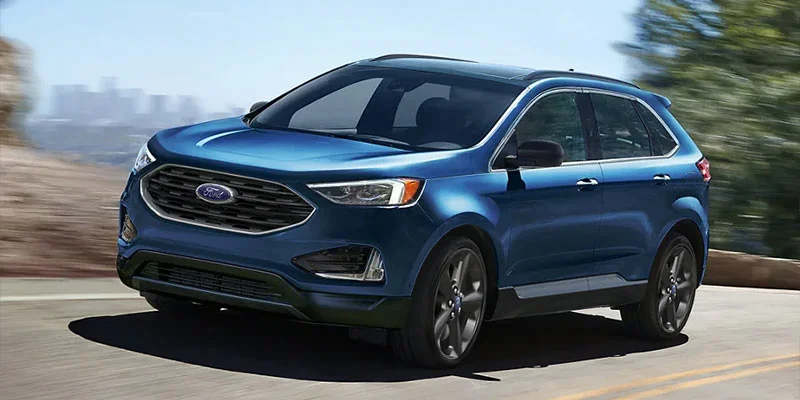
Priced at an estimated $39,960 for base trims and rising beyond $48,700 for higher-end ST-Line models, the Edge sits squarely between compact crossovers and larger three-row SUVs in both cost and practicality.
Under the hood, the 2026 Edge typically features Ford’s 2.0-liter turbocharged four-cylinder engine, producing around 250 horsepower and 279 lb-ft of torque, paired with an eight-speed automatic transmission.
All-wheel drive is available, and the SUV’s unibody construction delivers a comfortable, composed ride suited to daily driving and highway cruising.
Interior space is family-friendly, with ample headroom, legroom for five passengers, and cargo capacity that easily accommodates luggage or gear. Technology includes a large infotainment display with SYNC 4A and advanced driver aids as standard.
While not the sportiest or most luxurious in class, the 2024 Edge’s mix of comfort, technology, and usability makes it a practical choice for buyers who valued the previous generation’s blend of everyday capability and modern features.
What makes a vehicle “similar” to the Ford Edge?
To fairly compare alternatives, it helps to define what the Edge does well:
- Two-row midsize SUV footprint (larger than compact, smaller than three-row)
- Comfortable ride and quiet cabin
- Strong available turbo power
- Practical cargo space without excessive bulk
- Pricing that sits between mainstream and premium
The vehicles below match that formula closely, even if they approach it with different priorities.
What We’re Looking for in an Edge Alternative
- Two-row layout (no unused third row)
- Turbocharged engine with 240+ hp
- Composed, comfortable highway ride
- Cargo space of 40+ cu ft (rear seats up)
- MSRP starting under $55,000
- AWD availability
- Modern infotainment with wireless CarPlay
- Strong standard safety suite
The Eight Best Alternatives
1. 2026 Hyundai Santa Fe
- MSRP:$36,650–$51,000
- Engine Option: 2.5-liter inline-four engine
- Horsepower: 277-HP
- Fuel Economy: 19-20 mpg City and 26-29 mpg Highway (EPA Estimated)
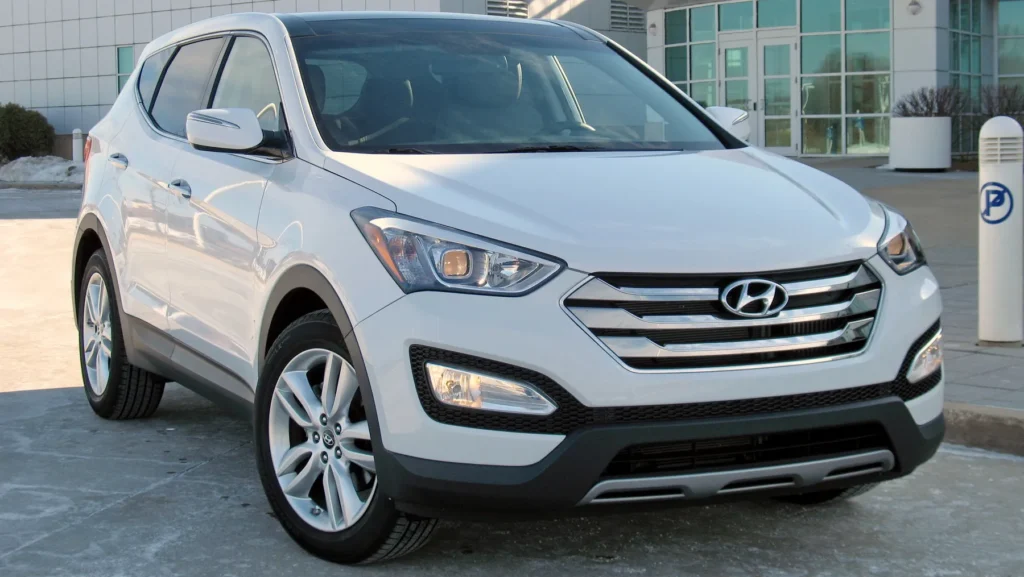
If there is one single vehicle that replicates the Edge’s role in the market most faithfully, it is the 2026 Hyundai Santa Fe. It occupies the same price tier, offers a similarly turbocharged powertrain with more horsepower than the Edge’s final generation (277 vs. 250), and delivers a comparably composed, comfort-tuned ride. For 2026, Hyundai made meaningful improvements rather than just shuffling the trim levels.
What’s New for 2026
The most significant mechanical change for 2026 is the replacement of the previous dual-clutch automatic with a conventional eight-speed automatic transmission in gas-only models. Dual-clutch transmissions are efficient but notorious for a hesitant, jerky feel at low speeds — an issue Hyundai has now largely resolved. The result is smoother stop-and-go behavior and a more relaxed driving experience around town. Hyundai has also elevated forward collision warning technology to standard across the entire trim lineup, which previously was reserved for upper trims.
Driving Character
The Santa Fe’s ride quality is its strongest selling point. The suspension is calibrated for comfort over sport, absorbing road imperfections with a composure that closely mirrors what Edge owners appreciated. It is not designed to be tossed around corners, but it handles highway lane changes and sweeping on-ramps with confidence. Steering feel is accurate but deliberately light — the kind of tuning that prioritizes ease over engagement, which suits most buyers in this segment perfectly well.
Interior & Technology
The Santa Fe’s cabin is one of the most thoughtfully designed in its class. Headroom and legroom for both rows are genuinely generous, and the seating position feels natural without requiring passengers to climb in or fold themselves down. The 12.3-inch infotainment display is standard from the SEL trim upward and responds quickly. Wireless Apple CarPlay and Android Auto are included, as is a digital instrument cluster. Standard safety technology includes adaptive cruise control, blind-spot monitoring, lane-keeping assist, and rear cross-traffic alert — a comprehensive package at base price.
Ownership Considerations
Hyundai backs the Santa Fe with a 5-year/60,000-mile basic warranty and a 10-year/100,000-mile powertrain warranty — still among the most generous coverage packages in the mainstream segment. A hybrid variant is available and delivers substantially better fuel economy for buyers willing to pay a modest premium. KBB Fair Purchase Pricing consistently shows buyers paying $950–$1,900 under MSRP, which means real-world prices are often more attractive than the sticker suggests.
Who Should Avoid It
Buyers who came to the Edge for its relatively sporty feel — particularly the ST-Line with its 335-hp V6 — will find the Santa Fe’s comfort-forward tuning underwhelming. If driving dynamics matter as much as practicality, consider the Mazda CX-70 or Chevrolet Blazer RS instead.
Strengths
- 277 hp outpunches the Edge
- Improved 8-speed auto for 2026
- Class-leading warranty coverage
- Hybrid option available
- Generous standard safety tech
- Strong resale value trajectory
Limitations
- Conservative, comfort-first handling
- Less visually distinctive exterior
- Third row on some trims adds complexity
- Base SE trim feels sparse
Verdict: The single most natural Edge replacement for the majority of buyers. Matches the Edge’s comfort, outpunches it on power and warranty, and costs slightly less to start. If you’re not sure where to begin, start here.
2. 2026 Subaru Outback
- MSRP:$36,445–$49,445
- Engine Option: 2.4-liter inline-four engine
- Horsepower: 180-HP to 260 HP
- Fuel Economy: 25 mpg City and 31 mpg Highway (EPA Estimated)
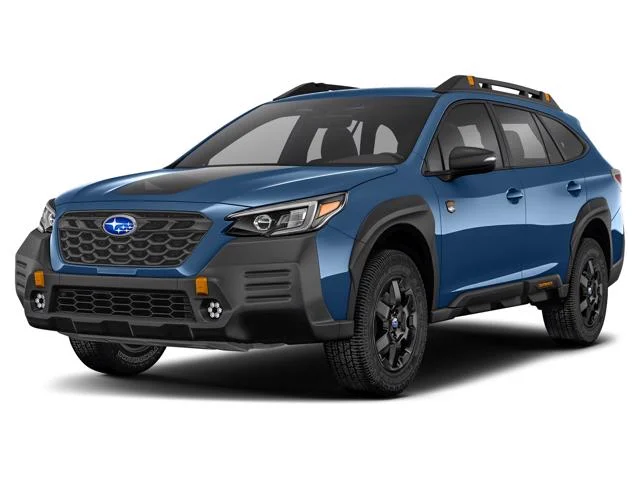
The 2026 Subaru Outback has undergone a full redesign that transforms it from an adventure-oriented station wagon into a proper midsize SUV. The silhouette is now taller, boxier, and more upright — closing the visual gap between the Outback and conventional SUVs like the Edge. The fundamentals that have always defined the Outback remain unchanged: standard symmetrical all-wheel drive at every trim level, genuine off-road capability through the Wilderness variant, and outstanding fuel economy for its class.
The Redesign in Detail
The most significant structural change is a two-inch increase in height, which translates directly into meaningfully more headroom and a more commanding seating position. Ground clearance is at least 8.7 inches across the lineup — substantially more than the Edge’s car-like stance. The wheelbase is unchanged from the outgoing generation, meaning interior dimensions are broadly comparable, but the taller roofline creates more useful cabin volume. Subaru has also reinstated physical buttons and knobs for climate controls, responding to widespread criticism of the previous generation’s touchscreen-only interface — a welcome and practical improvement.
Powertrain Options
The base engine is a 2.5-liter naturally aspirated flat-four producing 180 horsepower, paired with a CVT and standard AWD. It is adequate rather than exciting — fuel economy of 25 city / 31 highway is excellent, but the powertrain feels strained when merging onto fast-moving highways at full load. The better choice for Edge-level performance is the turbocharged 2.4-liter engine available on Limited XT, Touring XT, and Wilderness trims. At 260 horsepower with strong mid-range torque, it transforms the Outback’s on-road character, delivering quick, confident acceleration and smooth highway passing power that directly rivals what the Edge provided.
Interior & Technology
A new 12.1-inch touchscreen multimedia system is paired with a 12.3-inch fully digital instrument cluster. Owners have praised both the display’s responsiveness and the return of physical climate controls as a major quality-of-life improvement. Cargo space behind the rear seats is generous, and redesigned roof rails now support static loads up to 800 pounds — genuinely useful for roof boxes, kayaks, or ski equipment. The available EyeSight driver assistance suite includes adaptive cruise control, pre-collision braking, lane-centering, and — new for 2026 on upper trims — optional hands-free highway driving assist.
Who Should Avoid It
The CVT transmission in base models will frustrate buyers who enjoyed the Edge’s conventional 8-speed automatic. The Outback also lacks the Edge’s more premium highway refinement at the base price point — road and wind noise are somewhat more present. Buyers who prioritize a polished, whisper-quiet interior should look at the Nissan Murano or Mazda CX-70 instead.
Strengths
- Standard AWD — no extra cost
- Complete 2026 redesign adds headroom & tech
- Turbo XT engine closely matches Edge feel
- Best-in-class fuel economy (base)
- 8.7-inch ground clearance standard
- Physical climate buttons reinstated
Limitations
- Base engine feels underpowered at highway pace
- CVT on base trims lacks conventional feel
- More road noise than top-tier competitors
- Turbo trims push toward $47,000+
Verdict: Specify the turbocharged XT engine and the Outback delivers everything the Edge did, plus real all-weather confidence and more ground clearance. The base naturally-aspirated model is a different car — capable but less satisfying for highway drivers.
3. 2026 Chevrolet Blazer
- MSRP: $36,295–$48,495
- Engine Option: 2.0-liter four-cylinder and 3.6-liter V-6
- Horsepower: 228-HP to 308 HP
- Fuel Economy: 18-22 mpg City and 26-29 mpg Highway (EPA Estimated)
The Chevrolet Blazer targets buyers who loved the Ford Edge’s more spirited upper trims — particularly the Edge ST with its 335-hp twin-turbo V6. While the Blazer’s RS doesn’t quite match that output (308 hp from a naturally aspirated 3.6-liter V6), it delivers a noticeably more engaging driving experience than most comfort-oriented competitors in this segment. The Blazer’s Camaro-inspired styling gives it a visual presence that turns more heads than the Edge ever did.
The Two Powertrains
The base 2.0-liter turbocharged four-cylinder (228 hp, 258 lb-ft torque) is paired with a nine-speed automatic and available in all trims. It handles daily driving and highway cruising competently, with adequate power for merging and passing. The 3.6-liter V6 producing 308 horsepower is available on the RS and as an option on the 3LT. The difference in character is substantial: the V6 provides effortless, linear power delivery with a pleasing exhaust note, whereas the turbo four occasionally feels breathless at the top of its rev range. For buyers who came to the Edge for performance, the V6 Blazer RS is the direct target.
Driving Dynamics
The Blazer RS with its sport-tuned suspension and 21-inch wheels is genuinely more engaging to drive than any mainstream competitor on this list. Steering feedback is more communicative, body roll in corners is better controlled, and the overall driving posture invites a more active approach. The trade-off is ride comfort: the RS rides noticeably firmer than the Edge did, and on rough urban roads it can feel choppy. The 2LT and 3LT with the standard suspension offer a better balance of comfort and composure for daily use.
Interior & Practicality
Cargo space behind the rear seat is competitive at approximately 64 cubic feet with seats folded. The interior design is attractive and tech-forward, with a 10-inch touchscreen standard on the base trim and a larger display on upper trims. Wireless Apple CarPlay and Android Auto are standard. One genuine limitation is rear headroom: the Blazer’s sloping roofline reduces vertical clearance in the second row, making it uncomfortable for passengers over about 6 feet tall. Families with teenagers should account for this before buying.
What’s Unchanged for 2026
The Blazer receives no significant updates for 2026, which is notable context: it is running on an aging platform, and critics at Edmunds gave it a 5.1 out of 10 — not a glowing assessment. The lack of a hybrid option and the absence of a meaningful update cycle are legitimate concerns for buyers who prioritize long-term value retention. Real-world transaction prices are well below sticker, with buyers routinely paying 4–5% under MSRP.
Strengths
- 308 hp V6 is the most engaging engine here
- Sport-tuned RS delivers real driving pleasure
- Bold, distinctive exterior design
- Competitive starting MSRP
- Large cargo hold (64 cu ft folded)
Limitations
- Aging platform; no 2026 updates
- RS suspension too firm for daily comfort
- Rear headroom tight for tall passengers
- No hybrid option at all
- Expert reviews are mixed-to-negative
Verdict: The best pick for buyers who primarily want driving enjoyment at a mainstream price. The V6 RS is genuinely fun to drive. Less suitable for buyers who prioritize long-term reliability perception or rear passenger comfort.
4. 2026 Honda Passport
- MSRP: $46,445–$55,345
- Engine Option: 3.5-liter V-6
- Horsepower: 285-HP
- Fuel Economy: 19 mpg City and 25 mpg Highway (EPA Estimated)
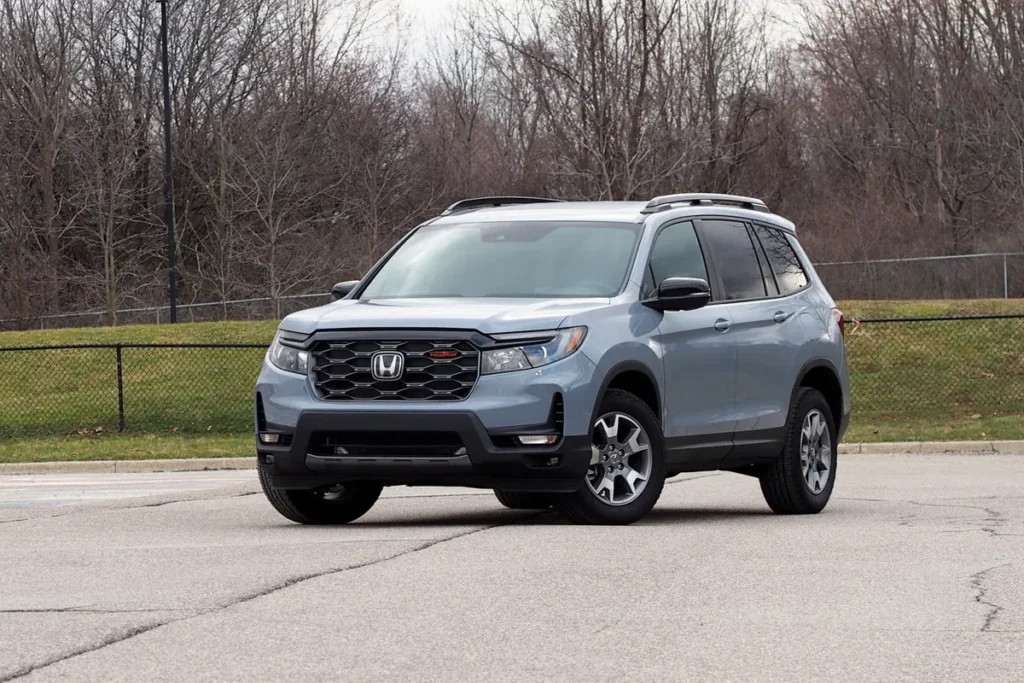
The Honda Passport has been completely redesigned for 2026 and emerges as the most practically capable Edge alternative on this list. Built on the same platform as the three-row Pilot, it now features a bolder, more upright stance, significantly more interior and cargo space than its predecessor, and a re-tuned V6 engine. AWD is standard across the entire lineup — no need to spec up or pay extra. At 5,000 pounds of towing capacity, it also leads this group for drivers who occasionally need to haul a trailer.
The Cargo Advantage
The redesigned Passport’s cargo numbers are exceptional: 44 cubic feet behind the second row and up to 83.8 cubic feet with the seats folded flat — the highest figures in this comparison and among the best in the entire midsize SUV segment. Honda has also added thoughtful storage features to the cargo area, including a removable bin below the floor for dirty gear, side pockets for smaller items, and a power liftgate with walkaway close on upper trims. For buyers who regularly haul large or awkward loads, this is a meaningful practical advantage over the Edge and most of its replacements.
Rear-Seat Space
Rear-seat legroom is a class standout at 40.9 inches — the most generous on this list — making the Passport an excellent choice for families regularly transporting adults in the second row. The rear seat bottom is long and supportive, and the angle is comfortable for extended trips. Compared to the Edge, which offered adequate but not exceptional rear accommodations, the Passport’s second row is genuinely superior.
Powertrain & Driving Feel
The 3.5-liter V6 produces 285 horsepower and pairs with a smooth 10-speed automatic transmission. Power delivery is linear and confident throughout the rev range, and the V6’s character is well-suited to the Passport’s go-anywhere persona. This is not a sporty SUV in the Blazer RS sense, but it delivers relaxed, effortless acceleration that feels well-matched to its character. Honda’s i-VTM4 torque-vectoring AWD system provides genuine capability on light trails and unpaved roads, not just wet pavement.
Interior Quality Caveats
Consumer Reports’ review of the 2026 Passport noted some interior quality concerns worth acknowledging: hard plastics throughout the cabin, unpadded rear window sills, and some rough fit-and-finish details that feel incongruous at a $46,000+ entry price. The interior is practical and functional but does not feel as premium as the price might suggest. Buyers who place high value on interior material quality should cross-shop the Mazda CX-70 carefully. Every trim does include Honda Sensing — their comprehensive suite of standard safety technology including adaptive cruise control, collision mitigation braking, and lane-keeping assist — as well as a 12.3-inch touchscreen with wireless connectivity.
Who Should Avoid It
At $46,445 to start, the Passport asks considerably more than the Edge’s base price. Buyers on tighter budgets will find the Santa Fe or Outback offer far more car per dollar. The lack of a hybrid powertrain is also a genuine disappointment for a vehicle redesigned in 2026, when competitors at similar price points offer hybrid efficiency.
Strengths
- Best-in-class cargo space (83.8 cu ft)
- Best rear legroom on this list (40.9 in)
- 5,000 lb towing capacity
- Standard AWD on all trims
- TrailSport trim for genuine off-road use
- Honda Sensing standard everywhere
Limitations
- Starts at $46,445 — priciest here
- No hybrid powertrain option
- Interior quality below price expectations
- Mediocre fuel economy for a non-hybrid
Verdict: The best option for buyers who genuinely use their SUV’s cargo space, regularly carry adults in the back seat, or need to tow. Less compelling for buyers primarily seeking comfort refinement or value — the price premium isn’t matched by interior quality.
5. 2026 Nissan Murano
- MSRP: $43,165–$51,295
- Engine Option: 2.0-liter four-cylinder
- Horsepower: 241-HP
- Fuel Economy: 21 mpg City and 27 mpg Highway (EPA Estimated)
The Nissan Murano has been completely rebuilt for the 2025–2026 generation, moving from its previous role as a comfortable but aging mainstream SUV into near-luxury territory. The redesign brings a strikingly elevated cabin — Venetian glass-inspired interior accents, dual 12.3-inch digital displays, Nissan’s famous Zero Gravity front seats — alongside a new engine, new transmission, and standard AWD across all trims. For buyers who valued the Edge’s highway comfort above all else, the Murano 2026 is arguably the most refined choice in this segment outside of a luxury brand.
The New Powertrain
Gone is the previous Murano’s 3.5-liter V6. In its place is Nissan’s VC-Turbo: a 2.0-liter turbocharged four-cylinder with variable compression ratio technology, producing 241 horsepower and 260 lb-ft of torque. This engine is paired with a new nine-speed automatic transmission and standard intelligent AWD. In everyday driving, the VC-Turbo delivers strong low-rpm torque and smooth power delivery well-suited to the Murano’s comfort character. The variable compression engineering is sophisticated, though real-world fuel economy results — 21 city / 27 highway — are not dramatically better than the V6 it replaced. Importantly, FWD is no longer available; every 2026 Murano is AWD.
Interior Excellence
The 2026 Murano’s interior is its defining strength and its primary reason for being on this list. The redesigned cabin features premium material quality that genuinely challenges vehicles costing $10,000–$15,000 more. Zero Gravity front seats — ergonomically designed to reduce driver fatigue by mimicking the seating position astronauts use during launch — are standard across all trims. Upper Platinum trims add semi-aniline leather with quilting, massage function, and ventilation. The dual 12.3-inch displays are responsive and well-integrated. For the buyer who spent most of their time in the Edge on long highway commutes, the Murano’s cabin is a meaningful upgrade.
The Towing Problem
The Murano’s single most significant limitation is its towing capacity: just 1,500 pounds. This is the lowest figure in this comparison by a substantial margin — the Honda Passport and VW Atlas Cross Sport both manage 5,000 pounds. If you ever need to tow a small trailer, a jet ski, a small boat, or a utility trailer, the Murano is functionally disqualified. This is a hard stop for a meaningful subset of buyers and worth clarifying upfront before falling in love with the interior.
Technology Highlights
New for 2026 on the Platinum trim is the availability of Nissan’s ProPilot Assist 2.1 — a hands-free highway driving mode that provides semi-autonomous steering and braking support on mapped highways. This positions the Murano’s technology suite at a genuinely competitive level against similarly priced offerings. Also new is the Invisible Hood View, which uses cameras to project a virtual view of the terrain immediately ahead of the vehicle — a useful feature on tight parking or light trail situations.
Strengths
- Near-luxury interior at mainstream price
- Zero Gravity seats reduce long-drive fatigue
- Standard AWD — no exceptions
- Hands-free highway driving (Platinum)
- Exceptionally smooth, quiet highway ride
- Premium cabin materials throughout
Limitations
- Only 1,500 lb towing capacity
- No hybrid option available
- VC-Turbo doesn’t deliver strong fuel economy
- Starts at $41,670 — premium pricing
- Cargo space below segment average
Verdict: The most comfortable and refined choice in this group for highway commuters and long-distance drivers. If you never tow anything and prioritize interior quality and ride smoothness above all, the Murano is exceptional. The towing limitation is a dealbreaker for roughly 20% of midsize SUV buyers.
6. 2026 Kia Sorento
- MSRP: $33,635–$49,035
- Engine Option:2.5-liter inline-four-cylinder
- Horsepower: 191-HP to 281-HP
- Fuel Economy: 23 mpg City and 31 mpg Highway (EPA Estimated)
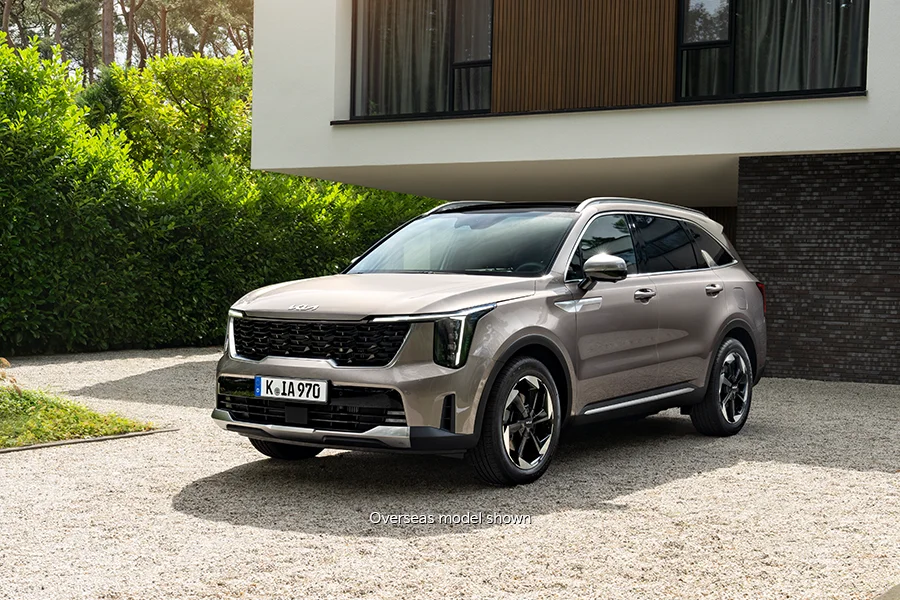
The Kia Sorento is marketed as a three-row SUV, but the practical reality is that the vast majority of Sorento owners never use the third row, treating it as a spacious two-row vehicle with exceptional value credentials. In that configuration, it makes a very compelling Ford Edge alternative — particularly for buyers who want the lowest entry price, the segment’s best warranty, or the option of a hybrid powertrain.
Powertrain Options
The Sorento’s powertrain lineup is the most diverse of any vehicle on this list. Base LX and S trims use a 2.5-liter naturally aspirated four-cylinder producing 191 horsepower — adequate but not exciting. The EX, SX, and SX Prestige get the turbocharged version of the same engine, delivering 281 hp and 312 lb-ft of torque through an eight-speed dual-clutch automatic. A hybrid variant produces 227 hp and delivers an EPA-estimated 34 mpg combined — by far the most efficient option here. A plug-in hybrid is also available. For Edge owners who appreciated a turbocharged engine, the Sorento’s 281-hp turbo delivers comparable performance to the Hyundai Santa Fe and closely rivals the Edge itself.
Interior Quality & Space
Kia has consistently elevated its interior quality over recent generations, and the current Sorento benefits from that trajectory. Materials feel appropriately premium at mid-trims, and the available 12.3-inch panoramic display integrating the infotainment and instrument cluster is one of the more visually impressive setups in this segment. With the third row folded — which takes only seconds — cargo space is flexible and practical. AWD is available on most trims and standard on upper configurations.
The Warranty Advantage
Kia’s 10-year/100,000-mile powertrain warranty (transferable to the original owner) remains the most comprehensive coverage in the mainstream segment and provides meaningful peace of mind over a typical 7–10-year ownership period. For buyers who plan to keep their vehicle long-term, this is a genuine financial advantage.
The Third-Row Trade-off
The third-row hardware adds weight, cost, and mechanical complexity to a vehicle that most buyers will never use it in. The seats themselves are genuinely uncomfortable for adults — best suited to children under 12. If you are certain you will never use a third row, the Atlas Cross Sport or Honda Passport offer a cleaner two-row package. If there is any chance you might need the occasional extra seat for children, the Sorento’s flexibility is a meaningful advantage at minimal real-world cost.
Dual-Clutch Transmission Note
The turbocharged Sorento uses a dual-clutch eight-speed automatic. As noted in the Santa Fe section, dual-clutch transmissions can exhibit hesitation and occasional clunkiness at very low speeds — particularly in stop-and-go traffic during cold weather. It is worth being aware of, though most Sorento owners report the behavior is manageable and improves after the drivetrain warms up.
Strengths
- Lowest starting price on this list
- Best-in-class warranty (10yr/100k mi)
- Hybrid and PHEV options available
- 281 hp turbo engine is genuinely quick
- Optional third row adds flexibility
- 31 mpg highway (turbo) leads this group
Limitations
- Dual-clutch can feel jerky at low speed
- Third row rarely usable for adults
- Base 191-hp engine feels underpowered
- Added third-row hardware means more to maintain
Verdict: The best choice for budget-conscious buyers who want a turbocharged engine, long-term ownership confidence, and the flexibility of an optional extra row. Specify the turbo engine — the base four-cylinder undersells everything this vehicle can be.
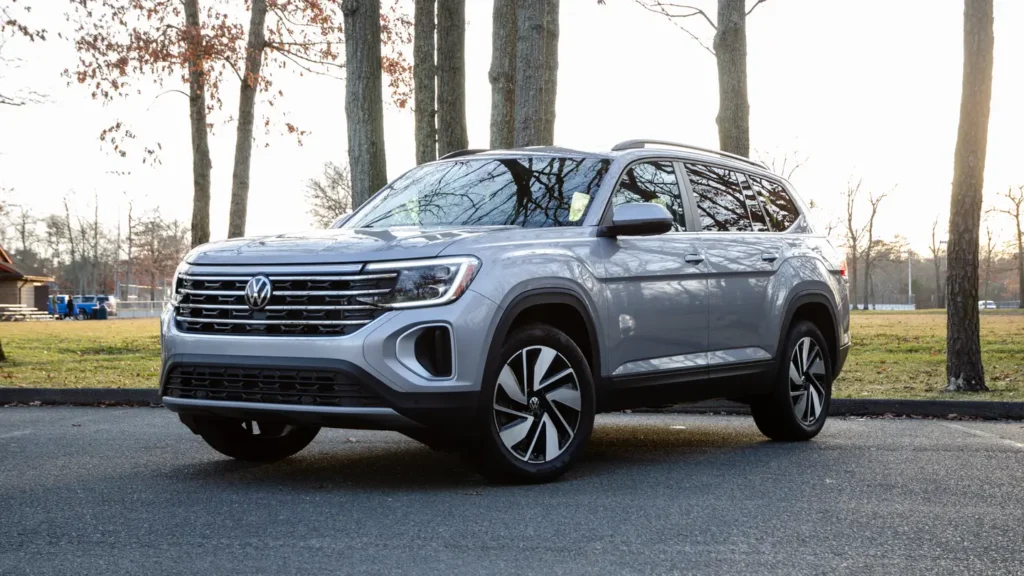
7. 2026 Volkswagen Atlas Cross Sport
- MSRP: $39,775–$55,095
- Engine Option:2.0-liter inline-four-cylinder
- Horsepower: 269-HP
- Fuel Economy: Not Released
The Volkswagen Atlas Cross Sport is what you get when you take a three-row Atlas, remove the third row, lower the roofline slightly for a sportier profile, and keep everything else largely intact. The result is a genuinely spacious, calm, and composed two-row midsize SUV that closely mirrors the Edge’s mission. If the Edge’s strongest selling points for you were interior room and highway serenity — rather than the driving dynamics or tech — the Atlas Cross Sport is the most direct structural equivalent.
The Interior Space Argument
The Atlas Cross Sport’s rear seat offers 40.4 inches of legroom — among the best in the segment and more than the Edge provided. Adults of any height can sit comfortably in the second row on long trips. Cargo space behind the second row measures 40.3 cubic feet, expanding to 77.6 cubic feet with the rear seats folded — second only to the redesigned Honda Passport on this list. The cabin’s width is particularly generous, making it feel roomier than its external dimensions might suggest. For families where rear passenger comfort is the primary concern, this is the strongest two-row option short of the Honda Passport.
Driving Character
The Atlas Cross Sport drives in a distinctly German way: stable, planted, and unhurried. The 2.0-liter TSI turbo four-cylinder delivers 269 horsepower and 273 lb-ft of torque, and it pulls smoothly through the eight-speed automatic. The overall driving experience prioritizes predictability and comfort over engagement — which suits most Edge owners who were not buying the Edge for sporty driving dynamics. Highway noise suppression is good, and the suspension absorbs most road imperfections without drama. The Cross Sport feels slightly smaller and more maneuverable than the full-length Atlas but retains most of its cabin space.
Technology: A Known Limitation
The Atlas Cross Sport’s infotainment situation is the most frequently cited criticism in expert reviews. The 12-inch touchscreen looks impressive and is generally easy to use, but VW has replaced physical buttons for audio volume, climate, and other key functions with touch-sensitive capacitive controls — the kind you have to look at rather than feel for while driving. Edmunds specifically flagged this as a distraction during driving. VW is expected to address this in the next-generation Cross Sport, but the current model asks buyers to accept a step backward in usability. Physical knobs and buttons matter for safety, and their absence here is a genuine inconvenience.
Value Positioning
The Atlas Cross Sport is holding its position for 2026 with only minor updates (a standard HomeLink garage opener added to most trims), marking time ahead of an expected redesign. KBB data shows buyers typically paying $1,375–$1,995 under MSRP. Starting at $39,775 and with strong towing capacity of 5,000 pounds, it is reasonably priced for its space and capability — though upper SEL Premium trims at $55,095 start to feel expensive given the interior material quality.
Strengths
- Best-in-class rear legroom (40.4 in)
- 77.6 cu ft cargo (second highest here)
- 5,000 lb towing capacity
- Calm, composed highway ride
- 269 hp turbo engine is right-sized
- Bucking the off-road trend — looks sleek
Limitations
- Touch-only controls are distracting to use
- Aging platform; redesign expected next year
- Interior materials lag the price
- No hybrid option available
- Average fuel economy
Verdict: Best for families who want maximum passenger space in a two-row package and can tolerate the touch-control interface. The upcoming redesign makes this a slightly risky purchase if you care about being on the current platform — but the deal pricing is compelling.
8. 2026 Mazda CX-70
- MSRP: $43,780–$58,200
- Engine Option:3.3-liter inline-six engine
- Horsepower: 280-HP to 340-P
- Fuel Economy: 23 MPG City and 28 MPG Highway
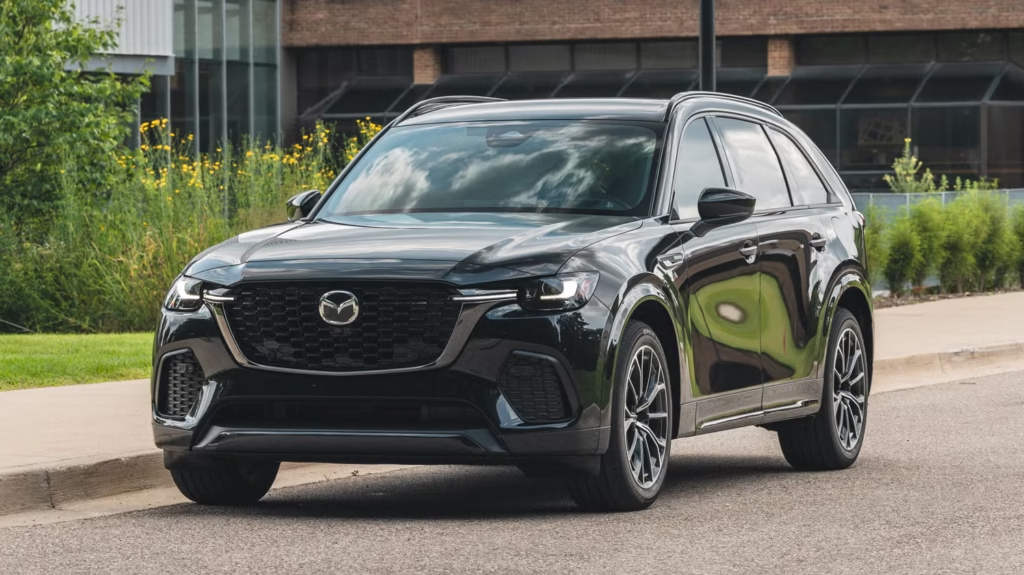
The Mazda CX-70 is the most premium vehicle on this list and the most rewarding to drive. Sharing its platform with the three-row CX-90, it trades the extra seats for more cargo room and a noticeably more engaging driving personality. If you came to the Edge’s ST-Line or ST trims for their performance and refinement, and you’re willing to spend slightly more to move upmarket, the CX-70 is the clear answer — and it delivers a driving experience competitive with vehicles from Audi and BMW costing considerably more.
The Inline-Six Advantage
Both versions of the CX-70 use a 3.3-liter turbocharged inline-six engine with a 48-volt mild-hybrid system. The standard version produces 280 horsepower and 332 lb-ft of torque; the Turbo S generates 340 horsepower and 369 lb-ft. The mild-hybrid system fills in torque at low engine speeds and sharpens throttle response without adding the weight and complexity of a full hybrid. An eight-speed automatic transmits power to all four wheels. The inline-six’s character — smooth, effortless, with a refined exhaust note — is meaningfully more premium than any four-cylinder competitor on this list. It also runs on regular unleaded (the base 3.3 Turbo), which is notable for a vehicle in this price range.
Driving Dynamics
Mazda’s handling philosophy is borrowed directly from its approach to sports cars: precise, well-damped, with steering that communicates road texture rather than filtering it out. The CX-70 corners with a composure and body control that makes its competitors feel vague by comparison. Yet it is not harsh — the suspension manages to be both sporty and comfortable, a combination that is genuinely difficult to achieve and that most mainstream competitors don’t attempt. Highway ride quality is excellent, with road and wind noise well-isolated. This is the vehicle on this list that will make a driver smile on a familiar mountain road — something the Edge, for all its virtues, rarely inspired.
Interior Quality
The CX-70’s cabin is the most genuinely premium of any vehicle here. Nappa leather upholstery, real wood or metal trim accents, soft-touch surfaces throughout the upper instrument panel, and a clean, uncluttered design aesthetic make it feel like a luxury-brand purchase without the luxury-brand price. Upper trims include a 12.3-inch touchscreen, head-up display, ventilated and heated front seats, and a premium audio system. Mazda’s commanders-style rotary interface for the infotainment can feel counterintuitive at first but is ultimately safer than touchscreen control while driving.
PHEV Option
A plug-in hybrid variant is also available starting at $44,250, using a 2.5-liter four-cylinder with a large electric motor and approximately 26 miles of electric range. This provides meaningful real-world efficiency for buyers with short daily commutes who can charge at home, though the PHEV’s driving character differs considerably from the turbocharged inline-six models and may feel less cohesive.
Who Should Avoid It
The CX-70 is the most expensive mainstream option here, with the most popular inline-six trims landing between $42,250 and $56,670. The cargo opening is somewhat narrower and lower than competitors — a genuine limitation for loading bulky items. Buyers who primarily haul large cargo will be better served by the Honda Passport. And buyers on a strict budget should be realistic: the trims where the CX-70 truly shines start around $46,000–$50,000.
Strengths
- Best driving dynamics on this list — by a margin
- Inline-six character is genuinely premium
- Interior quality competes with luxury brands
- 280–340 hp with 48V mild hybrid
- PHEV option for efficiency-focused buyers
- Refined safety system upgrades for 2026
Limitations
- Highest price point on this list
- Narrower cargo opening limits bulky loads
- Rotary infotainment has learning curve
- Turbo S requires premium fuel
- Less practical-focused than most competitors
Verdict: The best choice for buyers who want to move upmarket from the Edge — more refined, more engaging, better quality in every dimension — without entering luxury-brand pricing.
Head-to-Head Comparison
| Vehicle | Starting MSRP | Max HP | AWD | Tow Cap. | Cargo (seats up) | Best For |
| Ford Edge (Reference) | $39,960 | 335 hp (ST) | Optional | 3,500 lb | 39.2 cu ft | Balanced daily use |
| Hyundai Santa Fe | $36,650 | 277 hp | Optional | 3,500 lb | 37.0 cu ft | Best all-rounder |
| Subaru Outback | $36,445 | 260 hp | Standard | 3,500 lb | 32.5 cu ft | All-weather / outdoors |
| Chevrolet Blazer | $36,295 | 308 hp | Optional | 4,500 lb | ~30 cu ft | Performance buyers |
| Honda Passport | $46,445 | 285 hp | Standard | 5,000 lb | 44.0 cu ft | Cargo / towing |
| Nissan Murano | $41,670 | 241 hp | Standard | 1,500 lb | ~32 cu ft | Highway comfort |
| Kia Sorento | $33,635 | 281 hp | Optional | 3,500 lb | 38.0 cu ft | Value + flexibility |
| VW Atlas Cross Sport | $39,775 | 269 hp | Optional | 5,000 lb | 40.3 cu ft | Passenger space |
| Mazda CX-70 | $42,250 | 340 hp | Standard | 5,000 lb | ~33 cu ft | Premium driving feel |
Frequently Asked Questions
Is a compact SUV a reasonable Ford Edge replacement?
In most cases, no. The Edge’s appeal was rooted in its width and interior volume — it genuinely seated five adults without compromise. Most compact crossovers (CR-V, Escape, Tucson) are 4–6 inches narrower and offer noticeably less rear-seat knee room and cargo space. If you regularly carry adults in the back seat or need to load large items, moving to a compact crossover will feel like a real downgrade. The vehicles in this guide stay within the midsize category for exactly that reason.
Do I need AWD?
Only if you regularly drive in snow, on unpaved roads, or in sustained wet conditions. For buyers in the Sun Belt or mild coastal climates, front-wheel drive with a good set of all-season tires handles the overwhelming majority of real-world conditions. AWD adds roughly $1,500–$2,000 to a vehicle’s price, plus a small fuel economy penalty. If you want AWD without thinking about it, the Subaru Outback, Nissan Murano, and Honda Passport all include it as standard. If it’s optional, only pay for it if your climate or driving patterns genuinely require it.
Which vehicle on this list has the best fuel economy?
The Kia Sorento Hybrid at an EPA-estimated 34 mpg combined leads by a meaningful margin. The Subaru Outback base (180 hp) follows at 25/31, which is strong for a non-hybrid. For turbocharged non-hybrid models, the Kia Sorento turbo at 23/31 and the Hyundai Santa Fe at 20/28 are the most efficient. The Honda Passport and Chevrolet Blazer RS are the least fuel-efficient options on the list.
Which is best for towing?
The Honda Passport, Volkswagen Atlas Cross Sport, and Mazda CX-70 all offer 5,000 lb towing capacity — the practical maximum for this vehicle class without moving to a body-on-frame SUV. The Chevrolet Blazer manages 4,500 lb. Most others top out at 3,500 lb, which handles small boats, cargo trailers, and jet skis. The Nissan Murano at 1,500 lb is the clear outlier to avoid if towing is any part of your use case.
Which offers the best long-term ownership value?
The Kia Sorento and Hyundai Santa Fe stand out for their 10-year/100,000-mile powertrain warranties, which meaningfully reduce long-term ownership risk. Subaru has a strong reputation for reliability and high residual values. The Mazda CX-70’s residual values also hold well. The Chevrolet Blazer, on an aging platform with mixed expert reviews, carries more uncertainty for long-term depreciation.
What if I want to replicate the Edge ST’s performance specifically?
The Edge ST produced 335 hp from a twin-turbocharged 2.7-liter V6 — a level of performance none of the mainstream vehicles on this list fully match. The closest are the Mazda CX-70 Turbo S (340 hp) and the Chevrolet Blazer RS V6 (308 hp). If performance is your primary criterion, the CX-70 Turbo S is the more refined and capable overall package; the Blazer RS is less expensive and more track-ready in feel.
Are any of these vehicles about to be redesigned?
The Volkswagen Atlas Cross Sport is expected to receive a full redesign for the 2027 model year. Buyers who care about being on the current platform may want to either wait or accept the current model’s aging design with the knowledge that dealer discounts will likely be available. The Subaru Outback is freshly redesigned for 2026. The Honda Passport was also fully redesigned for 2026. The Nissan Murano was redesigned for 2025–2026. All other vehicles on the list are in the middle of their current generation cycles.
Making Your Decision
Replacing the Ford Edge is not about finding a perfect duplicate. The Edge’s genius was its balance — a vehicle that was genuinely good at almost everything without being exceptional at any single thing. The vehicles above approach that same balance differently, and the right choice depends on which dimension of the Edge’s character mattered most to you personally.
Best All-Rounder
Hyundai Santa Fe
Closest match to the Edge formula at a lower price
Best for Driving Enjoyment
Mazda CX-70
Most refined, most engaging, best interior quality
Best for Highway Comfort
Nissan Murano
Near-luxury interior, zero-gravity seats, smooth ride
Best for Cargo & Towing
Honda Passport
83.8 cu ft, 5,000 lb tow, standard AWD
Best Value
Kia Sorento
Lowest price, best warranty, hybrid option
Best for Performance
Chevrolet Blazer RS
308 hp V6, sport-tuned, engaging to drive
Best for Passenger Space
VW Atlas Cross Sport
40.4-inch rear legroom, widest two-row cabin
Best All-Weather Capability
Subaru Outback
Standard AWD, 8.7-inch clearance, rugged design
Whatever you choose, take the time to test-drive the turbocharged variants specifically — the base engines on the Sorento, Outback, and Santa Fe can feel like different vehicles compared to their turbocharged siblings, and the character difference matters for long-term satisfaction. The midsize SUV market in 2026 is genuinely competitive, and any of these eight vehicles will serve you well if matched to your actual priorities.