Most MDX owners never need to think about firing order — until a cylinder misfire code appears on the dashboard and suddenly it becomes the most important number in the repair process.
The Acura MDX has carried three distinct engine families across four generations and more than two decades of production, and understanding how each one fires is the foundation of every ignition-related diagnosis, spark plug service, and coil replacement job done on these vehicles.
What makes the MDX’s engine history particularly interesting is the consistency Honda maintained across platform changes: the fundamental firing sequence stayed identical across every engine variant from 2001 through to 2026.
The configuration shifted between generations, the displacement grew, a turbocharger arrived, a hybrid system came and went — yet the sequence itself never changed. That predictability matters, and this guide explains exactly why.
What Firing Order Means And Why It Matters
The Basic Mechanics Behind Ignition Sequence
A firing order is the specific sequence in which an engine’s cylinders receive their spark and complete the combustion cycle. In a V6 engine like those used across every MDX generation, six cylinders must fire in a carefully timed rotation that balances power delivery, reduces vibration, and keeps the crankshaft turning smoothly between each combustion event.
If every cylinder fired consecutively — 1, 2, 3, 4, 5, 6 — the crankshaft would receive its power pulses unevenly and the engine would run rough, vibrate excessively, and generate torsional stress. Engineers select firing sequences that alternate between cylinder banks and distribute combustion events across the crankshaft’s rotation to keep everything smooth.
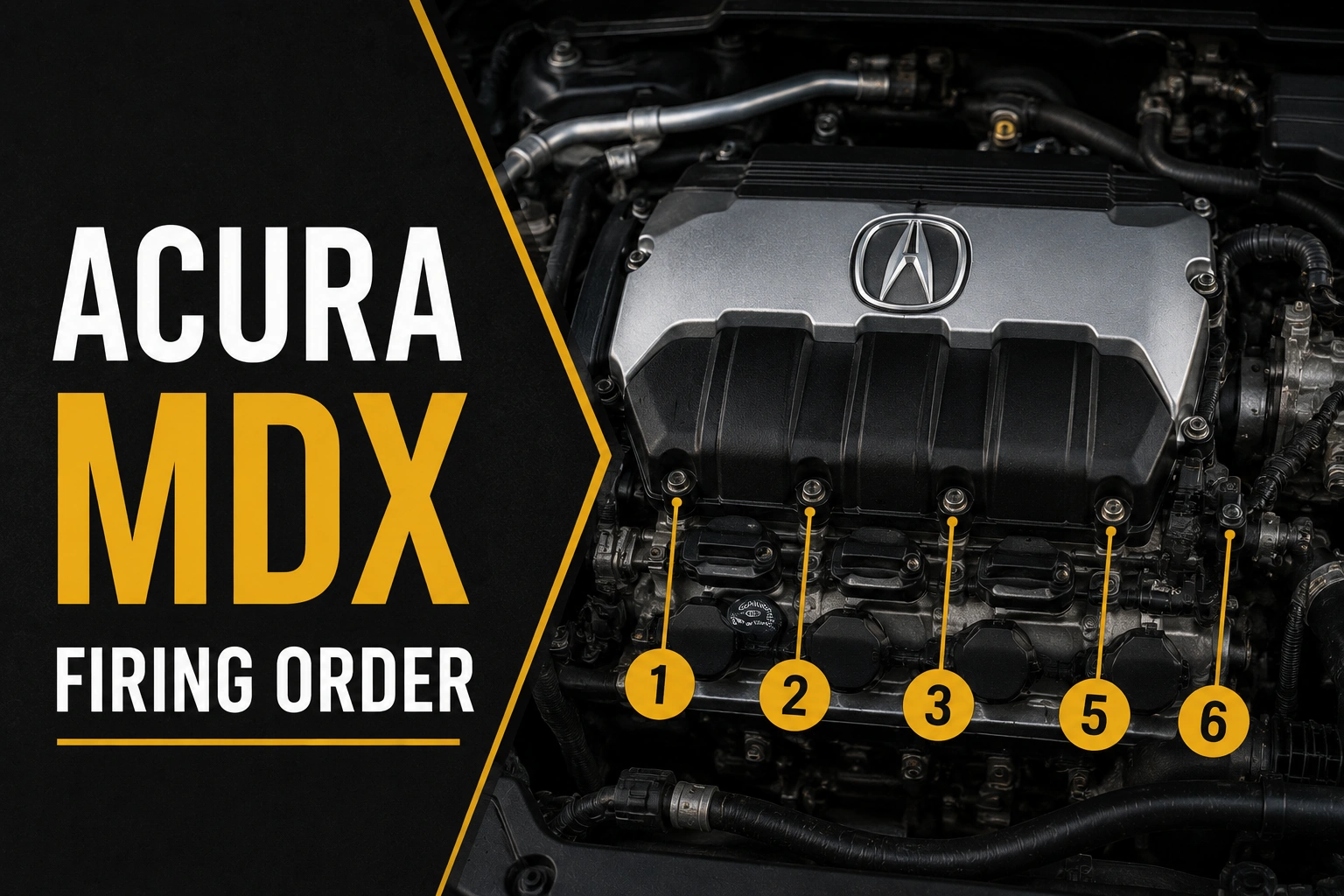
The Acura MDX uses the firing order 1-4-2-5-3-6 across every engine in every generation from 2001 to 2026. This sequence is shared across the Honda J-series V6 engine family and applies to the 3.5L J35, the 3.7L J37, the 3.0L hybrid, and the 3.0L turbocharged engine used in the current generation.
Why This Specific Sequence Works For A V6
The 1-4-2-5-3-6 pattern used in Honda’s J-series alternates firing events between the two cylinder banks rather than running three consecutive cylinders on the same bank in a row. This creates a more even distribution of combustion forces across the crankshaft’s rotation.
For a 60-degree V6 like the J-series — Honda’s J-family uses a 60-degree bank angle unlike the 90-degree V6s common in American engines — this particular sequence works well with the crankshaft journal spacing to produce even power intervals. Each cylinder fires 120 degrees of crankshaft rotation apart, which is the theoretically ideal interval for a smooth-running six-cylinder.
When a single cylinder in this chain misfires consistently, the engine’s balance breaks down immediately. That is why an OBD-II misfire code always specifies which cylinder number is affected — it tells you exactly where the chain has broken, and knowing the firing order tells you whether the misfire is isolated or potentially part of a pattern involving related cylinders in the sequence.
Acura MDX Engine History And Firing Order By Generation
First Generation MDX (2001–2006) — 3.5L J35A3 V6
- Engine Code: J35A3 (2001–2002), J35A5 (2003–2006)
- Displacement: 3.5 liters (3,471 cc)
- Configuration: SOHC, 24-valve, transverse V6
- Bank Angle: 60 degrees
- Firing Order: 1-4-2-5-3-6
- Power Output: 240 hp @ 5,300 rpm (2001–2002); 260 hp @ 5,500 rpm (2003); 265 hp @ 5,500 rpm (2004–2006)
- Torque: 245 lb-ft @ 3,000 rpm (2001–2002); 250 lb-ft @ 3,000–4,500 rpm (2004–2006)
- Bore × Stroke: 89.0 mm × 93.0 mm
- Compression Ratio: 10.0:1
- Fuel System: Sequential multiport fuel injection
- Ignition: Coil-on-plug (individual coils per cylinder)
- Timing: Belt-driven single overhead cam per bank
- Spark Plug Gap: 0.039–0.043 inches (1.0–1.1 mm)
- Original MSRP Range: $34,500–$38,000 (2001); $35,500–$39,500 (2006)
The first-generation MDX debuted in October 2000 as a 2001 model and brought a unibody crossover architecture to a market segment that still expected body-on-frame construction.
The J35A3 engine was already known from the Honda Odyssey, where it had established a reputation for smooth power delivery and reasonable fuel economy for its era.
For the MDX, Honda’s engineers modified the intake manifold with a two-stage design that used different runner lengths depending on engine speed — shorter runners for high-RPM power, longer runners for low-end torque.
VTEC (Variable Valve Timing and Lift Electronic Control) was activated after approximately 4,100 rpm, providing a noticeable increase in response in the upper half of the rev range.
Cylinder Layout — First Generation (3.5L J35A3/J35A5):
The J35A3 is mounted transversely in the engine bay, meaning the crankshaft runs side-to-side rather than front-to-back. From the perspective of standing in front of the vehicle and looking at the engine:
- Front Bank (toward the radiator): Cylinders 4, 5, 6 — numbered left to right
- Rear Bank (toward the firewall): Cylinders 1, 2, 3 — numbered left to right
The MDX forum community confirmed this layout directly: “The order goes: Rear (firewall) 1 2 3 / Front (bumper) 4 5 6.” Cylinder 1 sits at the rear bank on the left (driver’s side when viewed from the front), making it the first cylinder encountered when following the firing sequence from the starting point.
| Cylinder Number | Bank Position | Side (Viewed From Front) |
| 1 | Rear (firewall side) | Left / Driver’s side |
| 2 | Rear (firewall side) | Center |
| 3 | Rear (firewall side) | Right / Passenger’s side |
| 4 | Front (radiator side) | Left / Driver’s side |
| 5 | Front (radiator side) | Center |
| 6 | Front (radiator side) | Right / Passenger’s side |
Firing Sequence Breakdown: 1 → 4 → 2 → 5 → 3 → 6 → back to 1
This means the engine alternates between the rear bank and the front bank in every firing event: rear left → front left → rear center → front center → rear right → front right. The symmetry of this pattern is intentional — it distributes combustion across both banks evenly and eliminates the possibility of two adjacent cylinders on the same bank firing consecutively.
Practical Application For First-Gen Owners:
The J35A3 and J35A5 engines are now over 20 years old in many service examples, and the most common ignition-related issues involve individual coil-on-plug failures and carbon-fouled spark plugs.
When an OBD-II scanner returns a P0301 through P0306 misfire code, the cylinder number directly matches the layout above. A P0304 code means cylinder 4 — front bank, driver’s side — which is the cylinder that fires second in the sequence after cylinder 1.
Valve clearance is the other critical maintenance item on these engines. Honda specified adjustment intervals of 30,000 miles, and tight valve clearances cause symptoms that mimic ignition misfires, including rough idle and hesitation.
Many first-gen MDX owners who received misfire codes found that a valve adjustment resolved the issue completely without any coil or plug replacement.
Second Generation MDX (2007–2013) — 3.7L J37A1 V6
- Engine Code: J37A1
- Displacement: 3.7 liters (3,664 cc)
- Configuration: SOHC, 24-valve, transverse V6
- Bank Angle: 60 degrees
- Firing Order: 1-4-2-5-3-6
- Power Output: 300 hp @ 6,000 rpm (2007–2009); 300 hp @ 6,000 rpm (2010–2013)
- Torque: 270 lb-ft @ 5,000 rpm (2007–2013)
- Bore × Stroke: 89.0 mm × 98.0 mm (stroke increased from first-gen)
- Compression Ratio: 11.0:1 (some trim levels 11.2:1)
- Engine Block: Die-cast aluminum with aluminum cylinder liners (changed from cast iron)
- Fuel System: Sequential multiport fuel injection with drive-by-wire throttle
- Timing: Belt-driven SOHC per bank
- Spark Plug Gap: 0.039–0.043 inches (1.0–1.1 mm)
- Original MSRP Range: $41,965 (base 2007) to $53,095 (Advance with entertainment 2013)
The second generation brought the most significant engine change in MDX history. Honda replaced the J35A5 with the larger J37A1, primarily to close the power gap against competitors — the second-gen MDX arrived with 300 horsepower and 270 lb-ft of torque, substantially above its predecessor.
Bore remained identical to the J35 at 89mm, but stroke grew from 93mm to 98mm, which is where the additional displacement came from.
The switch from cast-iron cylinder liners to aluminum liners made the J37 lighter than its predecessor despite the larger displacement. Honda compensated for aluminum’s lower wear resistance by using a Nikasil-equivalent plating process on the cylinder walls.
This change reduced engine mass but also means that cylinder bore repairs require specialized equipment — unlike cast-iron liners, aluminum-lined bores cannot simply be bored oversize and fitted with conventional pistons.
Cylinder Layout — Second Generation (3.7L J37A1):
The J37A1 is also mounted transversely and shares the same cylinder bank layout as the J35. The numbering convention is identical:
- Front Bank (toward radiator): Cylinders 4, 5, 6 — left to right
- Rear Bank (toward firewall): Cylinders 1, 2, 3 — left to right
| Cylinder | Bank | Location |
| 1 | Rear | Far left (driver’s side) |
| 2 | Rear | Center |
| 3 | Rear | Far right |
| 4 | Front | Far left (driver’s side) |
| 5 | Front | Center |
| 6 | Front | Far right |
Firing Order: 1 → 4 → 2 → 5 → 3 → 6
Second-Gen Specific Notes:
The J37A1 introduced Variable Cylinder Management (VCM) on certain MDX models. VCM deactivates three cylinders under light load conditions — specifically cylinders 1, 3, and 5 or cylinders 1, 3, and 4 depending on operating conditions — to improve fuel economy.
When the system deactivates cylinders, the intake and exhaust valves on those cylinders are held shut and fuel injection is suspended.
This is directly relevant to firing order diagnosis because VCM can sometimes be misinterpreted as a misfire when the system is transitioning between modes. A rough transition between three-cylinder and six-cylinder operation is a known characteristic rather than a fault, but it can generate P0300 (random misfire) codes if the VCM solenoids are sticking or the rocker arm oil control valves are not functioning cleanly.
Knowing that VCM selectively disables specific cylinders helps narrow down whether a misfire code is a genuine ignition fault or a VCM transition symptom.
The J37A1’s oil consumption is a documented concern on second-gen MDX models, particularly between 80,000 and 150,000 miles. Low oil accelerates wear on the VCM-related components and can cause erratic cylinder deactivation, which in turn can cause intermittent misfire codes. Regular oil checks between service intervals are especially important on these engines.
Third Generation MDX (2014–2020) — 3.5L J35Y5 And 3.0L Hybrid
- Petrol Engine Code: J35Y5 (2014–2020)
- Hybrid Engine Code: J30A5 with two-motor hybrid system (Sport Hybrid SH-AWD)
- Petrol Displacement: 3.5 liters
- Hybrid Petrol Displacement: 3.0 liters
- Firing Order (Both Engines): 1-4-2-5-3-6
- Petrol Power: 290 hp @ 6,200 rpm; 267 lb-ft @ 4,500 rpm
- Hybrid Combined Power: 321 hp (petrol engine + dual rear motors combined)
- Petrol Fuel Economy: 18 city / 26 highway (AWD)
- Hybrid Fuel Economy: 26 city / 27 highway (SH-AWD)
- Petrol Transmission: 9-speed automatic
- Hybrid Transmission: 7-speed dual-clutch
- Original MSRP Range: $42,765 (base 2014) to $63,890 (Sport Hybrid Advance 2020)
The third generation brought two important changes to the MDX engine lineup: the Sport Hybrid SH-AWD system with a 3.0L naturally aspirated V6 and three electric motors, and an updated version of the familiar 3.5L J-series for the non-hybrid models.
J35Y5 Cylinder Layout (Third-Gen Non-Hybrid):
The J35Y5 returns to the same transverse layout established in the first generation and preserved in the second, with identical bank positions:
- Rear Bank (firewall): Cylinders 1, 2, 3
- Front Bank (radiator): Cylinders 4, 5, 6
Sport Hybrid 3.0L Cylinder Layout:
The 3.0L hybrid uses the same 1-4-2-5-3-6 firing order, and its cylinder numbering follows the same transverse convention. The left-side bank (driver’s side when viewed from the front) houses cylinders 1, 2, and 3 running front to rear.
The right-side bank houses cylinders 4, 5, and 6, also running front to rear. The hybrid system’s electric motors are mounted at the rear axle and do not alter the combustion engine’s firing sequence in any way.
| Engine | Firing Order | Bank 1 (Cylinders 1-3) | Bank 2 (Cylinders 4-6) |
| J35Y5 (3.5L) | 1-4-2-5-3-6 | Rear bank / firewall side | Front bank / radiator side |
| Hybrid 3.0L | 1-4-2-5-3-6 | Left side bank (front to rear) | Right side bank (front to rear) |
An important distinction for hybrid owners: the 3.0L V6 in the Sport Hybrid system starts and stops frequently as the system manages power between the combustion engine and the electric motors.
Cold-start misfires are more likely on hybrid MDX engines simply because the engine cycles on and off more often than in conventional vehicles.
If P030X codes appear specifically during cold starts or immediately after the engine reactivates from auto-stop, carbon buildup on intake valves (a direct result of the stop-start cycling) is a likely contributing factor rather than a coil or plug failure.
Fourth Generation MDX (2022–2026) — 3.5L J35Y8 And 3.0L Turbocharged
- Standard Engine Code: J35Y8
- Type S Engine Code: C30A turbo (Honda’s in-house developed twin-scroll turbo V6)
- Standard Displacement: 3.5 liters
- Type S Displacement: 3.0 liters turbocharged
- Firing Order (Both): 1-4-2-5-3-6
- Standard Power: 290 hp @ 6,200 rpm; 267 lb-ft @ 4,500 rpm
- Type S Power: 355 hp @ 6,500 rpm; 354 lb-ft @ 4,500 rpm
- Type S 0–60 mph: 4.7 seconds
- Standard Transmission: 10-speed automatic
- Type S Transmission: 10-speed automatic with wider gear ratios
- Fuel Economy (Standard AWD): 18 city / 26 highway / 21 combined
- Fuel Economy (Type S AWD): 17 city / 24 highway / 20 combined
- Original MSRP Range (2022): $47,200 (base) to $72,300 (Type S Advance)
- 2026 MSRP Range: $48,000 (base) to $74,950 (Type S Advance)
The fourth-generation MDX represents the most significant platform change in the nameplate’s history. Built on an entirely new rear-wheel-drive-biased platform (shared with the TLX), the fourth-gen shifted the MDX’s character toward a more rear-biased setup rather than the front-biased architecture of previous generations.
The Type S model introduces the C30A twin-scroll turbocharged 3.0L V6 — the first forced-induction engine in MDX history. This engine is a purpose-built performance unit rather than an adaptation of an existing naturally aspirated engine. Despite the turbocharger and the 355 hp output, the firing sequence remains 1-4-2-5-3-6.
Fourth-Gen Cylinder Layout — J35Y8 (Standard):
The J35Y8 continues the transverse mounting from all previous MDX generations, with the same bank assignments:
- Rear Bank (firewall): Cylinders 1, 2, 3
- Front Bank (radiator): Cylinders 4, 5, 6
Fourth-Gen Cylinder Layout — C30A Turbo (Type S):
The Type S engine uses a different cylinder bank orientation from the naturally aspirated engines. Because the C30A uses direct fuel injection and a twin-scroll turbocharger feeding from both exhaust manifolds, the cylinder configuration is described differently in the service manual — but the ignition firing order remains 1-4-2-5-3-6.
The C30A’s cylinder 1 is on the left bank (driver’s side in the engine bay), with cylinders 2 and 3 following rearward on the same bank. Cylinders 4, 5, and 6 occupy the right bank in the same front-to-rear numbering order.
| Generation | Years | Engine | Firing Order | Spark Plug Type |
| 1st Gen | 2001–2006 | J35A3 / J35A5 | 1-4-2-5-3-6 | NGK IFR5E11 or equivalent iridium |
| 2nd Gen | 2007–2013 | J37A1 | 1-4-2-5-3-6 | NGK IZFR6K13 iridium |
| 3rd Gen | 2014–2020 | J35Y5 / 3.0L Hybrid | 1-4-2-5-3-6 | NGK iridium (same family) |
| 4th Gen | 2022–2026 | J35Y8 / C30A Turbo | 1-4-2-5-3-6 | OEM iridium long-life |
How To Use The Firing Order For Real-World Diagnostics
Reading Misfire Codes And Tracing The Source
When an OBD-II scanner returns a misfire code on any MDX generation, the cylinder number in the fault code maps directly to the cylinder layout described above. P0301 is cylinder 1, P0302 is cylinder 2, through P0306 for cylinder 6.
A P0300 code indicates a random or multiple-cylinder misfire, which is typically a fuel delivery, compression, or VCM system issue rather than an isolated ignition fault.
For single-cylinder misfires, the standard diagnostic process follows the firing sequence backward: if cylinder 4 is misfiring (P0304), the mechanic swaps the coil from cylinder 4 to an adjacent cylinder and clears the code.
If the misfire moves to the new cylinder’s number, the coil is confirmed as the fault. If the misfire stays on cylinder 4, the spark plug or the injector is the next item to investigate.
Checking Spark Plugs In Firing Order
When changing spark plugs as part of a scheduled service, some technicians prefer to remove, inspect, and reinstall plugs in the firing order sequence (1, 4, 2, 5, 3, 6) rather than by bank (all rear bank first, then all front bank).
This approach allows a quick comparison of plug condition across the firing sequence — if alternating plugs in the sequence show similar wear while the others differ, it can point toward a VCM-related cylinder group behaving differently from its pair in the firing rotation.
Coil Replacement Strategy On MDX Engines
All four MDX generations use coil-on-plug ignition with individual coils per cylinder. On first and second generation models especially, coil failures tend to cluster rather than occur in complete isolation — when one coil develops a high-resistance failure, the increased load on the ignition system can accelerate wear on adjacent coils.
Many experienced MDX owners and independent mechanics recommend replacing coils in pairs aligned with the firing sequence: if coil 1 fails, coil 4 (the next in sequence to fire) is the most likely candidate for a similar failure in the near term.
Engine Specs Summary Across All MDX Generations
| Spec | 1st Gen (2001–2006) | 2nd Gen (2007–2013) | 3rd Gen (2014–2020) | 4th Gen (2022–2026) |
| Engine | J35A3/J35A5 | J37A1 | J35Y5 / 3.0L Hybrid | J35Y8 / C30A Turbo |
| Displacement | 3.5L | 3.7L | 3.5L / 3.0L | 3.5L / 3.0L Turbo |
| Firing Order | 1-4-2-5-3-6 | 1-4-2-5-3-6 | 1-4-2-5-3-6 | 1-4-2-5-3-6 |
| Power (base) | 240–265 hp | 300 hp | 290 hp | 290 hp |
| Power (top) | 265 hp | 300 hp | 321 hp (hybrid) | 355 hp (Type S) |
| Torque (base) | 245–250 lb-ft | 270 lb-ft | 267 lb-ft | 267 lb-ft |
| Compression | 10.0:1 | 11.0:1 | 10.5:1 | 11.5:1 (Type S) |
| Cylinder Bank 1 | Rear (firewall) | Rear (firewall) | Left side | Rear / Left |
| Cylinder Bank 2 | Front (radiator) | Front (radiator) | Right side | Front / Right |
| MSRP Start | $34,500 | $41,965 | $42,765 | $47,200 |
FAQs
What is the firing order for the Acura MDX?
The firing order for every Acura MDX from 2001 to 2026 is 1-4-2-5-3-6. This applies to all engine variants: the 3.5L J35A3 and J35A5 (first generation), the 3.7L J37A1 (second generation), the 3.5L J35Y5 and 3.0L hybrid engine (third generation), and the 3.5L J35Y8 and 3.0L turbocharged C30A (fourth generation and current Type S). The firing sequence is a consistent feature of Honda’s J-series V6 engine family.
Where is cylinder 1 on the Acura MDX?
On the first and second generation MDX with the J35 and J37 transversely mounted V6 engines, cylinder 1 is located on the rear bank (the side closest to the firewall) on the driver’s left side when viewed from the front of the vehicle. On third and fourth generation MDX models, cylinder 1 is on the left-side bank (again, driver’s side when viewed from the front), at the front of that bank. In both cases, cylinders 1, 2, and 3 share one bank and cylinders 4, 5, and 6 share the opposite bank.
What engine does the Acura MDX use?
The MDX has used four main engine variants across its production history. The first generation (2001–2006) used the 3.5L J35A3 and J35A5. The second generation (2007–2013) used the larger 3.7L J37A1, which was the most powerful naturally aspirated engine in the MDX lineup until the Type S arrived. The third generation (2014–2020) offered a revised 3.5L J35Y5 and an optional Sport Hybrid system with a 3.0L V6 and three electric motors. The fourth generation (2022–2026) uses a 3.5L J35Y8 for standard models and a twin-scroll turbocharged 3.0L C30A engine for the Type S variant, producing 355 horsepower.
What causes a misfire on the Acura MDX?
The most common causes of misfire codes on any MDX generation are failed or weakened ignition coils, worn spark plugs past their service interval, tight valve clearances (especially on first-generation J35 engines with over 80,000 miles), carbon buildup on intake valves (particularly on third-generation engines with direct injection or the stop-start hybrid system), and VCM solenoid or rocker arm oil control valve issues on second-generation J37A1 engines with Variable Cylinder Management. A correct diagnosis always starts with reading the specific cylinder number from the OBD-II fault code and cross-referencing it with the cylinder layout.
Is the firing order the same for the MDX Type S?
Yes. The Acura MDX Type S uses the 3.0L twin-scroll turbocharged C30A engine, and its firing order is 1-4-2-5-3-6 — identical to every other engine ever fitted to an MDX. The turbocharger changes the induction system and increases power substantially, but it has no effect on the ignition firing sequence, which is determined by crankshaft geometry and camshaft timing.
How often should spark plugs be replaced on the Acura MDX?
Acura specifies iridium spark plug replacement at approximately 100,000-mile intervals on most MDX generations, though this assumes the engine has been maintained correctly and operating conditions have been normal. On older first-generation MDX models running the J35A3 or J35A5, it is worth inspecting plugs at 60,000 miles given the engine’s age. On high-mileage second-generation J37A1 engines with oil consumption issues, plug fouling can occur well before the 100,000-mile interval, particularly on cylinders that experience oil entry through worn valve seals.
What is the spark plug gap for the Acura MDX?
The spark plug gap for first and second generation MDX engines (J35A3, J35A5, J37A1) is 0.039 to 0.043 inches, or approximately 1.0 to 1.1 millimeters. For third and fourth generation models using iridium long-life plugs, the gap is pre-set by the manufacturer and should not be adjusted. Iridium and platinum electrode plugs have fine wire electrodes that are brittle and can crack if gapped by conventional methods. Always install OEM or OEM-equivalent iridium plugs on MDX engines without adjusting the gap.
Does the firing order change with Variable Cylinder Management on the second-gen MDX?
No. Variable Cylinder Management on the J37A1 deactivates specific cylinders under light load by holding their intake and exhaust valves closed and suspending fuel injection, but it does not change the firing order of the cylinders that remain active. The cylinders that continue firing do so in the same 1-4-2-5-3-6 sequence, simply skipping the deactivated cylinders’ combustion events. When the engine returns to full six-cylinder operation, all cylinders resume their normal positions in the sequence.
Why does the Acura MDX use 1-4-2-5-3-6 instead of a different firing order?
The 1-4-2-5-3-6 sequence is Honda’s standard firing order for its J-series 60-degree V6 engine family because it distributes combustion events evenly across both cylinder banks and produces 120-degree intervals between each firing event on a six-cylinder crankshaft. This eliminates the vibration that would result from consecutive cylinders on the same bank firing back-to-back, and it works particularly well with the J-series engine’s 60-degree bank angle and crankshaft journal arrangement to minimize first-order and second-order vibration throughout the engine’s operating range.