The GMC Acadia is one of those vehicles that quietly changed shape and character across its three generations without most owners noticing just how much the engineering underneath them shifted.
What started in 2007 as a full-size crossover built on the Lambda platform with a single 3.6-liter V6 has evolved into a completely different machine — one that now relies on a turbocharged four-cylinder that produces more power than the V6 it replaced.
That evolution matters for every owner who needs to touch the ignition system, diagnose a misfire, or simply understand how their specific engine fires. The firing order, the cylinder layout, and the ignition hardware are all different depending on which generation and which engine you have.
Getting that detail wrong leads to misfire codes, rough idle, and diagnostic sessions that chase the wrong problem entirely. This guide covers every engine the Acadia has used from 2007 through 2026 with full precision.
The Engineering Foundation: Why The Acadia’s Firing Orders Changed So Dramatically Across Generations
Most owners who have spent time with more than one Acadia generation are surprised to learn that no single firing order or cylinder layout applies across all model years.
The three-generation span from 2007 through 2026 introduced three fundamentally different engine configurations: a transversely mounted V6, naturally aspirated inline-four cylinders in two different displacements, a turbocharged inline-four, and a turbocharged 2.0L inline-four. Each engine type has a different architecture, and that architecture determines the firing sequence.
The confusion starts with the V6’s unusual cylinder orientation. Unlike rear-wheel-drive V6 engines where the two cylinder banks run front-to-back, the Acadia’s transversely mounted 3.6L sits sideways in the engine bay.
The two banks run front-to-rear relative to the vehicle but left-to-right from the perspective of someone standing in front of the engine. This flips conventional descriptions of which cylinders are on which “side,” and it is exactly the source of most cylinder identification errors on first-generation Acadia repairs.
The inline-four engines of the second and third generation are mechanically simpler to picture — a straight row of four cylinders from one end to the other — but they introduced a different firing sequence that has no relation to the V6 firing order. A mechanic who memorized the 3.6L sequence for a 2012 Acadia and then works on a 2018 model with the 2.5L four-cylinder is working with completely different information.
Why Transverse V6 Cylinder Identification Trips Up Even Experienced Mechanics
On a rear-wheel-drive vehicle, the driver’s side and passenger’s side are fixed reference points that align with everyone’s intuition. On a front-wheel-drive or AWD crossover with a transversely mounted V6, those reference points become confusing because the engine’s two cylinder banks now run front-to-back within the vehicle — not side to side.
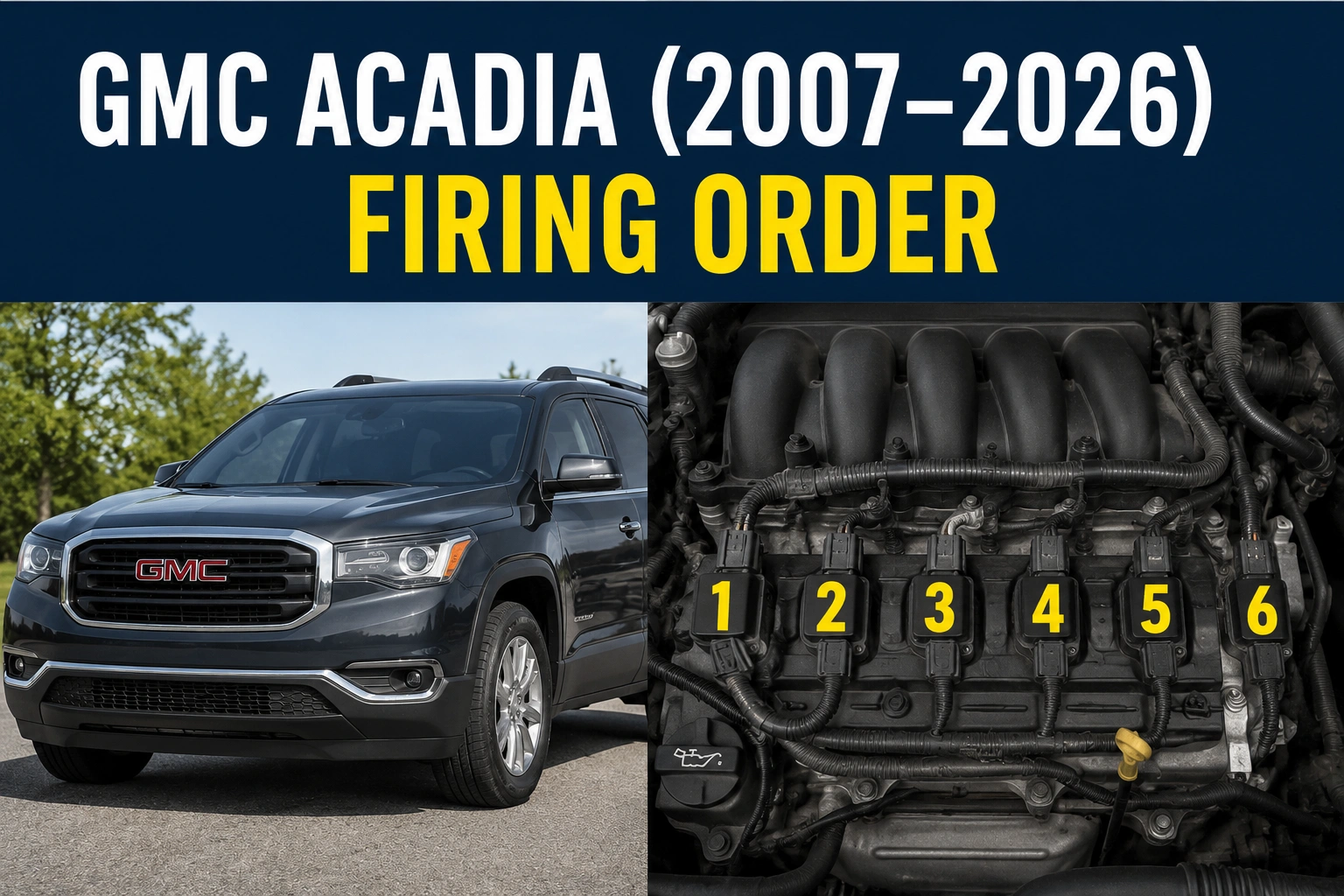
On the 2009 GMC Acadia 3.6L engine, looking at the engine from left to right, the front three cylinders are 2, 4, 6, and the back three cylinders are 1, 3, 5. That description from the engine’s service documentation is accurate but initially counterintuitive — cylinder 1 is in the rear bank, not the front.
The reason this matters practically: when a technician receives a P0303 code indicating a cylinder 3 misfire, they need to know exactly where cylinder 3 is before touching anything. On the Acadia’s 3.6L, cylinder 3 is in the rear bank — behind the engine, close to the firewall — not in the front row that is easy to access from above. Misidentifying this location sends the technician to the wrong coil pack and delays the actual repair.
First Generation Acadia (2007–2016): The 3.6L V6 In Three Versions
The first-generation GMC Acadia shared the GM Lambda platform with the Saturn Outlook, the Chevrolet Traverse, and the Buick Enclave. The Acadia went on sale in 2006 as a 2007 model in the United States, Canada and Mexico.
Every first-generation Acadia sold in North America used a variation of the 3.6-liter V6. The engine went through three distinct iterations across the ten model years of this generation, each with improved output and updated internal hardware, but the same firing sequence throughout all three versions.
3.6L LY7 V6 — 2007 Through 2008
The LY7 was the launch engine for the Acadia. It was derived from the same GM High Feature V6 family that debuted in the Cadillac CTS, making its appearance in a family crossover a significant technology transfer downmarket.
- Firing Order: 1-2-3-4-5-6
- Engine Architecture: Transversely mounted DOHC V6, 60-degree bank angle
- Displacement: 3.6L (217 cubic inches)
- Output: 275 hp / 251 lb-ft torque
- Ignition System: Coil-on-plug, individual coils per cylinder — no distributor
- Valvetrain: Dual overhead camshafts with Variable Valve Timing (VVT) on intake cams only
- Timing: Chain-driven — no belt service required
- Cylinder 1 Location: Rear bank, driver’s side (left from driver’s perspective, closest to firewall)
- Rear bank cylinders (driver’s side of vehicle, from driver’s left to right): 1, 3, 5
- Front bank cylinders (passenger’s side of vehicle, from driver’s left to right): 2, 4, 6
- Spark Plug: ACDelco 41-103 (iridium)
- Spark Plug Gap: Factory pre-gapped (do not adjust iridium plugs)
- Spark Plug Torque: 13 lb-ft
The LY7 used Variable Valve Timing exclusively on the intake camshafts. This generation did not yet have dual-sided VVT, which limits how aggressively the ECM can optimize combustion across the RPM range compared to later versions. Despite this, the engine established the Acadia’s reputation for smooth V6 power and demonstrated that the firing sequence 1-2-3-4-5-6 was well-suited to the Lambda platform’s noise and vibration targets.
The LY7 uses a coil-on-plug ignition arrangement, meaning each cylinder has its own dedicated ignition coil mounted directly on its spark plug. The ECM fires each coil according to the 1-2-3-4-5-6 sequence with no physical wiring between cylinders that could be misrouted. Misfire diagnosis on this engine is clean: an OBD-II code identifies the specific cylinder number, and the coil swap test (moving the coil from the suspect cylinder to a confirmed-good cylinder and checking whether the misfire code moves with it) confirms or rules out coil failure in minutes.
3.6L LLT V6 — 2009 Through 2012
The 2009 model year engine was the direct injected LLT, producing 288 hp and 270 lb-ft of torque. The LLT represented a meaningful internal upgrade while preserving the same external firing characteristics.
- Firing Order: 1-2-3-4-5-6 — unchanged from LY7
- Key Change From LY7: Added Gasoline Direct Injection (GDI) replacing port injection
- VVT: Dual-sided — both intake and exhaust cam phasing now variable
- Output: 288 hp / 270 lb-ft torque
- Ignition System: Coil-on-plug (unchanged layout)
- Cylinder Layout: Identical to LY7 — rear bank = 1, 3, 5 / front bank = 2, 4, 6
The switch from port injection (LY7) to direct injection (LLT) is the most significant engineering change between these two versions, and it introduces a long-term maintenance consideration that the LY7 did not carry: intake valve carbon deposits.
In port-injected engines, fuel spray washes the backs of the intake valves on every intake stroke, keeping them clean. Direct injection bypasses the valves entirely, delivering fuel directly into the combustion chamber. Oil vapors from the PCV system still coat the intake valve backs, but without fuel washing them, those deposits accumulate over time. On the LLT, meaningful carbon buildup on intake valves typically begins around 60,000 to 80,000 miles. The deposits disrupt airflow into the combustion chamber, reducing combustion efficiency and eventually causing misfire-like symptoms even when the ignition system is functioning correctly.
The established fix is walnut shell blasting — a procedure where crushed walnut shells are blasted through the intake ports with the valves closed, removing carbon without damaging the valve material. This procedure is performed with the intake manifold removed and typically costs $300 to $600 depending on labor rates. It does not affect the firing order or the ignition components but is the most consequential preventive maintenance item on higher-mileage LLT engines.
3.6L LFX V6 — 2013 Through 2016 (and 2016 Limited)
The LFX replaced the LLT across most of GM’s V6 lineup and brought meaningful improvements to both performance and efficiency for the final years of first-generation Acadia production.
- Firing Order: 1-2-3-4-5-6 — consistent across all first-gen V6 versions
- Output: 288 hp standard; The 2016 Acadia Limited has a 3.6L V6 engine producing 310 hp and 271 lb-ft of torque
- VVT: Dual-sided VVT retained and refined
- Compression Ratio: 11.5:1 (increased from LLT’s 11.2:1)
- Ignition: Coil-on-plug
- Direct injection: Retained from LLT
- Notable Internal Changes: Redesigned combustion chambers, updated piston design, improved oil consumption characteristics
The LFX also retained the same cylinder numbering layout — rear bank houses 1, 3, 5 and front bank houses 2, 4, 6 — making service procedures for spark plugs, ignition coils, and fuel injectors identical in terms of cylinder location to the LY7 and LLT.
One noteworthy difference in the LFX compared to its predecessors: GM improved the timing chain tensioner design to address the occasional chain rattle complaints that appeared on LLT engines at high mileage. The LFX timing chain is the same lifetime-rated component (no scheduled replacement), but with revised tensioner geometry that holds proper tension more consistently as chain wear accumulates over time.
Second Generation Acadia (2017–2023): Three Engines And A Different Cylinder Layout
The second-generation Acadia was downsized significantly compared to the first generation, moving to the GM C1 platform and competing more directly against the Ford Edge and Jeep Grand Cherokee rather than the three-row, full-size SUV segment. In 2017, the second generation Acadia was repositioned as a mid-size crossover utility vehicle in order to compete in the growing midsize SUV market.
This generation introduced the first four-cylinder engines ever offered in an Acadia, and with those engines came entirely different firing sequences and cylinder layouts.
2.5L LCV Naturally Aspirated I4 — 2017 Through 2022
The 2.5L four-cylinder was the base engine offering for second-generation Acadia models and represents the simplest powertrain in the Acadia’s history.
- Firing Order: 1-3-4-2
- Engine Architecture: Naturally aspirated DOHC inline-four
- Displacement: 2.5L (152 cubic inches)
- Output: 193 hp / 188 lb-ft torque
- Ignition: Coil-on-plug, one coil per cylinder
- Cylinder Layout: Four cylinders in a straight line, numbered 1 through 4 from front to rear (cylinder 1 nearest the accessory belt/pulley end)
- Cylinder 1: Frontmost cylinder, closest to engine’s belt drive side
- Transmission: 6-speed automatic (2017–2019), 9-speed automatic (2020–2022)
- Spark Plug Type: Iridium (do not regap)
The inline-four layout eliminates all the bank identification complexity of the V6. There are no banks — just a single row of four cylinders counted from front to rear. Cylinder 1 is always the frontmost. Cylinder 4 is always the rearmost. This makes physical cylinder identification straightforward once the engine cover is removed.
The firing order 1-3-4-2 for this engine is a standard sequence for most inline-four engines. It places combustion events as far apart in the engine as possible — cylinder 1 at the front fires, then cylinder 3 in the middle, then cylinder 4 at the rear, then cylinder 2 near the front again. This distribution prevents consecutive cylinders from firing, which would create an uneven torque pulse through the crankshaft.
The 2.5L LCV does not use Active Fuel Management (cylinder deactivation), which keeps its ignition and fuel system straightforward. All four cylinders are always active. The coil-on-plug layout means each cylinder’s coil is directly above its spark plug and clearly numbered. Misfire diagnosis maps directly from OBD-II codes to physical cylinder location.
3.6L LGX V6 — 2017 Through 2023
The LGX was the optional V6 for the second generation and was also the final V6 ever offered in an Acadia.
- Firing Order: 1-2-3-4-5-6 — consistent with all previous Acadia V6 engines
- Output: 310 hp / 271 lb-ft torque
- VVT: Dual-sided on both banks
- Cylinder Layout: Transversely mounted — same bank arrangement as first-generation V6
- Rear bank (firewall side): Cylinders 1, 3, 5
- Front bank (accessible from above): Cylinders 2, 4, 6
- Transmission: 6-speed (2017–2019), 9-speed (2020–2023)
The LGX firing order is the same as the LY7, LLT, and LFX, but the LGX’s cylinder layout in the second-generation (smaller) Acadia engine bay places the rear bank cylinders 1, 3, and 5 in an even more confined space between the back of the engine and the firewall than in the first generation. This makes rear bank spark plug and coil service on the second-generation Acadia more physically involved than on the larger-bodied first-generation model.
On the LGX, GM continued using direct injection — with the same intake valve carbon deposit implications as the LLT and LFX. Walnut blasting at 60,000 to 80,000-mile intervals remains the maintenance answer for direct injection engines across all three V6 versions that used GDI in the Acadia.
2.0L LSY Turbocharged I4 — 2020 Through 2023
For the 2020 model year, GMC unveiled the refreshed Acadia with a new available turbocharged 2.0L I4 LSY gasoline engine producing 228 horsepower and 258 pound-feet of torque.
- Firing Order: 1-3-4-2
- Engine Architecture: Turbocharged DOHC inline-four
- Output: 228 hp / 258 lb-ft torque
- Cylinder Layout: Inline, numbered 1 through 4 from front to rear — identical layout to 2.5L
- Cylinder 1: Frontmost cylinder
- Ignition: Coil-on-plug
- Transmission: 9-speed automatic
- Notable Feature: Higher torque at lower RPM compared to the naturally aspirated 2.5L, due to turbo boost
The 2.0L LSY shares the same firing order as the 2.5L LCV four-cylinder (1-3-4-2), which makes sense given that both are inline-four configurations from the same GM engine family. The physical cylinder identification is also identical: four cylinders in a row, front to rear, numbered 1 through 4.
What distinguishes the LSY from the LCV in terms of ignition service is the presence of the turbocharger and its heat contribution. Turbocharged engines run hotter in the ignition system zone because turbo heat soaks the engine bay after shutdown. This can accelerate ignition coil degradation on engines that are routinely pushed hard and then immediately shut off without a cool-down period. Coil packs on the LSY are the same coil-on-plug design and are individually replaceable when a single cylinder misfire is diagnosed.
Third Generation Acadia (2024–2026): The Turbocharged 2.5L LK0 Takes Over Entirely
The third-generation Acadia arrived for 2024 as a fundamentally different vehicle — resized back to three-row, full-size crossover dimensions, moved to a new platform, and powered by a single engine option with no V6 available at all.
The turbo four-cylinder is rated at 328 horsepower and 326 pound-feet of torque, which represents an 18-horsepower and 55-pound-feet increase over the old V6. The decision to eliminate the V6 entirely was driven primarily by CAFE emissions standards — a fact that generated debate among Acadia loyalists but reflects where the automotive industry is heading.
2.5L LK0 Turbocharged I4 — 2024 Through 2026
All 2024 GMC Acadia trims are powered by a new turbocharged 2.5L I-4 LK0 engine. Essentially a smaller version of the turbo 2.7L I-4 L3B, the LK0 is rated at 328 horsepower and 326 pound-feet of torque.
- Firing Order: 1-3-4-2
- Engine Architecture: Turbocharged DOHC inline-four, direct injection
- Displacement: 2.5L (same displacement as the older LCV, but entirely different engine)
- Output: 328 hp / 326 lb-ft torque
- Ignition: Coil-on-plug, one coil per cylinder
- Cylinder Layout: Inline, numbered 1 through 4 front to rear
- Cylinder 1: Frontmost, nearest the accessory belt
- Transmission: 8-speed automatic (GM describes this as a 9-speed with one forward gear removed)
- Platform: GM C1 (VSS-S) with GM Global B electronics — capable of over-the-air software updates
The firing sequence 1-3-4-2 is consistent with the two previous Acadia four-cylinder engines (the LCV 2.5L and the LSY 2.0L), which creates continuity for anyone who has worked on a second-generation four-cylinder Acadia before moving to the third generation.
What changed substantially with the LK0 is the output level. The older 2.5L LCV produced 193 hp. The third-generation LK0 produces 328 hp from the same displacement. The turbocharger and direct injection combination, combined with advanced variable valve timing on both cams and the engine’s long-stroke architecture, achieves output levels that require the ignition system to be precision-matched to the combustion demands. Coil-on-plug hardware is retained, with each coil directly bonded to its spark plug.
The LK0 uses a high-pressure fuel injection system operating at significantly elevated pressure compared to the naturally aspirated LCV. This is relevant to any cylinder-specific fuel injector diagnosis — injector failure on the LK0 manifests as cylinder-specific misfires and lean codes that look similar to ignition coil failure on an OBD-II scanner.
The cylinder identification used for coil diagnosis (1 = front, 4 = rear) is the same for injector diagnosis, which keeps the diagnostic process consistent.
Complete Firing Order Reference Table — All Acadia Engines 2007 Through 2026
| Generation | Model Years | Engine Code | Engine | Firing Order | Ignition System | Cylinder 1 Location |
| 1st Gen Lambda | 2007–2008 | LY7 | 3.6L V6 (port injection) | 1-2-3-4-5-6 | Coil-on-plug | Rear bank, left side |
| 1st Gen Lambda | 2009–2012 | LLT | 3.6L V6 (direct injection) | 1-2-3-4-5-6 | Coil-on-plug | Rear bank, left side |
| 1st Gen Lambda | 2013–2016 | LFX | 3.6L V6 (direct injection) | 1-2-3-4-5-6 | Coil-on-plug | Rear bank, left side |
| 2nd Gen C1 | 2017–2022 | LCV | 2.5L I4 NA | 1-3-4-2 | Coil-on-plug | Front of inline row |
| 2nd Gen C1 | 2017–2023 | LGX | 3.6L V6 (direct injection) | 1-2-3-4-5-6 | Coil-on-plug | Rear bank, left side |
| 2nd Gen C1 | 2020–2023 | LSY | 2.0L I4 Turbo | 1-3-4-2 | Coil-on-plug | Front of inline row |
| 3rd Gen C1 (VSS-S) | 2024–2026 | LK0 | 2.5L I4 Turbo | 1-3-4-2 | Coil-on-plug | Front of inline row |
Cylinder Identification By Engine Type — The Practical Guide
No diagnostic procedure works correctly if the cylinder in question has not been correctly identified first. Every OBD-II misfire code on an Acadia maps to a specific physical location in the engine — and that location differs completely between the V6 and the inline-four engines.
Finding The Right Cylinder On The First-Gen 3.6L V6
The transverse mounting of the 3.6L V6 is the source of the most consistent confusion in Acadia repair. The standard description — that looking at the engine from the front of the vehicle, cylinders 2, 4, and 6 are in the front bank (closer to you) and cylinders 1, 3, and 5 are in the rear bank (closer to the firewall) — is the correct reference for all three first-generation V6 versions and for the LGX V6 in the second generation.
What confuses people is that the “front” bank in this context runs parallel to the vehicle’s front bumper, not from front to rear of the vehicle. The engine sits sideways. The bank of cylinders you can see when you lift the hood and look directly down is the front bank — cylinders 2, 4, and 6. The bank tucked against the firewall, requiring a mirror or a long-reach tool to access comfortably, is the rear bank — cylinders 1, 3, and 5.
Within each bank, cylinders run from left to right as you stand at the front of the vehicle. So in the front bank: cylinder 2 is on the left, cylinder 4 is in the middle, cylinder 6 is on the right. In the rear bank: cylinder 1 is on the left (driver’s side), cylinder 3 is in the middle, cylinder 5 is on the right (passenger’s side).
Practical consequence for spark plug replacement:
The front bank plugs (2, 4, 6) are accessible from above with standard extensions. The rear bank plugs (1, 3, 5) require a longer extension or a universal joint and often benefit from removing the engine cover and some intake components for comfortable access. On the first-generation (larger) Acadia, rear bank access is tight but manageable. On the second-generation (smaller) Acadia with the LGX V6, rear bank access is more restricted because the engine sits in a tighter bay.
Finding The Right Cylinder On Any Acadia Inline-Four Engine
On the LCV 2.5L, LSY 2.0L, and LK0 2.5L turbo, cylinder identification is genuinely simple. All four cylinders are in a straight row running across the engine bay. Cylinder 1 is at the end closest to the accessory belt and drive pulleys — the side of the engine that has the serpentine belt visible. Cylinder 4 is at the opposite end, closest to the transmission side.
Moving from the belt end toward the transmission: 1, 2, 3, 4. Each cylinder has exactly one coil-on-plug assembly directly above it. The coil connectors are typically labeled, and the loom routing from the ECM to each coil follows the cylinder numbering clearly.
An OBD-II code P0301 means cylinder 1 is misfiring — that is the frontmost cylinder, belt-side. P0304 means cylinder 4 is misfiring — the rearmost cylinder, transmission-side.
Ignition Coil Failures On The Acadia 3.6L — The Most Common Misfire Source
The Acadia 3.6L often faces ignition coil failure and spark plug wear causing cylinder misfires. P0303 indicates a misfire in cylinder 3, commonly caused by faulty ignition coil or spark plug. Ignition coil failure on the 3.6L V6 family is so frequently documented that it has become one of the defining reliability topics in Acadia owner communities.
Why The 3.6L Coil Packs Fail More Than Average And What To Do About It
The 3.6L V6’s individual coil-on-plug design theoretically gives each cylinder independent ignition control and eliminates the wiring complexity of a distributor system. In practice, the coil units on the LY7, LLT, LFX, and LGX have shown higher-than-average failure rates compared to GM’s truck-based LS V8 coil packs.
Several contributing factors have been identified. Thermal cycling is primary — the 3.6L runs at higher temperatures than naturally aspirated truck V8s, and the coil units are mounted directly in the hottest zone of the engine.
Each ignition event also subjects the coil’s internal windings to the electrical stress of producing a high-voltage spark through an iridium-tipped plug, and that stress accumulates over thousands of starts.
When one coil fails on the 3.6L, the standard recommendation from most Acadia specialists is to replace all six coils simultaneously rather than just the failed unit. The reasoning is straightforward: if one coil has accumulated enough thermal and electrical cycles to fail, the remaining five are at a similar point in their service life.
Replacing one today means another fails in six months. Replacing all six at once costs more per service event but eliminates the pattern of repeat single-coil failures that many owners experience when replacing them individually.
Coil pack costs on the 3.6L range from $25 to $55 per coil for quality aftermarket units (such as ACDelco D590C or equivalent), or $50 to $90 each for OEM-spec replacements.
At six coils, the total parts cost for a full set replacement runs $150 to $530 depending on which sourcing approach is used. Labor to access and replace all six on the first-generation Acadia typically adds one to two hours at shop rate.
Misfire Diagnosis Map — OBD-II Codes By Cylinder And Location
| OBD-II Code | Cylinder | Engine Type | Physical Location |
| P0301 | 1 | 3.6L V6 | Rear bank, left (driver’s side) |
| P0302 | 2 | 3.6L V6 | Front bank, left (driver’s side) |
| P0303 | 3 | 3.6L V6 | Rear bank, center |
| P0304 | 4 | 3.6L V6 | Front bank, center |
| P0305 | 5 | 3.6L V6 | Rear bank, right (passenger’s side) |
| P0306 | 6 | 3.6L V6 | Front bank, right (passenger’s side) |
| P0301 | 1 | I4 (any) | Frontmost cylinder, belt side |
| P0302 | 2 | I4 (any) | Second from front |
| P0303 | 3 | I4 (any) | Third from front |
| P0304 | 4 | I4 (any) | Rearmost cylinder, transmission side |
Spark Plug Service Specifications — All Acadia Engines
| Engine | Code | Plug Socket | OEM Plug | Gap | Torque | Service Interval |
| 3.6L V6 (port inj.) | LY7 | 5/8″ | ACDelco 41-103 | Pre-gapped (iridium) | 13 ft-lb | 100,000 miles |
| 3.6L V6 (direct inj.) | LLT | 5/8″ | ACDelco 41-110 | Pre-gapped (iridium) | 13 ft-lb | 97,500 miles |
| 3.6L V6 (direct inj.) | LFX | 5/8″ | ACDelco 41-110 | Pre-gapped (iridium) | 13 ft-lb | 97,500 miles |
| 3.6L V6 (direct inj.) | LGX | 5/8″ | ACDelco 41-110 | Pre-gapped (iridium) | 13 ft-lb | 97,500 miles |
| 2.5L I4 NA | LCV | 5/8″ | ACDelco 41-162 | Pre-gapped (iridium) | 13 ft-lb | 97,500 miles |
| 2.0L I4 Turbo | LSY | 5/8″ | ACDelco 41-110 | Pre-gapped (iridium) | 13 ft-lb | 45,000 miles |
| 2.5L I4 Turbo | LK0 | 5/8″ | ACDelco 41-110 or equiv. | Pre-gapped (iridium) | 13 ft-lb | 45,000 miles |
Important: Never regap iridium-tipped spark plugs. The iridium electrode is thin and fragile — attempting to bend or adjust it can fracture the tip, which then falls into the combustion chamber and causes serious engine damage. If a new plug appears to have an incorrect gap out of the box, return it rather than adjusting it.
Turbocharged engines (LSY and LK0) carry a shorter spark plug service interval than the naturally aspirated V6 and 2.5L I4 because turbocharging increases combustion temperature and pressure, which accelerates electrode wear. On the third-generation LK0, GM specifies plug inspection at 45,000 miles — less than half the interval of the naturally aspirated engines.
Why The 3.6L V6 Firing Order Seems Too Simple To Be Real
The most common reaction when someone first looks up the GMC Acadia 3.6L firing order is skepticism. 1-2-3-4-5-6 seems almost impossibly straightforward for a modern V6 engine. Every other V6 they have encountered — the Honda V6’s 1-4-2-5-3-6, the Ford Modular V6 patterns, older Chevy V6 sequences — uses something more complex. How can a six-cylinder engine simply fire in numerical order?
The answer is rooted in the 3.6L’s 60-degree bank angle and the specific crankshaft throw arrangement GM chose for the High Feature V6. A V6 with a 60-degree bank angle has its cylinder banks positioned so that an evenly spaced crankshaft throw arrangement produces combustion events at intervals of 120 degrees of crankshaft rotation. With six cylinders firing over 720 degrees (two full revolutions), the 120-degree spacing divides evenly and cleanly.
The sequential 1-2-3-4-5-6 firing order is mathematically compatible with this spacing because the alternating bank arrangement — rear bank fires, front bank fires, rear bank fires — keeps the combustion events alternating between banks at the required 120-degree intervals. It looks simple on paper and actually is simple, which is part of why this engine was so effectively adapted across so many GM platforms (Cadillac CTS, Chevrolet Camaro, Chevrolet Traverse, Buick Enclave, and the full Acadia lineup) without major tuning changes to the firing sequence.
The simplicity of the firing order also meant that when the LLT, LFX, and LGX updates arrived, GM could retain the same ignition sequencing hardware and ECM calibration structure while changing the fuel delivery system, compression ratio, and valve timing parameters. The continuity of the firing sequence across 16 years of 3.6L V6 production is not a coincidence — it is a direct benefit of the crankshaft design choice made at the engine’s conception.
Frequently Asked Questions
What is the firing order for the 2008 GMC Acadia?
The 2008 GMC Acadia uses the 3.6L LY7 V6 engine with a firing order of 1-2-3-4-5-6. Cylinder 1 is located in the rear bank on the driver’s side (left side as you face the front of the vehicle), nearest to the firewall. The front bank, visible from above when the hood is open, contains cylinders 2, 4, and 6 from left to right. The ignition system is coil-on-plug with no distributor.
Is the firing order the same for all GMC Acadia 3.6L engines?
Yes. All 3.6L V6 engines used in the GMC Acadia — the LY7 (2007–2008), LLT (2009–2012), LFX (2013–2016), and LGX (2017–2023) — use the same firing order of 1-2-3-4-5-6. The cylinder bank layout is also identical across all four versions: rear bank contains cylinders 1, 3, and 5; front bank contains cylinders 2, 4, and 6.
What is the firing order for the 2017 GMC Acadia with the 2.5L engine?
The 2017 Acadia with the 2.5L LCV naturally aspirated inline-four uses a firing order of 1-3-4-2. Cylinder 1 is at the front of the engine, nearest the accessory belt. Cylinders count sequentially toward the rear: 1, 2, 3, 4 front to rear. Each cylinder has its own coil-on-plug ignition coil directly above the spark plug.
What firing order does the 2024 GMC Acadia use?
The 2024 Acadia uses the new 2.5L LK0 turbocharged inline-four engine with a firing order of 1-3-4-2. This is the same sequence as the previous four-cylinder Acadia engines (LCV and LSY), though the LK0 is an entirely new engine with turbocharging and significantly higher output. Cylinder 1 is the frontmost cylinder nearest the belt drive side, and cylinder 4 is the rearmost.
Why does my Acadia 3.6L have cylinder 1 near the firewall rather than at the front?
The 3.6L V6 is mounted transversely (sideways) in the Acadia’s engine bay, meaning the two cylinder banks run parallel to the vehicle’s front bumper rather than front-to-back. In this orientation, the “rear” bank sits close to the firewall and contains cylinders 1, 3, and 5. The “front” bank is the one you see when you open the hood — it contains cylinders 2, 4, and 6. This is a standard convention for transversely mounted V6 engines and is consistent across GM’s Lambda and C1 platform vehicles.
How do I identify which cylinder is misfiring on a GMC Acadia without removing anything?
Connect an OBD-II scanner to the port under the dashboard (driver’s side, near the steering column base). Read any stored codes — P0301 through P0306 on V6 engines indicate which specific cylinder is misfiring. The cylinder number in the code maps directly to the cylinder layout: for V6 engines, odd numbers are in the rear bank and even numbers are in the front bank. For inline-four engines, the number indicates the position from front (1) to rear (4). From there, the coil swap test confirms whether the coil or another component is the fault.
Does the 2020 Acadia 2.0L turbo have the same firing order as the 2.5L?
Yes. Both the 2.0L LSY turbocharged engine and the 2.5L LCV naturally aspirated engine use the same firing order of 1-3-4-2. Both are inline-four configurations with cylinder 1 at the front (belt side) and cylinder 4 at the rear. The physical cylinder identification procedure is identical for both engines.
When should I replace the ignition coils on my Acadia 3.6L?
There is no fixed factory replacement interval for ignition coils — GM does not specify a mileage-based coil replacement schedule the way it does for spark plugs. However, based on documented failure patterns on the LY7, LLT, LFX, and LGX engines, most experienced Acadia technicians recommend replacing all six coils simultaneously when the first failure-related misfire occurs, regardless of mileage. The typical failure zone is 80,000 to 130,000 miles, though early failures below 60,000 miles are documented on some examples. Replacing the spark plugs at the same service visit (if they are approaching their interval) is efficient because both components are in the same location and share the same labor time.