The Chevrolet Silverado has been America’s best-selling full-size pickup for most of its existence, and a big reason for that staying power is the sheer variety of engines it has offered across nearly three decades.
From the old-school Vortec V6 of 1999 all the way to the turbocharged four-cylinder and inline-six diesel options of today, no other half-ton truck has carried more powertrain diversity under one nameplate.
Each of those engines has its own firing order — a specific combustion sequence that the entire ignition and fuel system is engineered around. Get it right and the engine runs with its signature smoothness.
Get it wrong and you are chasing misfires, backfires, and fault codes that no amount of swapping parts will fix until the sequence itself is corrected. This guide covers every Silverado engine from 1999 through 2026, generation by generation.
Why The Silverado’s Firing Order History Is More Complex Than Most People Expect
Most truck owners assume that because the Silverado has always used a V8, the firing order has always been the same. That assumption runs into problems fast.
The Silverado has used at least seven distinctly different firing sequences across its production life, spanning V6 gasoline engines, small-block V8s, LS-architecture V8s, a V8 diesel, an inline-six diesel, and a turbocharged four-cylinder. Each sequence reflects specific crankshaft geometry, bore/stroke ratios, and the balance characteristics of that engine’s design.
Even within the LS family — the engine platform that powers every Silverado V8 from 1999 through the current production year — there is a critical distinction between the old small-block firing order (1-8-4-3-6-5-7-2, used on 1999 model year carryover 5.0L and 5.7L engines) and the LS-architecture order (1-8-7-2-6-5-4-3, used on every Gen III, IV, and V LS engine since 1999). Mixing these two up is the single most common firing order error on early GMT800-platform Silverados.
Why GM Changed From The Old Small-Block Firing Order To The LS Order
The traditional Chevy small-block sequence of 1-8-4-3-6-5-7-2 served the 265, 283, 302, 327, 350, and 400 cubic inch engines from 1955 onward. When GM designed the LS architecture in the mid-1990s, they rethought the crankshaft completely.
The LS crank uses a different pin phasing than the traditional small-block. This required a new firing sequence — 1-8-7-2-6-5-4-3 — that distributes combustion events evenly given the LS’s specific crank geometry. On paper the sequences look almost identical, but swapping cylinders 4/7 and 3/6 relative to each other produces very different combustion event spacing.
The practical consequence: a mechanic who has worked on traditional Chevy 350 engines for years and assumes the LS uses the same sequence will install ignition components incorrectly on a Silverado. The truck will misfire on specific cylinders in a pattern that makes it look like a coil or injector problem when the real issue is sequence error.
First Generation GMT800 Silverado (1999–2006) — All Engines And Firing Orders
The first generation Silverado introduced the GMT800 platform and brought the Vortec engine family to what was then a dramatically updated truck. This generation carried a wide range of engines, including one carryover from the previous C/K series that used the old small-block firing order.
4.3L Vortec V6 (Code W / LU3) — 1999 Through 2006
The 4.3-liter V6 was the base engine option and is the engine most people forget the Silverado ever offered. It remained available through the entire first generation.
- Firing Order: 1-6-5-4-3-2
- Ignition System: Distributor (1999–2002), then Distributorless (2003+)
- Distributor Rotation: Clockwise
- Cylinder 1 Location: Front of the driver’s side (left) bank
- Driver’s side cylinders (front to rear): 1, 3, 5
- Passenger’s side cylinders (front to rear): 2, 4, 6
- Spark Plug Gap: 0.060 inches (1.52 mm)
The 4.3L V6 in the Silverado was architecturally derived from the 350 small-block — it is essentially a 350 with the two rear cylinders removed. Despite that heritage, the firing order is completely different from the V8. The V8 uses either 1-8-4-3-6-5-7-2 or 1-8-7-2-6-5-4-3, while the 4.3L uses 1-6-5-4-3-2. Never apply V8 wire routing logic to a 4.3L.
Early 1999–2002 models used a central distributor. From 2003 onward, the 4.3L switched to a distributorless ignition with individual coil packs. The fundamental firing sequence did not change with that ignition upgrade — the same 1-6-5-4-3-2 order applies to both ignition system configurations.
One detail most people miss: Cylinder 1 on the 4.3L V6 Silverado is on the driver’s side, not the passenger’s side. This is the opposite of many V6 engines from other manufacturers and from the Nissan VQ family, which places cylinder 1 on the passenger side. Confirm this before routing any wires or identifying coils.
4.8L Vortec V8 (Code V / LR4) — 1999 Through 2006
The 4.8-liter was introduced as the entry-level V8 option for the Silverado 1500, representing the first appearance of the Gen III LS engine family in a full-size truck application.
- Firing Order: 1-8-7-2-6-5-4-3
- Ignition System: Coil-Near-Plug (no distributor)
- Cylinder 1 Location: Front of the driver’s side (left) bank
- Driver’s side cylinders (front to rear): 1, 3, 5, 7
- Passenger’s side cylinders (front to rear): 2, 4, 6, 8
- Spark Plug Gap: 0.060 inches (1.52 mm)
The LR4 used the coil-near-plug ignition system from launch — there was no distributor version. Each coil pack serves one cylinder, mounted near (but not directly on) the spark plug via a short plug wire. The coil positions are numbered to match their cylinders, which makes identification straightforward if the connectors have not been disturbed.
5.3L Vortec V8 (Code T / LM7 and variants) — 1999 Through 2006
The 5.3L became the most popular Silverado engine from almost the moment it launched. Its balance of output, fuel economy, and durability made it the default choice for most buyers.
- Firing Order: 1-8-7-2-6-5-4-3
- Ignition System: Coil-Near-Plug
- Cylinder 1 Location: Front of the driver’s side (left) bank
- Driver’s side cylinders (front to rear): 1, 3, 5, 7
- Passenger’s side cylinders (front to rear): 2, 4, 6, 8
- Spark Plug Gap: 0.060 inches (1.52 mm)
The 5.3L LM7 iron-block engine and its aluminum-block companion the LM4 share the same firing sequence. Different engine codes (L59 for flex-fuel, L33 for the high-output aluminum version) all use the same 1-8-7-2-6-5-4-3 sequence. The Gen III 5.3L does not use Active Fuel Management — that technology arrived with Gen IV.
5.7L Vortec V8 (Code R / L31) — 1999 Only
The 5.7L was a carryover engine from the previous C/K series and was available for only one year in the first-gen Silverado before being phased out in favor of the all-new LS-based engines.
- Firing Order: 1-8-4-3-6-5-7-2 (Old small-block sequence — different from all other Silverado V8s)
- Ignition System: Distributor
- Distributor Rotation: Clockwise
- Cylinder 1 Location: Front of the driver’s side (left) bank
This is the single most critical piece of firing order information for GMT800 owners: the 1999 5.7L L31 uses the traditional small-block sequence, while every other V8 in the first-gen Silverado uses the LS sequence. The bank layout and cylinder 1 location are identical — only the sequence around the distributor cap differs. A 1999 Silverado with a 5.7L is worked on using the old small-block rules; everything else in this generation uses LS rules.
6.0L Vortec V8 (Code U / LQ4) — 2001 Through 2006
The 6.0L was reserved for Silverado HD and work truck applications, bringing more torque for towing and payload duty.
- Firing Order: 1-8-7-2-6-5-4-3
- Ignition System: Coil-Near-Plug
- Cylinder 1: Front of driver’s side bank
- Driver’s side (front to rear): 1, 3, 5, 7
- Passenger’s side (front to rear): 2, 4, 6, 8
The LQ4 was also used in the Silverado SS sport version as the LQ9 high-output variant. Both share the same firing sequence and cylinder layout.
8.1L Vortec V8 (Code G / L18) — 2001 Through 2006
The 8.1-liter was the largest gasoline engine ever offered in a half-ton truck platform and was available in the Silverado 2500HD and 3500 for heavy-duty towing applications.
- Firing Order: 1-8-7-2-6-5-4-3
- Displacement: 496 cubic inches — the largest displacement Silverado engine ever
- Ignition: Coil-Near-Plug
Despite being a physically massive engine completely different in architecture from the LS V8s, the 8.1L shared the same LS-pattern firing sequence. The 8.1L was not an LS engine — it was a development of the old big-block architecture — but GM chose the same firing sequence, making it compatible with the same diagnostic logic.
Second Generation GMT900 Silverado (2007–2013) — Expanded V8 Options
The GMT900 Silverado was a comprehensive redesign that retained the Vortec engine family while adding the 6.2L V8 for the first time in a Silverado application.
4.3L LU3 V6 — Carryover Through GMT900
The 4.3L continued into the second generation with minimal changes.
- Firing Order: 1-6-5-4-3-2 — unchanged from GMT800
4.8L LR4 / LC9 V8 — 2007 Through 2013
The 4.8L received a Gen IV update for the GMT900 generation under the LC9 engine code.
- Firing Order: 1-8-7-2-6-5-4-3
- No AFM on the 4.8L — all cylinders always active
- Updated Variable Valve Timing on 2010+ models
5.3L Gen IV V8 — Multiple Codes (LC9, LMG, LY5) — 2007 Through 2013
The 5.3L Gen IV brought Active Fuel Management (AFM) to the Silverado, which allowed four cylinders to deactivate under light load conditions. The firing order itself did not change, but AFM introduced a new layer of complexity.
- Firing Order: 1-8-7-2-6-5-4-3
- AFM deactivates cylinders 1, 4, 6, and 7 during V4 mode
- The remaining active cylinders (2, 3, 5, 8) still fire in the same relative sequence
This is an important technical nuance. When the engine is in V4 mode, it is not firing in a different order — it is simply skipping the deactivated cylinders. The ECM does not resequence the firing order; it maintains the same rotation and simply does not trigger the coils or inject fuel on the deactivated cylinders. When misfire codes appear in AFM mode, the firing order is not the source of the problem — the AFM lifters, AFM solenoids, or cylinder deactivation hardware are the more likely culprits.
6.0L LY6 / L96 V8 — 2007 Through 2013 (HD Models)
- Firing Order: 1-8-7-2-6-5-4-3
- Variable Valve Timing added for Gen IV
- No AFM on HD truck applications
6.2L L92 / L9H V8 — 2007 Through 2013
The 6.2L entered the Silverado lineup for the first time in the GMT900 generation, initially exclusive to certain high-output trims and the Silverado SS successor.
- Firing Order: 1-8-7-2-6-5-4-3
- AFM present on certain L9H applications
- Cylinder 1: Front of driver’s side bank — same as all LS V8s in the Silverado
Third Generation K2XX Silverado (2014–2018) — EcoTec3 Engine Family
The K2XX generation brought a complete overhaul of the engine family under the EcoTec3 branding. All three gasoline V8 options now used direct injection, Variable Valve Timing, and Active Fuel Management.
4.3L EcoTec3 V6 (LV3) — 2014 Through 2018
The 4.3L Vortec was replaced by the all-new LV3 EcoTec3 V6 for the K2XX generation. Despite the wholesale redesign — new aluminum block, direct injection, AFM — the firing sequence carried forward unchanged.
- Firing Order: 1-6-5-4-3-2
- Ignition: Individual coil-on-plug (new for this engine generation)
- AFM deactivates cylinders 1 and 4 in V3 mode
- Cylinder 1: Front of driver’s side bank
5.3L EcoTec3 V8 (L83) — 2014 Through 2018
- Firing Order: 1-8-7-2-6-5-4-3
- Direct injection replaces port injection
- Dynamic Fuel Management (DFM) capable on late production
- Cylinder 1: Front of driver’s side bank
6.2L EcoTec3 V8 (L86) — 2014 Through 2018
- Firing Order: 1-8-7-2-6-5-4-3
- Highest output gasoline V8 in the Silverado lineup
- 420 hp / 460 lb-ft in final K2XX tune
Fourth Generation T1XX Silverado (2019–2026) — The Most Diverse Powertrain Lineup
The T1XX generation brought more powertrain diversity to the Silverado than any generation before it: a turbocharged four-cylinder, updated V8s, and an inline-six diesel. Each engine family has a different architecture and a different firing sequence.
2.7L Turbo Four-Cylinder (L3B) — 2019 Through 2026
The 2.7L L3B is the first and only four-cylinder engine ever offered in a full-size Silverado. Introduced as a base engine option for 2019, it was designed specifically to replace the 4.3L V6 — and it produces more power while consuming less fuel.
- Firing Order: 1-3-4-2
- Engine Architecture: Turbocharged DOHC inline-four
- Cylinder Layout: Cylinders 1 through 4 in a straight line, front to rear
- Cylinder 1: Frontmost cylinder, closest to the engine’s belt/pulley end
- Ignition: Individual coil-on-plug, no distributor
- Spark Plug Gap: Factory pre-gapped (do not adjust iridium plugs)
- AFM Mode: Deactivates cylinders 2 and 3 under light load via GM’s Sliding Cam System
The inline-four configuration is fundamentally different from anything else in the Silverado’s history. There are no banks, no driver-side versus passenger-side cylinder identification. The four cylinders run in a single row from front to rear, numbered 1 through 4 sequentially. The firing order 1-3-4-2 is the standard sequence for most inline-four engines, producing the necessary 180-degree crank intervals between combustion events.
One specific detail relevant to AFM diagnosis: when cylinders 2 and 3 deactivate on the L3B, the two remaining active cylinders (1 and 4) are at opposite ends of the engine. This asymmetric deactivation requires the dual balance shaft system to manage the vibration that would otherwise be pronounced with two adjacent cylinders inactive.
The 2.7L uses 5W-30 oil, not 0W-20 like the V8s. This is one of the most common service errors on T1XX trucks. Always confirm the engine code before oil selection.
5.3L EcoTec3 V8 (L82 / L84 / L87) — 2019 Through 2026
The 5.3L carried forward into the T1XX generation with updates, switching from AFM (Active Fuel Management) to DFM (Dynamic Fuel Management) on certain variants.
- Firing Order: 1-8-7-2-6-5-4-3 — unchanged from every previous generation
- DFM can deactivate any individual cylinder from 1 to 7 cylinders depending on load
- Cylinder 1: Front of driver’s side bank
- Spark Plug Service Interval: Factory iridium plugs rated to 100,000 miles
DFM is a more sophisticated version of AFM that allows more flexible deactivation patterns — not just fixed V4 mode but any combination of cylinders from 1 through 7 at a time. The firing order remains fixed; the ECM simply bypasses the deactivated cylinders within that sequence on each revolution.
6.2L EcoTec3 V8 (L87) — 2019 Through 2026
- Firing Order: 1-8-7-2-6-5-4-3
- 420 hp standard; updated to higher output in recent model years
- DFM capable
- Part of the GM recall N252494000 (NHTSA 24V-795) affecting 2021–2024 production — oil specification was updated as a result
3.0L Duramax Inline-Six Diesel (LM2 / LZ0) — 2020 Through 2026
The 3.0L Duramax represents the most architecturally different engine in Silverado history. It is the only inline-six in the lineup’s history, the only diesel in the Silverado 1500’s history, and the only engine that cannot be compared directly to anything else in the Silverado engine family.
- Firing Order: 1-5-3-6-2-4
- Engine Type: Turbocharged DOHC inline-six diesel
- Cylinder Layout: Six cylinders in a straight line, numbered 1 through 6 front to rear
- Cylinder 1: Frontmost cylinder, closest to the accessory drive end
- Ignition: High-pressure common rail diesel injection — no spark plugs, no ignition coils
- Fuel Injection Pressure: Up to 36,260 psi (2,500 bar)
- Glow Plugs: Yes — used for cold-start assist only, not ongoing ignition
The firing order for diesel engines refers to injector sequencing — the order in which the high-pressure common rail injectors deliver fuel to each cylinder. There are no spark plugs and no ignition coils to worry about. The 1-5-3-6-2-4 sequence produces the six-pulse-per-revolution power delivery pattern that gives the LM2 its exceptional smoothness — the inline-six configuration is inherently balanced, requiring no balance shafts for smooth operation.
The LM2 became the LZ0 for 2023, receiving an update to 305 hp and 495 lb-ft. The firing sequence remained 1-5-3-6-2-4 through this update.
Complete Firing Order Reference Table — All Silverado Engines 1999 To 2026
| Engine | Code | Years | Type | Firing Order | Ignition System | Cylinder 1 |
| 4.3L V6 Vortec | LU3 | 1999–2013 | V6 gasoline | 1-6-5-4-3-2 | Distributor (1999–02), DIS (2003+) | Front, driver’s side |
| 4.3L EcoTec3 V6 | LV3 | 2014–present | V6 gasoline DI | 1-6-5-4-3-2 | Coil-on-plug | Front, driver’s side |
| 4.8L V8 Vortec | LR4 / LC9 | 1999–2013 | V8 gasoline | 1-8-7-2-6-5-4-3 | Coil-near-plug | Front, driver’s side |
| 5.0L / 5.7L SBC | L30 / L31 | 1999 only | V8 gasoline | 1-8-4-3-6-5-7-2 | Distributor | Front, driver’s side |
| 5.3L Vortec V8 | LM7 / LM4 variants | 1999–2013 | V8 gasoline | 1-8-7-2-6-5-4-3 | Coil-near-plug | Front, driver’s side |
| 5.3L EcoTec3 V8 | L83 / L82 / L84 / L87 | 2014–present | V8 gasoline DI | 1-8-7-2-6-5-4-3 | Coil-on-plug | Front, driver’s side |
| 6.0L Vortec V8 | LQ4 / LQ9 / LY6 / L96 | 2001–2013 | V8 gasoline | 1-8-7-2-6-5-4-3 | Coil-near/plug | Front, driver’s side |
| 6.2L V8 | L92 / L9H / L86 / L87 | 2007–present | V8 gasoline DI | 1-8-7-2-6-5-4-3 | Coil-on-plug | Front, driver’s side |
| 8.1L Vortec V8 | L18 | 2001–2006 | V8 gasoline | 1-8-7-2-6-5-4-3 | Coil-near-plug | Front, driver’s side |
| 6.6L Duramax V8 Diesel | LB7/LLY/LBZ/LMM | 2001–2011 | V8 diesel | 1-2-7-8-4-5-6-3 | Diesel injection | Front, passenger’s side |
| 2.7L Turbo 4-cyl | L3B | 2019–present | I4 turbo gasoline | 1-3-4-2 | Coil-on-plug | Front, inline front |
| 3.0L Duramax I6 | LM2 / LZ0 | 2020–present | I6 turbo diesel | 1-5-3-6-2-4 | Diesel injection | Front, inline front |
Cylinder Identification Guide — How To Confirm The Right Cylinder Before Any Work
Every LS-based Silverado V8 (and that covers 1999 through 2026 for every V8 except the 1999-only 5.7L) uses the same bank and cylinder numbering arrangement.
The LS Cylinder Numbering Layout — Valid For All Silverado V8s Since 1999
Standing in front of the truck and looking rearward into the engine bay:
- The left side (driver’s side) is Bank 1 — odd cylinders 1, 3, 5, 7 front to rear
- The right side (passenger’s side) is Bank 2 — even cylinders 2, 4, 6, 8 front to rear
- Cylinder 1 is always the frontmost cylinder on the driver’s side
This consistent numbering is one of the most useful things about the LS engine family. Every OBD-II misfire code on any LS Silverado — P0301 through P0308 — maps directly to this layout. A P0305 code means cylinder 5 is misfiring, which is the third cylinder back on the driver’s side.
The 4.3L V6 Cylinder Layout — Different From The V8
The 4.3L V6 follows the same side assignment (odd cylinders driver’s side, even cylinders passenger’s side) but the numbering only goes to 6. Cylinder 1 is still the front driver’s side cylinder.
- Driver’s side (front to rear): 1, 3, 5
- Passenger’s side (front to rear): 2, 4, 6
On distributor-equipped 4.3L models, the rotor points to the cylinder 1 terminal when that cylinder is at compression TDC. The firing order around the cap proceeds 1-6-5-4-3-2 in the clockwise direction of distributor rotation.
The 6.6L Duramax V8 Diesel — The One Exception
The 6.6L Duramax diesel (available in Silverado HD models) reverses the bank assignment compared to gasoline engines. Cylinder 1 on the 6.6L is on the passenger’s side, which is the opposite of every gasoline engine in the Silverado lineup. This is important if a technician familiar with the gas engines moves to HD diesel service.
- Passenger’s side (front to rear): 1, 3, 5, 7
- Driver’s side (front to rear): 2, 4, 6, 8
- Firing Order: 1-2-7-8-4-5-6-3
Ignition System Evolution — From Distributor To Coil-On-Plug
Understanding how the ignition hardware changed across Silverado generations explains why the same firing order can require completely different service procedures depending on the year.
Distributor Systems (1999 Early 5.7L, Early 4.3L)
The 1999 5.7L L31 was the last distributor-equipped engine offered in the Silverado. The distributor cap and rotor determine which cylinder receives spark at each point in the crankshaft’s rotation, which means the firing order is physically embodied in how the spark plug wires are routed around the cap.
Changing a wire’s position on the distributor cap is mechanically equivalent to changing the firing order for that cylinder. This is why distributor cap service on the old small-block or early 4.3L requires marking every wire before removal — one transposed wire produces an immediate and obvious misfire on the affected cylinder pair.
Coil-Near-Plug Systems (Gen III LS Engines, 1999–2007)
The Gen III LS engines used a coil-near-plug system: each cylinder has its own ignition coil, but the coil is mounted near the valve cover rather than directly on the spark plug. A short, dedicated spark plug wire runs from each coil to its corresponding plug.
These short wires are color-coded and numbered, which makes identification straightforward when the system is intact. When the wires have been disturbed or replaced without attention to numbering, any combination of crossed connections produces specific misfire patterns that OBD-II codes can identify precisely.
Coil-On-Plug Systems (Gen IV And Gen V LS Engines, 2007–Present)
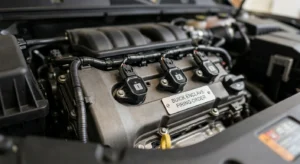
Gen IV and Gen V EcoTec3 engines use true coil-on-plug ignition — the coil mounts directly on the spark plug with no intermediate wire. Each coil is connected to the ECM by a three-wire harness: power, ground, and trigger signal. The coil is triggered in the correct firing sequence entirely by the ECM’s software.
There are no spark plug wires to misroute. A firing order error is not possible by mislabeling hardware — the ECM fires each coil in the correct sequence automatically. When a coil fails on these systems, the result is a single-cylinder misfire logged as a P030X code (with X being the cylinder number). The swap test — moving the suspected coil to a different cylinder and confirming the misfire code moves with it — remains the most reliable field diagnostic.
Deep Analysis: The Engineering Reason The LS Order Is Different From The Old Small-Block
The switch from 1-8-4-3-6-5-7-2 to 1-8-7-2-6-5-4-3 between the traditional small-block and the LS is not arbitrary. It reflects a fundamental difference in crankshaft design philosophy.
The traditional small-block crankshaft had its throws phased so that cylinders 4 and 7 fired consecutively in the sequence. On a street engine, this is manageable, but it produces a specific exhaust sound signature and slightly uneven torque pulses that performance builders learned to address with camshafts that swapped the 4/7 relationship — a modification called a “4/7 swap cam.”
The LS crank was designed from the start with the 4/7 swap built in as the baseline configuration. The 1-8-7-2-6-5-4-3 sequence positions cylinder 7 to fire early in the sequence (third position) and cylinder 4 later (seventh position), increasing the interval between their respective firings. The result is more evenly distributed torque pulses and reduced secondary vibration at the specific RPM ranges where truck engines spend most of their time.
This is why the LS engine won Ward’s 10 Best Engines award 11 consecutive times from 1997 to 2007 — and why its fundamental firing sequence has remained unchanged from the 1999 4.8L Vortec through the 2026 6.2L EcoTec3. GM got the sequence right the first time.
Misfire Diagnosis: Using Firing Order Knowledge To Pinpoint Problems
When an OBD-II scanner reports a misfire code, the firing order knowledge translates directly into a diagnosis strategy.
How To Read A Misfire Code On Any Silverado
Every misfire code on a Silverado follows the same format: P030X, where X is the specific cylinder number. On all LS V8 Silverados, the cylinder number maps directly to the driver’s side / passenger’s side layout described earlier.
| OBD-II Code | Cylinder | Location On LS V8 Silverado | Bank |
| P0301 | 1 | Front, driver’s side | Bank 1 |
| P0302 | 2 | Front, passenger’s side | Bank 2 |
| P0303 | 3 | Second from front, driver’s side | Bank 1 |
| P0304 | 4 | Second from front, passenger’s side | Bank 2 |
| P0305 | 5 | Third from front, driver’s side | Bank 1 |
| P0306 | 6 | Third from front, passenger’s side | Bank 2 |
| P0307 | 7 | Rear, driver’s side | Bank 1 |
| P0308 | 8 | Rear, passenger’s side | Bank 2 |
On the 4.3L V6, misfire codes P0301 through P0306 apply with the same driver’s side / passenger’s side layout but only three cylinders per bank.
On the 2.7L I4, P0301 through P0304 apply to the front-to-rear sequential layout.
The AFM / DFM Misfire Pattern — What Looks Like A Sequence Problem But Is Not
A persistent misfire on cylinders 1, 4, 6, and 7 simultaneously — the four cylinders that AFM deactivates on Gen IV 5.3L engines — points strongly toward an AFM system problem rather than a firing order issue. Failed AFM lifters on the deactivated cylinders, a stuck Active Fuel Management solenoid, or DEX-OS oil life that has degraded the solenoid’s response all produce this specific four-cylinder pattern.
The correct diagnosis sequence when this pattern appears: confirm the firing order is correct (it almost always is on coil-on-plug systems), check the oil level and condition, read AFM-specific manufacturer codes with an enhanced scan tool, and perform a compression test on the affected cylinders to rule out physical lifter failure.
Spark Plug Service Guide By Engine Generation
| Engine | Socket | OEM Plug Brand | Gap | Torque | Service Interval |
| 4.3L LU3 V6 Vortec | 5/8″ | ACDelco R42LTS6 | 0.060″ | 11–15 ft-lb | 30,000 mi (std) |
| 4.3L LV3 EcoTec3 | 5/8″ | ACDelco 41-110 (iridium) | Pre-gapped | 11 ft-lb | 97,500 mi |
| 4.8L LR4 V8 | 5/8″ | ACDelco 41-985 | 0.060″ | 11–15 ft-lb | 30,000 mi |
| 5.3L Gen III V8 | 5/8″ | ACDelco 41-985 | 0.060″ | 11–15 ft-lb | 30,000 mi |
| 5.3L EcoTec3 V8 | 5/8″ | ACDelco 41-110 (iridium) | Pre-gapped | 11 ft-lb | 97,500 mi |
| 6.0L Vortec V8 | 5/8″ | ACDelco 41-985 | 0.060″ | 11–15 ft-lb | 30,000 mi |
| 6.2L EcoTec3 V8 | 5/8″ | ACDelco 41-110 (iridium) | Pre-gapped | 11 ft-lb | 97,500 mi |
| 2.7L L3B Turbo I4 | 5/8″ | ACDelco 41-110 | Pre-gapped | 11 ft-lb | 45,000 mi |
| 3.0L LM2 Duramax I6 | N/A (diesel) | N/A — uses glow plugs | N/A | N/A | Inspect at major service |
| 8.1L Vortec V8 | 5/8″ | ACDelco 41-985 | 0.060″ | 11–15 ft-lb | 30,000 mi |
Critical note on iridium plugs: Do not regap factory iridium plugs. The iridium tip is fragile and bending the electrode to adjust the gap can fracture it. If a plug appears mis-gapped out of the box, return the part — do not adjust it. GM specifically notes in the EcoTec3 service documentation that iridium plug electrode adjustment voids the plug and can introduce fragments into the combustion chamber.
Frequently Asked Questions
What is the firing order for a 2005 Silverado 5.3L?
The 2005 Silverado 5.3L uses the Gen III LM7 (or L59 flex-fuel variant) engine with a firing order of 1-8-7-2-6-5-4-3. Cylinder 1 is at the front of the driver’s side bank. The ignition system is coil-near-plug with individual coil packs per cylinder. The cylinders run 1, 3, 5, 7 front to rear on the driver’s side and 2, 4, 6, 8 front to rear on the passenger’s side.
Is the 5.3L Silverado firing order the same as the 6.2L?
Yes. Both the 5.3L and 6.2L use the LS architecture firing order of 1-8-7-2-6-5-4-3, and both use the same cylinder numbering layout — odd cylinders (1, 3, 5, 7) on the driver’s side front to rear, even cylinders (2, 4, 6, 8) on the passenger’s side front to rear. This consistency applies across every LS-based V8 Silverado from 1999 through the current production year.
What is the firing order for the Chevy Silverado 4.3L V6?
The 4.3L V6 Silverado uses a firing order of 1-6-5-4-3-2, which is different from every V8 option in the truck. Cylinder 1 is on the driver’s side front. Driver’s side cylinders run 1, 3, 5 from front to rear; passenger’s side runs 2, 4, 6. On distributor-equipped models (1999–2002), the distributor rotates clockwise. From 2003 onward on the Vortec version, and from 2014 onward on the EcoTec3 version, the system is distributorless.
What is the firing order for the 2020 Silverado 3.0 Duramax diesel?
The 3.0L Duramax LM2 inline-six diesel uses a fuel injector firing sequence of 1-5-3-6-2-4. This engine has no spark plugs and no ignition coils — combustion is achieved through compression ignition with glow plugs for cold-start assist. The six cylinders run in a straight line from front to rear, numbered 1 through 6, with cylinder 1 at the front.
Does the firing order change when the 5.3L Silverado switches into V4 mode with AFM or DFM?
No. The firing order of 1-8-7-2-6-5-4-3 remains constant whether the engine is running on all eight cylinders or in V4 mode. In deactivation mode, the ECM simply bypasses the deactivated cylinders within the same rotation — it does not resequence the active cylinders into a different order. The physical crankshaft throws and combustion timing remain unchanged; only fuel injection and valve operation are suspended on the deactivated cylinders.
What is the firing order for the 2019 Silverado 2.7L Turbo?
The 2.7L L3B turbocharged four-cylinder uses a firing order of 1-3-4-2. This is an inline-four engine, so there are no cylinder banks — all four cylinders are in a single row numbered 1 through 4 from front to rear. Cylinder 1 is the frontmost. The ignition system is coil-on-plug with one coil per cylinder.
Why does my 1999 Silverado with the 5.7L use a different firing order than everything else?
The 1999 Silverado with the 5.7L L31 engine was a carryover from the previous C/K series and uses the traditional Chevy small-block firing order of 1-8-4-3-6-5-7-2 — not the LS architecture order of 1-8-7-2-6-5-4-3. This engine uses a central distributor while all other V8s in the GMT800 generation use coil-near-plug ignition. It was replaced after one year by the all-new Gen III LS engines. If you are servicing a 1999 Silverado V8, confirm whether it has the 5.7L L31 or the 5.3L LM7/4.8L LR4 before applying any ignition sequence information.
How do I identify which cylinder is misfiring on a Silverado without a scan tool?
Remove each ignition coil connector one at a time with the engine running. When you disconnect a coil and the engine’s idle quality changes noticeably (rougher, more pronounced miss), that cylinder was contributing to combustion — it is not the misfiring cylinder. When you disconnect a coil and the idle quality does not change, that cylinder was already not contributing properly — it is the misfiring cylinder. Use the cylinder layout diagram to map the position of the disconnected coil to its cylinder number, then cross-reference with the coil swap test using a known-good coil from another cylinder to confirm.