
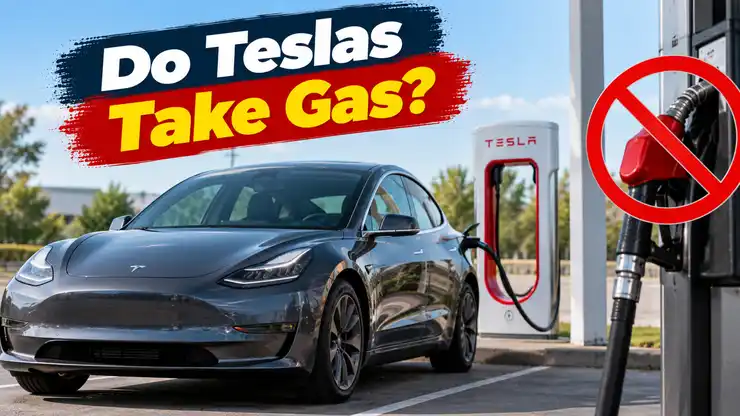
Tesla has changed the way many people think about cars by replacing the traditional gasoline engine with an electric powertrain. However, people considering an electric vehicle often have practical questions about refueling, charging, long-distance travel, and what happens when the battery runs low. One of the most common questions is, do Teslas take gas?
The answer is no. Tesla vehicles are fully electric cars, which means they do not use gasoline or diesel to power their motors. Instead, they store electricity in a rechargeable battery and use electric motors to turn the wheels. Rather than visiting a gas station for regular refueling, Tesla owners charge their vehicles at home, at public charging stations, or at Tesla Superchargers.
Although the basic idea is straightforward, owning an electric car involves a few differences that are worth knowing before buying one. From charging costs and battery range to road trips and emergency situations, understanding how Tesla vehicles operate can help you decide whether an electric car suits your daily needs.
Do Teslas Take Gas Or Run Entirely On Electricity?
No, Teslas do not take gas. Every standard Tesla passenger vehicle is designed as a battery-electric vehicle (BEV), meaning it uses electricity stored in a rechargeable battery instead of gasoline burned inside an engine.
Traditional gasoline cars use an internal combustion engine to convert fuel into mechanical power. A Tesla uses an electric motor, which receives electricity from the battery and converts it into rotational force that moves the wheels.
This difference affects almost every part of vehicle ownership. You do not need to visit a gas station to fill a Tesla, change engine oil, replace spark plugs, or maintain a conventional exhaust system. Instead, you need to manage battery charging, monitor energy consumption, and follow the manufacturer’s maintenance recommendations for the electric powertrain and other vehicle components.
How Does A Tesla Work Without Gas?
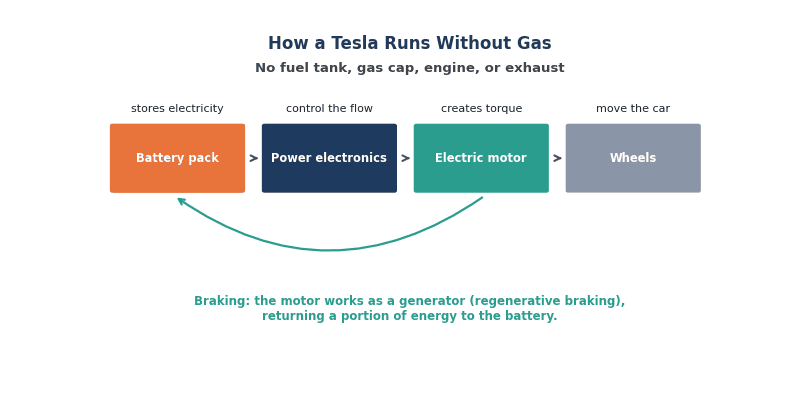
A Tesla uses several major components to produce and deliver power.
The battery pack stores electrical energy. The electric motor converts that energy into motion, while power electronics control how electricity reaches the motor. A thermal management system helps keep the battery and other components within appropriate operating temperatures.
When you press the accelerator, the vehicle’s control systems deliver electricity to the motor. The motor produces torque, turning the wheels and moving the car forward.
Unlike a typical gasoline vehicle, an electric motor does not need to build engine revolutions before producing useful torque. This is one reason Tesla vehicles can accelerate quickly, even from a standstill.
When you slow down, the motor can also work as a generator. This process, called regenerative braking, converts some of the vehicle’s kinetic energy back into electricity and returns it to the battery.
Regenerative braking does not create free energy. It recovers a portion of energy that would otherwise be lost mainly as heat during conventional braking. The recovered energy can help extend driving range, particularly in stop-and-go traffic and on routes involving frequent deceleration.
Tesla Models That Do Not Require Gas
Tesla’s main passenger-vehicle lineup includes the following models.
- Tesla Model 3: A compact electric sedan suited to commuting, daily errands, and longer journeys. It uses a rechargeable battery and electric motors rather than gasoline.
- Tesla Model Y: An electric crossover with additional cargo space and a higher seating position. It also runs entirely on electricity.
- Tesla Model S: A larger luxury sedan known for strong acceleration and long-range configurations. It has an all-electric powertrain.
- Tesla Model X: A larger electric SUV offering additional passenger and cargo flexibility without needing gasoline.
- Tesla Cybertruck: An electric pickup designed for utility and towing applications. Its electricity consumption can vary considerably with payload, towing, speed, and weather.
Although these vehicles differ in size, performance, and battery capacity, they share the same basic principle: electricity replaces gasoline as their source of propulsion.
Do Teslas Have Gas Tanks Or Gas Caps?
No. Tesla passenger vehicles do not have conventional gasoline tanks, fuel pumps, fuel injectors, or gasoline filler caps.
Instead, they have a charging port where an electrical connector plugs into the vehicle. The charging-port location varies by model, and the connector used depends on the vehicle and charging equipment.
A Tesla does not need a gasoline tank because there is no internal combustion engine that requires fuel. The space and mechanical systems used for a conventional fuel tank and exhaust system are unnecessary.
This also means you cannot fill a Tesla with gasoline to extend its range. If a Tesla runs low on battery power, the correct response is to find a suitable charging station or arrange roadside assistance if necessary.
What Happens When A Tesla Battery Runs Low?
When the battery charge becomes low, the vehicle displays warnings and estimates how much driving range remains. The available range depends on battery charge, driving conditions, energy consumption, and the vehicle’s configuration.
If the battery reaches a critically low level, the vehicle may limit performance and eventually be unable to continue driving.
Unlike a gasoline car, you cannot solve the problem by pouring a few gallons of fuel into the tank. You need access to electrical charging.
It is best to plan a charging stop before the battery reaches a critically low level, especially on unfamiliar roads or in areas where chargers are less common.
How Do You Charge A Tesla Instead Of Buying Gas?
Charging is the electric-vehicle equivalent of refueling, but it works differently from filling a gasoline tank.
You connect the car to an electricity supply, and the battery stores energy for later use. The time required depends on the charging equipment, the vehicle’s charging capabilities, the battery’s current state of charge, temperature, and other conditions.
Tesla owners generally have three main charging options: home charging, public charging, and DC fast charging.
Home Charging
For many owners, charging at home is the most convenient way to keep a Tesla ready for daily use.
You can plug the vehicle into a suitable household outlet where supported, or install dedicated charging equipment designed for electric vehicles. A properly installed 240-volt charging setup in the United States generally provides faster home charging than a standard 120-volt household outlet.
The exact charging speed depends on the electrical circuit, equipment, vehicle, and other factors.
Home charging allows you to add energy while the car is parked overnight. Instead of making a separate trip to a gas station, you can begin many mornings with the battery charged to your preferred daily limit.
However, installation costs should be considered. A dedicated charger may require electrical work, and the final price depends on wiring distance, panel capacity, permits, and local labor rates.
Renters and people living in apartment buildings may have fewer charging options. Before purchasing a Tesla, check whether your home or parking facility provides reliable charging access.
Tesla Superchargers And Public Charging Stations
Tesla Superchargers are DC fast-charging stations designed to add substantial energy during longer journeys.
They can charge compatible vehicles much faster than ordinary household outlets. However, the maximum charging speed is not maintained throughout the entire session.
Charging is usually fastest under suitable conditions when the battery has a relatively low state of charge. As the battery fills, the vehicle reduces charging power to protect battery health and manage temperature.
This is why charging from 10% to 50% can take a different amount of time from charging from 80% to 100%.
Public charging networks also include other DC fast chargers and slower AC charging stations. Availability, connector compatibility, access requirements, and payment methods vary by location.
Before relying on a particular station, check that it supports your Tesla and is available for public use.
How Long Does It Take To Charge A Tesla?
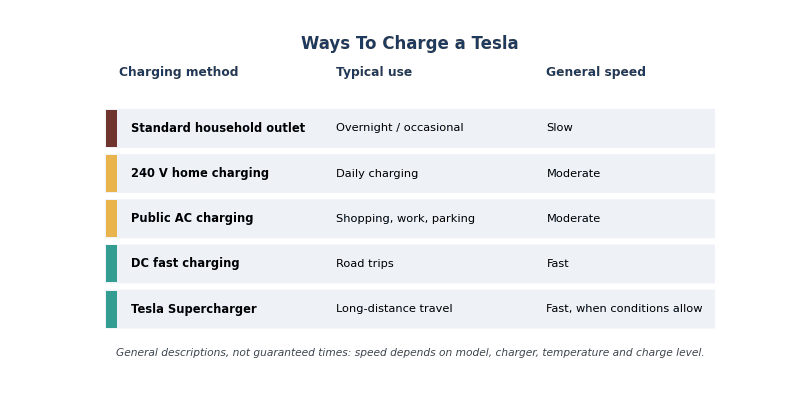
Charging time depends on the power source and the amount of energy the battery needs.
| Charging Method | Typical Use | General Charging Speed |
|---|---|---|
| Standard household outlet | Overnight or occasional charging | Slow |
| 240V home charging | Daily charging | Moderate |
| Public AC charging | Shopping, work, parking | Moderate |
| DC fast charging | Road trips | Fast |
| Tesla Supercharger | Convenient long-distance charging | Fast, when conditions allow |
These descriptions are general rather than guaranteed charging times. Actual performance varies by Tesla model, charger output, battery temperature, state of charge, and electrical conditions.
For example, a vehicle charging from a low battery level at a high-powered fast charger may gain energy quickly at first. The same vehicle can charge much more slowly as it approaches a high state of charge.
A practical daily routine is to charge at home when possible and use fast charging when you need to travel farther than your current battery range allows.
Does Charging A Tesla Cost Money?
Yes. Electricity is not free unless you have access to a genuinely free charging arrangement or a special benefit that covers the cost.
The total cost depends on how much energy the vehicle uses and what you pay per kilowatt-hour (kWh).
Home electricity is often cheaper than public DC fast charging, but rates vary by region and time of day. Some utilities offer time-of-use plans that make overnight charging less expensive.
The following example shows how to estimate charging costs.
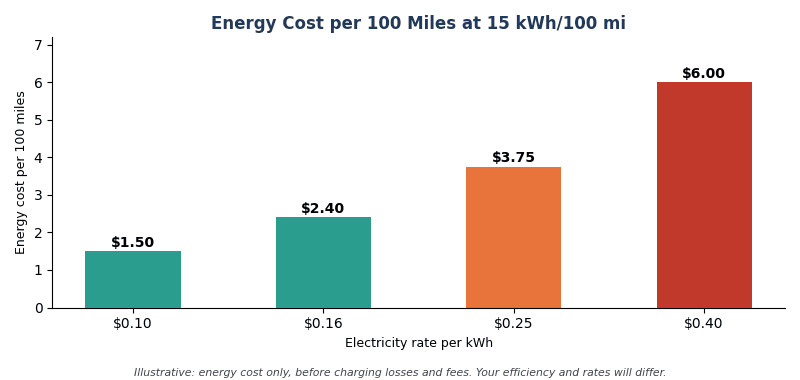
Suppose a Tesla uses 15 kWh of electricity to travel 100 miles, and your electricity rate is $0.16 per kWh.
\[ 15 \times \$0.16 = \$2.40 \]
That gives an estimated energy cost of $2.40 per 100 miles before accounting for charging losses or other fees.
If charging losses increase the electricity drawn from the outlet, the amount paid will be somewhat higher than the energy stored in the battery alone.
| Electricity Rate | Cost For 15 kWh |
|---|---|
| $0.10/kWh | $1.50 |
| $0.16/kWh | $2.40 |
| $0.25/kWh | $3.75 |
| $0.40/kWh | $6.00 |
These figures illustrate energy cost only. They do not represent guaranteed Tesla operating costs, because actual efficiency and electricity prices vary.
How Much Does It Cost To Run A Tesla Compared With A Gas Car?
Not buying gasoline does not mean a Tesla is free to operate. Owners still pay for electricity, tires, insurance, registration, maintenance, and possible repairs.
The financial advantage depends on the price of electricity, gasoline prices, vehicle efficiency, annual mileage, and the cost of installing home charging equipment.
A driver who travels many miles and charges at home at a favorable electricity rate may save substantially on energy. Someone who relies almost entirely on expensive public fast charging may see a smaller difference.
Comparing Electricity Costs With Gasoline
Consider two hypothetical vehicles that each travel 12,000 miles per year.
Assume the gasoline vehicle averages 30 miles per gallon and gasoline costs $3.50 per gallon. Its annual fuel use would be:
\[ 12{,}000 \div 30 = 400 \text{ gallons} \]
\[ 400 \times \$3.50 = \$1{,}400 \]
Now assume the electric vehicle consumes 15 kWh per 100 miles and pays $0.16 per kWh.
\[ 12{,}000 \times 0.15 = 1{,}800 \text{ kWh} \]
\[ 1{,}800 \times \$0.16 = \$288 \]
Under these assumptions, the estimated annual energy costs are $1,400 for gasoline and $288 for electricity, before charging losses and other fees.
This example is not a universal promise of savings. A less efficient gasoline car, higher gasoline prices, and low home electricity rates would increase the electric vehicle’s advantage. Higher electricity rates, extensive fast charging, or a more energy-intensive EV would narrow it.
To make a fair comparison, use your own annual mileage, local electricity rates, fuel prices, and the actual efficiency of the vehicles you are considering.
Does A Tesla Cost Less To Maintain?
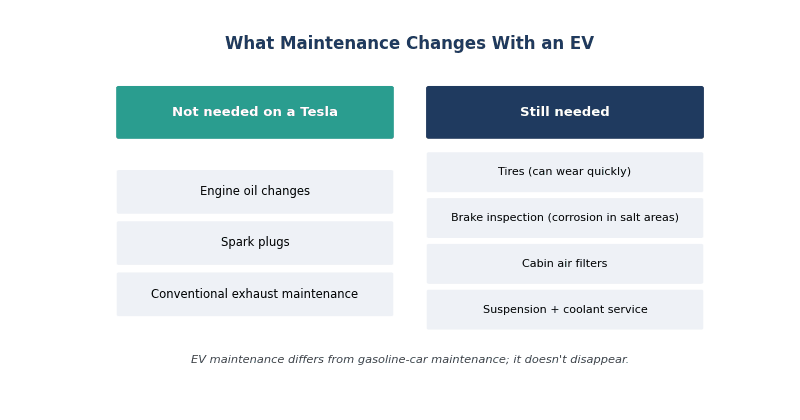
Electric vehicles generally require fewer routine powertrain maintenance services than gasoline vehicles.
A Tesla does not need conventional engine oil changes, spark plug replacements, engine air-intake servicing, or exhaust-system maintenance associated with an internal combustion engine.
However, several maintenance items remain important.
| Maintenance Item | Tesla | Gasoline Car |
|---|---|---|
| Engine oil changes | Not required | Usually required |
| Spark plugs | Not required | Required on applicable engines |
| Exhaust system | No conventional exhaust | Present |
| Tires | Required | Required |
| Brake inspection | Required | Required |
| Cabin air filters | Required | Required |
| Suspension components | Required | Required |
| Coolant service | Model-specific requirements | Model-specific requirements |
| Battery or powertrain repairs | May be expensive | Engine/transmission repairs may be expensive |
Tesla vehicles use regenerative braking, which can reduce the use of friction brakes in normal conditions. However, brake components still require inspection and can experience corrosion, particularly in areas where road salt is common.
Tires may also wear quickly on some electric vehicles because of their weight, available torque, driving style, and tire selection.
The most accurate conclusion is that EV maintenance differs from gasoline-car maintenance rather than disappearing completely.
What About Insurance And Battery Replacement?
Insurance costs depend on the model, location, driving record, coverage, repair costs, and many other factors.
Some Teslas can be more expensive to insure than comparable gasoline cars, so insurance quotes should be part of the ownership calculation.
Battery replacement is another concern, although a battery does not automatically need replacement after a fixed number of years. Battery condition depends on chemistry, temperature exposure, charging patterns, age, mileage, and other factors.
A battery repair or replacement outside warranty can be expensive. However, replacing the entire battery pack is not a routine service that every Tesla owner should expect to perform at a predetermined mileage.
Before buying a used Tesla, review the specific vehicle’s battery and drive-unit warranty, service history, condition, and applicable warranty terms.
What Tesla Owners Should Know Before Taking A Road Trip
A Tesla can be used for long-distance travel, but road-trip planning differs from conventional gasoline-car travel.
With a gasoline car, a driver can often refuel in a few minutes at a wide range of stations. With a Tesla, the trip may require charging stops, and the time needed at each stop depends on the vehicle and charger.
The good news is that navigation and charging information can make the process relatively straightforward.
How Tesla Navigation Helps With Charging
Tesla navigation can help plan routes and identify compatible charging stops. On supported routes and vehicles, it can estimate battery charge at arrival and suggest charging along the way.
These estimates are useful, but they are not guarantees.
Driving speed, weather, elevation, wind, passenger load, cargo, and tire pressure can all affect energy consumption. Cold weather can also increase energy use because the cabin and battery may need heating.
For a long trip, it is sensible to leave some flexibility in the plan rather than relying on the smallest possible battery reserve.
Check charger availability, especially in remote areas, during busy travel periods, or when weather conditions could affect driving range.
Does Cold Weather Affect Tesla Range?
Yes. Cold weather can reduce the range available from an electric vehicle.
Low temperatures affect battery performance, while cabin heating consumes electricity. Battery conditioning may also use energy, particularly before or during fast charging.
The size of the effect varies depending on temperature, route, speed, heating settings, and battery condition.
Preconditioning the vehicle while it is connected to a charger can help reduce the energy drawn from the battery for initial cabin heating. Where supported, navigation to a fast charger can also prepare the battery for charging.
Hot weather can affect energy consumption as well, especially when air conditioning is used extensively.
For that reason, the range displayed under one set of conditions should not be treated as a guarantee for every trip.
Can You Run Out Of Battery In A Tesla?
Yes. A Tesla can run out of usable battery energy if the driver continues traveling without charging.
This is similar in practical consequence to a gasoline car running out of fuel, although the recovery process is different.
If the battery becomes critically low, the car may warn you, reduce available performance, and eventually stop being able to drive.
If you are approaching a very low state of charge, reduce unnecessary energy use and head toward a suitable charger if it is safe to do so. Do not continue driving deeper into a remote area hoping the remaining range estimate will be sufficient.
If the vehicle cannot reach a charger, contact roadside assistance and explain that it is an electric vehicle requiring appropriate recovery or charging support.
Not every roadside service can provide mobile charging, and towing procedures must follow the manufacturer’s instructions. A Tesla should not simply be towed with its driven wheels rolling on the road unless the approved procedure for that vehicle allows it.
Can You Use A Tesla In Areas With Few Charging Stations?
You can, but charging access should be evaluated before purchase.
People who live in cities with extensive charging infrastructure may find Tesla ownership relatively simple. Drivers who regularly travel through rural areas or regions with sparse charging coverage may need more careful planning.
Home charging can reduce dependence on public infrastructure for ordinary daily travel. If you can charge overnight, you may rarely need a public station except on longer journeys.
If home charging is unavailable, investigate workplace charging, public AC chargers, DC fast chargers, and the compatibility of the vehicle with local networks.
The best electric vehicle is not necessarily the one with the longest advertised range. It is the one whose real-world range and charging options fit your routine.
Final Thoughts
The answer to “Do Teslas Take Gas?” is simple: no. Tesla passenger vehicles use rechargeable batteries and electric motors rather than gasoline engines. They receive energy from home charging equipment, public charging stations, or compatible DC fast chargers.
That changes how you plan trips, maintain your vehicle, and pay for energy. Home charging can make everyday ownership convenient, and electricity can cost less per mile than gasoline under favorable conditions. However, insurance, tires, charging equipment, battery condition, and the price of public fast charging should all be considered.
Before purchasing a Tesla, evaluate your daily mileage, home charging options, local electricity rates, long-distance travel needs, and the vehicle’s expected ownership costs. The ability to charge reliably is just as important as the battery’s advertised range.
For drivers who can charge conveniently and choose a model that fits their travel needs, a Tesla can offer a practical alternative to a traditional gasoline-powered vehicle without requiring any gasoline at all.
Do Teslas Ever Need Gasoline?
No. Tesla passenger vehicles are fully electric and do not use gasoline or diesel for propulsion. They need electricity from a compatible charging source.
Can You Put Gas In A Tesla?
No. Teslas do not have conventional fuel tanks or gasoline engines. Gasoline cannot be used to power their electric motors.
How Often Do You Need To Charge A Tesla?
It depends on daily mileage, battery size, driving conditions, and charging access. Many owners charge at home overnight as needed rather than waiting for the battery to become nearly empty.
Is Charging A Tesla Cheaper Than Buying Gas?
It often can be, particularly when charging at home at a favorable electricity rate. Actual savings depend on electricity prices, gasoline prices, vehicle efficiency, public charging fees, and annual mileage.
Can A Tesla Charge At Home Using A Regular Outlet?
Some Tesla models can charge from a suitable standard household outlet using compatible equipment, but charging is relatively slow. A properly installed higher-voltage home charging setup generally adds energy much faster.
What Happens If A Tesla Runs Out Of Battery?
The vehicle eventually becomes unable to continue driving. You will need suitable charging assistance or recovery to a charging location. Avoid running the battery critically low, particularly on remote roads where charging options are limited.