Super Tech motor oil has been a popular choice for drivers looking for a reasonably priced engine lubricant without automatically paying for a premium brand name. Sold through Walmart, the brand has developed a reputation for offering several viscosity grades and formulations that meet recognized industry requirements.
The question of who actually makes Super Tech oil is more interesting than it first appears. Walmart owns the retail brand, but it does not operate as the sole blender of every bottle sold under the Super Tech name.
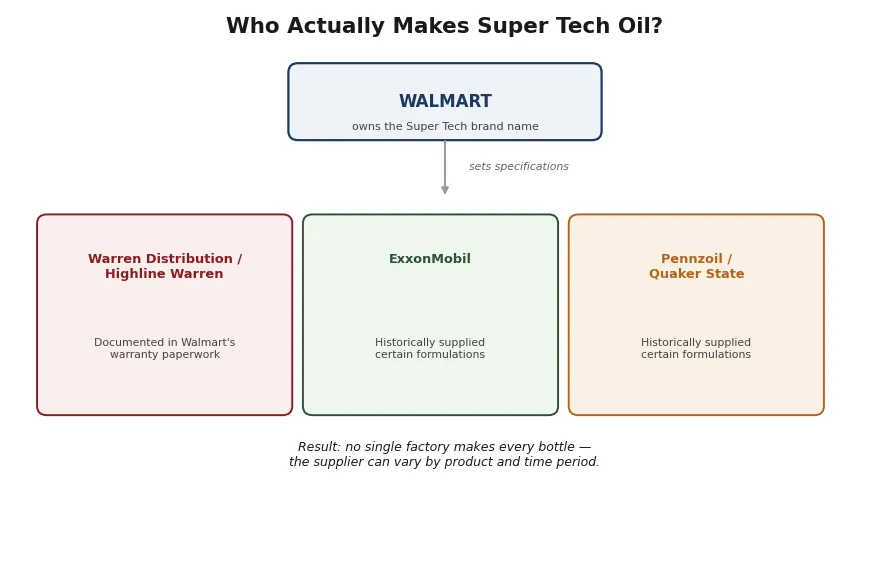
The supply arrangement has involved established lubricant manufacturers, with Warren Distribution, now part of Highline Warren, being the most clearly documented manufacturer associated with Super Tech automotive fluids. Older documentation and industry records also show that other major lubricant companies have produced certain Super Tech products for Walmart.
That means there is no simple answer such as “one company makes every Super Tech oil.” The manufacturer can depend on the product, formulation, supply arrangement, and production period.
Who Actually Makes Super Tech Oil?
Super Tech is a Walmart private-label automotive brand, which means the name on the bottle belongs to Walmart rather than to the company that necessarily blends every formulation.
This business model is common in the lubricant industry. A retailer can establish product specifications and sell the finished lubricant under its own brand while using specialized lubricant manufacturers to blend, package, and supply the product.
For Super Tech automotive fluids, Warren Distribution has been a major manufacturer and supplier. Walmart’s own Super Tech limited warranty documentation identifies Warren Distribution as the manufacturer of Walmart’s Super Tech automotive fluids.
Warren Distribution later became part of Highline Warren, following the combination of Warren Distribution and Highline Aftermarket. This is why current references can use the names Warren Distribution, Warren Performance Products, or Highline Warren depending on the product, documentation, or time period being discussed.
Warren Distribution And Highline Warren
Warren Distribution has a long history in private-label lubricants and has supplied products for numerous brands. The company has operated in the lubricant industry for decades, making it a significant player behind products that consumers may recognize under different retail names.
The important point is that private-label manufacturing does not necessarily mean an unknown or low-capability factory.
A private-label blender can operate large-scale facilities, formulate products to specific specifications, source base oils and additive packages, conduct quality testing, and package finished lubricants for different customers.
Walmart’s Super Tech warranty documentation specifically states that claims involving defective Super Tech lubricant are handled through Warren Distribution and identifies Warren as the manufacturer of Walmart’s Super Tech automotive fluids.
Highline Warren is therefore an important name when researching the current manufacturing history of Super Tech automotive fluids.
However, saying “Warren makes Super Tech” is more accurate than saying “Warren is the only company that has ever made every Super Tech oil.”
The historical supply chain is more complicated.
Have Other Companies Made Super Tech Oil?
Yes.
Historical information from lubricant-industry discussions and correspondence has identified ExxonMobil and Pennzoil-Quaker State among suppliers that have produced certain Super Tech motor oils.
One historical exchange published by Bob Is The Oil Guy includes a response attributed to Pennzoil stating that it blended some Super Tech motor oils for Walmart according to Walmart’s specifications. The same discussion identified Warren Distribution, ExxonMobil, and Shell/Pennzoil-Quaker State among suppliers at that time.
This is important because online claims sometimes reduce the answer to a single manufacturer.
The more accurate answer is that Warren Distribution has been a major and clearly documented Super Tech supplier, while other manufacturers have also supplied certain Super Tech products during different periods or in different markets.
The supplier relationship can change over time, so older information should not automatically be applied to a bottle purchased today.
Why Walmart Uses Multiple Manufacturers
Using multiple lubricant suppliers gives a large retailer flexibility in production, logistics, capacity, and regional distribution.
Motor oil is a high-volume product. Walmart sells large quantities across a broad geographic area, so relying on one production facility for every formulation would not necessarily be the most efficient supply strategy.
Different manufacturers can also specialize in different product categories or have available blending and packaging capacity for particular formulations.
This arrangement does not automatically tell you whether an oil is good or bad.
The more useful questions are whether the specific product meets the required viscosity, industry specification, OEM approval, and performance requirements for your engine.
Super Tech Is A Private-Label Product, Not A Single Formula
Another important detail is that “Super Tech oil” does not describe one formulation.
The range has included conventional oils, synthetic blends, full synthetic motor oils, high-mileage products, and different viscosity grades.
A 5W-30 full synthetic and a 10W-30 conventional product are not the same lubricant simply because both carry the Super Tech name.
The formulation can include different base-oil combinations and additive systems designed around the performance requirements of that particular product.
This is why judging the entire Super Tech range from one bottle can be misleading.
When evaluating the oil, look at the exact product and specification printed on the container.
How Super Tech Motor Oil Is Made And What Goes Into It
Motor oil is not simply crude petroleum placed into a bottle.
Finished engine oil is a carefully formulated mixture of base oils and performance additives. The formulation has to provide appropriate lubrication while controlling oxidation, deposits, wear, sludge, viscosity changes, corrosion, and other problems that occur inside an operating engine.
The base oil provides most of the fluid’s volume and fundamental lubricating characteristics.
The additive package gives the finished oil many of the properties needed for modern engines.
The exact formulation is proprietary, so consumers generally cannot determine every component simply by reading the bottle.
Base Oil And Additive Technology
Motor oils can use different categories of base oils.
Depending on the formulation, manufacturers can combine mineral base stocks with synthetic components or use highly refined synthetic base oils.
Full synthetic products generally use more highly engineered base-oil systems than conventional products, although the exact composition depends on the formulation and manufacturer.
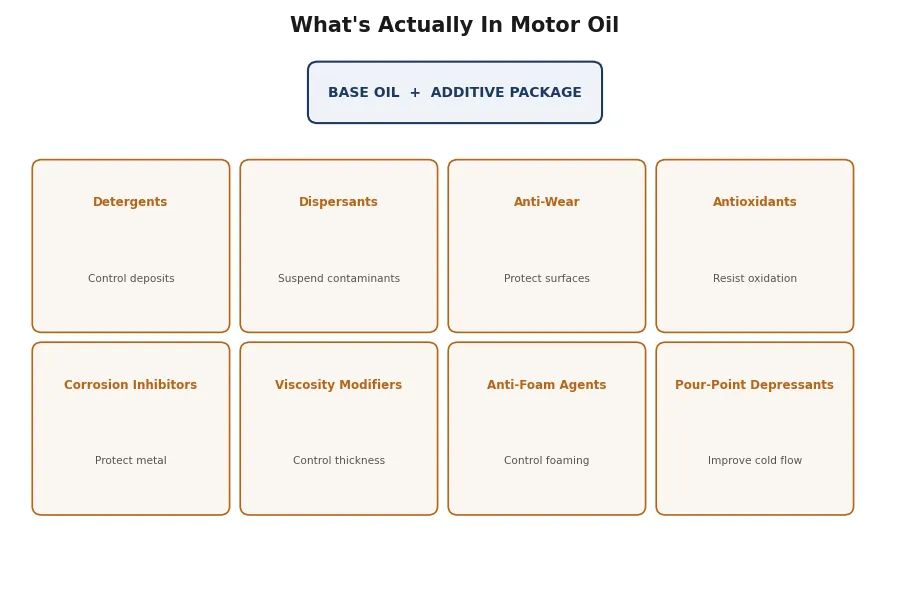
Additives then provide additional performance characteristics.
Common additive categories include:
| Additive Type | General Purpose |
| Detergents | Help Control Deposits And Keep Engine Surfaces Cleaner |
| Dispersants | Help Keep Contaminants Suspended |
| Anti-Wear Additives | Help Protect Loaded Engine Surfaces |
| Antioxidants | Help Resist Oil Oxidation |
| Corrosion Inhibitors | Help Protect Metal Surfaces |
| Viscosity Modifiers | Help Control Viscosity Across Temperatures |
| Anti-Foam Agents | Help Control Excessive Foaming |
| Pour-Point Depressants | Help Improve Low-Temperature Flow |
The final formulation must balance these properties.
Adding more of one additive does not automatically make an oil better. Additive chemistry involves compatibility, concentration, temperature behavior, volatility, deposit control, emissions-system requirements, and many other considerations.
That is why an engine oil should be evaluated as a complete formulation rather than by looking for one particular ingredient.
What The SAE Viscosity Number Means
The number printed on an oil bottle, such as 5W-30 or 0W-20, describes its viscosity classification under SAE standards.
The first number with the “W” relates to low-temperature viscosity performance.
The second number represents the oil’s viscosity classification at operating-temperature conditions.
A lower first number generally indicates better low-temperature flow characteristics.
A lower second number represents a lower operating-temperature viscosity.
However, viscosity should not be chosen simply because a thinner oil appears more modern or a thicker oil seems more protective.
The vehicle manufacturer specifies the appropriate viscosity based on engine design, temperature range, fuel economy targets, oil-pressure requirements, clearances, emissions equipment, and other engineering considerations.
If the owner’s manual specifies 0W-20, switching to 10W-40 simply because it feels “thicker” is not automatically beneficial.
API And Other Industry Specifications Matter
The letters and certification marks on an oil container can tell you more about suitability than the brand name alone.
The American Petroleum Institute (API) maintains performance categories and licensing programs for engine oils.
Depending on the product and application, you may also see ILSAC specifications or manufacturer-specific approvals and requirements.
These specifications exist because modern engines place demanding requirements on lubricants.
An oil that meets the required specification has been formulated and evaluated against the relevant performance requirements.
This is one reason consumers should pay close attention to the specification listed on the bottle.
A familiar brand name does not make an oil appropriate for every engine.
Likewise, an unfamiliar private-label name does not automatically make an oil unsuitable.
Does Super Tech Meet Modern Oil Standards?
Specific Super Tech formulations can carry current industry certifications, but the exact specification depends on the product and production version.
For example, Walmart currently lists Super Tech full synthetic products with specific viscosity grades and product specifications.
The important habit is to check the current bottle, rather than relying on an old review or a photograph of a previous formulation.
Motor-oil specifications evolve.
API categories change as engine technology develops, and manufacturers may update formulations to satisfy newer requirements.
A Super Tech bottle purchased several years ago should not automatically be assumed to have the same formulation or certification information as the current product.
Is Super Tech Oil Good For Your Engine?
For an engine that calls for a Super Tech formulation meeting the correct specification, the brand name alone is not a reason to reject it.
The more meaningful evaluation is whether the oil satisfies the requirements specified by the engine manufacturer.
A modern engine may require a particular viscosity and performance standard. If the Super Tech product meets those requirements, it can be a suitable lubricant for that application.
That does not mean every Super Tech product is suitable for every vehicle.
The same rule applies to premium brands.
A high-priced 5W-30 does not become appropriate for an engine requiring a different viscosity or manufacturer-specific approval simply because it costs more.
Private Label Does Not Automatically Mean Lower Quality
The private-label model sometimes creates the impression that a product must be inferior because the company on the label is not the actual blender.
That assumption is not technically sound.
Large private-label lubricant manufacturers operate sophisticated blending and packaging facilities. They produce lubricants for different customers according to defined specifications.
The finished product still needs to satisfy the requirements established for that particular formulation.
The more useful way to judge an engine oil is therefore to look beyond the retail branding.
Check the viscosity.
Check the API category.
Check ILSAC certification when applicable.
Check OEM approvals or specifications.
Then compare those details with the vehicle manufacturer’s requirements.
Super Tech Vs Premium Motor Oil Brands
Comparing Super Tech with brands such as Mobil 1, Pennzoil, Valvoline, Castrol, or other established names can become misleading if the comparison is based only on brand reputation.
Each brand offers multiple formulations.
A premium manufacturer can have several products with completely different specifications, just as Super Tech does.
The right comparison should therefore be made between products with the same viscosity and applicable performance standards.
| Comparison Point | What To Look For |
| Viscosity | Must Match Manufacturer Requirement |
| API Category | Should Meet Or Exceed Required Specification |
| ILSAC | Important Where Specified |
| OEM Approval | Required For Some Engines |
| Full Synthetic | Useful When Required Or Preferred |
| High-Mileage Formula | Consider Vehicle Condition And Manufacturer Guidance |
| Change Interval | Follow Vehicle And Oil Requirements |
| Packaging Information | Check Current Certification And Product Details |
Price can be a useful consideration, but it should come after compatibility.
Saving money on an oil that does not meet the engine’s requirements is not a sensible saving.
Using an appropriately specified lower-cost oil, on the other hand, can be perfectly reasonable.
Why Oil Analysis Is More Useful Than Internet Arguments
Engine-oil discussions often become centered around opinions about which brand is “best.”
Used-oil analysis can provide more useful information for a particular engine and maintenance interval.
Laboratory analysis can examine properties such as viscosity, wear metals, contamination, oxidation, and other indicators.
However, even oil analysis has limitations.
A single sample does not prove that one brand is universally better than another.
Results depend on engine design, mileage, operating conditions, oil-change interval, filtration, fuel dilution, coolant contamination, and many other factors.
The best interpretation is therefore specific to the engine and maintenance routine.
The Oil Change Interval Still Matters
A good lubricant cannot compensate for neglecting the vehicle’s maintenance requirements.
Oil gradually accumulates contaminants and experiences thermal and chemical stress.
The appropriate replacement interval depends on the engine, oil specification, operating conditions, and manufacturer’s recommendations.
Modern vehicles may calculate service intervals using mileage, time, engine operating conditions, or a combination of factors.
Following the owner’s manual is generally a better strategy than copying someone else’s oil-change schedule from the internet.
Frequent short trips, severe heat, towing, dusty conditions, extended idling, and other demanding operating conditions can affect maintenance requirements.
The correct oil and correct service interval work together.
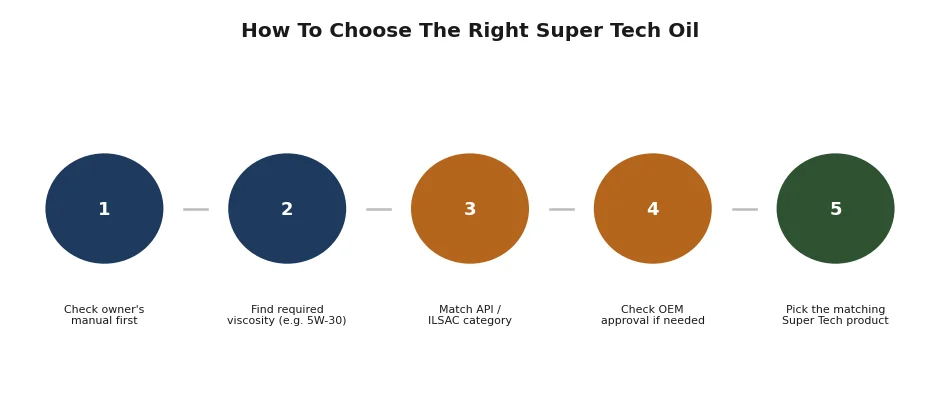
How To Identify And Choose The Right Super Tech Oil
Choosing Super Tech oil should begin with the vehicle rather than the shelf.
Find the required viscosity and performance specification in the owner’s manual or official manufacturer information.
Then look for a Super Tech product that satisfies those requirements.
This method eliminates much of the confusion surrounding private-label motor oil.
Read The Front And Back Of The Bottle
The front label usually gives the viscosity and broad product description.
The back label contains more useful technical information.
Look for the SAE viscosity grade, API information, ILSAC information where applicable, and any manufacturer-specific claims or approvals.
Do not choose based solely on words such as “synthetic,” “advanced,” or “high mileage.”
Those descriptions can help distinguish product types, but the technical specification is more important for determining compatibility.
A 0W-20 full synthetic oil and a 5W-30 full synthetic oil are both synthetic, but that does not mean they can automatically be substituted for each other.
High-Mileage Super Tech Oil
High-mileage oils are formulated with older vehicles and engines in mind.
They can include additive packages intended to support seal conditioning and deposit control.
However, high mileage alone does not mean a vehicle must use a high-mileage formulation.
The vehicle’s required viscosity and specifications still come first.
An older vehicle requiring 5W-30 should not automatically be given a thicker oil just because it has accumulated a lot of miles.
Engine condition matters as well.
Oil consumption, leaks, worn seals, deposits, and mechanical condition can influence what maintenance strategy makes sense.
If an engine is consuming significant oil, changing brands or viscosity without diagnosing the cause may simply hide the symptom temporarily.
Synthetic Vs Conventional Super Tech Oil
The choice between synthetic and conventional oil should be based on the engine requirements and intended use.
Many newer engines are designed around synthetic or synthetic-based lubricants and may specify a particular low-viscosity formulation.
Synthetic oils can offer advantages in areas such as low-temperature flow, oxidation resistance, volatility, and performance under demanding conditions, depending on the formulation.
Conventional oil can still be appropriate for engines designed around it.
There is no universal rule that every engine automatically benefits from switching to the most expensive synthetic product.
The vehicle manufacturer’s recommendation remains the starting point.
Does The Manufacturer On The Bottle Matter?
It can be useful information, but it should not be the primary deciding factor.
Knowing that Warren Distribution or another established blender produced a particular oil can provide useful context about the supply chain.
However, the identity of the blender does not replace the technical specification.
The same manufacturer can produce many different formulations.
A product’s suitability comes from its formulation and certification, not merely from the name of the facility that blended it.
This is one of the most important points when researching private-label automotive products.
Why The Same Super Tech Product May Not Always Look Identical
Packaging and formulation can change.
Walmart can update labels, specifications, container designs, and supplier arrangements over time.
Older internet photographs may therefore look different from bottles currently displayed in stores.
Some consumers attempt to identify the blender solely from bottle markings or cap designs.
Historical discussions have used packaging clues such as container markings to identify certain suppliers, but these methods are not a dependable way to establish the manufacturer of every current bottle.
The label’s current product information and official documentation are more reliable.
What Makes Super Tech Attractive To Many Consumers
The biggest appeal of a private-label lubricant is usually the combination of specification and cost.
Walmart’s purchasing scale allows it to sell high-volume automotive products under its own brand.
That can reduce some of the costs associated with traditional premium-brand marketing and distribution.
The result is a product positioned around value rather than prestige.
That does not automatically make Super Tech superior to premium oils.
It simply means the consumer may be paying less for a product that still meets the relevant performance requirements.
For routine maintenance, that can be a sensible proposition when the product is correctly matched to the vehicle.
The Most Important Question Is Not “Who Makes It?”
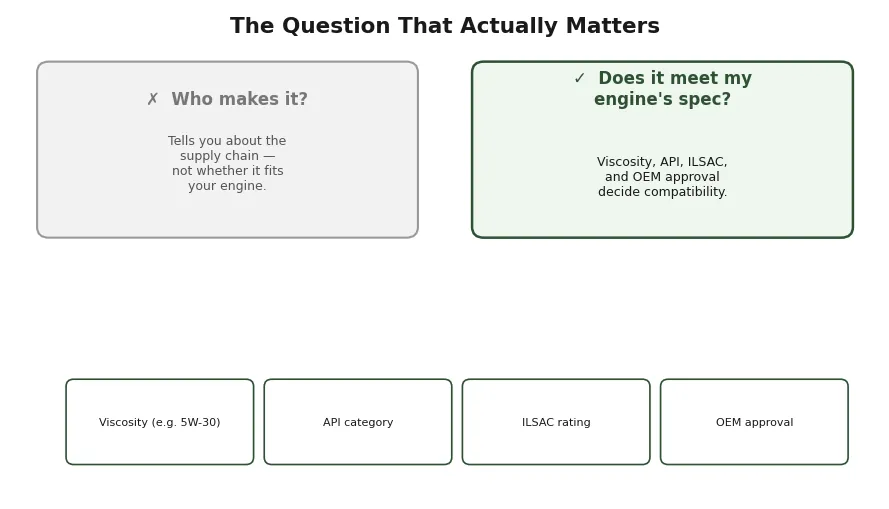
Knowing who makes Super Tech is useful because it clarifies the supply chain.
But from an engine-protection standpoint, an even more important question is “Does this specific Super Tech product meet my engine manufacturer’s requirements?”
If the answer is yes, the fact that the bottle carries a Walmart private-label name is not, by itself, a technical reason to reject it.
If the answer is no, switching to another product from the same manufacturer will not solve the problem.
Engine oil is a specification-driven product.
The brand on the front of the bottle is only one part of the information.
The viscosity, performance category, certifications, approvals, formulation, service interval, and engine requirements all matter.
Final Verdict On Who Makes Super Tech Oil
The clearest answer is that Warren Distribution has been a major manufacturer of Super Tech automotive fluids for Walmart, and Warren’s automotive lubricant operations are now associated with Highline Warren. Walmart’s own Super Tech warranty documentation identifies Warren Distribution as the manufacturer of its automotive fluids.
However, the history is not limited to one supplier.
Historical records indicate that ExxonMobil and Pennzoil-Quaker State have also produced certain Super Tech products for Walmart, depending on the product and period.
Therefore, the most accurate answer is not that every bottle of Super Tech oil comes from one factory or one oil company.
Super Tech is a private-label product line, and its manufacturing supply chain can involve established lubricant manufacturers working to Walmart’s specifications.
For consumers, the practical takeaway is straightforward. Choose the Super Tech viscosity and formulation that matches the vehicle manufacturer’s requirements, then verify the current API, ILSAC, and OEM specifications printed on the container where applicable.
A familiar premium brand may provide additional formulation options, but a private-label oil that meets the required specification can still be a legitimate choice.
The name on the bottle tells you who is selling the product.
The technical specifications tell you whether it belongs in your engine.
Who Makes Super Tech Oil For Walmart?
Warren Distribution has been a major manufacturer of Super Tech automotive fluids for Walmart, and its lubricant operations are now part of Highline Warren. Walmart’s own Super Tech warranty documentation identifies Warren Distribution as the manufacturer of Walmart’s Super Tech automotive fluids. Historical records also show that other lubricant manufacturers have supplied certain Super Tech products.
Is Super Tech Oil Made By Warren Distribution?
Yes, Warren Distribution has been a documented manufacturer of Super Tech automotive fluids. The company has supplied Walmart’s private-label automotive products for many years. Because Super Tech is a private-label range, however, it is more accurate to say Warren has been a major supplier rather than claiming that Warren has manufactured every Super Tech product in every period.
Is Super Tech Oil The Same As Mobil 1 Or Pennzoil?
No. A Super Tech product should not automatically be considered the same formulation as Mobil 1 or Pennzoil simply because a major lubricant company may have produced certain Super Tech products historically. Different brands can have different formulations, additive packages, specifications, and performance characteristics. The correct comparison is between products that meet the same requirements for your engine.
Is Super Tech Full Synthetic Oil Good?
A Super Tech full synthetic product can be a suitable choice when its viscosity and performance specifications match the vehicle manufacturer’s requirements. The important details are the exact formulation, SAE grade, API or ILSAC status, and any required OEM specification. Do not choose an oil solely because it is labeled full synthetic.
Why Is Super Tech Oil Less Expensive Than Some Major Brands?
Private-label products can have different marketing, packaging, distribution, and retail strategies than major premium brands. Walmart also sells Super Tech at large scale, which can support a value-focused business model. A lower retail price does not by itself prove that the lubricant is inferior, just as a higher price does not automatically prove that an oil is better for a particular engine.
Does Super Tech Oil Meet API Standards?
Specific Super Tech motor oils can carry API and other industry certifications, but the exact status depends on the formulation and current product version. Always check the certification information printed on the bottle rather than relying on an older review or photograph. The oil should meet the performance category required by your vehicle manufacturer.
Can I Use Super Tech Oil In Any Car?
No. Super Tech is a range of different oils rather than one universal formula. Your vehicle may require a particular viscosity, API category, ILSAC specification, or manufacturer approval. Select the exact Super Tech product that meets those requirements rather than assuming every Super Tech oil can be used in every engine.
Who Makes Super Tech Full Synthetic Oil?
Warren Distribution has been a major supplier of Super Tech motor oils, including synthetic products, but the supply chain can vary by product and time period. Historical information also identifies other major lubricant companies as suppliers of certain Super Tech formulations. The current bottle and product documentation are the best references for the specific formulation being purchased.
Is Super Tech Oil Safe For High-Mileage Engines?
It can be, provided the selected formulation meets the engine’s required viscosity and performance specifications. Super Tech also offers high-mileage formulations intended for vehicles with greater mileage. High mileage alone does not determine the correct oil, so the owner’s manual and engine condition should remain the starting points for choosing the lubricant.
Does The Oil Manufacturer Matter More Than The Brand Name?
Not necessarily. The manufacturer’s identity can provide useful information about the supply chain, but engine compatibility depends primarily on the finished product’s specifications and formulation. A private-label oil produced by an established lubricant blender can meet demanding industry requirements, while a premium-branded oil can still be inappropriate if it does not meet the specifications required by a particular engine.