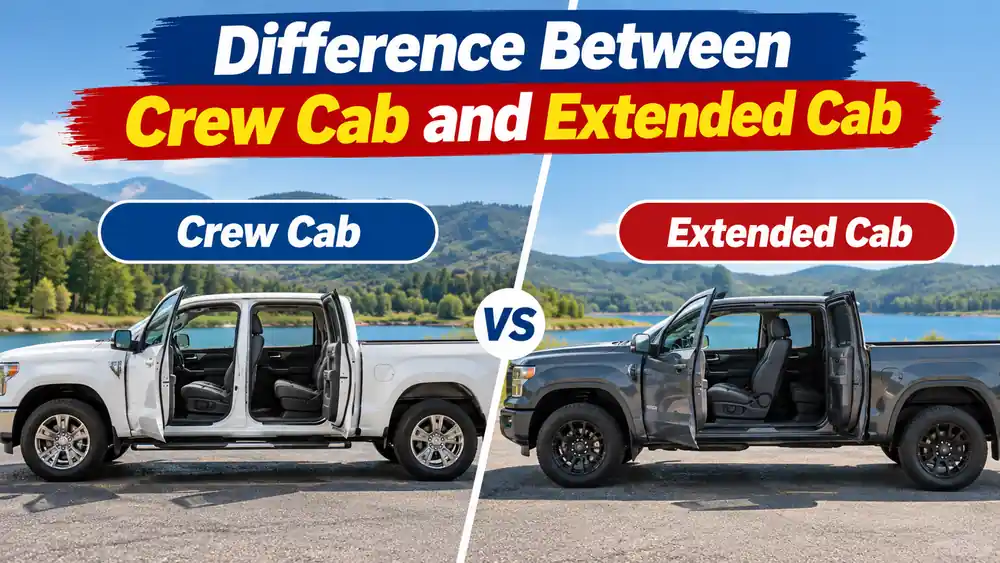
Pickup trucks are no longer limited to basic work duties. Modern trucks are used for commuting, family travel, towing, hauling, outdoor recreation, and long-distance trips, which makes cab configuration an important part of the buying decision. Two of the most common choices are the crew cab and extended cab, and while both provide more interior space than a traditional regular cab, they are designed around different priorities.
The main difference between a crew cab and an extended cab comes down to rear-seat space, passenger comfort, exterior size, cargo-bed availability, and the way the truck fits into everyday use. A crew cab normally provides a full-size second row with four conventional doors, while an extended cab generally has a smaller rear compartment and less convenient rear access.
Neither configuration is automatically right for every truck owner. The better choice depends on how many people regularly ride in the truck, how much rear-seat space is needed, whether bed length matters, and how the truck will be used for work or recreation. The details below break down those differences so you can choose based on practical needs rather than appearance alone.
Crew Cab And Extended Cab: What Sets Them Apart?
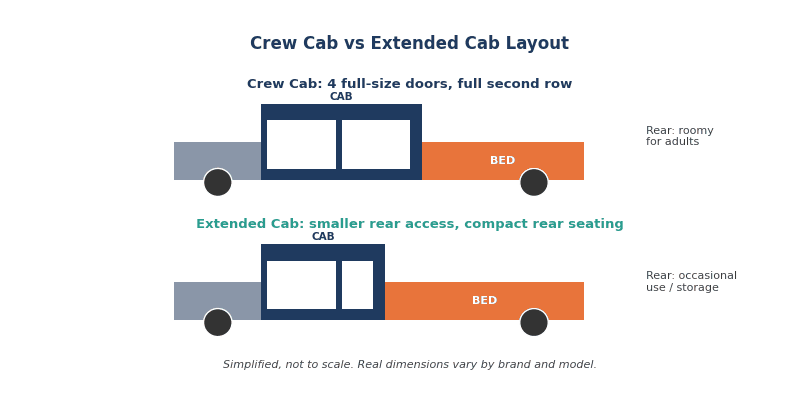
The terms crew cab and extended cab describe the passenger compartment of a pickup truck. Although manufacturers use different names for similar layouts, the basic distinction is relatively straightforward. A crew cab is designed to provide substantially more rear passenger room, while an extended cab adds occasional-use seating behind the front row without making the cabin as large as a crew cab.
The terminology can become confusing because truck manufacturers use names such as Double Cab, SuperCrew, Quad Cab, King Cab, SuperCab, and Double Cab for different configurations. These names are not perfectly interchangeable across brands. For that reason, looking at the actual seating arrangement, door design, rear legroom, and interior dimensions is more useful than relying only on the marketing name.
Crew Cab Design And Interior Layout
A crew cab typically has four full-size doors and two rows of seating. The rear doors open in the same general manner as the front doors, making it easy for adults to enter and leave the second row. Most modern crew cab pickups have enough rear-seat space for adults to sit comfortably for everyday travel, although exact room varies considerably between models.
The rear bench usually provides usable legroom, headroom, shoulder room, and hip room. Some trucks also offer reclining rear seatbacks, under-seat storage, folding cushions, rear air vents, USB charging ports, cupholders, and other features designed around passengers who spend meaningful time in the second row.
This layout is especially useful for families, work crews, and owners who regularly carry passengers. A child seat is also generally easier to install and access in a full-size rear seating area, although the exact fit should always be checked with the specific truck and child restraint.
Extended Cab Design And Interior Layout
An extended cab adds a smaller seating or storage area behind the front seats. Depending on the truck, the rear compartment may include compact bench seating, jump seats, or fold-down seats. Some extended-cab trucks have rear-hinged access doors, while others use a different door arrangement.
Rear legroom is usually considerably more limited than in a crew cab. The rear area can still be useful for children, shorter passengers, tools, bags, emergency equipment, or occasional passengers, but it is generally not designed around the same level of rear-seat comfort.
One important advantage is that an extended cab can provide a useful compromise between a regular cab and a crew cab. Buyers who rarely carry adults but want somewhere to put equipment or passengers can gain extra interior utility without choosing the largest cab configuration available.
Door Configuration Makes A Major Difference
Door design is one of the easiest ways to recognize the practical difference between the two layouts. A crew cab generally uses four conventional full-size doors, so rear passengers can enter independently without opening a front door first.
Many extended-cab pickups use smaller rear doors, and some older designs require the front door to be opened before rear access is possible. The exact arrangement varies by manufacturer and generation, so it is worth checking the specific truck rather than assuming every extended cab works the same way.
For frequent passenger use, this distinction becomes much more important than it may appear in a dealership parking lot. Full-size rear doors make loading people, child seats, groceries, luggage, and bulky items much easier.
Crew Cab Vs Extended Cab: Detailed Comparison
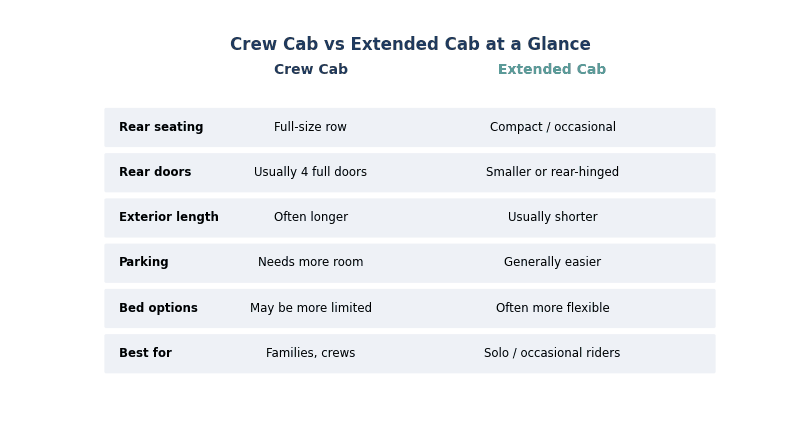
The best way to see the difference is to compare the two layouts according to the areas that matter during ownership. Interior room is only one part of the equation. Bed length, maneuverability, parking, cargo flexibility, price, and passenger access can all influence the final choice.
| Feature | Crew Cab | Extended Cab |
|---|---|---|
| Front Seating | Two adults | Two adults |
| Rear Seating | Full-size second row | Compact rear seating |
| Rear Passenger Space | Generous on most models | More limited |
| Rear Doors | Usually four full-size doors | Smaller or rear-hinged doors on many models |
| Adult Passenger Comfort | Better suited to regular use | Better suited to occasional use |
| Child Seating | Generally easier | Depends heavily on model |
| Interior Storage | Strong | Strong, especially for equipment |
| Exterior Length | Often longer | Usually shorter |
| Parking | Can require more space | Generally easier |
| Bed-Length Options | May be more limited depending on truck | Often offers useful bed configurations |
| Family Use | Very suitable | Better for occasional passengers |
| Work Use | Excellent for crews | Useful for tools and occasional passengers |
| Rear Access | Convenient | Can be less convenient |
| Cabin Priority | Passenger room | Balance between cabin and bed |
| Typical Buyer | Families, crews, mixed-use owners | Solo drivers, work users, occasional passengers |
These differences are not absolute because manufacturers package their trucks differently. A particular extended cab can have more useful rear space than another manufacturer’s compact cab, while a crew cab may be offered with several bed lengths depending on the truck’s chassis.
Interior Space And Passenger Comfort
The biggest functional advantage of a crew cab is rear-seat space. Adults can normally sit behind the front passengers without feeling as restricted as they would in a compact rear compartment. This makes the configuration particularly useful when the truck doubles as a family vehicle.
An extended cab is more focused on occasional rear use. The rear seats can be practical, but they may not provide the legroom or seat cushioning expected from a conventional second row. For short trips, that may not matter. For long journeys, the difference becomes much more noticeable.
Rear-seat comfort should therefore be judged according to frequency rather than simply the number of seats listed on the specification sheet. A truck technically capable of carrying five or six people may still be a poor fit if several adults regularly need to sit in the back.
Cargo Bed And Overall Truck Packaging
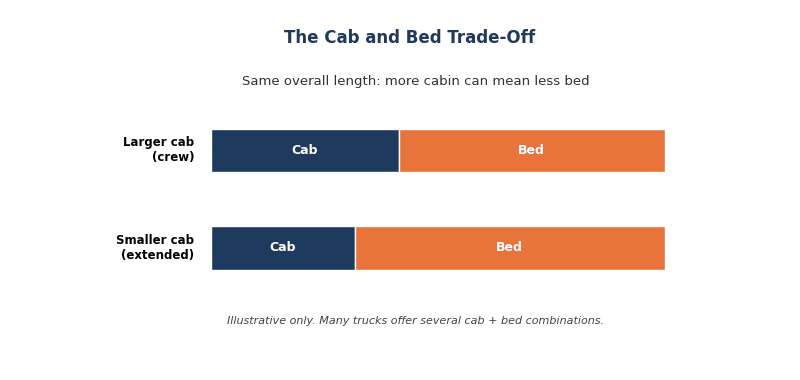
Cab size also affects the way manufacturers package the pickup’s bed. A larger passenger compartment consumes more of the truck’s overall length, which can influence the bed length available in a particular configuration.
This does not mean every crew cab has a short bed or every extended cab has a long bed. Modern full-size and midsize pickups are offered in numerous combinations. However, buyers should compare the actual wheelbase, overall length, cab configuration, and bed length rather than selecting a cab first and assuming the rest of the truck will remain unchanged.
For contractors, landscapers, outdoor enthusiasts, and owners who regularly transport long or bulky cargo, bed dimensions can be just as important as rear-seat room.
Maneuverability And Parking
An extended cab may have an advantage when maneuvering in tight spaces because some versions are shorter than comparable crew cab configurations. A shorter wheelbase can make certain parking situations easier, although turning radius depends on suspension, steering geometry, wheelbase, tire size, and other factors.
Crew cabs can be large vehicles, particularly when paired with a long bed. They may require more attention in compact parking garages, narrow streets, older residential driveways, and crowded parking lots.
However, modern pickup trucks often compensate with rear cameras, parking sensors, surround-view cameras, blind-spot monitoring, and other driver-assistance systems. These features can make a large truck easier to position, but they do not eliminate the physical dimensions of the vehicle.
Everyday Family Use
For families, a crew cab often makes practical sense because the cabin behaves more like a conventional four-door vehicle. Parents can access rear seats without moving the front seats or opening another door, and passengers can enter from either side.
The rear row can also be useful for school bags, sports equipment, groceries, luggage, and other items that need to remain inside the cabin. A crew cab does not automatically replace the usefulness of the truck bed, but it creates a second enclosed cargo area.
An extended cab can work for a family when rear passengers are occasional or mostly children. For households where adults frequently occupy the second row, the smaller rear compartment may become a limitation over time.
How To Choose Between A Crew Cab And Extended Cab
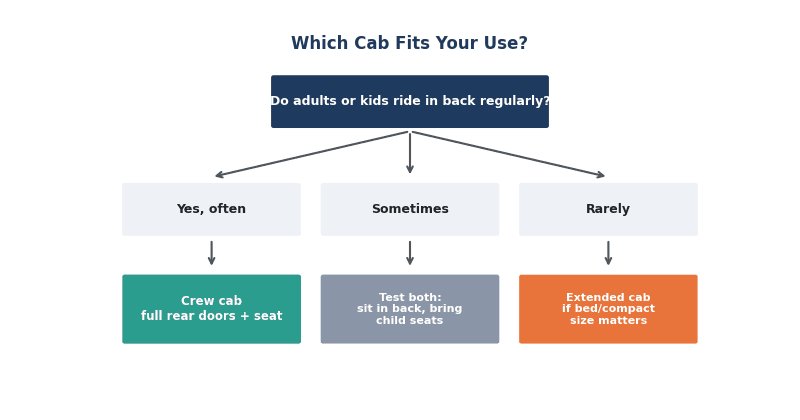
The right cab configuration depends less on what looks impressive on a dealer lot and more on how the truck will be used during an ordinary week. A useful way to make the decision is to consider passenger frequency, cargo requirements, parking conditions, ownership duration, and expected changes in your lifestyle.
Choose A Crew Cab When Rear Passengers Matter
A crew cab is particularly practical when the second row will be occupied regularly. Families with children, businesses transporting multiple employees, and owners who frequently take friends or relatives on trips can benefit from the larger rear compartment.
The full-size rear doors are another major advantage. Loading a child into a car seat, helping an older passenger into the truck, or placing bags behind the front seats is much easier when there is unobstructed access to the second row.
There is also a long-term consideration. People often buy trucks for several years rather than replacing them quickly. A rear seat that feels adequate today may become less useful when children grow or when the truck’s role changes from work vehicle to family vehicle.
Choose An Extended Cab When The Rear Area Is Occasional
An extended cab can make more sense when the truck primarily serves one or two people. The additional rear compartment can hold tools, work gear, groceries, luggage, emergency equipment, or passengers when necessary.
For some owners, paying for a larger crew cab simply to carry rear passengers a few times a month may not provide enough practical benefit. An extended cab can preserve a more compact truck configuration while still offering more interior utility than a regular cab.
This configuration can also appeal to buyers who prioritize the truck bed. Depending on the model, an extended cab may be available with bed lengths or wheelbases that better match work requirements.
Think About Your Typical Passenger Mix
The number of passengers is important, but their size and travel duration matter too. Four adults making a 10-minute trip have different requirements from four adults spending several hours on a highway.
Similarly, two adults and two small children may fit comfortably in a configuration that becomes restrictive as the children grow. If the truck is expected to remain in the family for many years, consider future passenger needs rather than only current household size.
The same principle applies to businesses. A contractor who usually drives alone may occasionally need to carry two workers. An extended cab may satisfy that requirement, while a company that transports a crew every day will generally need a cabin designed around frequent rear passengers.
Consider The Truck Bed Before Choosing The Cab
One of the most overlooked parts of the decision is the relationship between cab and bed. Buyers sometimes focus heavily on interior comfort and discover later that the chosen truck does not have enough bed length for their equipment.
Measure the items you actually carry. Lumber, ladders, motorcycles, landscaping equipment, toolboxes, camping gear, coolers, and recreational equipment can require very different cargo solutions.
A longer bed can sometimes be more useful than extra rear-seat space, while a crew cab can be more valuable when enclosed passenger and storage space are the priority. There is no universal answer because the correct balance depends on the truck’s job.
Consider Future Ownership Rather Than Just Today’s Needs
Pickup trucks frequently remain in service for many years. That makes future planning valuable. A buyer who currently drives alone might later use the truck for family travel, while a work truck may eventually become a recreational vehicle.
Think about how the truck could be used three, five, or even ten years from now. A cab configuration that feels slightly larger than necessary today could become valuable later, while an extended cab may remain the better choice if bed capacity and compact dimensions are consistently more important.
Cost, Resale, Towing, Storage And Practical Ownership Factors
Cab configuration influences more than seating. It can affect purchase price, curb weight, wheelbase, fuel consumption, towing configuration, insurance considerations, storage, and resale demand. These effects vary by truck and trim level, so they should be evaluated using the exact configuration being considered.
Purchase Price And Ownership Costs
Crew cab pickups are often positioned higher in a manufacturer’s lineup than simpler cab configurations, but the actual price difference depends on the model, trim, drivetrain, bed length, and equipment.
The purchase price is only one part of ownership cost. A larger truck may also have different tire sizes, wheel choices, fuel requirements, insurance costs, and maintenance expenses. These factors are not caused solely by the cab, but the selected configuration can change the overall vehicle specification.
Rather than assuming that one cab style is always cheaper, compare similarly equipped trucks. A basic crew cab and a highly equipped extended cab may have overlapping prices, while two trucks with identical trim levels may differ considerably.
Weight And Towing Considerations
Crew cabs can add weight compared with smaller cab configurations, but towing capacity cannot be determined from cab style alone. Engine output, transmission, axle ratio, cooling equipment, suspension, tires, wheelbase, hitch equipment, and manufacturer ratings all matter.
A heavier truck configuration can influence payload because payload capacity is related to the vehicle’s gross vehicle weight rating and curb weight. Adding passengers, cargo, accessories, and aftermarket equipment also uses available payload.
For anyone who tows regularly, the correct approach is to check the manufacturer’s towing and payload ratings for the exact vehicle configuration. Do not rely on a general statement such as “crew cabs tow less” because specifications differ substantially between trucks.
Interior Storage Is An Underrated Advantage
The extended cab’s smaller rear area can be surprisingly useful for owners who treat the truck as a mobile workshop. Tools, safety equipment, jackets, backpacks, camera equipment, and other items can remain inside the cabin instead of occupying the bed.
Crew cabs offer even more usable enclosed space, particularly when the rear seats fold. Some trucks provide storage compartments beneath the rear cushions, creating additional space for equipment that should remain protected from weather.
This is one reason cab choice should not be reduced to passenger comfort. Interior storage can have a significant effect on daily practicality, especially for tradespeople and outdoor users.
Resale And Market Demand
Resale value depends on many factors, including brand reputation, model condition, mileage, powertrain, trim, maintenance history, regional demand, accident history, and equipment.
Cab configuration can influence the audience interested in the truck. A crew cab may appeal to buyers seeking a family-friendly pickup, while an extended cab can attract buyers who prioritize work utility and a different balance between cabin and bed space.
There is no universal resale rule saying one configuration will always retain more value. Regional demand can make a major difference. The best approach is to check comparable used listings for the exact model, engine, trim, cab, bed, and drivetrain.
Crew Cab Vs Extended Cab For Work Trucks
For work use, the choice depends heavily on the type of work. A technician who carries tools and occasionally transports another worker may find an extended cab practical. A construction crew that regularly carries several employees will likely place greater value on full-size rear seating.
Bed access is another consideration. Some work equipment belongs in the bed because of its size or weight, while smaller tools may be safer inside the cab. A crew cab can provide more protected storage, but the larger cabin may alter the available bed configuration.
Fleet buyers should also consider how the trucks will actually be assigned. A vehicle used primarily by one employee has different requirements from a truck shared by a field crew.
Crew Cab Vs Extended Cab For Long Trips
Long-distance travel highlights the difference between the two configurations. Rear passengers have more room to change seating positions and stretch their legs in a crew cab, while the compact rear area of an extended cab can become tiring over several hours.
The difference is less significant when the truck normally carries only one or two people. In that case, the additional rear space may function primarily as cargo storage.
Seat design, suspension tuning, road noise, climate control, tire choice, and wheel size can also affect long-distance comfort. Cab size is important, but it should not be considered in isolation.
A Practical Buying Checklist For The Right Cab
Before choosing a truck, spend time inside both configurations if both are available. Sit in the driver’s seat first and adjust it to your normal position. Then move into the rear seat and check whether your knees, feet, shoulders, and head have adequate room.
Open every door and test how easy it is to enter and exit. If children will use the rear seats, bring the child seats you actually use and check installation space. If adults will regularly ride in the back, have them sit there for several minutes rather than relying on exterior impressions.
Next, inspect the bed. Measure its length and width and compare those numbers with the equipment you normally carry. Check the payload rating and towing capacity for the exact configuration rather than the maximum figure advertised for the model family.
Finally, think about where the truck will be parked. Measure the garage, driveway, parking area, or storage space. A truck that works perfectly on the road may become inconvenient if its length makes everyday parking difficult.
| Question | Crew Cab Makes More Sense When… | Extended Cab Makes More Sense When… |
|---|---|---|
| Do adults regularly sit in back? | Yes | Rarely |
| Are children frequent passengers? | Yes | Sometimes |
| Is rear access important? | Very important | Less important |
| Is enclosed storage valuable? | Very valuable | Valuable |
| Is a shorter truck preferred? | Not the priority | Often useful |
| Is bed length a major priority? | Depends on configuration | Often worth considering |
| Is the truck mostly used by one person? | Possible | Often practical |
| Is it a family vehicle? | Strong fit | Depends on passenger needs |
| Does the truck carry a work crew? | More suitable | Better for occasional passengers |
| Is future passenger capacity uncertain? | More flexible | More specialized |
The final decision should be based on the actual truck configuration, not simply the label attached to it. Compare wheelbase, bed length, interior measurements, payload, towing ratings, door design, rear-seat dimensions, and available features.
A test drive is also valuable because specifications do not reveal everything. The steering feel, visibility, seat position, ride quality, rear-seat access, and parking characteristics can change how the truck feels in everyday use.
Final Verdict: Crew Cab Or Extended Cab?
The difference between a crew cab and extended cab is primarily a matter of how the truck divides its available space between passengers and cargo. A crew cab provides a larger second row and easier rear access, making it particularly useful when adults, children, or work crews regularly travel in the truck.
An extended cab takes a different approach. It provides additional cabin space without dedicating as much of the truck’s overall package to a full-size rear passenger area. That can make it attractive to buyers who normally drive alone or with one passenger but still want extra seating or protected storage.
The most useful buying decision comes from matching the configuration to real-world use. Count the people who regularly ride in the truck, consider the equipment you carry, examine the bed options, check the exact towing and payload ratings, and think about how your needs could change during ownership.
There is no single cab layout that suits every pickup owner. The right configuration is the one that provides the space you actually use without forcing you to compromise on the truck’s most important job.
Frequently Asked Questions
Is A Crew Cab Bigger Than An Extended Cab?
Yes, a crew cab generally has a larger passenger compartment than an extended cab. The biggest difference is usually the second-row seating area, where crew cabs provide substantially more legroom and easier access. Exact dimensions vary by manufacturer and model.
Can Adults Sit Comfortably In An Extended Cab?
Adults can sit in an extended cab, but comfort depends heavily on the specific truck. Some provide reasonable rear space, while others are better suited to children, short trips, or occasional passengers. Checking the actual rear legroom is more useful than relying on the cab name.
Does A Crew Cab Have A Shorter Bed?
Not necessarily. Crew cab pickups are offered with different bed lengths depending on the manufacturer and model. However, selecting a larger cab can limit which bed configurations are available, so buyers should compare the exact cab-and-bed combinations offered for the truck they want.
Is An Extended Cab Better For Work?
It can be a practical choice for work when the truck is primarily used by one or two people and the rear area is needed mainly for tools or occasional passengers. A crew cab may be more useful when multiple workers regularly travel together.
Does Crew Cab Affect Towing Capacity?
It can, but there is no universal towing penalty associated with every crew cab. Towing capacity depends on engine, transmission, axle ratio, chassis, suspension, tires, wheelbase, equipment, and manufacturer ratings. Always check the rating for the exact truck configuration.
Which Cab Has More Interior Storage?
A crew cab generally provides more total interior space, but the usefulness of that space depends on the truck’s seat-folding design and storage compartments. An extended cab can still provide valuable protected storage for tools, bags, and equipment, especially when the rear seats are not regularly occupied.