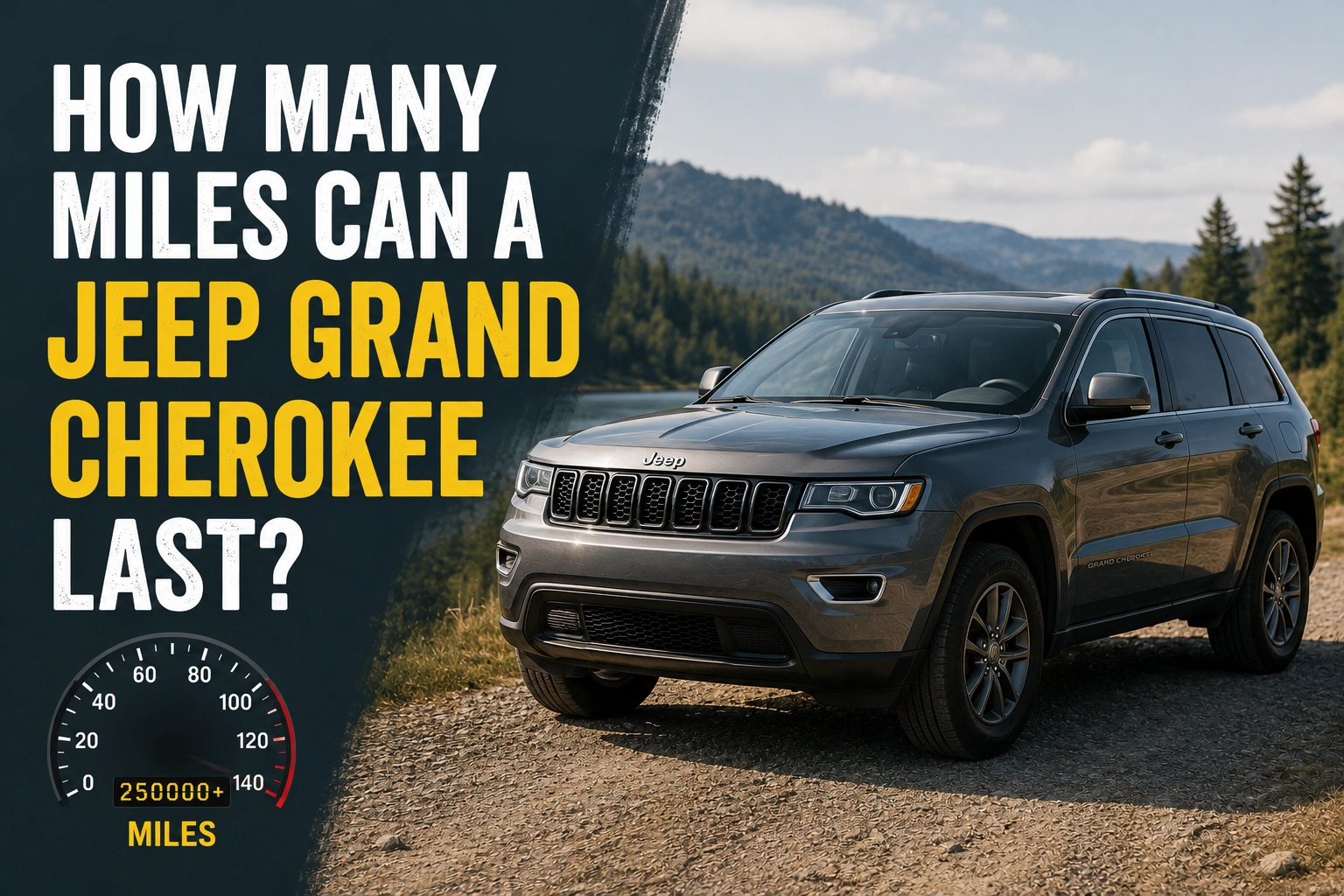
Three hundred thousand miles sounds like a stretch for a midsize SUV, yet plenty of Jeep Grand Cherokee owners have crossed that number and kept driving. Others watch their Cherokee limp toward the junkyard well before 150,000 miles, worn down by skipped oil changes and ignored warning lights.
That gap between best-case and worst-case outcomes is wider on this SUV than on most rivals. The reason comes down to generation, engine choice, and how the truck gets treated over the years.
Jeep built the Grand Cherokee to handle rock trails, snow-packed highways, and daily school runs with equal ease. That rugged reputation only holds up when maintenance keeps pace with the odometer.
Real mileage data, the engines worth trusting, the generations worth watching, and the habits that separate a 300,000-mile Cherokee from a 120,000-mile scrap-yard candidate all sit below, broken down year by year and part by part.
How Many Miles Can A Jeep Grand Cherokee Really Last
Most Grand Cherokees settle into a comfortable 150,000 to 200,000-mile service life with routine care. A meaningful share push past 250,000, and a smaller group crosses 300,000 without a rebuilt engine or transmission.
Long-term ownership data puts the average closer to 142,000 miles, with roughly one in eight examples reaching the 200,000-mile mark. That figure reflects the entire population of Grand Cherokees on the road, including trucks that sat through missed oil changes and unresolved recalls.
A cared-for example clears that average with room to spare. This gap between the statistical average and the realistic ceiling really comes down to maintenance discipline rather than engine design.
Highway-heavy driving pushes the number higher still, since steady cruising speeds put far less strain on an engine than constant stop-and-go traffic. A Grand Cherokee used mostly for interstate commuting often outlasts an identical truck used for short city errands, even at the same total mileage.
Generation matters too. Older, mechanically simpler trucks built before heavy electronic control units frequently outlast newer ones on raw mechanical parts, even if their cabins feel dated by comparison.
| Generation | Model Years | Realistic High-Mileage Ceiling | Standout Long-Haul Engine |
|---|---|---|---|
| ZJ | 1993–1998 | 200,000–250,000 miles | 4.0L Inline-Six |
| WJ | 1999–2004 | 200,000+ miles | 4.7L PowerTech V8 |
| WK | 2005–2010 | 200,000–250,000 miles | 3.7L V6 |
| WK2 | 2011–2021 | 200,000–300,000 miles | 3.6L Pentastar V6 |
| WL | 2022–Present | Data still developing | 3.6L Pentastar V6 |
These numbers reflect well-maintained examples reported by owners and technicians, not a guaranteed outcome for every unit of that generation.
Highest Mileage Grand Cherokees On Record
Owner forums and dealership service logs are full of Grand Cherokees that refused to quit on schedule. A 1997 model recently crossed 299,000 miles on its original drivetrain, with its owner crediting nothing fancier than consistent fluid changes.
A 2015 Grand Cherokee running the 5.7L HEMI V8 reportedly reached 286,000 miles under daily commuter use, still pulling strong compression numbers at that point. Neither truck needed a major engine rebuild to get there.
Among early 2000s trucks, the 4.0L inline-six earns a near-mythical reputation with long-time Jeep owners. Examples with 200,000-plus miles show up often enough that mechanics rarely blink at the number, and the engine’s simple pushrod design leaves less to fail.
These high-mileage examples share a pattern worth noticing. None of them skipped basic service, and none sat unused for long stretches, which causes its own damage through dried gaskets and stale fluids.
Key Factors That Decide Your Grand Cherokee’s Lifespan
Two Grand Cherokees can roll off the same assembly line and end up decades apart in usable life. Engine choice sets the ceiling, and daily habits decide whether that ceiling ever gets reached.
Climate plays a quiet role too. Trucks from road-salt states fight rust on brake lines and subframes long before their engines show real wear, while desert-region examples often fail through sun-baked interior parts and overworked AC systems first.
Body style and trim add another layer. Air-suspension-equipped Overland and Summit trims ride beautifully but carry extra components that eventually need attention, while a base Laredo on steel springs simply has fewer parts that can fail with age.
Engine Choice And Long-Term Durability
The 3.6L Pentastar V6 is the safest long-term bet in the current WK2 and WL lineup. It powers a huge slice of the Stellantis catalog, from minivans to pickups, so parts stay cheap and any independent mechanic already knows its quirks.
Stepping up to the 5.7L HEMI V8 brings more muscle and a genuine shot at 250,000-plus miles, but almost every example develops a cold-start tick as exhaust manifold bolts loosen under heat cycles. It’s a known, well-documented flaw rather than a mystery problem, and shops fix it with upgraded hardware.
Diesel buyers get the 3.0L EcoDiesel V6, offered between 2014 and 2019, which rewards attentive owners with strong torque and real fuel savings. It also punishes neglect faster than the gas engines, with rod bearings, oil coolers, and EGR coolers as the parts most likely to fail once service gets pushed past due dates.
Older trucks running the 4.0L inline-six or 4.7L V8 trade modern refinement for mechanical simplicity, which historically means fewer failure points as the miles climb.
Driving Habits And Terrain That Wear Parts Faster
Short trips are harder on a Grand Cherokee than long highway stretches. Cold starts under five miles rarely let the oil reach full temperature, which lets condensation and unburned fuel contaminate it faster than the mileage alone would suggest.
Towing near the rated limit stresses the transmission and cooling system more than any other single part. An aftermarket transmission cooler is a cheap way to add years to an automatic gearbox used for regular towing duty.
Heavy off-road use accelerates wear on control arms, ball joints, and skid-plated components, even on Trail Rated trims built for it. A quick inspection after rough trails catches loose bolts and torn boots before they turn into bigger repairs.
Extended idling, common in extreme heat or cold climates, adds engine hours without adding miles, which quietly throws off maintenance schedules based purely on odometer readings.
Common Mechanical Problems Across Grand Cherokee Generations
Electrical faults top the complaint list across nearly every Grand Cherokee generation, ahead of engine or transmission issues combined. That pattern shows up consistently in complaint records going back to the WJ years.
Trucks from 2011 through 2013 carry the heaviest reputation for trouble, largely due to a failure-prone electrical control unit sitting under the hood, exposed to heat and moisture. Fuel pump shutdowns and hard-to-start complaints trace back to that single part on those model years.
An 8-speed automatic transmission, introduced for 2014, needed real software and hardware maturity before it settled down. Early complaints centered on harsh, delayed shifts, while a rotary gear selector on some trims drew safety recalls after drivers thought the truck was parked when it wasn’t.
Raw complaint counts by year can mislead shoppers, since a more popular model year simply generates more reports even at a normal failure rate. Weighing complaints against sales volume for that year gives a fairer read than the headline number alone.
Suspension parts join the list on higher-mileage trucks, particularly control arm bushings and, on air-ride trims, the compressor and air springs themselves. A truck that rides noticeably softer or louder than it used to is usually flagging a part nearing the end of its life.
| Generation | Watch-Out Years | Most Common Complaint |
|---|---|---|
| WJ | 1999–2000 | Transmission shift quality, wiring grounds |
| WK | 2005–2007 | Oil leaks, front suspension wear |
| WK2 | 2011–2013 | Electrical control unit failures, stalling |
| WK2 | 2014–2015 | Transmission hesitation, touchscreen freezes |
| WL | 2022–2023 | Software bugs, early-production recalls |
Electrical And Infotainment Glitches Owners Report Often
Uconnect infotainment freezes rank among the most repeated complaints on WK2 and WL trucks, usually solved with a software update rather than new hardware. A frozen screen alone rarely signals a deeper electrical fault.
Backup camera delays and phantom dashboard warning lights show up often enough to earn their own threads on owner forums. Loose grounding connections or a weakening battery cause a surprising share of these false alarms.
Key fob battery drain is a smaller but persistent complaint, particularly on trucks that sit unused for several days at a stretch. A tired battery struggles to keep the modules that support the fob system awake.
None of these quirks typically strand a driver on their own, but they add up in shop visits and can mask a genuinely failing component if ignored too long. Treating repeat warning lights as background noise remains the most common owner mistake.
Maintenance Practices That Add Years To Your Jeep
Jeep’s factory schedule calls for service every 7,500 miles or six months, whichever comes first. Sticking to that rhythm, rather than stretching intervals to save money, is the single biggest factor separating high-mileage survivors from early trade-ins.
Skipping one oil change rarely kills an engine outright. A pattern of skipped changes across several years is what quietly shortens a Grand Cherokee’s working life.
| Mileage Marker | Service Task |
|---|---|
| Every 7,500 miles / 6 months | Oil and filter change, tire rotation, brake check |
| 30,000 miles | Replace air filter and fuel filter |
| 60,000 miles | Inspect spark plugs and timing chain |
| 90,000 miles | Replace hoses, flush steering fluid, inspect suspension |
| 100,000–150,000 miles | Replace drive belt, inspect PCV valve |
| 150,000+ miles | Transmission fluid service, coolant flush, bushing check |
Running a few thousand miles past these markers rarely causes harm. Ignoring them by tens of thousands of miles is where real damage compounds, since worn fluid stops protecting parts long before a dashboard light admits there’s a problem.
Fluids And Parts That Matter Most
Coolant deserves more attention than most owners give it, since the Pentastar V6 and HEMI V8 both rely on aluminum components sensitive to old, acidic coolant. A flush every five years or 100,000 miles protects the water pump and radiator far more than the cost suggests.
Transmission fluid matters even more on the 8-speed-equipped WK2 and WL trucks. This gearbox runs tighter tolerances than older transmissions, and degraded fluid shows up as harsh, hesitant shifts long before any warning light appears.
Four-wheel-drive models add a differential and transfer case fluid change to the list, typically every 30,000 to 60,000 miles depending on how much towing or off-roading the truck sees. Owners who only track engine oil often miss this step entirely.
Synthetic oil is worth the extra cost across nearly every Grand Cherokee engine option. It holds up better to the heat cycles behind the HEMI’s exhaust manifold issues, and it flows more consistently during the cold starts that stress the Pentastar V6 hardest.
Buying Or Keeping A High-Mileage Grand Cherokee
A Grand Cherokee typically retains a little over half its original value after five years, which softens the sting of depreciation compared with some rivals. That retention rate makes clean, higher-mileage examples a genuinely rational buy rather than a compromise.
Chasing the lowest odometer reading often means paying a steep premium for a handful of extra years of statistical safety margin. A truck with 140,000 miles and full service records frequently outlasts a neglected one carrying half that mileage.
Trade-in timing matters for current owners too. Values tend to soften noticeably once a Grand Cherokee crosses the 150,000-mile mark, so keeping and maintaining a paid-off truck past that point often beats trading toward a new loan and restarting the depreciation curve.
Inspection Checklist Before You Buy A Used Unit
- Ask for complete service records, not just a Carfax summary, and look for consistent oil change gaps.
- Listen for a cold-start tick on HEMI-equipped trucks, a strong sign of the common exhaust manifold bolt issue.
- Run the transmission through every gear at low speed, checking for delayed or harsh engagement.
- Check for open recalls tied to the VIN, especially electrical control unit issues on 2011 to 2013 trucks.
- Bounce each corner of the suspension on air-ride trims to catch a sagging or failing air spring early.
- Inspect the frame and brake lines closely on any truck that spent winters in a road-salt region.
A used Grand Cherokee that passes every point on that list is a fair bet at nearly any mileage. One that fails two or three points might still be fine, but it belongs in a negotiation, not a full-price deal.
The mileage number that matters most isn’t printed on any spec sheet. It’s the one attached to a truck with clean records, a healthy electrical system, and an owner who never treated the boring stuff as optional.
A few common questions from Grand Cherokee owners and shoppers:
How many miles can a Jeep Grand Cherokee last before major repairs pile up?
Most owners start seeing bigger-ticket repairs, like transmission service or suspension component replacement, somewhere past 150,000 miles. A Grand Cherokee with consistent service history often pushes that point closer to 200,000 miles before anything major comes due, especially on trucks running the 3.6L V6.
What counts as high mileage for a Jeep Grand Cherokee?
Anything over 150,000 miles is generally treated as high mileage in the used market, though the truck itself doesn’t necessarily agree. A well-documented example at that mark can still have half its usable life ahead of it, particularly once the timing chain, transmission, and suspension have all been checked.
Which Jeep Grand Cherokee engine holds up best over time?
The 3.6L Pentastar V6 has the strongest reputation for long-term ease of ownership, mainly because it’s shared across so many Stellantis models that parts and repair knowledge stay cheap and widely available. The 5.7L HEMI V8 lasts just as long mechanically but comes with a well-known exhaust manifold bolt issue that most owners eventually address.
Is a Jeep Grand Cherokee still reliable after 100,000 miles?
Yes, provided the maintenance schedule was followed and no major warning signs were ignored along the way. Reliability past that mark depends far more on service history and how the truck was driven than on the odometer number by itself.
How much should I plan to spend yearly maintaining a Grand Cherokee?
Annual repair and maintenance costs average a little under $700, roughly in line with other midsize SUVs in its class. Costs run lower for well-maintained trucks with clean histories and climb sharply for ones with deferred repairs stacking up.
Should I buy a used Grand Cherokee with over 150,000 miles on it?
A high-mileage example with full service records and a clean inspection is often a smarter buy than a low-mileage truck with an unknown history. Mileage alone tells a much smaller part of the story than most shoppers assume, and a cheap price on a neglected truck rarely stays cheap for long.