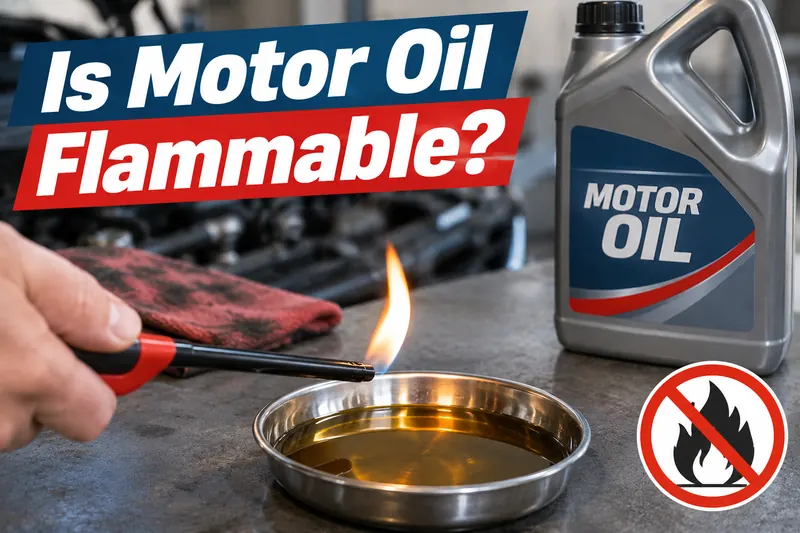
Motor oil is a petroleum-based lubricant designed to protect an engine under conditions involving heat, pressure, friction, and constant mechanical movement. Because it is derived from petroleum, many people naturally assume that it behaves like gasoline or another highly flammable automotive fluid.
The reality is more nuanced. Motor oil can burn, but ordinary engine oil is much harder to ignite than gasoline because it generally produces far less vapor at normal temperatures.
That distinction matters when storing oil in a garage, changing engine oil, cleaning an engine bay, dealing with an oil leak, or responding to a vehicle fire. The temperature of the oil, the amount present, ventilation, the presence of an ignition source, and whether the oil is spread into a thin film can all change the fire risk.
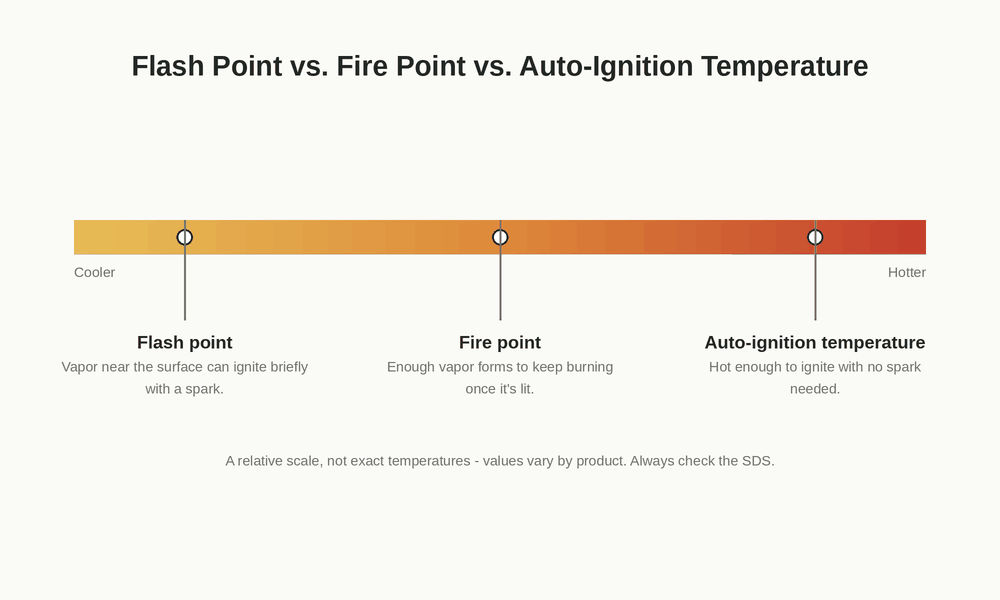
The most useful measurement is the flash point, which describes the temperature at which a liquid produces enough vapor near its surface to form an ignitable mixture with air. OSHA uses flash point as a primary factor when evaluating liquid fire hazards.
Is Motor Oil Flammable Or Combustible?
The short answer is that motor oil can catch fire and burn, but typical motor oil should not be treated as though it has the same ignition behavior as gasoline.
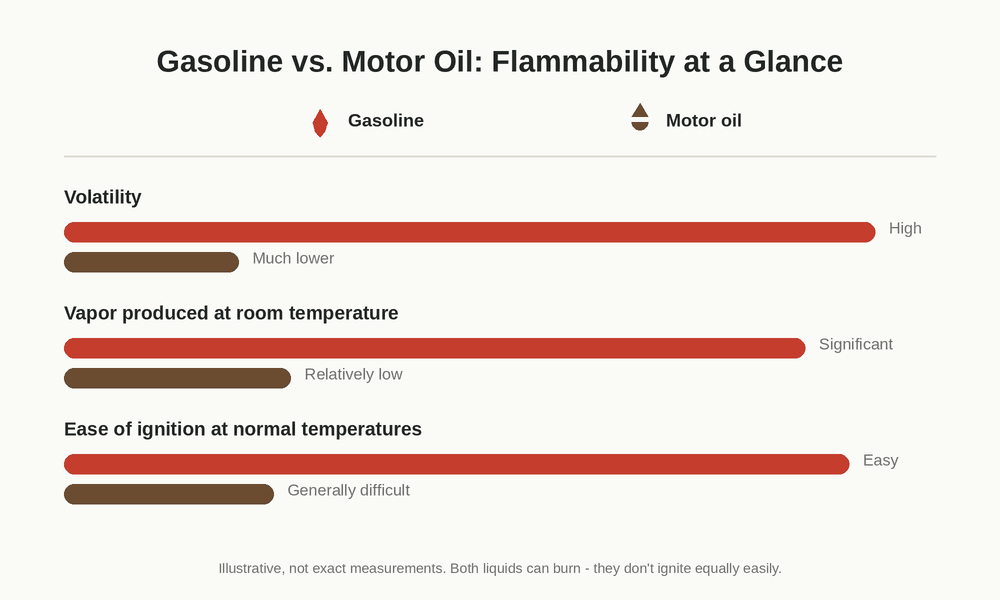
The difference comes largely from volatility. Gasoline evaporates readily at ordinary temperatures, creating a substantial amount of vapor that can mix with air and ignite. Engine oil is much thicker and less volatile. At normal ambient temperatures, it generally produces considerably less vapor.
That does not make motor oil fireproof.
A hot surface, open flame, spark, or sufficiently high temperature can ignite oil vapors. Once oil is burning, the fire can continue as long as there is enough heat and oxygen to sustain combustion.
This is why an engine-oil leak onto a very hot exhaust manifold or turbocharger can be a serious fire hazard even though the oil sitting in a bottle in a cool garage is much harder to ignite.
OSHA defines flash point as the minimum temperature at which a liquid gives off enough vapor to form an ignitable mixture with air near the surface. Under OSHA’s Hazard Communication criteria, liquids with flash points above 93°C (199.4°F) are outside the four flammable-liquid categories, although a material can still burn when sufficiently heated.
That distinction is important because people often use “flammable” and “burnable” as though they mean exactly the same thing.
They do not.
| Property | Gasoline | Motor Oil |
|---|---|---|
| Volatility | High | Much Lower |
| Vapor Production At Room Temperature | Significant | Relatively Low |
| Easily Ignited At Normal Temperatures | Yes | Generally Much More Difficult |
| Can Burn? | Yes | Yes |
| Flash Point | Very Low Compared With Engine Oil | Generally Much Higher |
| Major Vehicle Fire Concern | Fuel Vapor And Liquid Fuel | Hot Surfaces, Leaks, Heated Oil And Oil-Soaked Materials |
| Storage Consideration | High Fire Hazard | Still Requires Proper Storage |
| Best Reference | Product SDS | Product SDS |
Exact properties vary between products. Conventional mineral oils, synthetic motor oils, diesel-engine oils, racing lubricants, and specialized fluids can have different formulations and physical properties.
That is why there is no single flash-point number that applies to every bottle labeled motor oil.
The product’s Safety Data Sheet (SDS) is the appropriate reference for the specific formulation. OSHA’s SDS requirements include physical and chemical properties such as flammability, flash point, auto-ignition temperature, boiling point, and vapor pressure.
What The Flash Point Actually Means
Flash point is one of the most misunderstood terms in automotive fire safety.
It does not mean the temperature at which the entire liquid suddenly catches fire.
Instead, it refers to the temperature at which the liquid produces enough vapor near its surface to create an ignitable mixture with air when an ignition source is introduced.
That means a liquid can have a relatively high flash point and still burn once it is already hot enough.
It also means that simply saying “motor oil is not flammable” would be inaccurate.
A better description is that typical motor oil is much less volatile and much harder to ignite than highly volatile fuels, but it remains a combustible petroleum product capable of burning under appropriate conditions.
OSHA specifically distinguishes the ease of ignition based on flash point. Its guidance notes that flash point and auto-ignition temperature are two important measurements when evaluating fire hazards.
Auto-ignition temperature is different from flash point. Flash point involves an external ignition source. Auto-ignition refers to the temperature at which a substance can ignite without an external flame or spark.
Those two temperatures should never be treated as interchangeable.
Why Hot Motor Oil Is More Concerning
Temperature changes the fire risk significantly.
Cold or room-temperature oil has relatively low vapor production. As the oil becomes hotter, evaporation increases and more combustible vapor can be generated.
This is one reason an oil leak inside an operating engine compartment deserves more attention than a sealed bottle of unused oil sitting on a shelf.
Engine components can become extremely hot.
Exhaust manifolds, turbocharger components, catalytic converters, exhaust pipes, and other parts may reach temperatures capable of igniting leaked fluids or oil-soaked materials under the right conditions.
The oil itself does not have to behave like gasoline for an engine-oil leak to create a fire hazard.
A small leak dripping directly onto a hot exhaust component can produce smoke at first. If enough oil accumulates and the temperature remains high, ignition can occur.
That is why persistent oil leaks should be repaired rather than dismissed simply because engine oil has a high flash point compared with gasoline.
What Makes Motor Oil Catch Fire?
Motor oil needs the right combination of fuel, heat, oxygen, and an ignition source for an ordinary fire to develop.
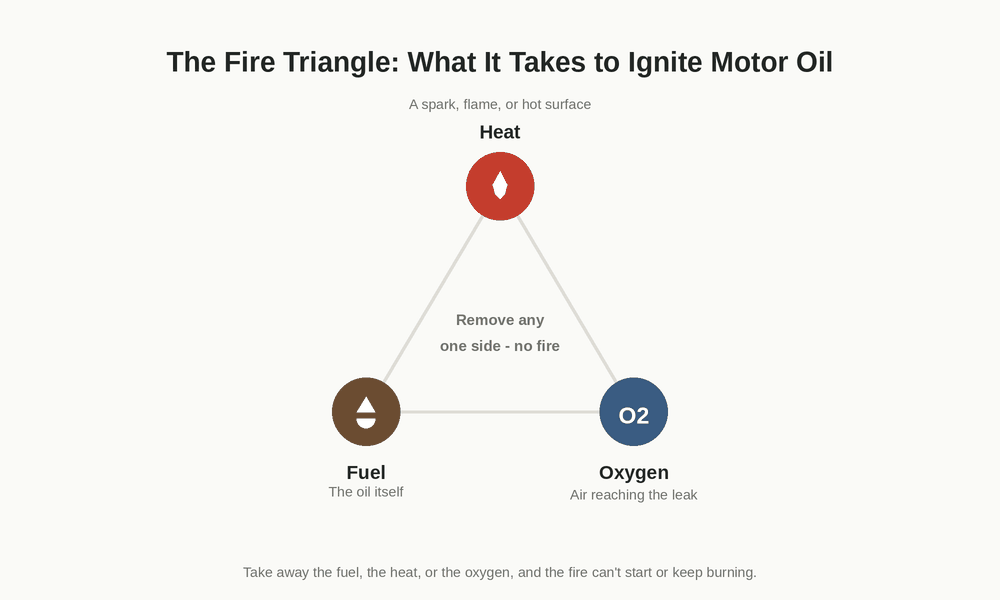
Removing one part of that combination can prevent ignition or stop combustion.
This is the basic principle behind fire prevention.
A sealed container of oil has fuel, but it has limited interaction with atmospheric oxygen. A cool bottle sitting in a garage is therefore very different from oil sprayed or spilled onto a hot engine component.
The physical form of the oil matters too.
A large pool of relatively cool oil behaves differently from a fine mist, thin film, or oil-soaked rag exposed to heat.
The greater the exposed surface area, the more opportunity there is for vaporization and interaction with oxygen.
This is why an oil leak that spreads across a hot surface can be more dangerous than the same amount of oil remaining inside a closed engine.
Engine Oil Leaks And Hot Exhaust Components
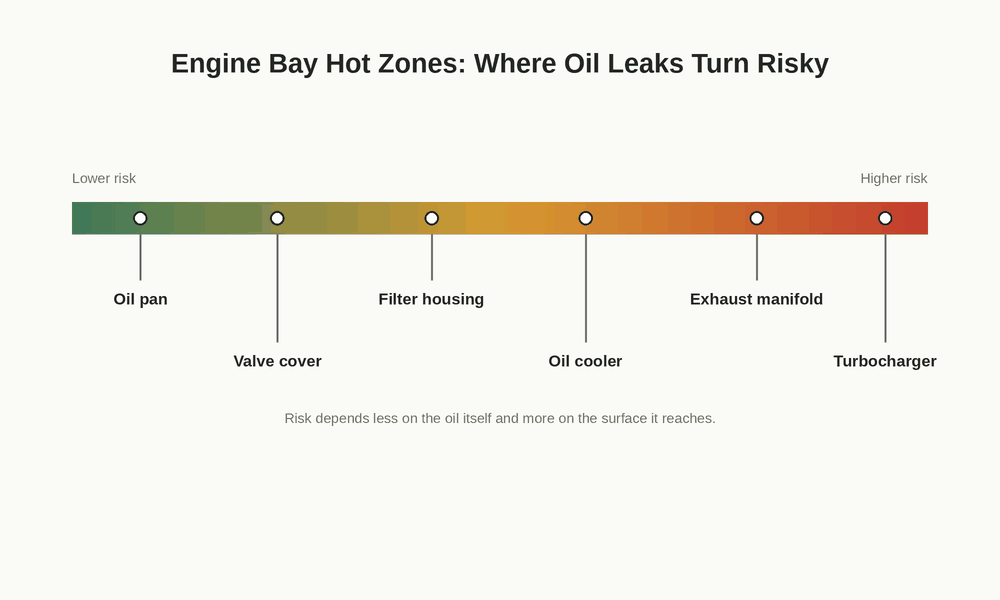
One of the most important real-world fire scenarios involving motor oil is an engine-oil leak.
Common leak points include:
- Valve-cover gaskets
- Oil-filter housing seals
- Oil pan gaskets
- Front and rear crankshaft seals
- Camshaft seals
- Turbocharger oil lines
- Oil cooler seals
- Drain plugs
- Filter seals
- Crankcase ventilation components
Not every leak creates an immediate fire risk.
A small leak that reaches the lower portion of the engine may simply leave oil spots underneath the vehicle.
A leak that allows oil to reach the exhaust manifold, turbocharger, downpipe, or another extremely hot component is more concerning.
Smoke from the engine bay can be an early warning sign.
The smell can also provide a clue. Burning engine oil often produces a strong acrid odor that is very different from the smell of fresh motor oil.
If smoke is coming from under the hood, the safest response is to pull over somewhere away from traffic and other hazards, shut the engine off, and assess the situation from a safe location.
Do not reach into an engine compartment that may contain active flames.
Oil-Soaked Rags And Absorbent Materials
Used shop rags create a different type of concern.
A rag containing engine oil may not burst into flames simply because it contains oil. However, oily rags should not be treated like ordinary dry fabric.
Used oil can remain combustible, and contaminated materials can present a fire hazard when stored improperly near heat or ignition sources.
The safest practice is to follow local requirements for storing and disposing of oily rags and automotive waste.
Do not leave heavily oil-soaked rags in a pile next to a heater, welding equipment, electrical equipment, or another heat source.
The broader lesson is simple: the physical environment matters as much as the chemical itself.
A liquid that is difficult to ignite in one situation can become much more hazardous when distributed across absorbent material and exposed to heat.
Can A Cigarette Ignite Motor Oil?
It is dangerous to assume that a cigarette is incapable of igniting automotive fluids simply because motor oil is not highly volatile.
A cigarette’s ability to ignite a particular material depends on temperature, vapor concentration, airflow, the physical form of the material, and other factors.
A pool of relatively cool motor oil is not equivalent to gasoline vapor.
But adding an open flame or other ignition source around petroleum products is unnecessary risk.
The safest workshop practice is to keep smoking, flames, welding, grinding sparks, heaters, and other ignition sources away from oil spills and automotive fluids.
This is especially important when oil is mixed with other substances.
A used drain pan may contain not only engine oil but traces of fuel, solvent, brake cleaner, coolant, or other chemicals. The resulting mixture may have different fire characteristics from clean unused motor oil.
How Hot Does Motor Oil Have To Get To Burn?
There is no universal temperature at which every motor oil suddenly catches fire.
Different formulations have different flash points, and the actual fire behavior depends on the test method, pressure, oxygen availability, contamination, surface area, and ignition source.
That is why a product-specific SDS is more useful than a generic internet number.
OSHA requires SDS physical-property information to include flash point and other characteristics because these properties can differ among chemical products.
API also notes that engine-oil testing can include flash point among other physical and performance properties.
The flash point is therefore a useful reference, but it should not be interpreted as a safe operating temperature.
For example, if an oil’s flash point is listed on its SDS, that does not mean the oil is completely incapable of burning below that temperature. Nor does it mean that reaching that temperature guarantees immediate ignition.
A flash-point test is a standardized measurement of vapor ignition under defined testing conditions.
Real-world conditions are more complicated.
| Term | Meaning | Why It Matters |
|---|---|---|
| Flash Point | Temperature at which enough vapor forms to ignite under specified test conditions | Indicates relative ease of ignition |
| Fire Point | Temperature at which vapor generation can sustain combustion under test conditions | More closely related to continued burning |
| Auto-Ignition Temperature | Temperature at which ignition can occur without an external ignition source | Important for very hot surfaces |
| Vapor Pressure | Tendency of a liquid to produce vapor | Helps indicate volatility |
| Combustible | Capable of burning under suitable conditions | Important for storage and handling |
These terms are related but not interchangeable.
Why The Oil Temperature In An Engine Matters
Motor oil operating inside an engine can become much hotter than the oil sitting in a storage container.
The oil circulates through areas exposed to combustion-generated heat, bearings, turbochargers, piston assemblies, and other components.
Modern engines use cooling systems and oil-control systems to keep temperatures within designed limits, but localized temperatures can still become very high.
A turbocharged engine is a good example.
Turbocharger bearings and surrounding components operate in a very hot environment. The oil feeding the turbocharger must withstand high thermal stress while continuing to lubricate moving components.
If an oil line develops a leak near a hot turbocharger housing, the fire risk is much greater than that of a sealed container of the same oil sitting on a garage shelf.
This is one reason turbocharger oil leaks should not be ignored.
The same principle applies to oil leaking onto exhaust components.
Synthetic Oil Versus Conventional Oil
People sometimes assume synthetic motor oil must be nonflammable because it is engineered to withstand higher temperatures.
That conclusion is incorrect.
Synthetic and conventional engine oils are both capable of burning under appropriate conditions.
Synthetic oils are formulated differently and can have different volatility, thermal stability, oxidation resistance, and other physical properties. However, they remain lubricating oils rather than fire-resistant fluids.
The exact flash point depends on the formulation.
That means comparing one generic “synthetic oil flash point” against one generic “conventional oil flash point” is not a reliable way to determine fire safety.
The product SDS provides the relevant information for the specific oil.
API’s engine-oil licensing system evaluates physical, chemical, and performance characteristics of licensed oils, and testing may include flash point among other properties.
The better question is therefore not:
“Is synthetic oil flammable?”
The better question is:
“What are the fire-related properties of this specific product, and how is it being stored or used?”
How To Store Motor Oil Safely
Motor oil is commonly stored in home garages, workshops, dealerships, parts stores, service centers, and industrial facilities.
Proper storage is straightforward.
Keep containers sealed when not in use.
Store them away from unnecessary heat.
Keep them away from open flames, welding operations, sparks, and high-temperature equipment.
Avoid storing oil where a vehicle could accidentally crush or damage the container.
Use the original container whenever practical because the label provides important product information.
Do not transfer automotive fluids into an unlabeled drink bottle or another container that could be mistaken for something else.
The storage area should also allow you to identify leaks quickly.
A container that has slowly leaked into cardboard, insulation, wood, or other absorbent material should be cleaned appropriately rather than left indefinitely.
What To Do With An Oil Spill
A small oil spill should be controlled promptly.
First, eliminate ignition sources.
Do not operate a flame-producing tool around the spill.
Stop the leak if it can be done safely.
Use an appropriate absorbent material and collect the contaminated material according to local disposal requirements.
Do not simply wash engine oil into a storm drain or onto the ground.
Used oil and oil-contaminated materials can create environmental problems as well as fire and slip hazards.
For a large spill, especially indoors or near drains, ignition sources, or waterways, professional spill-response guidance may be appropriate.
The specific cleanup requirements vary by location and the quantity involved.
Can Motor Oil Explode?
Motor oil itself does not normally behave like an explosive material.
That distinction is important.
A container of engine oil does not normally explode simply because it is exposed to an ordinary flame in the same way a pressurized fuel system or certain volatile chemical mixtures might.
However, heating a sealed container can create dangerous pressure.
A container exposed to a major fire can rupture or become involved in the fire even if the oil itself is relatively difficult to ignite under normal conditions.
The surrounding environment also matters.
An automotive workshop can contain gasoline, solvents, aerosols, batteries, tires, compressed gases, and other materials. A fire involving several products can therefore become much more severe than a fire involving motor oil alone.
Never assume that a workshop is safe simply because the main lubricant present has a relatively high flash point.
Fire safety must consider the entire environment.
What To Do If Motor Oil Catches Fire
A motor-oil fire should be treated as a real fire, not something that can safely be handled with improvised methods.
If oil catches fire inside a vehicle or garage, prioritize personal safety.
Turn off the engine or equipment if you can do so without approaching the flames.
Move away from the fire.
Keep other people away.
Call emergency services when the fire is beyond your ability to control safely.
Never pour water onto a burning oil fire.
Water can spread burning oil and make the situation significantly worse.
The appropriate extinguisher depends on the fire classification and local safety requirements. In many settings, an extinguisher rated for Class B flammable-liquid fires is used for petroleum-based liquid fires, but users should follow the extinguisher label and local fire-safety guidance.
Do not attempt to fight a rapidly growing vehicle fire simply because you have an extinguisher.
A small fire can become much larger very quickly, particularly around an engine compartment where fuel, plastic components, electrical wiring, insulation, and other materials are present.
Why Water Is A Poor Choice
Oil and water do not mix in the way many people expect.
If water reaches burning oil that is hot enough, the water can rapidly turn to steam. That sudden expansion can eject burning oil outward and spread the fire.
This is one of the reasons ordinary water extinguishing methods are inappropriate for many cooking-oil and petroleum-liquid fires.
A person standing nearby can be injured by splashing burning liquid.
The correct response is to use appropriate firefighting equipment or leave the area and call emergency responders.
When An Engine Oil Leak Becomes An Emergency
A small oil spot underneath a parked vehicle is not automatically an emergency.
An active leak onto a hot exhaust component is different.
Watch for:
- Smoke from the engine compartment
- Burning-oil odor
- Oil dripping onto the exhaust
- Visible flames
- Rapidly falling oil level
- Oil spraying under pressure
- Warning lights accompanied by smoke
- Overheating
- Fire near fuel-system components
If smoke or flames appear while driving, pull over as soon as safely possible.
Turn off the engine.
Get everyone out of the vehicle.
Move away from traffic and from the vehicle.
Do not open the hood fully if flames are visible underneath it because opening it can introduce additional oxygen and expose you to heat and flames.
Call emergency services.
The safest response is to create distance rather than trying to diagnose the leak while the engine is hot.
Final Thoughts On Is Motor Oil Flammable
So, is motor oil flammable? Motor oil can absolutely burn, but ordinary engine oil is considerably less volatile and harder to ignite than gasoline. Its relatively high flash point means it generally does not produce large amounts of ignitable vapor at normal temperatures, but sufficient heat can make oil vapors combustible and allow the oil to burn.
The distinction between flammable, combustible, flash point, and auto-ignition is important. OSHA uses flash point as a major factor in classifying liquid fire hazards, while the product’s Safety Data Sheet provides the specific physical and fire-related properties for that formulation.
For vehicle owners, the biggest practical concern is usually not a sealed bottle of engine oil suddenly catching fire. It is oil leaking onto a very hot engine or exhaust component, particularly around turbochargers, exhaust manifolds, and other high-temperature areas.
A clean oil spill in a cool location is a different situation from oil sprayed across a hot surface.
Temperature, surface area, oxygen, contamination, and ignition sources all influence the outcome.
Store oil in sealed, labeled containers away from unnecessary heat and ignition sources. Clean spills promptly, dispose of used oil responsibly, and repair engine leaks rather than allowing oil to accumulate around hot components.
Most importantly, never use water on a burning oil fire. If an automotive oil fire is growing or cannot be safely controlled immediately with appropriate equipment, get away from the vehicle and contact emergency services.
FAQs
Is Motor Oil Flammable?
Motor oil can burn, but ordinary engine oil is much less volatile than gasoline and is generally much harder to ignite at normal temperatures. Its exact fire characteristics depend on the formulation, so the manufacturer’s Safety Data Sheet is the best reference for the specific product. OSHA uses flash point as a key measurement when evaluating liquid fire hazards.
Can Motor Oil Catch Fire On A Hot Engine?
Yes. An oil leak can become a fire hazard when it reaches extremely hot components such as an exhaust manifold, turbocharger housing, or other exhaust parts. The risk is different from a bottle of cool oil because the hot surface can increase vapor generation and provide a strong ignition source.
What Temperature Does Motor Oil Catch Fire?
There is no single temperature that applies to every motor oil. Different formulations have different flash points and other fire-related properties. Flash point describes when sufficient vapor can form an ignitable mixture under specified test conditions; it does not mean the entire oil instantly catches fire at that temperature. Check the product’s SDS for its specific flash point.
Can You Put Water On A Motor Oil Fire?
Water should not be used to fight a burning oil fire because it can cause burning oil to spread or be violently displaced. The appropriate firefighting method depends on the type and size of the fire and the equipment available. For a vehicle fire that is growing or producing significant flames or smoke, move away and contact emergency services.
Is Synthetic Motor Oil Flammable?
Synthetic motor oil can burn under appropriate conditions. Being synthetic does not make engine oil fireproof. Synthetic formulations can have different physical properties from conventional oils, so the flash point and other safety information should be checked in the product-specific SDS rather than assuming all synthetic oils have identical characteristics.
Is Used Motor Oil More Flammable Than New Motor Oil?
Used oil can contain fuel, combustion byproducts, additives, metals, dirt, and other contaminants picked up during engine operation. Its physical properties can therefore differ from fresh oil. Because the exact composition depends on the engine and service history, used oil should be handled as a potentially combustible petroleum product and stored in suitable closed containers away from heat and ignition sources.