Oil leaks are among the most common maintenance concerns on an aging vehicle, but the cost of fixing one can vary dramatically. An oil gasket replacement may be a relatively inexpensive repair when the leaking seal is easy to reach, yet the bill can become considerably higher when the gasket sits between major engine components or requires extensive disassembly.
The term “oil gasket” is also broader than it sounds. A leak may come from an oil pan gasket, valve cover gasket, timing cover seal, oil filter housing gasket, front or rear crankshaft seal, or another sealing surface. Each component has a different replacement procedure, labor requirement, and parts cost.
That is why an estimate based only on the phrase oil gasket replacement cost can be misleading. The most useful approach is to identify exactly where the oil is escaping, determine whether the leak is minor or severe, and then compare parts, labor, diagnostic time, and related repairs. Knowing what goes into the estimate also makes it easier to recognize when a quote is reasonable and when further diagnosis is needed.
Oil Gasket Replacement Cost And What You Are Actually Paying For
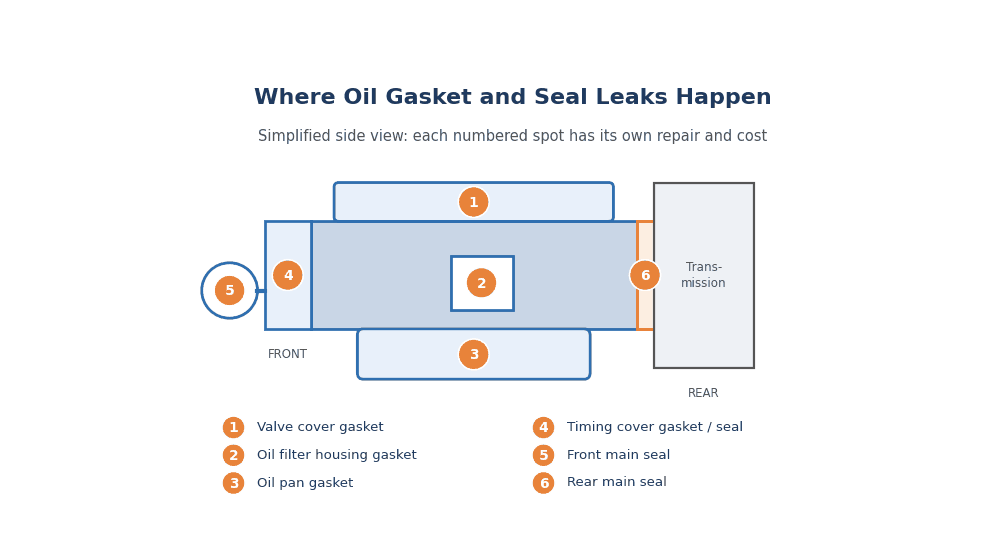
For many vehicles, the gasket itself is not the expensive part. Labor is often the largest portion of the final repair bill because reaching the leaking gasket can require removing other components.
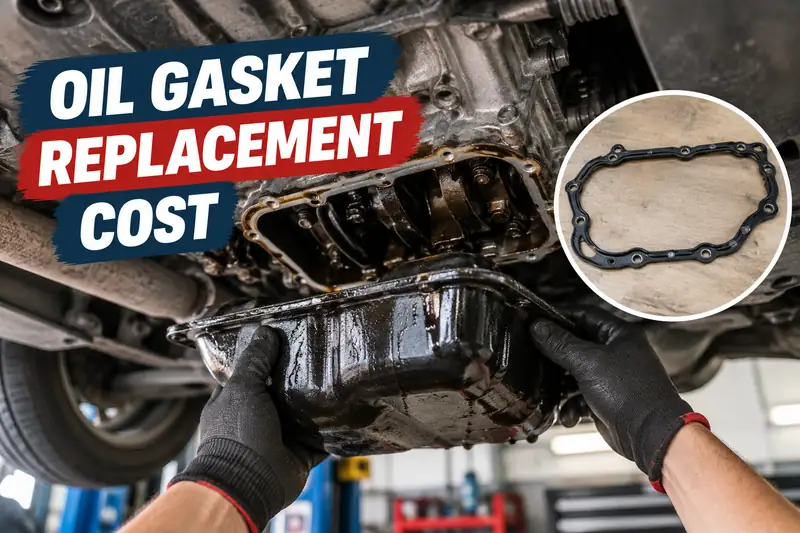
A simple valve cover gasket replacement may involve removing the cover, cleaning the mating surfaces, installing the new gasket, and reinstalling the components. An oil pan gasket can be more involved depending on vehicle design and whether suspension components, exhaust parts, brackets, or other components interfere with access.
More difficult leaks can involve seals positioned deep within the engine. A rear main seal, for example, may require substantial transmission-related work before the seal can be reached.
A useful way to look at the repair is:
Total Repair Cost = Diagnosis + Parts + Labor + Fluids + Additional Required Work
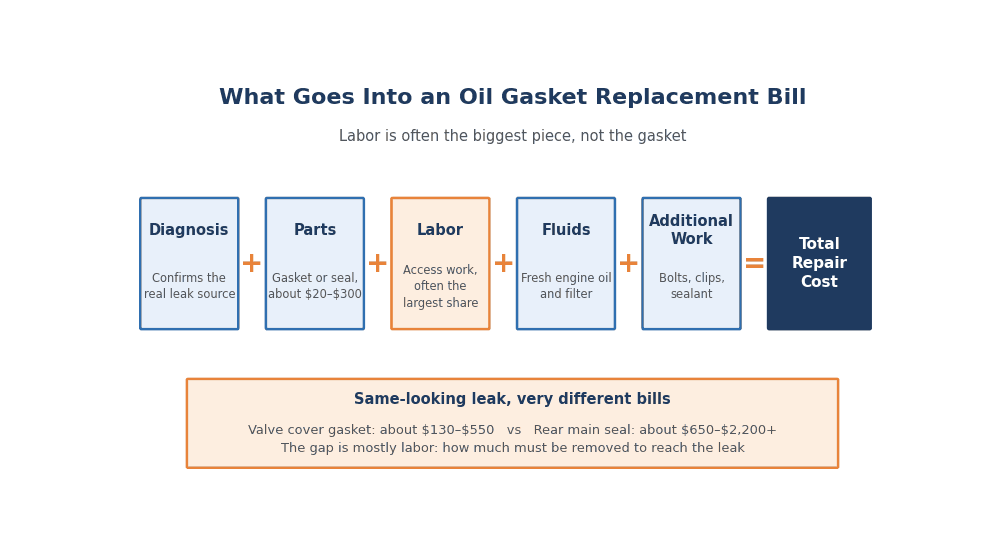
This explains why two vehicles with what appears to be the same oil leak can receive very different estimates.
Typical Oil Gasket Replacement Cost Ranges
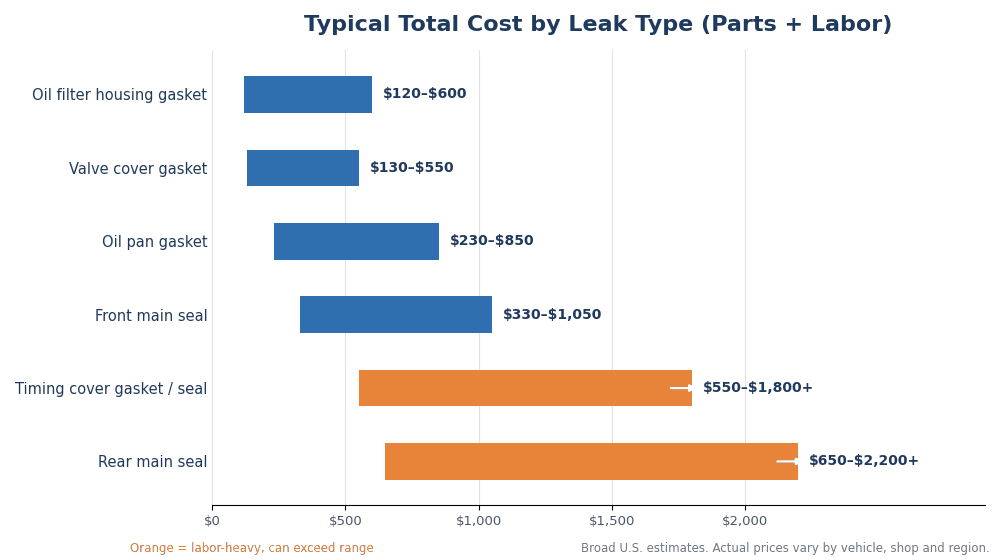
Prices vary by vehicle, location, engine design, shop labor rate, gasket quality, and the amount of additional work required. The following figures are broad U.S. estimates rather than fixed prices.
| Repair | Typical Parts Cost | Typical Labor Cost | Approximate Total |
|---|---|---|---|
| Valve Cover Gasket | $30–$150 | $100–$400 | $130–$550 |
| Oil Pan Gasket | $30–$150 | $200–$700 | $230–$850 |
| Oil Filter Housing Gasket | $20–$100 | $100–$500 | $120–$600 |
| Timing Cover Gasket/Seal | $50–$300 | $500–$1,500+ | $550–$1,800+ |
| Front Main Seal | $30–$150 | $300–$900 | $330–$1,050 |
| Rear Main Seal | $50–$200 | $600–$2,000+ | $650–$2,200+ |
These are general ranges. Some vehicles can fall well outside them because of engine configuration, manufacturer design, regional labor rates, or additional repairs discovered during disassembly.
Dealership pricing can also be higher than an independent repair shop because labor rates and operating costs differ.
Why Labor Can Cost More Than The Gasket
A gasket may cost only a few dozen dollars, but replacing it properly can take several hours.
The technician may need to:
- Raise and safely support the vehicle
- Remove shields or covers
- Drain engine oil
- Remove obstructing components
- Separate the old sealing surface
- Clean old gasket material
- Inspect the mating surfaces
- Install the new gasket
- Apply sealant where specified
- Reassemble the components
- Refill the engine with oil
- Start the engine
- Check for leaks
Some engines also require specific tightening sequences and torque specifications.
This is important because gasket replacement is not simply a matter of removing an old rubber or composite piece and inserting a new one. The sealing surfaces need to be clean and correctly assembled.
Parts Quality Also Affects The Estimate
There can be a significant difference between a low-cost aftermarket gasket and an original-equipment or high-quality aftermarket component.
For common applications, reputable aftermarket manufacturers can offer excellent products. However, extremely cheap sealing components may have questionable material quality, poor dimensional accuracy, or inconsistent durability.
The correct choice depends on the vehicle and application.
For a straightforward gasket that is easy to replace, saving a modest amount on the part may not justify using an unknown component because the labor required to replace it again can exceed the original savings.
Diagnostic Cost Should Not Be Confused With Repair Cost
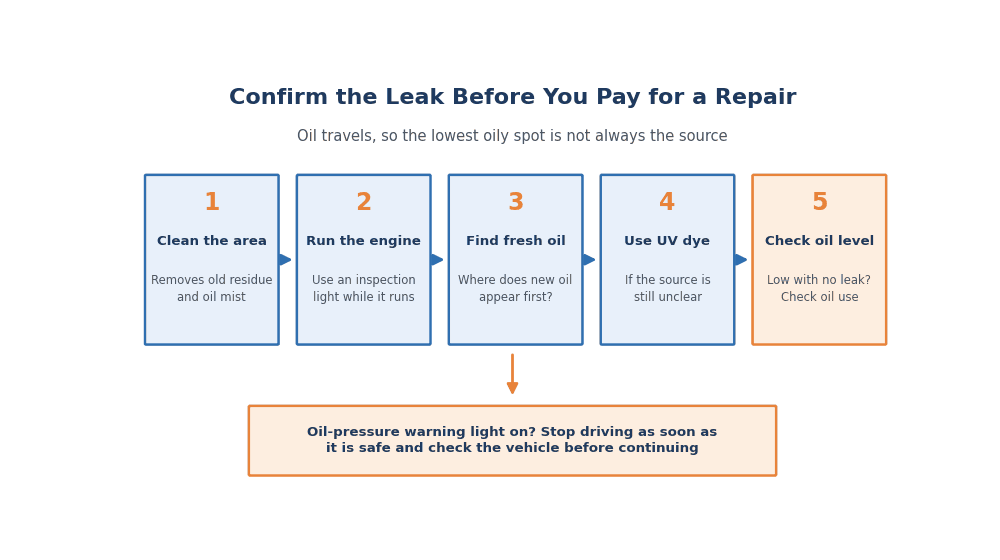
A professional shop may charge a diagnostic fee before replacing any component.
That is reasonable when the source of an oil leak is not obvious.
Oil can travel along engine surfaces before dripping onto the ground. For example, oil leaking from a valve cover can run down the side of the engine and make it appear as though a lower gasket is leaking.
A technician may clean the area, use an inspection light, run the engine, and monitor where fresh oil first appears.
Some leaks require dye and ultraviolet inspection when the source is difficult to identify.
Paying for accurate diagnosis can therefore prevent an unnecessary gasket replacement.
Factors That Make Oil Gasket Replacement More Expensive
The location of the leak is usually the biggest factor, but several other details influence the final price.
Engine Design And Accessibility
Two engines can perform the same function while having completely different service layouts.
On one vehicle, a valve cover may be immediately accessible from the top of the engine. On another, the cover may sit beneath intake components, ignition components, wiring, brackets, or other equipment.
The same principle applies to oil pans.
Some oil pans can be removed easily after draining the oil. Others may require moving structural components or supporting part of the drivetrain before the pan can be separated.
This is why labor estimates should be based on the specific vehicle rather than a generic gasket replacement price.
Oil Pan Gasket Replacement
The oil pan is located at the lower portion of the engine and stores engine oil in many vehicle designs.
An oil pan leak can occur because of a failed gasket, damaged sealing surface, loose fasteners, corrosion, impact damage, or excessive sealant problems.
The replacement procedure typically involves draining the oil, removing the pan, cleaning the mating surfaces, inspecting the pan for distortion or cracks, installing the appropriate gasket or sealant, and refilling the engine with the correct oil.
Some vehicles use a traditional gasket while others use a manufacturer-specified liquid sealant.
That distinction matters because using the wrong sealant or applying too much can cause another leak or allow excess material to enter areas where it does not belong.
Valve Cover Gasket Replacement
Valve cover gaskets are another common source of engine oil leaks.
The valve cover seals the upper portion of the engine and prevents oil from escaping around the cylinder head area.
A failing gasket may produce oil around the top or side of the engine. Oil can also reach spark plug wells on some engine designs, potentially causing ignition problems if the leak becomes severe.
Valve cover replacement is often less expensive than major engine seals because the component is usually accessible from above.
However, labor can increase if the vehicle has multiple valve covers or difficult access.
Oil Filter Housing Gasket
Some engines use a separate oil filter housing or oil cooler assembly with its own seals and gaskets.
When those seals deteriorate, oil may leak down the engine block and create the appearance of a much larger leak.
This is particularly important on engines where the housing is mounted in a difficult location.
A correct diagnosis can prevent replacing a different gasket simply because oil has migrated away from its original source.
Timing Cover And Front Seal Repairs
Timing-related oil leaks can be more expensive because the front portion of the engine may contain numerous components.
Depending on the vehicle, accessing the timing cover can involve removing belts, pulleys, brackets, accessories, or other components.
If the timing system is already being serviced for another reason, combining repairs can sometimes reduce duplicated labor.
For example, if major timing-system components are already being removed, it may be practical to address an accessible seal or gasket at the same time if the manufacturer recommends it and the additional parts cost is justified.
The exact repair strategy should be based on the vehicle’s service procedure rather than automatically replacing every nearby seal.
Rear Main Seal Replacement
A rear main seal is one of the repairs most likely to generate a substantial labor bill.
The seal is positioned where the engine crankshaft exits toward the transmission. Access can require significant drivetrain disassembly.
That is why a rear main seal can have a relatively inexpensive part but a high overall replacement cost.
There is also an important diagnostic issue: oil leaking near the transmission does not automatically mean the rear main seal has failed.
Transmission fluid, engine oil, and other fluids can migrate through the area. Correct fluid identification and leak tracing are important before authorizing an expensive repair.
How To Tell If A Gasket Is Really Leaking
An oil spot under a vehicle does not identify the leaking component by itself.
Oil can travel considerable distances across an engine before gravity causes it to drip. Airflow can spread oil across additional components while the vehicle is moving.
That is why looking underneath the vehicle and seeing oil near the oil pan is not enough to conclude that the oil pan gasket is responsible.
Check The Location Of Fresh Oil
Fresh oil is generally more useful diagnostically than an old oily surface.
An engine can accumulate years of residue, dust, and oil mist. The lowest and dirtiest area may not be the original leak source.
After the engine is properly cleaned, a technician can observe where fresh oil first appears.
This creates a much more reliable diagnostic picture.
Look At Oil Level And Leak Severity
Check the engine oil level using the procedure specified by the vehicle manufacturer.
If the oil level is significantly low, the leak should receive prompt attention.
A small seep that leaves occasional residue may not have the same urgency as a leak that produces visible drops after every drive.
However, even a slow leak should not simply be ignored indefinitely.
Running an engine with insufficient oil can result in severe internal damage.
Oil Leaks Versus Oil Consumption
Not every low oil level is caused by an external gasket leak.
Some engines consume oil internally through piston rings, valve seals, turbocharger systems, or other mechanisms.
A vehicle can therefore have low oil without leaving a visible puddle underneath.
If oil level repeatedly falls but external leaks cannot be found, the diagnosis needs to consider oil consumption as well.
Oil Leak Inspection Checklist
| Observation | Possible Direction |
|---|---|
| Oil around top of engine | Valve cover or upper engine seal |
| Oil running down engine side | Upper leak migrating downward |
| Oil concentrated around oil pan edge | Oil pan or nearby source |
| Oil near transmission bellhousing | Rear main seal or another fluid source |
| Oil around filter housing | Housing gasket/seal |
| Oil near crankshaft pulley | Front seal or timing cover area |
| Oil with burning smell | Oil reaching hot exhaust components |
| No visible external leak | Possible internal consumption |
These observations are clues rather than definitive diagnoses.
How To Save Money Without Cutting Corners
The best way to reduce gasket repair costs is not necessarily to find the cheapest gasket. It is to reduce unnecessary labor and avoid replacing components that are not actually defective.
Get The Leak Diagnosed Before Ordering Parts
A shop should be able to explain where the oil is believed to be coming from and why.
If the source is uncertain, ask whether the engine needs cleaning or additional leak testing.
This is particularly valuable when the estimate involves a high-labor repair such as a rear main seal or timing cover gasket.
A proper diagnosis can cost less than an incorrect repair.
Ask For A Written Estimate
A useful estimate should separate major categories.
For example:
| Estimate Item | What To Ask |
|---|---|
| Diagnosis | Is leak location confirmed? |
| Parts | Which gasket or seal is being replaced? |
| Labor | How many labor hours? |
| Engine Oil | Is fresh oil included? |
| Filter | Is an oil filter included? |
| Sealant | Is manufacturer-specified sealant required? |
| Additional Parts | Are any bolts, clips, or seals required? |
| Taxes/Fees | Are these included in the quoted total? |
This makes estimates from different repair facilities easier to compare.
Ask Whether Related Work Can Be Combined
If another repair already requires removal of the same components, combining the work may reduce duplicated labor.
For example, certain timing-system repairs involve removing components that also provide access to oil seals.
However, this does not mean every nearby gasket should automatically be replaced.
Parts should be replaced when inspection, service recommendations, or the repair procedure justify doing so.
Don’t Choose A Repair Shop Based Only On The Lowest Quote
A very low estimate may exclude diagnostic time, fluids, additional seals, or necessary labor.
A more useful comparison is to ask what is included in each estimate.
Two shops quoting different prices may actually be proposing different scopes of work.
One might quote only the gasket, while another includes oil, filter, cleaning, inspection, and post-repair leak testing.
The cheapest number on the page is therefore not always a meaningful comparison.
When An Oil Leak Needs Immediate Attention
Not every oil leak requires the same level of urgency, but certain symptoms should not be ignored.
If the engine oil warning light comes on, stop driving as soon as it is safe to do so and check the vehicle according to the manufacturer’s instructions.
An oil-pressure warning is different from a simple reminder to check the oil level. Low oil pressure can indicate a serious lubrication problem and continued engine operation may cause major damage.
Other warning signs include:
- Rapid oil loss
- Large puddles under the vehicle
- Smoke from the engine compartment
- Burning oil smell
- Oil reaching hot exhaust components
- Repeated low oil-level warnings
- Unusual engine noises
- Visible oil spraying rather than slowly seeping
A leak that appears minor can become more serious if a gasket suddenly fails.
Can You Drive With A Leaking Oil Gasket?
The answer depends on leak severity, oil level, and where the oil is going.
A very slow seep with a stable oil level may allow limited driving while arrangements are made for repair. A rapidly leaking engine should not be driven because oil loss can become severe in a short period.
The location also matters.
Oil dripping onto an exhaust component can create smoke and potentially increase fire risk. Oil reaching belts or other components can cause secondary problems.
If there is any uncertainty about whether the vehicle is safe to drive, having it inspected or transported is safer than relying on assumptions.
Why Ignoring A Small Leak Can Become Expensive
A gasket leak does not necessarily remain at the same rate forever.
Rubber and composite sealing materials age due to heat cycles, pressure, chemical exposure, and mechanical movement. A minor seep may gradually become a visible leak.
Oil can also contaminate nearby components.
For example, oil reaching rubber components, electrical connectors, ignition parts, or belts can create secondary problems depending on the location.
Repairing the original leak before these additional problems develop can therefore reduce the total ownership cost.
Final Thoughts On Oil Gasket Replacement Cost
Oil gasket replacement cost depends far more on which gasket is leaking and how difficult it is to reach than on the price of the gasket itself. A simple valve cover gasket may be relatively straightforward, while an oil pan, timing cover, or rear main seal can require considerably more labor.
The most important step is accurate leak identification. Oil frequently travels from one part of the engine to another, making visual inspection alone unreliable. Cleaning the area, monitoring fresh oil, checking fluid characteristics, and using appropriate diagnostic methods can prevent an expensive misdiagnosis.
When comparing estimates, look beyond the total number. Check the labor hours, gasket quality, oil and filter costs, sealant requirements, additional parts, taxes, and whether post-repair leak inspection is included.
A good repair is not simply one that stops the visible drip. The sealing surfaces need to be prepared correctly, the correct gasket or seal installed, fasteners tightened according to specification, and the engine checked afterward.
For vehicle owners, the practical rule is straightforward: identify the exact source, compare the complete repair scope, and address significant oil loss before it develops into an engine problem.