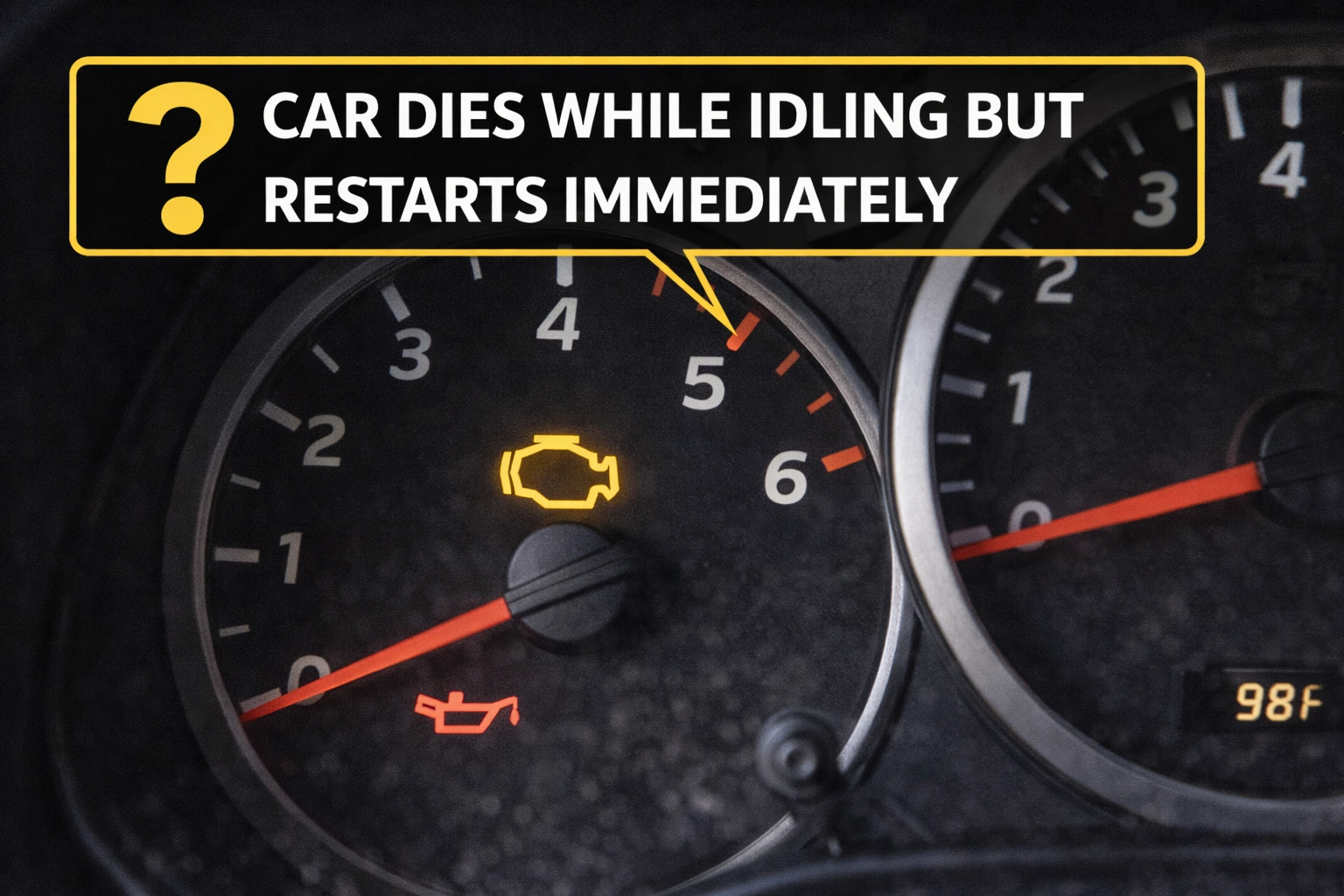
Few car problems are as unsettling as an engine that suddenly stalls while idling, only to restart without hesitation seconds later. It often happens at traffic lights, in parking lots, or while warming up — never at a convenient time.
Because the car restarts immediately, many drivers assume it’s a fluke and keep driving. That’s understandable, but it’s not always wise.
When a car stalls at idle but restarts immediately, it usually means three important things:
- The engine is mechanically capable of running — catastrophic failure is unlikely
- Fuel and spark are present at least intermittently — the system isn’t completely dead
- The problem is often related to airflow, sensors, or idle control — not internal engine damage
Key Insight: At idle, engines operate with very tight margins. Airflow is minimal, fuel delivery is precise, and the engine relies heavily on sensors and control systems to maintain around 600–800 RPM in most modern vehicles. A small disruption — too little air, incorrect sensor data, or unstable fuel pressure — can cause the engine to stall even though it runs perfectly fine at higher speeds.
This guide is written for everyday drivers, DIY-minded owners, and anyone trying to decide whether a stalling issue is minor, manageable, or a sign of something more serious. We’ll break down why a car can die at idle but restart right away, what systems are most commonly involved, and how to approach diagnosis without guessing or overspending.
Note
This article is based on established engine diagnostic principles and real-world failure patterns documented in OEM service manuals, manufacturer Technical Service Bulletins (TSBs), and professional automotive repair databases including ALLDATA, Mitchell 1, and Identifix.
Additional reference was made to Bosch and Denso engine management documentation, ASE training materials, and emissions-system diagnostic guides used in professional workshops.
How Engine Idle Works
Before diagnosing the problem, it helps to understand what the engine is doing at idle.
At idle, your engine runs at its lowest stable RPM — typically 600–900 RPM for most gasoline engines. To achieve this, several systems work together in real time:
| System | Role at Idle |
| Throttle body / IAC | Controls air volume entering the engine |
| MAF / MAP sensor | Measures airflow or manifold pressure for fuel calculation |
| Fuel injectors | Deliver a precise, lean fuel pulse |
| Ignition system | Fires at the exact correct timing |
| ECU (Engine Control Unit) | Coordinates all of the above simultaneously |
| Oxygen sensors | Provide feedback to trim fuel delivery |
When any one of these systems delivers slightly wrong data or slightly wrong output, the engine may not receive the precise air-fuel ratio it needs to sustain idle. The result: stall.
The reason it restarts immediately is that most of these failures are transient — the sensor hiccups, the valve sticks briefly, or the pressure drops momentarily — then recovers enough for ignition to succeed again.
For a deeper understanding of engine management systems, the Bosch Automotive Handbook is one of the most comprehensive references available to the public.
Most Common Causes
1. Dirty or Failing Idle Air Control (IAC) System
The idle air control system regulates how much air bypasses the throttle plate when your foot is off the accelerator. If it sticks, gets clogged with carbon, or responds too slowly, the engine may not get enough air to stay running at low RPM.
How it fails: The IAC valve (or electronic throttle body on modern vehicles) has a small passage that allows air to enter even when the throttle plate is fully closed. Over time, carbon deposits from blow-by gases narrow this passage. In many vehicles, carbon buildup can reduce airflow by 20–30% — enough to stall an engine at idle.
Typical symptoms:
- Stalls only at idle, never while driving
- Restarts immediately after stall
- Rough or fluctuating idle RPM (“hunting” idle)
- More noticeable when engine is fully warm
- May resolve temporarily in cold weather
Vehicles most affected: High-mileage vehicles, cars driven mostly in stop-and-go traffic, engines with direct injection (which produces more carbon deposits)
DIY Diagnosis: With a basic OBD-II scanner, check for codes P0505–P0509 (IAC system codes). Even without codes, a visual inspection of the throttle bore — a flashlight and mirror reveal carbon buildup clearly.
Fix:
- Throttle body and IAC cleaning: $20–$40 DIY, $100–$200 at a shop
- Use a dedicated throttle body cleaner — not carburetor cleaner or brake cleaner
Important: Do not replace before cleaning. Cleaning resolves this issue far more often than replacement. A new IAC valve installed into a dirty throttle body will fail at the same rate.
2. Vacuum Leaks (Especially Small or Intermittent Ones)
At idle, engines run on a precise stoichiometric air-fuel ratio of approximately 14.7:1 (by weight). A small vacuum leak introduces unmetered air — air the MAF sensor never measured — leaning out the mixture enough to stall the engine.
How it fails: Vacuum hoses are made of rubber that dries, cracks, and shrinks with age and heat cycling. At idle, engine vacuum is at its peak (typically 15–20 inHg), so even a pinhole crack draws in significant unmetered air. At higher RPMs, vacuum drops and the leak becomes proportionally less significant, which is why the car may run fine while driving but stall at idle.
Common vacuum leak locations:
- Cracked or disconnected vacuum hoses (especially small-diameter ones behind the intake)
- PCV valve or PCV hose
- Intake manifold gaskets (especially on vehicles with plastic lower intakes)
- Brake booster supply line
- EVAP purge solenoid vacuum port
- Throttle body gasket
Typical symptoms:
- Idle stalling, especially when warm
- Subtle hissing sound from engine bay
- Higher idle RPM than normal at times (ECU adding fuel to compensate)
- Check engine light may or may not appear (P0171 or P0174 — system running lean)
Data point: Even a vacuum leak equivalent to a 2–3 mm hose crack can destabilize idle while remaining unnoticed at higher RPM.
DIY Diagnosis: Use a can of carburetor cleaner (carefully — it’s flammable). With the engine idling roughly, spray small amounts around vacuum hose connections and intake joints. If the idle momentarily smooths out, you’ve found your leak. A safer alternative is using a smoke machine, which mechanics use to pressurize the intake and visually locate leaks.
Fix:
- Hose replacement: $10–$50
- Intake manifold gasket: $200–$600 depending on engine configuration
- PCV valve + hose: $15–$80 DIY
3. Faulty Mass Airflow (MAF) Sensor
The MAF sensor sits between the air filter and throttle body and measures the volume and density of air entering the engine. The ECU uses this data to calculate fuel delivery. If the MAF under-reports airflow at idle, the engine receives too little fuel and stalls.
How it fails: The MAF sensor uses a heated wire or film element that can become contaminated with oil vapor (especially from a dirty air filter), dust, or silicone from certain aftermarket air filter oils. A contaminated MAF doesn’t necessarily fail completely — it may read accurately at higher airflow (highway driving) but be proportionally inaccurate at the low airflow levels seen at idle.
Typical symptoms:
- Stalls at idle but restarts easily
- Hesitation or stumble when coming to a stop
- Worse with A/C on (increased engine load)
- Sometimes no check engine light despite real inaccuracy
- Poor fuel economy
Practical insight: A MAF sensor that’s only 10–15% out of range can cause idle stalling without affecting highway driving — because at highway speeds, even a proportional error still provides enough fuel. At idle, that same percentage error falls below the survival threshold.
DIY Diagnosis: With a scanner that reads live data, check MAF sensor readings in grams per second (g/s). At idle, most 4-cylinder engines should read 2–7 g/s; 6-cylinders 5–10 g/s. Compare your reading to manufacturer specifications. You can also unplug the MAF sensor and try idling — if idle actually improves with it unplugged (the ECU switches to a default fuel map), the MAF is likely faulty.
Fix:
- MAF sensor cleaning with CRC MAF sensor cleaner: $10
- MAF sensor replacement: $150–$400 (OEM) or $50–$120 (aftermarket)
Critical warning: Never use brake cleaner, carburetor cleaner, or compressed air on a MAF sensor. The heated wire element is extremely fragile — wrong cleaners will destroy it instantly.
4. Throttle Body Carbon Buildup
Modern engines use electronic throttle control (ETC) — a drive-by-wire system with no mechanical cable between the accelerator pedal and throttle plate. Carbon buildup around the throttle plate reduces airflow at idle (when the plate is nearly closed), effectively choking the engine.
How it fails: Unlike older port-fuel-injected engines, many modern direct-injection engines (GDI) do not wash the intake valves and throttle body with fuel. Carbon deposits from crankcase blow-by accumulate over time. Some manufacturers have issued Technical Service Bulletins (TSBs) addressing carbon buildup as a known issue on specific models.
Typical symptoms:
- Stalls when coming to a stop from highway speeds
- Rough idle immediately after restart
- Happens more often after long highway drives (carbon loosens when warm)
- Idle quality gradually worsens over months
Vehicles most affected: GDI engines (common in vehicles after 2012), including many BMW, Audi, Volkswagen, Hyundai/Kia GDI engines, and GM EcoTec engines
Fix:
- Throttle body cleaning service: $50–$150
- Some manufacturers recommend cleaning every 30,000–60,000 miles as preventive maintenance
5. Failing Crankshaft or Camshaft Position Sensor
These sensors tell the ECU exactly where the engine’s pistons are in their rotation cycle, enabling precise fuel injection and ignition timing. If the signal drops briefly at idle, the ECU loses positional data and shuts down injection — causing an immediate stall. When signal returns, the engine restarts normally.
How it fails: Position sensors use a magnetic field disrupted by a notched reluctor ring. The sensors themselves can fail due to heat damage, vibration cracking internal wiring, or simple age. Critically, these sensors often fail intermittently for weeks or months before complete failure — which is why a stall-and-restart pattern is a classic early warning sign.
Typical symptoms:
- Sudden, instantaneous stall with no warning
- Immediate restart
- No check engine light initially (intermittent faults may not store codes)
- Problem worsens in frequency over time
- May eventually fail to start at all
Data point: Many position sensors fail intermittently before complete failure, sometimes for weeks or months. Waiting until complete failure means potentially being stranded.
DIY Diagnosis: Check for codes P0335–P0338 (crankshaft position sensor) or P0340–P0349 (camshaft position sensor). If no codes are stored, use a scope or graphing scan tool to watch the sensor waveform at idle — signal dropouts appear as flat sections in an otherwise regular wave pattern.
Fix: Sensor replacement: $150–$350 (parts + labor). These are relatively straightforward repairs on most engines.
Do not ignore this symptom. When the sensor fails completely, the car may not restart at all — and it can fail without warning while driving.
6. Fuel Delivery Issues
At idle, fuel pressure must remain stable. Weak fuel pumps or failing pressure regulators may drop pressure just enough to lean out the mixture and stall the engine — particularly after the vehicle has been running and fuel system components are heat-soaked.
How it fails: Fuel pumps are submerged in the fuel tank and cooled by the fuel itself. Running consistently on low fuel accelerates pump wear by reducing cooling. A pump in early failure may maintain adequate pressure at higher engine speeds (where ECU compensation is more forgiving) but drop below the threshold at idle.
Typical symptoms:
- Stalls at idle, especially when engine is hot
- Longer cranking times that develop gradually over weeks
- Worse symptoms with low fuel level in tank
- Occasional hesitation during acceleration
Numbers that matter: Most gasoline engines require 40–60 psi of fuel pressure. Drops below the lower end of that range at idle can cause lean-condition stalling. A fuel pressure gauge (available for ~$30) can confirm this without a shop visit.
Related component: A failing fuel pressure regulator can cause similar symptoms — vacuum-controlled regulators that stick open allow fuel to return to the tank too quickly, dropping rail pressure at idle.
Fix:
- Fuel pressure testing: $100 diagnostic fee at a shop, or DIY with a gauge
- Fuel pump replacement: $400–$1,000 (includes labor — most require tank removal)
- Fuel pressure regulator: $100–$300
7. EGR Valve Stuck Open
The Exhaust Gas Recirculation (EGR) valve reduces NOx emissions by routing a portion of exhaust gases back into the intake manifold to dilute the air-fuel charge. Critically, the EGR valve should be completely closed at idle — only opening partially under light-to-medium throttle at operating temperature.
How it fails: Carbon deposits from exhaust gases cause the EGR valve to stick partially open. At idle, this introduces inert exhaust gases into the air-fuel mixture, diluting oxygen levels below the threshold needed for combustion.
Typical symptoms:
- Rough, unstable idle
- Stalling at stops
- Check engine light (typically P0400–P0408 series codes)
- Engine runs fine at higher RPM (EGR contribution is proportionally smaller)
Fix:
- EGR valve cleaning: $100–$200
- EGR valve replacement: $150–$500 depending on location and vehicle
8. Bad Idle Speed Control Motor
On older vehicles with a mechanical throttle cable, a separate idle speed control (ISC) motor or stepper motor manages airflow at idle independently of the throttle plate. When this motor fails, the ECU loses its primary idle correction mechanism.
Typical symptoms:
- Idle RPM too low or irregular
- Stalls that worsen when accessories are switched on (A/C, headlights, rear defroster)
- More common in vehicles pre-2005
Fix: ISC motor replacement: $100–$300
9. Failing Ignition System
Worn spark plugs, failing ignition coils, or deteriorating ignition wires can cause cylinder misfires. At highway speeds, the engine can absorb misfires on one or two cylinders and still run smoothly. At idle, a misfire on even one cylinder can drop RPM low enough to stall the engine.
Typical symptoms:
- Rough idle with occasional stall
- Check engine light with misfire codes (P0300–P0308)
- May feel like a vibration or shudder at idle
Fix:
- Spark plug replacement: $50–$250 depending on engine
- Ignition coil: $100–$300 per coil
- Ignition wires (if applicable): $50–$150 set
The NGK Spark Plug Application Guide is a reliable free resource for finding correct spark plug specifications.
10. Battery or Alternator Problems
This is often overlooked, but an underperforming battery or failing alternator can cause idle stalls — particularly when electrical demand is high (A/C on, headlights, blower motor running).
How it fails: When alternator output drops or battery voltage sags under load, the ECU and fuel pump can receive insufficient voltage. Fuel pump output drops, sensors send incorrect voltage-dependent signals, and the engine stalls.
Typical symptoms:
- Stalls specifically when multiple electrical loads are active simultaneously
- Battery warning light
- Dimming headlights at idle
- Restarts immediately after stall
Fix:
- Battery test and replacement: $100–$250
- Alternator replacement: $300–$700
Step-by-Step Diagnosis at Home
If your car stalls at idle and restarts, here is the recommended diagnostic sequence before spending money:
Step 1: Note the Pattern
Keep a log of when stalls occur:
- Only when warm? Only when cold?
- Only with A/C on?
- At every stop or occasionally?
- After highway driving? After short trips?
This pattern narrows the cause significantly before any tools are used.
Step 2: Check for Warning Lights
A check engine light stores diagnostic trouble codes (DTCs) that point directly to the failing system. Even if the light isn’t on, an OBD-II scanner can reveal pending codes that haven’t triggered the light yet.
Step 3: Scan for Codes
Purchase or borrow an OBD-II scanner. Budget models start at $25–$40 and provide code reading. Better models ($100–$200) read live sensor data, which is far more useful for intermittent problems.
Relevant code ranges:
- P0100–P0103: MAF sensor circuit
- P0171 / P0174: System lean (vacuum leak or MAF)
- P0300–P0308: Misfire
- P0335–P0349: Crankshaft/camshaft position sensor
- P0400–P0408: EGR system
- P0505–P0509: IAC system
Step 4: Inspect Visually
With the engine off and cool:
- Check all vacuum hoses for cracks, splits, or disconnection
- Inspect the air filter (a severely clogged filter reduces airflow)
- Look at the PCV hose condition
- Check spark plug wires (if present) for cracks or burning
Step 5: Clean Before Replacing
For IAC and throttle body issues, cleaning is almost always the correct first step. It costs under $20 and resolves the issue in the majority of cases.
Step 6: Test Fuel Pressure
If cleaning and code checks reveal nothing, a fuel pressure test is the next logical step. A fuel pressure gauge screws directly onto the Schrader valve on the fuel rail (similar to a tire valve). Specifications are in your owner’s manual or service manual.
Reading OBD-II Trouble Codes
The OBD-II (On-Board Diagnostics, Generation 2) system has been standard on all vehicles sold in the US since 1996 and across the EU since 2004. It monitors hundreds of engine and emissions parameters continuously.
When a sensor or system falls outside its expected range, the ECU stores a Diagnostic Trouble Code (DTC) and may illuminate the check engine light.
Three important nuances:
- Codes point to systems, not parts. A P0171 (System Lean, Bank 1) indicates the engine is running lean — but the cause could be a MAF sensor, a vacuum leak, a fuel pressure issue, or an oxygen sensor. The code begins the diagnosis, it doesn’t end it.
- Intermittent faults may not store codes. If a sensor hiccups and recovers, the ECU may not log a code unless the fault occurs a defined number of times. A stall-and-restart pattern often produces no stored codes initially.
- Pending codes exist before the check engine light. Many scanners can read “pending” codes that haven’t triggered the light yet — these are valuable early warnings.
The EPA’s official OBD-II resource page and the Society of Automotive Engineers (SAE) maintain authoritative documentation on DTC standards.
When Is It Safe to Keep Driving?
This is the question most drivers ask first. Here is an honest, practical answer:
Generally Okay for Short Term
- Stalls only occasionally (once every few days or less)
- Restarts immediately, every time
- No check engine light or other warning lights
- No loss of power, hesitation, or rough running while actually driving
- No stalling at highway speed
Stop Driving — Address Immediately
- Stalling becomes more frequent — weekly → daily → multiple times per day is a clear progression
- Engine dies while slowing down — particularly dangerous at intersections
- Check engine light is flashing — a flashing CEL indicates an active misfire severe enough to damage the catalytic converter. Stop immediately.
- Car stalls and does not restart immediately — the underlying fault has worsened
- Stalling occurs at highway speeds — a fundamentally different and more dangerous situation
- Power steering or brake assist affected — both can be reduced when the engine stalls
Secondary damage risk: Repeated stalling cycles are hard on the starter motor, battery, and catalytic converter (raw fuel entering a hot cat causes damage). Addressing the issue early prevents these compounding repairs.
Repair Costs Breakdown
| Cause | DIY Cost | Shop Cost | Difficulty |
| IAC / Throttle body cleaning | $20–$40 | $100–$200 | ★☆☆☆☆ Easy |
| Vacuum hose replacement | $10–$50 | $100–$300 | ★★☆☆☆ |
| MAF sensor cleaning | $10 | $80–$120 | ★☆☆☆☆ Easy |
| MAF sensor replacement | $50–$150 | $200–$450 | ★★☆☆☆ |
| Throttle body cleaning | $20–$40 | $80–$200 | ★★☆☆☆ |
| EGR valve cleaning/replacement | $50–$150 | $200–$500 | ★★★☆☆ |
| Spark plugs | $30–$60 | $100–$300 | ★★☆☆☆ |
| Ignition coil | $30–$80 each | $150–$350 each | ★★☆☆☆ |
| Crankshaft position sensor | $20–$60 | $150–$350 | ★★★☆☆ |
| Fuel pump | $80–$300 | $400–$1,000 | ★★★★☆ Hard |
| Battery | $100–$200 | $150–$280 | ★☆☆☆☆ Easy |
| Alternator | $100–$250 | $300–$700 | ★★★☆☆ |
Common Mistakes Drivers Make
1. Replacing parts before cleaning them Carbon buildup on a throttle body or IAC valve is the single most common cause of idle stalling — and it costs $20 to clean. Many drivers spend $300 on a new throttle body when a $20 can of cleaner would have fixed it.
2. Ignoring the problem because the car restarts, a stall-and-restart pattern is the early stage of several failures that eventually become no-start situations. The crank sensor that causes an occasional stall today will eventually fail completely — possibly leaving you stranded.
3. Clearing codes without recording them If you use a scanner to clear a code before writing it down and researching it, you lose the only diagnostic information the car provided. Always photograph or write down codes before clearing.
4. Assuming stalling equals major engine failure The vast majority of idle stalling issues are sensor, airflow, or fuel delivery related — not internal engine damage. A car that stalls at idle but runs smoothly at highway speeds almost certainly has functioning pistons, rings, rods, and bearings.
5. Replacing the MAF with the wrong cleaner Using brake cleaner or carburetor cleaner on a mass airflow sensor destroys the heated wire element instantly. Only dedicated MAF sensor cleaners should ever touch the sensor element.
6. Skipping the fuel system Many drivers focus on air and ignition systems while overlooking fuel delivery. A weak fuel pump that drops pressure at idle produces identical symptoms to a vacuum leak or IAC fault. A $30 fuel pressure gauge test rules this out definitively.
Frequently Asked Questions
Why does my car stall only when idling with the A/C on?
Air conditioning adds a significant load — the A/C compressor clutch draws engine power when engaged. A healthy idle control system compensates automatically by opening the IAC valve slightly. A weak or dirty IAC system, or a failing alternator, cannot compensate for this added load, causing the idle to drop below the survival threshold and stall.
Can bad gasoline cause idle stalling?
Rarely, unless the fuel is significantly contaminated with water or diesel. Modern fuel systems and ECUs are designed to handle normal fuel quality variations. However, stale fuel (in a vehicle stored for months) can cause idle instability because it evaporates differently and has lower volatility.
Will a tune-up fix idle stalling?
Sometimes. If worn spark plugs are causing cylinder misfires that drop idle RPM below the stall threshold, new plugs resolve it. But idle stalling is statistically more often a sensor, airflow, or fuel system issue than an ignition issue. A tune-up is worthwhile maintenance regardless, but shouldn’t be expected to fix every idle stall.
Is intermittent idle stalling dangerous?
It can be. A stall at a traffic light in a busy intersection creates a real hazard — particularly if power steering (hydraulic) or brake booster assistance is temporarily reduced. Stalling while completing a turn at low speed is also dangerous because steering effort increases suddenly.
How long can I drive with this problem?
There’s no universal answer. A car that stalls once a week at idle and restarts immediately is less urgent than one stalling daily and taking two or three cranks to restart. Use the worsening-frequency signal: if it’s happening more often, act sooner. If it’s been stable for months, it’s still worth diagnosing but is less immediately urgent.
Why does it only happen when the engine is warm?
Thermal expansion changes tolerances throughout the engine. A cracked vacuum hose may seal when cold but open when the rubber expands. An IAC valve that operates normally when cold may stick when hot due to carbon binding. Fuel pumps that are marginal often perform worse when heat-soaked after a long drive. Warm-only stalling is a classic sign of a component that’s close to its failure threshold.
My car has no check engine light. Does that mean nothing is wrong?
No. Many intermittent faults don’t store codes unless they occur repeatedly or within a defined window. Early crank sensor failures, borderline MAF readings, and small vacuum leaks often cause real idle problems without triggering a code. The absence of a check engine light rules out confirmed, consistent faults — it does not rule out the fault causing your symptom.
Should I use a dealership or an independent shop?
For idle stalling diagnosis, an experienced independent shop with a quality scan tool (capable of reading live data, not just codes) is usually sufficient and more affordable. Dealerships have access to manufacturer-specific diagnostic software and TSBs, which can be valuable for vehicles where carbon buildup or sensor drift is a documented known issue. If an independent shop has diagnosed it as “nothing found,” a dealership visit may be warranted.
When a car dies while idling but restarts immediately, it’s rarely random — and it’s rarely catastrophic. Most of the time, the engine is signaling that idle control or airflow precision is compromised. The good news is that many fixes are affordable and straightforward when addressed early.
The hierarchy of probability:
- Dirty IAC / throttle body — most common, cheapest fix
- Vacuum leak
- MAF sensor (contaminated)
- Throttle body carbon deposits
- Crank/cam position sensor — most dangerous to ignore
- Fuel delivery
- EGR valve
- Ignition system
- Alternator/battery
The practical approach:
- Start with cleaning (throttle body, IAC, MAF) before buying any parts
- Scan for codes even without a check engine light — pending codes are informative
- Note the pattern — when it happens tells you almost as much as what codes are stored
- Address worsening symptoms promptly — a stall-and-restart that becomes a stall-and-won’t-restart often happens without warning
Treat idle stalling as a message — not an emergency, but not something to dismiss. A methodical approach will save money, reduce frustration, and keep your car reliable where it matters most: in everyday driving.