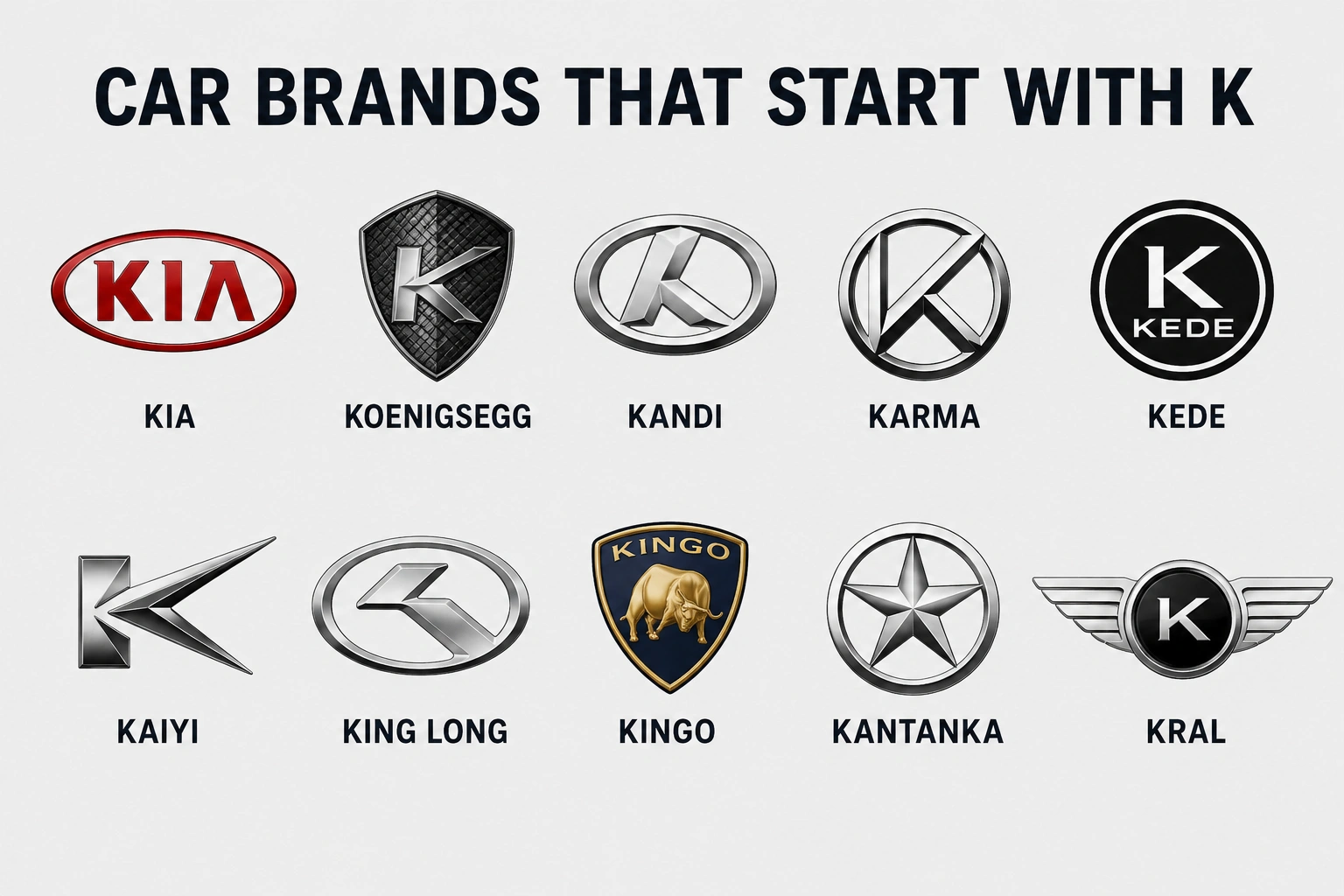
The letter K punches well above its weight in the automotive world. It opens the name of Kia, a brand that started building bicycles in South Korea in 1944 and has grown into one of the three largest automotive groups on the planet — posting its third consecutive all-time US sales record in 2025 with 852,155 units.
It gives us Koenigsegg, a Swedish hypercar manufacturer operating from a repurposed fighter jet hangar in Ängelholm that regularly breaks world speed records with vehicles costing north of two million dollars.
And it takes in everything between those extremes — Russian diesel trucks that dominate the Dakar Rally, Austrian motorcycle makers who decided to build a track-day supercar with Audi’s help, a Chinese ultra-luxury SUV that starts at over a million dollars, and a handful of extinct American manufacturers whose stories reveal as much about industrial history as they do about engineering. The brands beginning with K are genuinely varied, and each one is worth knowing.
All Car Brands That Start With K: The Complete Reference
1. Kia
Kia’s story is one of the most dramatic transformations in modern manufacturing history. The company was founded on 9 June 1944 in Seoul as Kyungsung Precision Industry, initially producing bicycle parts and steel tubing before graduating to complete bicycles and eventually motorcycles. The first Kia-branded car, the T-600 three-wheeled truck, appeared in 1962. Full passenger car production began in 1974 with the Kia Brisa, a small saloon based on a Mazda 1000 platform. For much of the following two decades, Kia operated as a modest domestic manufacturer, surviving a near-collapse during the 1997 Asian financial crisis that resulted in its acquisition by Hyundai Motor Company in 1998.
What followed that acquisition is one of the great corporate rehabilitation stories in automotive history. Under Hyundai’s ownership, Kia gained access to shared platforms, engineering resources, and capital that allowed it to accelerate product development in a way that would have been impossible independently. The brand hired Peter Schreyer — Volkswagen’s chief designer and the man responsible for the original Audi TT — as its chief design officer in 2006, and the visual transformation of the Kia lineup that followed was immediate and striking. The “tiger nose” grille, introduced across the range from 2010 onward, gave Kia a coherent design identity for the first time.
By the mid-2010s, Kia was producing vehicles that won segment awards in reliability, design, and value. By the early 2020s, it was producing vehicles that genuinely challenged established premium brands on quality and technology. The EV6 crossover, launched in 2021, won the 2022 European Car of the Year award — a landmark achievement for a brand that had been considered a budget alternative just a decade earlier. The EV9 electric three-row SUV launched in 2023 and won multiple international Car of the Year awards. In 2025, Kia America posted 852,155 units sold, its highest annual total ever and the third consecutive annual record — surpassing the 800,000 unit mark for the first time in the company’s history.
The brand’s 10-year/100,000-mile powertrain warranty in the United States — the longest of any mainstream manufacturer — reflects genuine confidence in product quality and has contributed significantly to building buyer trust over two decades. Kia’s Sportage, Telluride, and Carnival each posted best-ever annual sales in 2025, and the Sportage was the single best-selling Kia model globally in 2024 with 587,717 units. In Q1 2026, hybrid model sales grew 73% year-over-year, placing Kia firmly in the conversation as one of the fastest-growing electrified vehicle manufacturers in the world.
- Founded: 9 June 1944, Seoul, South Korea (as Kyungsung Precision Industry)
- Headquarters: Seoul, South Korea
- Parent: Hyundai Motor Group (acquired 1998)
- 2025 US sales: 852,155 units (all-time record, third consecutive year)
- 2024 global best-seller by model: Sportage — 587,717 units
- Key awards: EV6 — 2022 European Car of the Year; EV9 — 2024 World Car of the Year
- Warranty: 10-year/100,000-mile powertrain (USA); 7-year/150,000-km (UK/Europe)
- Current lineup: Picanto, Rio, Stonic, Soul, Seltos, Sportage, Sorento, Telluride, EV3, EV4, EV5, EV6, EV9, K4, K5, Carnival, PV5 (commercial EV)
2. Koenigsegg
In 1991, a 19-year-old Christian von Koenigsegg wrote a business plan for a company that would build the world’s greatest sports car. That plan sat in a drawer for three years before he founded Koenigsegg Automotive AB in 1994 in Ängelholm, Sweden, in a facility that had previously served as a Swedish Air Force base for Draken fighter jets. The company produced its first complete vehicle, the CC prototype, in 1996. By 2002, the CC8S had received road-legal homologation and became the first production car to officially exceed 100 hp per kilogram of car weight. The Agera RS subsequently became the world’s fastest production car in November 2017 with a two-way average speed of 277.9 mph (447.2 km/h) on a closed Nevada highway.
What makes Koenigsegg remarkable is not merely the performance numbers — though those are extraordinary — but the engineering originality behind them. The company has developed its own bespoke solutions for virtually every major system rather than buying components off-the-shelf. The Koenigsegg Direct Drive system in the Regera replaces a conventional multi-speed gearbox with a single direct connection between the engine and wheels, using electric motors to fill any torque gap. The Light Speed Transmission in the Jesko — a nine-speed multi-clutch unit — can shift between any two gears instantaneously rather than stepping through intermediate ratios, a feat no other automotive transmission has achieved. The Gemera’s 2,300-horsepower hybrid powertrain fits four adults in genuine comfort inside a car that weighs less than 1,750 kg. In August 2025, the Jesko Absolut broke the 0–400–0 km/h world record for homologated road cars with a time of 25.21 seconds — meaning the car accelerated to 249 mph and came to a complete stop in under 26 seconds.
Total production across all Koenigsegg models since 1994 is measured in the low hundreds. The Jesko was limited to 125 units; all were sold before the car was shown publicly. The Gemera is in production at the company’s Ängelholm facility, with first customer deliveries beginning in late 2023. The CC850, a limited-edition homage to the original CC, has 70 units planned. Price points across the current range begin at approximately $2 million for the Jesko Attack and extend beyond $3.5 million for top-specification Gemera configurations.
- Founded: 1994, Ängelholm, Sweden
- Headquarters: Ängelholm, Sweden (former Swedish Air Force base)
- Founder: Christian von Koenigsegg
- Production: Fewer than 300 vehicles since founding
- Current models: Jesko Attack, Jesko Absolut, Gemera, Regera (production ending), CC850, Sadair’s Spear
- Record: 0–400–0 km/h world record (25.21 seconds, Jesko Absolut, August 2025); former fastest production car (Agera RS, 277.9 mph, 2017)
- Price range: Approximately $2M–$3.5M+ depending on model and specification
3. KTM
KTM is a name almost universally known in the motorcycle world. Founded in 1934 in Mattighofen, Austria by Hans Trunkenpolz as a metal-working shop, the company evolved through post-war challenges into one of the world’s leading manufacturers of motocross, enduro, and road bikes. KTM motorcycles have won the Dakar Rally an astonishing 21 times, making them the most successful brand in the history of that event. But in 2008, KTM did something that surprised the automotive world: it launched a car.
The KTM X-Bow (pronounced “crossbow”) debuted at the 2008 Geneva Motor Show as a production vehicle rather than a concept. Developed in collaboration with KISKA GmbH for design, Audi for the engine, and Dallara — one of the most respected chassis engineering companies in motorsport — for the carbon fibre monocoque tub, the X-Bow was uncompromising from the outset. The base model features an Audi-sourced 2.0-litre turbocharged four-cylinder producing 240 horsepower in a car that weighs just 790 kg in its lightest form, giving a power-to-weight ratio that a Porsche 911 Turbo cannot approach. There is no roof, no windscreen in the base configuration, no radio, no air conditioning. It accelerates from 0 to 100 km/h in 3.9 seconds in standard form and substantially quicker in higher-powered variants.
The range has expanded significantly over its production life. The GT version added a windscreen and basic weather protection. The GTX introduced the 2.5-litre Audi five-cylinder producing 493 horsepower. The GT4 is a factory-prepared racing car competing in GT4 championships across Europe. The GT-XR, announced for road use in 2023, uses the five-cylinder to produce over 500 horsepower in a road-legal car weighing around 1,048 kg — giving it a specific power output that places it in genuine hypercar territory. Production takes place at KTM Sportcar GmbH in Graz, Austria, with annual output measured in dozens rather than hundreds of units.
- Founded: 1934, Mattighofen, Austria (motorcycles); X-Bow car launched 2008
- Headquarters: Mattighofen, Austria
- Key product: KTM X-Bow track/road car (2008–present)
- Engine supplier: Audi (2.0L and 2.5L turbocharged four and five-cylinder units)
- Chassis partner: Dallara
- Current X-Bow variants: R, RR, GT, GTX, GT4 (racing), GT-XR
- Notable achievement: Dakar Rally — 21 motorcycle category wins
- Weight (base): 790 kg; top power: 493+ hp (GTX/GT-XR)
4. Karma Automotive
Karma Automotive occupies one of the most unusual positions in the American automotive industry — a luxury electric and hybrid vehicle manufacturer based in Moreno Valley, California, with Chinese ownership and a heritage that traces directly back to Henrik Fisker’s original Fisker Karma. When Fisker Automotive collapsed in 2013, its production assets and intellectual property were purchased by Chinese investor Wanxiang Group in 2014. The company was rebranded as Karma Automotive, relocated to California, and set about producing an updated version of the original Fisker Karma under the new Revero name.
The Karma Revero GT, launched in 2020, is a genuine piece of American craft manufacturing. Its body is hand-painted at the California facility, with each panel receiving individual attention that no mass-production process can replicate. The interior is appointed in sustainable materials including wood, leather, and open-pore aluminium trim. The powertrain is a series hybrid arrangement: a 1.5-litre turbocharged BMW three-cylinder petrol engine serves as a generator to maintain the 28 kWh battery pack, while twin rear-mounted electric motors produce a combined 536 horsepower and drive the rear wheels. A solar roof panel, covering approximately 1.5 square metres of photovoltaic cells, can generate up to 1.5 miles of range per hour of direct California sunlight. Total range in combined mode reaches approximately 360 miles. Karma also offers the GS-6 series — a more conventionally styled four-door electric grand tourer aimed at Tesla and Porsche Taycan buyers — and has announced multiple new models under its Karma Future series development programme.
- Founded: 2014, Moreno Valley, California, USA (successor to Fisker Automotive)
- Headquarters: Moreno Valley, California
- Parent: Wanxiang Group (Chinese investment conglomerate)
- Current models: Revero GT, GS-6, GS-6 Sport
- Powertrain: Series hybrid (BMW I3 engine + dual electric motors); all-electric options
- Solar roof: Standard on Revero GT; generates up to 1.5 miles/hour in direct sunlight
- Revero GT output: 536 hp combined; 0–60 mph in approximately 4.5 seconds
5. Kamaz
Few automotive names carry as much industrial weight in Russia and the former Soviet states as Kamaz. The Kama Automobile Plant was established in Naberezhnye Chelny in the Republic of Tatarstan — a city essentially built from scratch around the plant’s construction in the late 1960s. The first Kamaz truck rolled off the production line on 16 February 1976, and within four years the plant was producing approximately 240 vehicles per day. By 1988, Kamaz had built its one-millionth truck. The company has since produced over 2.5 million vehicles and 3 million engines, and today approximately every third heavy truck operating in Russia and the CIS countries is a Kamaz product.
Kamaz’s technical reputation rests on two very different pillars. The first is workhorse reliability in the most demanding conditions imaginable — the Siberian winter, the Central Asian steppe, the Afghan mountains, and the construction sites of a country that spans eleven time zones. The second is motorsport excellence: the Kamaz Master racing team has won the Dakar Rally truck category an extraordinary 19 times, making it the most successful team in the history of that event. The racing trucks, using turbocharged diesel engines producing over 900 horsepower, bear only a passing resemblance to the production vehicles but are maintained and developed by factory engineers using genuine production knowledge. Kamaz has also begun transitioning to electric commercial vehicles: the KAMAZ-6282 electric bus entered service in Moscow in 2017, and over 2,000 electric Kamaz buses now operate in the Russian capital.
- Founded: 1969 (construction began); first vehicle 16 February 1976
- Headquarters: Naberezhnye Chelny, Republic of Tatarstan, Russia
- Part-owner: Rostec State Corporation
- Production: Over 2.5 million trucks since founding; over 35,000 employees at the main plant
- Key product: Heavy trucks, dump trucks, buses, electric buses, military vehicles
- Dakar Rally: 19 wins in the truck category (most successful team ever)
- Notable model: KAMAZ-5320 (original 1976); KAMAZ-4326 Dakar racer
6. Karmann
Wilhelm Karmann GmbH was not a car manufacturer in the conventional sense — it did not develop its own vehicles from a blank sheet of paper. What it was, for over a century, was one of the finest coachbuilders in the world: a company that took other manufacturers’ chassis and clothed them in bodywork that was often more beautiful, more technically sophisticated, and more desirable than anything the original manufacturer could have produced alone. Founded in Osnabrück, Germany in 1901 by Wilhelm Karmann Sr., the company spent the first fifty years of its existence producing horse-drawn carriages, automobile bodies, and convertible roof systems for Adler, Opel, and Ford.
The relationship that defined Karmann’s legacy began in 1949, when the company started producing the Volkswagen Beetle Cabriolet — a contract that eventually ran for 31 years and produced over 330,000 units. Then in 1955 came the VW Karmann Ghia, a collaboration between Karmann’s manufacturing expertise and the Italian studio Ghia’s design talent that produced one of the most elegant sports cars of the 1950s. The Karmann Ghia sat on the Beetle’s platform but wore bodywork that would not have looked out of place at a Ferrari dealership — proving that platform sharing and design excellence could coexist spectacularly. Later projects included the convertible versions of the Volkswagen Golf, Scirocco, Audi 80, and Cabrio, as well as contract manufacturing for Porsche (the 914) and Mercedes-Benz (the CLK convertible). Karmann filed for insolvency in April 2009 during the global financial crisis and was subsequently acquired by Volkswagen AG, which continues to use the Osnabrück plant for specialist production.
- Founded: 1901, Osnabrück, Germany
- Status: Acquired by Volkswagen AG in 2009 (following insolvency)
- Key products: VW Beetle Cabriolet (31 years, 330,000+ units), VW Karmann Ghia, VW Golf Cabrio, Porsche 914, various Audi and Mercedes-Benz convertibles
- Legacy: Defined European coachbuilding for over a century; Karmann Ghia a design icon
7. Kaiser-Frazer (Kaiser Motors)
The Kaiser-Frazer Corporation represents one of the most ambitious attempts in American automotive history to challenge the established “Big Three” — General Motors, Ford, and Chrysler. Founded in 1945 by industrialist Henry J. Kaiser (who had made his name building the Liberty Ships that supplied Allied forces in World War II) and automotive executive Joseph W. Frazer (former president of Willys-Overland), the company set up production at the enormous Willow Run facility in Michigan — a plant previously used to build B-24 Liberator bombers.
Kaiser and Frazer produced genuinely modern cars that in many technical respects were ahead of the Big Three — particularly in body construction, where their “anatomic” or “step-down” body design was innovative for its era. The 1951 Kaiser was named Motor Trend’s Car of the Year, and the company’s Darrin model, a fibreglass-bodied sports car designed by Howard “Dutch” Darrin, was the first fibreglass-bodied car in American production history — predating the Chevrolet Corvette. However, Kaiser-Frazer could not achieve the economies of scale necessary to compete on price with GM and Ford, and the Korean War’s material shortages severely hampered production. The company exited the American market in 1955, selling its tooling and rights to its Willys Jeep operations which eventually passed to American Motors Corporation. Kaiser continued vehicle production in Argentina under the IKA (Industrias Kaiser Argentina) brand until the 1960s, producing models that outlasted the American parent by years.
- Founded: 1945, Willow Run, Michigan, USA
- Closed: 1955 (US operations); Argentina continued into the 1960s
- Founders: Henry J. Kaiser, Joseph W. Frazer
- Notable achievement: 1951 Motor Trend Car of the Year; produced America’s first fibreglass-bodied car (Darrin)
- Legacy: Jeep heritage; Kaiser Jeep Corporation became part of American Motors Corporation
8. Kenworth
Kenworth Truck Company is one of the oldest and most respected commercial vehicle manufacturers in the United States, with a heritage stretching back to 1912. Founded by George T. Gerlinger and Edgar K. Worthington in Kirkland, Washington (the “Ken” and “Worth” of the brand name come from the founders’ surnames), the company relocated to Seattle in 1923 and was acquired by PACCAR — the parent company it shares with sister brand Peterbilt — in 1945.
Kenworth builds medium-duty and heavy-duty trucks for long-haul freight, construction, logging, and speciality applications. The T680, the brand’s flagship long-haul truck, is the best-selling Class 8 vehicle in North America and has won the American Trucking Associations’ Technology and Maintenance Council Efficiency Trophy multiple times. Kenworth was also among the earliest US commercial vehicle manufacturers to invest seriously in zero-emission technology: the T680E is a battery-electric version of the T680 with a 240-mile operational range, and the brand has participated in hydrogen fuel cell truck development programmes with Toyota.
Kenworth trucks are as embedded in American cultural identity as the highways they travel. The classic Kenworth W900 — a conventional cab-over-engine design with an enormous bonnet, chrome exhaust stacks, and an imposing presence — appears in more films and country songs than any other commercial vehicle. Smokey and the Bandit, Duel, and countless other films used Kenworth trucks as co-stars precisely because their visual presence was already iconic.
- Founded: 1912, Kirkland, Washington, USA; relocated to Seattle 1923
- Headquarters: Kirkland, Washington, USA
- Parent: PACCAR Inc. (since 1945; also owns Peterbilt)
- Key products: T680 (long-haul), W900 (conventional), C500 (heavy haul), T680E (electric)
- Notable achievement: T680 — best-selling Class 8 truck in North America
- Cultural legacy: Among the most recognisable commercial vehicle brands in American film and popular culture
9. Karlmann King
The Karlmann King is one of the most extraordinary vehicles ever offered for public sale — an armoured, angular ultra-luxury SUV built on the Ford F-550 Super Duty platform by International Automotive Technologies (IAT), a Chinese design and manufacturing company that assembles the vehicles in Europe. The King’s exterior design is deliberately aggressive and angular, referencing the stealth aircraft aesthetic with flat black panels, sharp creases, and a silhouette that resembles nothing else on the road or, for that matter, on any runway. Opening its scissor doors reveals an interior trimmed in the finest Italian leather, open-pore wood veneers, carbon fibre, and real gold accents in bespoke specifications.
Standard features on a base Karlmann King include a 4K television system, a built-in PlayStation entertainment console, a stargazer glass roof, atmospheric LED mood lighting, a central control touch panel, an onboard WiFi hub, and a chiller for champagne and refreshments. Optional additions include upgraded audio systems, fully automatic curtains, additional security enhancements, and custom livery finishes. The powertrain is a 6.8-litre Ford V10 producing approximately 398 horsepower — powerful but modest given the vehicle’s 4,500 kg kerb weight, which limits performance to a top speed of around 140 km/h. An armoured version weighs approximately 6,000 kg and carries a correspondingly higher price tag. Base price begins at approximately $1.08 million and rises to $3.8 million for the most heavily specified examples, making it one of the most expensive production SUVs ever offered to the public.
- Founded/Launched: 2016
- Manufacturer: IAT (International Automotive Technologies), China; assembled in Europe
- Based on: Ford F-550 Super Duty
- Engine: 6.8L Ford V10, approximately 398 hp
- Kerb weight: Approximately 4,500 kg (base); 6,000 kg (armoured)
- Price range: $1.08 million – $3.8 million
- Notable: Considered one of the world’s most expensive production SUVs
10. Keating Supercars
Keating Supercars is a low-volume British manufacturer founded by Anthony Keating, with ambitions centred firmly on outright speed rather than exclusivity of ownership. The company has produced a series of vehicles — the SKR, TKR, ZKR, and Bolt — each targeted at record-breaking performance. The TKR and ZKR were designed to challenge the Veyron for the world’s fastest production car title, with claimed performance figures that, if verified, would have placed them among the quickest vehicles ever built. The Bolt, unveiled at Autosport International 2016, was designed for the American market with a more road-focused brief.
Keating’s challenge is one familiar to every small British performance specialist: the gap between claimed and independently verified performance is wide, and the production volumes needed to qualify as a “production car” under various record-attempt criteria are difficult to achieve without substantial manufacturing infrastructure. Nevertheless, the brand represents a tradition of British grassroots performance engineering that dates back decades — the belief that a determined engineer with the right components and a good chassis can challenge established manufacturers regardless of budget.
- Founded: Mid-2000s, North Yorkshire, England
- Founder: Anthony Keating
- Status: Active; low-volume
- Notable models: SKR, TKR, ZKR, Bolt
- Focus: Outright speed; record-breaking performance vehicles
11. Kandi Technologies
Kandi Technologies Group is a Chinese-American electric vehicle company with operations in Jinhua, China and a sales presence in the United States. Founded in 2002, Kandi initially focused on micro EVs and electric scooters for the Chinese domestic market before pivoting to target US buyers with affordable entry-level electric cars. The K27 and K23 models, launched in the American market in 2020, generated considerable attention as among the cheapest EVs available in the United States, with pre-incentive prices that placed them below the threshold of most mainstream EV options.
Kandi’s approach is straightforward: build small, simple electric vehicles with modest range but ultra-low pricing, targeting urban and suburban commuters who need affordable zero-emission transport rather than long-range capability. The K27 is a two-seat micro EV with a 100-mile range. The K23 is a larger five-seat SUV with a longer range. Both have received mixed reviews for build quality and interior finish — the price gap versus mainstream alternatives is real, but so is the quality gap. Whether Kandi can close that gap as its engineering matures will determine whether the brand achieves meaningful market penetration in the increasingly competitive entry-level EV segment.
- Founded: 2002, Jinhua, Zhejiang Province, China
- Headquarters: Jinhua, China; US operations in Atlanta, Georgia
- Key products: K27 micro EV, K23 electric SUV
- Market focus: Affordable urban electric mobility
- Notable: Among the lowest-priced EVs offered in the United States
12. King Long
King Long Automobile Group is one of China’s largest bus manufacturers, founded in 1988 in the Fujian Province. The company produces a comprehensive range of passenger buses, coaches, and commercial vans, selling in China and exporting to over 140 countries across Asia, Africa, Europe, Latin America, and the Middle East. In markets where public transport infrastructure is expanding rapidly — particularly Sub-Saharan Africa, Southeast Asia, and parts of Latin America — King Long has established a strong presence by offering modern, well-equipped buses at prices that European manufacturers cannot match.
The brand’s most internationally visible product may be its electric bus range, which has been adopted by operators in multiple countries seeking to decarbonise their public transport fleets. King Long has invested heavily in hydrogen fuel cell bus technology as well, positioning itself as a full-spectrum clean-energy commercial vehicle manufacturer. Total production exceeds 10,000 vehicles annually, and the company employs over 10,000 people across its Fujian operations.
- Founded: 1988, Xiamen, Fujian Province, China
- Key products: Passenger buses, coaches, electric buses, hydrogen fuel cell buses, vans
- Export markets: Over 140 countries
- Annual production: 10,000+ vehicles
- Notable: One of China’s three largest bus manufacturers
13. Koenig Specials
Koenig Specials is a German tuning company rather than a car manufacturer in the conventional sense, but its impact on the cars it touched was so dramatic that it earns inclusion as a brand in its own right. Founded by Willi Koenig in Munich in the early 1970s, the company became famous through the 1980s and early 1990s for transforming Ferrari models into vehicles that exceeded the performance limits the original factory had set. Koenig did not merely add a body kit and a larger exhaust — it systematically re-engineered Ferrari powertrains with twin turbochargers and significant internal modification to produce cars with output figures that Ferrari’s own F40 could not match.
The most famous Koenig project was the complete transformation of the Ferrari Testarossa into the Koenig Competition Evolution, which in some specifications produced over 1,000 horsepower from a twin-turbocharged version of Ferrari’s 4.9-litre flat-twelve engine. In an era before the internet made information instantly verifiable, Koenig’s claimed performance figures generated enormous press coverage across the automotive world. The company also modified the Ferrari 348, 512 BB, and 456 GT. Koenig vehicles remain among the most collectible and controversial tuned Ferraris in existence — loved by those who appreciate the audacity of the project, questioned by purists who prefer their Ferraris unmodified.
- Founded: Early 1970s, Munich, Germany
- Founder: Willi Koenig
- Status: Largely inactive in current form
- Specialty: Ferrari tuning and modification; twin-turbocharged conversions
- Notable project: Ferrari Testarossa Competition Evolution — 1,000+ hp
14 Kaditcha
Kaditcha is one of the more obscure entries on this list — a name known mainly to specialists in Australian motorsport history but deserving wider recognition for its achievements within that specific context. The brand built and raced sports cars in Australia during the late 1970s and early 1980s, competing in the Australian Sports Car Championship. The Kaditcha K583, the brand’s most significant creation, was the first closed-top Group A sports car built in Australia and incorporated “ground effect” aerodynamic principles — downforce generated by the car’s underbody — that were cutting-edge technology in that era. Powered by a 5.0-litre Chevrolet V8 engine, the K583 dominated the Australian Sports Car Championship in the early 1980s, with Chris Clearihan winning the 1982 championship in a Kaditcha racer that finished that year in first, second, and third positions. The car was later renamed the Romano WE84 after Bap Romano won the Australian Sports Car Championship in it in 1984.
- Active: Late 1970s–mid 1980s, Australia
- Status: Defunct
- Notable model: Kaditcha K583 — first closed-top Group A sports car in Australia
- Achievement: Australian Sports Car Championship dominance 1982–1984
15. Keller Motors
Keller Motors Corporation is little more than a footnote in American automotive history, but it represents a particular type of post-war American entrepreneurialism that is worth acknowledging. Based in Huntsville, Alabama, Keller produced just 18 examples of its Super Chief model between 1947 and 1950 before the death of company founder George D. Keller ended the enterprise. The Super Chief was a reimagined version of the Bobbi-Kar — a small, economical vehicle designed for the domestic personal transport market in the austerity period immediately following World War II. Despite employing nearly 70 engineers, designers, and purchasing agents, the company never achieved the production scale needed to survive. Eighteen units and a determined dream — that is the Keller Motors story in full.
- Founded: 1947, Huntsville, Alabama, USA
- Closed: 1950
- Production: 18 vehicles total (Super Chief)
- Founder: George D. Keller
16. Korvensuu
Korvensuu holds the distinction of being Finland’s first automobile manufacturer, a fact that tends to surprise even committed automotive historians. Frans Lindström founded the company to build a demonstration vehicle — the 1913 Korvensuu — not for mass production but to prove that Finnish engineers could design and build a complete automobile. The car featured a 10-horsepower air-cooled engine and seating for two people. Almost no examples of the original Korvensuu survive. The brand produced fewer vehicles than any other manufacturer on this list — possibly as few as one or two — but its historical significance as the starting point of Finnish automotive manufacturing is genuine.
- Founded: 1913, Finland
- Status: Historical; not active
- Production: Extremely limited; possibly one or two vehicles
- Significance: Finland’s first automobile manufacturer
The Global Legacy Of K-Brands: How They Shaped Modern Automotive Culture
The range of brands beginning with K spans a century and virtually every category of vehicle imaginable. Putting them together in one frame reveals patterns that individual brand analysis tends to obscure.
Why Kia’s Rise Tells The Full Story Of Korean Manufacturing
The trajectory of Kia from bicycle-part manufacturer to global automotive powerhouse in eight decades is one of the most compressed periods of industrial advancement in history. Japan took a comparable journey over a slightly longer period with Toyota and Honda. China is attempting it now with BYD and Geely. But Kia’s route is uniquely instructive because it was shaped by two catastrophic events — the 1997 Asian financial crisis that brought the company to the brink of extinction, and the acquisition by Hyundai that followed — both of which ultimately accelerated rather than hindered its development.
The 2025 US sales record of 852,155 units represents something important beyond the number itself. It reflects the brand’s success in building genuine desirability rather than merely offering value. When the EV6 won the European Car of the Year in 2022, it was not awarded on the basis of competitive pricing — it won because the vehicle itself, judged against all competitors in its segment, was considered the best. When the Telluride retained the J.D. Power ALG Residual Value Award for the fourth consecutive year in 2025, it was not because of clever incentive programmes — it was because the market had concluded that a Telluride loses less of its purchase price over three years than any other three-row SUV. These are quality signals, not discount signals.
The 73% year-over-year growth in hybrid sales in Q1 2026 reflects another dimension of Kia’s transformation. The brand now operates seven hybrid models in the US market and has built the manufacturing infrastructure to deliver them at scale. Kia is not merely participating in the electrification transition — it is competing at the front of it.
Koenigsegg’s Engineering Philosophy And What It Means For The Industry
Koenigsegg has produced fewer vehicles in thirty years than Kia produces in a single working day. By volume, it is irrelevant. By engineering influence, it is one of the most significant automotive companies of the 21st century. The technologies that Koenigsegg has pioneered — its carbon fibre manufacturing methods, its proprietary transmission and motor designs, its variable turbocharger geometry solutions, its 3D-printed titanium components — filter outward from Ängelholm into the broader automotive world through engineers who trained there, through technology licensing discussions, and through the pressure that Koenigsegg’s performance benchmarks place on every other performance manufacturer.
The 2025 0–400–0 km/h record of 25.21 seconds by the Jesko Absolut matters not because most buyers care how quickly a car can reach 249 mph and stop again, but because the technologies required to achieve it — the braking systems, the aerodynamic management, the transmission logic, the tyre compound coordination — drive development that eventually appears in more accessible vehicles. Every Porsche 911 GT3 owner owes something to the engineers who pushed the boundaries of what a car can do under extreme conditions, regardless of which brand pushed them.
Read More
Car Brands And Models Starting With G
Car Brands And Models Starting With F
Popular Car Models Starting with K: A Comprehensive Guide
The automotive world features numerous standout vehicles whose model names begin with the letter “K.” From affordable, reliable daily drivers by Kia to ultra-exclusive hypercars and classic icons from various manufacturers, these models span sedans, SUVs, trucks, and performance machines. This single-section listing-style blog explores the most popular and notable ones, highlighting their key features, history, appeal, and why they stand out in a crowded market. Whether you’re a budget-conscious buyer, a family hauler seeker, or a speed enthusiast, there’s something intriguing in the “K” lineup.
Kia K4 (2025–present): Kia’s compact sedan successor to the Forte/Cerato brings fresh styling and modern tech to the entry-level segment. Available as both sedan and hatchback variants, it offers efficient engines (including turbo options), spacious interiors for its class, advanced driver assistance systems, and user-friendly infotainment with wireless connectivity. Starting around $22,000–$25,000 MSRP, the K4 emphasizes value, fuel efficiency, and bold design that punches above its weight. It’s ideal for young professionals and first-time buyers looking for a practical yet stylish daily commuter with strong safety ratings.
Kia K5 (2021–present, formerly Optima): This midsize sedan rebranded with a sportier “K” identity and delivers dynamic handling, upscale features, and excellent value. With available turbocharged engines producing strong performance, available all-wheel drive, and a quiet, comfortable cabin packed with premium tech like large touchscreens and advanced safety suites, the K5 competes head-on with pricier rivals. Pricing starts in the high $20,000s, making it a favorite for families and commuters who want sedan practicality with engaging drive dynamics. Its sharp looks and long warranty further boost its popularity.
Kia K2700 and K2900: These light commercial trucks (primarily in select markets) offer robust utility for businesses and work-focused users. Known for durability, payload capacity, and straightforward mechanics, they serve as no-nonsense haulers with diesel efficiency. While less flashy than passenger cars, their reliability in fleet operations and tough environments keeps them relevant in the commercial “K” space.
Renault Kadjar: A popular compact crossover SUV in Europe and other regions, the Kadjar blends SUV versatility with car-like driving manners. It features efficient engines, spacious interiors, modern styling, and family-friendly features like ample cargo space and tech options. Its balanced ride and value positioning made it a strong seller in competitive segments before later evolutions.
Skoda Kamiq: This subcompact crossover stands out for its practical design, high seating position, and clever interior packaging typical of Skoda. With efficient powertrains, generous equipment levels, and a focus on everyday usability, the Kamiq appeals to urban families and drivers seeking a stylish, affordable crossover with surprising space and refinement.
Opel Kadett (historical, 1936–1995): One of the more iconic older “K” models, the Kadett was a mass-market European staple across multiple generations. It offered reliable transportation, evolving from basic economy cars to more refined models with better performance and features. Its long production run cemented its place as a beloved everyday vehicle in Europe, influencing many modern compacts.
Other notable “K” models from Kia and beyond: Kia has leaned into “K” naming with variants like the K7, K8, and K9 in certain markets (luxury-oriented sedans emphasizing comfort and power). Models like the Ford KA (a small city car popular in Europe for its nimble handling and affordability) and various utility trucks round out the list. Daewoo Kalos (an older compact) and others like the Panther Kallista (a classic British sports car) add variety, though they are less common today.
Shifting to high-performance territory, while Koenigsegg’s brand starts with “K,” many flagship models like the Agera, Regera, Jesko, Gemera, and CC series (CC8S, CCR, CCX) carry different naming conventions but represent the pinnacle of hypercar engineering from the Swedish manufacturer. These limited-production machines boast record-breaking speeds, innovative hybrid and combustion tech, extreme aerodynamics, and luxurious yet track-focused interiors. Priced in the millions, they symbolize ultimate exclusivity and performance rather than volume sales. The Jesko and Gemera, for instance, push boundaries with massive power outputs and unique four-seater or mega-power configurations.
Karma models (e.g., Revero): From the American luxury brand, these plug-in hybrids emphasize sustainable performance with striking design, high-end interiors, and electric-assisted powertrains. They target buyers seeking eco-conscious grand touring with distinctive styling.
In the broader landscape, “K” models often highlight innovation in their segments. Kia’s “K” sedans like the K4 and K5 showcase the brand’s transformation into a design and tech leader, offering class-leading warranties (typically 10 years/100,000 miles powertrain) that build buyer confidence. These vehicles frequently earn strong reviews for reliability, features, and resale value, making them smart financial choices.
FAQs
What car brands start with the letter K?
The most notable active car brands beginning with K are Kia (South Korea), Koenigsegg (Sweden), KTM (Austria), Karma Automotive (USA), Kamaz (Russia), Kenworth (USA), King Long (China), Kandi Technologies (USA/China), and Karlmann King (China). Historic or defunct K-brands of significance include Karmann (Germany), Kaiser-Frazer (USA), Kaditcha (Australia), Keller Motors (USA), and Korvensuu (Finland). The most commercially significant K-brand by a very large margin is Kia, which posted all-time US sales records in three consecutive years through 2025.
Which is the most expensive car brand starting with K?
Koenigsegg is the most expensive car brand beginning with K by a considerable margin. The Koenigsegg Jesko Absolut starts at approximately $2,800,000 and the Gemera exceeds $3,400,000. Custom specifications for either model can push pricing well beyond those figures. The Karlmann King armoured SUV, while technically built by Chinese manufacturer IAT rather than a dedicated car manufacturer, reaches $3.8 million at full specification and is among the most expensive production SUVs ever sold.
Is Kia the same company as Hyundai?
Kia and Hyundai are separate brands but part of the same parent organisation — Hyundai Motor Group, which acquired a controlling stake in Kia in 1998 during the Asian financial crisis. The two brands share platforms, powertrain technology, and engineering resources, but they operate with distinct design languages, separate dealer networks, and individual brand identities. Genesis, Hyundai Motor Group’s dedicated luxury brand, is a third member of the group. In terms of combined global volume, Hyundai Motor Group is consistently one of the three largest automotive groups in the world.
What is the Koenigsegg Gemera and why is it significant?
The Koenigsegg Gemera is a four-seat grand tourer with 2,300 horsepower, making it the most powerful production car that seats four adults ever built. It is significant because it disproves the assumption that extreme hypercar performance and practical four-person capacity are incompatible. The Gemera’s wheelbase of 3,000 mm accommodates genuine rear-seat occupant space, full luggage capacity, and a combined powertrain range of over 900 miles. It also holds the distinction of being the first four-seat car produced by Koenigsegg, challenging the brand’s conventional identity as a pure two-seat sports car manufacturer.
What Dakar Rally records does Kamaz hold?
KAMAZ-Master, the factory racing team of Kamaz trucks, has won the Dakar Rally truck category 19 times, making it the most successful team in the history of that competition’s truck class. The team’s success is built on specially developed racing variants of Kamaz commercial truck platforms, powered by turbocharged diesel engines producing over 900 horsepower. The racing trucks weigh approximately 9 tonnes and can reach 140 km/h across rough terrain. KAMAZ-Master’s dominance of the Dakar Rally truck class, particularly across the 2010s and early 2020s, is considered one of the most impressive sustained performances in professional motorsport.
Is KTM an Austrian brand?
Yes, KTM is an Austrian manufacturer. It was founded in 1934 in Mattighofen, Upper Austria. The company is primarily known as a motorcycle manufacturer — its Dakar Rally record of 21 wins is the most successful in the history of that event. The KTM X-Bow sports car, launched in 2008, was developed at KTM Sportcar GmbH in Graz, Austria, in collaboration with Audi (for the engine) and Dallara (for the carbon fibre chassis). Despite the car’s global distribution, it is still produced in Austria and represents the only passenger car in KTM’s product lineup.
What happened to Karmann, the German coachbuilder?
Karmann filed for insolvency in April 2009 during the global financial crisis, primarily because its dependence on contract manufacturing made it vulnerable to sudden changes in customer orders. Volkswagen, which had been Karmann’s largest and most important client for decades, acquired the Osnabrück manufacturing facility following the insolvency and continues to use it for specialist production. The Karmann name is no longer used commercially, but the Osnabrück plant lives on as part of Volkswagen’s production network. Karmann’s most famous products — the VW Karmann Ghia and the VW Golf Cabriolet — remain highly collectible.
What is Kia’s warranty and how does it compare to competitors?
In the United States, Kia offers a 10-year/100,000-mile powertrain warranty — the longest standard powertrain warranty offered by any mainstream car manufacturer in the American market. The basic bumper-to-bumper coverage is 5 years/60,000 miles. In the UK and Europe, the standard warranty is 7 years/150,000 km. These warranty terms are significantly longer than those offered by Toyota (5-year/60,000-mile powertrain in the US), Honda (5-year/60,000-mile in the US), and most European brands. Kia implemented this warranty structure in 2001 as a deliberate signal to sceptical buyers that the brand was prepared to back its quality claims with financial commitment.