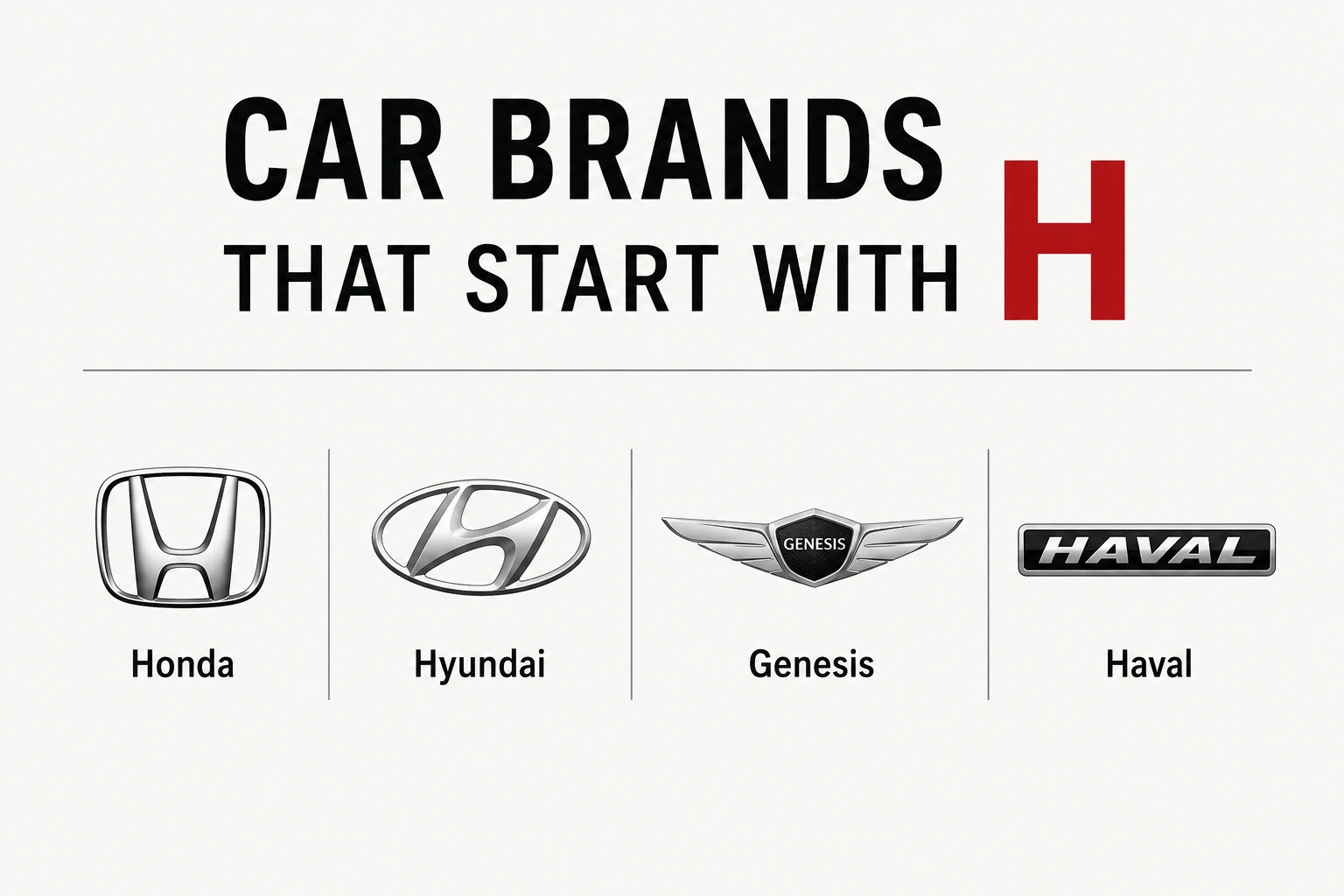
The letter H carries more automotive weight than almost any other letter in the alphabet. It opens the name of Honda, the Japanese giant that has quietly become one of the most trusted car manufacturers on Earth.
It starts Hyundai, the South Korean brand that went from budget curiosity to genuine global powerhouse in less than four decades. And it gives us names like Hispano-Suiza, Hudson, Horch, and Hennessey — brands that span a century of engineering ambition, from hand-built Edwardian luxury cars to 1,817-horsepower modern hypercars.
Some of these names are printed on millions of windscreens every morning. Others survive only in museums or racing history books. A few are making a remarkable comeback in the electric age.
Put them all together, and the populer car brands that start with H tell a story about every corner of the global automotive industry — its past, its present, and where it is clearly heading.
All Car Brands That Start With H: The Complete Guide
The sheer variety here is striking. The letter H covers mass-market Japanese reliability, South Korean innovation, brutal American off-roaders, luxury Chinese sedans, extinct British family cars, Argentine racing machines, and modern EV hypercars. Below is a detailed look at every notable brand beginning with H, organised by their significance and reach.
1. Honda
Honda is not simply a car company. It is one of the most prolific engine manufacturers on the planet, producing powerplants for motorcycles, marine craft, lawn equipment, aircraft, and of course, automobiles. Founded in 1948 by Soichiro Honda in Hamamatsu, Japan, the company began life as a motorcycle manufacturer and only moved into four-wheeled vehicles in 1963. What followed was one of the most sustained runs of automotive success in history. Honda’s engineering philosophy has always centred on efficiency, reliability, and the idea that a car should be genuinely useful to the person who owns it — not merely impressive on paper.
The brand is particularly strong in the United States, where the Accord and Civic have each held the title of best-selling car in their respective segments for extended periods. Honda was also a pioneer of hybrid technology through the Insight, which launched in 1999 as one of the first production hybrid vehicles sold in North America. Today, the company’s electric and hybrid lineup continues to expand, with the e:Ny1, Honda e, and a growing range of electrified CR-Vs and Accords signalling the brand’s transition into a fully electrified future. Honda also operates the Acura luxury brand in North America and HPD (Honda Performance Development), its motorsport arm responsible for IndyCar and endurance racing programmes.
- Founded: 1948, Hamamatsu, Japan
- Headquarters: Minato, Tokyo, Japan
- Key segments: Compact cars, family saloons, SUVs, hybrids, EVs, sports cars
- Global reach: Sold in over 150 countries; one of the world’s top five car manufacturers by volume
- Notable achievement: NSX supercar, two-time manufacturer; VTEC engine technology; consistent top safety ratings globally
2. Hyundai
The story of Hyundai is one of the most remarkable industrial transformations of the 20th and 21st centuries. When Hyundai Motor Company launched in 1967, South Korea had virtually no domestic automotive industry to speak of. By the late 1990s, Hyundai was producing vehicles competitive enough to sell in major European and American markets. By the 2020s, the Hyundai Motor Group — which includes Kia, Genesis, and Ioniq as sub-brands — had become one of the three largest automotive groups in the world.
The brand’s approach has always been to offer more equipment, more warranty coverage, and more visual ambition than the competition at a given price point. That strategy worked spectacularly. The Hyundai Tucson, Santa Fe, Sonata, and Elantra became household names across Asia, Europe, and the Americas. But it is Hyundai’s pivot towards electrification that has generated the most attention in recent years. The Ioniq 5 won the World Car of the Year award in 2022 — a genuine landmark moment for a brand that was still considered a budget option just fifteen years earlier. The Ioniq 6, a sleek electric saloon with an 800-volt charging architecture, followed in 2023 and extended that winning streak.
Hyundai also owns a 33% stake in Kia Corporation and fully controls Genesis Motor, its luxury sub-brand. Its manufacturing facility in Ulsan, South Korea, is the largest single automobile production complex in the world.
- Founded: 1967, Seoul, South Korea
- Headquarters: Seoul, South Korea
- Key segments: Compact cars, SUVs, electric vehicles, hydrogen fuel cell (Nexo), commercial vehicles
- Global reach: Sold in 193 countries; 5,000+ dealerships worldwide
- Notable achievement: Ioniq 5 — multiple Car of the Year wins; Nexo hydrogen fuel cell SUV; first-year US sales record set in 1986
3. Hummer
No brand better captures a specific moment in American automotive culture than Hummer. The story begins in 1983, when AM General began producing the High Mobility Multipurpose Wheeled Vehicle — the HMMWV or “Humvee” — for the United States military. When images of the Gulf War broadcast these machines worldwide, the demand for a civilian version became impossible to ignore. The Hummer H1 launched in 1992 and was sold directly to the public as the most imposing vehicle money could buy for road use. General Motors acquired the brand in 1998 and followed with the H2 (2002) and H3 (2005), which were designed to bring Hummer’s visual presence within reach of a broader market.
At its peak, Hummer was a genuine cultural phenomenon — beloved by collectors, construction executives, professional athletes, and anyone who simply wanted the most unmistakable vehicle on the road. The brand was discontinued in 2010 amid GM’s bankruptcy restructuring. But the name came back in a form no one had predicted. In 2021, GMC relaunched the Hummer EV as an electric subbrand — a full-size electric pickup truck with up to 1,000 horsepower, an 830-mile towing range, and an extraordinary feature called “Crab Walk” that allows all four wheels to steer simultaneously, letting the vehicle move diagonally. It is one of the most technologically complex production vehicles ever made, and it represents a genuinely clever second act for a brand many had written off.
- Founded: 1992 (civilian brand); revived 2021 as GMC Hummer EV
- Headquarters: Detroit, Michigan, USA
- Key segments: Military-derived off-road vehicles; now electric trucks and SUVs
- Notable models: H1, H2, H3, Hummer EV Truck, Hummer EV SUV
- Notable achievement: “Crab Walk” technology on the EV; up to 1,000 hp electric output
4. Holden
Holden occupies a unique place in automotive history. It was never a truly global brand, and it was always closely linked to its parent company, General Motors. But within Australia, Holden was something far more significant than a car manufacturer — it was a national institution, a source of genuine pride, and a fixture of the country’s motorsport culture for decades. Founded in 1856 as a saddlery company, Holden transitioned into automotive manufacturing in the 1920s and produced its first fully Australian car in 1948. For the next seven decades, the brand produced vehicles specifically designed for Australian roads, climate, and culture.
The Holden Commodore, in particular, became the definitive Australian family car. Its rivalry with the Ford Falcon formed the backbone of Australian touring car racing, with the Bathurst 1000 — run at Mount Panorama — becoming one of the world’s most beloved motorsport events. Holden also spawned HSV (Holden Special Vehicles), its high-performance sub-brand, which produced supercharged V8 variants of the Commodore that are now highly sought-after collector cars. When GM announced it would cease Australian manufacturing in 2017 and eventually retire the Holden brand entirely in 2020, the reaction across the country was one of genuine national mourning. The last Holden was sold in 2021, closing a chapter in Australian industrial history that will not be reopened.
- Founded: 1856; car production began 1931; first Australian car 1948
- Headquarters: Port Melbourne, Victoria, Australia (now closed)
- Status: Discontinued 2020; parent was General Motors
- Notable models: Commodore, Monaro, Torana, Kingswood, EK, FX
- Legacy: Backbone of Australian motorsport; Bathurst 1000 heritage
5. Haval
Haval is one of the most important car brands most people in the West have never heard of — but that is changing rapidly. Established in 2013 as the dedicated SUV sub-brand of GWM (Great Wall Motors), China’s largest SUV manufacturer, Haval has grown into a dominant force in multiple markets including China, Australia, South Africa, Russia, Brazil, and parts of the Middle East and Europe. The brand’s strategy is straightforward: build practical, well-equipped SUVs at prices that undercut the established Japanese and European competition, with quality levels that have improved dramatically with each generation.
The Haval H6 is the brand’s flagship and bestseller. At various points, the H6 has been the best-selling SUV in China — not just among Chinese brands, but overall. That is a staggering achievement in the world’s largest automotive market. The brand has also been active in expanding its hydrogen and hybrid technology, with the H6 Hybrid and DHH (Dedicated Hybrid) variants demonstrating that Haval is not simply a budget alternative but an increasingly serious engineering proposition. In markets like South Africa and Australia, Haval has built a strong retail presence and genuine customer loyalty. Expect to see the brand continue expanding into European markets over the coming years as GWM’s global ambitions grow.
- Founded: 2013, Baoding, China (sub-brand of GWM / Great Wall Motors)
- Key segments: Compact SUVs, mid-size SUVs, hybrid and hydrogen vehicles
- Top markets: China, Australia, South Africa, Russia, Brazil
- Notable models: H6, H2, H4, H9, Jolion, Dargo
- Notable achievement: Consistent best-selling SUV in China; growing global export footprint
6. Hennessey
Hennessey Performance Engineering was founded by John Hennessey in Texas in 1991, and it operates in a peculiar but fascinating space: somewhere between a tuning house and a bespoke hypercar manufacturer. For most of its history, Hennessey built its reputation by taking already-powerful production cars — Dodge Vipers, Chevrolet Corvettes, Ford GTs, Cadillac CTS-Vs — and transforming them into vehicles with output figures that were previously associated only with racing machines. A Hennessey-tuned car was not a factory product with a badge and a warranty; it was a statement of intent, built for customers who wanted to go faster than almost any other road vehicle could.
But the company’s ambitions evolved. The Hennessey Venom GT, built on a modified Lotus Exige chassis and powered by a twin-turbocharged 7.0-litre V8, recorded a one-way top speed of 270.49 mph (435.31 km/h) at the Kennedy Space Center in 2014 — making it one of the fastest production cars ever measured. Then came the Venom F5, unveiled in 2020, which Hennessey claims is the first purpose-built hypercar capable of exceeding 300 mph (483 km/h). Powered by a 6.6-litre twin-turbo V8 producing 1,817 horsepower, the F5 is both a technical tour de force and a declaration that American performance engineering can compete at the very highest level. Only 24 units of the Venom F5 were planned for production.
- Founded: 1991, Sealy, Texas, USA
- Key segments: Performance tuning; bespoke hypercars
- Notable models: Venom GT, Venom F5, Venom F5 Roadster, HPE upgrades for major production brands
- Notable achievement: Venom GT — 270.49 mph one-way top speed (2014); Venom F5 — 1,817 hp, 300 mph target
7. Hispano-Suiza
Few names in automotive history carry as much prestige as Hispano-Suiza. Founded in 1904 in Barcelona by Swiss engineer Marc Birkigt and Spanish businessman Damián Mateu, the company quickly established itself as the preeminent manufacturer of luxury automobiles for European royalty and aristocracy. In the 1910s and 1920s, Hispano-Suiza cars were considered the finest in the world — technically superior to Rolls-Royce and Bugatti by many contemporary assessments. The H6, introduced at the 1919 Paris Motor Show, was a masterpiece of engineering: a 6.6-litre six-cylinder car with an aluminium overhead cam engine derived from the company’s aircraft powerplants, capable of reaching 140 km/h at a time when most cars struggled to hit 80 km/h.
The brand fell silent after World War II, when the economic disruption of post-war Europe made ultra-luxury car production commercially unviable. But in 2019, the Hispano-Suiza name was revived by the founding family’s descendants — specifically by Miguel Suqué Mateu — with a genuinely stunning electric hypercar called the Carmen. Named after his mother, the Carmen is built on a carbon fibre tub, produces 1,019 horsepower from four electric motors, and is styled to honour the aerodynamic elegance of the original 1930s cars. The more extreme Carmen Boulogne variant pushes output to 1,114 hp. Only 19 examples of each model were produced, cementing Hispano-Suiza’s identity as one of the most exclusive automotive names on earth.
- Founded: 1904, Barcelona, Spain; revived 2019
- Key segments: Ultra-luxury grand tourers (historic); electric hypercars (modern)
- Notable models: H6B, J12, Carmen EV, Carmen Boulogne EV
- Notable achievement: Carmen EV — 1,019 hp; only 19 units built; heritage spanning a century
8. Hongqi
Hongqi — which translates literally as “Red Flag” — is one of the most fascinating car brands in the world, and almost entirely unknown outside of China and specialist automotive circles. Established in 1958 by FAW (First Automobile Works), Hongqi was created to serve the Chinese government and Communist Party leadership. For decades, the massive, limousine-style Hongqi CA770 was the vehicle in which senior party officials were chauffeured, giving the brand an air of official power and national prestige that no other Chinese automaker could match.
In recent years, FAW has invested heavily in transforming Hongqi from a government fleet brand into a genuine luxury competitor targeting wealthy Chinese consumers and, increasingly, international markets. The modern Hongqi lineup includes the H9 — a large luxury saloon that competes directly with the Mercedes-Benz E-Class and BMW 5 Series — as well as the E-HS9 electric SUV, a full-size seven-seater that targets the Audi Q8 and Cadillac Escalade markets. Design language is bold, architectural, and deliberately patriotic, drawing on motifs from Chinese cultural history. The brand sold over 400,000 units in 2022 — a dramatic jump from fewer than 5,000 units a decade earlier — and represents one of the clearest examples of China’s luxury automotive ambitions.
- Founded: 1958, Changchun, China (by FAW Group)
- Key segments: Luxury saloons, large SUVs, electric vehicles, state/ceremonial cars
- Notable models: CA770 (historic), H9, HS5, HS7, E-HS9
- Notable achievement: Grew from under 5,000 annual sales to over 400,000 by 2022
9. Hillman
Hillman was one of Britain’s most important mass-market car manufacturers for much of the 20th century, even though its name is largely forgotten outside of classic car circles today. Founded in Coventry in 1907 by William Hillman, the brand became part of the Rootes Group in 1928 — a British automotive conglomerate that also owned Humber, Singer, and Sunbeam. Through the Rootes Group, Hillman produced a succession of well-regarded family cars that were affordable, practical, and genuinely popular with the British public.
The Hillman Minx, produced from 1931 to 1970 in multiple generations, was the brand’s cornerstone model — a reliable, inexpensive family saloon that sold in large numbers across the UK and export markets. The Hillman Imp, introduced in 1963, was a more ambitious attempt to compete with the Mini: a rear-engined, rear-wheel-drive small car with an aluminium overhead cam engine. While it was technically interesting, reliability issues hampered its commercial success. When Chrysler acquired the Rootes Group in the late 1960s, the Hillman brand was gradually run down. By the time Peugeot took over the assets in 1978, Hillman had been effectively absorbed into the Chrysler Europe range. The Hillman name was retired in 1981.
- Founded: 1907, Coventry, England
- Defunct: 1981
- Parent: Rootes Group, then Chrysler Europe, then Peugeot
- Notable models: Minx, Imp, Hunter, Avenger, Husky
- Legacy: Important part of British automotive heritage; Coventry manufacturing tradition
10. Hudson
The Hudson Motor Car Company occupies a genuinely significant place in American automotive history. Founded in Detroit in 1909 — named after department store magnate Joseph Hudson who provided the financing — the company grew quickly into a mid-priced alternative to Ford and General Motors. Hudson’s engineering department was consistently innovative, introducing the first production car with a side-valve engine placed below the crankshaft centre line. This “step-down” body design, introduced on the 1948 models, placed the passenger floor between the frame rails rather than on top of them, lowering the vehicle’s centre of gravity and creating a dramatically improved ride.
Hudson also produced some of the most celebrated stock car racers in early NASCAR history. The Hudson Hornet — a large, powerful saloon — dominated American oval racing from 1951 to 1954, winning 78 out of 148 races in that period. The character “Doc Hudson” in Pixar’s film Cars was directly based on a 1951 Hudson Hornet, introducing a new generation to the brand’s racing legacy. Financial difficulties led Hudson to merge with Nash-Kelvinator in 1954 to form American Motors Corporation (AMC). The Hudson name was finally retired in 1957. The company’s Detroit factory was demolished, but the Hudson nameplate remains one of the most beloved names in American classic car collecting.
- Founded: 1909, Detroit, Michigan, USA
- Defunct: 1957 (merged into AMC)
- Notable models: Hudson Hornet, Hudson Wasp, Hudson Commodore, Hudson Jet
- Legacy: NASCAR dominance 1951–1954; “step-down” engineering innovation; inspiration for Disney/Pixar’s Cars
11. Horch
August Horch built two car companies in Germany during the early 20th century, and both became legendary. His first company became Audi. His second company — which he named Horch, using his own surname (Horch is German for “listen,” the literal translation of the Latin “Audi”) — became one of the most respected luxury car manufacturers in pre-war Germany. Founded in 1904 in Zwickau, Horch produced large, powerful luxury automobiles that were favoured by German nobility, senior industrialists, and government officials.
The Horch 853 roadster, produced from 1935 to 1937, is widely regarded as one of the most beautiful pre-war automobiles ever built. Its long bonnet, sweeping fenders, and elegant proportions remain the benchmark by which pre-war German automotive design is judged. Horch became part of the Auto Union consortium in 1932 — the famous four-ring symbol that still appears on Audi cars today represents the union of Horch, Audi, DKW, and Wanderer. After World War II, manufacturing in Zwickau fell under East German control, and the Horch name was retired. August Horch’s legacy lives on through Audi, making him one of the rare figures in automotive history whose influence genuinely shaped two separate iconic brands.
- Founded: 1904, Zwickau, Germany
- Defunct: After World War II (absorbed into Auto Union/Audi)
- Notable models: Horch 853, Horch 930V, Horch 670
- Legacy: One of the four founding brands of Auto Union (Audi’s four rings); August Horch also founded Audi
12. Hino
Hino Motors is not a brand that most private car buyers would encounter on a dealership forecourt, but it is one of the most important commercial vehicle manufacturers in Asia and beyond. Established in 1942 as a division of Tokyo Gas Industry, Hino became an independent company in 1946 and has been a subsidiary of Toyota since 2001. The company specialises in heavy-duty trucks, medium-duty trucks, and buses — vehicles that form the backbone of freight logistics, public transport, and construction operations across Japan, Southeast Asia, Africa, and the Americas.
What makes Hino particularly interesting from a historical perspective is that the company did, briefly, produce passenger cars. The Hino Contessa, produced from 1961 to 1967, was a rear-engined compact saloon with genuinely stylish Italian-influenced bodywork designed by Michelotti. It was a credible small car that sold in Japan and export markets, but when Toyota acquired a controlling interest in Hino, the decision was made to focus entirely on commercial vehicles. Today, Hino is investing heavily in hydrogen fuel cell trucks and electric commercial vehicle development, making it a significant player in the decarbonisation of freight transport.
- Founded: 1942, Tokyo, Japan
- Headquarters: Hino, Tokyo, Japan
- Parent: Toyota Motor Corporation (since 2001)
- Key segments: Heavy trucks, medium trucks, buses, commercial vehicles
- Historic note: Produced the Contessa passenger car 1961–1967
13. HSV (Holden Special Vehicles)
HSV was Australia’s answer to AMG and M Power. Established in 1987 as a joint venture between Holden and British performance specialist Tom Walkinshaw Racing, HSV’s mission was to take the Holden Commodore platform and extract maximum performance from it. The result was a range of vehicles that became the definitive expression of Australian performance car culture: supercharged V8s producing up to 430 horsepower in road-legal trim, with handling packages, body kits, and interiors that transformed a workhorse family car into something genuinely exciting.
HSV models like the GTS, Senator Signature, and Clubsport R8 developed fierce cult followings and strong resale values. The GTSR W1, produced in 2017 as HSV’s final hurrah before Holden ended Australian manufacturing, was fitted with a Chevrolet LSA supercharged V8 producing 474 kW (635 hp) and is now one of the most sought-after Australian cars ever made. When Holden closed its manufacturing operations, HSV lost its production base and the brand effectively ended with it. Today, original HSV vehicles command serious collector premiums, particularly the final-generation supercharged models.
- Founded: 1987, Clayton, Victoria, Australia
- Defunct: 2020 (alongside Holden)
- Parent: Joint venture: Holden and Tom Walkinshaw Racing (later 100% Holden)
- Notable models: GTS, Clubsport, Senator, GTSR W1, Maloo ute
- Legacy: Defined Australian performance car culture; GTSR W1 now a prized collector vehicle
14. Hotchkiss
Hotchkiss is a name better known to military historians than car enthusiasts today, but the company produced some of the finest French automobiles of the early 20th century. Originally an American-owned munitions manufacturer that set up operations in Saint-Denis, France, Hotchkiss entered car production in 1903. The company’s vehicles were known for superb build quality, refined engineering, and a touring character that made them popular with wealthy French buyers who preferred something more understated than Hispano-Suiza but more refined than Renault.
Hotchkiss cars won the Monte Carlo Rally multiple times during the 1930s — four victories in total — which demonstrated that the brand’s touring cars were not merely comfortable but genuinely capable at sustained high-speed travel over demanding conditions. The Hotchkiss 686 and 686 GS models from the late 1930s are considered among the finest French cars of their era. After World War II, the company struggled to re-establish itself in a French market dominated by Citroën, Renault, and Peugeot, and car production wound down in the early 1950s. Hotchkiss subsequently pivoted to commercial vehicles, Jeeps (assembled under licence), and eventually defence contracts, but the passenger car chapter closed for good.
- Founded: 1903, Saint-Denis, France
- Defunct: Early 1950s for passenger cars
- Notable models: Hotchkiss AM80, Hotchkiss 686, Hotchkiss 686 GS
- Legacy: Four Monte Carlo Rally victories; respected French luxury touring cars
15. Healey
Donald Healey was one of the most important figures in British post-war sports car development — a rally driver, engineer, and entrepreneur who founded his own car company in Warwick in 1946. The Healey Motor Company produced a series of capable sports cars that combined lightweight bodywork with robust American powertrains, which was both pragmatic and commercially clever in an era when British engines were often underpowered by international standards.
The most significant chapter in the company’s history came through a partnership with Austin. The Austin-Healey range — beginning with the 100 in 1952 — became one of the defining sports cars of the 1950s and 1960s, selling in enormous numbers in the British and American markets. The Austin-Healey 3000 is widely regarded as one of the finest British sports cars of its era. When British Leyland ended the Austin-Healey partnership in 1972, the Healey name continued briefly with the Healey 3000 and Jensen-Healey before fading from production. The Austin-Healey name remains one of the most celebrated in British motoring history, and well-preserved examples are highly valued at auction.
- Founded: 1946, Warwick, England
- Notable partnership: Austin-Healey (1952–1972) with BMC
- Notable models: Healey 100, Austin-Healey 3000, Jensen-Healey
- Legacy: Key figure in post-war British sports car development; Austin-Healey 3000 a collector classic
16. Humber
Humber was one of Britain’s oldest and most respected car brands, tracing its origins to a bicycle manufacturer founded in Nottingham in 1868. By the Edwardian era, Humber had become associated with quality and restrained prestige — not as flamboyant as Rolls-Royce, but considered a step above the mainstream. During both World Wars, Humber supplied staff cars and military vehicles to the British forces, cementing a reputation for durability and engineering solidity.
As part of the Rootes Group, Humber sat at the top of the range, with models like the Humber Super Snipe and Humber Imperial serving as the preferred cars of senior British civil servants, senior military officers, and affluent professionals. The Super Snipe, in particular, was a genuinely handsome large saloon that compared favourably with contemporary Rover and Jaguar products. When Chrysler absorbed the Rootes Group, Humber limped on briefly before the name was retired in 1976. The brand’s legacy is one of solid British craftsmanship that never quite achieved the international fame its quality deserved.
- Founded: 1868 (bicycles); cars from early 1900s
- Defunct: 1976
- Parent: Rootes Group, then Chrysler Europe
- Notable models: Super Snipe, Imperial, Hawk, Sceptre
- Legacy: Royal warrants; British military staff car supplier in both World Wars
17. HiPhi
HiPhi is the most recent major entry on this list — a premium Chinese electric vehicle brand founded in 2017 and backed by Human Horizons. The HiPhi X, its debut model launched in 2021, caused genuine attention in the automotive world not merely because it was expensive (its Chinese market price was equivalent to roughly $80,000 USD) but because of its genuinely unusual approach to design and technology. The X features what the company calls “programmable doors” — a complex system of coach doors, dihedral doors, and conventional doors that can be configured and animated in multiple ways. The interior is dominated by large digital screens and a level of connectivity that positions it as a technology showcase as much as a driving machine.
HiPhi followed the X with the Y and Z models, and the brand has attracted serious attention in European markets, particularly in Scandinavia and Germany, where it began selling in 2023. The company’s philosophy — that a luxury electric car should offer an experience that mass-market EV brands cannot replicate — positions it squarely in competition with BMW’s i-division, Mercedes EQ, and Lucid Motors. Whether HiPhi can sustain the investment required to build a luxury brand from scratch in a crowded market remains to be seen, but the quality of its early products suggests the ambition is real.
- Founded: 2017, Shanghai, China (Human Horizons)
- Key segments: Premium electric vehicles, luxury SUVs, electric saloons
- Notable models: HiPhi X, HiPhi Y, HiPhi Z
- Markets: China, Germany, Norway, Sweden, Netherlands
18. Hindustan Motors
Hindustan Motors holds a place in Indian history roughly analogous to Holden’s in Australia — it was the car manufacturer that defined domestic motoring for generations, even if its products were far from cutting-edge by global standards. Founded in 1942 in West Bengal, the company’s most famous product was the Ambassador — a licensed version of the 1956 Morris Oxford that remained in continuous production from 1958 until 2014. The Ambassador became India’s dominant taxi, government vehicle, and family car for half a century, and its enduring familiarity made it an icon of Indian urban life even as its technology fell decades behind international standards.
The Ambassador’s longevity was partly a product of India’s protectionist economic policies, which shielded domestic manufacturers from foreign competition until the 1990s. When liberalisation opened the Indian market to Maruti Suzuki, Hyundai, and eventually global majors, Hindustan Motors could not compete and gradually wound down production. The Ambassador name was later licensed to Peugeot, though that partnership did not result in meaningful commercial production. Hindustan Motors represents a fascinating case study in industrial heritage — a car company whose single iconic model outlasted entire generations of global automotive technology.
- Founded: 1942, Kolkata, West Bengal, India
- Key segment: Family cars, taxis, government vehicles
- Notable model: Ambassador (1958–2014)
- Legacy: The Ambassador defined Indian motoring for fifty years
19. Hawtai
Hawtai Motor Group is a Chinese automaker headquartered in Beijing that rarely appears in Western automotive coverage but plays a meaningful role in the Chinese domestic market and several export regions. Founded in 2000, Hawtai entered into a joint venture with Hyundai Motor in 2003, an arrangement that allowed the company to produce and sell Hyundai-branded SUVs in certain Chinese markets. That partnership gave Hawtai access to Korean powertrain and platform technology that significantly accelerated the development of its own products.
With a reported production capacity of around 350,000 units annually, Hawtai manufactures sedans, SUVs, and commercial vehicles under its own badge. The brand has invested in diesel-electric hybrid technology and positioned itself as a “clean vehicle” company within China’s increasingly emissions-conscious regulatory environment. Hawtai is also a parts supplier to other Chinese manufacturers, giving it a broader industrial footprint beyond pure vehicle sales. Outside China, the brand has a modest presence in markets like Russia, Iran, and parts of Southeast Asia.
- Founded: 2000, Beijing, China
- Key segments: Sedans, SUVs, commercial vehicles
- Notable connection: Joint venture with Hyundai Motor (2003)
- Production capacity: Approximately 350,000 units annually
20. Hulme
Hulme Supercars is one of the more surprising names on this list — a supercar manufacturer from New Zealand, a country not generally associated with high-performance car production. Founded by businessman Mark Prendergast in honour of New Zealand’s Formula 1 World Champion Denny Hulme, the company produced a limited-run mid-engined supercar called the Hulme CanAm. Powered by a supercharged Chevrolet LS V8 producing around 700 horsepower, the CanAm was named as a tribute to the famous Can-Am sports car racing series in which Denny Hulme competed during his career.
The car was hand-built in small numbers and priced in the supercar category, targeting the same buyers who might consider a Lotus or a boutique British manufacturer. What it represented was the determination of a small country with strong motorsport heritage to produce something genuinely world-class. Hulme remains a very low-volume manufacturer, but its existence is a testament to the global reach of automotive passion — the desire to build fast, exciting cars is not limited to the industrial heartlands of Japan, Germany, or the United States.
- Founded: 2008, Auckland, New Zealand
- Named after: Denny Hulme — New Zealand’s only Formula 1 World Champion (1967)
- Notable model: Hulme CanAm — supercharged V8, approximately 700 hp
- Production: Very limited; bespoke manufacture
Quick Comparison: Major H-Brand Profiles At A Glance
| Brand | Country | Founded | Status | Segment |
| Honda | Japan | 1948 | Active | Mass-market, hybrids, EVs |
| Hyundai | South Korea | 1967 | Active | Mass-market, EVs, hydrogen |
| Hummer | USA | 1992 | Active (EV revival) | Off-road, electric trucks |
| Holden | Australia | 1856 | Defunct (2020) | Family cars, performance |
| Haval | China | 2013 | Active | SUVs, hybrids |
| Hennessey | USA | 1991 | Active | Hypercars, performance tuning |
| Hispano-Suiza | Spain | 1904 | Active (EV revival) | Ultra-luxury, EV hypercars |
| Hongqi | China | 1958 | Active | Luxury, state cars, EVs |
| Hillman | UK | 1907 | Defunct (1981) | Economy family cars |
| Hudson | USA | 1909 | Defunct (1957) | Mid-range, performance |
| Horch | Germany | 1904 | Defunct | Luxury (became Audi) |
| Hino | Japan | 1942 | Active | Commercial trucks, buses |
| HSV | Australia | 1987 | Defunct (2020) | High-performance |
| Healey | UK | 1946 | Defunct | Sports cars |
| Humber | UK | 1868 | Defunct (1976) | Prestige family cars |
| HiPhi | China | 2017 | Active | Premium electric vehicles |
| Hindustan | India | 1942 | Largely inactive | Budget family cars, taxis |
Also Check: Car Brands And Models Starting With G
Car Brands And Models Starting With F
Car Brands And Models Starting With E
Car Brands And Models That Start With D
The Legacy, Innovation And Global Impact Of H-Brands
It would be easy to look at the list above and draw a simple conclusion: some of these brands succeeded, and some failed. But the reality is considerably more nuanced than that. The car brands beginning with H reflect broader patterns in global industrial history — the rise of Asian manufacturing, the decline of traditional European and British mass-market producers, the peculiar cultural power of American muscle, and the latest wave of Chinese EV ambition — that are genuinely worth examining in depth.
Why Asian H-Brands Came To Dominate The Global Market
The two most commercially dominant brands on this entire list are Honda and Hyundai, and both are Asian. That is not a coincidence. Both companies emerged in the post-war period in economies that were rebuilding rapidly and had strong government support for industrial development. Both adopted manufacturing philosophies — Toyota Production System adjacency in Honda’s case, relentless cost and quality improvement in Hyundai’s — that emphasised efficiency, reliability, and continuous incremental improvement over the kind of radical stylistic leaps that characterised American and European brands of the same era.
Honda’s VTEC engine technology, introduced in 1989, was a landmark in naturally aspirated engine development — a variable valve timing system that allowed a relatively small engine to produce high power outputs at high revs while remaining economical at lower ones. The Civic Type R, in multiple generations, used VTEC to become one of the most driver-focused front-wheel-drive cars ever made, setting Nürburgring lap records and generating genuine emotional attachment from enthusiasts worldwide. That combination of engineering seriousness and affordable pricing created a loyal customer base that competitors have spent decades trying to match.
Hyundai’s trajectory is different but equally instructive. In 1986, the Excel became the fastest-selling first-year import in American automotive history — it was cheap, basic, and often unreliable, but it found a market. Two decades of quality improvement later, Hyundai was producing vehicles that topped reliability surveys and won design awards. The investment in electric vehicle technology — particularly the 800-volt charging architecture shared across the Hyundai-Kia-Genesis group — has given the conglomerate a genuine technical advantage over many established European competitors in the EV space. The Ioniq 5’s 800V system allows charging speeds that approach 240 kW, filling the battery from 10% to 80% in approximately 18 minutes under ideal conditions.
The Rise Of Chinese H-Brands And What It Means
Haval, Hongqi, and HiPhi represent three distinct angles on China’s automotive ambitions, and together they tell a fascinating story about how Chinese car manufacturing has evolved in a single generation.
Haval is the volume play — practical SUVs at competitive prices, exported to markets that previously had no appetite for Chinese automotive products. The fact that Haval has built genuine brand loyalty in markets like South Africa and Australia, where consumers are discerning and alternatives are plentiful, suggests that the quality gap between Chinese and established brands has narrowed more than many Western observers recognise.
Hongqi is the prestige play — a domestic luxury brand with genuine state backing, architectural design language, and rapidly improving technology, targeting the growing number of wealthy Chinese consumers who prefer to buy domestic. The brand’s remarkable sales growth from under 5,000 to over 400,000 annual units in a decade reflects both improving product quality and a broader cultural shift in China towards preference for domestically produced luxury goods.
HiPhi is the technology play — a company that launched directly into the premium electric space with products designed to compete with the best European and American luxury EV brands, using technology showcases and unusual design as its primary differentiators. Whether it succeeds long-term, it represents the ambition and self-confidence of the current generation of Chinese automotive entrepreneurs.
The Cultural Power Of Extinct H-Brands
What is striking about the defunct brands on this list — Holden, Hudson, Hillman, Humber, Horch, Healey, HSV — is how much emotional currency they still hold. Holden’s retirement was treated as a national tragedy in Australia. Hudson Hornets are treasured collector cars that attract premium prices at Barrett-Jackson and RM Sotheby’s auctions. The Austin-Healey 3000 and original HSV GTS are on most British and Australian enthusiasts’ bucket lists.
This longevity of affection for extinct brands points to something important about car culture: the emotional attachment people form with the vehicles of their youth, and by extension the manufacturers that produced them, is remarkably durable. A brand like Holden did not merely sell cars — it provided the vehicles in which Australians got married, took their children to school, and drove to Bathurst to watch race cars. Those experiences do not fade when the brand closes. They persist in memory, in museum collections, and in the prices paid at classic car auctions for decades.
Related Posts:
All Car Models That Start With H: The Definitive List
Beyond brand names, a remarkable number of specific car model names also begin with H. Some come from the H-brands above; others are models produced by manufacturers whose primary name begins with a different letter.
Honda Models Beginning With H
- HR-V — Compact crossover SUV; one of Honda’s best-selling models globally; first generation launched 1999, current third generation from 2021; available in hybrid form in many markets
- Honda e — Retro-styled urban electric city car; rear-wheel drive; launched 2020; sold primarily in Europe and Japan; 154 hp; 220 km WLTP range
- Honda e:Ny1 — Honda’s mainstream European electric SUV; launched 2023; 204 hp; 412 km WLTP range; replaces the e:NS1 in the European market
Hyundai Models Beginning With H
- H-1 (iMax/iLoad) — Hyundai’s large van and people carrier; sold in Asia, the Middle East, and Oceania; seats up to 12; workhorse vehicle for commercial and family use
- HB20 — Subcompact hatchback designed specifically for the Brazilian market; launched 2012; one of Brazil’s top-selling cars; also available as the HB20S saloon and HB20X crossover
- H350 — Commercial van produced for fleet and light commercial operators; based on a joint venture platform with Fiat; sold primarily in Europe and Asia
Hummer Models Beginning With H
- H1 — The original civilian Hummer; based directly on the military Humvee; produced 1992–2006; powered by a 6.5-litre diesel V8; 86-inch width made it the widest production road vehicle of its era; extremely capable off-road
- H2 — Full-size luxury SUV on a Chevrolet Tahoe platform; produced 2002–2009; 6.0-litre Vortec V8; 365 hp; the most commercially successful Hummer model
- H3 — Mid-size SUV on the GMT355 platform shared with the Chevrolet Colorado; produced 2005–2010; 3.7-litre five-cylinder engine; more city-friendly than the H1 or H2
- Hummer EV (Pickup) — Electric truck; up to 1,000 hp; 0–60 mph in approximately 3.0 seconds; “Crab Walk” diagonal movement; 350+ mile range; launched 2021
- Hummer EV SUV — Electric SUV version; slightly shorter wheelbase than the pickup; same drivetrain options; launched 2022
Holden Models Beginning With H
- HK Monaro — Two-door fastback coupe; launched 1968; one of the most celebrated Australian muscle cars; available with Chevrolet-sourced V8 engines; direct ancestor of the later Monaro GTS
- HQ Statesman — Full-size luxury saloon; launched 1971; top of the Holden range; often used as government transport
- HZ Kingswood — Family saloon and wagon; produced 1977–1980; one of the best-selling Holden models in its era; reliable, spacious, and quintessentially Australian
Other Notable H Models (Various Brands)
- Highlander (Toyota) — Three-row mid-size SUV; one of Toyota’s best-selling vehicles in the United States; produced since 2000; available in hybrid form; seats seven or eight passengers
- Hilux (Toyota) — One of the world’s most enduring pickup trucks; produced continuously since 1968; renowned for extraordinary reliability and off-road capability; best-selling vehicle in Australia and numerous other markets for multiple years
- Huracán (Lamborghini) — V10-powered supercar; produced since 2014; 5.2-litre naturally aspirated V10; up to 640 hp in standard form; all-wheel drive; replaced the Gallardo
- Hornet (Dodge) — Compact crossover SUV launched in 2022; available in standard and Plug-In Hybrid forms; shares platform with the Alfa Romeo Tonale
- Hornet (Hudson) — Legendary American saloon from the early 1950s; dominant NASCAR racer 1951–1954; powered by a 308 cubic inch six-cylinder “Twin H-Power” engine
- Huayra (Pagani) — Carbon fibre hypercar; produced since 2011; AMG-sourced 6.0-litre twin-turbo V12; 730 hp; named after the Andean wind god; fewer than 150 units produced
- Henry J (Kaiser-Frazer) — American compact economy car produced 1950–1954; one of the first American compact cars; notable for its low price and light weight
- Harrier (Toyota) — Compact luxury SUV sold in Japan since 1997; known for premium interior quality and smooth ride; the Harrier nameplate was used as “Lexus RX” in export markets during its early years
FAQs
What is the most popular car brand starting with H?
Honda and Hyundai are comfortably the most popular and best-selling car brands starting with H globally. Honda ranks consistently among the top five car manufacturers in the world by annual sales volume, while Hyundai has risen to become part of the third-largest automotive group on earth, particularly after its dramatic growth in electric vehicles during the early 2020s.
Which H car brand makes the fastest cars?
Hennessey Performance Engineering holds the most extreme speed credentials among H brands. The Hennessey Venom GT recorded a one-way top speed of 270.49 mph in 2014, and the Venom F5 targets 300 mph with its 1,817-horsepower twin-turbocharged V8. Hispano-Suiza’s Carmen EV produces over 1,000 hp, making it an extremely fast electric hypercar, though its performance is geared more towards sensation than outright top speed records.
Is Hummer still being made?
Yes, but in a completely different form to the original brand. The original Hummer brand was discontinued by General Motors in 2010. In 2021, GM revived the name as a sub-brand under GMC with the Hummer EV — an all-electric pickup truck and SUV that retains the brand’s off-road character while producing up to 1,000 electric horsepower. The Hummer EV is built at GM’s Factory ZERO in Detroit.
What happened to Holden?
General Motors announced in February 2020 that it would retire the Holden brand entirely. Manufacturing had already ended in Australia in 2017. The decision reflected GM’s strategic decision to withdraw from right-hand-drive markets outside North America. The last Holden vehicles — imported models rebadged from Chevrolet and other GM brands — were sold through to 2021. The brand’s retirement was widely mourned in Australia and New Zealand. HSV, the performance sub-brand, closed alongside it.
Which car brands starting with H are electric or hybrid?
Several H brands are investing heavily in electrification. Hyundai leads with its dedicated Ioniq EV range and Nexo hydrogen fuel cell vehicle. Honda has the Honda e city car, e:Ny1 SUV, and a growing hybrid lineup. The Hummer EV is an all-electric off-roader. Hispano-Suiza produces exclusively electric hypercars. HiPhi is an EV-only brand. Hongqi has launched multiple electric models including the E-HS9. Haval has introduced hybrid and hydrogen-hybrid variants of its popular SUVs.
What are the most collectible cars from H brands?
The most financially valuable and emotionally significant collectibles from H brands include the Hispano-Suiza H6B and J12 from the 1920s–30s, the Hennessey Venom GT and Venom F5, original Hummer H1 trucks in good condition, HSV GTSR W1 models from 2017, Austin-Healey 3000 roadsters, Hudson Hornet NASCAR-replica road cars, and the Horch 853 roadster from 1935–37. Among modern cars, early Honda NSX models and limited-run Honda Type R variants also command strong collector premiums.
Is Haval a reliable brand?
Haval’s reliability reputation has improved significantly over successive generations of its vehicles. Early models sold in markets like Australia and South Africa received mixed reliability feedback, but newer generations — particularly the H6 and Jolion — have received substantially improved reviews and performed competitively in independent reliability assessments. Haval’s standard five-year warranty in most markets reflects the brand’s confidence in its current product quality. As with any brand, independent long-term owner data is more reliable than manufacturer claims.
What does Hongqi mean and why is it significant?
Hongqi means “Red Flag” in Mandarin Chinese. It was chosen deliberately as a patriotic symbol when FAW created the brand in 1958, designed to provide China’s Communist Party leadership with a domestically produced luxury vehicle instead of relying on imported foreign cars. The name carries significant historical and political weight in China, which has helped the brand maintain a premium image even as it expanded beyond government fleet use into the private luxury market. The modern Hongqi lineup — spanning luxury saloons, large SUVs, and electric vehicles — reflects China’s broader ambition to produce prestige automobiles that compete with the established European and American luxury brands on quality, technology, and design rather than simply price.
Which H car brand has the longest history?
Humber, which traces its origins to a bicycle company founded in 1868, has the longest continuous history of any brand on this list, spanning over a century before its retirement in 1976. Hispano-Suiza, founded in 1904 and revived in 2019, has the most remarkable timeline — dormant for over six decades before returning as a modern EV hypercar brand. Holden, also tracing its roots to 1856 as a saddlery business, has the earliest founding date, though vehicle production did not begin until much later. Among currently active brands, Honda (1948) and Hyundai (1967) are the oldest, with Honda holding a slight seniority.