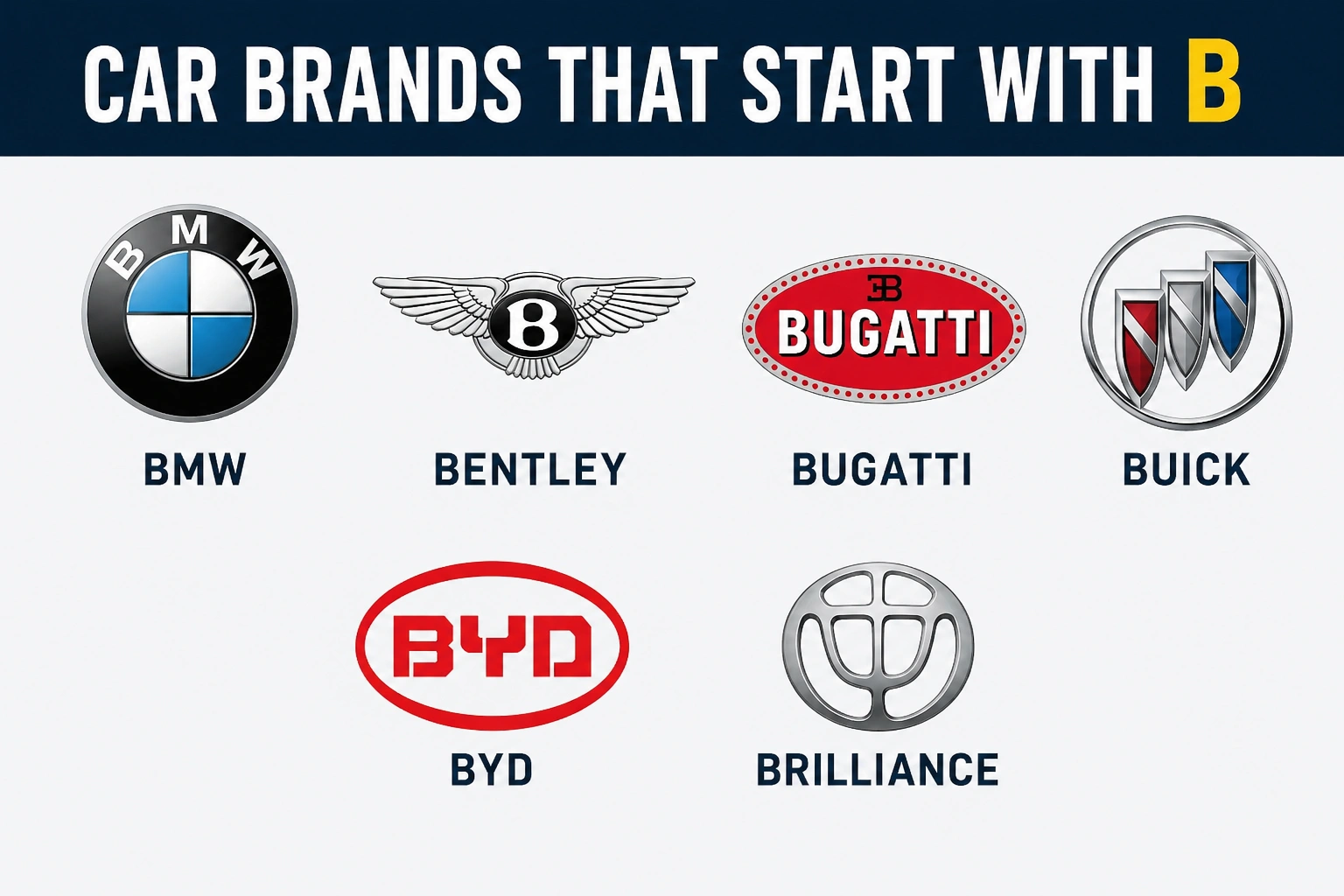
The letter B carries remarkable weight in the automotive world. It’s the starting point for some of the oldest, fastest, most celebrated, and most surprising car brands ever built.
From a century-old British institution that still hand-stitches every interior panel to a Chinese company that quietly became the world’s largest seller of new energy vehicles — the brands behind that single letter span every segment, continent, and philosophy in the car business.
There’s something genuinely fascinating about how many distinct automotive legacies have been built under this one letter. Some of these names are immediately recognizable to anyone who’s ever glanced at a dealership window.
Others are niche, rare, or historically significant in ways that most casual buyers never encounter. This guide covers them all, with real context, specs, ratings, and the kind of detail that actually helps you decide what to buy, appreciate, or simply know more about.
The Biggest B Names In The Global Car Market
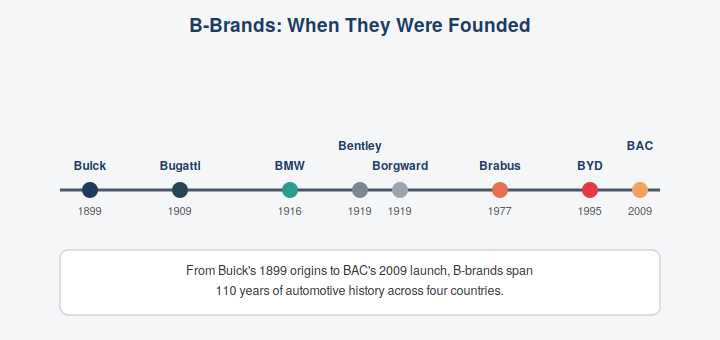
Before getting into the more specialized brands, it makes sense to spend real time with the names that most people encounter every day. BMW, Bentley, Bugatti, Buick, and BYD collectively represent hundreds of billions of dollars in annual revenue and billions of miles driven every year.
Each one has a genuinely different reason for existing, a different type of customer, and a different relationship with quality, price, and purpose.
1. BMW
Bayerische Motoren Werke, founded in Munich in 1916, didn’t start out making cars at all. The company built aircraft engines during World War I, and the blue and white roundel logo is still widely interpreted as a spinning propeller against a Bavarian sky — although BMW itself has offered different explanations over the years.
The pivot to motorcycles came first, then automobiles in the late 1920s, and the company spent decades building a reputation that would eventually allow it to define what a premium car could and should feel like.
The phrase “The Ultimate Driving Machine” became more than a tagline. It was a genuine promise that BMW honored through the E30 3 Series, the E46, the iconic M3 in its many generations, and the sports-minded 5 Series that set the standard for executive sedans.
Today, the lineup covers everything from the compact 1 Series and 2 Series to the flagship 7 Series and i7, plus a growing collection of SUVs under the X designation and the fully electric i-lineup. The M division continues to produce some of the most sought-after performance cars in the world, including the M3, M4, M5, and M8.
Current BMW Lineup At A Glance:
| Model | Segment | Starting Price (USD) | Key Feature |
| BMW 3 Series | Compact Luxury Sedan | ~$45,000 | Most balanced in lineup |
| BMW 5 Series | Midsize Luxury Sedan | ~$57,000 | Tech + comfort blend |
| BMW 7 Series / i7 | Full-size Flagship | ~$97,000 | J.D. Power: 81/100 |
| BMW X3 | Compact Luxury SUV | ~$47,000 | Strong reliability record |
| BMW X5 | Midsize Luxury SUV | ~$65,000 | Best-selling BMW SUV |
| BMW M3 / M4 | Performance Sedan/Coupe | ~$75,000 | KBB Owner Rating: 4.2/5 |
| BMW Z4 | Roadster | ~$56,000 | J.D. Power 2025: 85/100 |
| BMW iX | Electric SUV | ~$87,000 | BMW’s flagship EV |
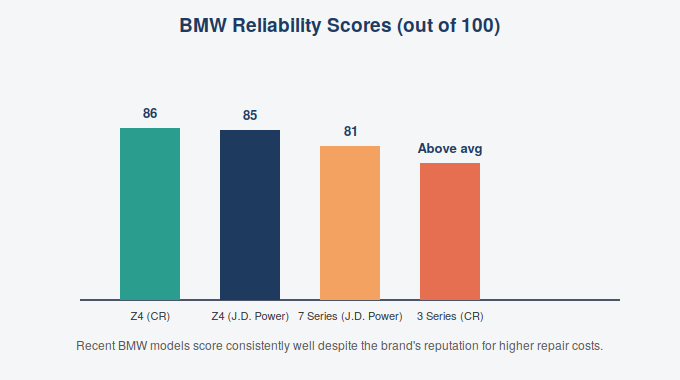
Reliability is where BMW gets complicated. The brand has always attracted criticism for high ownership costs, and that reputation isn’t entirely unfair — annual repair costs average between $773 and $1,206 depending on the model, according to Auto Reliability Index data. However, the brand’s reliability story has improved meaningfully in recent years.
The 2024 BMW 3 Series is rated more reliable than average for its model year by Consumer Reports. The BMW Z4 scored 86 out of 100 on Consumer Reports for 2024 and earned an 85 out of 100 from J.D. Power in 2025 — genuinely strong numbers for a German sports car. The 2025 BMW 7 Series scored 81 on J.D. Power’s reliability measure, which is notable for a flagship sedan stuffed with advanced technology.
Where BMW genuinely earns its reputation is in the depth of its engineering DNA. The 3 Series has won more comparison tests against its peers than arguably any other nameplate in automotive history.
The M division’s approach — taking already-capable base platforms and turning them into machines with race-caliber braking, suspension geometry, and engine tuning — remains a benchmark for how performance variants should be built. The inline-six engine, in various states of tune, has been a constant thread through the brand’s history and continues to be one of the more characterful powerplants in modern production cars.
One genuine concern for potential buyers is the BMW infotainment system and iDrive software, which has drawn criticism in some recent models for being overly complex and occasionally glitchy. The 2023 X1 and 2018 4-Series are flagged by Auto Reliability Index as statistical outliers for higher complaint rates within their respective lineups — worth noting if those are models you’re considering.
2. Bentley
Bentley Motors was founded in 1919 by Walter Owen Bentley — known to everyone as W.O. — who wanted to build a fast car that was also a good car. The early Bentleys were race cars that happened to be road-legal, winning Le Mans five times between 1924 and 1930. W.O. Bentley reportedly described his ideal product as “a fast car, a good car, the best in its class.”
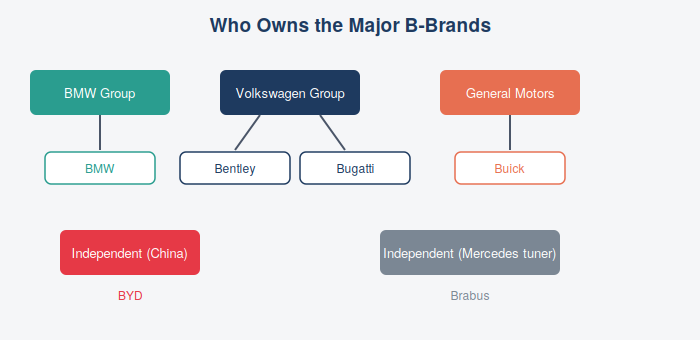
The Bentley Boys — a group of wealthy amateur racers who drove the cars at Le Mans — became part of the brand’s mythology. Rolls-Royce acquired Bentley in 1931, and the company eventually ended up under Volkswagen Group ownership in 1998, which provided the financial foundation for the current generation of models.
The modern Bentley lineup is focused and deliberate. Three model lines cover the entire range: the Continental GT coupe and Continental GTC convertible, the Flying Spur four-door sedan, and the Bentayga SUV.
Every single car is assembled at Crewe in England, where craftspeople spend extraordinary amounts of time on interior finishing — hand-stitching leather, hand-polishing wood veneers, and fitting components to tolerances that go well beyond what any automated line can achieve. A typical Bentley interior has more than 15 hides of leather, and the hand-stitching alone can take 15 hours per car.
Bentley Current Models — Pricing And Ratings:
| Model | Type | Starting Price (USD) | KBB Expert Rating | KBB Consumer Rating |
| 2025 Continental GT | Luxury Coupe (PHEV) | ~$296,950 | 4.5/5 | 4.5/5 |
| 2025 Continental GTC | Luxury Convertible (PHEV) | ~$323,550 | 4.5/5 | 4.5/5 |
| 2025 Flying Spur | Ultra-Luxury Sedan (PHEV) | ~$266,250 | N/A | 4.0/5 |
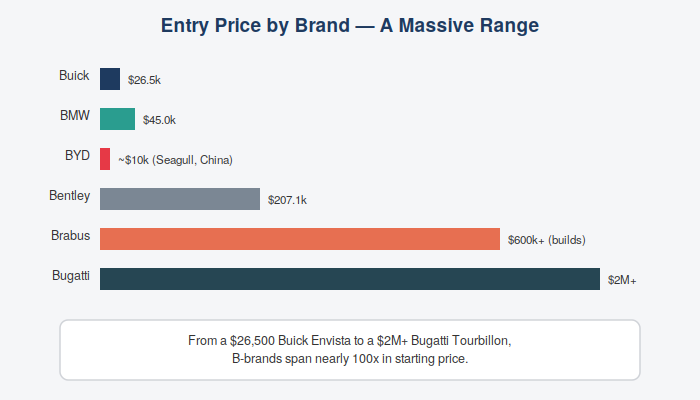
| 2025 Bentayga | Luxury SUV | ~$207,050 | N/A | 5.0/5 |
| 2025 Bentayga EWB | Extended Luxury SUV | ~$237,550 | N/A | 5.0/5 |
The biggest technical news from Bentley recently is the shift to plug-in hybrid powertrains across the range. The 2025 Continental GT and Flying Spur now use a twin-turbocharged 4.0-liter V8 paired with a 190-horsepower electric motor, producing a combined 782 horsepower in top Speed and Mulliner trims, and 671 horsepower in the base High Performance Hybrid configuration.
The Flying Spur’s old V6 PHEV, V8, and W12 options are gone — replaced entirely by this new hybrid system. Top Gear’s review of the 2025 Flying Spur described the new powertrain as genuinely impressive, noting that the car is rapid without being loud about it.
A Bentley is one of the few cars in the world where the interior experience arguably outweighs the mechanical one. The 100 Wilton wool carpets, the diamond-knurled aluminum controls, the 15 color-matched speaker grilles, and the endless personalization options through the Mulliner customization program mean that essentially no two Bentleys are identical. For buyers in this segment, that level of individuality matters enormously.
One insight worth noting: the extended wheelbase Bentayga EWB has essentially taken over the chauffeur-driven limousine duty from the Flying Spur among ultra-high-net-worth buyers. Sales data and market commentary suggest that wealthy buyers who once ordered Flying Spurs for rear-seat travel are now choosing the Bentayga EWB instead — the shift toward SUVs happening even at this price point.
3. Bugatti
Few automotive names carry the mystique that Bugatti does. Founded in 1909 by Italian-born designer Ettore Bugatti in the Alsace region of France, the brand was always about the intersection of artistry and mechanical extremity. The pre-war Bugatti Type 35 remains one of the most successful racing cars in history, winning over 1,000 races. The Type 57 Atlantic — built in the 1930s — is regularly cited among the most beautiful cars ever made, with surviving examples worth tens of millions of dollars at auction.
The modern era of Bugatti began when Volkswagen Group revived the brand and introduced the Veyron in 2005. The Veyron changed everything: a quad-turbocharged 8.0-liter W16 engine, 1,001 horsepower, an electronically limited top speed of 253 mph (408 km/h), and a price tag of €1 million.
It required Michelin to develop entirely new tires capable of handling speeds that conventional rubber would simply destroy. A privately entered Bugatti also won the very first Monaco Grand Prix in 1929, and the brand’s racing driver Jean-Pierre Wimille won the 24 Hours of Le Mans twice for the marque, in 1937 and 1939.
Bugatti Historical And Current Models:
| Model | Production Era | Engine | Horsepower | Top Speed | Starting Price |
| Veyron 16.4 | 2005–2015 | W16 quad-turbo | 1,001 hp | 253 mph | ~$1.5M+ used |
| Chiron | 2016–2024 | 8.0L W16 quad-turbo | 1,479–1,578 hp | 261 mph (limited) | ~$3M+ used |
| Chiron Super Sport 300+ | 2021–2022 | W16 | 1,578 hp | 304 mph (unlimited) | ~$3.9M new |
| Divo | 2019–2021 | W16 | 1,479 hp | 236 mph | ~$5.8M |
| Mistral Roadster | 2024 | W16 | 1,578 hp | TBC | €5M (99 units, sold out) |
| Tourbillon | 2025–present | V16 hybrid | 1,775 hp | TBC | ~€3.8M+ |
The Bugatti Tourbillon is the current flagship and the brand’s first departure from the famous W16 engine. Under new co-ownership with Rimac — the Croatian EV performance company — the Tourbillon uses a naturally aspirated V16 internal combustion engine paired with electric motors, producing a combined 1,775 horsepower.
Unlike the Chiron, the Tourbillon’s V16 engine is not named after a racing driver; it represents a deliberate break from the W16 era. The car was announced in February 2024 and confirmed in June 2024.
One genuinely remarkable engineering note about the Chiron Super Sport 300+: in 2019, a development version of this car achieved 304.773 mph — the first production car to officially break 300 mph. The tires had to be specifically engineered for this run, and the car’s body was modified slightly from standard spec. Bugatti sold 30 production examples at approximately $3.9 million each, and every single one was claimed before the speed record had even been set.
Bugatti production numbers are always microscopic. The entire Chiron run was capped at 500 units over roughly eight years. The Mistral Roadster had only 99 build slots.
The Tourbillon’s production number hasn’t been publicly confirmed, but the brand has historically produced fewer than 100 cars per year. This is not a brand you stumble into — it operates on a reservation and relationship basis, and many prospective buyers are turned away.
4. Buick
Buick is one of the founding blocks of General Motors. David Dunbar Buick established the original company in 1899, and by 1908 it had been folded into the newly formed General Motors under William Durant.
For most of the 20th century, Buick sat at the top of GM’s mass-market hierarchy — above Chevrolet and Pontiac, below Cadillac — and served as the aspirational brand for middle-class American buyers who wanted something a step above the ordinary without stepping fully into luxury territory.
The brand’s current lineup is entirely SUV-based, having discontinued its passenger car range in recent years. The Envista sits at the entry level, the Encore GX above it, the Envision in the middle, and the three-row Enclave at the top. It’s a clean, focused range that fits the current market reality, and several of these vehicles are significantly more refined than their prices might suggest.
Buick Current Lineup:
| Model | Type | Starting Price (USD) | Seating | Key Strength |
| Buick Envista | Subcompact SUV | ~$26,500 | 5 | Entry-level value |
| Buick Encore GX | Small SUV | ~$29,900 | 5 | Urban practicality |
| Buick Envision | Compact SUV | ~$42,995 | 5 | Standard AWD (2024+) |
| Buick Enclave | 3-Row Midsize SUV | ~$50,000 | 7 | 328 hp (2025 redesign) |
The 2025 Buick Enclave represents a significant redesign. The new turbocharged 2.5-liter four-cylinder engine produces 328 horsepower and 326 lb-ft of torque — more than the old V6 despite being physically smaller. J.D. Power noted that acceleration is strong both from a stop and at highway speeds, and the suspension delivers a smooth, composed ride.
The interior quality, particularly in the top Avenir trim, is genuinely impressive and compares favorably with near-luxury alternatives from Acura, Infiniti, and Lincoln.
Reliability data for Buick is generally positive for recent models. According to data compiled across multiple sources, the 2018–2024 Enclave years are among the most dependable in Buick’s recent history.
The Envision’s 2024 refresh added standard all-wheel drive — a meaningful practical upgrade — and a new 30-inch seamless display screen. However, Consumer Reports flagged the 2025 Envision as slightly below average for its model year, primarily due to infotainment and in-car electronics concerns, including screen blackout issues that several owners reported. This is worth monitoring if you’re considering a very recent model.
A genuine hidden-gem angle: Buick’s Avenir trim level delivers interior quality and comfort that rivals some European near-luxury brands at a lower transaction price. The real-wood trim, genuine leather, and quiet cabin in a top-spec Enclave Avenir are legitimately impressive.
The brand’s biggest challenge isn’t the product — it’s perception. Buyers who dismiss Buick based on its traditional reputation often miss vehicles that would genuinely satisfy them.
5. BYD
Build Your Dreams — that’s what BYD stands for. Founded in Shenzhen, China, in 1995 by Wang Chuanfu, BYD started as a battery manufacturer. That origin story is not incidental — it’s the foundation of everything the company does.
Unlike automakers that had to pivot to electric powertrains, BYD essentially grew an automaker around its battery expertise. By 2023, BYD had surpassed Tesla to become the world’s largest seller of new energy vehicles (a category that includes both fully electric and plug-in hybrid vehicles). The numbers are staggering: in 2023, BYD sold approximately 3 million new energy vehicles globally.
BYD’s product range in China spans everything from budget city cars like the Seagull (which starts at roughly $10,000 in the Chinese market) to the premium Han EV sedan, the luxury Yangwang U8 SUV (a flagship that competes with Range Rover), and the Denza line of premium vehicles. The company also owns the Fang Cheng Bao off-road brand and the luxury Yangwang sub-brand.
BYD Key Models:
| Model | Type | Key Spec | Market |
| BYD Seagull | City EV Hatchback | ~100-mile range | China, select global |
| BYD Dolphin | Compact EV Hatchback | ~200-mile range | Global |
| BYD Atto 3 (Yuan Plus) | Compact EV SUV | ~250-mile range | Global |
| BYD Seal | Midsize EV Sedan | ~350-mile range | Global |
| BYD Han EV | Full-size Premium Sedan | ~400-mile range | Global |
| BYD Tang | 7-Seat SUV (EV/PHEV) | Dual motor AWD | Global |
| Yangwang U8 | Luxury Off-road SUV | 1,100+ hp | China primary |
What makes BYD technically interesting is its blade battery technology, introduced in 2020. Unlike conventional lithium-ion packs that use cylindrical or prismatic cells in modules, the blade battery uses elongated flat cells arranged directly in the pack structure, eliminating the module layer and improving both energy density and thermal safety.
BYD claims the blade battery is significantly less prone to thermal runaway — the chain reaction that causes EV battery fires — than conventional pack designs. Independent testing has largely supported these claims.
In Western markets, BYD is still building its presence. The brand operates in Europe, Australia, and parts of Latin America, but has not entered the US market as of 2026 due to a combination of tariffs and regulatory considerations.
In Europe, the BYD Atto 3, Seal, and Dolphin are available through a growing dealer network, and early reviews have been positive — particularly noting the value for money relative to equivalent European or Korean EVs at similar price points.
One critical insight about BYD that often gets overlooked: the company doesn’t just make cars. It also manufactures the batteries that go into many other manufacturers’ vehicles, produces electric buses and trucks globally, and is one of the largest solar panel manufacturers in China.
When you buy a BYD vehicle, you’re buying from a vertically integrated energy and technology company, not just a car brand. That integration is part of why BYD can offer competitive pricing on EVs — it doesn’t pay external suppliers for the most expensive component in an electric vehicle.
Brabus, Borgward, And The Niche B Brands Worth Knowing
Beyond the five major names, the letter B hides a fascinating collection of niche manufacturers, tuning houses, and historically significant brands that deserve a proper look. Some of them make headlines at auto shows. Others are known mainly to collectors and enthusiasts. A few have come and gone and come back again.
6. Brabus
Founded in Bottrop, Germany, in 1977, Brabus built its entire identity on a single premise: take a Mercedes-Benz, and make it significantly more powerful, more aggressive, and more exclusive than the standard factory spec.
Over four decades, Brabus has grown from a small tuner to a globally recognized name with showrooms on multiple continents. The company’s modifications range from engine upgrades and suspension tuning to completely bespoke interior conversions with materials and craftsmanship that rival (and in some cases exceed) the standard AMG treatment.
Brabus’ most famous creations have included an 888-horsepower version of the Mercedes S-Class, the Brabus Rocket based on the CLS 63 AMG that was once the world’s fastest production sedan, and more recently, full conversion packages for the Mercedes G-Class that transform an already substantial off-roader into something truly extraordinary.
The company also works on Smart cars, Porsche vehicles, and has more recently ventured into boats and electric vehicles. A Brabus-modified G63 can carry a price tag exceeding $600,000 — more than the standard G-Class costs to begin with.
- Brabus typically warrants its modifications, and finished vehicles carry a Brabus identification plate alongside the Mercedes serial number
- The brand produces limited numbers of each model, maintaining exclusivity
- Brabus interior conversions are available independently from mechanical upgrades
7. Borgward
The original Borgward company was a prominent German automaker from 1919 to 1961, producing the Isabella, Lloyd, and Goliath nameplates alongside the main Borgward line. Financial difficulties led to the company’s dissolution in 1961 — a controversial collapse that many historians have argued was poorly managed and possibly avoidable.
The name sat dormant for decades until a Chinese company purchased the rights and relaunched the brand in 2015, primarily targeting the Chinese SUV market with models like the BX7 and BX5. The relaunch had a turbulent history of its own and faced criticism for trading on a European heritage while building cars that had little actual connection to the original German company. As of recent years, the brand’s status and future remain uncertain in terms of international expansion.
8. BAC Mono
Briggs Automotive Company, founded in Liverpool, England, in 2009, produces exactly one vehicle: the BAC Mono. It is a single-seat, road-legal racing car that weighs approximately 555 kilograms and uses a 340-horsepower turbocharged four-cylinder engine.
The power-to-weight ratio places it in performance territory that humbles far more expensive machinery. The Mono R variant uses a carbon fiber monocoque chassis and can complete a 0-60 mph run in roughly 2.7 seconds.
It’s road-legal in most markets but requires a full racing helmet to drive — the car has no roof, no windshield, and no passenger seat by design.
BAC positions the Mono as the world’s first road-legal single-seater produced commercially, and the engineering quality is exceptional for a company of its size. Production numbers are tiny — fewer than 100 cars per year — making each one genuinely rare.
A Complete Reference List Of Car Brands Starting With B
For those who want the full picture rather than just the major names, here’s a comprehensive reference of B-letter car brands spanning luxury, mass market, historical, and niche segments:
| Brand | Country | Segment | Status |
| BMW | Germany | Luxury/Performance | Active |
| Bentley | United Kingdom | Ultra-Luxury | Active |
| Bugatti | France | Hypercar | Active |
| Buick | USA | Premium Mass-Market | Active |
| BYD | China | EV / Mass Market | Active |
| Brabus | Germany | Performance Tuner | Active |
| BAC | United Kingdom | Track/Road Extreme | Active |
| Borgward | Germany (orig.) / China (relaunched) | SUV | Limited/Uncertain |
| BAIC Motor | China | Mass Market | Active |
| Baojun | China | Economy | Active |
| Bestune | China | Economy/Midsize | Active |
| Bitter | Germany | Sports-Luxury Niche | Limited Production |
| Bowler | United Kingdom | Off-Road Racing | Active |
| Brilliance | China | Economy | Active |
| Bertone | Italy | Design/Coachbuilder | 1912–2014 (defunct) |
| Benz & Cie | Germany | Historical (Karl Benz) | Historical |
| Berkeley | United Kingdom | Sporting Microcars | 1956–1960 (defunct) |
How To Choose Between B Brands — A Practical Buying Framework
The brands listed in this guide serve entirely different purposes, and choosing the right one is less about prestige and more about what you actually need from a vehicle. Matching the brand’s core strength to your daily reality is worth thinking through carefully before making any financial commitment.
Matching Your Budget And Lifestyle To The Right Brand
Someone shopping for an everyday reliable vehicle who likes a premium feel without an extreme price is genuinely well-served by Buick — particularly the Enclave or Envision. These are comfortable, well-equipped vehicles with competitive warranty coverage and lower ownership costs than European luxury alternatives.
The brand’s traditional reputation as “old person’s car” is outdated; the current product lineup is legitimately competitive.
Someone who drives hard, appreciates sharp reflexes, and is willing to accept higher service costs in exchange for an engaged mechanical experience will likely find BMW the most satisfying. The 3 Series continues to deliver a driving quality that few competitors match in normal road conditions, and the M division cars represent the highest expression of that philosophy. Just go in with clear eyes about the maintenance budget required.
If the priority is sustainability combined with real-world practicality and value, BYD’s global lineup deserves serious consideration — in markets where it’s available.
The blade battery technology is genuinely advanced, the charging infrastructure in China is mature, and pricing is competitive against European and Korean alternatives. In markets where BYD isn’t yet available, keep an eye on the timeline; expansion is ongoing.
For high-net-worth buyers who want a statement vehicle with genuine craft behind it, Bentley occupies a position that no other brand quite replicates. The Bentayga has matured into a very convincing luxury SUV, and the new plug-in hybrid Continental GT is both faster and more refined than the model it replaces. The Mulliner customization division means your car can be as individualized as you want it to be.
And if you simply want the most technically remarkable, rarest, and most expensive — Bugatti is the only honest answer. The Tourbillon’s V16 hybrid powertrain represents a fresh direction for the brand, and its limited production numbers mean that ownership is a genuinely exclusive experience.
You’ll likely spend years on a waiting list before one becomes available, assuming you’re invited to purchase one at all.
Quick Comparison — B Brands By Category:
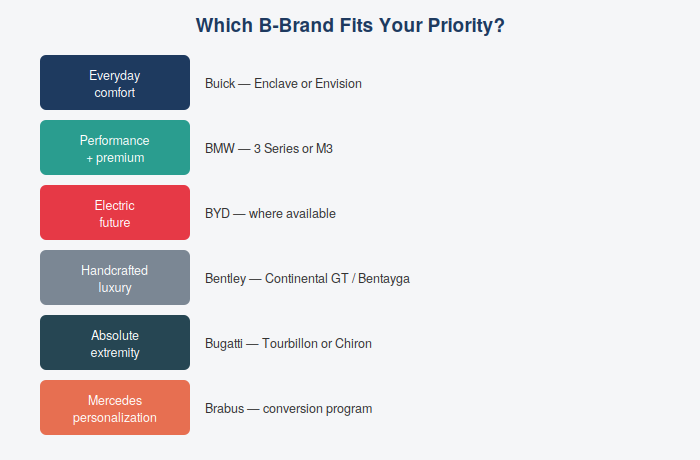
| Priority | Best B Brand Match | Why |
| Everyday reliability + comfort | Buick Enclave or Envision | Value, warranty, refined ride |
| Performance + premium feel | BMW 3 Series or M3 | Engineering depth, sharp dynamics |
| Electric vehicle future | BYD (where available) | Battery expertise, competitive range |
| Handcrafted ultra-luxury | Bentley Continental GT or Bentayga | Craft, exclusivity, heritage |
| Absolute performance extremity | Bugatti Tourbillon or Chiron | Top speed, engineering milestone |
| Mercedes personalization | Brabus conversion | Bespoke power and interior upgrades |
| Road-legal track experience | BAC Mono | Single-seat, lightweight, extreme |
FAQs
What car brands start with B?
The most recognized brands are BMW, Bentley, Bugatti, Buick, and BYD. Beyond these, there are numerous niche and regional brands including Brabus, BAC, Borgward, BAIC, Baojun, Bestune, Brilliance, Bowler, and Bitter, plus historical names like Benz & Cie and Bertone. Depending on how you count coachbuilders, tuners, and historical manufacturers, the total number of B-letter car brands exceeds 60.
What is the most reliable B car brand?
Among major brands, reliability varies by model and year. BMW’s 3 Series and Z4 score well on Consumer Reports and J.D. Power for recent model years — the 2024 3 Series was rated above average for its year by Consumer Reports, and the Z4 scored 85/100 on J.D. Power in 2025. Buick’s Enclave (2018–2024 models) also scores well across reliability surveys. Bentley and Bugatti are too low-volume and high-complexity for standard reliability comparisons.
Is BMW better than Bentley?
They serve fundamentally different purposes. BMW is a performance luxury brand built for drivers who want an engaged, sporty experience at a premium price. Bentley is a hand-built ultra-luxury brand focused on cabin opulence, exclusivity, and effortless high-speed travel. Comparing them directly is a bit like comparing a tailored suit to a race jacket — both are excellent, but at entirely different things. If you can only afford one, the decision is usually made by budget before anything else, since the entry gap between the brands is roughly $150,000 or more.
Why is Bugatti so expensive?
Several factors stack on top of each other. The engineering required to safely put 1,500-plus horsepower into a road-legal vehicle and contain it at 261 miles per hour is genuinely extraordinary — it required custom tire development, specialized brake systems, and body aerodynamics tested in dedicated wind tunnels. Production numbers are deliberately tiny (500 Chirons over eight years), which means no economy of scale. Each car requires hundreds of hours of hand assembly and quality verification. The materials used — carbon fiber monocoques, aerospace-grade aluminum components, bespoke interiors — are expensive at any volume. And Bugatti’s heritage and name carry a market premium that buyers are willing to pay. The combination adds up to a base price that starts above $2 million for any current model.
What is the cheapest B car brand to own?
Buick is generally the most affordable to purchase and maintain among recognized B brands. The Envista starts below $27,000, and RepairPal data suggests Buick vehicles have below-average annual maintenance costs compared to European luxury brands. BYD is competitive in markets where it’s available, with some models offering compelling total-cost-of-ownership figures due to lower EV running costs. Budget-market Chinese B brands like Baojun and Bestune are cheapest in absolute purchase price but are not widely sold outside China.
Is BYD available in the United States?
As of 2026, BYD does not sell passenger cars in the United States. This is primarily due to a 100% tariff imposed on Chinese-made EVs in the US market. BYD is active in Europe, Australia, Southeast Asia, Latin America, and the Middle East. The brand’s expansion into the UK and EU markets has been ongoing, with models like the Atto 3, Dolphin, and Seal available through European dealers.
What does BMW stand for, and what does the logo mean?
BMW stands for Bayerische Motoren Werke — Bavarian Motor Works in English. The blue and white divided circle in the logo represents the colors of the Bavarian state flag. BMW has offered different explanations over the years — some official communications suggested the segments represented a spinning propeller, which would connect to the brand’s aviation engine history, but this interpretation has been disputed. The current official position is that it represents the Bavarian regional colors.
What Bentley model is best for everyday use?
The Bentayga is widely considered the most practical Bentley for regular use. It has the ground clearance and visibility of an SUV, seats five comfortably, has a usable cargo area, and — in the hybrid version — offers some electric-only range for short urban trips. The Continental GT is a spectacular machine but is better suited as a weekend or long-distance car than a daily driver, particularly in urban environments where its low profile and wide body can be challenging to maneuver. For rear-seat passengers who want maximum comfort, the Bentayga EWB (Extended Wheelbase) is the current recommendation from most Bentley dealers.
What is the Bugatti Tourbillon?
The Tourbillon is the successor to the Bugatti Chiron, announced in February 2024 and revealed in June 2024. It uses an all-new naturally aspirated V16 engine paired with electric motors, producing a combined 1,775 horsepower. Unlike the Chiron, which used a W16 quad-turbocharged engine (a configuration unique to Bugatti and Bentley), the Tourbillon’s engine is a traditional V-configuration, which allows for a different weight distribution and character. The car is named after the tourbillon mechanism in high-end watchmaking — a rotating escapement designed to counteract the effects of gravity on movement accuracy. The name reflects Bugatti’s positioning at the intersection of mechanical artistry and engineering excellence.
Are there electric cars from B brands?
Yes — several. BYD’s entire lineup is either fully electric or plug-in hybrid, and the brand is one of the global leaders in EV production. BMW’s i-division produces the iX, i4, i5, i7, iX1, and iX3. Bentley’s Continental GT, Flying Spur, and Bentayga are all moving to plug-in hybrid powertrains, with a fully electric Bentley model expected before 2030. Bugatti’s Tourbillon incorporates an electric hybrid system alongside its V16. The letter B is, somewhat unexpectedly, one of the more electrified corners of the automotive alphabet.