
Three letters — C, H, E — have shaped more chapters of automotive history than any other combination. And if you narrow it down to just the first one, the letter C delivers a lineup of manufacturers so wide in scope and so varied in character that no other letter in the alphabet can quite match it. American muscle and European innovation.
Century-old luxury institutions and a two-year-old California hypercar company using 3D printing and artificial intelligence. The oldest continuously produced American sports car and a Spanish performance brand that didn’t exist six years ago. All of them start with C.
What makes the C-brands uniquely interesting in 2026 is how much is actively changing across all of them simultaneously. Cadillac has quietly become one of the most credible luxury EV brands in America. Chevrolet put 1,064 horsepower into a car that costs less than a base Ferrari.
Citroën is leading Europe’s charge against budget Chinese EVs with a $20,000 electric hatchback. Chrysler turned 100. And Czinger, from a factory in Los Angeles, is building the fastest road-legal car at Laguna Seca using methods that Bugatti and Koenigsegg don’t use yet.
This is the complete guide to the brands, the cars, the history, and the honest assessments of where each one stands today.
Also Check: Top Car Brands That Start With B
Best Car Brands That Start With A
List Of Car Companies That Start With C
1. Cadillac
Cadillac’s history stretches back to 1902, making it the oldest surviving luxury car brand in the United States. Founded in Detroit and named after Antoine de la Mothe Cadillac, the French explorer who founded the city, the brand grew under General Motors into the standard-setter for American prestige — the car that presidents rode in, that film stars drove, and that the phrase “the Cadillac of…” became embedded in everyday language as a synonym for the finest version of anything.
The decades between the 1970s and 2010s were difficult. German luxury brands — BMW, Mercedes-Benz, and Audi — redefined what premium cars could be, and Cadillac spent years chasing rather than leading.
The V-Series performance lineup launched in the early 2000s announced genuine ambition, and the CTS and CT6 sedans showed real engineering seriousness. But it was the electrification strategy that began with the 2023 LYRIQ that has genuinely repositioned the brand.
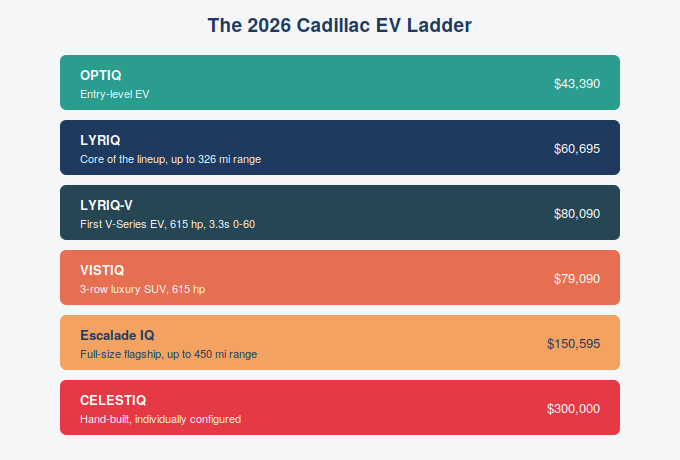
Cadillac now claims to be the leading luxury EV brand in the United States — a claim backed by actual sales figures rather than aspirational projections. The 2026 model year brings one of the most comprehensive luxury EV lineups of any brand: OPTIQ, LYRIQ, VISTIQ, Escalade IQ, and the extraordinary hand-built CELESTIQ at the pinnacle.
The 2026 Cadillac EV Lineup — What Each Model Does
2026 Cadillac LYRIQ
The LYRIQ was the model that began Cadillac’s electric transformation and it remains the core of the lineup. For 2026, it starts at $60,695 and offers a comprehensive range of configurations.
- Starting MSRP: $60,695 (Luxury RWD) / $64,195 (Luxury AWD)
- LYRIQ-V (first-ever V-Series EV): $80,090
- Battery: 102 kWh rated energy
- Range: Up to 326 miles (RWD) / 303 miles (AWD)
- Power (RWD): 365 hp
- Power (AWD): 515 hp
- LYRIQ-V power: 615 hp / 650 lb-ft torque
- LYRIQ-V 0–60 mph: 3.3 seconds (Cadillac’s quickest car ever)
- Charging port: CCS1 standard; NACS adapter available for Tesla Supercharger access
- Super Cruise: Available — hands-free highway driving on 400,000+ miles of mapped roads
- 17.7-inch diagonal infotainment display
- Average transaction price paid: $57,968 (5% below MSRP per TrueCar June 2026 data)
2026 Cadillac VISTIQ (New Model)
The VISTIQ is the newest addition to the Cadillac lineup, slotting between the LYRIQ and the larger Escalade IQ as a three-row luxury electric SUV.
- Starting MSRP: $79,090
- Drivetrain: Dual motor AWD only
- Power: Up to 615 hp / 650 lb-ft torque
- 0–60 mph: 3.7 seconds
- Standard wheels: 21-inch (22- and 23-inch options available)
- Super Cruise: Standard
- Character: Full three-row seating, luxury-first orientation
2026 Cadillac OPTIQ
The entry-level Cadillac EV, smaller than the LYRIQ and aimed at buyers entering the luxury segment.
- Starting MSRP: $43,390 (the most accessible Cadillac EV)
- Updates for 2026: More power, more standard features, built-in NACS port for direct Supercharger compatibility (no adapter required)
- Notable: The first Cadillac with a factory NACS port — significant for ease of charging access
2026 Cadillac Escalade IQ
The electric version of Cadillac’s most iconic model.
- Starting MSRP: $150,595
- Character: Full-size luxury SUV, up to 450 miles of range, Air Ride Adaptive suspension, executive rear seating
- Super Cruise: Standard
- Note: Separate from the conventional Escalade (gas-powered) which continues alongside it
2025 Cadillac CELESTIQ (Hand-Built Ultra-Luxury EV)
- Starting price: $300,000 (each unit individually configured)
- Build method: Hand-built in Warren, Michigan
- Key features: Five interactive HD screens, four-zone glass roof with Smart Glass technology (each section can be independently tinted), Super Cruise, bespoke interior configuration per customer
- Customer base: Positioned directly against Rolls-Royce and Bentley
The Remaining ICE Models For 2026
| Model | Type | Starting MSRP | Status |
| CT4 | Compact sedan (ICE) | $37,095 | Final year — discontinued after 2026 |
| CT4-V / CT4-V Blackwing | Performance sedan | ~$60,000 | Final year |
| CT5 | Midsize sedan (ICE) | ~$47,000 | New generation coming |
| CT5-V Blackwing | Supercharged V8 performance sedan | $99,095 | Manual transmission available |
| Escalade | Full-size SUV (gas) | Continues | Alongside Escalade IQ |
| XT4, XT5, XT6 | Gas SUVs | Various | Continuing |
What The Cadillac Pivot Actually Means
The CT4 discontinuation after 2026 is a significant signal. Cadillac is deliberately vacating the entry-level segment to raise its average transaction price and reinforce luxury positioning. That means the $37,095 CT4 disappears with no direct replacement — the brand’s floor shifts upward to the $43,390 OPTIQ. For buyers who valued an accessible Cadillac entry point, that window is closing.
The V-Series EV strategy is equally interesting. The LYRIQ-V, at 615 hp and 3.3 seconds to 60 mph, is faster than the CT5-V Blackwing’s 6.2-second time with its supercharged V8. That the brand’s most powerful model is now electric — not gasoline — is a statement about where the product hierarchy is heading.
The CT5-V Blackwing with its supercharged 6.2-liter V8 and available 6-speed manual transmission starts at $99,095 and remains a legitimate performance achievement, but it’s the last of its kind in the Cadillac lineup.
2. Chevrolet
Chevrolet was founded in 1911 by Louis Chevrolet and William Durant, who had been ousted from General Motors and used the new brand to buy his way back in. By 1918, Chevrolet was producing enough volume that its earnings helped Durant repurchase control of GM.
The brand has been a core part of General Motors ever since — responsible for more total vehicle sales than any other GM division and consistently among the top three best-selling brands in the United States.
In 2026, Chevrolet occupies a position that no other American manufacturer quite matches: it sells the most affordable new EV SUV in the country at $34,995 and the most powerful production V8 ever installed in an American car, in the same model year. That range — from democratic accessibility to extreme engineering excess — defines what Chevrolet is.
The 2026 Chevrolet Equinox EV — Democratizing Electric Mobility
No single Chevrolet product has done more to expand EV accessibility in recent years than the Equinox EV. It launched as one of the most affordable new electric vehicles in America and has held that position into 2026, where the base LT1 trim starts at $34,995 including the $1,800 destination charge.
2026 Chevrolet Equinox EV — Specifications
- Starting MSRP: $34,995 (LT1 FWD, including destination)
- LT2 FWD: $41,795
- RS FWD: $44,095
- AWD adds: $3,300 to any trim
- Power (FWD): 220 hp
- Power (AWD): 300 hp
- Battery: 79 kWh (usable)
- Range (FWD): Up to 288 miles (EPA estimated)
- Infotainment: 17.7-inch diagonal touchscreen (Google built-in)
- Charging: DC fast charge at up to 150 kW
- Super Cruise: Available on higher trims
- RS trim interior option: Adrenaline Red theme with heated seats and sunroof
- Notable: No Apple CarPlay or Android Auto — Google-based system only
The Equinox EV’s most important feature is something that rarely appears in specification tables: it qualifies for the $7,500 federal EV tax credit as of its 2025 launch, because it is assembled in North America.
That brings the effective starting price for eligible buyers to $27,495 — genuinely competitive with conventional gasoline compact SUVs. The base gas-powered Equinox starts at $28,800, meaning the EV is only marginally more expensive once the credit is applied.
The 288-mile range on the FWD model and real-world longer ranges reported by owners — Electrek noted that Cadillac’s similar EVs frequently exceed EPA estimates in everyday driving — make the Equinox EV a practical daily vehicle rather than a range-anxiety compromise.
2026 Chevrolet Equinox (Gas)
- Starting MSRP: $28,800 (LT FWD)
- Engine: 1.5L turbocharged inline-4, 175 hp
- Transmission: 6-speed automatic
- AWD available: Yes
- Fuel economy: Approximately 26–28 mpg combined
- Infotainment: 11-inch touchscreen with Apple CarPlay and Android Auto
The 2025 And 2026 Corvette — America’s Greatest Sports Car Family
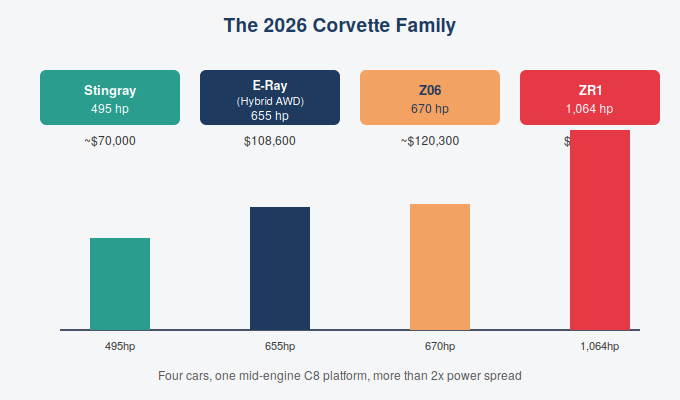
The Corvette deserves its own section because in 2026 it isn’t really one car — it’s a family of four increasingly extreme machines built on the same mid-engine C8 platform, each targeting a different level of performance ambition.
2026 Corvette Lineup At A Glance
| Model | Power | Starting MSRP | 0–60 mph | Top Speed |
| Stingray | 495 hp | ~$70,000 | ~3.9 sec | 194 mph |
| E-Ray (Hybrid AWD) | 655 hp combined | $108,600 | ~2.5 sec (est) | 184 mph |
| Z06 | 670 hp (flat-plane V8) | ~$120,300 | 2.6 sec | 195 mph |
| ZR1 | 1,064 hp (twin-turbo) | $185,000 | Sub-3.0 sec | 233 mph |
2026 Corvette E-Ray — The First Hybrid, First AWD Corvette
- Powertrain: 6.2L LT2 V8 (495 hp, rear) + front-mounted electric motor (160 hp)
- Combined output: 655 hp
- Drivetrain: AWD (first in Corvette history)
- Starting MSRP: $108,600
- Character: All-weather performance capability; electric motor eliminates wheelspin from the front axle during hard acceleration
2026 Corvette ZR1 — The Landmark
- Engine: 5.5L LT7 twin-turbocharged V8 with flat-plane crankshaft
- Power: 1,064 hp — the most powerful V8 ever in a production car from an American manufacturer
- Torque: 828 lb-ft
- Transmission: 8-speed dual-clutch automatic
- Starting MSRP: $185,000
- Top speed (ZTK package): 233 mph
- Notable comparison: A Porsche 911 GT3 starts at $224,495; a McLaren Artura at $254,100; a Ferrari 296 GTB at $346,950 — all produce less power than the ZR1
The ZR1’s price-per-horsepower ratio is genuinely unprecedented in the supercar world. At $185,000, it delivers more power than anything at that price from any manufacturer anywhere in the world. That calculation will change as the ZR1X arrives — rumoured to produce over 1,200 hp from a hybrid system — but the base ZR1 already represents an engineering achievement that commands respect regardless of where you stand on American muscle.
The Corvette’s 70-year history contains more reinvention than most brands manage across an entire corporate lifetime. The transition from front-engine to mid-engine for the C8 generation was the most dramatic — a change GM engineers had been studying since the 1960s and finally executed for 2020.
The result is a car that competes with Ferrari and Lamborghini in objective performance measures while remaining accessible to a vastly wider economic range of buyers. That positioning — genuinely exotic performance at attainable (relative) prices — is the consistent thread through every Corvette generation.
2026 Chevrolet Full Lineup Summary
- Trax: Subcompact SUV, from $20,400 — one of the most affordable new vehicles in the US
- TrailBlazer: Compact crossover, from $25,900
- Equinox: Compact SUV (gas), from $28,800
- Equinox EV: Compact SUV (electric), from $34,995
- Blazer EV: Midsize SUV (electric)
- Blazer: Midsize SUV (gas)
- Silverado 1500: Full-size truck, from $36,900 — consistently among the top three best-selling trucks in the US
- Silverado EV: Electric full-size truck
- Colorado: Midsize truck
- Tahoe / Suburban: Full-size SUVs
- Traverse: Three-row SUV
- Corvette family: Sports car range from $70,000 to $185,000+
3. Chrysler
Walter P. Chrysler officially founded the Chrysler Corporation on June 6, 1925. One hundred years later, the brand celebrated that centenary with a remarkable acknowledgment of its own legacy — and a frank conversation about its future.
For years, the brand operated with a lineup limited to the Pacifica minivan and its plug-in hybrid variant. The question of whether Chrysler would survive as a distinct entity was regularly raised by automotive journalists and industry analysts.
In 2025, the answer became clearer. New leadership at Stellantis, a renewed commitment to product investment, and a centenary calendar of events including the 100th Anniversary Edition Pacifica reinforced that the brand is not simply being phased out.
A refreshed 2027 Pacifica was revealed at the New York International Auto Show on April 1, 2026, and plans are confirmed for a new crossover and a third product inspired by the Halcyon concept.
The 2026 Chrysler Pacifica — Still America’s Most Capable Minivan
The Pacifica has been the backbone of Chrysler’s US lineup since 2017 and continues to hold a dominant position in the minivan segment — a segment Chrysler itself invented with the original Dodge Caravan in 1983.
The Pacifica is not just another family van. It is a genuinely well-engineered vehicle with class-exclusive features that no rival has matched.
2026 Chrysler Pacifica — Key Specifications
- Starting MSRP: $42,465 (Select FWD, including destination)
- 100th Anniversary Edition: $44,390 (FWD) / $47,385 (AWD)
- Pacifica Plug-in Hybrid Select: $51,070
- Pacifica Plug-in Hybrid 100th Anniversary Edition: $52,565
- Engine (gas): 3.6L Pentastar V6, 287 hp / 262 lb-ft torque
- Transmission: 9-speed automatic (gas) / e-CVT (PHEV)
- PHEV electric range: 32–33 miles (EPA all-electric)
- PHEV total range: 520 miles (combined gas + electric)
- PHEV fuel economy: 82 MPGe
- AWD: Optional on gas models; front-wheel drive standard
- Seating: 7 or 8 passengers
What Makes The Pacifica Different From Every Rival:
- Stow ‘n Go seating: Second and third-row seats fold completely flat into the floor — no removal required. No minivan competitor offers this. The system celebrated its 20th anniversary in 2025 and remains exclusive to Chrysler/Dodge minivans
- Uconnect Theater: Rear seatback video screens with built-in Amazon Fire TV integration — the first minivan to offer this
- FamCAM: Interior camera system giving a bird’s-eye view of rear-facing child-seat occupants
- First and only plug-in hybrid minivan: The Pacifica PHEV’s 82 MPGe and 32-mile electric range are unmatched in the segment; no other minivan manufacturer offers a plug-in hybrid option
- Standard safety features: More standard safety features than any other vehicle in its class
The Chrysler 100th Anniversary Edition adds the 100th anniversary badge, available in three colours (Red Hot, Bright White, and Hydro Blue), and builds on the Select trim specification. The option package — which can include Uconnect Theater, upgraded Alpine 13-speaker audio, and Amazon Fire TV seatback screens — adds meaningful entertainment capability to a vehicle already known for family-friendliness.
Why Chrysler’s Future Is More Interesting Than It Looks
The brand’s limited lineup has been a weakness for years. One minivan, even a well-executed one, doesn’t sustain long-term brand health. The 2027 Pacifica refresh and the confirmed crossover product signal a return to product investment.
The Halcyon concept, shown in 2024, previewed an electric luxury sedan with an unusual glass and light-forward design language that didn’t look like anything else from the Stellantis portfolio — suggesting Chrysler’s future product direction will be genuinely distinct rather than rebadged variants of existing platforms.
Chrysler entering its second century with a bold vision of innovation is not just marketing language. The brand has specifically stated it aims to blend engineering excellence with attainable vehicles — a position that differentiates it from both the value-focused Dodge brand and the premium positioning of Alfa Romeo within Stellantis’s North American portfolio.
4. Citroën
No automotive brand of comparable scale has maintained a more consistent philosophy of unconventionality than Citroën. Founded in 1919 by André Citroën — an engineer and entrepreneur who had previously manufactured herringbone gears and ran one of France’s largest munitions factories during World War I — the company introduced innovations that were genuinely ahead of their time and occasionally ahead of what the market was ready for.
The Traction Avant of 1934 was the world’s first mass-produced front-wheel-drive car. The 2CV, launched in 1948, was arguably the most democratic automobile ever built — designed to motorise rural France with a vehicle that cost as little as possible, weighed as little as possible, and could traverse unpaved roads carrying a basket of eggs without breaking them.
The DS of 1955 brought hydropneumatic self-levelling suspension to the mainstream, looked like nothing else on the road, and remained in production for 20 years. These are not incremental improvements — they are structural departures from what the rest of the industry was doing.
The modern Citroën carries that heritage forward with mixed results. The brand is no longer at the engineering frontier in the way it was during the DS era. But its commitment to comfort — specifically the Advanced Comfort suspension with Progressive Hydraulic Cushions, which uses hydraulic bumpers to absorb small road imperfections before they reach the springs — is a genuine differentiator that owners notice immediately.
The 2025 And 2026 Citroën Lineup — An Electric-First European Brand
Citroën ranked 10th out of 30 manufacturers in the 2025 What Car? Reliability Survey — a far better showing than several better-known rivals including MG, Renault, Skoda, and Volkswagen. That reliability context matters when evaluating its electric lineup.
2025/2026 Citroën ë-C3 — The Affordable Electric Hatchback Fighting Chinese Rivals
- Starting price (UK): £20,595 (approximately $26,000 USD equivalent)
- Battery: 43.7 kWh usable
- Official range: Up to 200 miles WLTP
- Real-world range: 155–170 miles (What Car? test)
- Motor power: 83 kW (111 hp)
- Charging: Standard AC charging
- Character: Basic, affordable, urban-focused
The ë-C3 is specifically positioned as Europe’s answer to low-cost Chinese electric vehicles flooding the EU market. Autocar called it “Europe’s fightback against low-cost Chinese challengers.” At this price point, with the Renault 5 and BYD Dolphin Surf as direct competitors, the ë-C3 offers Citroën’s trademark comfort focus in an entry-level package.
Real-world range falls below the official figure, which is a noted limitation — the Renault 5 uses energy more efficiently — but the comfort and build quality are strong relative to price.
2025/2026 Citroën ë-C5 Aircross — The Family Electric SUV
- Starting price (UK): £34,065 (Standard Range) / Higher for Long Range
- Standard Range battery: 73 kWh, 207 hp
- Long Range battery: 97 kWh, 227 hp
- Long Range range: Up to 422 miles WLTP
- 0–62 mph (Standard Range): 8.9 seconds
- Advanced Comfort suspension: Standard across range
- Boot capacity: 651 litres (seats up) / 1,600+ litres (rear bench folded)
- Safety: Euro NCAP 4-star rating
- Warranty: 3 years/60,000 miles vehicle; 8 years/100,000 miles battery; 8 years/100,000 miles major components (with Citroën-approved servicing)
The ë-C5 Aircross Long Range’s 422-mile WLTP range is one of the highest figures in the family SUV segment — notably more than the Kia EV6, the Volkswagen ID.4, and the Tesla Model Y in equivalent configurations.
The 97 kWh battery is genuinely large for this class and the on-board charger accepts 160 kW — fast by the segment’s standards. The trade-off is the 8.9-second 0–62 time, which is slower than direct competitors. Citroën’s priority is range and comfort, not acceleration.
Citroën C5 X (PHEV and Petrol)
- The C5 X is a fastback-style crossover positioned above the standard C5 lineup
- Available as petrol (PureTech 130), mild hybrid, and plug-in hybrid
- Wheelbase-forward design that sits higher than an estate but lower than an SUV
- The PHEV variant uses an electric motor that resolves the grabby brakes reported on petrol versions
- Advanced Comfort suspension is central to its appeal on long motorway journeys
| Model | Body Style | Power | Battery / Range | Starting Price |
| ë-C3 | Hatchback | 83 kW (111 hp) | 44 kWh / 200 mi WLTP | £20,595 |
| ë-C3 Aircross | B-SUV | 83–136 kW | 44–54 kWh / 249 mi WLTP | ~£24,000 |
| ë-C4 | Crossover hatch | Various | 54 kWh / 250+ mi | £29,180 |
| ë-C4 X | Fastback SUV | Various | 54 kWh | ~£31,000 |
| ë-C5 Aircross | Family SUV | 207–227 hp | 73–97 kWh / 422 mi | £34,065 |
| C5 X (PHEV) | Fastback crossover | Petrol + electric | PHEV | ~£35,000 |
5. CUPRA
CUPRA is one of the most fascinating brand origin stories in recent automotive history. Before 2018, CUPRA was simply SEAT’s internal performance division — badging given to sportier variants of standard SEAT models.
When the parent company, Volkswagen Group’s Spanish subsidiary, decided to create a standalone performance brand, it took the performance division’s name and gave it an entirely independent identity, design language, and product strategy.
Founded as an independent brand in 2018, CUPRA now sells its own models — not just sportier versions of SEATs — and has positioned itself as an alternative to Volkswagen’s performance brands for buyers who want something with more visual aggression and less conservative German restraint.
The brand’s lion head logo, its use of gold and copper accents, and its interior design language featuring scale-pattern trims and bucket seats are all deliberate differentiators from its VW Group stablemates.
The most significant strategic decision was to go electric faster than almost any European mainstream brand. The Cupra Born EV arrived in 2021, the Cupra Tavascan in 2024, and the brand is expanding its EV lineup rapidly with models like the Raval and Terramar planned for 2025 and beyond.
The 2025 And 2026 CUPRA Lineup
2026 CUPRA Formentor — The Flagship Petrol SUV
The Formentor is CUPRA’s most established model, a compact SUV coupe that shares its platform with the SEAT Ateca but is designed from the outset as a CUPRA product rather than a SEAT variant.
- Starting MSRP (UK): £35,315–£64,495 depending on trim and engine
- Engines available: 1.5 TSI (150 hp) / 2.0 TSI (242 hp / 333 hp VZ3) / e-Hybrid PHEV (268 hp)
- Top spec: VZ3, 333 hp, 4Drive AWD, Akebono upgraded brakes
- 2025 refresh: New front-end design with triangular headlight inserts, updated interior
- Infotainment: 12.9-inch central display (updated with 2024 facelift)
- Standard features (V1 base): Adaptive cruise control, LED headlights, three-zone climate control, keyless entry
- Reliability (brand): 13th out of 30 in 2025 What Car? survey
2025/2026 CUPRA Tavascan — The Electric Performance SUV
The Tavascan is CUPRA’s most important electric vehicle and arguably its most technically accomplished product. Built on Volkswagen Group’s MEB platform alongside the VW ID.4 and Skoda Enyaq, it shares bones with more conventional alternatives but CUPRA’s chassis tuning and styling give it a genuinely different character.
- Powertrain options: 282 hp RWD / 335 hp AWD (dual motor)
- Battery: 77 kWh (82 kWh total capacity)
- Range (RWD): Up to 340 miles WLTP
- Range (AWD/VZ): Up to 320 miles WLTP
- 0–62 mph (AWD): 5.5 seconds
- Drag coefficient: 0.26 Cd — exceptionally aerodynamic for an SUV
- Length: 4,644 mm — directly comparable to Kia EV6 and Polestar 2
- Distinctive interior: Dragon-scale flying buttress console, bucket seats in VZ trims, Sennheiser audio partnership
- Safety: Five-star Euro NCAP rating (November 2024)
- Criticism: Heavy at 2.3 tonnes; brake pedal blending between regen and friction brakes criticised as inconsistent
The CUPRA Born — The EV That Started It All
The Born is CUPRA’s electric hatchback, built on the MEB platform alongside the Volkswagen ID.3. Edmunds described it as a model that allows CUPRA to “extract more out of the shared bones” — the chassis tuning and suspension setup deliver a more engaging result than the mechanically similar VW ID.3 despite sharing almost all of the structural components.
- Power: Up to 231 hp (e-Boost limited function)
- Battery: 77 kWh
- Range: Up to 372 miles WLTP
- Transmission: Single-speed, RWD
- Key selling point: More engaging than the VW ID.3 using similar hardware, thanks to CUPRA-specific suspension calibration
Why CUPRA Matters As A Brand Signal
CUPRA’s growth from zero to a recognised independent brand in seven years is one of the auto industry’s more interesting marketing achievements. It targets buyers who want VW Group engineering quality and reliability but find the VW, Skoda, and Audi brands visually conservative.
The gold accents, aggressive body styling, and deliberately emotive naming (Formentor, Tavascan, Leon, Born) create a brand personality that’s genuinely distinct from the corporate family it belongs to.
The brand is not yet available in the US. Plans for North American expansion have been discussed internally within Volkswagen Group, and the Tavascan’s MEB platform is already validated for US safety and emissions requirements, meaning the regulatory path is clear. Whether and when CUPRA formally enters the US market is one of the genuinely open questions in the premium compact segment for 2027 and be.
6. Czinger
If the C-brand list needed one entry to prove that this category is not just legacy American and European manufacturers, it’s Czinger. Founded in 2019 in Los Angeles, Czinger Vehicles produces the 21C — a hybrid hypercar built with a manufacturing philosophy that is fundamentally different from anything else in production.
The 21C uses additive manufacturing (3D printing) for over 20% of its structural components, including suspension nodes and chassis elements. These aren’t decorative 3D-printed parts — they are structural, load-bearing components designed by artificial intelligence algorithms to be as light as possible while meeting specific stiffness and strength targets. The shapes the AI generates look organic, almost like bone structure, because they follow the same mathematical optimisation principles that biological structures use.
The technology comes from Czinger’s parent company Divergent Technologies, whose facility was simultaneously producing structural components for Bugatti, Aston Martin, McLaren, SpaceX, and the US military in 2024. That manufacturing pedigree is not a startup claim — it’s a verified production contract list.
The 2026 Czinger 21C — Specification And Achievement
2026 Czinger 21C — Core Specifications
- Starting price: ~$2.35 million USD
- Engine: 2.9L twin-turbocharged V8 with flat-plane crankshaft
- Engine output: 750 hp from the V8 alone, revving to 11,000 rpm
- Electric system: 800V hybrid system with three electric motors
- Combined system output: 1,250 hp (standard) / 1,350 hp (Blackbird Edition)
- Torque: 1,061 lb-ft combined
- Drivetrain: Rear-mid engine, AWD
- Transmission: 7-speed single-clutch sequential (bespoke by XTrac, casing 3D-printed in-house)
- 0–60 mph: 1.9 seconds
- Top speed: 219 mph (standard) / 253 mph (V Max variant)
- Downforce at 200 mph: 2,552 kg
- Seating: 1+1 tandem (driver ahead, passenger behind) — fighter jet configuration
- Body structure: Carbon fibre monocoque with 3D-printed structural nodes
- Curb weight: 1,664 kg
- Total units planned: 80 (now focused on V Max and Blackbird variants for remaining allocation)
Verified Track Records (2024–2025)
- Circuit of the Americas (COTA): 2:10.70 — first official production car lap record at this circuit, set in stock configuration, July 2024
- Laguna Seca: Record lap time — part of the “Gold Rush” campaign in July 2025, where the 21C set five production car lap records at five tracks over five consecutive days
- Total time shaved in Gold Rush campaign: 16.26 seconds off existing benchmarks combined across five tracks
The Corvette ZR1 came within seconds of the COTA record in February 2026, reflecting how the 21C’s records are being challenged as more extreme production cars emerge — and how competitive the performance benchmark Czinger set actually was.
Why The 21C Matters Beyond Its Performance Numbers
The 21C is not just a fast car — it’s a proof-of-concept for an entirely different way to build vehicles. Traditional car manufacturing requires expensive tooling: stamping dies, casting moulds, and fixtures that cost tens of millions of dollars and take months to produce.
Divergent’s additive manufacturing approach eliminates much of that tooling, allowing rapid design iteration without the capital cost that typically gates performance optimization.
In 2024, Divergent’s facility was simultaneously producing components for Bugatti, Aston Martin, McLaren, SpaceX, and the US military — demonstrating that this is a proven industrial process, not a boutique experiment. The 21C’s performance is the advertising campaign for a manufacturing capability that is available to other automotive companies right now.
7. Caterham
Caterham Cars makes one car, has made essentially one car since the company was founded in 1973, and has no plans to make a fundamentally different car. The Caterham Seven is a direct continuation of the Lotus Seven designed by Colin Chapman in 1957, which Caterham purchased the manufacturing rights to when Lotus moved on to other projects.
It weighs between 490 kg and 600 kg depending on specification, has no electronic driving aids in most configurations, no ABS as standard, no power steering, and no roof unless you pay extra for one.
In 2026, the Caterham Seven starts at approximately £25,000 in basic kit form and approaches £90,000 in the top-spec Seven 620R. The 620R produces 311 hp from a supercharged 2.0L Ford engine and weighs 500 kg — giving a power-to-weight ratio of approximately 620 hp per tonne, comparable to a Ferrari LaFerrari.
Caterham Seven 620R — Specifications
- Engine: 2.0L Ford Duratec supercharged, 311 hp
- Weight: 500 kg
- Power-to-weight: ~620 hp/tonne
- 0–60 mph: 2.8 seconds
- Top speed: 155 mph
- Starting price: ~£88,000
- The basic Seven 160: 660cc 3-cylinder, 80 hp, from ~£25,000
The Seven’s appeal is genuine and specific. In a world where modern cars increasingly mediate the relationship between driver and road through electronic systems, the Seven removes all mediation. You feel every surface imperfection through the steering.
You have to manage the throttle, the braking, and the balance yourself. It’s demanding in a way that almost no road car sold today is demanding, and for a particular type of buyer, that demand is exactly the point.
Caterham received investment and new ownership structures in recent years, and a new model — the Project V, an electric coupé concept — has been shown. Whether that represents a genuine direction or exploratory concept work remains to be seen. The Seven itself continues unchanged in its essential DNA.
Complete Reference: All Major C-Brand Manufacturers
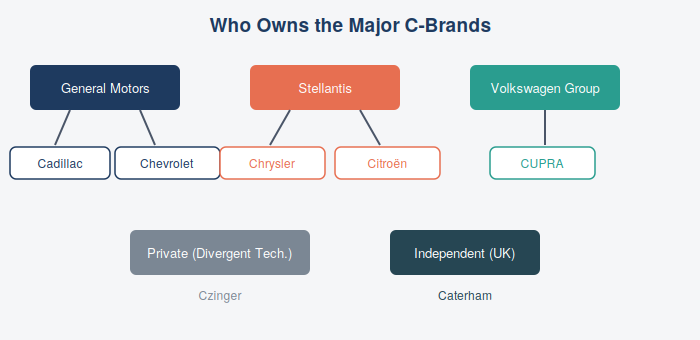
| Brand | Country | Founded | Current Owner | Market Focus | Active |
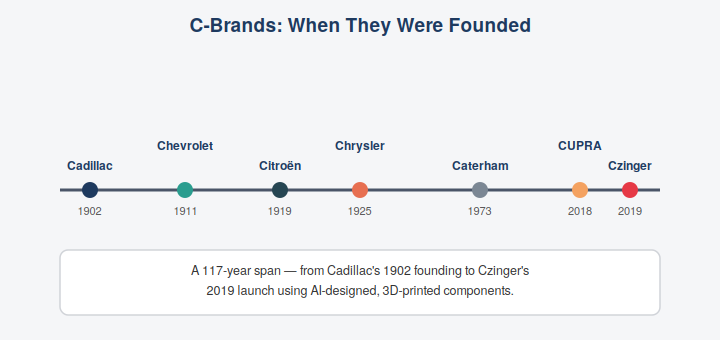
| Cadillac | USA | 1902 | General Motors | Luxury / Electric | Yes |
| Chevrolet | USA | 1911 | General Motors | Mass market / Performance | Yes |
| Chrysler | USA | 1925 | Stellantis | Family / Minivan | Yes |
| Citroën | France | 1919 | Stellantis | Comfort / EV | Yes |
| CUPRA | Spain | 2018 | Volkswagen Group | Performance EV | Yes |
| Czinger | USA | 2019 | Private (Divergent) | Hypercar | Yes |
| Caterham | UK | 1973 | Private | Lightweight sports | Yes |
| Chevrolet Corvette | USA | 1953 | General Motors | Sports car | Yes (sub-brand) |
| Citroën (DS) | France | 1955/2014 | Stellantis | Luxury EV | Yes (separate brand) |
| Callaway | USA | 1977 | Private | Modified Corvette | Yes (low volume) |
| Cizeta | Italy | 1988 | Private | Supercar | Dormant |
| Chrysler (300) | USA | 1925 | Stellantis | Sedan | Retired 2023 |
Frequently Asked Questions
What car brands start with the letter C?
The major active C-brands in 2026 include Cadillac, Chevrolet, Chrysler, Citroën, CUPRA, Czinger, and Caterham. Within the Chevrolet family, the Corvette also carries its own brand identity. DS Automobiles originated as Citroën’s premium sub-brand and is now a separate Stellantis brand. Callaway is a low-volume American manufacturer specialising in modified Corvette variants. Defunct notable C-brands include Chrysler’s former DeSoto division, Cord (classic American luxury car, 1929–1937), and Cizeta (Italian V16 supercar, largely dormant since the 1990s).
Is CUPRA the same as SEAT?
No, CUPRA is a separate brand, though it shares ownership and engineering with SEAT under the Volkswagen Group umbrella. CUPRA was established as an independent brand in 2018, having previously been SEAT’s internal performance division. CUPRA now develops its own models (Formentor, Tavascan, Born, Leon) with distinct design, naming, and product strategy. Both brands are managed under the CUPRA & SEAT company structure but marketed separately. SEAT focuses on value-oriented mainstream vehicles in European markets, while CUPRA targets a premium, performance-oriented buyer.
How much does the Czinger 21C cost and how many will be made?
The Czinger 21C starts at approximately $2.35 million as of 2026, with the V Max variant priced at around $2.4 million. The Blackbird Edition commands a premium above the standard model. Total planned production is 80 units, with the remaining allocation focused on the V Max long-tail variant and Blackbird Edition. Czinger has paused other vehicle projects (a planned SUV and GT were shelved) to concentrate resources on completing the 21C’s production run and pursuing the Nürburgring lap record.
Why is Cadillac discontinuing the CT4 after 2026?
Cadillac is retiring the CT4 as part of its deliberate strategy to reposition the brand further upmarket and shift its product focus toward electric vehicles. Without a CT4 replacement, the brand’s entry price point rises to the OPTIQ EV at $43,390. This intentional narrowing of the price floor is designed to support higher average transaction prices and reinforce Cadillac’s luxury positioning — a strategy explicitly acknowledged in the brand’s 2026 model year pricing communications. The CT5 will receive a new generation with a combustion engine.
What is Chrysler’s Stow ‘n Go seating and why is it exclusive?
Stow ‘n Go is Chrysler’s proprietary seating system in the Pacifica minivan where the second and third-row seats fold completely flat into recesses in the floor, requiring no removal. Competing minivans — including the Honda Odyssey and Kia Carnival — require owners to physically remove the second or third-row seats (which are heavy) to achieve comparable cargo capacity. The Stow ‘n Go system allows conversion from full passenger configuration to flat cargo floor in under a minute. It celebrated its 20th anniversary in 2025 and no competitor has successfully replicated it, partly because the floor recess design requires significant engineering commitment that reduces underbody packaging space for other components.
Is Citroën still making petrol cars in 2026?
Yes. While Citroën has significantly expanded its electric lineup, petrol-powered models continue in the C3 Aircross (1.2 Turbo, available from March 2026 without the mild hybrid module), C5 X (PureTech 130), and other variants depending on market. In European markets, the brand’s strategy is clearly electric-first, but petrol options remain available particularly in markets where EV charging infrastructure is less developed. Citroën’s stated direction aligns with Stellantis’s broader commitment to reducing combustion vehicles over time, but no firm end-date for petrol sales has been published.
Can I buy a Caterham Seven in the United States?
Yes, with limitations. The Caterham Seven is available in the United States primarily as a kit car, which allows it to avoid full FMVSS (Federal Motor Vehicle Safety Standards) certification requirements that would otherwise be prohibitively expensive for a low-volume UK manufacturer. The kit car classification means the buyer technically assembles the final vehicle, though Caterham and its US partners facilitate this process to varying degrees of owner involvement. Import duties, state registration requirements, and the practical matter of finding a mechanic familiar with the car are additional considerations for US buyers.
What makes the 2026 Corvette ZR1 significant in the supercar world?
The ZR1’s 1,064 hp from a 5.5-liter twin-turbocharged V8 represents the most powerful production V8 engine ever produced by an American manufacturer and is delivered at a starting price of $185,000 — significantly less than directly comparable European hypercars. A Porsche 911 GT3 (starting at $224,495) produces 502 hp. A McLaren Artura ($254,100) produces 690 hp. A Ferrari 296 GTB ($346,950) produces 819 hp. The ZR1 produces more power than all three at a lower price than all three. Its 233 mph top speed with the ZTK Performance Package places it among the fastest road-legal cars sold by any mainstream manufacturer. The ZR1 also recently came within seconds of the Czinger 21C’s production car record at Circuit of the Americas, demonstrating its competitive standing against dedicated hypercar products.