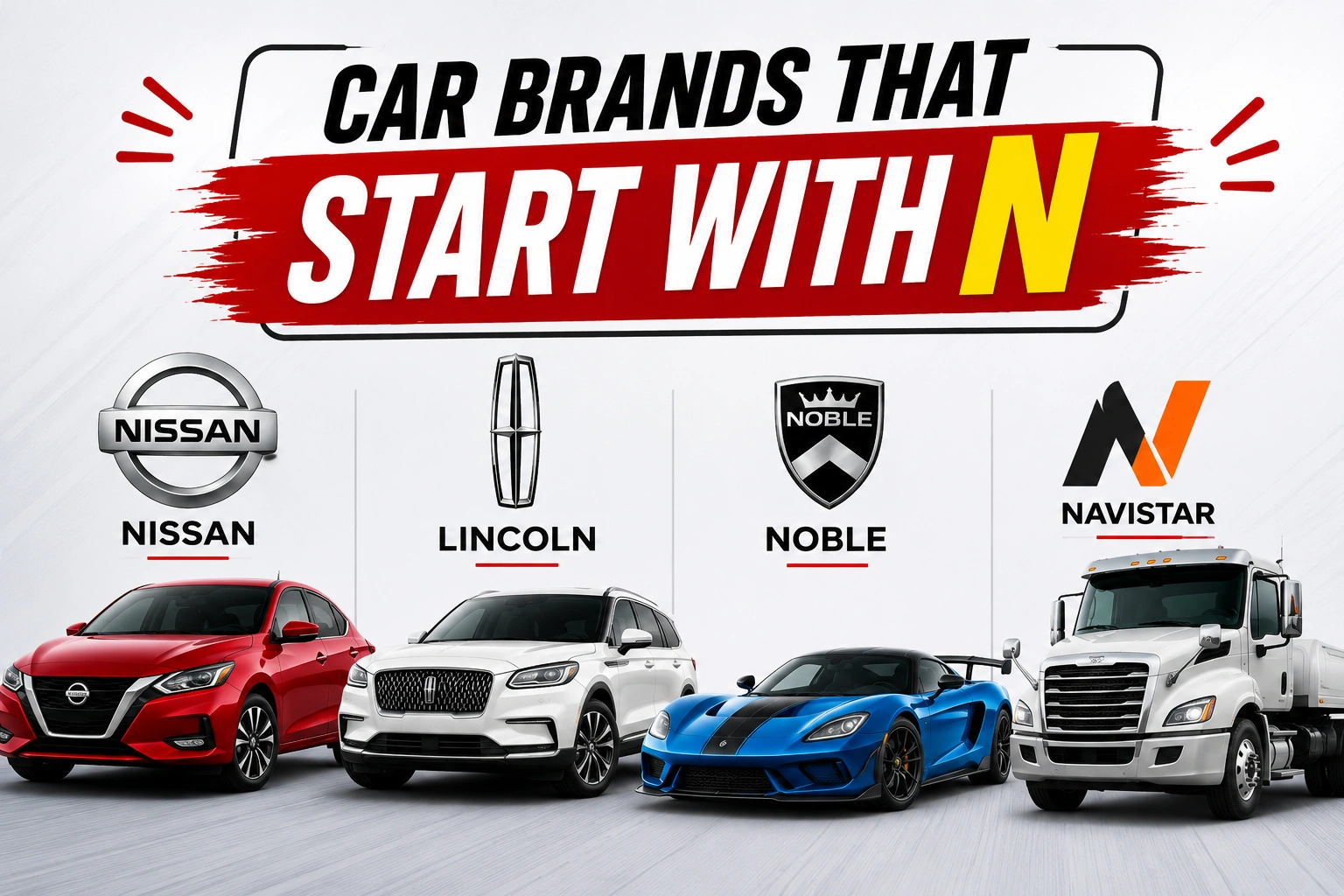
The letter N has produced some of the most distinct and historically significant names in the automotive world. It opens Nissan, a Japanese giant whose R35 GT-R spent 18 years as a technological benchmark before production concluded in August 2025.
It gives us NIO, the Shanghai-based electric vehicle brand that invented battery swapping at scale and is now fielding a 150 kWh ultralong-range sedan capable of over 1,000 kilometres on a single charge.
It takes in Noble Automotive, a small British workshop in Leicestershire that builds mid-engined supercars entirely stripped of electronic driver aids and sells them to buyers who want the most direct possible connection between their inputs and the machine.
Between those extremes — the volume giant, the electric pioneer, the purist boutique builder — the N-brands tell a story that spans over a century of global automotive development, from American Edwardian manufacturers and German Wankel pioneers to China’s current EV boom and its very public casualties.
All Car Brands That Start With N: The Complete Reference
1. Nissan
Nissan Motor Co., Ltd. traces its corporate origins to 1911 when Masujiro Hashimoto established the Kwaishinsha Motor Car Works in Tokyo, which produced the DAT automobile. The name Nissan came into formal use in 1934, derived from the abbreviation of Nihon Sangyo — “Japan Industries” — the holding company that controlled the manufacturing group. Through the post-war decades, Nissan established itself as one of Japan’s two dominant automotive forces alongside Toyota, building global volume through a combination of practical family cars, rugged commercial vehicles, and occasional moments of engineering brilliance that earned global respect.
The brand’s 2024 global production figures reflected a difficult year. Global production across the January-December 2024 period declined 8.7% from 2023 levels, and December 2024 production fell 19.3% year-on-year. These figures sit against the backdrop of Nissan’s well-publicised financial difficulties and the prolonged discussions with Honda about a potential business merger — negotiations that began in late 2023 and continued through 2025 without a concluded agreement. Despite these challenges, Nissan’s product planning announcements in late 2025 outlined an ambitious lineup of new models for FY26, including an all-new Patrol (the first right-hand-drive market globally for the latest generation), a third-generation Leaf EV, an all-new one-ton pickup in partnership with Mitsubishi, and a refreshed Qashqai with third-generation e-POWER technology.
The brand’s most emotionally significant recent event was the conclusion of R35 GT-R production in August 2025, after 18 years of continuous assembly. The R35 GT-R debuted at the 2007 Tokyo Motor Show and became one of the most technologically celebrated performance vehicles ever produced — a twin-turbocharged V6-powered all-wheel-drive sports car that embarrassed significantly more expensive European rivals in every independent performance test it faced. Its retirement closes a chapter in Nissan’s performance heritage that will not easily be reopened.
Nissan also announced plans to double the global NISMO product lineup from five to ten models, reflecting the brand’s commitment to expanding its performance sub-brand even as it navigates wider corporate challenges. Current NISMO offerings include the Z, Armada (US market), Ariya EV, Skyline, and X-Trail/Rogue. The Ariya NISMO, bringing 320 kW and 600 Nm of torque to Nissan’s flagship electric SUV, began European sales in 2024 in celebration of NISMO’s 40th anniversary.
Founded: 1934 (Nissan Motor Co.); roots from 1911 (Kwaishinsha/DAT)
Headquarters: Yokohama, Japan
Alliance: Renault-Nissan-Mitsubishi Alliance
Current lineup: Z, GT-R (production ended August 2025), Leaf, Ariya, Kicks, Rogue/X-Trail, Pathfinder, Patrol, Murano, Frontier/Navara, Titan, Armada, Sentra, Altima, Maxima, Note, Juke, Qashqai, Magnite
2024: Global production down 8.7% year-on-year; ongoing discussions with Honda regarding potential merger
Notable: R35 GT-R production concluded August 2025 after 18 years; NISMO lineup set to double to 10 models globally
2. NIO
NIO Inc. was founded in November 2014 in Shanghai by entrepreneur William Li (Li Bin), with a mission that was clear from the outset: challenge the assumption that a premium electric car had to be built in California or Germany to be world-class.
The company announced itself to the world not with a sensible family SUV but with the EP9 — an electric track car that in 2016 broke the Nürburgring lap record for electric vehicles with a time of 6 minutes 45.9 seconds. It was a statement of intent that established NIO’s identity as a technology-first, performance-capable brand targeting affluent Chinese buyers who wanted an alternative to Tesla that was unmistakably Chinese.
From its founding through to 2023, NIO released eight core models: the ET series sedans (ET5, ET5 Touring, ET7), the ES series SUVs (ES6, ES7, ES8), and the EC series coupe-SUVs (EC6, EC7), with most vehicles priced above 300,000 yuan — positioning them directly against Mercedes-Benz, BMW, and Audi in the Chinese luxury market. Total R&D investment reached 43 billion yuan by the end of 2023, with more than 10 billion yuan invested in both 2022 and 2023 alone. The 2024 NIO ET7, equipped with a 150 kWh ultralong-range battery, became the only battery-electric executive sedan confirmed to have exceeded 1,000 kilometres in a real-life range test — a figure that no European or American rival can approach.
NIO’s most distinctive technological contribution to the automotive industry is its battery swap system. Rather than waiting for a vehicle to charge at a conventional charging point, NIO owners can drive into a purpose-built swap station and exchange their depleted battery for a fully charged one in approximately three minutes — faster than filling a petrol tank. By early 2025, NIO operated over 1,300 battery swap stations across China, and the company announced plans to begin deploying its fifth-generation swap stations from Q1 2026. NIO has also signed battery swap cooperation agreements with Changan, Geely, JAC, Chery, and Lotus Technology, signalling the potential for the standard to become an industry-wide format.
The company expanded beyond its NIO flagship brand with two additional sub-brands: Onvo, targeting mainstream family EV buyers, and Firefly, aimed at the affordable urban EV market in Europe. In 2025, NIO aimed to reach approximately 440,000 combined deliveries across all three brands. The brand’s global footprint extended to Norway, Germany, the Netherlands, Denmark, and Sweden through its European expansion.
Founded: November 2014, Shanghai, China
Headquarters: Shanghai, China; design in Munich; software in San Jose, USA
Founder: William Li (Li Bin)
Current models (NIO brand): ET5, ET5 Touring, ET7, ET9, ES6, ES7, ES8, EC6, EC7
Sub-brands: nvo (mainstream), Firefly (affordable)
Battery swap stations: 1,300+ in China (early 2025); 5th-gen deployment from Q1 2026
R&D investment: 43 billion yuan total by end of 2023
Notable: Only BEV executive sedan to exceed 1,000 km real-world range (ET7 with 150 kWh battery)
3. Noble Automotive
Noble Automotive was founded by Lee Noble in 1999 in Leicestershire, England, with a philosophy that remains unchanged across every vehicle the brand has produced: build a mid-engined sports car with the minimum weight, the maximum mechanical feedback, and the fewest electronic aids that a reasonable buyer would accept. Noble has never had the resources of a Ferrari, the marketing budget of a Lamborghini, or the racing heritage of a McLaren. What it has had, consistently, is an engineering sensibility rooted in the belief that a supercar should challenge and reward its driver rather than assist and protect them.
The Noble M12 and M400 models established the brand’s reputation in the early 2000s with twin-turbocharged Ford Duratec V6 engines in lightweight steel chassis. These were raw, demanding cars that tested drivers genuinely — Top Gear’s Jeremy Clarkson described an early Noble as one of the most exciting cars he had driven. The M600, launched in 2010, represented a significant escalation: a 4.4-litre twin-turbocharged Volvo-Yamaha V8 producing up to 650 horsepower, through a six-speed manual gearbox, in a carbon fibre body weighing just 1,250 kg. On the Top Gear test track, the M600 posted a lap time of 1:17.7 with The Stig at the wheel — placing it fourth fastest in the programme’s history at the time and ahead of cars costing three times as much. Autocar’s road test noted that during testing, the M600 accelerated faster than a McLaren F1 in almost every in-gear increment from 20 to 160 mph — a fact that placed it among the fastest point-to-point road cars of its era regardless of price.
The M600’s successor, the M500, arrived in late 2022 after a development period that stretched back to its 2018 Goodwood Festival of Speed debut. The M500 uses a twin-turbocharged Ford 3.5-litre V6 from the Ford GT supercar, producing approximately 550 horsepower in a car that weighs 1,350 kg. Managing director Peter Boutwood confirmed the chassis is approximately 70% M600 in fundamental architecture, but with roomier accommodation, better access, and improved brake assistance. The M500 is priced at approximately £150,000 in the UK — roughly half the M600’s launch price — positioning it as a more broadly accessible Noble without any compromise to the brand’s core philosophy. Importantly, Noble operates independently and has no connection to any group or parent company, which means the brand’s product development moves slowly but entirely according to its own priorities.
Founded: 1999, Leicestershire, England
Founder: Lee Noble
Status: Active, current management under Peter Boutwood
Current model: M500 (2022–present); M600 production 2010–2018
M600 specs: 4.4L twin-turbo Volvo/Yamaha V8; up to 650 hp; 1,250 kg; £206,000
M500 specs: 3.5L twin-turbo Ford V6; approximately 550 hp; 1,350 kg; approximately £150,000
Notable: M600 posted 1:17.7 Top Gear lap time; faster than McLaren F1 in 20-160 mph increments per Autocar
4. NISMO
NISMO — the name is a contraction of Nissan Motorsport — was established in Tokyo in 1984 initially as a motorsport and vehicle customisation division. Its remit has always been dual: compete in racing and translate the lessons learned into enhanced road vehicles available to Nissan’s regular customer base. NISMO’s 40th anniversary was celebrated in 2024, and the milestone coincided with the brand’s most ambitious road car expansion to date, with Nissan announcing plans to double the global NISMO road car lineup from five to ten products.
The NISMO versions of Nissan’s road cars are not simply cosmetic upgrades. The NISMO Z, for example, uses the same 3.0-litre twin-turbocharged V6 as the standard Z but with recalibrated engine management, upgraded suspension tuning developed directly from Nissan’s racing programmes, Brembo brake systems, and Rays lightweight alloy wheels. The Ariya NISMO brings 320 kW (429 hp) and 600 Nm of torque to NIO’s flagship electric SUV, using an enhanced version of the e-4ORCE all-wheel-drive system with torque vectoring calibrated specifically for the NISMO variant. On the motorsport side, NISMO has competed in Super GT, Blancpain GT, and the Formula E championship, providing a genuine technical pipeline between competition and road.
Founded: 1984, Tokyo, Japan (Nissan Motorsport International)
Parent: Nissan Motor Co.
Current road models: Z NISMO, Armada NISMO, Ariya NISMO, Skyline NISMO, X-Trail/Rogue NISMO; expanding to 10 total
Notable: 40th anniversary in 2024; Ariya NISMO — 320 kW, 600 Nm, enhanced e-4ORCE AWD
5. Nash Motors
Nash Motors holds a genuinely important but frequently overlooked place in American automotive history. Founded by Charles W. Nash in 1916 — Nash had previously served as president of General Motors before disagreeing with William Durant — the company produced vehicles in Kenosha, Wisconsin for nearly four decades. Nash was not merely a volume manufacturer; it was an engineering innovator that regularly produced firsts the larger Detroit manufacturers then adopted years later.
The Nash Weather Eye, introduced in 1938, was the first factory-installed forced-air heating and ventilation system in an American production car — the direct ancestor of every modern automotive HVAC system. Nash introduced the first reclining front seats in an American production car, an option on 1936 models that could fold flat to create what Nash’s marketing somewhat boldly called a “travel bed.” Nash also introduced the unibody construction method to mainstream American cars with its 1941 models, years before Ford and General Motors adopted the technique at scale.
The Nash Ambassador, the brand’s flagship model produced from 1927 to 1957, earned the nickname “the Kenosha Duesenberg” among enthusiasts for its interior quality and construction standards. The Nash Rambler, launched in 1950, is credited by many automotive historians as the first modern American compact car — a deliberately economical small vehicle that anticipated the market demand that would become undeniable during the fuel crises of the 1970s. Nash-Kelvinator Corporation merged with Hudson Motor Car Company in 1954 to form American Motors Corporation (AMC), ending the Nash name but establishing the AMC lineage that would eventually include the Jeep brand and AMC’s own distinctive products.
Founded: 1916, Kenosha, Wisconsin, USA
Closed: Merged into AMC in 1954
Founder: Charles W. Nash
Notable firsts: actory HVAC (Weather Eye, 1938); reclining seats (1936); unibody construction
Notable models: Nash Ambassador (“Kenosha Duesenberg”), Nash Rambler (first modern American compact car), Nash-Healey sports car
Legacy: Predecessor to AMC; significant contribution to automotive comfort technology
6. NSU
NSU Motorenwerke AG is one of the more tragic stories in European automotive history — a genuinely innovative German manufacturer that produced one of the most technologically ambitious cars of the 1960s, was broken by the reliability consequences of that ambition, and ultimately disappeared into the Audi brand that absorbed it. Founded in Neckarsulm, Germany in 1873 originally as a manufacturer of knitting machines, NSU transitioned to bicycles, then motorcycles, and finally to automobiles in the early 20th century. By the 1950s and early 1960s, NSU was producing the Prinz — a rear-engined small car that competed in the same segment as the Volkswagen Beetle.
The NSU Ro 80, launched in 1967, was one of the most forward-thinking cars ever produced by any manufacturer. Designed by Claus Luthe, it was aerodynamic, spacious, and front-wheel-drive at a time when those characteristics were rare in combination. But its defining feature was its engine: a twin-rotor Wankel rotary unit producing 115 PS — smooth, compact, and mechanically elegant in concept. The Ro 80 won the 1967 European Car of the Year award, and its accolades were deserved. The problem was the rotor tip seals. Early production Ro 80s consumed apex seals at a rate that made the engine effectively unreliable in everyday ownership, requiring replacement far more frequently than any comparable piston engine. The warranty costs and reputation damage that accumulated over the early years of the Ro 80’s production proved devastating to the relatively small NSU company.
Volkswagen AG acquired NSU in 1969, merging it with Auto Union to create Audi NSU Auto Union AG. The Ro 80 continued in production until 1977 with an improved engine, and well-maintained examples are now respected collectors’ pieces. NSU’s engineering legacy — particularly the aerodynamic work of Claus Luthe, who later designed for BMW — influenced the cars that Audi and VW built for years afterward. The NSU factory in Neckarsulm is now the Audi plant where the A4, A5, A6, and TT are assembled.
Founded: 1873, Neckarsulm, Germany (knitting machines); cars from 1905
Absorbed: Into Audi NSU Auto Union AG, 1969 (now Audi AG)
Notable model: NSU Ro 80 — 1967 European Car of the Year; first production car with Wankel engine as standard
Legacy: Audi’s Neckarsulm plant is the former NSU factory; Claus Luthe (Ro 80 designer) later chief designer at BMW
7. Neta Auto — China’s EV Casualty
Neta Auto — operated by parent company Hozon New Energy Automobile — entered the Chinese EV market as one of the earliest and most optimistic domestic startups. At its peak in 2022, Neta delivered over 150,000 vehicles and was celebrated as a rising star in China’s rapidly expanding EV ecosystem. The brand competed at the affordable end of the Chinese EV market, with models like the Neta V subcompact SUV and the Neta U compact crossover priced below the major premium brands. In Thailand, Neta became the second-best-selling EV brand in 2023 with over 12,000 units, trailing only BYD — a remarkable achievement for an emerging Chinese brand in a competitive Southeast Asian market.
The collapse that followed was fast and very public. By 2024, Chinese deliveries had dropped nearly 50% year-on-year, falling to approximately 87,000 units. A planned Series E funding round targeting $550–620 million collapsed in February 2025 when production stalled and investors withdrew. Debt reached approximately $1.3 billion. Suppliers began filing legal claims. Employees staged sit-ins over unpaid wages, with many staff reportedly going without salaries since November 2024. The ASEAN NCAP awarded the Neta V (Aya) a 0-Star crash safety rating — a devastating reputational blow in export markets where safety standards form a fundamental buying criterion. On 20 June 2025, Hozon Auto officially entered bankruptcy proceedings after a creditor petition was accepted by the Jiaxing Intermediate People’s Court. The Neta story serves as a sobering illustration of the risks facing Chinese EV startups that expanded aggressively without building the financial resilience needed to survive the brutal consolidation cycle now underway in China’s automotive market.
Founded: Hozon New Energy Automobile founded 2014; Neta brand launched 2018
Headquarters: Jiaxing, Zhejiang Province, China
Status: Entered bankruptcy proceedings 20 June 2025
Peak delivery year: 2022 — over 150,000 units
Models: Neta V/Aya, Neta U/X, Neta S, Neta GT
Notable: 0-Star ASEAN NCAP rating for Neta V; bankruptcy after debt reached approximately $1.3 billion
8. Navistar International
Navistar International Corporation was created in 1986 when International Harvester restructured its commercial vehicle and engine operations, separating them from the agricultural equipment business that had been the original company’s core. Navistar manufactures trucks, buses, and defence vehicles under the International and IC Bus brand names, and has long been one of the largest suppliers of medium and heavy commercial vehicles in North America.
The company’s International-branded trucks are among the most recognisable commercial vehicles in the United States — particularly the International LoneStar, a retro-styled Class 8 long-haul truck designed to evoke the golden era of American trucking, and the International ProStar, a volume heavy-haul truck used by major freight carriers.
Navistar was acquired by Traton SE — Volkswagen’s truck and bus division — in 2021, bringing the American commercial vehicle maker into the same group as MAN, Scania, and Volkswagen Truck & Bus. The acquisition gave Navistar access to European commercial vehicle technology and scale, while Traton gained a significant US market footprint.
Founded: 1986, Chicago, Illinois, USA (from International Harvester restructuring)
Parent: Traton SE (Volkswagen Group; acquired 2021)
Key brands: International (trucks), IC Bus (school and transit buses)
Key products: International LoneStar, ProStar, HX series heavy trucks
Market: Primarily North America; defence and specialty vehicles globally
9. Napier
S.F. Edge & Co.’s racing relationship with Napier cars represents one of the earliest and most important chapters in British motorsport history. D. Napier & Son, founded in London in 1808 originally as a precision engineering workshop, began producing automobiles in 1900 under the guidance of Montague Napier and racing enthusiast Selwyn Francis Edge. In 1902, Edge drove a Napier to victory in the Gordon Bennett Cup — the most prestigious international motor race of the Edwardian era — becoming the first British driver to win an international motor race. The following year, a Napier set the world land speed record at 84.73 mph.
Napier cars were regarded as the finest in Britain during the early years of the 20th century — technically superior to Rolls-Royce in several respects and consistently competitive in the racing events that served as the primary means of demonstrating mechanical capability in that era. When Rolls-Royce launched its Silver Ghost in 1906 and began its own reputation for supreme quality, the two brands entered a famous rivalry that Rolls-Royce ultimately won in terms of commercial longevity. Napier ceased car production in 1924, pivoting to aero engine manufacturing — a decision that proved prescient, as Napier aircraft engines powered several significant British aircraft of the Second World War.
Founded:1808, London, England (engineering); cars 1900–1924
Defunct:Car production ended 1924; aero engines continued
Notable achievement:1902 Gordon Bennett Cup victory — first British win in international motor racing; 1903 land speed record (84.73 mph)
10. National Motor Vehicle Company
National Motor Vehicle Company was founded in Indianapolis, Indiana in 1900 by Arthur C. Newby — one of the co-founders of the Indianapolis Motor Speedway. The company’s initial products were electric cars, making it an early American practitioner of zero-emission vehicle technology more than a century before the current EV boom. National subsequently transitioned to internal combustion engine vehicles, producing both passenger models and racing cars that competed at the highest levels of early American motorsport. The 1910 National 40 racing car and the 1913 Series V-N3 passenger model were among the company’s most significant products. National merged with Dixie Flyer and Jackson into Associated Motor Industries in 1923, and the consolidated company closed entirely in 1924.
Founded: 1900, Indianapolis, Indiana, USA
Closed: 1924
Founder: Arthur C. Newby (co-founder of Indianapolis Motor Speedway)
Notable: One of America’s first electric car manufacturers; also produced competitive race cars
11. Nikola Motors
Nikola Corporation (named, like Tesla, after inventor Nikola Tesla) was founded in 2014 by Trevor Milton in Salt Lake City, Utah with an extraordinarily bold mission: build hydrogen fuel cell semi-trucks and transform long-haul freight transport. The company generated enormous investor enthusiasm and a peak market capitalisation of approximately $34 billion following its SPAC listing in June 2020 — briefly exceeding the market capitalisation of Ford Motor Company despite having no vehicles in production.
The collapse was severe. In September 2020, a short-seller research firm published a detailed report alleging that Nikola had fabricated or exaggerated aspects of its technology claims, including rolling a non-functioning prototype downhill to simulate a truck driving under its own power. Trevor Milton resigned within days and was subsequently convicted of fraud charges in 2022. The company continued under new leadership, eventually delivering the Class 8 hydrogen fuel cell semi-truck Nikola Tre FCEV to customers beginning in 2023. However, commercial viability remained challenging in the absence of widespread hydrogen refuelling infrastructure, and Nikola filed for Chapter 11 bankruptcy protection in February 2024. The bankruptcy filing did not immediately halt vehicle production but represented a fundamental question about the commercial sustainability of hydrogen trucking without the infrastructure investment that had been promised during the company’s promotional period.
Founded: 2014, Salt Lake City, Utah, USA
Founder: Trevor Milton (resigned 2020; convicted of fraud 2022)
Status: Filed Chapter 11 bankruptcy February 2024
Notable model: Nikola Tre FCEV — Class 8 hydrogen fuel cell semi-truck
Market capitalisation peak: Approximately $34 billion (2020)
12. Nardi
Nardi began operations in Turin in 1932 at the initiative of engineer Enrico Nardi, initially as a small workshop preparing sports cars and developing bespoke components for Maserati and Alfa Romeo. Through the late 1930s, Nardi developed several of his own vehicles, including the Nardi-Danese sports car created with engineer Augusto Danese — a machine that competed in the Mille Miglia and Targa Florio and brought the workshop genuine racing recognition. After World War II, the business pivoted decisively away from complete vehicle manufacture and toward the production of steering wheels and aluminium-and-wood interior components for sports and luxury cars. Today, Nardi steering wheels are found in a remarkable range of classic and collector vehicles, and the company continues producing handcrafted interior components for classic car restorers worldwide.
Founded: 1932, Turin, Italy
Founder: Enrico Nardi
Status: Active as interior components manufacturer
Notable: Racing heritage from Mille Miglia and Targa Florio; now renowned for handcrafted steering wheels
13. Nembo
Giorgio Neri and Luciano Bonacini established Nembo in Modena, Italy in 1959. Initially a repair workshop, Nembo quickly found a more prestigious role producing bespoke coachwork for Ferrari, Lamborghini, and Maserati vehicles. The firm’s most recognised creations were the Nembo Spiders — open-top conversions of Ferrari 250 GT models with sleek, aerodynamically refined bodywork that enhanced the original cars’ already elegant proportions. Nembo also produced the Lamborghini 400GT Monza conversion. Like many Italian coachbuilders of the era, Nembo operated at the intersection of craft tradition and racing ambition, producing vehicles that were as much rolling sculptures as performance machines. The company ceased operations in the late 1960s.
Founded: 1959, Modena, Italy
Defunct: Late 1960s
Notable: Ferrari 250 GT Nembo Spider; Lamborghini 400GT Monza coachwork
14. Nagant
The Nagant brothers of Liège, Belgium are better known to history for the Nagant M1895 revolver than for their automobiles, but the Nagant Frères company’s automotive chapter is legitimate and interesting. By the turn of the 20th century, the company had extended its manufacturing activities to vehicle production, initially through a licensed version of the Gobron-Brillié model before developing its own designs. Nagant cars participated in early European motor racing events and were considered creditable examples of Edwardian engineering. The automotive division was relatively brief, ending in the early 1900s as the company refocused on its core arms manufacturing business.
Founded: Late 1890s automotive activity, Liège, Belgium
Known for: Licensed Gobron-Brillié vehicles; early Belgian motoring heritage
Quick Comparison: Notable N-Brands At A Glance
| Brand | Country | Founded | Status | Segment |
|—|—|—|—|—|
| Nissan | Japan | 1934 | Active | Mass-market, performance, EVs |
| NIO | China | 2014 | Active | Premium electric vehicles |
| Noble Automotive | UK | 1999 | Active | Handbuilt supercars |
| NISMO | Japan | 1984 | Active | Performance sub-brand (Nissan) |
| Nash Motors | USA | 1916 | Defunct (1954) | Family cars, compacts |
| NSU | Germany | 1873 | Defunct (1969) | Cars, Wankel technology |
| Neta Auto | China | 2018 | Bankrupt (June 2025) | Affordable EVs |
| Navistar | USA | 1986 | Active (Traton/VW) | Commercial trucks, buses |
| Napier | UK | 1808 | Defunct (1924 cars) | Edwardian performance cars |
| National (USA) | USA | 1900 | Defunct (1924) | Early electric/ICE cars |
| Nikola Motors | USA | 2014 | Bankrupt (Feb 2024) | Hydrogen semi-trucks |
| Nardi | Italy | 1932 | Active | Components, steering wheels |
| Nembo | Italy | 1959 | Defunct | Ferrari/Lambo coachwork |
| Nagant | Belgium | 1890s | Defunct | Edwardian automobiles |
The Deeper Story: What N-Brands Reveal About Automotive Industry Trends
The brands listed above are not simply a random alphabetical collection. Arranged by era and current status, they form a remarkably coherent map of three distinct periods in automotive history — and each period has something specific to teach.
The Edwardian Innovators And Their Forgotten Lessons
Nash, Napier, National, and NSU each achieved something genuinely significant in their time, yet none of them survive as independent car manufacturers today. What ended them was different in each case — Nash merged voluntarily, Napier chose aircraft engines over cars, National was absorbed into a failed consolidation, NSU was broken by engine reliability — but the common thread is that being first or innovative is not sufficient protection against the structural pressures of the automotive market.
Nash’s innovation record is particularly striking in retrospect. The Weather Eye forced-air heating system of 1938 was not a gimmick — it was a practical solution to a genuine comfort problem that improved the daily lives of every owner who experienced it, and it became the template for every automotive HVAC system that followed. The Nash Rambler’s positioning as America’s first modern compact car anticipated by two decades the market shift that the oil crises of 1973 and 1979 would force on the entire American industry. These were not lucky accidents; they were the result of deliberate engineering thinking. Yet Nash could not survive the consolidation forces that swept through the American automotive industry in the 1950s.
NSU’s story is the most instructive for modern readers because it maps directly onto current automotive risk. A company bets its future on a new propulsion technology that is genuinely superior in some ways — the Wankel engine’s smoothness and compactness are real advantages — but fails to solve the reliability problems that come with it before committing to volume production. The warranty costs destroy the company before the technology matures. The parallel to first-generation EV brands racing to market without fully validated systems is precise and sobering.
Neta And The Chinese EV Consolidation: A Warning For The Entire Sector
The collapse of Neta Auto — which entered formal bankruptcy on 20 June 2025 — is the most significant automotive brand failure in the N category, and it tells a story that extends well beyond one Chinese startup’s difficulties.
At its 2022 peak, Neta was delivering over 150,000 vehicles annually and was regarded as one of the stars of China’s EV new wave. Its entry-level pricing made EVs accessible to buyers who could not afford NIO or BYD’s more expensive offerings. Its expansion into Thailand was celebrated as evidence that Chinese EV brands could compete internationally without relying solely on the domestic market. By June 2025, every element of that story had reversed: deliveries had collapsed by over 40%, a $1.3 billion debt burden proved insurmountable, employees went unpaid for months, and a 0-Star ASEAN NCAP crash rating for the Neta V destroyed whatever export credibility remained.
The broader lesson is one that AlixPartners articulated in 2024: from 487 Chinese EV makers in 2018, the number had already fallen to approximately 130 by 2024, and fewer than 15 are expected to survive to 2030. This is a consolidation cycle of extraordinary speed and severity, driven by the combination of ferocious price competition, high capital requirements for EV development, and a domestic Chinese market in which BYD has captured dominant share while simultaneously expanding exports. Neta’s story is not an isolated failure — it is one data point in a trend that will reshape the global automotive industry over the next five years.
NIO’s contrasting position is instructive. The company invested 43 billion yuan in R&D over its first nine years — a figure that reflects genuine commitment to building proprietary technology rather than assembling bought-in components. Its battery swap network required sustained capital investment. Its three-brand structure (NIO, Onvo, Firefly) was built to address different market segments rather than competing only in one. These investments created real competitive advantages: the ET7’s 1,000-km range is a fact, not a marketing claim. That is why NIO, despite its own periods of financial pressure, has not followed Neta into bankruptcy.
All Popular Car Models That Start With N: The Complete Reference
1. Navara (Nissan)
The Nissan Navara — known as the Frontier in North America and NP300 in Mexico and parts of Europe — launched in 1997 and has become one of Nissan’s most globally significant models. In Australia, the Middle East, Southeast Asia, and Africa, the Navara is a fixture of both commercial and lifestyle use, valued for its turbodiesel capability, a payload of at least 1,100 kg across all variants, and SUV-rivalling interior quality in higher specifications. Its most technically notable innovation came with the 2016 generation, which introduced independent rear suspension to the mid-size pickup segment — all rivals used leaf spring setups — delivering a meaningfully smoother road ride without compromising payload capability. The latest Navara uses a 2.3-litre Renault-sourced twin-turbodiesel engine with 140 or 190 hp depending on specification, with both six-speed manual and seven-speed automatic transmissions available.
Manufacturer: Nissan
Production: 1997–present (also sold as Frontier/NP300)
Current engine: 2.3L Renault twin-turbo diesel; 140 or 190 hp
Payload: Minimum 1,100 kg across all variants
Key innovation: First mid-size pickup with independent rear suspension (2016)
Markets: Global; dominant in Australia, Middle East, Southeast Asia, Africa
2. Niro (Kia)
The Kia Niro launched in 2016 as a compact crossover SUV available exclusively in hybrid form — a deliberate positioning as a practical eco-focused alternative to conventional compact SUVs. It has since evolved to offer hybrid, plug-in hybrid, and fully electric variants in the same body, making it one of the few models that allows buyers to choose their preferred powertrain without selecting a different vehicle. The second-generation Niro, launched for 2023, received a complete redesign with bolder styling, a significantly improved interior, and a longer electric range for the EV variant of up to 253 miles (EPA). Consumer Reports has consistently rated the Niro above average for reliability across its hybrid variants.
Manufacturer: Kia
Production: 2016–present (second generation from 2022)
Powertrain options: Hybrid, PHEV (up to 33 miles electric range), EV (up to 253 miles EPA range)
Body style: Compact crossover SUV
Note: Same body, three powertrain options — rare in the compact SUV segment
3. Nexo (Hyundai)
The Hyundai Nexo is the most production-ready and commercially available hydrogen fuel cell passenger vehicle currently on sale globally. Launched in 2018, it generates electricity from hydrogen gas through a fuel cell stack, emitting only water vapour from its tailpipe. Its WLTP range of 666 km (414 miles) exceeds most battery-electric vehicles currently available, and hydrogen refuelling takes approximately five minutes — comparable to petrol. The Nexo is available in specific markets with developed hydrogen infrastructure, including South Korea, California, Germany, and parts of Japan.
Manufacturer: Hyundai
Launched: 2018
Powertrain: Hydrogen fuel cell — 163 hp; 395 Nm
WLTP range: 666 km (414 miles)
Refuelling time: Approximately 5 minutes
Emissions: Water vapour only
4. NSX (Honda/Acura)
The Honda NSX (sold as Acura NSX in North America) earned its legacy by doing something no Japanese car had done before: challenging Ferrari and Lamborghini at their own game and winning on engineering merit. The original NSX launched in 1990 with a mid-mounted 3.0-litre VTEC V6 in an all-aluminium body — the first production car with a full aluminium monocoque. At the time, it was the fastest car ever to have lapped the Nürburgring. It also featured input from Formula 1 driver Ayrton Senna in its development, who helped tune the steering and handling to be more accessible to non-professional drivers. The second-generation NSX, launched in 2017 as an Acura in North America, used a 3.5-litre twin-turbo V6 combined with three electric motors for a combined output of 573 hp — a sport hybrid system that influenced the entire industry’s approach to performance electrification.
Manufacturer: Honda / Acura
First generation: 1990–2005; 3.0L VTEC V6; aluminium monocoque
Second generation: 2017–2022; 3.5L twin-turbo V6 + 3 electric motors; 573 hp combined
Historic achievement: First production car with full aluminium monocoque body; Nürburgring fastest lap at launch; Ayrton Senna development input
Legacy: Proved Japanese manufacturers could build a world-class supercar
5. Note (Nissan) — Japan’s Practical Urban Workhorse
The Nissan Note is a subcompact hatchback that has been a consistent seller in Japan, the UK, and other right-hand-drive markets since its first generation in 2004. In Japan, the current third-generation Note — available exclusively as an e-POWER hybrid — is one of the country’s best-selling cars, valued for its spacious interior relative to its exterior dimensions and its fuel efficiency through Nissan’s series-hybrid e-POWER system. The e-POWER system uses a 1.2-litre petrol engine solely as a generator, while the wheels are driven exclusively by electric motors — providing the smooth, quiet acceleration of an EV without the charging requirement.
Manufacturer: Nissan
Production: 2004–present (third generation from 2020)
Japanese market powertrain: e-POWER series hybrid (petrol engine as generator; electric drive only)
Notable: One of Japan’s best-selling cars; third generation sold exclusively as e-POWER in Japan
Body style: Subcompact hatchback; Note Aura is a premium variant for the Japanese market
6. NX (Lexus) — The Luxury SUV That Reinvented The Compact Segment
The Lexus NX launched in 2014 as Lexus’s entry into the compact luxury SUV segment — a segment that had previously been dominated by the BMW X3 and Audi Q5. The NX immediately distinguished itself through bold styling (featuring the prominent Lexus spindle grille), a turbocharged 2.0-litre four-cylinder engine (the first turbocharged engine in a Lexus), and a comprehensive hybrid variant. The second-generation NX, launched in 2021, adopted a more advanced multimedia system, plug-in hybrid capability for the first time in the NX family, and an 18-inch screen in top configurations. Consumer Reports’ 2024 reliability data rated the NX and NX Hybrid above average, contributing to Lexus’s consistent top-three position in brand reliability surveys.
Manufacturer: Lexus (Toyota)
Production: 2014–present (second generation from 2021)
Engine options: 2.5L hybrid (NX 350h), 2.4L turbo (NX 350), 2.5L PHEV (NX 450h+)
PHEV range: Approximately 37 miles electric-only (NX 450h+)
Reliability: Above average per Consumer Reports 2024 and 2025
7. Navajo (Ford) — America’s First Modern Compact SUV
The Ford Navajo deserves a mention as one of the pioneers of the compact SUV segment in North America. Produced from 1991 to 1994 as a joint venture between Ford and Mazda (it was essentially a two-door version of the Mazda Navajo/Ford Explorer sharing the same platform), the Navajo was among the first vehicles to demonstrate that compact off-road-capable SUVs could find a mainstream audience outside specialist buyers. It was discontinued when Ford consolidated its SUV strategy around the four-door Explorer, but its brief existence helped define the segment that now represents the largest category in the US automotive market.
Manufacturer: Ford / Mazda (joint venture)
Production: 1991–1994
Body style: Two-door compact SUV
Engine: 4.0L V6; 155 hp
Significance: Early example of compact two-door SUV formula; shared platform with Ford Explorer and Mazda Navajo
8. Neon (Chrysler/Dodge) — America’s Underrated Compact Champion
The Chrysler Neon — sold as the Dodge Neon in most markets and Plymouth Neon during its first generation — launched in 1994 as an attempt by Chrysler to build a genuinely competitive compact car at a time when the segment was dominated by Honda Civic and Toyota Corolla. The Neon succeeded in several ways its critics did not anticipate: it offered a genuine 2.0-litre DOHC engine option with 150 hp at a time when most compact rivals used smaller, less powerful units, and its SRT-4 performance variant — a turbocharged model producing 215 hp — became one of the most celebrated affordable performance cars of the early 2000s, capable of matching much more expensive sports cars in straight-line performance.
Manufacturer: Chrysler (Dodge/Plymouth); second generation as Dodge Neon only
Production: 1994–2005 (two generations)
Performance variant: SRT-4 — 2.4L turbocharged; 215 hp; approximately $20,500 (2003 US)
Legacy: SRT-4 remains a cult performance car; defined affordable performance in the early 2000s
FAQs
What car brands start with the letter N?
The most significant active car brands beginning with N include Nissan (Japan), NIO (China), Noble Automotive (UK), NISMO (Japan, Nissan’s performance division), and Navistar International (USA, commercial vehicles). Notable historic or defunct brands include Nash Motors (USA), NSU (Germany, absorbed into Audi), and Napier (UK). Among recent automotive news, Neta Auto (China) officially entered bankruptcy proceedings in June 2025 after a rapid decline from a peak of 150,000 annual deliveries, and Nikola Motors (USA) filed for Chapter 11 bankruptcy in February 2024.
Is the Nissan GT-R still being made?
No. Nissan officially concluded production of the R35 GT-R in August 2025, ending an 18-year production run that began with the car’s debut at the 2007 Tokyo Motor Show. The final production region was Japan, which had continued selling the GT-R after it was discontinued in other markets. The 2025 GT-R Premium Edition T-spec and GT-R NISMO Special Edition, launched in Japan in June 2024, were among the last models to be delivered. No confirmed successor to the R35 GT-R has been announced.
What makes NIO’s battery swap technology significant?
NIO’s battery swap system allows owners to exchange a depleted battery for a fully charged one in approximately three minutes at a dedicated swap station — faster than refuelling a petrol vehicle. With over 1,300 swap stations across China by early 2025 and a fifth-generation station format beginning deployment in Q1 2026, the network has real practical utility for Chinese NIO owners. NIO has also signed battery swap cooperation agreements with Changan, Geely, JAC, Chery, and Lotus Technology, raising the possibility of the swap standard being adopted across multiple brands — which would be the industry breakthrough that makes the technology genuinely transformative rather than brand-specific.
Why did NSU fail despite producing the revolutionary Ro 80?
The NSU Ro 80, launched in 1967 and winner of the European Car of the Year, was technically outstanding in concept — aerodynamic, front-wheel-drive, spacious, and powered by a smooth twin-rotor Wankel engine. The problem was the engine’s rotor tip apex seals, which wore out far more quickly than conventional piston engines of the period, requiring frequent replacement and generating enormous warranty costs. The reliability damage destroyed NSU’s reputation and financial position, leading to its acquisition by Volkswagen in 1969 and eventual absorption into Audi NSU Auto Union AG. The Neckarsulm factory where the Ro 80 was built is now Audi’s production facility for the A4, A5, A6, and TT.
What happened to Nash Motors?
Nash Motors, founded by Charles W. Nash in 1916 in Kenosha, Wisconsin, merged with Hudson Motor Car Company in 1954 to form American Motors Corporation (AMC). The merger was driven by the financial pressure of competing with GM and Ford, both of which had access to economies of scale that neither Nash nor Hudson could match independently. The Nash name was subsequently retired as AMC established its own brand identity. Nash’s legacy includes several genuine automotive firsts: the Weather Eye HVAC system (1938), reclining front seats (1936), and unibody construction for mainstream American cars (1941). The Nash Rambler is also credited as America’s first modern compact car.
What is the most reliable car model starting with N?
Based on Consumer Reports and J.D. Power reliability data, the Lexus NX and NX Hybrid are among the most consistently reliable vehicles with an N name, both rated above average in the 2024 and 2025 surveys. The Kia Niro Hybrid also performs well, with Consumer Reports rating it above average for reliability in multiple recent editions. The Nissan Note e-POWER, while primarily a Japanese market model, receives strong owner satisfaction scores in Japan for its electric-drive smoothness and reliability.
Is NIO available outside China?
Yes. NIO has expanded to several European markets including Norway, Germany, the Netherlands, Denmark, and Sweden, where it sells its ET7, ES8, and other models through its own stores. The European expansion has progressed gradually, with NIO positioning itself as a premium alternative to Tesla and German luxury EVs. The company’s Onvo sub-brand, targeting mainstream family buyers, and Firefly, targeting the affordable urban EV market, are both planned for European introduction. Sales volumes in Europe remain relatively modest compared to China, but the brand’s presence is established and growing.