Volkswagen built the car that motorised an entire continent. Volvo spent decades engineering vehicles specifically so that fewer people would die on roads. VinFast launched from a country with almost no automotive history and took its electric SUVs to America, Europe, and Australia within five years of building its first factory.
These are not incremental stories — they are seismic shifts that reshaped industries, challenged assumptions, and in some cases changed how governments thought about transportation.
The V brands collectively cover more extremes than almost any other letter: from the people’s car to the hypercar, from a Swedish safety laboratory to a Vietnamese EV startup, from a hand-built French electric racer to a hulking American muscle machine with a V10 that sounds like a thunderstorm in a tunnel. Here is the full picture, without shortcuts.
All Car Brands That Start With V
1. Volkswagen
- Country: Germany
- Founded: 1937
- Status: Active
- Headquarters: Wolfsburg, Lower Saxony, Germany
- Group Portfolio: Audi, Porsche, Lamborghini, Bentley, Škoda, SEAT/Cupra, MAN, Scania, and more
- Known For: The Beetle, the Golf, mass-market European motoring, the MQB platform, the ID electric range
Volkswagen translates directly as “the people’s car,” and for most of its history, that description has been entirely accurate. The company was founded in 1937 under the Nazi government as part of a state initiative to produce an affordable car accessible to ordinary German workers — an initiative engineered by Ferdinand Porsche, who designed the original Beetle.
The political context of its founding is inescapable, but what happened afterwards is one of the most remarkable industrial recovery stories in history. Under British military administration immediately after World War II, the company resumed production in a bombed-out Wolfsburg factory with no German buyers in sight, selling vehicles to Allied forces and rebuilding capacity month by month.
Within a decade, VW had transformed into West Germany’s largest employer and was exporting to North America, Australia, and Latin America with a growing consistency that established the Beetle as a genuine global phenomenon.
Today, the Volkswagen Group is the largest automotive manufacturer in the world by revenue and the second largest by volume. Its brand portfolio includes names at virtually every price point and performance level — from the affordable SEAT Ibiza to the Lamborghini Revuelto — and its commercial vehicle and truck divisions through MAN and Scania add industrial scale that no other car group matches.
The ID electric range, launched from 2019 onward with the ID.3 hatchback and ID.4 crossover, represents the company’s most significant product pivot since the Golf replaced the Beetle in 1974. VW has committed to substantial carbon reduction targets and is investing billions in battery cell manufacturing through its PowerCo subsidiary.
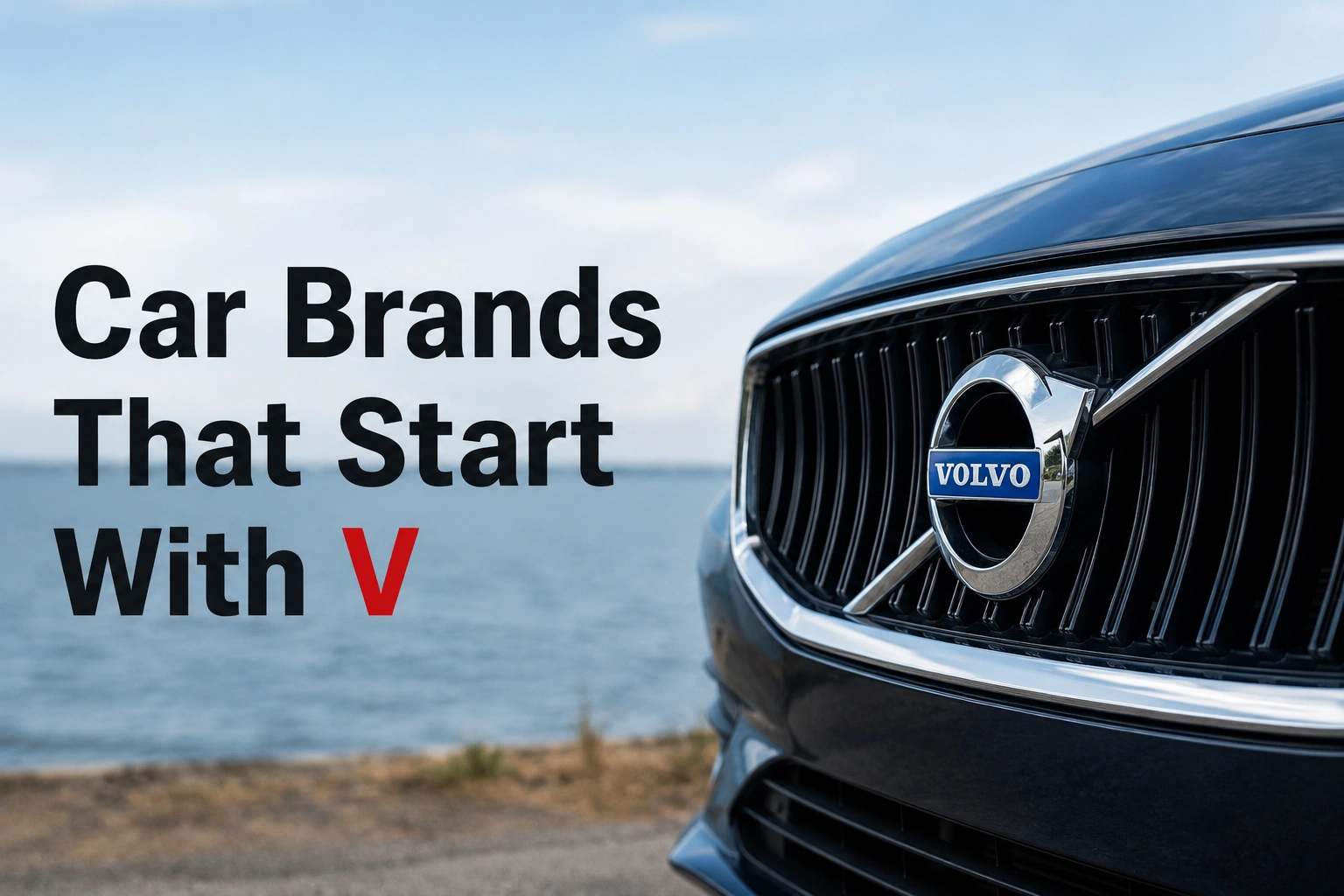
2. Volvo Cars
- Country: Sweden
- Founded: 1927
- Status: Active
- Parent Company: Geely Automobile Holdings (since 2010)
- Headquarters: Gothenburg, Sweden
- Known For: Safety engineering, Scandinavian design, the three-point seatbelt (invented by Volvo’s Nils Bohlin in 1959 and given freely to the world), XC-series SUVs, Polestar performance vehicles
Volvo Cars is perhaps the only major manufacturer in history to build an entire brand identity around preventing its customers from being killed. That sounds blunt, but it is the honest version of what Volvo has been doing since the 1950s — investing in crash safety research, structural engineering, and occupant protection not as marketing features but as core product values.
The three-point seatbelt, developed by Volvo engineer Nils Bohlin and patented in 1959, was offered royalty-free to the entire global automotive industry because Volvo’s management decided the technology was too important to keep exclusive. That decision, almost unique in corporate history, is estimated to have saved over a million lives in the decades since. No other automotive technology — not airbags, not ABS, not crumple zones — has a comparable death-prevention record.
Geely’s acquisition in 2010 was widely seen as a risk: a Chinese company with limited global automotive experience buying a Swedish premium brand with a deeply loyal customer base. What followed proved the sceptics wrong. Under Geely’s ownership, Volvo received the investment it had been unable to secure under Ford, developed the Scalable Product Architecture platform from scratch, and launched the XC90, XC60, XC40, and C40 Recharge in rapid succession.
The brand’s profitability, market positioning, and product quality all improved substantially. Volvo’s commitment to complete electrification by 2030 — selling only battery-electric vehicles after that point — is one of the most aggressive decarbonisation timelines in the premium segment.
3. VinFast
- Country: Vietnam
- Founded: 2017
- Status: Active (NASDAQ: VFS from 2023)
- Parent Company: Vingroup (Vietnam’s largest private conglomerate)
- Headquarters: Haiphong, Vietnam
- Known For: Vietnam’s first domestically produced cars, aggressive global EV expansion, factory-built design by Pininfarina and Torino Design
VinFast is one of the most audacious industrial projects of the 21st century. Vietnam had virtually no domestic car manufacturing tradition in 2017 when Pham Nhat Vuong — billionaire founder of Vingroup — announced plans to build a car factory capable of producing 250,000 vehicles per year within 21 months. Most industry analysts called it impossible.
VinFast delivered the first production vehicles from its Haiphong plant in June 2019, roughly on schedule. What made this possible was a combination of enormous capital investment, contracts with established engineering firms (Magna Steyr for manufacturing consultation, Pininfarina and Torino Design for exterior styling), and a willingness to move with a speed that no legacy manufacturer would have attempted.
The brand’s early models used licenced platforms from BMW to accelerate development, but VinFast has since moved to its own VMG-A/B architecture. The VF 8 and VF 9 electric SUVs launched in North America and Europe from 2022 onward, making VinFast the first Vietnamese carmaker to sell vehicles in those markets.
The US launch involved an unconventional battery subscription model that was later dropped in response to market feedback — an example of the brand’s willingness to adapt quickly.
A factory in North Carolina was announced for US production, and manufacturing partnerships in India began in 2024, giving VinFast a genuinely global production footprint within seven years of its founding. That pace has no precedent in automotive history.
4. Vauxhall
- Country: United Kingdom
- Founded: 1857 (marine engines); cars from 1903
- Status: Active
- Parent Company: Stellantis (since 2021)
- Sister Brand: Opel (identical vehicles, different badge)
- Known For: British family cars, the Cavalier, Astra, Corsa, Insignia; griffin badge heritage
Vauxhall is Britain’s oldest surviving car brand and one of the country’s most deeply embedded automotive institutions. Founded in 1857 by Alexander Wilson along the Thames in Vauxhall, south London — a location from which the brand takes its name — the company originally manufactured marine engines before pivoting to cars in 1903 and relocating to Luton, Bedfordshire, where its headquarters has remained ever since. General Motors acquired Vauxhall in 1925, and for most of the 20th century the brand shared platforms and powertrains with Opel in Germany, selling the same cars under different badges in the UK and continental European markets respectively. This structure has continued under PSA and subsequently Stellantis ownership, though the brands have become even more closely aligned since 2017.
Vauxhall’s cultural footprint in Britain extends beyond pure sales figures. The Cavalier of the 1980s and the Astra in its various forms have been fixtures on British roads for generations, and the brand’s presence in fleet and company car markets has made it a default choice for large portions of British businesses throughout its modern history.
Today, the Vauxhall Corsa Electric, Mokka Electric, and Astra Sports Tourer Plug-in Hybrid represent the brand’s transition toward electrification — a transition mirrored exactly in the Opel range across the Channel.
5. Venturi
- Country: France / Monaco
- Founded: 1984 (as MVSC); current electric focus from mid-2000s
- Status: Active (limited production)
- Headquarters: Monaco
- Known For: Pioneer in electric performance vehicles, polar exploration vehicles, Venturi Buckeye Bullet land speed record cars
Venturi is the most unusual automaker on this list and arguably one of the most scientifically interesting vehicle manufacturers anywhere in the world. Founded in France in 1984 and now based in Monaco under Gildo Pallanca Pastor’s ownership, the company began as a conventional French sports car maker producing turbocharged GT cars in small numbers during the late 1980s and early 1990s before pivoting entirely to electric propulsion in the mid-2000s.
What followed is a portfolio that ranges from the Venturi Fetish electric sports car — one of the first purpose-built electric performance cars to reach production — through to the Antarctic Traversal vehicle built for Jean-Louis Etienne’s polar expedition, and the Buckeye Bullet electric land speed record cars developed in partnership with Ohio State University.
The Buckeye Bullet programme deserves particular attention because its engineering objectives place it in a different category from anything else called an “electric car.” The Buckeye Bullet 3, running at the Bonneville Salt Flats in 2016, set a world land speed record for electric vehicles at 341.4 mph — a figure achieved through engineering specifically designed for that single purpose, not for road use.
Venturi’s willingness to pursue these extreme applications while also building road-registered vehicles reflects a genuinely research-oriented approach to automotive development that is rare among manufacturers of any size.
6. Vector Motors
- Country: United States
- Founded: 1971 (as Vehicle Design Force); cars from 1989
- Status: Functionally defunct (last production circa 1993)
- Founder: Gerald Wiegert
- Known For: The Vector W8 — America’s answer to the exotic supercar; fighter jet-inspired design; one of the most dramatic production cars of the late 1980s
Vector Motors is proof that automotive ambition and commercial success are entirely separate things. Founded by Gerald Wiegert in California in the early 1970s under the name Vehicle Design Force, Vector Aeromotive spent nearly two decades developing its flagship vehicle before the W8 Twin Turbo finally entered production in 1989.
The car looked unlike anything else on American roads: a low, wide, wedge-shaped body with fighter aircraft cockpit-style windows, billet machined interior components, and aerodynamic details borrowed directly from aerospace design. Power came from a twin-turbocharged 6.0-litre V8 producing anywhere from 625 hp to a claimed 1,200 hp depending on the boost setting — figures that were genuinely extraordinary for a road car in 1989.
Only 17 Vector W8s were ever produced, and the company’s history was turbulent: an Indonesian investor group acquired control in the early 1990s, launched a follow-up model called the M12 that used a Lamborghini Diablo drivetrain, and then lost a bitter legal battle with Wiegert over the company’s ownership. Production effectively ended by 1993.
The W8 has since become one of the most collectible American cars of its era — precisely because so few were made and because its engineering ambition was so far ahead of what most domestic manufacturers were attempting at the time.
7. VAM (Vehículos Automotores Mexicanos)
- Country: Mexico
- Founded: 1946
- Status: Discontinued 1986
- Parent: AMC (American Motors Corporation)
- Known For: Producing American Motors vehicles for the Mexican market with local modifications; one of Latin America’s significant domestic automotive operations
VAM occupied an interesting position in Mexican automotive history as a joint venture between the Mexican government and American Motors Corporation that adapted AMC products for local market conditions rather than simply importing them. The company’s best-known products — the AMC Rambler, Jeep derivatives, and the locally-developed VAM American and VAM Lerma — were tailored for Mexican roads, Mexican fuel quality, and Mexican buyer preferences in ways that pure import operations could never accommodate.
The company closed in 1986 when the Mexican government ended the regulatory protections that had made domestic auto production commercially viable, but VAM’s three decades of operation helped establish Mexico’s automotive industry infrastructure that would later attract the major global manufacturers that now make the country one of the world’s largest car producers.
V Brands At A Glance
| Brand | Country | Founded | Status | Key Distinction |
| Volkswagen | Germany | 1937 | Active | World’s largest automotive group by revenue |
| Volvo Cars | Sweden | 1927 | Active (Geely-owned) | Invented the 3-point seatbelt; given it to the world free |
| VinFast | Vietnam | 2017 | Active (NASDAQ listed) | Built a 250,000-unit factory in 21 months |
| Vauxhall | UK | 1857 | Active (Stellantis) | Britain’s oldest surviving car brand |
| Venturi | France/Monaco | 1984 | Active (limited) | Electric land speed record: 341.4 mph |
| Vector Motors | USA | 1971 | Defunct (~1993) | W8 Twin Turbo: 17 units; aerospace-inspired |
| VAM | Mexico | 1946 | Discontinued 1986 | AMC joint venture; Mexican market adaptation |
Car Models That Start With V (Across All Manufacturers)
1. Volkswagen Golf
- Produced By: Volkswagen AG
- Type: Compact (C-segment) hatchback
- In Production: 1974–present (eighth generation; facelift for 2024)
- Key Fact: Over 37 million units sold across eight generations — the best-selling nameplate in the compact segment in history
The Volkswagen Golf is one of the most consequential cars ever produced, and the argument for that claim rests on evidence rather than sentiment. When it launched in 1974 as the successor to the Beetle — designed by Giorgetto Giugiaro at Italdesign — the Golf faced an almost impossibly large expectation: replace a car that had sold over 21 million units and occupied a unique cultural position in the global automotive landscape.
It succeeded by being something the Beetle was not: a modern, front-wheel-drive hatchback with a practical tailgate, a folding rear seat, and structural safety appropriate for the decade’s new crash standards. The millionth Golf was built in October 1976, just two and a half years after production started — a pace that validated the replacement strategy completely.
Eight generations later, the Golf remains Volkswagen’s identity car in the way the Beetle once was, though the Tiguan crossover now outsells it in volume — a market shift that reflects broader European buying patterns rather than any decline in the Golf’s quality.
The current eighth generation, refreshed for 2024, offers petrol, diesel, mild hybrid, plug-in hybrid (the GTE), and fully electric (the Golf GTE outputs up to 272 PS combined) variants across the same familiar five-door body.
The GTI performance variant, which has existed since 1976, remains one of the benchmarks for the hot hatch segment after nearly fifty years in continuous production. The Golf R, with its 333 PS four-wheel-drive system and Drift mode, is the most powerful standard production Golf ever sold.
2. Viper — Dodge
- Produced By: Dodge (Chrysler / FCA / Stellantis)
- Type: High-performance two-seat sports car
- Produced: 1992–2017 (five generations)
- Key Fact: The V10 engine in the first-generation Viper shares design roots with Lamborghini, which was owned by Chrysler at the time of the car’s development
The Dodge Viper is the American supercar that refused to compromise, and its 26-year production run tells the story of what happens when an automotive company decides to build something genuinely extreme rather than something commercially safe.
The concept originated in the late 1980s when Chrysler designer Tom Gale, engineer François Castaing, and Carroll Shelton — of Cobra fame — sketched out a vision for a modern American sports car with none of the electronic safety nets that were beginning to spread through the industry. No traction control on early models. No ABS initially. A massive 8.0-litre V10 engine shared in design terms with Lamborghini (then a Chrysler subsidiary), producing 400 horsepower from the first generation and growing to 645 horsepower in the final fifth generation.
The Viper’s production history is a series of escalating performance figures wrapped around a car that always prioritised mechanical involvement over electronic assistance.
The ACR (American Club Racer) variant of the fifth generation, fitted with extreme aerodynamic downforce packages, set lap records at numerous American circuits including VIR, where it outpaced the Porsche 911 GT3, Corvette Z06, and Audi R8.
The final production Viper rolled off the Conner Avenue Assembly line in Detroit in August 2017, ending production permanently — though its collector value has risen steadily since. Well-preserved examples of the GTS Blue with white stripe configuration are now among the most sought-after American sports cars from the 1990s and 2000s.
3. Volvo XC90
- Produced By: Volvo Cars
- Type: Full-size luxury SUV (7-seater)
- In Production: 2002–present (second generation from 2015)
- Key Fact: The second-generation XC90 won 2016 World Car of the Year; the XC90 T8 Twin Engine was the world’s first plug-in hybrid seven-seat SUV at its 2014 announcement
The Volvo XC90 is the vehicle that saved Volvo Cars as a credible premium manufacturer. That statement requires context: when Ford was preparing to divest Volvo in 2009–2010, the brand’s product lineup was ageing, its market positioning was unclear, and its profitability was poor. Geely’s acquisition came with a commitment to fund a new platform from scratch — the Scalable Product Architecture — and the XC90 was the first vehicle to launch on that platform in 2015.
The reception was so positive, and the product so clearly competitive with the BMW X5 and Mercedes-Benz GLE, that it immediately repositioned Volvo as a serious premium player rather than a value alternative. Volvo sold 46,866 XC90s in 2015 alone, a record for the nameplate at the time.
The XC90’s engineering is notable for reasons beyond its commercial success. The second-generation model introduced Volvo’s Drive-E four-cylinder engine family to the flagship SUV segment — a deliberate statement that a large, heavy, premium seven-seat SUV did not require a six or eight-cylinder engine if the turbocharging and supercharging were properly engineered.
The T8 plug-in hybrid uses a 2.0-litre four-cylinder with both a turbocharger and a supercharger driving the front wheels, combined with an electric motor at the rear axle for a combined system output of up to 455 hp — all from an engine architecture that produces less than 50g/km of CO2 in official testing when the battery is charged.
The 2022 facelift brought revised exterior lighting and a Google-powered infotainment system that replaced the previous Sensus interface. The fully electric EX90, launched as the XC90’s eventual successor, debuted in 2022 with 517 hp from dual motors and a 111 kWh battery.
4. Volkswagen Beetle
- Produced By: Volkswagen AG
- Type: Compact economy car (original); retro-styled compact (New Beetle / A5)
- Produced: 1938–2003 (original); 1997–2011 (New Beetle); 2011–2019 (A5 Beetle)
- Key Fact: The original Beetle’s production run of 21,529,464 units between 1938 and 2003 made it the best-selling single-model nameplate in automotive history until the Toyota Corolla eventually surpassed it
The Volkswagen Beetle’s position in automotive history is singular. It began as a state project, survived a war, rebuilt a company, and went on to sell over 21.5 million units in a production run that lasted 65 years without the fundamental design changing — the longest such run in automotive history.
The original Beetle’s rear-mounted air-cooled engine, platform chassis, and rounded bodywork were the work of Ferdinand Porsche and remained largely intact through the Karmann Ghia era, through the counter-culture adoption in 1960s America, and through the Mexican production that kept the line alive until 2003 long after European and American production had ended. The final original Beetle rolled off the Puebla, Mexico assembly line on July 30, 2003.
The New Beetle of 1997 and the subsequent A5 Beetle of 2011 used the Golf platform rather than anything mechanically connected to the original, making them retro-styled Golf derivatives rather than true successors.
The A5 version, discontinued in 2019, was a better car in nearly every measurable way than the original — safer, faster, more comfortable, more economical — but it never recaptured the original’s cultural status. That status, achieved organically over decades of genuine affordability and mechanical simplicity, cannot be replicated by design alone.
5. Vitara — Suzuki
- Produced By: Suzuki Motor Corporation
- Type: Mini SUV (first generation); Compact crossover SUV (current)
- In Production: 1988–present (fifth generation ongoing)
- Key Fact: The original Vitara was one of the cars that popularised the small, affordable 4×4 SUV for private buyers in Europe and Asia — a format that had previously been associated primarily with agricultural or military use
The Suzuki Vitara deserves significantly more recognition than it typically receives in histories of the compact SUV segment. When it launched in 1988 — sold as the Escudo in Japan and various regional names elsewhere — it arrived at a moment when genuine four-wheel-drive capability was either confined to expensive, truck-derived full-size SUVs or to agricultural vehicles.
The Vitara offered real low-range four-wheel drive, a solid rear axle in its first iterations, and dimensions small enough for urban use at a price that ordinary buyers could consider. That combination, at that price point, at that time, directly contributed to the normalisation of the compact SUV as a mainstream vehicle category. Without the Vitara and its close competitors from that period, the explosion of the crossover segment in the 2010s might have arrived considerably later.
The current fifth-generation Vitara, launched in 2015 and updated significantly in 2019 and 2022, has moved away from the body-on-frame construction and solid rear axle of earlier generations toward a monocoque platform with independent rear suspension — a concession to the modern crossover market that improved ride comfort and on-road dynamics substantially at the cost of some off-road absolute capability.
Available in petrol, mild hybrid, and full hybrid configurations, the latest Vitara offers up to 180 km of claimed fuel economy in its hybrid variant (WLTP combined). It continues to be produced at Suzuki’s Magyar Suzuki plant in Esztergom, Hungary for the European market, and sells consistently across Asia, Latin America, and Africa.
6. Volvo V60
- Produced By: Volvo Cars
- Type: Compact executive estate (D-segment wagon)
- In Production: 2010–present (second generation from 2018)
- Key Fact: The first-generation V60 Plug-in Hybrid D6 was the world’s first diesel plug-in hybrid production car, combining a five-cylinder diesel engine with a rear-axle electric motor for 49g/km CO2 and a claimed 155 mpg equivalent
The Volvo V60 occupies a very specific and valuable niche: a premium compact estate that competes directly with the Audi A4 Avant, BMW 3 Series Touring, and Mercedes-Benz C-Class Estate at a price point and with a character that appeals to buyers who prioritise practicality without sacrificing refinement or Scandinavian design identity.
Volvo has a longer and deeper history with estate cars than almost any other manufacturer — the Amazon estate of the 1950s, the 145, the 245, and the V70 all built institutional loyalty among buyers who needed load-carrying capacity but refused to accept that a practical car had to be ungainly.
The second-generation V60, launched in 2018 on the Compact Modular Architecture platform, is genuinely one of the best compact estates currently available. Its T8 Recharge plug-in hybrid system — combining a 2.0-litre four-cylinder petrol engine driving the front wheels with a rear-axle electric motor — produces 455 hp combined in the most powerful configuration, giving the V60 T8 AWD acceleration that matches premium performance estates from BMW and Mercedes while generating well under 50g/km CO2 in official EU testing with a full battery.
The interior quality, featuring Swedish wool seat upholstery options, the Bowers & Wilkins audio system, and Google-powered navigation integrated into a 9-inch portrait touchscreen, sets a standard for the segment that more expensive alternatives from German brands do not consistently match.
7. VinFast VF 8 — VinFast
- Produced By: VinFast Trading and Production LLC
- Type: Midsize electric crossover SUV
- In Production: 2022–present
- Key Fact: The VF 8 was the first Vietnamese-built electric vehicle sold commercially in the United States and Canada, arriving in late 2022 for North American customers
The VinFast VF 8 carries a weight of historical significance that is disproportionate to its commercial numbers. As the vehicle through which Vietnam’s first car brand entered the world’s most competitive automotive market, it represents a genuine milestone in the globalisation of the electric vehicle industry.
The VF 8 is a midsize five-seat electric SUV built on VinFast’s VMG-A/B platform, powered by a 75.3 kWh or 87.7 kWh battery depending on configuration. The Eco variant produces 201 hp from a single front motor; the Plus variant uses dual motors for 402 hp and all-wheel drive. EPA-rated range for US-market vehicles came in below what VinFast’s own figures had suggested at launch — around 207 miles for the Plus trim versus claimed figures above 250 — which generated some critical attention and led to subsequent software updates to improve energy management.
What the VF 8’s North American launch demonstrated most clearly was that VinFast was genuinely committed to international markets rather than using them as marketing exercises.
The brand opened over 50 dealerships across seven US states, hired experienced automotive retail staff, and offered a 7-year/100,000-mile vehicle warranty alongside an 8-year/unlimited mileage battery warranty — terms that exceeded most established EV manufacturers. That warranty confidence, particularly the unlimited mileage battery coverage, is a significant commercial commitment that speaks to VinFast’s faith in the hardware it is building.
8. Volkswagen Passat
- Produced By: Volkswagen AG
- Type: Mid-size family car / large family car (D-segment)
- In Production: 1973–present (ninth generation B9 from 2023, estate-only in Europe)
- Key Fact: The Passat was among the first cars designed by Giorgetto Giugiaro at Italdesign for VW, sharing its platform with the Audi 80 in first-generation form — a shared platform strategy that became standard practice across the VW Group
The Volkswagen Passat has spent fifty years being the car that the Golf buyer graduates to — practical, refined, competitively priced relative to its German premium competitors, and consistently well-engineered without being emotionally engaging.
That description sounds like faint praise, but the Passat’s commercial durability across nine generations proves it is exactly the kind of product the market absorbs in sustained volumes. First launched in 1973 on a platform shared with the Audi 80 — with exterior styling by Giugiaro — the Passat introduced many European buyers to front-wheel drive in a family-sized package at a time when rear-wheel drive was still the default configuration for cars of that size.
The ninth-generation Passat, launched in 2023 for the European market, made a decisive break with the previous estate-and-sedan strategy by offering only the estate (Variant) body in Europe, acknowledging that sedan versions had been comprehensively outsold by the wagon for years.
It uses the MQB Evo platform and is offered with 1.5-litre TSI e-Hybrid (petrol mild hybrid) and 2.0-litre TDI powertrains, plus a 1.5-litre TSI eHybrid plug-in capable of 100 km of claimed electric range from its 19.7 kWh battery — the largest PHEV battery fitted to a Passat to date. In North America, where the sedan retained more commercial relevance, the Passat was discontinued in 2023 and replaced strategically by the larger Atlas in VW’s lineup.
V Models Quick Reference
| Model | Brand | Type | Active Years | Notable Fact |
| Golf | Volkswagen | Compact hatchback | 1974–present | 37 million+ sold; GTI running since 1976 |
| Viper | Dodge | Two-seat sports car | 1992–2017 | 8.0L V10; 645 hp final gen; 17 ACR lap records |
| XC90 | Volvo | Full-size luxury SUV | 2002–present | T8 PHEV: world’s first plug-in 7-seat SUV |
| Beetle | Volkswagen | Compact economy/retro | 1938–2019 | 21.5M original units; longest single-model run |
| Vitara | Suzuki | Mini/compact crossover | 1988–present | Helped create the affordable compact 4×4 market |
| V60 | Volvo | Compact executive estate | 2010–present | World’s first diesel plug-in hybrid production car |
| VF 8 | VinFast | Midsize electric SUV | 2022–present | First Vietnamese EV commercially sold in the USA |
| Passat | Volkswagen | Mid-size family car | 1973–present | 50 years; B9 estate-only in Europe from 2023 |
FAQs
What car brands start with the letter V?
The major car brands beginning with V include Volkswagen (Germany), Volvo Cars (Sweden), VinFast (Vietnam), Vauxhall (UK), Venturi (France/Monaco), Vector Motors (USA, defunct), and VAM / Vehículos Automotores Mexicanos (Mexico, discontinued 1986). Additional niche manufacturers include Vanderhall (USA, three-wheeled autocycles), Valmet Automotive (Finland, contract manufacturer), and VÜHL (Mexico, lightweight sports cars).
What car models start with the letter V?
Notable car models beginning with V include the Volkswagen Golf, Dodge Viper, Volvo XC90, Volkswagen Beetle, Suzuki Vitara, Volvo V60, VinFast VF 8, Volkswagen Passat, Volkswagen Polo, Volvo V90, and numerous others across different manufacturers and segments.
Who owns Volkswagen Group?
Volkswagen AG is primarily controlled by Porsche Automobil Holding SE, which holds around 31.9% of the ordinary shares and approximately 53% of the voting rights. The Piëch and Porsche families are the principal beneficial owners through Porsche SE. The state of Lower Saxony holds approximately 11.8% of ordinary shares and has specific governance rights under German law. Volkswagen Group itself owns Audi, Porsche AG, Lamborghini, Bentley, Škoda, SEAT, Cupra, and others.
Is Volvo still a Swedish company?
Volvo Cars is Swedish in its engineering culture, workforce, design identity, and manufacturing roots — its headquarters and primary production facilities remain in Gothenburg. However, it has been owned by Geely Automobile Holdings of China since 2010, when Geely purchased the company from Ford for approximately $1.8 billion. The acquisition has generally been regarded as positive for the brand’s financial health and product development investment.
What happened to the Dodge Viper?
The Dodge Viper was discontinued in August 2017 when FCA (now Stellantis) ended production at the Conner Avenue Assembly plant in Detroit. The decision was commercially driven — sales volumes had declined despite the fifth generation being critically well-received — rather than a reflection of product quality. As of 2025, there are no confirmed plans to revive the nameplate, though periodic rumours of an electric or hybrid successor have circulated.
How did VinFast build a car factory so quickly?
VinFast’s rapid construction was achieved through enormous capital allocation from Vingroup, which funded the Haiphong manufacturing complex in its entirety. The company also contracted established engineering and manufacturing consultants — including Magna Steyr — to transfer production knowledge quickly, hired Pininfarina and Torino Design for styling to eliminate the need to build in-house design capability from scratch, and sourced platforms and powertrains under license from established manufacturers for its earliest vehicles. The combination of money, external expertise, and urgency allowed it to compress a timeline that would typically take 7–10 years at a conventional manufacturer.
What is the Volvo XC90 T8?
The Volvo XC90 T8 is a plug-in hybrid variant of the XC90 that combines a 2.0-litre four-cylinder petrol engine (turbocharged and supercharged simultaneously) driving the front wheels with a separate electric motor on the rear axle. Combined system output is up to 455 hp. It was the world’s first plug-in hybrid seven-seat SUV when announced in 2014. The current version is sold as the XC90 Recharge in the T8 or B5/B6 mild hybrid configurations.
How many Volkswagen Beetles were made?
The original Volkswagen Beetle, produced between 1938 and 2003, achieved a total production run of 21,529,464 units — making it the highest-production single nameplate in automotive history at the time of its discontinuation, surpassing the Ford Model T. The New Beetle (1997–2011) and A5 Beetle (2011–2019) were separate models using the Golf platform and are counted separately from the original’s totals.
Is the Suzuki Vitara still made?
Yes, the Suzuki Vitara remains in production as of 2025 in its fifth generation, which launched in 2015 and has been updated in 2019 and 2022. It is produced at Magyar Suzuki’s Esztergom plant in Hungary for the European market and at various facilities for other global markets. It is available with petrol, mild hybrid, and full hybrid powertrains depending on the market, and continues to sell consistently across Europe, Asia, Latin America, and Africa.
What was special about the first-generation Dodge Viper’s engine?
The original Dodge Viper’s 8.0-litre V10 engine was developed in collaboration with Lamborghini, which was owned by Chrysler at the time the Viper was being conceived in the late 1980s. Lamborghini’s engineers — particularly those from its Automobili Lamborghini unit — contributed to the design of the aluminium block and helped with specific aspects of the engine’s architecture. The V10 produced 400 horsepower and 465 lb-ft of torque in the original configuration, with no traction control and minimal electronic intervention, making it one of the most unfiltered performance experiences of its era.