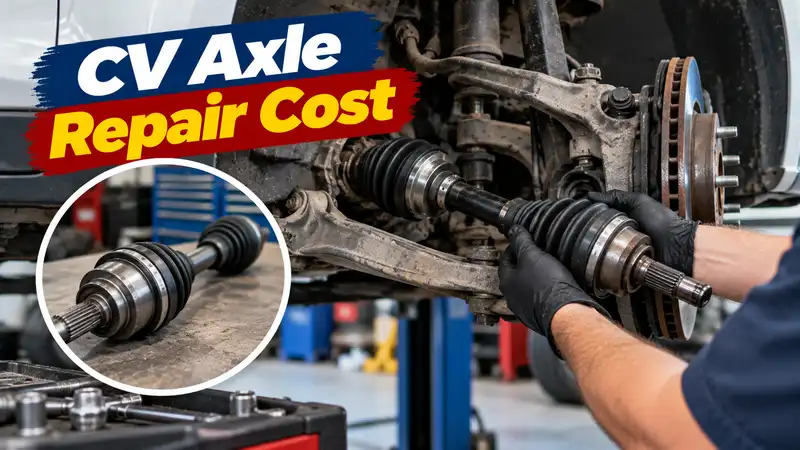
The CV axle repair cost can vary considerably depending on the vehicle, the type of axle, the damaged component, parts quality, labor rates, and whether additional suspension or drivetrain work is required. What looks like a simple clicking noise can sometimes require a complete axle assembly, while a torn CV boot discovered early may present a different repair decision.
CV axles transfer power from the transmission or differential to the driven wheels while allowing the suspension to move and, on steering axles, allowing the wheels to turn. Their constant-velocity joints have to operate through changing angles while handling substantial torque. Protective boots keep grease inside the joints and contaminants outside.
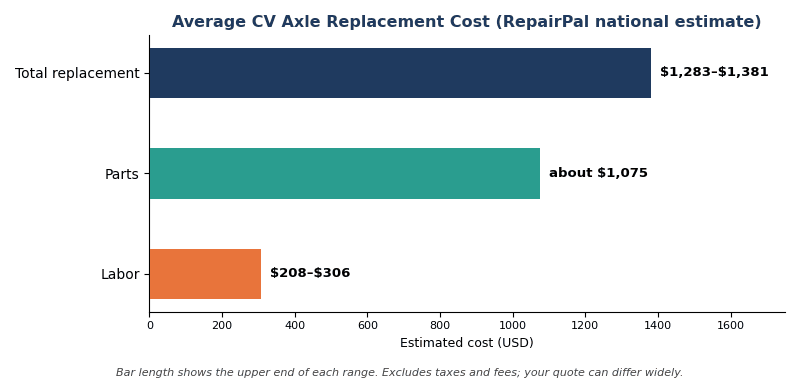
RepairPal’s September 2026 national estimate places average CV axle replacement at approximately $1,283 to $1,381, including an estimated $208–$306 in labor and roughly $1,075–$1,076 in parts. However, that is a broad national estimate rather than a guaranteed price for a particular vehicle.
The important question is therefore not simply “How much does a CV axle cost?” It is what failed, what vehicle you have, and what repair is actually necessary?
Average CV Axle Repair Cost And What You Are Paying For
The term “CV axle repair” can be misleading because technicians often replace the complete CV axle assembly rather than rebuilding an individual joint. A typical axle assembly includes the shaft, inner CV joint, outer CV joint, boots, clamps, and grease.
When a joint has already suffered significant wear, replacing only the protective boot may not restore reliable operation. RepairPal notes that once a boot has failed, permanent joint damage may already have occurred, which is one reason complete axle replacement is commonly recommended.
Typical CV Axle Replacement Cost
There is no single price that applies to every car.
As a current reference, RepairPal estimates an average CV axle replacement at $1,283–$1,381, with labor estimated at $208–$306 and parts at approximately $1,075–$1,076. The estimate excludes taxes and fees and does not account for location-specific differences or additional repairs.
That national number also demonstrates why online price discussions can be confusing. Vehicle-specific axle costs can be very different.
For example, RepairPal currently lists axle-shaft replacement estimates of approximately $587–$704 for a Ford F-150, $1,098–$1,270 for a Toyota Tacoma, and $1,041–$1,125 for a Jeep Wrangler. These are examples of axle-shaft estimates, not universal CV-axle prices, and should not be treated as quotes for every version of those vehicles.
The difference comes from vehicle design, parts availability, labor requirements, axle configuration, and the exact repair being performed.
CV Axle Repair Versus CV Axle Replacement
There is an important difference between repairing a CV axle and replacing it.
A repair might involve replacing a damaged boot before the joint has suffered significant contamination or wear. In other cases, the joint itself may be serviced separately.
Replacement usually means installing a complete axle assembly.
For many modern vehicles, complete axle replacement is often more practical because the labor required to disassemble and rebuild a worn joint can approach the cost of installing a complete replacement assembly.
A complete assembly also gives the technician a new shaft, joints, boots, grease, and associated components rather than repairing only one part of an already aged assembly.
What A CV Axle Assembly Does
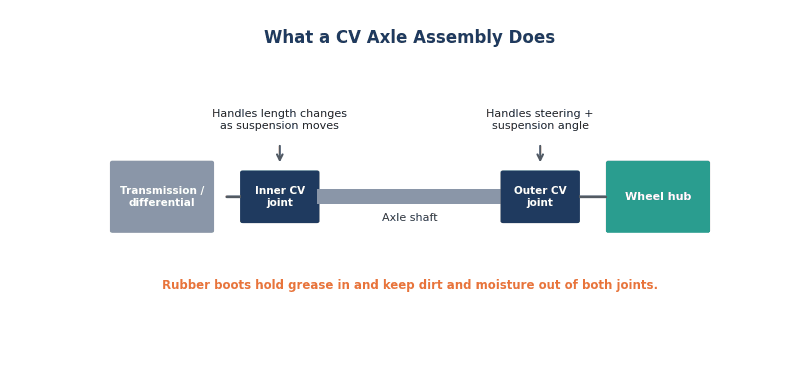
The CV axle connects the transmission or differential to the wheel hub.
On a front-wheel-drive vehicle, the front axles have to perform two jobs simultaneously. They transmit engine torque while allowing the front wheels to steer and the suspension to move.
That combination places significant demands on the CV joints.
The outer joint usually handles the changing angle associated with steering and suspension movement. The inner joint accommodates changes in axle length and drivetrain geometry as the suspension moves.
All of this happens while the axle transfers torque from the powertrain to the wheel.
This is why a damaged CV axle should not be considered simply a “metal rod” that can be ignored after a noise appears.
General CV Axle Cost Breakdown
| Cost Factor | Typical Effect On Price |
|---|---|
| Replacement axle | Usually the largest parts expense |
| Labor | Depends on access and vehicle design |
| Diagnosis | May be charged separately |
| Wheel alignment | Sometimes required after related suspension work |
| Axle nut/fasteners | May need replacement depending on vehicle |
| Transmission fluid | May be lost on some axle designs |
| Differential fluid | Possible consideration on certain drivetrains |
| Wheel bearing damage | Can add substantially to the bill |
| Rust or seized components | Can increase labor time |
| OEM parts | Usually higher parts cost |
| Aftermarket parts | Wider range of pricing and quality |
A written estimate should identify what is actually being replaced rather than simply listing “axle repair.”
What Causes A CV Axle To Fail?
CV axles are designed for long service, but they operate in an environment that exposes them to heat, water, dirt, road debris, steering movement, suspension travel, and repeated torque loads.
The CV boot is particularly important because it protects the joint.
A small boot crack can eventually become a major joint problem if grease escapes and contaminants enter.
Torn Or Cracked CV Boot
A damaged CV boot is one of the most common early signs of CV joint trouble.
The boot is a flexible rubber or thermoplastic cover around the joint.
Its job is to retain specialized grease while keeping road contaminants away from the joint’s precision surfaces.
Once the boot tears, grease can escape.
You may notice grease splattered around the inside of the wheel, suspension components, or nearby axle area.
At this stage, the joint may not yet be making noise.
That creates an important repair opportunity.
If the joint is inspected early and has not suffered significant contamination or wear, boot replacement may sometimes be possible.
Once the joint has operated without adequate grease or has ingested dirt and moisture, however, replacing only the boot may not solve the problem.
Outer CV Joint Wear
The outer CV joint is often associated with a clicking or popping sound during turns.
The noise can become more noticeable when accelerating while making a tight turn.
This happens because the joint is operating at a greater angle while transmitting torque.
The exact sound and symptoms vary by vehicle and the severity of wear.
A clicking noise from a front corner does not automatically prove the outer CV joint is bad, because suspension, steering, wheel bearing, and tire-related problems can create noises that sound similar.
A proper inspection should confirm the source.
Inner CV Joint Problems
Inner CV joints can produce symptoms that differ from the classic turning click.
A worn inner joint may contribute to vibration or shudder during acceleration.
The symptom can sometimes be confused with wheel imbalance, tire problems, engine misfire, transmission issues, or worn engine mounts.
The key clue is often the relationship between the vibration and power application.
If a vibration appears primarily under acceleration and changes when the throttle is released, the inner axle or another drivetrain component may deserve inspection.
Again, this is a diagnostic clue rather than proof.
Normal Wear And High Mileage
CV axles experience repeated cycles of torque and movement.
Mileage alone does not determine their remaining life.
A vehicle used mostly on smooth roads may place different demands on its axles than one frequently driven over rough surfaces or subjected to heavy loads.
Suspension modifications can also alter axle angles.
Lifted or lowered vehicles may place additional demands on CV joints depending on the design and amount of geometry change.
Damaged Axle Shaft
The shaft itself can become damaged by an impact, collision, severe pothole, or other event.
A bent shaft can produce vibration.
Damage to the splines can interfere with proper connection to the hub or transmission/differential.
A severely damaged axle should not be straightened or improvised into service.
Replacement with the correct component is generally the appropriate repair.
Symptoms Of A Bad CV Axle And How To Diagnose It
Correct diagnosis is critical because several suspension and drivetrain problems can imitate CV axle symptoms.
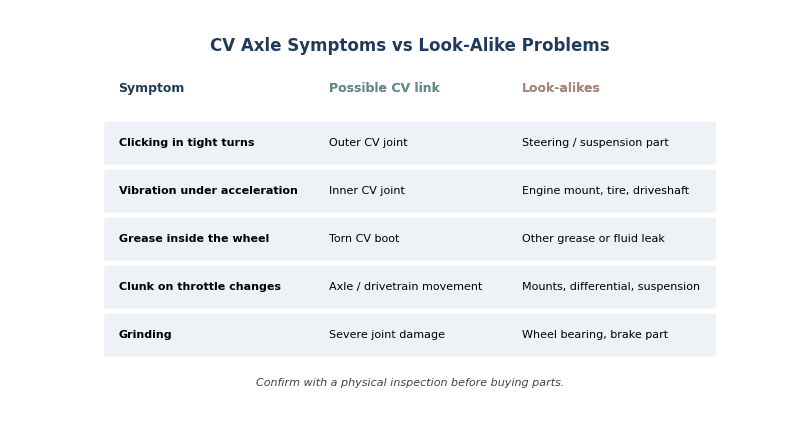
A clicking noise does not automatically mean the axle needs to be replaced.
A vibration does not automatically mean an inner CV joint is worn.
The strongest diagnosis comes from combining the symptom with a physical inspection and, when necessary, a road test.
Clicking Or Popping While Turning
A repetitive clicking or popping sound during tight turns is a classic symptom associated with an outer CV joint.
The noise may become more obvious during low-speed turns with acceleration.
If the noise changes significantly when steering in one direction compared with the other, that information can help a technician identify which side requires closer inspection.
However, steering and suspension components can also produce clicking or popping sounds.
That is why the CV joint should be physically inspected before purchasing parts.
Vibration During Acceleration
A vibration that appears mainly under acceleration can point toward an inner CV joint or another drivetrain component.
The distinction is important.
Wheel imbalance typically relates closely to vehicle speed and can often remain noticeable while coasting.
A drivetrain vibration can change significantly when torque is applied or removed.
A worn engine mount can also allow excessive powertrain movement and produce similar sensations.
Tire and wheel problems, driveshaft issues on rear-wheel-drive vehicles, and transmission-related problems should also be considered.
Grease Around The Inside Of The Wheel
Grease splattered around the inside of the wheel is a strong visual clue.
When a CV boot tears, centrifugal force can throw grease outward as the axle rotates.
You may see grease on:
- Inner wheel surfaces
- Suspension components
- Control arms
- Brake-area components
- Nearby underbody surfaces
If the boot is torn but the joint has not yet developed symptoms, early inspection can potentially prevent more extensive damage.
Once dirt and moisture enter the joint, however, the condition can deteriorate quickly.
Clunking During Acceleration Or Deceleration
A clunk is not a classic CV-axle symptom by itself.
It can originate from engine mounts, transmission mounts, suspension bushings, differential components, driveshaft joints, or other drivetrain components.
A technician should determine whether the noise corresponds to torque changes.
If the clunk occurs every time the throttle is applied or released, drivetrain movement becomes relevant.
The axle should still be inspected, but it should not automatically be blamed.
Clicking While Driving Straight
A clicking sound while driving straight is less specific than clicking during turns.
Possible causes include axle-related components, wheel bearings, brakes, tires, loose shields, or other rotating parts.
The speed and frequency of the clicking can provide additional information.
If the sound increases directly with vehicle speed, wheel and rotating components deserve closer attention.
If it appears primarily when torque is applied, drivetrain components may become more relevant.
CV Axle Symptoms At A Glance
| Symptom | Possible CV Axle Connection | Other Possibilities |
|---|---|---|
| Clicking during tight turns | Outer CV joint | Steering/suspension component |
| Vibration under acceleration | Inner CV joint | Engine mount, tire, driveshaft |
| Grease around wheel | Torn CV boot | Other grease/fluid leak |
| Clunk on throttle changes | Axle/drivetrain movement | Mounts, differential, suspension |
| Noise over bumps | Possible axle movement | Suspension components |
| Grinding | Severe joint damage possible | Wheel bearing, brake component |
| Noises after boot failure | Joint may be contaminated | Other rotating components |
How A Technician Diagnoses A CV Axle
Diagnosis typically starts with a visual inspection.
The technician can inspect the boots for cracks, tears, grease leakage, damaged clamps, or other signs of deterioration.
A road test may then be used to reproduce clicking, vibration, or other symptoms.
RepairPal notes that diagnosing a CV axle can involve removing the wheel to inspect the boots, followed by a test drive if the source is not visually obvious.
The axle itself may then be examined for play, damage, or other abnormalities.
This process matters because replacing an axle without confirming the fault can leave the original noise or vibration unresolved.
CV Axle Replacement Cost Factors
Two vehicles can require the same basic repair but produce very different invoices.
The largest differences usually come from parts pricing, labor access, vehicle configuration, and additional components discovered during inspection.
Parts Cost
The replacement axle is often the largest individual expense.
OEM axles typically cost more than many aftermarket alternatives.
However, aftermarket parts vary substantially in quality.
The cheapest available axle is not necessarily the most economical choice if it produces vibration, has poor boot quality, or fails prematurely.
The correct axle must match:
- Vehicle year
- Make and model
- Engine
- Transmission
- Drivetrain
- Left or right side
- Axle configuration
- ABS or sensor requirements where applicable
A parts catalog match based only on the vehicle model can sometimes be insufficient.
Labor Cost
CV axle replacement is not simply a matter of removing one bolt.
Depending on the vehicle, the technician may need to remove the wheel, axle nut or bolt, brake components, and selected suspension components before removing the axle from the hub and transmission/differential.
RepairPal’s axle-shaft replacement guidance describes this general process and notes that suspension components may need to be disconnected to free the axle.
Labor rates vary by location and shop type.
A vehicle with easy axle access may take less time than a model where corrosion, limited clearance, or additional components complicate removal.
Rust And Seized Components
Rust can dramatically change the repair process.
The axle may be stuck in the hub.
A fastener may be seized.
A suspension connection may require additional work.
These conditions can increase labor time.
Rust is especially relevant in regions where roads are heavily exposed to salt and moisture.
A shop should communicate additional work before proceeding whenever practical.
AWD And 4WD Systems
All-wheel-drive and four-wheel-drive vehicles can have more complex axle arrangements.
Depending on the design, there may be additional front or rear drive axles, intermediate shafts, differentials, or related components.
Parts availability and labor requirements can therefore differ significantly from a simple front-wheel-drive application.
A quote should clearly identify which axle is being replaced.
Wheel Bearing Or Hub Problems
The hub and bearing assembly interfaces with the outer portion of the axle.
If the vehicle has a worn wheel bearing, replacing the axle alone may not resolve the noise.
A technician should inspect both components when symptoms overlap.
A damaged wheel bearing can also contribute to vibration, humming, or wheel play.
This is one reason a complete inspection is more valuable than diagnosing from one symptom.
CV Axle Boot Repair Versus Complete Axle Replacement
A torn boot does not automatically mean the entire axle is ruined.
Timing matters.
If the boot is damaged but the joint remains clean, properly lubricated, and free of abnormal wear, boot replacement may sometimes be appropriate.
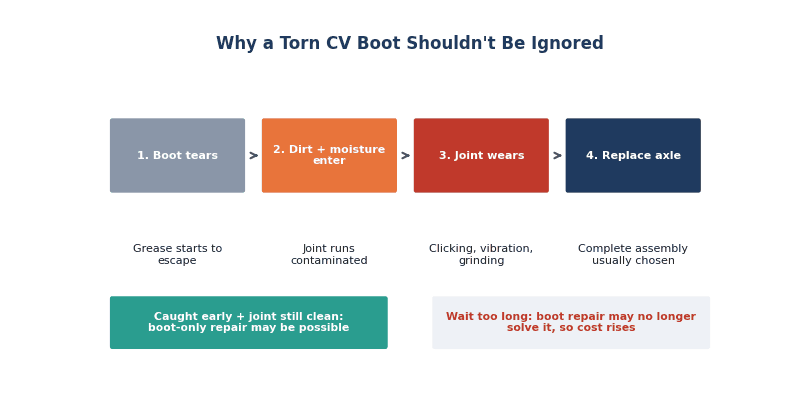
Once the joint has been contaminated or has developed clicking, grinding, or excessive play, complete axle replacement becomes more logical.
When A Boot Repair May Make Sense
A boot-focused repair can make sense when:
- The tear is discovered early
- Grease loss is limited
- The joint has no abnormal noise
- The joint surfaces are not damaged
- The vehicle is otherwise in good condition
- The repair cost is justified for that particular application
However, labor can make boot replacement less attractive.
The joint often has to be disassembled and cleaned.
That can approach the labor involved in replacing the complete axle.
Why A Complete Axle Is Often Chosen
A complete axle provides a fresh shaft and CV joints rather than repairing one portion of an aging assembly.
RepairPal specifically notes that complete new axle assemblies can be more economical and reliable than rebuilding individual components in many cases.
That does not mean a complete replacement is automatically required every time a boot tears.
It means the economics should be evaluated based on labor, parts, joint condition, vehicle age, and the likelihood of future failure.
How To Read A CV Axle Repair Estimate
A good estimate should tell you more than a single final number.
Ask the repair facility to separate:
- Diagnostic labor
- Parts
- Labor
- Shop supplies
- Taxes
- Additional recommended repairs
Also ask whether the quote is for one axle or both.
Replacing both sides is not automatically necessary simply because one side failed.
The condition of the other axle should be evaluated independently.
Questions Worth Asking The Repair Shop
| Question | Why It Matters |
|---|---|
| Which CV axle has failed? | Confirms the side and component |
| What evidence shows it has failed? | Prevents unnecessary replacement |
| Is the boot torn? | Establishes whether contamination occurred |
| Is the joint making noise? | Helps determine severity |
| Is the quote for one side or both? | Clarifies total scope |
| Is the part OEM or aftermarket? | Helps evaluate parts quality |
| Are additional parts required? | Identifies possible hidden costs |
| Is an alignment required? | Clarifies post-repair requirements |
| Are new axle nuts included? | Some applications require new hardware |
| Is there a parts warranty? | Important for future problems |
A trustworthy estimate should make the repair understandable before work begins.
OEM Versus Aftermarket CV Axles
OEM parts are designed to meet the vehicle manufacturer’s specifications.
Aftermarket parts can provide more choices at different price points.
The quality range is broad.
For a common vehicle, a reputable aftermarket axle may be a practical option.
For a vehicle with unusual axle geometry, high torque output, performance modifications, or known sensitivity to axle vibration, parts selection becomes more important.
The decision should consider warranty, manufacturer reputation, fitment, boot quality, materials, and the shop’s experience with that vehicle.
Can You Drive With A Bad CV Axle?
The answer depends on the condition.
A minor boot tear with no joint noise may not create an immediate driving emergency, but it should be addressed before contamination causes joint damage.
A CV joint that is already clicking, grinding, vibrating heavily, or showing significant damage deserves more urgent attention.
A severely damaged axle can eventually fail to transmit power properly.
The consequences can vary by drivetrain and failure mode.
A vehicle that develops severe vibration, loud grinding, significant steering-related noise, or other major symptoms should not be driven unnecessarily until it has been inspected.
Why Ignoring A Torn Boot Can Increase The Repair
A torn boot allows grease to escape.
Once the protective seal is compromised, road dirt and moisture can enter.
The joint then operates in a contaminated environment.
Initially, you may only notice grease around the wheel.
Later, the joint can begin clicking.
At that stage, the repair may have progressed from a potentially limited boot service to complete axle replacement.
This is one of the clearest examples of why early inspection can affect total repair cost.
How To Reduce Unnecessary CV Axle Repair Costs
Saving money on axle repair is less about finding the cheapest part and more about avoiding the wrong repair.
Start with an accurate diagnosis.
A vibration caused by a tire problem will not disappear because you install a new CV axle.
A wheel bearing noise will not necessarily disappear after axle replacement.
A worn engine mount can imitate drivetrain problems.
The first expense worth paying for is often a proper diagnosis.
Compare Complete Quotes
Get estimates from more than one reputable repair facility when practical.
Compare the scope of work rather than just the total number.
One shop may quote a low-cost aftermarket axle while another quotes an OEM assembly.
One estimate may include new hardware while another may not.
One shop may identify a wheel bearing problem that another has overlooked.
The cheapest estimate is therefore not automatically the lowest total cost.
Ask About The Warranty
Parts and labor warranties vary.
Find out how long the replacement axle is covered and whether the warranty applies to both the component and installation labor.
A replacement axle that fails shortly after installation can become much more expensive if the original labor is not covered.
Keep the invoice and parts information.
Don’t Automatically Replace Both Axles
Some owners assume that both sides should be replaced at the same time because one axle has failed.
That is not always necessary.
The opposite axle should be inspected.
If it has torn boots, excessive play, clicking, or other signs of deterioration, replacing it may be reasonable.
If it is healthy, replacing it simply because the other side failed may provide little immediate benefit.
CV Axle Repair Cost Compared With Other Related Repairs
The following comparison illustrates why diagnosis matters.
| Repair | Can Produce Similar Symptoms? | Typical Repair Approach |
|---|---|---|
| CV axle | Yes | Replace axle assembly when joint/shaft is worn |
| Wheel bearing | Yes | Replace bearing or hub assembly |
| Engine mount | Yes | Replace damaged mount |
| Tire/wheel imbalance | Yes | Balance or repair tire/wheel |
| Driveshaft joint | Yes | Repair or replace affected component |
| Suspension joint | Yes | Replace worn component |
| Differential issue | Sometimes | Diagnose and repair drivetrain |
Costs vary widely by vehicle, location, and exact component.
RepairPal’s current axle-shaft data demonstrates that even within the same broad category, vehicle-specific estimates can differ significantly.
That is why a general “average CV axle price” should be used only as a planning reference.
A Deeper Look At What Makes One CV Axle More Expensive Than Another
A CV axle is not necessarily expensive because the physical shaft is complicated.
Much of the cost comes from the precision components at each end and the engineering required to make the assembly operate reliably through changing angles and torque loads.
A high-output vehicle may use stronger axle components.
An AWD vehicle can have additional axle assemblies.
A newer vehicle may incorporate specific sensor or sealing requirements.
Some vehicles also have axle designs that require additional disassembly during replacement.
Parts availability can create another difference.
A common compact car may have several aftermarket suppliers producing replacement axles.
A less common performance vehicle may have fewer options, resulting in a higher parts price.
This is why the vehicle’s exact year, engine, transmission, and drivetrain should always be included when requesting a price.
Final Thoughts
The CV axle repair cost is not a fixed number. Current national data puts average CV axle replacement around $1,283–$1,381, but individual vehicles can fall substantially outside that range. RepairPal’s current estimates also show significant variation between different models, reinforcing the importance of obtaining a vehicle-specific estimate.
The most important factor is identifying what actually failed.
A torn CV boot discovered early can present a different repair opportunity than a joint that has already developed clicking and wear. A vibration under acceleration may involve an inner CV joint, but tires, wheel bearings, engine mounts, driveshafts, and other drivetrain components can create similar symptoms.
Before approving an expensive repair, ask what evidence confirms the axle is defective, whether the quote covers one or both sides, what type of replacement part will be installed, and whether additional components are involved.
A good repair decision is based on diagnosis, part quality, labor, vehicle configuration, and long-term reliability, rather than the lowest number on a quote.
Can I drive with a bad CV axle?
A vehicle with a mildly damaged CV boot may still be driveable for a limited period, but continued operation can allow contamination and joint wear to progress. If the axle is producing loud clicking, grinding, severe vibration, or other major symptoms, unnecessary driving should be avoided until the vehicle is inspected.
How much does a CV axle replacement cost?
Current RepairPal data places the average CV axle replacement estimate at approximately $1,283–$1,381, including estimated parts and labor. However, the actual cost varies significantly by vehicle, location, parts choice, and additional work.
Can I replace a CV axle myself?
A mechanically experienced person with the correct tools and vehicle-specific repair information may be able to replace an axle, but the job involves lifting the vehicle safely and disconnecting wheel, suspension, and drivetrain components. RepairPal recommends considerable experience and appropriate repair information because incorrect removal or installation can damage the transmission, steering, suspension, or replacement axle.
Is it better to replace a CV boot or the entire axle?
It depends on the condition of the joint. If a boot has recently torn and the joint remains clean and undamaged, boot replacement may be possible. If the joint is contaminated, worn, clicking, or otherwise damaged, complete axle replacement is commonly the more practical repair.
Should I replace both CV axles at the same time?
Not necessarily. The opposite axle should be inspected for worn joints, damaged boots, grease leakage, or other problems. If it remains in good condition, replacing it solely because the other axle failed may not be necessary. If both sides show significant wear, replacing both can reduce the likelihood of another repair in the near future.
How long does a CV axle usually last?
There is no universal mileage limit for a CV axle. Service life depends on vehicle design, road conditions, suspension geometry, boot condition, driving conditions, contamination, and the amount of torque the axle handles. A CV axle with an intact boot can last a long time, while a torn boot can accelerate joint wear considerably.