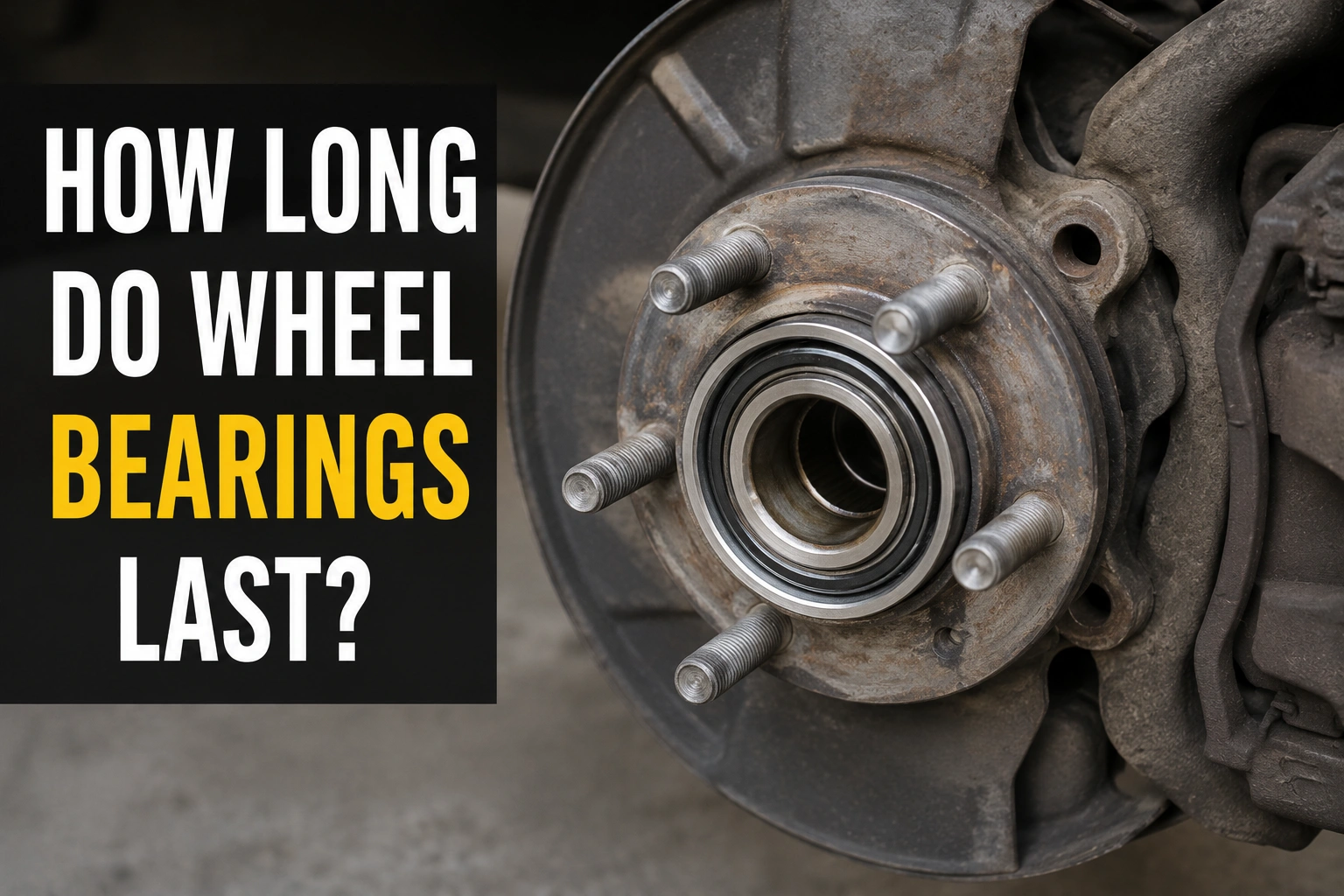
Wheel bearings sit inside the wheel hub of every vehicle ever built, spinning thousands of times per mile, supporting the full weight of the car, absorbing road shock, and doing it all while sealed inside a compact metal assembly that most drivers never see and rarely think about.
They are among the most mechanically humble components on the vehicle — no fluid to change, no filter to swap, no visible wear indicator to check. They simply rotate, and rotate, and rotate, until eventually they cannot anymore.
The question of how long they last does not have a single clean answer, and any source that gives a hard number without context is giving an incomplete picture.
After going through owner community forums, engineering documentation from bearing manufacturers, and real-world accounts from mechanics who have pulled thousands of these units from vehicles at various mileages, a much more nuanced and useful picture emerges.
The range runs from under 50,000 miles in extreme cases to well past 200,000 miles in others — not because of luck, but because of identifiable, specific factors that any owner can understand and some can actively manage. That is the full story worth telling.
What A Wheel Bearing Actually Does?
Most discussions about wheel bearing lifespan skip over the part that explains why they fail in the first place. The engineering context matters because it makes every other piece of information about longevity make sense rather than appearing as a random collection of mileage figures.
A wheel bearing is a precision assembly of hardened steel balls or tapered rollers housed inside an inner and outer race, packed with grease, and sealed with rubber lip seals. Its job is to allow the wheel to rotate freely around the spindle or axle while the vehicle bears down on the assembly with its full weight.
That means every wheel bearing is simultaneously under radial load — the downward pressure of the vehicle’s weight — and axial load — the lateral forces generated by cornering. It handles both at once, at all times, while the wheel spins at speeds that can exceed 1,000 RPM at highway velocities.
The grease inside the bearing provides lubrication between the rolling elements and the races. The seals keep that grease in and keep contamination out. This dual seal function is what makes the bearing essentially maintenance-free in normal operation — but it is also the point of failure when conditions compromise the seals.
Once contamination enters the bearing cavity, the grease chemistry changes, the rolling elements begin to wear irregularly, and the degradation accelerates. A bearing that has been contaminated even once begins aging faster than one that has maintained its sealed integrity throughout its service life.
Modern wheel bearings on most passenger vehicles are sealed hub assemblies — the bearing is integrated into a flanged hub that also carries the ABS tone ring and typically has mounting provisions for the brake rotor.
When this type of bearing fails, the entire hub assembly is replaced as a unit. Older designs used serviceable tapered roller bearings that could be cleaned, repacked with fresh grease, and returned to service — but these are largely gone from modern passenger vehicles.
The sealed hub assembly is more convenient and more compact, but it also means there is no maintenance interval and no way to extend service life through repacking once contamination has entered.
How Long Wheel Bearings Actually Last — The Honest Range
The most frequently cited figure for wheel bearing lifespan is 85,000 to 100,000 miles under normal operating conditions. That number appears across manufacturer guidelines, independent technical resources, and mechanic training materials — and it is a reasonable starting point.
But a deeper look at real-world data reveals something more useful: the range of actual bearing lifespans is far wider than that single figure suggests, and the reasons for that variance are specific and knowable.
After reviewing owner accounts from communities including BobIsTheOilGuy, a highly respected mechanic forum where contributors include professional technicians and long-term vehicle owners, several patterns stand out that no generic mileage figure captures.
One contributor reported a Toyota Camry reaching 215,000 miles on original front bearings. Another described a vehicle used as a taxi with a travel trailer towing on weekends reaching 245,000 miles without a bearing replacement.
Both are legitimate data points — but so are the front bearings that failed at 45,000 miles on a vehicle regularly driven over rutted rural roads. All of these outcomes are real, and the difference between them is not random.
The cleaner framework for thinking about wheel bearing lifespan is not a mileage target but a condition target. A bearing in good condition — sealed, properly loaded, free of contamination — can last indefinitely in the mechanical sense.
The practical limit comes from seal degradation over time even without impact damage, from the cumulative effect of road shock on the rolling element geometry, and from the gradual breakdown of the factory grease after years of thermal cycling.
Understanding which of these factors applies to a specific vehicle and how to recognize when they are beginning to manifest is more useful than waiting for a mileage number.
The Variance That Most Guides Miss — OEM Versus Aftermarket Replacement Life
One of the most practically significant pieces of information about wheel bearing lifespan rarely appears in mainstream guides: original equipment bearings consistently outlast aftermarket replacements.
This is not a general statement about aftermarket parts — it is a specific characteristic of wheel bearings that comes from the precision manufacturing tolerances, the grease formulations, and the seal quality used in OEM production.
The BobIsTheOilGuy forum community — which represents some of the most technically rigorous owner-mechanic discussion available online — has discussed this extensively. One contributor’s summary was direct: leave OEM for as long as possible.
All aftermarket bearings even from the dealer don’t last as long. This observation is consistent with what bearing engineers describe as the consequence of manufacturing tolerance variation — OEM bearings are produced to the vehicle manufacturer’s exact specifications with closely controlled metallurgy and grease viscosity.
Many replacement bearings are produced to compatible but less precise tolerances that result in higher operating temperatures and faster grease degradation.
This matters for anyone who has already replaced a bearing and is wondering why the replacement failed earlier than the original. It is also relevant for anyone shopping replacement parts: premium brands like SKF, Timken, and Moog with known quality control standards consistently outperform commodity imports in real-world durability testing.
Paying the premium for a bearing from a recognized manufacturer is one of the most straightforward ways to extend the service life of a replacement bearing toward OEM territory.
What Shortens Wheel Bearing Life — The Specific Factors
Road Conditions And Impact Damage — The Single Biggest Accelerant
Every pothole, every curb strike, every railroad crossing hit at speed, and every rutted gravel road section delivers a shock load directly to the wheel bearing. Normal bearing design accounts for the radial and axial loads of driving — but impact loads are different in character.
They are brief, intense spikes that can deform the rolling element or the race surface in ways that leave marks invisible to the eye but immediately detectable by the bearing’s subsequent behavior.
These marks, called brinelling, create localized high-friction points in the bearing’s rotation path. Every subsequent revolution passes those marks again, generating additional heat and accelerating wear.
A single hard pothole hit does not immediately destroy a bearing. What it does is introduce damage that begins compounding. The affected bearing runs hotter than a healthy one, which breaks down the grease faster, which allows the rolling elements to run drier, which accelerates wear further.
In urban environments where pothole density is high — and in many American cities in 2026, pothole density is genuinely severe — bearings face this kind of repeated impact stress throughout their service lives.
A compact car driven primarily on smooth suburban roads can reach 150,000 miles on original bearings. The same model driven on deteriorated urban pavement may develop noise before 60,000 miles.
Road surface quality is the single variable that most affects real-world bearing life for most drivers, and it is the one variable they cannot control.
Water, Road Salt, And Contamination — The Silent Killer
After impact damage, contamination is the most documented cause of premature wheel bearing failure — and in northern states where winter road salt treatment is heavy, it is arguably more consequential than impact damage for most drivers.
Road salt is particularly destructive to bearing seals because it attacks the rubber compounds that seals are made from, causing them to harden, crack, and shrink over time.
Once a seal has degraded enough to allow even a small amount of salt water intrusion into the bearing cavity, the contamination process accelerates rapidly. Salt water changes the grease chemistry, accelerates corrosion on the steel races and rolling elements, and introduces abrasive particles that increase friction and heat.
Deep water fording produces the same effect through a different mechanism. When a wheel bearing is hot from normal operation and the wheel is suddenly submerged in water — crossing a flooded road, driving through a deep puddle at speed — the temperature differential can actually pull water past the bearing seal through thermal contraction.
This is why off-road vehicles and vehicles driven regularly through flooded roads develop bearing failures at much lower mileages than identical vehicles used on dry pavement. The MOOG engineering documentation for wheel bearings specifically identifies driving through deep water or mud as a factor that can cause bearing failure regardless of mileage, because a single thermal water ingestion event can compromise the grease that was designed to last 100,000 miles.
For drivers in northern states with heavy winter salt use, this means that bearing life expectations should be calibrated lower than the standard 85,000 to 100,000-mile range.
Many mechanics in the Great Lakes region, the Northeast, and the upper Midwest routinely see bearing failures in the 50,000 to 70,000-mile range on vehicles that were otherwise well-maintained, simply because the road salt environment accelerates seal degradation progressively throughout the vehicle’s life.
Vehicle Weight, Towing, And Suspension Modifications
The load a wheel bearing carries directly affects how long it lasts, and several specific factors increase that load beyond the design baseline. Vehicles that tow regularly subject their rear bearings to significantly elevated loads — a rear wheel bearing on a vehicle consistently towing near its rated capacity experiences more load cycles per mile than the same bearing on an unladen vehicle.
The acceleration, braking, and cornering forces involved in towing are all amplified by the added weight. Industry technical guidance consistently identifies towing as one of the primary reasons vehicle owners see earlier-than-expected bearing failures, particularly at the rear of the tow vehicle.
Suspension and wheel modifications deserve specific mention because they are less obviously connected to bearing life but have a measurable effect. Installing wider wheels changes the bearing’s load moment arm — the distance from the bearing’s center to the outer edge of the wheel contact patch.
A wider contact patch effectively applies more leverage to the bearing assembly during cornering. Lowering a vehicle’s suspension changes the camber angle of the wheels, concentrating the bearing’s load on a narrower path across its rolling elements rather than distributing it evenly.
Both of these modifications, which are extremely common in the enthusiast community, accelerate bearing wear in ways that most owners do not anticipate.
Warning Signs That A Wheel Bearing Is Failing
Recognizing a failing wheel bearing before it reaches a critical state matters both for safety and for preventing secondary damage. A bearing in early failure is a manageable repair. One that has progressed to the point of extreme play introduces uncertainty into the steering assembly and, in worst-case scenarios documented in service records, can allow the wheel to detach from the vehicle at speed.
The classic early symptom is a hum or drone that changes in character with vehicle speed. The sound is generated by the irregular contact between worn rolling elements and the race surface, and it scales with rotation speed — louder at higher speeds, quieter at lower speeds.
The diagnostic detail that helps localize it is the relationship between the sound and steering input: when the driver turns the wheel slightly left or right at highway speed, the load shifts from one wheel to the other.
On most front bearings, a hum that increases when turning right is coming from the left bearing, because turning right shifts weight to the right and unloads the left bearing slightly, changing the contact pattern. This relationship works in reverse too — hum that increases turning left tends to come from the right bearing.
In more advanced stages, the hum transitions to a grinding or growling sound that is audible inside the cabin without any effort. Vibration transmitted through the steering wheel or through the floorboard in the case of rear bearings appears.
The jack-and-spin test — with the vehicle safely on jack stands, spinning each wheel by hand and feeling for roughness or audible grinding — confirms what the road noise suggested.
Detectable play when gripping the tire at 12 and 6 o’clock and rocking it indicates that the bearing has progressed beyond noise into structural looseness.
Wheel Bearing Replacement Cost And What To Expect
| Vehicle Type | Bearing Type | Typical Labor Time | Average Total Cost (USA, 2026) |
| Front wheel drive compact sedan | Sealed hub assembly | 1–1.5 hours per side | $180–$350 per side |
| Rear wheel drive sedan (non-drive axle) | Sealed hub assembly | 1–1.5 hours per side | $150–$300 per side |
| 4WD truck or SUV (front, driven) | Sealed hub assembly | 1.5–2.5 hours per side | $250–$500 per side |
| Rear-drive axle (drive shaft equipped) | Separate bearing or hub | 2–3 hours | $300–$550 per side |
| Older serviceable tapered bearing | Separate bearing race | 1–2 hours per side | $100–$250 per side |
Labor rates vary significantly by region. Dealer service typically costs 30–50% more than independent shop rates. Parts cost varies by OEM vs. premium aftermarket vs. economy-tier options.
The question of whether to replace bearings in axle pairs comes up consistently in both consumer forums and professional mechanic discussions. The recommendation to replace in pairs is sound in principle — if one bearing on an axle has worn out from age or road conditions, the other bearing has experienced the same environment and the same mileage.
It may follow within months. However, replacing a bearing that is showing no symptoms is a financial decision that each owner has to weigh for their specific situation. A bearing in advanced failure that has caused measurable play or significant noise should be accompanied by replacing the axle partner.
A bearing replaced proactively at a moderate mileage on a well-maintained vehicle may not warrant a precautionary replacement of its functional partner.
How To Extend Wheel Bearing Life?
The advice given in most maintenance guides for extending wheel bearing life is either too generic to be actionable or focuses on maintenance items that no longer apply to sealed modern hub assemblies. After filtering out what does not apply to current vehicles, the genuinely useful practices are narrower and more specific.
Maintain proper tire inflation consistently. Underinflated tires increase the contact patch width and the lateral forces transmitted through the wheel assembly during cornering. Both of these increase bearing load beyond the design baseline.
Checking tire pressure monthly and maintaining the door jamb specification reduces bearing load in a way that compounds over tens of thousands of miles. It is also free and takes three minutes.
Avoid habitually driving through standing water at speed when an alternate path is available. The thermal ingestion mechanism described earlier is most likely to occur when a hot bearing is rapidly cooled by water immersion.
Slowing before entering standing water reduces the temperature differential and reduces the inflow risk.
For vehicles used in northern climates, pressure washing the wheel wells thoroughly during spring — removing the winter’s accumulated salt and grit — reduces the ongoing contact between salt residue and the bearing seal material. This is one of the most direct and most underutilized actions available to northern-climate drivers for managing bearing seal longevity.
Have the wheel alignment checked after any significant road impact. A pothole strike hard enough to be felt through the steering wheel can alter wheel alignment in ways that change the bearing’s load distribution. Correcting that alignment promptly restores the designed load geometry and stops the compounding wear pattern that misalignment creates.
Frequently Asked Questions
How do you tell if a noise is a wheel bearing or a tire?
The diagnostic distinction between tire noise and bearing noise is one of the most common questions in the wheel-end discussion, partly because the two sounds share a similar drone character at highway speeds. The key difference is how each responds to vehicle inputs. Tire noise varies primarily with road surface — it sounds different on concrete versus asphalt, and worn or improperly inflated tires produce noise at frequencies that change with speed in a consistent pattern. Bearing noise responds to steering input: a gradual turn of the wheel at highway speed shifts load between bearings and changes the sound in a way that tire noise does not. A bearing-related hum that increases when turning slightly in one direction and decreases when turning the other is a diagnostic indicator that no tire noise pattern produces.
Is it safe to drive on a noisy wheel bearing?
Early-stage bearing noise — a faint hum that changes with speed — is not an immediate safety crisis. However, continuing to drive on a bearing in any stage of audible failure allows the damage to progress, and the progression is not linear. A bearing that hums today can develop physical play within a few thousand miles, and a bearing with measurable play introduces uncertainty into the steering and braking geometry. The general recommendation is that a bearing producing audible noise should be inspected and scheduled for replacement within a few hundred miles rather than deferred for weeks. A bearing producing grinding sounds or that has detectable play during a jack-stand inspection should be addressed before extended highway driving.
Can a wheel bearing failure cause an ABS warning light?
Yes, and this is one of the more surprising connections that many drivers do not make. Modern sealed hub assemblies incorporate the ABS wheel speed sensor tone ring directly into the bearing assembly. When the bearing develops enough play or wear that the tone ring’s position changes relative to the sensor, the sensor readings become inconsistent. The ABS module reads those inconsistent signals as a fault and activates the ABS warning light. A wheel bearing failure can activate ABS warnings, traction control warnings, and in some vehicles, stability control warnings — all without any actual fault in those electronic systems. Addressing the bearing resolves all of these warning lights simultaneously.
Should both wheel bearings on the same axle be replaced at once?
This depends on the condition of both bearings and the context of the replacement. If one bearing has failed from road impact damage — a specific event rather than general age — the other bearing may still be in good condition and does not necessarily need replacement. If the failure is age and mileage-driven, the partner bearing has experienced identical conditions and is at similar risk of failure within a comparable timeframe. Most mechanics recommend replacing in pairs when the failure is age-driven and both bearings have similar mileage exposure. When cost is a meaningful constraint and the partner bearing shows no play or noise during a jack-stand inspection, documenting its condition and monitoring it closely is a reasonable compromise.
What does a wheel bearing replacement cost in the USA in 2026?
Costs vary considerably by vehicle type, drivetrain configuration, and whether the work is done at a dealer or independent shop. For a standard front-wheel-drive compact sedan, a single front sealed hub assembly replacement at an independent shop typically runs $180 to $350 including parts and labor. Four-wheel-drive trucks and SUVs with driven front axles are more complex and typically run $250 to $500 per corner. Dealer pricing runs approximately 30 to 50 percent higher than independent shop rates for the same job. Premium bearing brands from SKF, Timken, or Moog typically add $30 to $60 to the parts cost compared to economy-tier options but offer meaningfully better service life in real-world conditions.