A 2009 Dodge Journey and a 2019 Dodge Journey share the same basic body structure underneath, something almost no other crossover on sale today can claim after an entire decade on the market.
Dodge gave this nameplate exactly one facelift, in 2011, and otherwise let it run essentially unchanged until the final 2020 model year closed the book entirely on a genuinely long production story.
That same vehicle also lived a genuine double life overseas, wearing a Fiat badge in Europe and offering diesel power American buyers never saw.
Three separate gasoline engine families, one shared four-cylinder bloodline with the Chrysler 200, and a surprisingly simple final chapter all shaped what firing order question actually applies to a specific Journey.
Every engine this crossover offered in North America, along with the global variants that occasionally confuse parts searches, gets sorted out here in complete detail.
Firing Order Basics And A Crossover That Never Got A Second Generation
Firing order describes the exact sequence in which an engine ignites fuel inside each cylinder. Engineers space these combustion events out deliberately around crankshaft rotation, a fixed design decision rather than something adjustable after the fact.
Most vehicles with a decade-plus production run go through at least one full redesign along the way. The Journey took a genuinely different path, and that consistency actually simplifies quite a bit of this research topic.
What Firing Order Actually Controls Inside An Engine
Every cylinder fires at a specific point in crankshaft rotation rather than simple numerical order. A four-cylinder engine completes one firing event every 180 degrees of rotation, while a V6 fires every 120 degrees, spacing power strokes evenly across a full combustion cycle.
That even spacing keeps vibration low and distributes mechanical stress evenly across bearings, mounts, and the crankshaft itself.
Getting this sequence wrong, whether through a genuine mechanical fault or a wiring mistake, produces rough running, wasted fuel, and accelerated wear over time.
Every Journey engine sold in North America uses coil-on-plug ignition rather than a distributor and plug wires. The engine control module fires each coil individually, timed against crankshaft and camshaft sensor data, which places firing order logic inside software rather than a physical harness that could be crossed by mistake.
Diagnostic trouble codes still follow the predictable pattern regardless of engine type. P0301 identifies cylinder one, P0302 identifies cylinder two, and the pattern continues through the highest cylinder count present, always referring to physical position rather than firing sequence.
One Body, Twelve Years, Three Engine Families
Dodge unveiled the Journey at the 2007 Frankfurt Motor Show before North American sales began for the 2009 model year, built on a platform shared closely with the Dodge Avenger and, eventually, the Chrysler Sebring and 200. That shared underpinning explains why so many of this crossover’s engines will look familiar to anyone who has researched those sedans.
A meaningful facelift arrived for 2011, bringing revised styling, a new interior, and a significant powertrain change alongside Dodge’s then-new logo.
Beyond that single update, the Journey rode out the remainder of its twelve-year North American run without a genuine ground-up redesign, an unusually long stretch for any modern crossover.
Three distinct gasoline engine families served this nameplate across its lifespan: an early V6 lineup offered only during the first two model years, a four-cylinder that remained available the entire time, and the modern Pentastar V6 that took over starting with the 2011 facelift.
Sorting out which applies to a specific Journey starts with pinning down the exact model year.
That single-generation consistency means body style and trim level rarely cause the confusion seen on vehicles that changed platforms mid-stream. Engine identification remains the one genuine variable worth confirming before assuming any firing order information applies.
2.4L Four-Cylinder Firing Order Across Every Journey Model Year
The 2.4-liter four-cylinder holds a distinction no other engine in this lineup can claim: it served as the base engine for every single model year the Journey was sold in North America, from 2009 through the final 2020 lineup.
That consistency makes it the single most relevant engine for anyone researching this crossover today.
Its origin story connects directly to a broader, genuinely international engineering effort worth exploring before diving into the specifications themselves.
Dodge leaned hard into launch promotion for this new nameplate, going as far as wrapping Dario Franchitti’s NASCAR entry in Journey-themed livery for the 2008 Daytona 500 before the crossover had even reached dealerships.
That marketing push had nothing to do with the engine sitting under any actual production model’s hood, but it captures how much attention Dodge placed on this launch at the time.
The World Gas Engine’s Shared Bloodline
This 2.4-liter engine traces back to the Global Engine Manufacturing Alliance, a joint venture Chrysler formed with Hyundai and Mitsubishi in the early 2000s to develop a modern four-cylinder without shouldering the full development cost alone.
Hyundai handled the base architecture, while Chrysler adapted it with its own fuel system, ignition components, and tuning for North American applications.
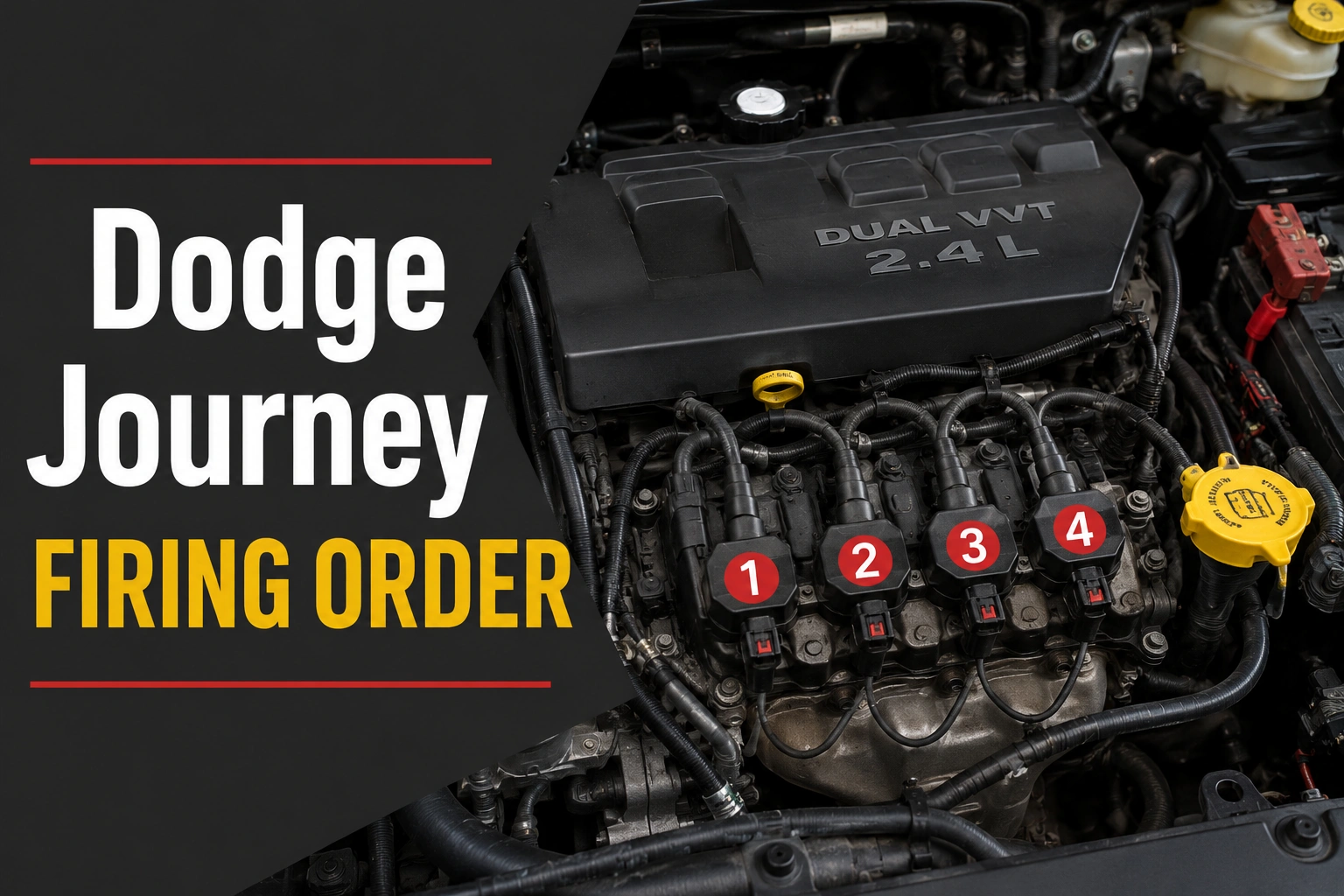
Its firing order runs 1-3-4-2, the standard pattern shared by the overwhelming majority of inline-four engines across the industry. Cylinder one sits at the front of the engine nearest the drive belt, with numbers two, three, and four following in a straight line back toward the firewall.
This exact engine, sharing the identical block, cylinder head design, and firing order, also powered the Chrysler Sebring and later Chrysler 200, along with the Dodge Avenger and Jeep Compass and Patriot during roughly the same period.
A firing order chart confirmed for any of these siblings applies without modification to a Journey using the same engine code.
Producing 173 horsepower throughout most of its Journey application, this engine prioritized affordability and simplicity over outright refinement.
Reviewers of the era frequently criticized its coarse, buzzy character under acceleration, a common complaint across every vehicle sharing this same World Engine architecture.
Why 2020 Buyers Only Had One Engine Choice
Dodge dramatically simplified the Journey lineup for its final 2020 model year, dropping the Pentastar V6 entirely and offering the 2.4-liter four-cylinder as the sole engine across both remaining trim levels.
This decision came alongside a broader trim consolidation down to just SE Value and Crossroad, stripping away the all-wheel-drive option that had required the V6 in prior years.
That final-year simplification wasn’t really about the engine itself so much as Dodge managing the Journey’s wind-down efficiently before full discontinuation.
The 2020 model also wasn’t sold in states following California emissions requirements, further narrowing an already shrinking market for a genuinely aging platform.
None of this business-side simplification changed the four-cylinder’s firing order or fundamental specifications in any way. A 2020 Journey’s 2.4-liter engine fires in the identical 1-3-4-2 sequence as the very first 2009 model, despite over a decade separating their production dates.
Owners shopping a final-year Journey specifically benefit from knowing this simplified, single-engine reality upfront. Unlike earlier model years where confirming V6 versus four-cylinder mattered enormously, every 2020 example shares identical engine specifications by default.
V6 Firing Order From The Early 3.5L To The Pentastar Era
Two distinct V6 eras split the Journey’s optional upgrade engine story into a clean before-and-after divide right at the 2011 facelift. Both share the identical numerical firing order despite representing genuinely different engineering generations.
That shared sequence makes the V6 side of this research considerably simpler than the trim-level changes surrounding it might suggest.
2.7L And 3.5L Firing Order In Early Journeys
The 2009 and 2010 model years offered a 3.5-liter V6, internally coded EGF, as the upgrade engine on SXT and R/T trims, producing 235 horsepower and 232 pound-feet of torque paired with a six-speed automatic transmission.
A smaller 2.7-liter V6 also appeared in the Journey’s broader specification history, sharing the same fundamental architecture as its larger sibling.
Both engines share an identical 1-2-3-4-5-6 firing order, part of the same Chrysler-designed V6 family that also included the 3.0-liter, 3.3-liter, 3.8-liter, and other displacement variants used across the company’s sedan and minivan lineup during this same general era.
Cylinder one sits at the front of one bank, with cylinders three and five continuing rearward on that same side.
This early V6 option disappeared entirely after just two model years, replaced by the all-new Pentastar starting with the 2011 facelift. That brief window makes 2009 and 2010 Journeys with this specific V6 comparatively uncommon today relative to the four-cylinder and later Pentastar-equipped examples that dominate the used market.
Parts availability for this specific early V6 has narrowed considerably given how quickly Dodge moved on to the Pentastar. Confirming the exact engine code before ordering ignition components remains especially important for anyone working on one of these earlier examples.
3.6L Pentastar Firing Order And Cylinder Layout
Chrysler’s all-new 3.6-liter Pentastar V6 replaced the outgoing 3.5-liter starting with the 2011 facelift, immediately delivering a meaningful jump to 283 horsepower alongside genuinely improved refinement.
This modern, dual-overhead-cam design represented a dramatic technical leap over the V6 it replaced, and remained available as the Journey’s optional upgrade engine all the way through the 2019 model year.
Its firing order runs 1-2-3-4-5-6, numerically identical to the older 3.5-liter and 2.7-liter engines despite sharing no meaningful architecture with them. The Pentastar’s 60-degree bank angle allows this simple, sequential pattern without the more complex crankshaft counterweighting other V6 designs require.
Cylinder one sits at the front of the passenger-side bank on this engine, with cylinders three and five continuing rearward on that same side, while the driver’s side holds cylinders two, four, and six.
This same engine and firing order pattern powers an enormous range of other Stellantis vehicles from the same era, from the Jeep Wrangler to the Dodge Charger and Durango.
All-wheel drive became available exclusively with this V6 throughout its Journey production run, never offered alongside the four-cylinder at any point.
That pairing makes engine identification straightforward for anyone specifically shopping for an all-wheel-drive example, since spotting that drivetrain configuration confirms Pentastar power automatically.
Trim naming shifted somewhat over this V6’s long run as well, with the original R/T performance trim eventually replaced by a GT badge in the Journey’s later years as sales softened and Dodge repositioned the lineup.
Neither renaming affected the underlying Pentastar specifications or firing order in any way, representing a marketing adjustment rather than a mechanical one.
Here’s how the complete gasoline lineup compares:
| Engine | Model Years | Type | Firing Order |
| 2.4L World Gas Engine I4 | 2009-2020 | Standard | 1-3-4-2 |
| 2.7L / 3.5L V6 | 2009-2010 | Optional upgrade | 1-2-3-4-5-6 |
| 3.6L Pentastar V6 | 2011-2019 | Optional upgrade | 1-2-3-4-5-6 |
A Global Nameplate Wearing Several Different Badges
North American buyers only ever saw a fraction of this vehicle’s full story. Dodge and its parent company marketed this same basic platform under multiple names and with engine options that never crossed the Atlantic in either direction.
China actually saw this platform before North America did in any meaningful production sense, with a version called the JCUV debuting at Auto China in 2008 ahead of Journey sales beginning stateside for 2009.
That early Chinese introduction reflected Chrysler’s broader global rollout strategy for this specific platform, rather than any indication of which market would eventually buy the most examples.
That global reach occasionally complicates online research for anyone not specifically searching North American sources.
The Fiat Freemont And International Diesel Story
Fiat sold a rebadged version of this exact platform as the Freemont across European, Australian, and South American markets starting in 2011, following Fiat’s acquisition of a controlling stake in Chrysler.
Beyond restyled front and rear fascias, the Freemont shared its fundamental engineering with the North American Journey, including engine choices that partially overlapped and partially diverged.
Diesel power reached international Journey and Freemont buyers through Fiat’s MultiJet common-rail diesel technology, an option never offered on any North American Journey.
This reflects broader market preferences, since diesel passenger vehicles remained far more common in Europe throughout this vehicle’s production run than in the United States or Canada.
The Journey also carried different names depending on the specific market, badged simply as “Dodge JC” in Japan since Isuzu already held rights to the Journey name there, and marketed as the “JCUV” in China from its early production days.
None of these naming variations changed the underlying North American gasoline engine specifications covered throughout this section.
International markets also saw a wider variety of transmission choices than North America ever did, including manual gearboxes and a dual-clutch automatic paired primarily with diesel engines overseas.
North American buyers only ever encountered conventional automatic transmissions across every gasoline engine offered, simplifying that particular variable considerably for domestic research.
Fiat discontinued the Freemont after the 2015 model year, several years before the North American Journey finally wound down in 2020.
That earlier international exit means most active online discussion and parts searches today center specifically on the longer-running North American version.
What This Means For Parts And Firing Order Research
Anyone searching online for Journey-related firing order information occasionally encounters results mixing North American and international specifications without clearly distinguishing between them.
Confirming a source specifically addresses the North American gasoline engines covered here, rather than a diesel Freemont sold overseas, avoids pulling irrelevant or simply inapplicable information.
The North American gasoline engines covered here, the 2.4-liter four-cylinder, the early 2.7-liter and 3.5-liter V6, and the later Pentastar, represent the complete and only story for any Journey actually sold through a United States or Canadian dealership.
Diesel-specific search results essentially never apply to a genuine North American example, regardless of how a specific listing or forum post happens to be worded.
VIN decoding remains the most reliable way to confirm exactly which engine, and by extension which market, a specific vehicle actually came from. North American Journey VINs follow standard decoding conventions available through most auto parts stores at no charge.
This international complexity mostly matters for online research accuracy rather than any genuine confusion likely to occur in a driveway or repair shop. A North American Journey owner working from a proper VIN decode or build sheet will never accidentally encounter diesel-specific information in the first place.
Practical Diagnosis Across Every Journey Engine
None of this technical and historical detail matters much until a check engine light appears or an engine starts running rough. Firing order and cylinder position knowledge turns that vague warning into a specific, targeted repair.
The sections below apply everything covered so far to real diagnostic work across every North American Journey model year.
Matching A Misfire Code To The Right Engine
A scan tool reading a P0301 through P0306 code identifies a misfiring cylinder by its physical position, never by where that cylinder falls within the firing sequence itself.
Confirming which engine sits under the hood comes first, since the physical cylinder map genuinely differs between the four-cylinder and either V6 option.
Once that’s settled, matching the engine against the correct chart from earlier sections points straight to the affected coil, plug, or injector. Swapping a suspect coil with a known-good unit from another cylinder remains a reliable confirmation test across every gasoline engine covered here.
Bank-specific codes only apply to the V6 options, since the four-cylinder’s single-row layout has no bank designation to confuse.
A Bank 1 designation on either the early 3.5-liter or the later Pentastar corresponds to the same passenger-side convention, simplifying this particular question compared to some other vehicles where bank orientation flips between engine generations.
Direct-injected Pentastar models can develop carbon buildup on intake valves over time, since fuel no longer washes over the valves the way it does on the port-injected four-cylinder and early V6 options.
A misfire that only appears after a cold start, improving as the engine warms, often points toward this specific concern rather than a straightforward ignition component failure.
Maintenance Habits That Matter Most By Engine Type
Spark plugs and coils on the four-cylinder and Pentastar V6 alike typically last well beyond 60,000 miles under normal conditions, a maintenance interval that held steady across this platform’s entire production run.
Replacing them proactively before symptoms appear costs considerably less than diagnosing a mystery rough idle months later.
Timing chain health deserves attention on high-mileage examples of either V6 generation, since a stretched chain won’t alter the programmed firing order but can throw crankshaft and camshaft sensor signals out of sync enough to trigger stored misfire codes.
This concern applies more to older, higher-mileage examples than to a Journey still well within its expected service life.
Owners of an early 2009 or 2010 model running the now-uncommon 3.5-liter V6 benefit from confirming parts availability before assuming standard Pentastar-era components will interchange.
Despite sharing an identical firing order, these two V6 generations don’t share ignition coils, plugs, or most other serviceable ignition components.
Keeping the exact engine code, not just model year or trim, documented in any service record prevents the most likely mistake on a vehicle with this much shared platform history: assuming parts sourced for a Chrysler 200 or Dodge Avenger automatically fit a Journey without confirming the specific engine code matches.
A compression test at the affected cylinder helps rule out deeper mechanical trouble once ignition components have been eliminated as the cause. This step matters especially on higher-mileage examples, where a persistent misfire that survives a fresh coil and plug sometimes points toward a genuine internal engine issue rather than anything firing-order related.
A VIN decode, available free at most parts stores, remains the fastest way to confirm the exact engine code before starting any repair.
A quick reference for common symptoms across this lineup:
| Symptom | Likely Cause | Applies To |
| Rough idle, specific cylinder code | Failing coil, plug, or injector | All gasoline engines |
| Misfire only after cold start | Carbon buildup on intake valves | Pentastar V6, direct-injected |
| Rattle at startup, quiets quickly | Early timing chain wear | High-mileage V6, either generation |
| Coarse, buzzy idle | Normal four-cylinder characteristic | 2.4L World Gas Engine |
Frequently Asked Questions
What is the firing order of a Dodge Journey 2.4L four-cylinder?
The 2.4-liter World Gas Engine fires in a 1-3-4-2 sequence across every model year it appeared, from 2009 through the final 2020 lineup. This same engine and firing order also powers the closely related Chrysler 200 and Dodge Avenger.
What is the firing order of a Dodge Journey 3.6 Pentastar V6?
The Pentastar fires in a 1-2-3-4-5-6 sequence from its 2011 debut through its final 2019 appearance in the Journey lineup. Cylinder one sits on the passenger-side bank.
Did the early V6 Journey use the same firing order as the later Pentastar?
Yes, both the 2009-2010 3.5-liter V6 and the 2011-2019 Pentastar share an identical 1-2-3-4-5-6 firing order, despite coming from genuinely different engine architectures and generations.
Does the Dodge Journey have a diesel engine option?
No, North American Journey models never offered diesel power. Diesel engines appeared only on the Fiat Freemont and other international versions of this platform sold outside the United States and Canada.
Why did the 2020 Journey only offer one engine?
Dodge simplified the lineup to just two trims for the final model year, dropping the Pentastar V6 and all-wheel drive entirely, leaving the 2.4-liter four-cylinder as the sole available engine.
Where can I confirm the exact firing order for my specific Dodge Journey?
A factory service manual matched to the exact model year and engine code remains the most reliable source. Most auto parts stores can also pull a firing order reference free of charge once given the vehicle’s VIN.
Twelve model years, one unusually long single generation, and three separate gasoline engine families still resolve into just two numbers once the correct engine gets identified. Every four-cylinder Journey fires 1-3-4-2, while every V6 version, early or late, fires 1-2-3-4-5-6.
Confirming the exact engine code, rather than assuming based on model year or trim alone, remains the only real starting point for applying any of this information correctly on a nameplate that shared so much with its sedan and international siblings.
That single habit turns a potentially confusing search across multiple related vehicles into a straightforward, five-minute answer.