The same V6 sitting under a Chevrolet Traverse’s hood also powered a Cadillac sedan, a Buick crossover, a Saturn built the same year, and even a Chevrolet sports car. Few family SUVs share this much engineering DNA with such a wide spread of unrelated-looking vehicles.
That shared architecture makes the Traverse’s firing order story unusually straightforward compared to most vehicles with a fifteen-year production history. One core engine family covers nearly the entire lineup, with a single short-lived exception most buyers never even considered.
Two full generations, one dominant six-cylinder engine, a brief turbocharged detour, and the cylinder-by-cylinder logic behind all of it get covered here in complete detail, along with why this particular crossover’s engine bay causes less confusion than most.
Firing Order Fundamentals For The Traverse’s V6 Foundation
Firing order describes the exact sequence in which an engine ignites fuel inside each cylinder. Engineers space these combustion events out deliberately across crankshaft rotation, not by chance.
A three-row family crossover might seem like an unlikely place to dig into this kind of mechanical detail. Millions of families have driven a Traverse to school drop-offs and road trips without ever wondering what happens inside the engine bay, yet the same basic combustion logic applies whether that Traverse rolled off the line in 2009 or 2023.
The Traverse actually makes an unusually clean case study precisely because so little changed under the hood across its history.
What Firing Order Means For A Transverse-Mounted Engine
Every cylinder fires at a specific point in crankshaft rotation, with a V6 completing one firing event every 120 degrees. That spacing keeps vibration low and spreads mechanical stress evenly across bearings and mounts.
The Traverse mounts its engine transversely, sitting sideways across the engine bay rather than facing front to back like a traditional rear-wheel-drive vehicle. This orientation comes from the unibody Lambda and C1XX platforms underpinning both Traverse generations, shared with the GMC Acadia and Buick Enclave.
Cylinder banks on a transverse V6 sit at an angle relative to the car’s direction of travel rather than running straight front to rear. What counts as the “front” of the engine, nearest the drive belt, often faces one side of the engine bay instead of the radiator.
None of this changes the actual firing sequence itself. It does change how a technician physically locates a specific cylinder, which matters enormously the moment a diagnostic code points to one.
Modern coil-on-plug ignition handles the actual firing electronically, with the engine control module timing each coil based on crankshaft and camshaft sensor data. Firing order still lives inside that programming, just without a distributor or plug wires to physically route in sequence.
Anyone coming from a rear-wheel-drive vehicle with a longitudinally mounted engine, like an older Camaro or full-size truck, needs to mentally reset expectations before working on a Traverse. The physical map looks different even when the underlying combustion logic follows familiar rules.
How To Identify Which Engine Code Is Under The Hood
A Traverse build sheet, visible through most VIN decoding tools, lists the exact engine code alongside model year and trim level. This single piece of information settles any doubt faster than trying to visually distinguish between engine generations.
The eighth character of a Traverse VIN corresponds to the engine code for that specific vehicle, a detail most owners never think to check until a repair question comes up. Parts counter staff and independent mechanics rely on this same character constantly when sourcing ignition components.
Visual identification offers a rougher shortcut for anyone without VIN access handy. First-generation Traverse models, built 2009 through 2017, carry the boxier original body style, while any 2018 or newer model runs the LFY by default unless the rare RS turbo badge appears on the rear hatch.
That RS-specific turbo badge remains the only reliable visual cue separating the four-cylinder from its V6 siblings, since neither engine is visible without opening the hood.
One Engine Family Powering Nearly Every Model Year
Chevrolet equipped the first-generation Traverse, sold from 2009 through 2017, with exactly one engine for its entire run: the 3.6-liter LLT V6. No other powertrain choice existed during those nine model years, a rare level of consistency for any modern vehicle.
The second generation, launched for 2018, continued that pattern with an updated 3.6-liter engine, this time badged LFY, standard across every single trim level. A turbocharged four-cylinder briefly joined the lineup as an RS-exclusive option, but only for two model years before Chevrolet quietly dropped it.
That means well over ninety percent of every Traverse built between 2008 and 2023 shares the exact same fundamental firing order. Compared to vehicles that cycled through four or five distinct engine families across a similar span, this represents about as simple a research question as this topic gets.
That consistency ended with the third-generation redesign for 2024, which dropped the V6 entirely in favor of a new turbocharged 2.5-liter four-cylinder. Everything covered here applies specifically to the 2008 through 2023 window, right before that fundamental architecture change took effect.
Owners benefit directly from this consistency. A firing order reference confirmed for a 2010 Traverse applies just as accurately to a 2023 model, provided both are running some version of the V6 rather than the rare turbocharged exception.
3.6L V6 Firing Order From LLT To LFY
Two engine codes cover the vast majority of Traverse production, and both share an identical firing order despite meaningful internal differences between them. Sorting out what actually changed, and what didn’t, clears up most confusion around this engine.
The story starts with an engine that debuted somewhere else entirely before ever reaching a Traverse showroom.
The Original LLT Firing Order And Cylinder Layout
The LLT V6 actually debuted on the 2008 Cadillac STS and CTS before General Motors brought it to every Lambda-platform crossover for the 2009 model year, including the Traverse, GMC Acadia, and Saturn Outlook. This direct-injected engine produced 281 horsepower in single-exhaust form and 288 horsepower with the dual-exhaust option.
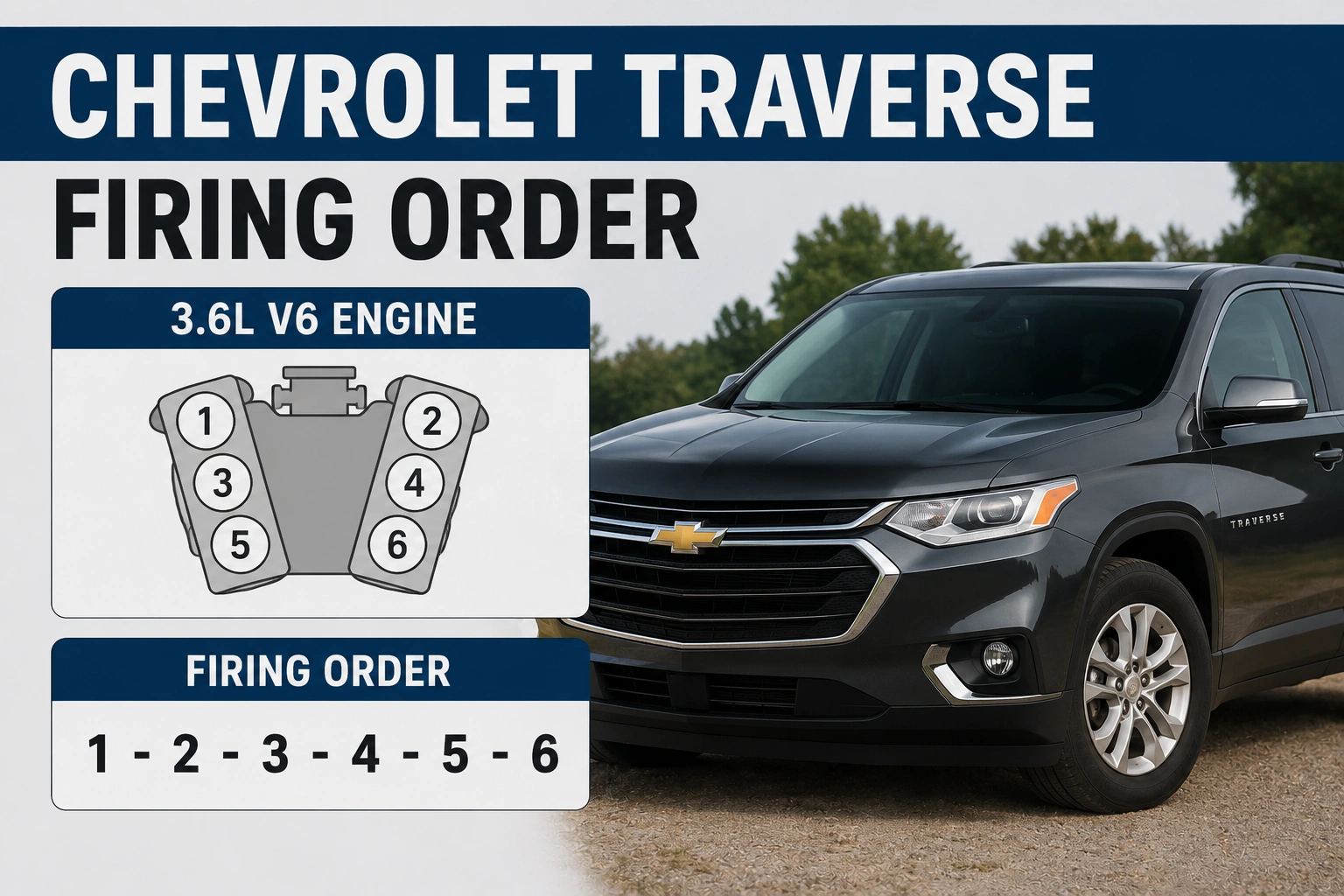
Its firing order runs 1-2-3-4-5-6, the standard sequence used across GM’s entire High Feature V6 family regardless of displacement or application. Cylinders one, three, and five sit on one bank running front to back relative to the engine itself, while two, four, and six occupy the opposite bank in the same order.
This same basic architecture, engine family, and firing sequence connects the Traverse directly to Cadillac sedans, Buick crossovers, and even later Camaro V6 applications. A firing order chart pulled for any of these vehicles applies identically to a first-generation Traverse.
Early LLT engines developed a documented reputation for timing chain wear, particularly on higher-mileage examples. That mechanical concern affects chain tension and cam timing accuracy, not the programmed firing order itself, though the symptoms can look remarkably similar to an untrained eye.
Dual-exhaust LLT models, distinguishable by their extra tailpipe, share the identical firing order and cylinder numbering as single-exhaust versions. The performance difference comes entirely from reduced backpressure, not any change to how or when cylinders actually fire.
How The LFY Refined The Formula Without Changing The Sequence
Chevrolet introduced the LFY V6 alongside the redesigned 2018 Traverse, an evolution of the LFX engine already serving other GM vehicles since 2012. Output climbed to 310 horsepower, a meaningful jump over the outgoing LLT’s rating.
Engineering changes ran deep under the surface. A redesigned cylinder head integrated the exhaust manifold directly into the casting, larger intake valves improved airflow, and a new inverted-tooth timing chain addressed the wear concerns that plagued earlier High Feature engines.
Despite all of that internal revision, the LFY retained the identical 1-2-3-4-5-6 firing order used by the LLT it replaced. Cylinder numbering and bank layout carried forward unchanged as well, meaning the fundamental combustion logic never needed to be relearned.
Stop-start technology, added specifically with the LFY, represents the most visible functional difference to everyday drivers. This feature shuts the engine off at stoplights and restarts it automatically, adding wear cycles the earlier LLT never had to handle but changing nothing about how or when each cylinder fires during normal operation.
GM engineers specifically preserved this firing order across the redesign to avoid disrupting engine control module calibration already proven reliable across millions of miles in other applications.
Reinventing a working combustion sequence would have added risk without any real performance benefit.
Flex-fuel capability, allowing E85 ethanol blends alongside standard gasoline, carried over from the LFX architecture into the LFY without requiring any change to injector timing relative to the firing sequence.
Owners running E85 shouldn’t expect any difference in cylinder behavior compared to standard gasoline, since the ECM adjusts fuel delivery rather than combustion order.
Here’s how the two main V6 variants compare:
| Engine Code | Model Years | Horsepower | Firing Order |
| LLT | 2009-2017 | 281-288 | 1-2-3-4-5-6 |
| LFY | 2018-2023 | 310 | 1-2-3-4-5-6 |
The Short-Lived 2.0L Turbo Four-Cylinder Option
One brief exception interrupts the Traverse’s otherwise uninterrupted V6 story. For two model years, a completely different engine architecture found its way into the lineup, then disappeared just as quickly.
Seeing why helps explain a genuinely unusual chapter in this vehicle’s engineering history.
Why RS Buyers Got A Different Engine For Two Years
Chevrolet launched the redesigned second-generation Traverse for 2018 with an unexpected second engine choice reserved exclusively for the sporty RS trim. This turbocharged 2.0-liter four-cylinder, badged LTG, produced 257 horsepower and a strong 295 pound-feet of torque, actually exceeding the standard V6’s torque figure.
Front-wheel drive was mandatory with this engine, and it never became available with all-wheel drive at any point during its short run. That restriction alone limited its appeal for family buyers who valued the security of all-wheel traction on a three-row crossover built for road trips and winter driving.
Market reception fell flat almost immediately. Buyers shopping a three-row family SUV generally expected six-cylinder smoothness and towing capability rather than a smaller, turbocharged engine more commonly associated with compact cars and sedans.
Competing three-row crossovers like the Ford Explorer had already normalized turbocharged four-cylinder power by this point, yet Chevrolet’s execution never gained similar traction with Traverse shoppers specifically. Badge expectations played a real role, since buyers cross-shopping a Chevrolet SUV skewed more conservative than those considering a nameplate already associated with turbocharged options.
Chevrolet discontinued the turbo option after the 2019 model year, leaving the LFY V6 as the sole engine choice for 2020 onward. Genuinely low production numbers make this specific configuration something of a rarity in the used market today.
Resale value reflects that rarity in an unusual way, with some enthusiast buyers specifically seeking out the turbocharged RS for its unique drivetrain rather than avoiding it. That niche appeal contrasts sharply with GM’s own assessment that the broader market simply wasn’t interested.
Where Else The LTG Turbo Four Appeared
This same 2.0-liter LTG engine saw considerably wider use elsewhere in GM’s lineup during the same period. Cadillac’s ATS and CTS sedans, along with the sixth-generation Camaro, all offered this exact turbocharged four-cylinder as either a standard or optional engine.
Its brief Traverse appearance stands out specifically because those other applications made more intuitive sense to buyers. A turbocharged sport sedan or sports car pairs naturally with a smaller, boosted engine in a way a three-row family hauler simply doesn’t in most shoppers’ minds.
Parts availability benefits from this wider adoption despite the Traverse-specific rarity. Ignition coils, turbochargers, and most internal components interchange freely across every LTG application, since GM used the same core engine with only minor calibration differences between vehicles.
Anyone sourcing parts for a rare turbocharged Traverse can reasonably expand their search to include compatible Cadillac and Camaro listings, often turning up better availability and pricing than a Traverse-specific search alone.
Firing Order And Cylinder Position On The LTG
The LTG turbo four uses a 1-3-4-2 firing order, the standard pattern shared by most GM inline-four engines regardless of application. This is the same LTG engine found in the Cadillac ATS, CTS, and sixth-generation Camaro of the same era.
Cylinder numbering follows a simple single-row layout, with cylinder one positioned nearest the drive belt and cylinder four closest to the transmission.
A twin-scroll turbocharger separates exhaust pulses from cylinders one and four into one scroll passage, with two and three sharing a separate scroll to reduce lag.
This engine shares absolutely nothing mechanically with the V6 options surrounding it in the same showroom. Ignition coils, cylinder count, firing sequence, and even basic engine architecture all differ completely between the LTG and any version of the High Feature V6.
Anyone working on one of these rare turbocharged Traverse models benefits from confirming the engine code before assuming standard V6 parts or firing order information applies.
A quick VIN decode settles this immediately, since the visual difference under the hood isn’t always obvious to an untrained eye.
Shared Architecture Across GM’s Lambda And C1XX Family
The Traverse never existed in true isolation, mechanically speaking. Its closest corporate cousins share not just a platform, but the exact same engine, firing order, and most underlying diagnostic logic.
That relationship offers real, practical value for anyone researching this specific vehicle.
Why An Acadia Or Enclave Diagram Also Works Here
GMC Acadia and Buick Enclave models built alongside each Traverse generation used the identical engine codes, firing orders, and cylinder layouts throughout. A firing order chart labeled for a 2012 Acadia applies without modification to a 2012 Traverse, since both ran the same LLT engine on the same Lambda platform.
Saturn Outlook buyers got this same treatment for the brand’s final year in 2009, before GM discontinued Saturn entirely. Even the Cadillac XT6, built on the later C1XX platform alongside the second-generation Traverse, shares core engine architecture with its more affordable stablemate.
This cross-platform consistency simplifies parts sourcing and diagnostic research considerably. A junkyard ignition coil pulled from a wrecked Enclave bolts directly onto a Traverse running the equivalent engine code, assuming both share the same generation and displacement.
Even the naming conventions overlap in ways that help research. Searching an engine code directly, rather than a specific model name, frequently surfaces technical service bulletins and recall information relevant across every badge sharing that same powertrain.
Forum communities and repair documentation for these sibling vehicles often cross-reference each other directly, since the underlying mechanical questions rarely differ. Searching slightly wider than just “Traverse” frequently turns up faster, more detailed answers to a specific diagnostic question.
Common Ignition And Timing Chain Issues Worth Knowing
Early LLT-powered Traverse models built before the LFX-based improvements arrived elsewhere in the GM lineup carry a well-documented risk of timing chain stretch at higher mileage.
A stretched chain doesn’t alter the programmed firing order, but it can throw crankshaft and camshaft sensor signals out of sync enough to trigger stored misfire codes.
Carbon buildup on intake valves affects both the LLT and LFY equally, since direct injection means fuel never washes over the valves the way it does on older port-injected designs.
This buildup can produce symptoms resembling an ignition problem even when every coil and plug tests perfectly healthy.
Water pump failures on early LLT engines occasionally introduce coolant into the engine oil, a serious concern that technicians sometimes discover only after chasing an unrelated misfire complaint for far too long. Catching this early prevents a straightforward repair from turning into a full engine rebuild.
None of these documented weak points require reprogramming or affect the underlying firing sequence in any way.
They do explain why so many Traverse-specific repair threads exist alongside generic firing order questions, since real symptoms often stem from wear rather than any confusion about cylinder numbering.
Practical Diagnosis And Maintenance For Traverse Owners
None of this technical history matters much until a check engine light appears or the engine starts running rough at a stoplight. Firing order and cylinder position knowledge turns that vague warning into a specific, targeted repair.
The sections below apply everything covered so far to real diagnostic work.
Tracking Down A Misfire By Generation
A scan tool reading a P0301 through P0306 code on a V6 Traverse identifies a misfiring cylinder by its physical position, never by where that cylinder falls within the firing sequence itself.
Confirming the engine code, LLT versus LFY, matters less here than it might on a vehicle with genuinely different firing orders across generations.
Since both major V6 versions share an identical 1-2-3-4-5-6 sequence and cylinder layout, a single reference chart covers nearly the entire Traverse lineup without modification.
The rare turbocharged models remain the one genuine exception, requiring their own separate cylinder map entirely.
Swapping a suspect ignition coil with a known-good unit from another cylinder remains one of the simplest confirmation tests available. If a misfire code follows the coil to its new position, the coil was the problem; if the code stays with the original cylinder, something else deserves a closer look.
Direct injection adds one extra diagnostic layer worth remembering. A misfire that only appears after a cold start, or one that seems to improve as the engine warms up, points toward carbon buildup on the intake valves rather than a straightforward ignition component failure.
Towing And Heavy-Load Considerations For This Engine
Traverse V6 models offer meaningful towing capability, typically rated between 1,500 and 5,000 pounds depending on drivetrain and available towing package. Sustained heavy loads place additional stress on the same timing chain and ignition components covered throughout this piece.
Firing order itself never changes under load, since it’s a fixed mechanical and programming characteristic rather than something that shifts with demand. What does change is how hard each cylinder works to maintain that sequence smoothly, particularly climbing grades or accelerating with a loaded trailer.
Regular fluid and ignition maintenance matters more for owners who tow regularly than for those using a Traverse purely for daily commuting. A misfire that only appears under load, rather than at idle, often points toward a marginal coil or plug finally failing under genuine stress rather than a random, unrelated issue.
Owners planning regular towing benefit from slightly shorter service intervals than the standard maintenance schedule suggests, particularly for spark plugs and any fluid shared between the engine and its supporting cooling systems.
Maintenance Habits That Protect This Engine Long-Term
Timing chain health deserves particular attention on high-mileage first-generation models still running the original LLT engine. A rattling noise on cold startup that quiets down within a few seconds often signals early chain stretch, worth addressing before it affects valve timing accuracy.
Extended-life spark plugs on both the LLT and LFY typically last well beyond 60,000 miles under normal driving conditions. Replacing them proactively before symptoms appear costs considerably less than diagnosing a mystery rough idle months later.
Regular oil changes matter more on this engine family than on many simpler competitors, given the documented water pump and timing chain concerns tied to contaminated or degraded oil. Clean oil protects the exact components responsible for keeping firing order execution accurate at the mechanical level.
Owners of the rare 2018 or 2019 turbocharged RS model should track maintenance separately from any V6 Traverse research, since parts, service intervals, and common failure points differ substantially between the two engine families.
The transition from a six-speed to nine-speed automatic transmission alongside the LFY engine changed shift behavior noticeably, though this transmission upgrade has no bearing on cylinder firing order and shouldn’t be confused with an engine-level change when researching symptoms.
A quick reference for common symptoms:
| Symptom | Likely Cause | Applies To |
| Rattle on cold startup, quiets quickly | Early timing chain stretch | LLT, high-mileage examples |
| Misfire only after cold start | Carbon buildup on intake valves | LLT and LFY, both direct-injected |
| Coolant mixing with oil | Failing water pump | LLT, first-generation models |
| Rough idle, specific cylinder code | Failing coil, plug, or injector | All engine variants |
Frequently Asked Questions
What is the firing order of a Chevrolet Traverse 3.6 V6?
Every 3.6-liter V6 used in the Traverse, including both the LLT and LFY versions, fires in a 1-2-3-4-5-6 sequence. This applies across both generations and every model year from 2009 through 2023.
Did the Traverse’s V6 firing order change between generations?
No, despite significant internal upgrades between the LLT and LFY engines, including a redesigned cylinder head and improved timing chain, the firing order and cylinder layout remained completely unchanged.
What is the firing order of the 2.0 turbo Traverse RS?
The LTG turbocharged four-cylinder, offered only for the 2018 and 2019 model years, fires in a 1-3-4-2 sequence. This shares nothing with the V6 firing pattern used everywhere else in the lineup.
Can I use a GMC Acadia firing order diagram on a Traverse?
Yes, both vehicles shared identical engine codes and firing orders throughout their parallel production histories on the same Lambda and C1XX platforms. A chart confirmed for one applies directly to the other, generation for generation.
Which cylinder is number one on a Traverse V6?
Cylinder one sits at the front of one bank, with cylinders three and five continuing along that same side. The opposite bank holds cylinders two, four, and six in the same front-to-back order, though the transverse mounting means “front” faces sideways in the engine bay rather than toward the radiator.
Where can I confirm the exact firing order for my specific Traverse?
A factory service manual matched to the exact model year and engine code remains the most reliable source. Most auto parts stores can also pull a firing order reference free of charge once given the vehicle’s VIN.
Fifteen years, two generations, and one dominant V6 architecture still come down to a single number worth remembering: 1-2-3-4-5-6. That sequence covers nearly every Traverse ever built, with the brief turbocharged RS exception standing as the one genuine outlier in an otherwise remarkably consistent engineering story.
Knowing which engine sits under a specific hood, more than knowing the generation or model year alone, remains the only real prerequisite for getting this right every time. That simplicity is rare enough in the automotive world to be worth appreciating on its own, even before the first misfire code ever shows up.