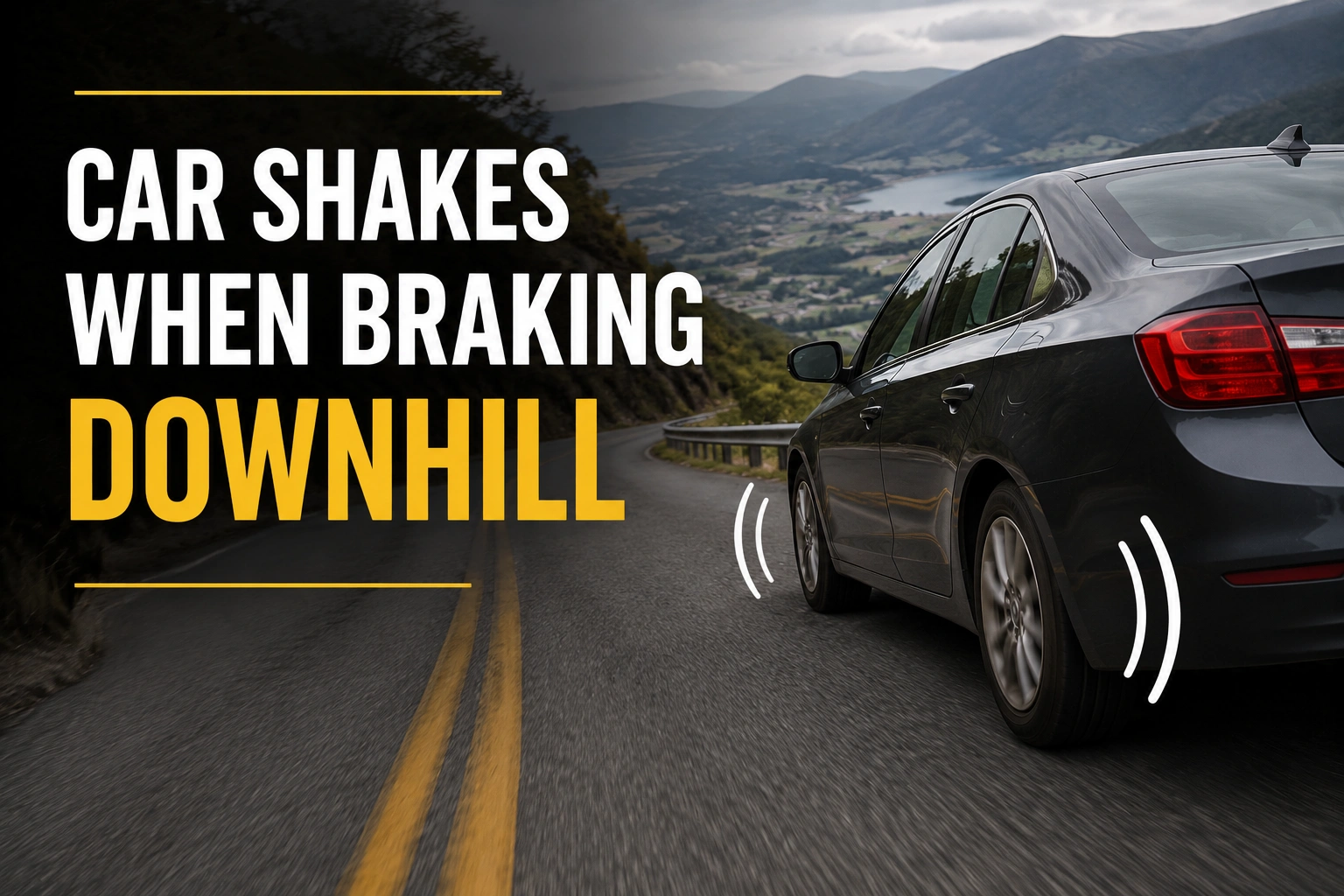
A shaking steering wheel on a steep descent ranks among the most unsettling feelings a driver can get behind the wheel. Hill roads, mountain passes, and long downhill stretches load a braking system far harder than everyday city routes ever do.
That vibration traveling up through the pedal, seat, or wheel rim is rarely random noise from an aging car. It is a mechanical signal, and each cause leaves a distinct pattern behind for anyone willing to look closely.
Engineers call this brake judder, and it shows up more often on descents because sustained pressure builds far more heat than short, occasional stops. Warped rotors, tired wheel bearings, worn suspension bushings, and unbalanced tires all create a similar shake for very different reasons.
Knowing what to check first, what a mechanic tests, and how to brake correctly on a hill turns a frightening moment into a problem solved in an afternoon.
Why Downhill Roads Push Braking Systems To Their Limit
Flat-road braking asks a car to shed speed for a few seconds at a time. A downhill stretch works differently, since gravity keeps pulling the car forward and brakes stay engaged for minutes rather than seconds on a long mountain pass.
That extended contact between pad and rotor turns kinetic energy into heat. Rotor temperatures on a steep descent can climb past 300 degrees Celsius within a few minutes, and metal expands unevenly once it gets that hot.
Uneven expansion creates what technicians call thickness variation, a difference of only a few microns across the rotor face. That tiny inconsistency makes the pad grab and release many times each second, felt as a pulse in the pedal or a shimmy through the wheel.
Steeper gradients, heavier loads, and higher entry speed before braking all add more heat into the system.
A loaded SUV descending a steep grade generates dramatically more brake heat than a hatchback easing down a gentle slope. That difference explains why identical worn parts can stay silent on flat roads yet shake violently on a hill.
Common Culprits Behind Brake Vibration On Hills
Several components can produce a similar shake, which makes self-diagnosis tricky without knowing what each culprit actually feels like. The list below covers the causes mechanics find most often during a hill-specific vibration complaint.
Warped Or Overheated Brake Rotors
Rotors absorb the brunt of downhill braking, and repeated heat cycles are their biggest enemy over time. Cast iron is strong but not infinitely tolerant of rapid heating followed by rapid cooling on a long descent.
A rotor rarely needs to bend visibly to cause judder. Most real-world cases involve thickness variation rather than true warping, though drivers and even some workshops use both terms loosely and interchangeably.
Symptoms usually appear only under braking and often worsen as speed increases before the stop begins. A pedal that pulses rhythmically, roughly in time with wheel rotation, points almost directly at this cause.
Mechanics measure the fault with a dial indicator, checking for runout beyond factory tolerance, typically around 0.05 millimeters on most passenger cars. Machining the surface fixes mild cases, though rotors below minimum thickness need full replacement instead.
Uneven Brake Pad Wear
Brake pads wear unevenly when a caliper piston sticks slightly or when friction material bonds unevenly to its backing plate. Downhill heat accelerates this unevenness, since one section of the pad often absorbs more friction than the rest.
Cheaper pad compounds fade faster under sustained heat, transferring material unevenly onto the rotor surface. This transferred layer, known as pad deposit, creates the same pulsing sensation as a warped rotor, even when the rotor itself measures perfectly flat under inspection.
A simple visual check helps confirm this at home. Pull each wheel and compare pad thickness side to side; a gap greater than 2 millimeters between pads on the same axle usually points to uneven wear.
Replacing pads in axle pairs, never as single units, keeps braking force balanced. This simple habit stops the shake from returning within a few thousand kilometers.
Loose Or Worn Wheel Bearings
Wheel bearings keep a wheel spinning true against its hub, and even minor play inside a worn bearing lets the wheel wobble under load. Braking downhill adds extra lateral force exactly when this wobble becomes most noticeable.
This cause differs from rotor or pad problems in one key way. Vibration often continues faintly even without touching the brake pedal, especially while cornering, and a low humming noise that changes pitch with speed usually arrives before any shaking starts.
Jacking up the wheel and rocking it by hand at the twelve and six o’clock positions reveals excess play in a failing bearing. Left unaddressed, a bad bearing can eventually seize or separate, turning an annoying vibration into a genuine safety hazard partway down a hill.
Worn Suspension And Steering Components
Control arm bushings, tie rod ends, and ball joints hold each wheel in precise alignment relative to the car. Age and mileage let these parts develop slack, and braking force during a descent exposes that slack more than steady-speed cruising ever does.
Weight transfers forward under braking, pressing harder onto front suspension components for the duration of the stop. A worn bushing that stays perfectly quiet on flat roads can suddenly clunk or shudder once that forward weight shift arrives on a hill.
A mechanic checks this during a suspension inspection using a pry bar, looking for movement in joints meant to stay rigid. Replacing a single worn bushing costs relatively little, but ignoring it long enough accelerates tire wear and throws off wheel alignment, adding expense later on.
Tire And Wheel Imbalance
An out-of-balance tire shakes mainly at speed, but braking adds a second layer of vibration whenever tread wear is also uneven. Cupping, a scalloped wear pattern often linked to worn shocks, amplifies vibration specifically during braking events.
A wheel that lost its balance weight, perhaps after striking a pothole, shimmies at certain speeds. It can feel noticeably worse under braking because the wheel decelerates unevenly around its own imbalance point.
Rotating tires every 8,000 to 10,000 kilometers and rebalancing after any hard curb strike keeps this cause off the list entirely. A quick visual scan for feathered or cupped tread, running a hand across the surface, often reveals the problem before a machine ever needs to confirm it.
| Cause | Where The Shake Is Felt | Typical Fix |
| Warped Or Overheated Rotors | Brake Pedal, Mainly While Stopping | Resurface Or Replace Rotors |
| Uneven Brake Pad Wear | Brake Pedal, Worsens With Heat | Replace Pads In Axle Pairs |
| Worn Wheel Bearings | Steering Wheel, Also While Cornering | Replace Bearing Or Hub Assembly |
| Worn Suspension Parts | Whole Car, Worse Under Load | Replace Bushings, Joints, Or Arms |
| Tire Or Wheel Imbalance | Steering Wheel, Worse At Speed | Balance, Rotate, Or Replace Tires |
How To Pinpoint The Exact Cause Yourself
A little detective work before any workshop visit saves diagnostic time and often saves money too. Three simple checks, done safely, narrow the cause down to one or two parts before a mechanic ever lifts the car onto a ramp.
Notice Where And When The Shake Happens
Location tells its own story. A shake felt only in the steering wheel usually points toward the front axle, while a shake felt through the seat or entire floor pan often means a rear-wheel or drivetrain component instead.
Timing matters just as much as location. A vibration that appears only while braking, then disappears the instant the pedal is released, points toward rotors or pads.
A vibration present at all times, pedal touched or not, points toward bearings, tires, or suspension wear. Speed at onset offers one more useful clue.
Judder that begins around 60 to 80 kilometers per hour during braking often traces back to rotor thickness variation, since that speed range generates enough heat and rotation frequency to make the defect obvious to the driver.
Test On A Safe, Straight Stretch
Find an empty, straight road with a gentle downhill grade, ideally one already familiar from daily use. Bring the car to about 60 kilometers per hour, then brake gently and note exactly what shakes and how strongly it does.
Repeat the same test while braking harder, then again while barely touching the pedal at all. A shake that only appears under firm braking suggests rotor or pad involvement, since light pressure generates far less heat and clamping force overall.
Try the same speed without braking, simply coasting down the same stretch of road. If the car still vibrates with no pedal input at all, wheel bearings, tires, or a driveshaft issue become far more likely than anything inside the brake caliper.
Watch For Extra Clues
Sound often arrives before a shake becomes obvious through the hands. Grinding suggests metal-on-metal contact from pads worn past their friction material entirely.
Clicking during turns points toward a CV joint rather than any brake component.
Smell matters too, in its own way. A sharp, hot metallic odor after a long descent is normal to a point, but a strong burning smell paired with a soft or sinking pedal suggests brake fade, a temporary yet serious loss of stopping power.
A pull to one side under braking, combined with the shake, usually means uneven pad wear or a caliper that partially seized on just one wheel, rather than a problem spread evenly across the entire car.
Braking Techniques That Protect Your Car On Descents
Correct technique prevents much of this damage before it ever starts. Shifting into a lower gear before a descent begins, not after speed has already built up, lets the engine absorb energy through compression rather than the brakes.
Manual transmissions handle this naturally by dropping one or two gears below what feels comfortable on flat ground.
Automatic transmissions offer a similar effect through low range, sport mode, or paddle shifters. Many modern SUVs also add dedicated hill descent control that pulses individual brakes automatically.
Riding the brake pedal lightly for an entire descent feels cautious but actually causes more damage than short, firm bursts. Continuous light pressure keeps pads and rotors in constant contact without any cooling gap, building heat steadily until fade eventually sets in.
A better rhythm exists: brake firmly for a few seconds to shed speed, release fully, and let the car coast while brakes cool. This on-off pattern, sometimes called stab braking, gives rotors time to shed heat between applications instead of cooking continuously.
Brake fluid plays a quieter role in this entire story. Fluid absorbs moisture over time, and moisture lowers its boiling point significantly, sometimes by more than 50 degrees Celsius in fluid untouched for three or four years.
On a long, hot descent, that older fluid can boil inside the caliper, turning firm pedal pressure into a spongy, sinking feel unrelated to pads or rotors. Changing brake fluid roughly every two years, regardless of mileage, guards against this hidden risk.
Loaded vehicles need earlier, more deliberate gear selection than an empty car. Extra passengers, luggage, or a trailer carry more kinetic energy at the same speed, and that extra mass converts directly into extra heat at the rotors during every single stop.
| Descent Type | Gear Advice | Braking Style |
| Gentle Slope | Normal Driving Gear | Light, Occasional Braking |
| Steep Hill | One Or Two Gears Lower | Firm Bursts With Cooling Gaps |
| Mountain Pass Or Loaded Vehicle | Lowest Comfortable Gear, Hill Descent Control If Fitted | Minimal Pedal Use, Rely On Engine Braking |
Repair Costs And When A Mechanic Visit Cannot Wait
Costs vary by car segment, brand, and region, but relative rankings help set expectations before any workshop quote arrives. Parts alone are usually the smaller expense, since labor and diagnostic time often make up the larger share of a brake-related bill.
| Repair Needed | Relative Parts Cost | Job Complexity |
| Brake Pad Replacement | Low | Simple, Often Same Day |
| Rotor Resurfacing Or Replacement | Moderate | Simple To Moderate |
| Wheel Bearing Replacement | Moderate To High | Moderate, Needs Press Tools |
| Suspension Bushing Or Ball Joint | Moderate | Moderate, Alignment Usually Follows |
| Wheel Alignment And Balancing | Low | Simple, Quick Turnaround |
Some situations do not leave room for scheduling convenience. A pedal that sinks toward the floor, a burning smell that lingers well after stopping, or a shake that suddenly worsens mid-descent all call for pulling over safely and arranging help rather than continuing home.
A shake that stays mild and consistent, without noise or pedal changes, can usually wait for the next scheduled service. Any downhill-specific symptom still deserves a direct mention to the mechanic, since a shake that never appears on a flat test drive can easily get missed during a routine inspection.
A shake on a downhill run is a car asking for attention, not a reason to panic outright. Nearly every cause traces back to ordinary wear, and each one carries a clear, well-understood fix.
Catching the pattern early, through sound, timing, or a simple driveway check, keeps hill roads enjoyable instead of stressful.
Frequently Asked Questions
Why does a car shake only when braking downhill and not on flat roads?
Downhill braking holds pads and rotors in extended contact, building heat that flat-road stops rarely produce. That extra heat exposes weaknesses, like slight rotor thickness variation or a lightly worn bearing, that stay completely silent during shorter, everyday braking events.
Is it safe to keep driving if the car shakes while braking?
Mild, consistent shaking without noise or pedal changes can usually wait for a scheduled service visit. A sudden increase in shaking, a burning smell, or a soft pedal on a descent means pulling over safely and arranging help instead of continuing the drive.
Can wheel alignment cause shaking during braking?
Alignment alone rarely triggers shaking directly, but it often travels alongside the real cause. Poor alignment speeds up uneven tire wear and stresses suspension bushings faster, both of which do produce vibration, so a shake often prompts an alignment check regardless.
Does engine braking actually reduce wear on brake pads and rotors?
Yes, quite noticeably. Shifting to a lower gear lets engine compression absorb a large share of a descent’s energy, so brakes handle smaller, shorter bursts of heat instead of one long, continuous load, which measurably slows pad and rotor wear over time.
Can old or low brake fluid cause vibration while braking?
Old fluid rarely causes the shake by itself, but it makes matters worse on a long descent. Moisture-contaminated fluid boils at a lower temperature, and boiling fluid creates a spongy, sinking pedal that can feel like it adds to any existing vibration.
How much does fixing a warped brake rotor typically cost?
Cost depends on the car and region, but resurfacing is the cheaper route whenever thickness allows it. Rotors machined below the minimum thickness stamped on the hub need full replacement instead, which costs more but restores a smooth, judder-free pedal feel right away.