A base Porsche 911 now costs more than a fully loaded Corvette Z06 with 670 horsepower. That single fact says a lot about sports car shopping in 2026: prices have climbed, but so has the performance available for far less money than the badge might suggest.
Eight cars anchor this year’s field, split honestly into two camps. Some cost less than a well-optioned pickup truck and still hit 60 mph in the mid-four-second range. Others carry six-figure stickers and the prestige to match.
What ties them together is a shared commitment to the driver over the passenger. Manual transmissions survive on five of these eight, naturally aspirated engines power two of them, and rear-wheel drive dominates the entire list.
Picking the right one means matching your budget, your daily commute, and your tolerance for a stiff ride to what each car actually delivers. The details below cover pricing, real specifications, and the honest trade-offs behind each badge.
What Makes A Sports Car Worth Buying In 2026
Power figures grab headlines, but weight distribution and chassis tuning decide how a car actually feels on a back road. A lighter car with less power often out-corners a heavier one with more.
Rear-wheel drive remains the default layout for a reason. It lets the front tires focus purely on steering while the rear tires handle acceleration, producing the balanced feel enthusiasts chase.
Transmission choice has become a genuine differentiator. A shrinking handful of manufacturers still offer manual gearboxes, and that scarcity now carries real resale value among enthusiasts.
Daily usability matters more than marketing suggests. Trunk space, ride quality on rough pavement, and a properly tuned infotainment system decide whether a sports car becomes a weekend toy or an everyday companion.
Engine character separates good sports cars from forgettable ones. Turbocharged engines deliver flatter, more accessible torque, while naturally aspirated engines reward higher revs with a sharper, more vocal experience.
Total cost of ownership deserves real attention before signing anything. Insurance premiums, tire replacement costs, and brake wear all run higher on performance cars than the sticker price alone suggests.
Depreciation curves vary wildly across this segment. Some of these cars hold value remarkably well, while limited-production halo trims can lose tens of thousands within the first few years of ownership.
Exhaust note and engine character still sway buyers as much as spec sheets do. A flat-six Porsche, a turbocharged inline-six, and a naturally aspirated V8 all sound distinct enough that many shoppers choose by ear before they choose by lap time.
Tire selection quietly shapes the entire ownership experience. Summer performance tires transform how any of these cars handle, but they also wear faster and lose grip sharply once temperatures drop near freezing.
Affordable Sports Cars That Still Deliver Thrills
These three prove that genuine driving excitement doesn’t require a six-figure loan. Each one starts under $65,000, and two of them dip well below $50,000 before a single option box gets checked.
None of them sacrifices the fundamentals to hit that price point. Rear-wheel drive, manual transmission availability, and real chassis tuning all survive at this end of the market.
1. Mazda MX-5 Miata
The Sport trim opens the lineup at $30,430, making the Miata the least expensive way into a genuine sports car today.
A 2.0-liter four-cylinder produces a modest 181 horsepower and 151 pound-feet of torque, numbers that undersell how the car actually feels from behind the wheel.
Every Miata sends power to the rear wheels through a standard six-speed manual, with a six-speed automatic optional only on the Grand Touring trim.
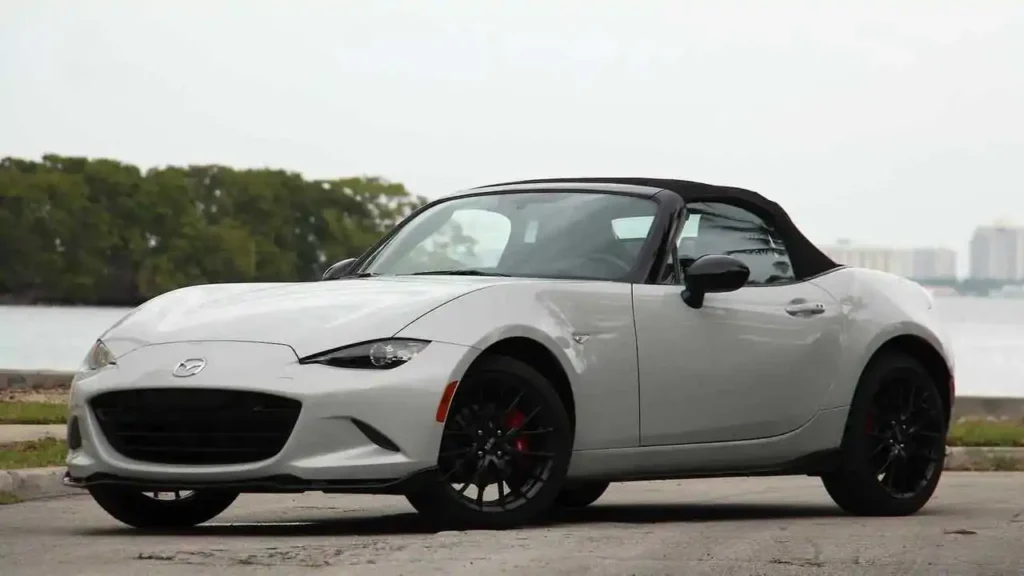
At roughly 2,300 pounds, the Miata weighs less than half of what several other cars on this list carry, and that lightness shows up in every steering input and gear change.
The Club trim adds a limited-slip differential, stiffer Bilstein dampers, and 17-inch BBS wheels for genuinely sharper handling, while the RF hardtop version trades a small amount of trunk space for a power-retractable roof.
Fuel economy reaches 29 mpg combined, easily the best figure on this entire list and a real advantage for a car meant to be driven often rather than parked for special occasions.
Nearly three decades of continuous refinement, what Mazda calls its kaizen philosophy, means the current ND-generation Miata still gets meaningful updates rather than a wholesale reinvention every few years.
2. Nissan Z
Money starts at $42,970 for the Sport grade, with the Performance trim adding real hardware for $52,970 and the range-topping NISMO reaching $65,750.
A twin-turbocharged 3.0-liter V6 produces 400 horsepower and 350 pound-feet of torque on Sport and Performance models, climbing to 420 horsepower on the NISMO.
Sport and Performance trims offer a choice between a six-speed manual and a nine-speed automatic, though the NISMO currently comes exclusively with the automatic.
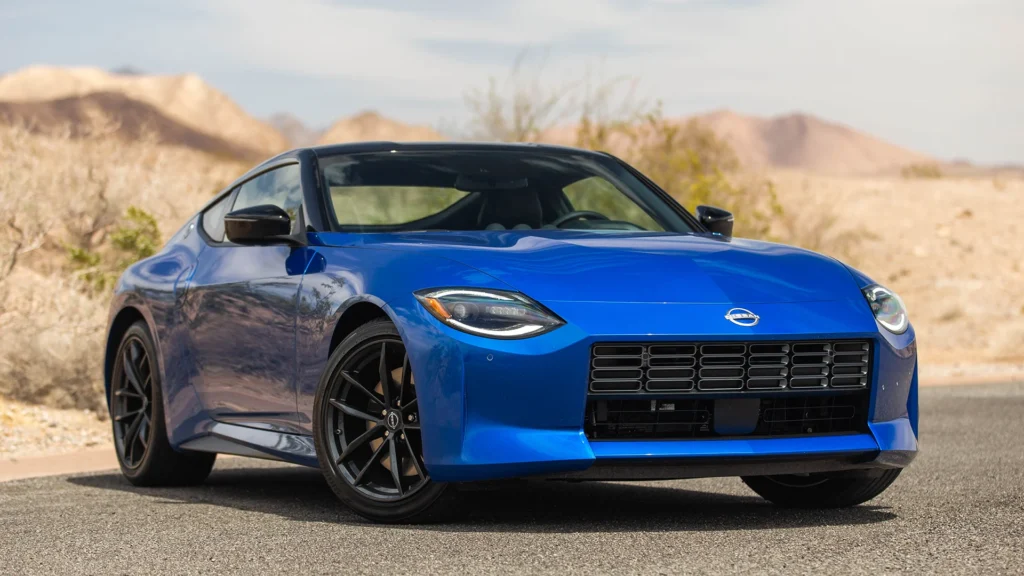
Zero to 60 mph arrives in roughly 4.3 seconds on the Performance trim, competitive with cars costing considerably more.
A new-for-2026 Heritage Edition package pays tribute to the 300ZX with retro-inspired styling cues, adding $2,940 to the Performance grade’s price.
Worth knowing before you buy: the Z’s platform and infotainment hardware trace back to the previous-generation 370Z, so the cabin technology trails newer rivals even as the drivetrain stays genuinely competitive.
The trade-off shows up in character rather than outright pace. Reviewers consistently describe the Z as closer to a comfortable grand tourer than a stripped-down track weapon, which suits buyers who want daily comfort alongside weekend excitement.
3. Ford Mustang Dark Horse
With the Camaro discontinued and the Challenger reborn as an electric Charger, the Dark Horse now carries the naturally aspirated V8 muscle car torch essentially alone.
Pricing lands around $63,080, a serious jump from a base Mustang but justified by genuinely track-focused hardware underneath.
A modified 5.0-liter Coyote V8 produces 500 horsepower and 418 pound-feet of torque, making it the most powerful naturally aspirated Mustang engine ever offered.
Buyers choose between a TREMEC six-speed manual or a 10-speed automatic, both feeding power to the rear wheels through standard MagneRide adaptive dampers and Brembo brakes.
Zero to 60 mph takes 4.6 seconds, and a class-first Drift Brake feature helps drivers control oversteer intentionally on track days.
For buyers wanting even more, the supercharged Dark Horse SC pushes output to 795 horsepower for around $103,490, edging remarkably close to the flagship Mustang GTD’s territory.
Every Dark Horse SC engine gets hand-assembled by a single technician at Ford’s Dearborn plant, a build process the brand borrows directly from how AMG builds its own performance V8s.
Serious Performance Without Supercar Money
This trio occupies the middle ground where genuine engineering credibility meets prices that stop just short of six figures for most configurations.
Each car here trades some outright value for a stronger brand pedigree, sharper dynamics, or a more special-feeling engine than the entry-level group above.
4. Toyota GR Supra
The base 3.0 trim asks $58,300, climbing to $61,450 for the better-equipped 3.0 Premium and $69,350 for the collector-focused MkV Final Edition.
That last name matters: 2026 marks the final year of production for this generation of Supra, giving the Final Edition trim genuine collectibility beyond typical marketing language.
Power comes from a turbocharged 3.0-liter inline-six built by BMW, producing 382 horsepower and 368 pound-feet of torque through rear-wheel drive.
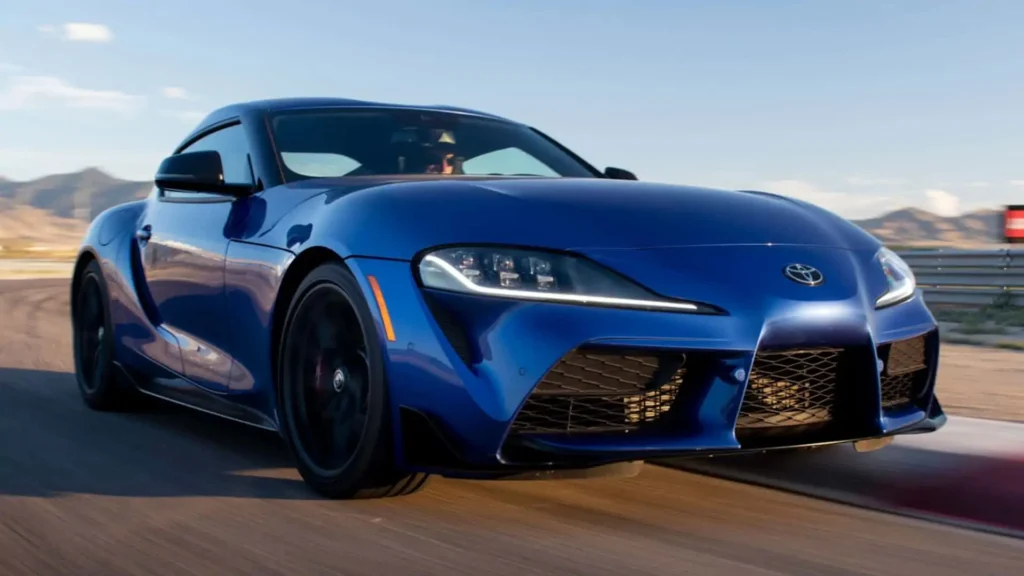
Buyers can select a six-speed manual or an eight-speed automatic at no cost difference, a rare bit of pricing fairness in this segment.
Zero to 60 mph comes in around 3.9 seconds with the automatic, while the manual runs a touch slower but rewards drivers who prefer to row their own gears.
Sharing its platform with the BMW Z4 gives the Supra genuinely sorted European chassis tuning, filtered through Toyota’s Gazoo Racing division for a distinct character from its German cousin.
Whether Toyota replaces this generation or retires the Supra name entirely remains an open question, which adds a genuine sense of occasion to buying one before production winds down.
5. BMW M4 Competition
Competition trim pricing begins at $86,400 for rear-wheel drive, climbing to $91,500 for the all-wheel-drive xDrive Coupe and $98,400 for the xDrive Convertible.
A twin-turbocharged 3.0-liter inline-six produces 523 horsepower and 479 pound-feet of torque, a meaningful step up from the base M4’s 473 horsepower.
Zero to 60 mph takes 4.1 seconds with rear-wheel drive alone, dropping to a genuinely quick 3.1 seconds once the xDrive all-wheel-drive system gets involved.
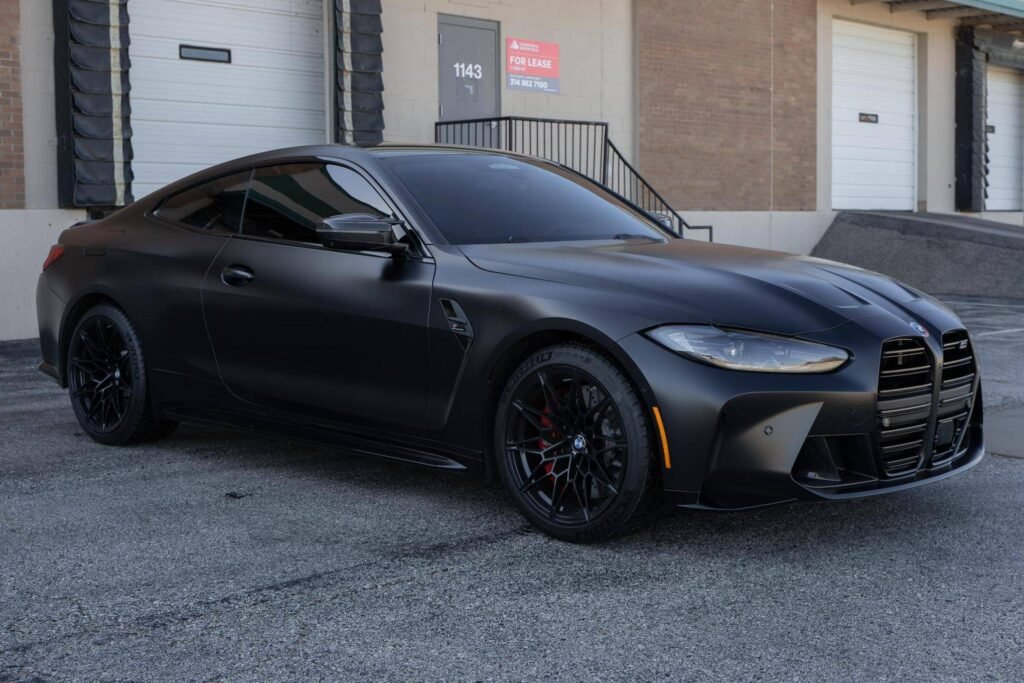
The cabin pairs a 12.3-inch digital instrument cluster with a 14.9-inch touchscreen, among the most tech-forward interiors in this entire class.
Worth noting honestly: some owners moving from naturally aspirated rivals have described the M4’s exhaust note and overall character as more muted than expected, even as the raw numbers remain thoroughly impressive.
A manual transmission does exist in the M4 lineup, though it’s reserved for the base non-Competition coupe rather than this more powerful trim.
Standard adaptive M suspension and an electronically controlled rear differential give the Competition genuine track composure, backed by a chassis that shrugs off broken pavement better than its stiff setup suggests.
6. Chevrolet Corvette Stingray
A 1LT coupe carries a $71,995 sticker, rising to $83,745 for a loaded 3LT, with convertible variants adding roughly $7,000 across the board.
Chevrolet’s decision to move the Corvette to a mid-engine layout for this generation transformed the car’s handling balance more than any spec sheet number could capture.
The naturally aspirated 6.2-liter V8 produces 490 horsepower and 465 pound-feet of torque standard, rising to 495 horsepower with the Z51 Performance Package’s upgraded exhaust.
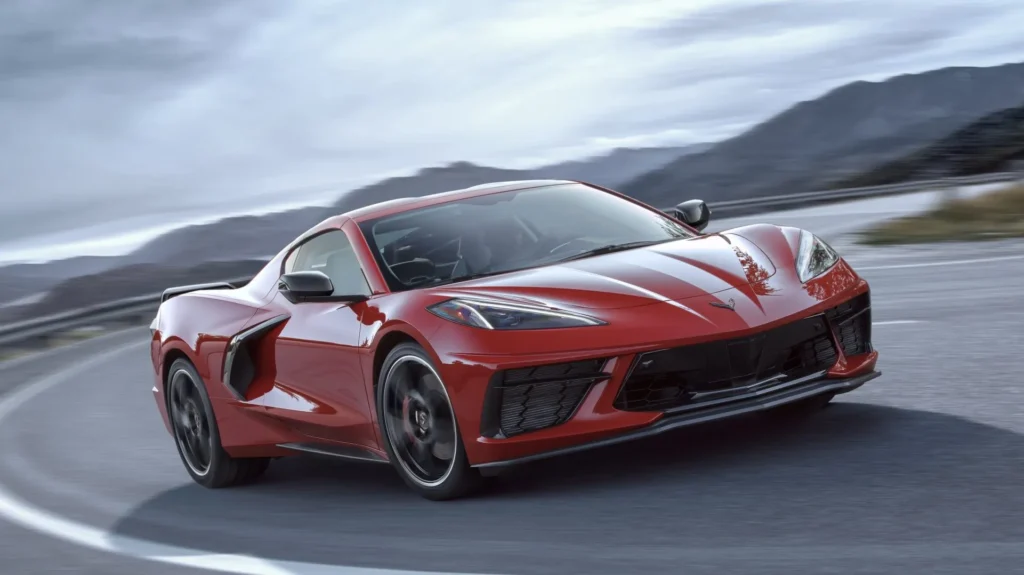
An eight-speed dual-clutch automatic is the only transmission offered, sending power exclusively to the rear wheels.
Zero to 60 mph takes just 2.9 seconds with Z51 equipped, a figure that would have required a Ferrari not long ago.
Practically speaking, the mid-engine layout gives the Stingray both a front trunk and a rear cargo area, real everyday usability that rivals like the Supra and 911 can’t match.
A driver-centric cockpit wraps the passenger side in a raised trim panel, a design choice that makes the cabin feel more like a cockpit than a conventional two-seat interior. Buyers wanting even more can step up to the 670-horsepower Z06 or the 1,064-horsepower ZR1 within the same showroom.
Icons Worth Saving Up For
These two cars ask for genuine financial commitment, and both justify it through decades of engineering reputation rather than simple horsepower bragging rights.
Neither is the fastest car on this list by the numbers, yet both remain the ones enthusiasts talk about most.
7. Porsche 911 Carrera
Porsche wants $129,950 for the 2026 Carrera coupe, a jump of nearly $8,000 over last year that pushed the base car’s price above a loaded Corvette Z06.
A twin-turbocharged 3.0-liter flat-six produces 389 horsepower and 332 pound-feet of torque, mounted in its traditional spot behind the rear axle.
Rear-wheel drive comes standard, paired with an eight-speed PDK dual-clutch transmission, while the stripped-down Carrera T trim adds a genuine seven-speed manual option for purists.
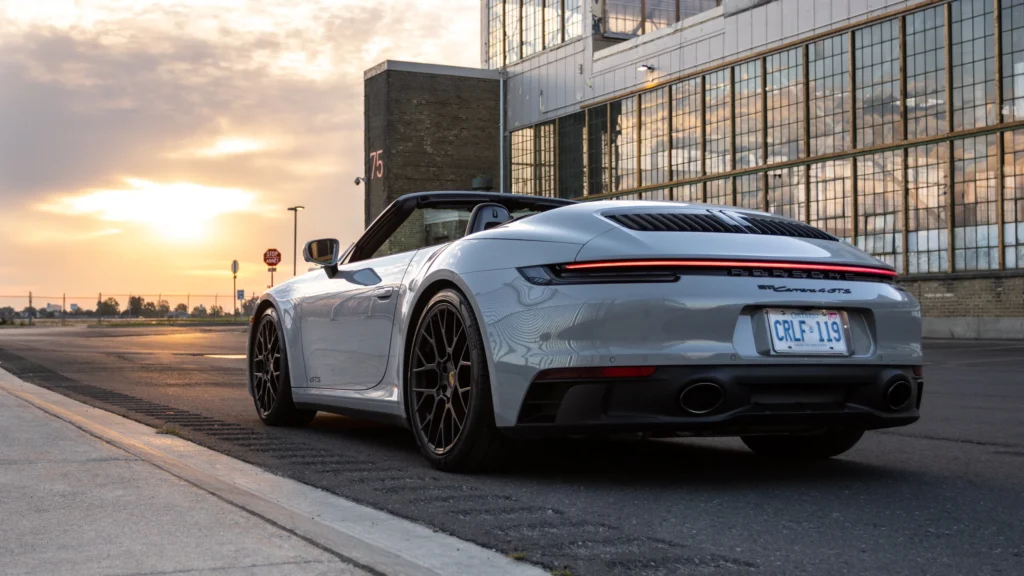
Zero to 60 mph takes 4.2 seconds with the PDK, respectable rather than blistering, since the Carrera prioritizes precision and everyday usability over outright numbers.
Porsche Active Suspension Management and rear-axle steering come standard, technology that keeps six-decade-old engineering feeling thoroughly current on real roads.
The badge alone explains part of the price, but few cars at any price point match the 911’s steering feel and everyday drivability in the same package.
Sixty years of unbroken production also means an enormous specialist network exists for maintenance and parts, a practical advantage that newer or lower-volume rivals on this list simply cannot replicate yet.
8. Lotus Emira
The entry Turbo trim runs $106,900, while the more capable V6 SE starts at $112,900 and climbs to $118,400 for the Racing Line package.
This matters beyond typical model-year news: the Emira is confirmed as the final internal-combustion car Lotus will ever produce before the brand goes fully electric.
The Turbo trim uses a Mercedes-AMG-sourced 2.0-liter four-cylinder making 360 horsepower, while the V6 SE steps up to a supercharged 3.5-liter V6 with 400 horsepower.
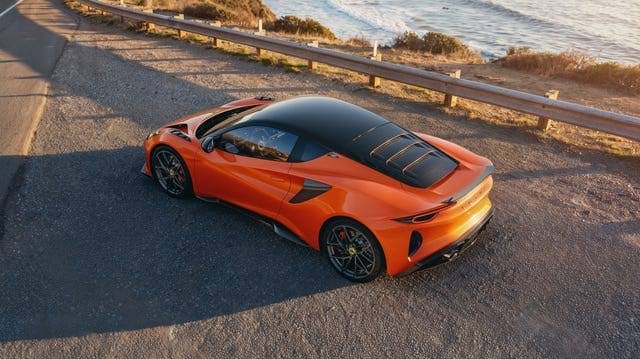
Unlike the Turbo, which comes only with an eight-speed dual-clutch automatic, the V6 SE offers a proper six-speed manual for drivers who want full mechanical engagement.
At roughly 3,200 pounds, the Emira weighs meaningfully less than every other car in this price bracket, a hallmark of Lotus engineering that shows up immediately in how the car changes direction.
Zero to 60 mph lands around 4.0 seconds, though the appeal here has always been cornering feel rather than straight-line bragging rights.
Lotus builds these cars in far smaller numbers than any other brand on this list, which means a smaller dealer network and longer waits for certain parts, a genuine trade-off for the exclusivity that comes with owning one.
How To Pick The Right Sports Car For Your Driving Style
Start with how you’ll actually use the car, not how you imagine using it. A weekend track car and a daily commuter demand very different priorities.
Buyers chasing pure driving feel with minimal complexity should look toward the Miata or Emira, both of which prioritize weight and balance over raw horsepower.
Those wanting maximum straight-line performance per dollar spent should focus on the Corvette Stingray, which delivers supercar acceleration at a fraction of supercar pricing.
Drivers who need year-round usability, including snow and rain, should consider the M4 Competition xDrive or a Carrera 4 variant, both of which add all-wheel drive.
Anyone chasing resale value and long-term collectibility should pay close attention to the GR Supra’s final-year status and the Emira’s position as Lotus’s last gas-powered car.
Below is a side-by-side comparison of pricing and core performance figures for all eight cars in this guide.
| Car | Starting Price | Powertrain | 0-60 MPH |
| Mazda MX-5 Miata | $30,430 | 2.0L I4, 181 HP | 6.4 sec |
| Nissan Z | $42,970 | Twin-Turbo 3.0L V6, 400 HP | 4.3 sec |
| Ford Mustang Dark Horse | $63,080 | 5.0L V8, 500 HP | 4.6 sec |
| Toyota GR Supra | $58,300 | Turbo 3.0L I6, 382 HP | 3.9 sec |
| BMW M4 Competition | $86,400 | Twin-Turbo 3.0L I6, 523 HP | 4.1 sec |
| Chevrolet Corvette Stingray | $71,995 | 6.2L V8, 490 HP | 2.9 sec |
| Porsche 911 Carrera | $129,950 | Twin-Turbo 3.0L Flat-6, 389 HP | 4.2 sec |
| Lotus Emira | $106,900 | Turbo 2.0L I4, 360 HP | 4.0 sec |
Budget alone shouldn’t decide this purchase. A Miata driven hard on a twisty road often delivers more genuine satisfaction than a faster car never pushed past half its potential.
Test drive on the roads you’ll actually use daily, not just a smooth dealership loop. A car that feels thrilling on glass-smooth pavement can turn punishing on the cracked, potholed streets many of us actually commute on.
A few quick questions worth answering before you buy:
Which of these sports cars is best for a daily commute?
The Nissan Z and BMW M4 Competition both ride comfortably enough for regular use, with usable trunk space and refined cabins. The Miata and Emira prioritize weight savings over ride comfort, so expect a firmer daily experience in exchange for sharper handling.
Is a manual transmission worth choosing over an automatic in 2026?
Modern automatics like Porsche’s PDK are objectively quicker at shifting than any human. A manual remains worth choosing for the physical engagement it adds, and cars with three pedals often hold their value better among enthusiast buyers down the road.
Do naturally aspirated engines still matter next to turbocharged ones?
Turbocharged engines deliver more power with better fuel economy and stronger low-end torque. Naturally aspirated engines like the Corvette’s V8 and Miata’s four-cylinder reward higher revs with sharper throttle response and a more distinct exhaust note that many drivers still prefer.
How much more does insurance typically cost for a sports car?
Sports cars generally cost 20 to 40 percent more to insure than a comparable sedan, with high-horsepower models like the M4 Competition and 911 landing at the upper end of that range. Getting a quote before purchase avoids an unpleasant surprise after signing.
Which car on this list holds its value best over time?
The Porsche 911 has the strongest resale reputation in this group by a wide margin, often retaining a higher percentage of its original price than any other car here, partly thanks to decades of consistent demand and a huge network of specialists. The GR Supra’s final-year status and the Emira’s status as the last combustion Lotus could both support stronger long-term values too, since limited production runs tend to attract collector interest once a nameplate ends.
Should I buy new or consider a slightly used model instead?
A one- or two-year-old example of most cars on this list offers significant savings with minimal mileage, since first-year depreciation tends to hit hardest. The main exception is limited-production or final-edition trims, which sometimes appreciate instead of depreciating, so check recent sale prices before assuming a used example will automatically cost less than ordering new.