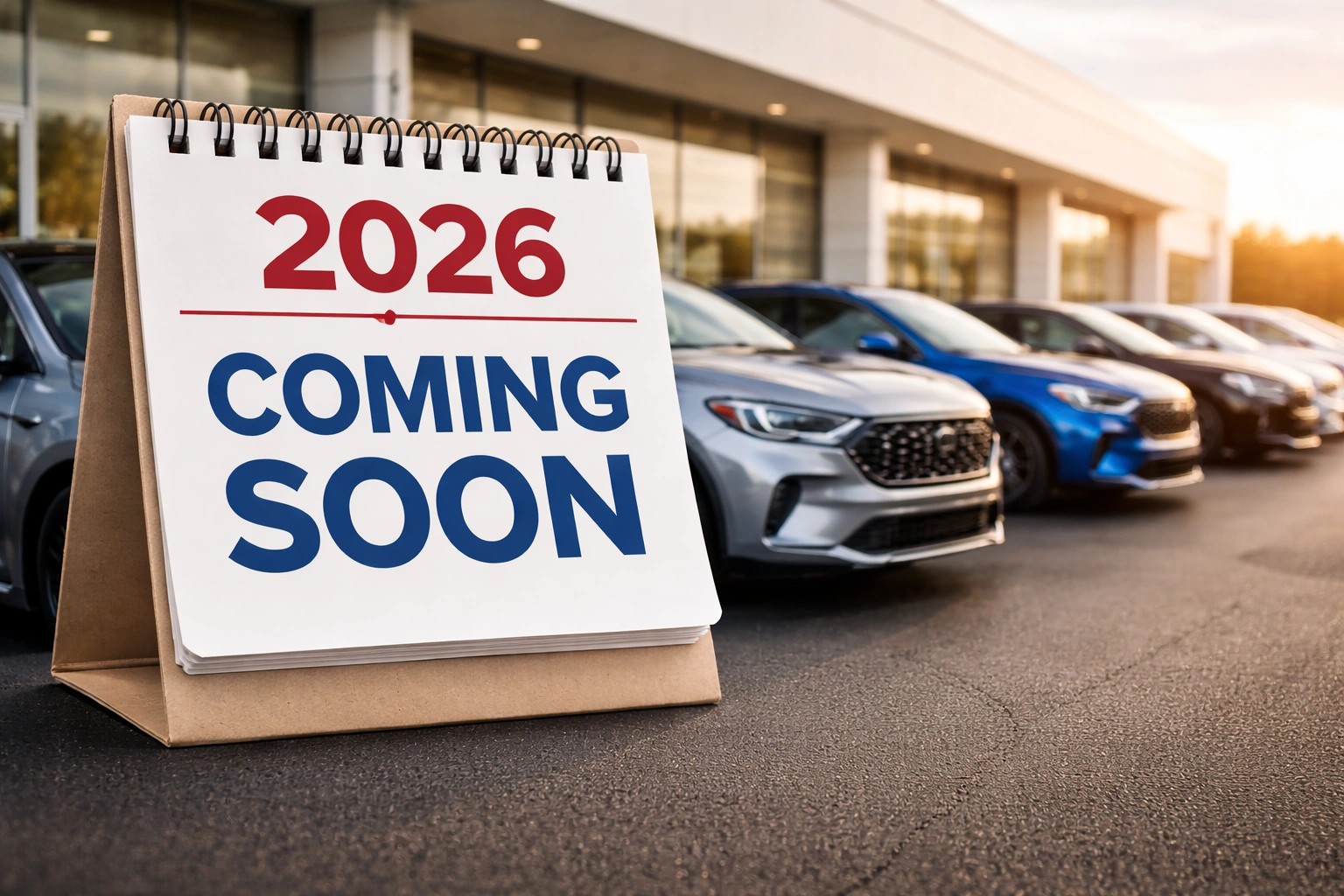
If you’re serious about buying a new vehicle, understanding when 2026 cars come out isn’t just helpful—it’s a strategic advantage.
Most buyers think new models arrive in January. That assumption alone can cost you money, limit your options, or make you miss better deals entirely.
In reality, automakers like Ford, Toyota, Honda, Chevrolet, and Tesla operate on a forward model-year system, where 2026 cars begin launching in 2025—often as early as mid-summer.
Not all 2026 cars arrive at the same time. Release timing is influenced by:
- Production cycles and factory scheduling
- Profit margins (SUVs and trucks get priority)
- Redesign vs carryover models
- Supply chain stability
- Competitive pressure between brands
That means two vehicles from the same brand can launch months apart, even within the same model year.
This blog breaks down the real automotive release strategy, not just generic timelines. You’ll learn how manufacturers think, how release timing actually works behind the scenes, and how to use that knowledge to buy smarter than the average buyer.
When Do 2026 Cars Come Out? (Precise Industry Answer)
Most 2026 model year vehicles will follow this timeline:
- July – August 2025: Early production and soft launches
- September – October 2025: Primary release window (majority of vehicles)
- November – December 2025: Secondary rollout (performance & niche models)
- January – March 2026: Delayed launches and EV releases
👉 Industry Reality:
Roughly 75–85% of 2026 cars are on sale by October 2025.
The Real Reason Cars Launch Before The Model Year (Deep Industry Breakdown)
1. Production Economics Drives Everything
Automakers don’t think in calendar years—they think in production efficiency.
Factories operate continuously. Shutting down production to wait for January would:
- Increase costs
- Disrupt supply chains
- Reduce annual output
Instead, manufacturers roll into the next model year seamlessly.
👉 This is why a “2026” car is often built in mid-2025.
2. High-Margin Vehicles Get Priority Release Timing
Not all cars are equal in the eyes of automakers.
SUVs and trucks generate the highest profit margins, so they are prioritized in:
- Production scheduling
- Chip allocation (in shortage scenarios)
- Early release windows
That’s why you’ll often see:
- New SUVs launching in August
- Sedans arriving later
- Some low-demand models delayed
3. Redesign Cycles Strongly Influence Release Timing
One of the most overlooked factors is the product lifecycle.
Every vehicle follows a cycle:
- Full redesign (every 5–7 years)
- Mid-cycle refresh (after 2–3 years)
- Carryover models (minimal changes)
How This Affects 2026 Releases:
- Full redesigns → Usually delayed (more testing required)
- Refresh models → Often released early
- Carryover models → Earliest to launch
👉 This is why some 2026 cars arrive in July, while others don’t show up until early 2026.
Month-By-Month 2026 Release Timeline (Expert-Level Breakdown)
July – August 2025 (Strategic Early Launch Window)
This phase is not random—it’s highly calculated.
Automakers release:
- High-volume models
- Fleet-focused vehicles
- Low-risk carryover models
Why early?
- Capture early buyers
- Reduce pressure on fall launches
- Start revenue flow early
Buyer Insight:
- You’ll pay full MSRP or higher
- Limited inventory and configurations
- Best for buyers who prioritize early access over price
September – October 2025 (Primary Industry Launch Window)
This is where the market fully activates.
Most 2026 vehicles arrive during this period because:
- Dealerships prepare for year-end sales
- Inventory pipelines stabilize
- Marketing campaigns peak
What actually happens here:
- Full trim availability
- Dealer allocations increase
- Comparison shopping becomes easier
👉 This is the most important window in the entire buying cycle.
November – December 2025 (Profit Optimization Phase)
Now the strategy shifts.
Manufacturers begin:
- Adjusting pricing strategies
- Introducing incentives selectively
- Clearing remaining previous-year inventory
Late releases during this phase often include:
- Performance variants
- Premium trims
- Lower-volume models
Buyer Advantage:
- First real discounts appear
- Dealers become more flexible
January – March 2026 (Irregular & Delayed Releases)
This phase is driven by disruption—not planning.
Vehicles launching here are often:
- Delayed due to supply chain issues
- Completely redesigned platforms
- Electric vehicles with software dependencies
Important Insight:
EVs (especially from Tesla) don’t follow traditional cycles because they depend heavily on:
- Software readiness
- Battery supply
- Production scaling
Why EVs Break The Traditional Release Cycle
Electric vehicles deserve special attention because they don’t follow normal patterns.
Unlike traditional automakers, Tesla operates without strict model-year transitions.
Instead, updates happen:
- Continuously
- Through software
- Mid-production cycle
👉 This is why asking “when does a Tesla model year release?” often doesn’t have a clear answer.
For 2026:
- Expect staggered EV launches
- More unpredictability
- Feature updates outside traditional timelines
Release Timing By Vehicle Category (Strategic Differences)
SUVs & Crossovers (Earliest Releases)
Why early?
- Highest demand
- Highest profit margins
- Competitive pressure
👉 Expect most 2026 SUVs between August and October 2025
Pickup Trucks (Delayed But Strategic)
Trucks are complex and high-value products.
They often launch later because:
- Production complexity is higher
- Demand is stable year-round
- Buyers are less price-sensitive
👉 Most 2026 trucks arrive October – December 2025
Sedans (Lower Priority Segment)
Sedans are no longer the industry focus.
This results in:
- Later release timing
- Less aggressive launch strategy
👉 Most arrive September – November 2025
Best Time To Buy A 2026 Car (Based On Strategy, Not Guesswork)
Phase 1: Early Buyer (Aug – Oct 2025)
Best for:
- Getting exact configuration
- Access to new tech
- Avoiding waitlists
Trade-off:
You pay the highest price.
Phase 2: Strategic Buyer (Nov – Dec 2025)
Best for:
- Balanced pricing + availability
- Early discounts
- Negotiation leverage
👉 This is the optimal window for most buyers.
Phase 3: Value Buyer (Jan – Feb 2026)
Best for:
- Maximum discounts
- Incentives and dealer pressure
Risk:
- Limited inventory
- Fewer choices
Advanced Buyer Strategy (What Most People Miss)
Strategy 1: Track Redesign Announcements
If a car is getting redesigned:
- Wait → better long-term value
If it’s a carryover model:
- Buy discounted older version
Strategy 2: Use Release Timing Against Dealers
Dealers behave differently at different times:
- Launch phase → confident, firm pricing
- End of year → aggressive, flexible
Strategy 3: Watch Inventory, Not Just Dates
Release doesn’t equal availability.
A car may be “launched” but:
- Not widely available
- Limited trims
- Long wait times
Common Mistakes That Cost Buyers Money
Buying In The First 2 Weeks Of Release
This is when pricing is at its peak and negotiation is weakest.
Waiting Too Long For Discounts
You may save money—but lose the exact model you wanted.
Ignoring Model Lifecycle
Buying right before a redesign can hurt resale value significantly.
Conclusion
Understanding when 2026 cars come out is more than just knowing dates—it’s about understanding how the automotive industry actually operates.
Most 2026 vehicles will arrive between July and October 2025, with the majority hitting dealerships by fall. However, the smartest buyers don’t just track release dates—they understand timing strategy.
- Buy early → best selection
- Buy later → better pricing
- Buy smart → balance both
If you approach the market with this knowledge, you won’t just buy a car—you’ll make a strategic purchase decision.