Ford’s diesel engineers made a genuinely deliberate choice back in 2011 that most Super Duty owners never think twice about. When the company finally designed its own diesel V8 in-house, ending a decade-plus partnership with an outside supplier, they switched that engine’s firing order to match Ford’s traditional gasoline V8 pattern instead of carrying the old sequence forward.
That single decision splits this truck’s entire diesel history into two distinct eras, separate from the gasoline V8 and V10 story running alongside it. Few heavy-duty trucks offer this much genuine engineering variety across one badge and one production run.
Every gas and diesel engine the F-250 has offered since the Super Duty name first arrived, along with the exact reason that firing order changed partway through, gets covered here in complete detail.
Why Super Duty Trucks Tell A Different Story
Heavy-duty trucks built for genuine towing and commercial work rarely stick with one simple engine story. The F-250 makes that especially clear once gas and diesel history get compared side by side.
What Firing Order Actually Controls Inside An Engine
Every cylinder fires at a specific point in crankshaft rotation rather than simple numerical order. A V8 fires every 90 degrees of rotation, while the rare V10 option packs a firing event into every 72 degrees, spacing power strokes evenly to keep vibration low under heavy load.
That even spacing matters enormously on a work truck regularly hauling near its rated capacity. Getting this sequence wrong, whether through a genuine mechanical fault or a wiring mistake on an older engine, produces rough running and accelerated wear precisely when reliability matters most.
Every Super Duty engine covered here uses coil-based ignition rather than a distributor and plug wires, with the engine computer firing each coil individually based on sensor data.
Firing order still matters enormously for hands-on repair work, since a stored misfire code always points to a specific physical cylinder.
Diagnostic trouble codes follow the same predictable pattern regardless of engine type. P0301 identifies cylinder one, P0302 identifies cylinder two, continuing through the highest cylinder count present, always referring to physical position rather than firing sequence.
Gas And Diesel Power Under One Badge
Ford introduced the Super Duty name for the 1999 model year, immediately offering buyers a genuine choice between gasoline V8, gasoline V10, and diesel V8 power within the same body style.
That three-way split continued in some form across every generation since, a level of powertrain variety few competing heavy-duty trucks matched consistently.
Diesel engines in particular carry a genuinely layered story. Ford sourced its Power Stroke diesel from International Navistar for over a decade before bringing development fully in-house starting with the 2011 model year, a transition that changed far more than just which company’s name appeared on the valve cover.
Sorting out which firing order applies to a specific F-250 starts with confirming fuel type first, then narrowing down the exact displacement and model year.
Gas and diesel engines from this truck’s history never share a firing order with each other, making that first distinction the most important one to get right.
These same engines rarely stayed exclusive to the F-250 either. The 6.0-liter and later 6.7-liter Power Stroke, along with the 6.8-liter V10, also powered the Ford Excursion and various E-Series vans built during overlapping years, meaning firing order knowledge gained from any of these siblings transfers directly to a Super Duty pickup sharing the same engine code.
Gas Engine Firing Order From The 5.4L V8 To The Modern 7.3L Godzilla
Three distinct gasoline engine eras served F-250 buyers across this truck’s history, each replacing the last as emissions requirements and market demands shifted. All of them ultimately trace back to the same fundamental Ford V8 firing philosophy.
The 5.4L V8 And The Unique 6.8L V10
A 5.4-liter Triton V8 served as the standard gasoline engine when the Super Duty launched, sharing its fundamental Modular architecture with the same engine found in F-150 trucks of that era.
Its firing order runs 1-3-7-2-6-5-4-8, with cylinders one through four on the passenger side and five through eight on the driver’s side.
Ford introduced a genuinely distinctive 6.8-liter V10 in 2005, built on that same Modular architecture but stretched to ten cylinders, positioned as an alternative to Dodge’s headline-grabbing V10 option of the same era.
Its firing order runs 1-6-5-10-2-7-3-8-4-9, a genuinely unique sequence reflecting its unusual cylinder count, with cylinders one through five on the passenger side and six through ten on the driver’s side.
This V10 replaced Ford’s long-running 7.5-liter big-block V8, giving buyers who wanted gas power without the diesel premium a genuinely capable towing option. Both the 5.4-liter V8 and 6.8-liter V10 remained available side by side through the end of the second-generation Super Duty in 2010.
Fuel economy never favored the V10 relative to either the smaller V8 or the diesel options sharing its showroom floor, a tradeoff that eventually limited its long-term popularity despite genuinely strong low-end torque delivery.
Its rarity today makes accurate firing order information particularly valuable, since fewer shops encounter this specific ten-cylinder layout regularly enough to have it memorized.
Boss And Godzilla: The Modern Gas Lineup
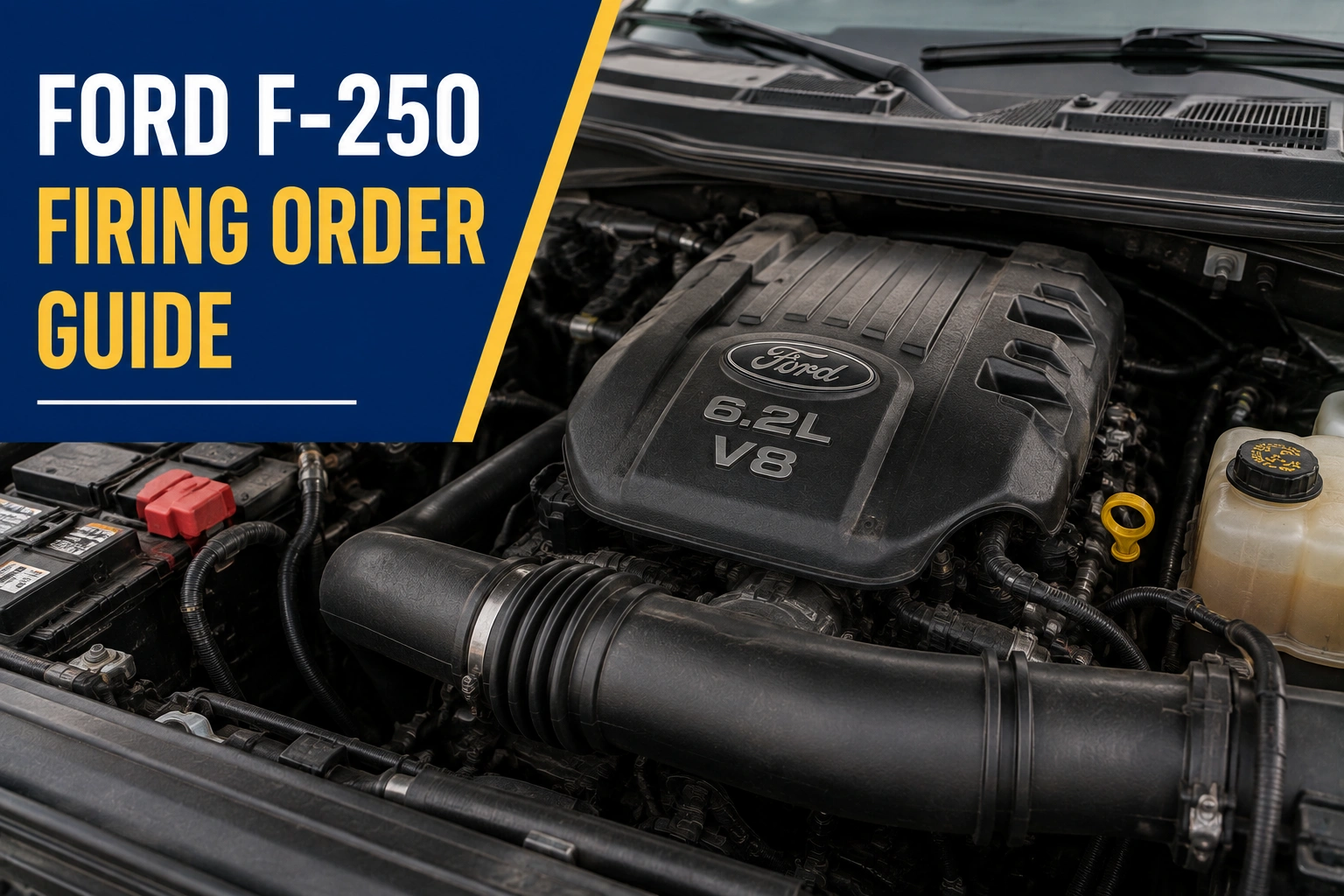
Ford replaced both the 5.4-liter V8 and 6.8-liter V10 with an all-new 6.2-liter Boss V8 starting with the third-generation redesign for 2011, simplifying the gasoline lineup down to one engine choice.
This design kept Ford’s established gasoline V8 firing order tradition intact, continuing the same 1-3-7-2-6-5-4-8 sequence used by the outgoing 5.4-liter.
A genuinely new 7.3-liter V8, nicknamed Godzilla internally, arrived for 2020 as the modern gasoline option, deliberately built with a traditional pushrod design rather than following the overhead-cam approach of recent decades.
This engine also maintains the same 1-3-7-2-6-5-4-8 firing order established across Ford’s gasoline V8 lineup for generations.
That consistency across the Boss and Godzilla engines, despite genuinely different internal architecture, reflects Ford’s broader pattern of preserving firing order logic within each cylinder-count family regardless of how much else changes under the surface.
A technician comfortable with an early 2000s 5.4-liter can apply identical cylinder logic to a brand-new Godzilla-powered truck.
Here’s how the gasoline lineup compares across every generation:
| Engine | Model Years | Type | Firing Order |
| 5.4L Triton V8 | 1999-2010 | Standard | 1-3-7-2-6-5-4-8 |
| 6.8L Triton V10 | 2005-2010 | Upgrade | 1-6-5-10-2-7-3-8-4-9 |
| 6.2L Boss V8 | 2011-2019 | Standard | 1-3-7-2-6-5-4-8 |
| 7.3L Godzilla V8 | 2020-present | Standard | 1-3-7-2-6-5-4-8 |
Power Stroke Diesel Firing Order And A Genuine Mid-Story Change
Diesel power defines the Super Duty’s reputation more than any other single detail, and its firing order story genuinely changed partway through this truck’s history. Tracing that change means looking at who actually designed each engine generation.
The Navistar-Built 7.3L, 6.0L, And 6.4L Sequence
International Navistar built every Power Stroke diesel offered in the F-250 from the Super Duty’s 1999 launch through the end of the second generation in 2010, spanning three genuinely different displacements. The 7.3-liter served through 2003, the 6.0-liter took over from 2003 through 2007, and the 6.4-liter closed out this era from 2008 through 2010.
All three share an identical 1-2-7-3-4-5-6-8 firing order, a sequence Navistar carried consistently across its own diesel engine rather than adopting Ford’s gasoline V8 convention.
Cylinder numbering follows an alternating pattern between banks, with cylinders one, three, five, and seven on the passenger side and two, four, six, and eight on the driver’s side.
That alternating layout differs from the sequential grouping found on Ford’s own gasoline V8 and V10 engines, a distinction worth remembering before assuming diesel and gas engines share identical cylinder logic simply because both are V8s.
The 6.0-liter in particular developed a well-documented reputation for reliability concerns, though none of those issues trace back to firing order or cylinder sequencing in any way.
Owners of any Navistar-built Power Stroke benefit from confirming this specific engine’s firing order before starting ignition-adjacent repair work, since assuming the newer Ford-designed sequence covered next would point straight at the wrong cylinder.
Why The 6.7L Switched To A Different Pattern Entirely
Ford ended its partnership with Navistar and designed its own diesel V8 entirely in-house for the first time, introducing the 6.7-liter Power Stroke for the 2011 model year in partnership with Austrian engineering firm AVL.
This genuinely significant shift gave Ford complete control over diesel architecture rather than relying on an outside supplier’s design philosophy.
Its firing order runs 1-3-7-2-6-5-4-8, matching Ford’s traditional gasoline V8 sequence rather than continuing the Navistar-era diesel pattern. This wasn’t a coincidental convergence; it reflects Ford’s own engineering team applying the same combustion logic they had already refined across decades of gasoline V8 production to their first fully in-house diesel design.
This 6.7-liter has remained the sole diesel option through every Super Duty generation since, including a high-output version introduced for heavier-duty applications, both sharing the identical firing order and cylinder layout.
That consistency simplifies diesel research considerably for anyone working on a 2011 or newer F-250, since generation and minor updates don’t affect the underlying sequence at all.
Anyone comparing an older Navistar-built diesel against a current 6.7-liter should treat them as genuinely separate research questions, despite both being Power Stroke-badged V8 diesels sharing considerable visual similarity under the hood.
Here’s how the complete diesel lineup compares:
| Engine | Model Years | Built By | Firing Order |
| 7.3L Power Stroke | 1999-2003 | Navistar | 1-2-7-3-4-5-6-8 |
| 6.0L Power Stroke | 2003-2007 | Navistar | 1-2-7-3-4-5-6-8 |
| 6.4L Power Stroke | 2008-2010 | Navistar | 1-2-7-3-4-5-6-8 |
| 6.7L Power Stroke | 2011-present | Ford | 1-3-7-2-6-5-4-8 |
Practical Diagnosis And Where The F-250 Stands Today
None of this technical and historical detail matters much until a check engine light appears or an engine starts running rough under load. Firing order and cylinder position knowledge turns that vague warning into a specific, targeted repair.
The current Super Duty lineup continues strong into 2027, offering both the 7.3-liter Godzilla gasoline V8 and the 6.7-liter Power Stroke diesel across F-250 through F-450 trims, with no indication of either engine facing discontinuation.
Ford has continued refining both engines incrementally rather than replacing them outright, with the diesel gaining periodic output increases and the gasoline V8 remaining a genuinely popular choice among buyers prioritizing lower upfront cost and simpler long-term maintenance over the diesel’s superior towing figures.
Neither refinement path has touched the firing order established for each engine since their respective introductions.
Matching A Misfire Code To The Right Engine
A scan tool reading a P0301 through P0310 code identifies a misfiring cylinder by its physical position, never by where that cylinder falls within the firing sequence itself.
Confirming fuel type and exact engine displacement comes first, since gas and diesel engines never share firing order on this truck regardless of how similar their cylinder counts might look on paper.
Once that’s settled, matching the engine against the correct chart from earlier sections points straight to the affected coil, injector, or glow plug. Swapping a suspect ignition coil with a known-good unit from another cylinder works reliably on gasoline engines, though this trick doesn’t apply to the compression-ignited diesel options.
Diesel misfires almost always trace back to fuel delivery, injector condition, or glow plug function rather than anything resembling spark-based ignition trouble.
A persistent rough-running diesel rarely benefits from chasing firing order questions once the correct cylinder has been identified through proper fuel system diagnostics instead.
A VIN decode or build sheet remains the fastest way to confirm both fuel type and exact engine code on a specific Super Duty, particularly valuable for anyone shopping a used truck from the 2008 through 2010 window when the outgoing Navistar diesel, the new gasoline lineup, and the final V10 applications all briefly overlapped. Most auto parts stores can pull this information within minutes at no charge.
Maintenance Habits That Matter Most By Engine Type
Spark plugs and coils on the modern gasoline lineup typically last well beyond 60,000 miles under normal conditions, while older Navistar-era diesel engines benefit from particularly close attention to injector and glow plug condition given their now-considerable age.
Replacing worn components proactively before symptoms appear costs considerably less than diagnosing a mystery misfire during a heavy towing trip.
The well-documented reliability concerns tied to the 6.0-liter Power Stroke specifically warrant extra caution for anyone shopping a used example from that era, though none of those documented issues involve firing order confusion.
Cooling system health, EGR function, and head gasket condition deserve far more attention on that particular engine than cylinder sequencing ever would.
Keeping the exact engine code, not just fuel type or generation, documented in any service record prevents the most relevant mistake given this truck’s layered history: assuming a diesel Super Duty’s firing order without confirming whether it predates or postdates Ford’s 2011 shift to in-house diesel design.
A quick reference for common symptoms across this lineup:
| Symptom | Likely Cause | Applies To |
| Rough idle, specific cylinder code | Failing coil, plug, or injector | Gasoline engines |
| Rough running under load, no spark fault | Injector or fuel delivery issue | All Power Stroke diesels |
| Hard starting, white smoke | Glow plug or injector wear | Older diesel, especially 6.0L |
| Confusing cylinder-numbering mismatch | Gas versus diesel bank convention | Cross-referencing engine types |
Frequently Asked Questions
What is the firing order of a Ford F-250 6.7 Power Stroke diesel?
The Ford-designed 6.7-liter fires in a 1-3-7-2-6-5-4-8 sequence, matching Ford’s traditional gasoline V8 pattern rather than the earlier Navistar-built diesel firing order.
What is the firing order of the older 7.3 or 6.0 Power Stroke?
Both Navistar-built engines fire in a 1-2-7-3-4-5-6-8 sequence, genuinely different from the Ford-designed 6.7-liter that eventually replaced them.
Why did the diesel firing order change with the 6.7L Power Stroke?
Ford brought diesel engineering fully in-house for the first time with this engine, and its own design team applied the same firing order already used across Ford’s gasoline V8 lineup instead of continuing Navistar’s convention.
What is the firing order of the 6.8 V10 gas engine?
The V10 fires in a 1-6-5-10-2-7-3-8-4-9 sequence, a genuinely unique pattern reflecting its ten-cylinder configuration and not shared by any V8 in this lineup.
Does the modern 7.3 Godzilla gas engine use the same firing order as older gas V8s?
Yes, the Godzilla maintains the same 1-3-7-2-6-5-4-8 sequence used by the original 5.4-liter Triton and the 6.2-liter Boss that came between them.
Where can I confirm the exact firing order for my specific F-250?
A factory service manual matched to the exact model year, fuel type, and engine code remains the most reliable source, and most parts stores can pull this free with a VIN.
Nearly three decades of Super Duty production still resolve into a short, dependable list once fuel type and exact engine get confirmed. Every gas V8 fires 1-3-7-2-6-5-4-8, the V10 fires 1-6-5-10-2-7-3-8-4-9, older Navistar diesels fire 1-2-7-3-4-5-6-8, and the modern Ford-built 6.7-liter fires 1-3-7-2-6-5-4-8.
Confirming fuel type first, then the exact engine code, remains the only real starting point for applying any of this information correctly on a truck built around genuine powertrain variety. That single habit, more than knowing generation or model year alone, separates an accurate five-minute diagnosis from an afternoon spent chasing the wrong cylinder entirely.