Few vehicles on American roads carry as much engine history under one nameplate as the Chevrolet Express. A van built in 2001 and one built in 2025 might look nearly identical from the outside.
Yet they could be running completely different engine architectures with completely different firing sequences. Four separate engine families passed through this van’s engine bay across its production run.
An old-school small block, a modernized small and big block combination, a distinctive V6, and two generations of Duramax diesel power all took a turn. Each one fires its cylinders differently.
Fleet managers, mobile mechanics, and DIY owners searching for a single answer often get frustrated fast. The correct firing order depends entirely on which engine sits under a specific van’s hood, and every sequence gets sorted out here.
Firing Order Fundamentals For A Van With This Much Engine History
Firing order describes the exact sequence in which an engine ignites fuel inside each cylinder. That sequence gets engineered around crankshaft geometry, not picked at random.
The Express makes an unusually good case study for this topic. Few commercial vans still in production trace their roots back nearly three decades while cycling through so many distinct engine designs.
What Firing Order Really Means For The Express Lineup
Every cylinder in an engine fires at a specific point in crankshaft rotation. A V6 completes one firing event every 120 degrees, while a V8 fires every 90 degrees.
Engineers space these events out deliberately. Even spacing keeps vibration low and spreads mechanical stress evenly across bearings, mounts, and the crankshaft itself.
On any Express built after the late 1990s, a computer-controlled ignition system executes this sequence rather than a mechanical distributor. Sensors track crankshaft and camshaft position constantly, feeding that data to the engine control module.
Firing order still carries real weight for anyone doing hands-on work. It tells a technician exactly where cylinder three physically sits, which becomes critical the moment a misfire code points to a specific number.
Commercial fleets in particular benefit from knowing this cold. A van down for diagnosis costs real money, and guessing at cylinder location wastes time that a quick reference sheet would save instantly.
Why This Van Went Through More Engines Than Most GM Vehicles
Most vehicles keep one core engine family for an entire generation. The Express instead saw a major powertrain overhaul in 2003, another wave of updates in 2006 and 2008, a diesel downsize around 2016, and a fresh V8 as recently as 2021.
Longevity explains most of this. Since the Express and its GMC Savana twin have stayed on the same basic GMT600 chassis since 1996, GM kept swapping in whatever engine technology made sense at the time rather than redesigning the whole platform.
That approach kept the van relevant for fleet buyers who valued proven mechanicals over flashy updates. It also means a used Express shopping list spans everything from a distributor-equipped V6 to a modern direct-injected engine shared with heavy-duty Silverado trucks.
Anyone servicing one of these vans regularly benefits from treating each model year range as its own small research project. Assuming a 2004 and a 2019 Express share identical specs leads to wasted parts orders and wrong repair manuals.
Gasoline V8 Firing Order From The Small Block Era To Today
Three distinct V8 firing patterns have powered gas-engine Express vans since 2000. Two of them share the same sequence despite coming from entirely different engine families.
Sorting these out by era makes the whole picture much easier to follow than jumping straight into engine codes.
Early Firing Order Before The 2003 Redesign
Express vans built for the 2000 through 2002 model years relied on older, distributor-equipped V8 engines carried over from the previous G-van generation. The 5.0-liter, 5.7-liter, and 7.4-liter big block all used an identical 1-8-4-3-6-5-7-2 firing order.
This sequence traces back decades, since it’s the same pattern Chevrolet used on small block V8s dating to the 1950s and big blocks used in heavy-duty trucks for just as long. Cylinder one sits at the front of the driver’s side bank, with the pattern continuing rearward and alternating banks.
A mechanical distributor handled ignition timing on these engines, rotating clockwise to send spark to each cylinder in sequence. Getting a plug wire out of order on one of these vans caused an immediate, obvious rough-running problem.
These older engines have grown increasingly rare on the road today given their age. Anyone still running one benefits from keeping a written reference nearby, since aftermarket parts counters see far fewer questions about this generation than the ones that followed.
The Modern Small Block And Big Block Pattern From 2003 Onward
Everything changed with the 2003 model year update. Chevrolet introduced Generation III small block V8s, based on the same LS architecture found in the Corvette, across the 4.8-liter and 6.0-liter Express engines, with the 5.3-liter joining shortly after for lighter-duty vans.
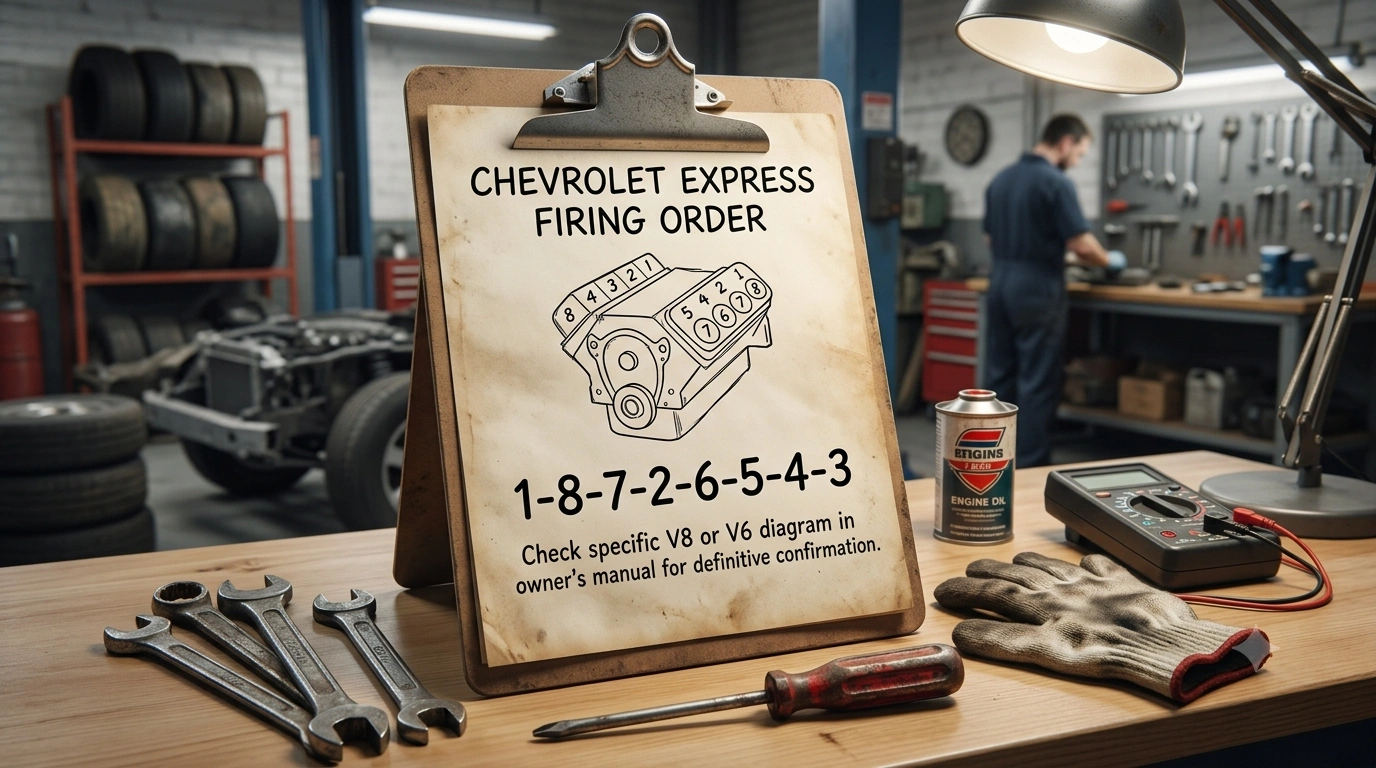
All three switched to a firing order of 1-8-7-2-6-5-4-3, a deliberate departure from the older 1-8-4-3-6-5-7-2 pattern. GM’s engineers swapped the firing position of two cylinder pairs specifically to reduce torsional stress on the crankshaft at higher RPM.
The 8.1-liter big block V8, offered on heavy-duty cutaway chassis through roughly 2009, adopted this same modern firing order despite being a completely different engine architecture. That’s a detail worth noting, since big block and small block engines rarely share identical specifications otherwise.
Distributorless ignition arrived alongside this update, with an individual coil serving each cylinder. This shift toward electronic control replaced any need to physically route plug wires in the correct sequence.
That 1-8-7-2-6-5-4-3 pattern carried forward for two full decades. The 6.6-liter L8T V8 introduced for 2021, replacing the outgoing 6.0-liter, kept the identical firing order despite being a newer engine design shared with heavy-duty Silverado and Sierra trucks.
Here’s how the gas V8 lineup breaks down across the full production run:
| Engine | Approximate Years | Displacement | Firing Order |
| Old Small Block / Big Block | 2000-2002 | 5.0L, 5.7L, 7.4L | 1-8-4-3-6-5-7-2 |
| Gen III/IV Small Block | 2003-2020 | 4.8L, 5.3L, 6.0L | 1-8-7-2-6-5-4-3 |
| Vortec Big Block | 2001-2009 | 8.1L | 1-8-7-2-6-5-4-3 |
| L8T Small Block | 2021-2026 | 6.6L | 1-8-7-2-6-5-4-3 |
V6 Firing Order Across Two Completely Different Engine Designs
Two entirely different 4.3-liter V6 engines have served as the Express’s entry-level gas option, separated by a multi-year gap. Both share one surprising trait in common.
That shared trait makes this section shorter than it might otherwise be, but the story behind it is worth exploring fully.
How Body Style Changes Access, Not Firing Order
Cargo vans, passenger vans, and cutaway chassis versions all share the same underlying engine choices within a given model year. A firing order confirmed for a 5.3-liter cargo van applies identically to a 5.3-liter cutaway chassis running an ambulance box or a passenger van shuttle body.
What changes between body styles is physical access, not the sequence itself. A cutaway chassis stripped down to just a cab and frame rail often provides easier engine bay access than a fully outfitted cargo van packed with shelving and partition walls.
Ambulance and shuttle bus builders working from Express cutaway chassis rarely touch engine internals directly, since that work typically happens before the upfit body goes on. Once a specialty body gets installed, later ignition or spark plug work sometimes requires removing panels never intended for casual access.
Fleet technicians servicing a mixed lineup of body styles benefit from remembering this distinction. The engine code, not the body configuration, determines which firing order chart to reach for.
The Original Vortec 4300 Firing Order
The original Vortec 4300 V6 served Express vans from the 2000 model year through 2014, when GM discontinued it alongside the light-duty 1500 series. This engine is essentially a small block V8 with two cylinders removed, a design approach GM has used since the mid-1980s.
Its firing order runs 1-6-5-4-3-2, confirmed across factory documentation and independent GM powertrain specification sheets alike. Cylinder one sits at the front of the driver’s side bank, with cylinders one, three, and five running front to rear on that side.
Cylinders two, four, and six occupy the passenger-side bank in the same front-to-rear order. This layout mirrors the small block V8 bank convention, which makes sense given the 4.3-liter’s direct lineage from that architecture.
Earlier Vortec 4300 versions used a traditional distributor, while later units transitioned to distributorless coil packs. Either way, the underlying firing sequence never changed across the engine’s entire fifteen-plus year run in this van.
How The EcoTec3 4.3L Kept The Same Sequence
Cadillac and Chevrolet passenger cars had already moved to the Gen V small block architecture by the time GM brought a 4.3-liter V6 back to the Express lineup for 2018. This new EcoTec3 4.3L, coded LV3, shares its core design with the direct-injected V8s used in modern Silverado trucks.
Despite an all-aluminum block, direct injection, and Active Fuel Management capable of running on fewer cylinders under light load, this new engine kept the exact same 1-6-5-4-3-2 firing order as its cast-iron predecessor. That continuity wasn’t guaranteed given how much else changed internally.
Output improved meaningfully over the outgoing engine, and fuel economy gained ground too. None of those improvements required touching the fundamental combustion sequence that had worked reliably for decades already.
This engine remains the standard entry-level option through the current 2026 model year. A technician pulling a firing order reference for either version of the 4.3-liter V6 can use the identical sequence regardless of which generation sits under the hood.
Diesel Firing Order For Every Duramax-Powered Express Van
Diesel power has appeared in two distinct forms across the Express lineup, and both differ substantially from anything covered so far. Neither shares a firing order with the gasoline engines in this same van.
Fleet buyers hauling heavy loads or covering long routes gravitated toward these options specifically for their torque advantage over gas power.
A now-rare 6.5-liter turbodiesel V8 briefly carried the diesel torch during the 2000 and 2001 model years, before Chevrolet dropped diesel power entirely until the Duramax arrived in 2006. Surviving examples are scarce enough today that a factory manual specific to that exact model year remains the most dependable source for anyone still running one.
6.6L Duramax V8 Firing Order And Its Reversed Cylinder Banks
The 6.6-liter Duramax V8 joined the Express lineup for 2006, using a detuned version of the diesel already serving GM’s medium-duty Kodiak and TopKick trucks. Several revisions followed over the next decade, including the LBZ, LMM, and LML variants, each addressing emissions requirements and durability improvements.
Every version shares an identical 1-2-7-8-4-5-6-3 firing order. This sequence differs completely from the 1-8-7-2-6-5-4-3 pattern used by the gas V8s sitting in the very same engine bay location on other trims.
Cylinder bank placement flips too, and this catches plenty of owners off guard. Cylinder one sits on the passenger side for the Duramax, with cylinders three, five, and seven following on that same bank, while the driver’s side houses the even-numbered cylinders instead.
That’s the exact opposite arrangement from every gas V8 covered so far. Someone comfortable finding cylinder one on a 5.3-liter gas engine needs to look at the opposite side of the engine bay entirely once a Duramax is involved.
Performance-minded diesel builders occasionally swap in an alternate firing camshaft that changes this sequence to 1-5-6-3-4-2-7-8, aimed at reducing stress on a known weak point near the crankshaft snout. Factory-stock commercial vans have no reason to touch this, but it explains why the topic generates so much discussion in diesel performance circles.
2.8L Duramax Four-Cylinder Firing Order
GM replaced the 6.6-liter Duramax V8 with a much smaller 2.8-liter Duramax inline-four for the 2017 model year, shared with the Chevrolet Colorado and GMC Canyon midsize trucks. This marked the first four-cylinder engine offered in a full-size Chevrolet van in decades.
Its firing order is 1-3-2-4, which surprises people expecting the same sequence used by most gasoline four-cylinders. A typical gas inline-four, including the turbocharged engines found in other GM products, commonly fires 1-3-4-2 instead, just two positions swapped from the diesel pattern.
Cylinder numbering stays simple regardless, running front to back in a single row from one to four. The turbocharger and high-pressure common-rail injection system add complexity elsewhere in the engine, but locating a specific cylinder remains straightforward.
GM discontinued this diesel option for the Express after the 2023 model year, leaving the lineup gas-only through 2026. Vans built during its roughly six-year run remain the only Express variants using this particular firing sequence.
Using This Information For Real Maintenance And Diagnosis
None of these firing order sequences matter much until a check engine light appears or a specific cylinder starts misbehaving. This is where the research actually pays off.
The next two sections turn all of this history into something directly usable in a shop or driveway.
Matching A Misfire Code To The Right Engine Family
A scan tool reading a P0301 through P0308 code identifies a misfiring cylinder by its physical position, not by where it falls in the firing sequence. Confirming which engine family sits under the hood comes first, since the same cylinder number sits in a different physical spot depending on the answer.
The engine code stamped on a build sheet or visible on the engine block itself settles this quickly. A quick VIN decode through any parts store also confirms displacement and engine family in under a minute.
Once the engine family is confirmed, matching it against the correct bank layout points straight to the affected coil, injector, or glow plug. Swapping a suspect coil or injector with a known-good unit from another cylinder remains a reliable confirmation test across gas and diesel engines alike.
Fleet vehicles benefit enormously from keeping a laminated reference card in the glovebox or shop binder specific to each van’s engine code. That small habit saves real diagnostic time across a fleet running several different Express generations simultaneously.
Maintenance Notes Specific To A Long-Running Commercial Van
High-mileage duty cycles are the norm for this van, and ignition components wear accordingly faster than they might in a lightly used passenger car. Spark plugs and coils on the gas V8 and V6 engines benefit from inspection well before manufacturer-recommended intervals on vans logging heavy daily miles.
Diesel-specific maintenance looks different entirely. Glow plugs, fuel injectors, and the high-pressure pump on both Duramax variants deserve particular attention, since diesel misfires often trace back to fuel delivery rather than spark-related causes seen on gasoline engines.
Timing chain wear affects the small block gas V8s and both 4.3-liter V6 generations over high-mileage service. A stretched chain won’t alter the programmed firing order itself, but it can throw crank and cam sensor signals out of sync enough to trigger stored codes or rough running.
Keeping detailed service records tied to each van’s specific VIN and engine code prevents a common fleet mistake: applying one generation’s maintenance schedule or parts list to a completely different engine wearing the same Express badge.
Parts Interchange Mistakes Worth Avoiding
Ignition coils and plugs designed for the Gen III small block will not interchange with EcoTec3 4.3-liter components, despite both engines sharing a similar-sounding displacement badge. Cross-shopping parts by displacement alone rather than engine code causes more wasted trips to the parts counter than almost any other mistake on this van.
Duramax injectors and glow plugs carry even less room for error, since 6.6-liter and 2.8-liter components share nothing in common beyond both being diesel parts. A parts counter employee working from displacement alone, rather than the full engine code, can easily hand over the wrong component.
Keeping the engine code visible on a shop tag or fleet spreadsheet prevents this entire category of mistake. That single string of characters, more than model year or displacement alone, is what actually determines which firing order chart, ignition parts, and service procedures apply.
A quick reference for common symptoms across this lineup:
| Symptom | Likely Cause | Applies To |
| Rough idle, specific cylinder code | Failing coil, plug, or injector | All engine families |
| Misfire only under load or towing | Fuel delivery or timing issue | Duramax diesel variants |
| Clunk or rattle at cold startup | Stretched timing chain | 4.3L V6, small block V8s |
| Backfire or no-start after ignition work | Plug wires or coils out of sequence | Pre-2003 distributor engines |
Frequently Asked Questions
What is the firing order of a Chevrolet Express 5.3 V8?
The 5.3-liter V8 uses a 1-8-7-2-6-5-4-3 firing order, matching every other Gen III and Gen IV small block used in the Express lineup. This applies across every model year the 5.3-liter was offered.
What is the firing order of the Chevrolet Express 4.3 V6?
Both the original Vortec 4300 and the newer EcoTec3 version use an identical 1-6-5-4-3-2 firing order. This holds true despite one being a cast-iron engine with a distributor and the other an aluminum, direct-injected design.
Does the Duramax diesel use the same firing order as the gas V8?
No, the 6.6-liter Duramax fires in a 1-2-7-8-4-5-6-3 sequence, completely different from the gas V8’s 1-8-7-2-6-5-4-3 pattern. Cylinder bank placement also reverses between the two engine types.
What firing order does the 6.0L Express engine use?
The 6.0-liter V8, offered from 2003 through 2020, uses a 1-8-7-2-6-5-4-3 firing order. This is identical to the 4.8-liter and 5.3-liter engines from the same Gen III and Gen IV small block family.
Is the 2.8L Duramax firing order different from a gas four-cylinder?
Yes, the 2.8-liter Duramax fires 1-3-2-4, while most GM gasoline four-cylinders use 1-3-4-2 instead. Only cylinders two and four swap positions between the two patterns.
Did the old 5.7L Express engine use a different firing order than newer V8s?
Yes, the 5.7-liter and other pre-2003 V8s used the older 1-8-4-3-6-5-7-2 sequence. Every Express V8 introduced from 2003 onward switched to the revised 1-8-7-2-6-5-4-3 pattern instead.
Why did GM change the small block firing order over the years?
Engineers swapped two cylinder pairs in the sequence to reduce torsional stress on the crankshaft, particularly at higher RPM and under heavy load. This change accompanied the broader shift to Gen III and Gen IV small block architecture starting in 2003.
Which cylinder is number one on a Chevrolet Express V8?
On every gas V8 used in this van, cylinder one sits at the front of the driver’s side bank. The Duramax diesel V8 reverses this convention, placing cylinder one on the passenger side instead.
Does the 8.1L big block Express engine share the small block firing order?
Yes, despite being a completely different, larger engine architecture, the 8.1-liter big block adopted the same 1-8-7-2-6-5-4-3 firing order used by the 4.8-liter, 5.3-liter, and 6.0-liter small blocks introduced the same year.
Is the EcoTec3 4.3L firing order different from the older Vortec 4300?
No, both engines share the identical 1-6-5-4-3-2 firing order despite significant differences in construction, fuel delivery, and cylinder deactivation technology. GM carried this sequence forward unchanged across both generations.
How do I identify which engine is in my Express before checking firing order?
The engine code stamped on the block, combined with a VIN decode available through most parts stores, confirms the exact engine family within minutes. Model year alone isn’t always enough, since some years offered multiple engine choices simultaneously.
Can incorrect firing order cause a no-start condition?
On older distributor-equipped engines, yes, since physically misrouted plug wires can prevent proper ignition timing entirely. Modern coil-on-plug Express engines rarely face this risk, since firing order lives in the ECM’s programming rather than physical wiring that could be reversed.
Where can I confirm the exact firing order for my specific Express?
A factory service manual matched to the exact model year and engine code remains the most reliable source. Most auto parts stores can also pull a firing order reference for free once given the vehicle’s VIN or engine code.
Does the Chevrolet Express still offer a diesel engine in 2026?
No, GM discontinued the 2.8-liter Duramax option after the 2023 model year, leaving the 2026 Express with gas-only power from the 4.3-liter V6 and 6.6-liter L8T V8. The lineup has carried over with only minor changes since that shift.
Did the Chevrolet Express ever offer a diesel before the Duramax?
Yes, a 6.5-liter turbodiesel V8 was available briefly during the 2000 and 2001 model years before Chevrolet dropped diesel power until the Duramax arrived in 2006. These early diesel vans are uncommon today given their age.
Does body style, like cutaway chassis versus cargo van, change the firing order?
No, firing order is determined entirely by the engine, not the body configuration. A cutaway chassis, passenger van, and cargo van running the same engine code share an identical firing order.
Can I use 5.3L parts on a 4.3L EcoTec3 engine?
No, despite both being V-configuration GM engines, ignition coils, plugs, and most internal components do not interchange between these different engine families. Always confirm the exact engine code before ordering parts.
Why does my Express have a different engine than a coworker’s same-year van?
Model years like 2010 through 2013 offered multiple simultaneous engine choices across the 1500, 2500, and 3500 series. Checking the build sheet or engine code directly is more reliable than assuming two vans built the same year share the same engine.
Four engine families, three completely different V8 firing patterns, and two distinct diesel sequences all trace back to one long-running commercial van. Getting the right number depends entirely on identifying the correct engine first.
Once that identification is settled, the actual diagnostic or repair work becomes remarkably simple. A misfire code paired with the correct cylinder map turns what feels like guesswork into a five-minute inspection almost every time.
Body style, model year, and even trim level all take a back seat to one simple question: which engine code is stamped on this particular van. Answer that first, and everything else falls into place.