Mazda has built a reputation for making cars that are stylish, enjoyable to drive, well equipped, and different from the mainstream. Yet despite those strengths, the brand does not have the same visibility or sales volume as Toyota, Honda, Ford, Chevrolet, Hyundai, or Kia in the United States.
That makes Mazda an interesting case in the automotive market. It is not an obscure manufacturer, nor is it struggling because nobody knows the name. In fact, Mazda sold 424,382 vehicles in the U.S. in 2024, its strongest year in recent history, before sales declined 3.3% to 410,346 vehicles in 2025.
The bigger question is why Mazda remains relatively small when many of its vehicles compete in some of the industry’s largest segments.
The answer is not one major weakness. Mazda’s lower popularity comes from a combination of limited model coverage, smaller dealer reach, strong competition, conservative product strategy, weaker brand visibility, and a customer base that tends to be more selective.
Mazda Is Popular, But It Is Not A Mainstream Giant
Calling Mazda “unpopular” needs some context. The company sells more than a million vehicles globally each year and has a particularly important presence in North America. Mazda reported global sales of about 1.26 million vehicles in calendar year 2025, including more than 410,000 in the United States.
The more accurate description is that Mazda is a smaller mainstream automaker.
That distinction matters because Mazda competes against companies with substantially larger product portfolios, manufacturing capacity, dealer networks, advertising budgets, and customer bases.
Toyota, Honda, Hyundai, Kia, Ford, Chevrolet, and Nissan have spent decades building enormous recognition in the U.S. market. Mazda has never had the same scale.
Mazda Has A Smaller Share Of The American Market
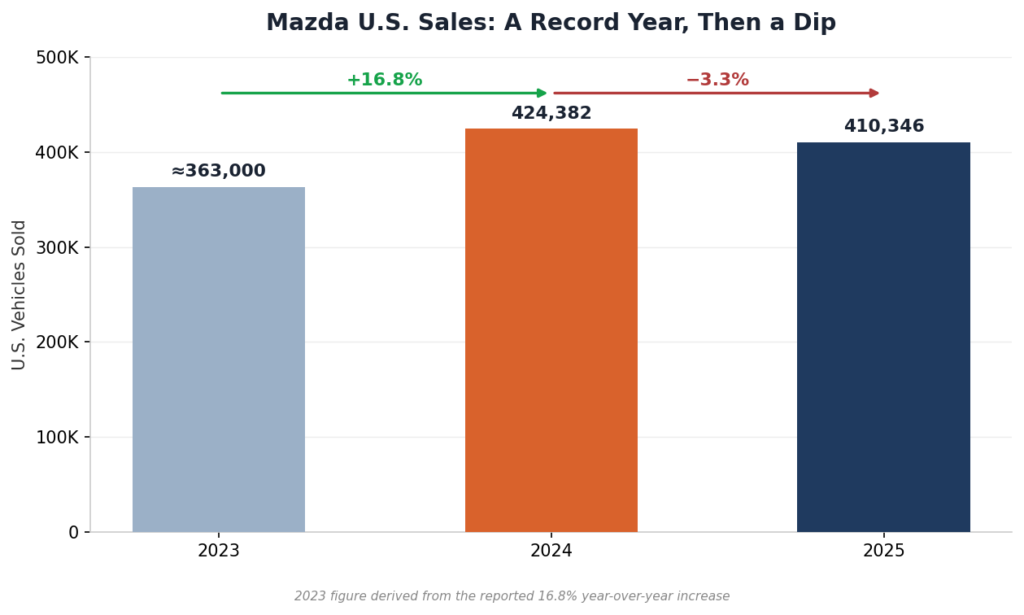
Mazda’s U.S. sales volume gives a useful perspective on the brand’s position.
In 2024, Mazda sold 424,382 vehicles in America, an impressive 16.8% increase over 2023. However, the company remained much smaller than the industry’s largest manufacturers. In 2025, Mazda sales fell to 410,346 units.
That does not indicate that Mazda vehicles are necessarily unpopular with their owners. Instead, it shows that the brand does not attract buyers in the same numbers as the biggest manufacturers.
| Factor | Mazda | Larger Mainstream Rivals |
| Brand Size | Relatively Small | Very Large |
| Model Range | More Limited | Broad |
| Dealer Network | Smaller | Extensive |
| SUV Coverage | Growing | Very Broad |
| Hybrid Availability | Expanding | Generally Broader |
| Truck Selection | Very Limited | Extensive |
| Brand Recognition | Strong But Smaller | Extremely High |
| Performance Focus | Strong | Varies |
| Luxury-Like Interior | Mazda Strength | Depends On Model |
| Overall Market Reach | Limited | High |
Mazda itself recognizes the importance of strengthening its sales foundation in individual markets. Its 2025 integrated report describes efforts to tailor product launches and branding activities to different markets while expanding its sales foundation.
That tells us something important: Mazda’s smaller presence is not simply a matter of poor vehicles. It is also a matter of scale and market strategy.
Mazda Has A Different Brand Identity
Mazda has historically positioned itself differently from brands that compete primarily on practicality, affordability, or sheer vehicle variety.
The company emphasizes design, engineering, driving dynamics, craftsmanship, and a more premium feel. That gives Mazda a distinctive personality, but it can also make the brand less obvious to buyers who simply want the most practical vehicle for the money.
A shopper looking for a three-row family SUV, pickup truck, minivan, inexpensive hybrid, or large commercial vehicle may find more choices elsewhere.
Mazda’s identity is therefore both an advantage and a limitation.
It creates loyalty among people who specifically like Mazda’s approach, but it does not necessarily attract every type of car buyer.
1. Mazda Does Not Have A Huge Vehicle Lineup
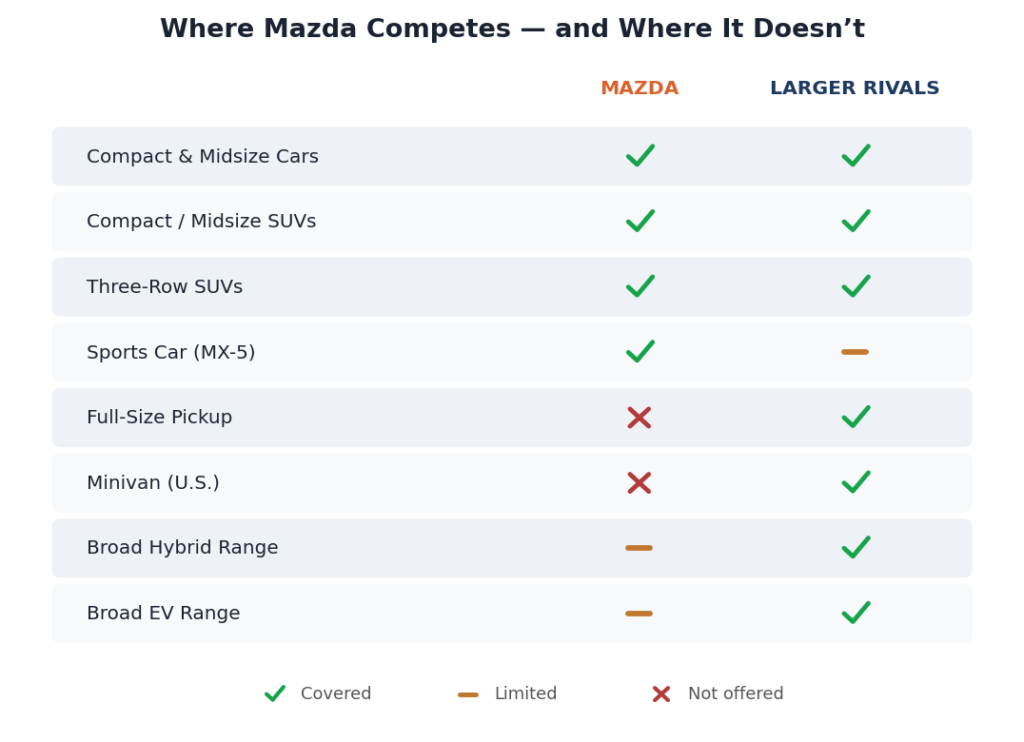
One of the biggest reasons Mazda is less visible than Toyota, Honda, or Hyundai is surprisingly simple: there are fewer Mazda vehicles to choose from.
A large automaker can cover nearly every major category.
It may sell compact cars, midsize sedans, multiple crossover sizes, three-row SUVs, pickup trucks, minivans, hybrids, plug-in hybrids, and electric vehicles.
Mazda has traditionally operated with a much narrower portfolio.
Mazda Focuses Heavily On Crossovers
The modern Mazda lineup is increasingly centered around SUVs and crossovers.
Models such as the CX-30, CX-5, CX-50, CX-70, and CX-90 give Mazda coverage across several SUV categories. That is a significant change from the company’s older lineup, which depended more heavily on sedans and smaller cars.
Mazda’s own sales data shows how important SUVs have become. The CX-5 remains one of the company’s strongest global products, with 334,578 units sold globally during calendar year 2025.
The CX-50 has also become an important North American product, particularly because it is produced in the United States through Mazda Toyota Manufacturing.
The problem is that even a strong crossover lineup cannot cover every category.
Mazda Does Not Offer A Pickup Truck
This is a major limitation in the American market.
Ford has the F-Series. Chevrolet has the Silverado. Ram has the 1500. Toyota has the Tacoma and Tundra. Nissan has the Frontier and Titan historically.
Mazda does not have a comparable full-size pickup.
That means Mazda automatically misses a large group of American buyers who use trucks for work, towing, recreation, commuting, or family transportation.
The old Mazda B-Series pickup is long gone, and the company has not replaced it with a dedicated modern truck for the U.S. market.
That is not necessarily a mistake.
Developing a competitive pickup requires enormous investment in engineering, manufacturing, powertrains, dealer support, towing capability, and marketing.
For a relatively small automaker, entering that segment would carry considerable financial risk.
The Sedan Market Has Become Smaller
Mazda still offers the Mazda3 sedan and hatchback, but the broader American market has shifted strongly toward SUVs and crossovers.
This has created a difficult situation for companies that historically depended on compact and midsize cars.
Mazda3 sales in the United States fell from 38,877 units in 2024 to 29,266 in 2025, a decline of 24.7%.
That does not necessarily mean the Mazda3 became a bad car.
It reflects a much larger consumer trend toward crossovers.
Mazda has responded by emphasizing its SUV portfolio, but the transition also means the company has fewer traditional passenger cars generating volume.
Limited Model Choices Reduce Brand Visibility
A buyer might walk into a Toyota dealership and see a large range of vehicles designed for very different needs.
A Mazda dealership generally has a more concentrated selection.
That can be beneficial for product quality and brand identity, but it reduces opportunities to capture customers.
Every missing vehicle category represents potential lost sales.
A family wanting a minivan may never consider Mazda. A contractor wanting a pickup may never visit a Mazda dealer. A buyer searching specifically for a three-row hybrid may immediately start elsewhere.
The result is a smaller customer funnel.
2. Mazda Faces Extremely Strong Competition
Mazda does not operate in an empty market.
Its vehicles compete against some of the strongest products in the automotive industry, many of which have enormous customer loyalty.
This is particularly challenging because Mazda often competes in categories where buyers have several highly established alternatives.
The CX-5 Faces A Difficult Segment
The Mazda CX-5 has been one of the company’s most important vehicles for years.
But compact SUVs are among the most competitive products in the market.
The CX-5 competes with vehicles such as the Toyota RAV4, Honda CR-V, Hyundai Tucson, Kia Sportage, Subaru Forester, Nissan Rogue, and Ford Escape depending on configuration and market.
These competitors have enormous brand recognition.
A buyer who wants a practical compact SUV may automatically start with Toyota or Honda because friends, family, dealerships, and online communities have reinforced those brands for years.
Mazda must therefore persuade customers to choose something different.
That is considerably harder than simply producing a good vehicle.
Toyota And Honda Have Powerful Reputation Advantages
Toyota and Honda have spent decades building reputations around reliability, resale value, practicality, and ownership costs.
Whether every individual Toyota or Honda is actually better than every Mazda is a different question.
The important point is that consumers often make purchasing decisions using perceived risk.
A person spending a large amount of money on a vehicle may choose the brand they already know.
Mazda therefore has to overcome a psychological barrier in addition to competing on specifications.
A CX-5 can have excellent interior quality and appealing driving dynamics, but the customer may still think:
“I already know Toyota. Why should I take a chance on something else?”
That is a branding challenge rather than an engineering problem.
Hyundai And Kia Have Expanded Quickly
Hyundai and Kia have also changed the competitive landscape.
Their modern vehicles offer attractive designs, extensive technology, long warranty coverage in the U.S., broad SUV lineups, and increasingly sophisticated interiors.
This has put additional pressure on Mazda.
Mazda’s premium-feeling cabin used to be one of its strongest differentiators. Today, several mainstream manufacturers have improved interior materials, displays, driver-assistance systems, exterior styling, and equipment levels.
Mazda can no longer depend on simply having a nicer cabin than mainstream competitors.
Subaru Competes For A Similar Buyer
Subaru is another interesting comparison.
Both brands appeal to customers who may value individuality over buying the most common vehicle on the road.
Subaru has a particularly strong position among buyers interested in all-wheel drive, outdoor activities, practicality, and distinctive brand identity.
Mazda has a different personality, but the two brands can compete for some of the same consumers.
Subaru also benefits from a very clear message.
Customers often know what a Subaru represents.
Mazda’s identity is more complicated: it combines sporty handling, upscale interiors, Japanese engineering, premium aspirations, and mainstream pricing.
That combination can be appealing, but it is not as immediately recognizable.
3. Mazda’s Dealer Network And Brand Visibility Are Smaller
Buying a car is not only about the vehicle.
Dealership availability matters.
A manufacturer with thousands of dealerships has more opportunities to put its vehicles in front of consumers, provide test drives, offer service, and maintain long-term customer relationships.
Mazda operates on a smaller scale.
Fewer Dealerships Mean Fewer Opportunities
Imagine two people living in different cities.
One might have several Toyota, Honda, Hyundai, and Kia dealerships nearby but only one Mazda dealership within reasonable driving distance.
Even if that person likes the CX-5, convenience can influence the final decision.
The buyer may choose another brand simply because servicing, test drives, trade-ins, or purchasing are easier.
This effect is difficult to measure through vehicle specifications, but it matters enormously in the real market.
A car manufacturer cannot sell a vehicle that the customer never sees.
Service Accessibility Influences Brand Choice
Customers also think about what happens after the purchase.
Routine maintenance, warranty work, recalls, software updates, parts availability, and repairs all require access to service facilities.
A larger dealer network can make ownership feel simpler.
Mazda’s smaller network is not necessarily a sign of poor service quality. It simply means that its physical reach is narrower.
That can become more important in rural areas or regions where Mazda dealerships are less common.
Advertising Scale Matters Too
Toyota, Honda, Ford, Chevrolet, Hyundai, and Kia are extremely visible.
Their advertisements appear across television, websites, sports broadcasts, social media, billboards, and dealership campaigns.
Mazda also advertises, but its overall market presence is smaller.
This creates a self-reinforcing cycle.
Large sales volume produces more vehicles on the road. More vehicles create more brand visibility. Greater visibility increases familiarity. Familiarity can encourage future purchases.
Mazda has fewer vehicles creating that effect.
Familiarity Is A Major Part Of Car Buying
Most consumers do not research every automobile manufacturer in detail.
They usually begin with brands they recognize.
A shopper might know Toyota Camry, Honda CR-V, Ford F-150, Chevrolet Silverado, Hyundai Tucson, and Kia Sportage without actively researching them.
Mazda has strong name recognition, but the brand does not have the same cultural presence as the industry’s largest manufacturers.
That makes customer acquisition harder.
4. Mazda Has Been Conservative With Powertrain Strategy
Powertrain strategy is another reason Mazda can appear less popular.
The automotive industry is rapidly moving toward hybrids, plug-in hybrids, battery-electric vehicles, and increasingly complex electrified drivetrains.
Mazda has moved into these technologies, but its transition has been relatively measured.
Hybrid Availability Has Been Limited Compared With Some Rivals
Hybrid demand has become important in the American market.
Toyota has built one of the strongest hybrid portfolios in the industry, while Honda, Hyundai, and Kia have also expanded their hybrid offerings.
Mazda’s U.S. hybrid strategy has historically been narrower.
The CX-50 Hybrid is particularly important because it uses Toyota’s hybrid system. Mazda introduced the CX-50 Hybrid in North America as part of its strategy to increase electrified vehicle availability.
That approach gives Mazda access to proven hybrid technology while limiting the enormous development cost of creating every component independently.
However, it also means Mazda entered a segment where competitors already had significant experience and customer recognition.
Mazda Has Historically Defended The Internal Combustion Engine
Mazda has taken a somewhat different technical approach from manufacturers that rapidly moved toward full electrification.
The company has continued investing in highly efficient gasoline engines, including its Skyactiv technology, while also developing hybrid and electric solutions.
That strategy has advantages.
Internal-combustion vehicles remain popular, infrastructure for conventional fueling is widespread, and many customers are not ready to switch completely to battery-electric vehicles.
But there is also a downside.
A customer specifically searching for a large range of hybrid or electric choices will find more options from some competitors.
The Rotary Engine Is An Example Of Mazda’s Unique Thinking
Mazda is famous for the rotary engine.
The technology gave the company a unique identity and produced iconic vehicles such as the RX-7 and RX-8.
However, rotary engines also presented challenges involving fuel economy, emissions, durability, and operating characteristics.
Mazda eventually stopped producing rotary-powered sports cars as mainstream products.
The company has since brought the rotary concept back in a very different role as a range-extender technology for certain electrified vehicles.
This illustrates Mazda’s broader engineering personality.
It often chooses technically interesting solutions rather than simply copying the market leader.
That can create exciting products, but unusual engineering does not always translate into mass-market popularity.
5. Mazda’s Premium Positioning Can Create A Pricing Problem
One of Mazda’s biggest strengths can also create a challenge.
Mazda vehicles often feel more upscale than their mainstream positioning suggests.
The interiors can feature attractive materials, clean dashboards, strong seating designs, and a restrained aesthetic.
But customers compare prices across brands.
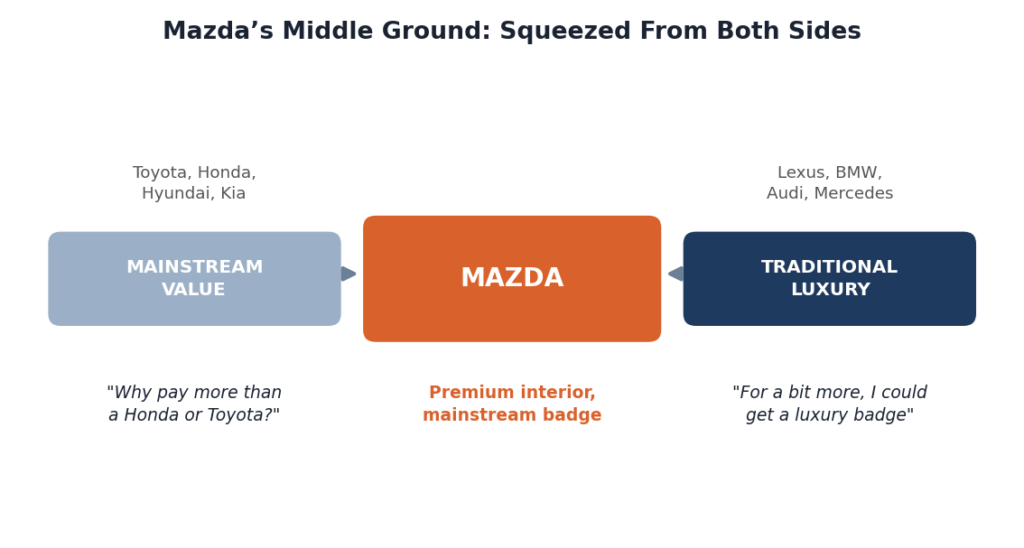
Mazda Sits In An Interesting Middle Ground
Mazda is generally positioned above the basic mainstream experience but below traditional luxury brands.
That middle position can be difficult.
A customer may look at a well-equipped Mazda and compare it with a less expensive Honda or Toyota.
Another customer may compare the same Mazda with an entry-level Lexus, Acura, BMW, Audi, or Mercedes-Benz.
Mazda can therefore face pressure from both directions.
Its premium-oriented design is an advantage when customers appreciate craftsmanship.
But it can be a disadvantage when shoppers focus primarily on equipment, price, or badge prestige.
A Premium Interior Does Not Automatically Create Luxury Demand
Luxury buyers often purchase more than interior materials.
They consider brand reputation, dealership experience, technology, performance, resale value, status, customization, and ownership services.
Mazda can provide several luxury-like qualities without having the decades-long luxury image of Lexus, BMW, Mercedes-Benz, or Audi.
That leaves Mazda in an unusual position.
It may offer a more sophisticated interior than some mainstream competitors, but the Mazda badge does not carry the same prestige as a luxury badge.
Technology Presentation Can Also Divide Buyers
Mazda has historically favored relatively simple cabin layouts and physical controls instead of putting every function onto a giant touchscreen.
Many owners appreciate this approach because it can reduce distraction and make common functions easier to operate.
Other buyers want large displays, maximum digital customization, and smartphone-like interfaces.
Neither approach is automatically superior.
It simply means Mazda’s design philosophy will appeal strongly to some customers and less strongly to others.
6. Mazda Has Fewer Vehicles That Appeal To Fleet And Commercial Buyers
Large automakers benefit from many different customer groups.
They sell vehicles to individuals, families, rental companies, businesses, government organizations, commercial fleets, and other institutional customers.
Mazda has fewer products suited to some of those markets.
No Full-Size Truck Limits Commercial Reach
A full-size pickup is not just a consumer product.
Businesses use trucks for construction, landscaping, transportation, maintenance, agriculture, towing, and countless other jobs.
Mazda does not participate directly in that huge segment in the U.S.
This limits the number of businesses that can become Mazda customers.
No Minivan Is Another Missing Category
Minivans remain a practical choice for families who prioritize passenger space and sliding doors.
Toyota, Honda, Kia, and Chrysler have historically competed in this category.
Mazda does not currently offer a mainstream U.S. minivan.
That means a family needing maximum people-moving practicality may leave the Mazda showroom before comparing the rest of the lineup.
Fleet Sales Can Increase Brand Visibility
Fleet vehicles have a secondary benefit for manufacturers.
A vehicle used by a rental company or business can expose thousands of people to a brand.
Those drivers may later consider purchasing a similar vehicle.
Mazda’s smaller fleet footprint means fewer opportunities for this kind of exposure.
This is another reason sales volume and brand recognition can reinforce each other.
7. Mazda’s Smaller Scale Affects Development And Marketing
Mazda is not Toyota.
That may sound obvious, but it is central to understanding the company’s market position.
A giant automaker can spread development costs across enormous production volumes.
A smaller automaker has to be more selective.
Scale Creates A Major Competitive Advantage
Suppose a manufacturer develops a new engine, transmission, infotainment platform, or hybrid system.
A company selling several million vehicles can spread those costs across a huge number of units.
A smaller manufacturer has fewer vehicles over which to recover the investment.
This makes product planning more difficult.
Mazda therefore has to choose carefully where it spends money.
Its partnership with Toyota is one example of how collaboration can provide access to technology and manufacturing scale.
The CX-50 is produced at Mazda Toyota Manufacturing in Alabama, a joint venture between Mazda and Toyota. Mazda has specifically identified maximizing CX-50 production and sales as an important part of its North American strategy.
Smaller Scale Can Also Limit Advertising
Advertising is another area where scale matters.
A company selling millions of vehicles can spend enormous amounts on marketing while distributing the cost across a larger sales base.
Mazda must achieve similar brand recognition with fewer vehicles.
That is a difficult equation.
It explains why a Mazda owner may be highly familiar with the brand while a casual car shopper may barely consider it.
8. Mazda’s Reputation Is Better Than Its Popularity Suggests
There is an important contradiction in the Mazda story.
The company may not be one of America’s largest automakers, but that does not mean its products are broadly considered poor.
Mazda has repeatedly earned strong reviews for design, handling, interior quality, safety, and engineering.
The MX-5 Miata, for example, has maintained a unique position in the sports-car market for decades.
The CX-5 has also become one of Mazda’s most important global products.
The Miata Shows Mazda’s Strength
The MX-5 Miata is perhaps the clearest example of Mazda’s philosophy.
Instead of building the largest or most powerful sports car, Mazda emphasizes lightweight construction, simplicity, balance, and driver involvement.
That approach has created an unusually loyal following.
In the U.S., Mazda sold 8,727 MX-5 Miatas during 2025, up 7.7% from 2024 despite the company’s overall U.S. sales decline.
That is not a huge sales number.
But the model has enormous influence relative to its volume.
It demonstrates that Mazda can create products with a strong emotional connection even when they do not generate mass-market sales.
Mazda Has A Strong Enthusiast Following
Mazda attracts buyers who care about steering feel, chassis balance, engine response, manual transmissions, design, and overall vehicle character.
That customer base is valuable.
However, enthusiasts represent a smaller portion of the total car-buying market than families and practical commuters.
A vehicle can be highly respected without becoming a volume leader.
That distinction is essential when discussing Mazda’s popularity.
9. Mazda’s SUV Expansion Is Changing The Picture
The argument that Mazda is simply becoming less relevant does not fully match recent data.
The company has been actively expanding its SUV lineup and adapting its strategy to changing consumer demand.
Mazda’s FY2025 report said North American sales reached 617,000 units, up 20% year over year, driven by products including the CX-50 and larger CX models.
The company’s U.S. calendar-year results were softer in 2025, but the longer-term strategy is clearly focused on SUVs, electrification, and greater North American production.
CX-50 Gives Mazda A Stronger American Position
The CX-50 is particularly important.
It was designed with North American customers in mind and is manufactured in Alabama through Mazda Toyota Manufacturing.
Its positioning also gives Mazda another product between the compact CX-30 and larger SUVs.
The model competes in a segment where buyers increasingly want crossover practicality without moving into a very large vehicle.
Larger CX Models Expand Mazda’s Reach
Mazda has also developed the CX-70 and CX-90 for larger vehicle categories.
These models give Mazda a chance to compete for customers who previously had fewer reasons to consider the brand.
The company’s integrated report identifies these larger products as part of its expansion in North America and other markets.
That strategy could gradually reduce one of Mazda’s historical weaknesses: an overly narrow lineup.
10. Mazda’s Popularity Could Improve With The Right Product Mix
Mazda’s future position depends less on becoming another Toyota and more on expanding the areas where its existing strengths matter.
The company does not need to abandon its identity.
Instead, it needs enough products to bring more people into the Mazda ecosystem.
More Hybrid Choices Could Help
Hybrid availability is increasingly important to mainstream buyers.
Mazda has already moved further into hybrids, and its partnership with Toyota provides a practical route into this market.
A broader range of hybrid SUVs could attract buyers who like Mazda’s interiors and styling but previously rejected the brand because of limited electrified choices.
A Stronger EV Strategy Could Increase Relevance
Electric vehicles represent another opportunity.
Mazda has introduced electric products in selected markets and continues developing electrification as part of its broader strategy.
The company does not necessarily need to become an EV-only manufacturer.
However, offering competitive electric vehicles across important segments would give Mazda another reason to appear on shoppers’ shortlists.
More Competitive Technology Could Broaden Its Appeal
Mazda’s physical controls and relatively restrained interiors are appealing to many drivers.
At the same time, buyers increasingly expect strong smartphone integration, advanced driver assistance, large displays, wireless connectivity, and sophisticated infotainment.
Mazda needs to balance its traditional simplicity with modern expectations.
The goal should not be to add technology simply for marketing.
The technology needs to improve usability.
Dealer Growth Could Have A Large Impact
Expanding dealership coverage could also improve Mazda’s visibility.
A potential buyer is much more likely to consider a vehicle when a dealership is nearby and service is convenient.
More dealerships also mean more test drives, more used Mazda inventory, stronger local advertising, and greater community presence.
For a relatively small brand, each additional market can have an outsized impact.
Why Mazda Is Not As Popular As Toyota Or Honda
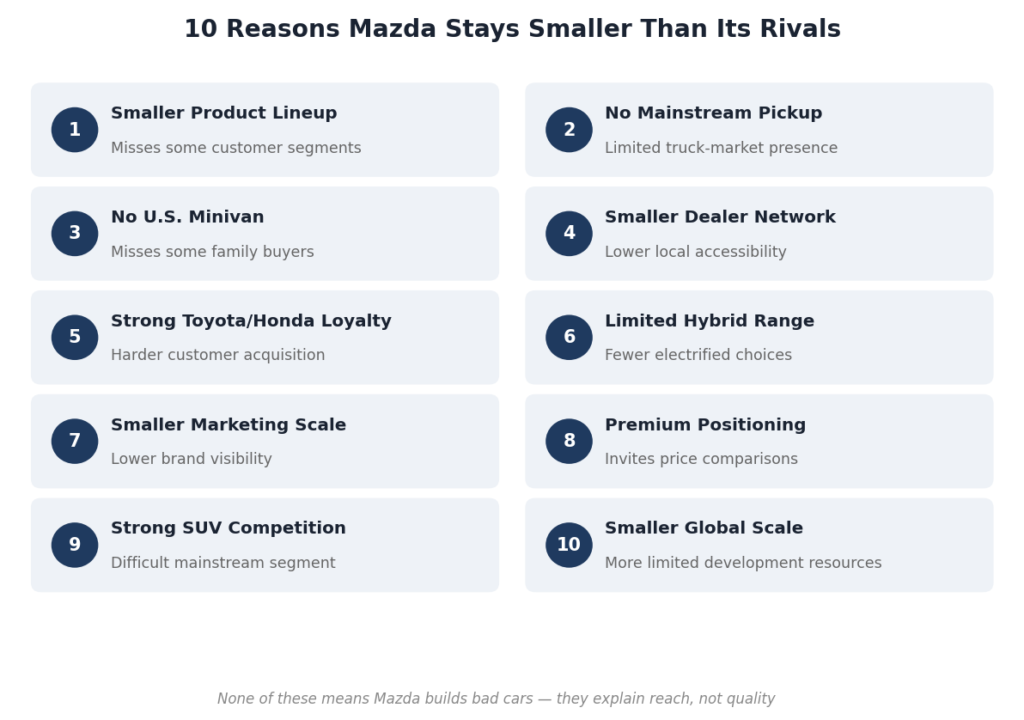
Mazda’s lower sales volume is best explained by several factors working together rather than one major defect.
The brand has fewer models, a smaller dealer network, less exposure, limited participation in certain high-volume categories, and historically narrower hybrid and electric offerings.
At the same time, Mazda faces competitors with enormous scale and deeply established reputations.
| Reason | Impact On Mazda |
| Smaller Product Lineup | Misses Some Customer Segments |
| No Mainstream Pickup | Limited Truck-Market Presence |
| No U.S. Minivan | Misses Some Family Buyers |
| Smaller Dealer Network | Lower Local Accessibility |
| Strong Toyota/Honda Loyalty | Harder Customer Acquisition |
| Limited Hybrid Range | Fewer Electrified Choices |
| Smaller Marketing Scale | Lower Brand Visibility |
| Premium Positioning | Can Increase Price Comparisons |
| Strong SUV Competition | Difficult Mainstream Segment |
| Smaller Global Scale | More Limited Development Resources |
None of these factors means Mazda makes bad cars.
In fact, some of Mazda’s strengths are precisely why the company has such a loyal customer base.
The brand simply operates with a different scale and strategy.
Is Mazda A Good Brand To Buy?
For the right buyer, Mazda can be an excellent choice.
Its vehicles tend to appeal to people who care about exterior styling, cabin quality, responsive handling, engineering, and a more distinctive alternative to the largest mainstream brands.
The CX-5, CX-50, Mazda3, and MX-5 Miata demonstrate different sides of that philosophy.
However, Mazda may not be the best match for someone who prioritizes the widest possible model selection, extensive hybrid availability, maximum towing capacity, a pickup truck, a minivan, or the largest dealer network.
The important thing is to compare the specific Mazda model with its direct competitors rather than judging the entire company by sales volume.
A brand can sell fewer vehicles and still produce a vehicle that is an excellent fit for a particular owner.
Frequently Asked Questions
Why Is Mazda Less Popular Than Toyota?
Mazda operates at a much smaller scale and has a narrower product lineup than Toyota. Toyota covers more vehicle categories, has a larger dealer network, offers a much broader range of hybrid models, and has built decades of mainstream brand recognition. Mazda competes successfully in several categories but does not have the same overall market reach.
Is Mazda Considered A Luxury Brand?
No. Mazda is generally considered a mainstream automotive brand, although many of its vehicles have a more upscale interior and design than their traditional mainstream positioning suggests. Mazda has deliberately emphasized craftsmanship and premium-feeling materials without becoming a conventional luxury manufacturer.
Are Mazda Cars Reliable?
Mazda has a strong reputation for engineering and reliability, but reliability varies by model, engine, transmission, model year, maintenance history, and individual vehicle condition. A buyer should research the specific year and powertrain rather than assuming that every Mazda has identical reliability.
Why Doesn’t Mazda Make A Pickup Truck?
Mazda does not currently offer a mainstream pickup truck in the U.S. market. Developing a competitive truck requires enormous investment in platforms, engines, transmissions, towing systems, manufacturing, and dealer support. Mazda has instead concentrated its resources on passenger cars and crossovers.
Is Mazda Losing Popularity?
Not necessarily. Mazda’s U.S. sales declined 3.3% in 2025 after rising 16.8% in 2024, so short-term sales have fluctuated. At the same time, the company continues expanding its SUV lineup and electrification strategy. Its latest financial results also show global sales growth in the first quarter of fiscal 2027.
Why Do Mazda Owners Like Their Cars So Much?
Mazda has developed a strong following because its vehicles often combine attractive styling, well-designed interiors, responsive handling, and a more focused engineering philosophy. The MX-5 Miata is an especially strong example of this approach. Mazda’s relatively small sales volume does not necessarily reflect the satisfaction or loyalty of its existing customer base.
Final Verdict
Mazda is not truly an unpopular car brand. It is better described as a smaller automaker competing in a market dominated by much larger companies.
Its limited lineup, smaller dealership footprint, absence from major categories such as full-size pickups, and narrower electrified portfolio naturally restrict the number of customers it can reach.
Strong competitors also make the situation harder. Toyota, Honda, Hyundai, Kia, Subaru, Ford, Chevrolet, and Nissan have built enormous ecosystems around their vehicles, dealerships, service departments, and customer communities.
Yet Mazda has something many high-volume manufacturers struggle to maintain: a distinct identity.
Its vehicles do not try to be everything for everyone. The company has historically focused on design, engineering, handling, craftsmanship, and a more engaging character.
That approach limits Mazda’s mass-market reach, but it also creates a loyal following.
The more interesting question for Mazda is not whether it should become as large as Toyota. It is whether it can expand its lineup, improve hybrid and electric coverage, strengthen its dealer network, and increase brand visibility without losing the characteristics that made people choose Mazda in the first place.
Its recent expansion into larger SUVs, hybrid vehicles, and North American production suggests that Mazda understands the need to grow. The company’s current strategy is aimed at increasing volume while maintaining its brand positioning.
So, if Mazda seems less common on American roads, that does not necessarily mean buyers are rejecting the brand.
In many cases, Mazda simply has fewer vehicles, fewer dealerships, and fewer reasons to appear in front of the average shopper.
And that is a very different problem from making bad cars.