Six. That’s how many genuinely different firing sequences have powered a Ram 1500 since 1994, more than almost any other nameplate on American roads. A V10 borrowed distant heritage from the Dodge Viper, a diesel V6 fires in a pattern shared with nothing else in this lineup, and the current truck can be ordered with a V8 that Dodge briefly discontinued and then publicly, dramatically brought back.
That last chapter happened within the past two model years, making this one of the more genuinely current automotive topics available anywhere.
Three decades of engine development, a nameplate split from Dodge into its own brand, and enough recent corporate reversal to fill a business school case study all shaped what firing order question actually applies to a specific truck.
Every engine this truck has used, in the exact order Dodge and Ram introduced them, gets covered here in complete, current detail.
Firing Order Basics And Why The Ram 1500 Needs Six Different Answers
Firing order describes the exact sequence in which an engine ignites fuel inside each cylinder. Engineers space these combustion events out deliberately around crankshaft rotation, a fixed design decision baked into the engine architecture rather than something adjustable after the fact.
Few vehicles have carried this much genuine engine diversity across their production history. That variety makes the Ram 1500 one of the more layered firing order topics available, but also one of the more rewarding once broken into distinct eras.
What Firing Order Actually Controls Inside An Engine
Every cylinder fires at a specific point in crankshaft rotation rather than simple numerical order. A V6 completes one firing event every 120 degrees of rotation, a V8 fires every 90 degrees, and a V10 packs a firing event into every 72 degrees of a single crankshaft revolution.
That spacing exists to keep vibration low and distribute mechanical stress evenly across bearings, mounts, and the crankshaft itself.
Getting this sequence wrong, whether through a genuine mechanical fault or crossed wiring on an older engine, produces rough running, wasted fuel, and accelerated wear.
Early second-generation Ram trucks relied on a physical distributor and plug wires to route spark to each cylinder in order, making a wiring mistake an immediate, obvious problem.
Every engine introduced from the mid-2000s onward switched to coil-on-plug ignition instead, with the engine control module firing each coil individually based on sensor data.
Diagnostic trouble codes follow the same predictable pattern regardless of ignition type or engine generation. P0301 identifies cylinder one, P0302 identifies cylinder two, and the pattern continues through the highest cylinder count present, always referring to physical position rather than firing sequence.
Six Firing Sequences Across One Nameplate’s History
Three distinct body generations carried this nameplate from 1994 through today: the second-generation “Big Rig” styled trucks from 1994 through 2001, the third generation running 2002 through 2008, and the long-running fourth and fifth generations covering 2009 through the present.
Ram split off from Dodge as its own standalone brand in 2010, midway through the fourth generation.
Across that span, six genuinely distinct firing sequences have powered various Ram 1500 configurations: two different V6 patterns, one V8 sequence shared across an enormous range of displacements, a unique ten-cylinder pattern, a diesel-specific sequence, and a brand-new inline-six pattern introduced within the past two model years. Few trucks anywhere offer this level of genuine mechanical variety under one badge.
That variety isn’t evenly distributed across the decades, though. Some patterns, like the V8 sequence, remained essentially unchanged for over twenty years and across a dozen different displacement variants, while others appeared for only a handful of model years before disappearing entirely.
Sorting out which pattern applies to a specific truck starts with identifying the exact engine, not just the generation or model year. Several of these generations offered multiple simultaneous engine choices, sometimes changing mid-cycle in ways that catch even experienced owners off guard.
Second And Third Generation Firing Order From 1994 Through 2008
The original modern Ram 1500, introduced for 1994 with its now-iconic “Big Rig” styling, launched with a genuinely wide engine spread that included one of the most distinctive powerplants ever offered in a half-ton pickup. That variety continued, with some changes, through the redesigned third generation.
Sorting these engines by cylinder count makes the whole picture considerably easier to follow than jumping straight into individual model years.
3.9L And 3.7L V6 Firing Order
A 3.9-liter Magnum V6 served as the base engine throughout the second generation, from 1994 through 2000, offering genuine towing capability well beyond what most half-ton base engines of that era could manage.
Its firing order runs 1-6-5-4-3-2, with cylinder one sitting at the front left of the engine, alongside cylinders three and five on that same driver’s side.
The third generation replaced this engine with an all-new 3.7-liter V6, sharing core architecture with the larger 4.7-liter V8 introduced alongside it.
Despite the displacement and generational change, this newer engine kept the identical 1-6-5-4-3-2 firing order and driver-side-first cylinder convention established by its predecessor.
This consistency across two genuinely different engine designs, separated by roughly a decade of development, reflects a broader pattern seen throughout Chrysler’s truck-application V6 engines specifically.
Factory documentation and independent repair references confirm this exact sequence across every model year either engine appeared in.
Neither V6 proved especially popular among Ram 1500 buyers relative to the V8 options sharing showroom space with them, and both are comparatively uncommon finds today.
Confirming the exact engine code before ordering ignition parts remains worthwhile given how easily these two similar-sounding V6 engines can be confused.
Magnum, PowerTech, And The Legendary V10
The 5.2-liter and 5.9-liter Magnum V8 engines anchored the second generation’s gas-powered lineup, with the 5.9-liter serving as the towing-focused upgrade option throughout this era.
Both share an identical 1-8-4-3-6-5-7-2 firing order, a sequence tracing back to Chrysler’s V8 engines from the 1960s and 1970s.
Above even the 5.9-liter sat something genuinely unusual for a pickup truck: an 8.0-liter Magnum V10, sharing distant architectural roots with the engine that powered the original Dodge Viper.
This massive engine fires in a 1-10-9-4-3-6-5-8-7-2 sequence, with cylinders one, three, five, seven, and nine occupying the driver’s side bank and the remaining even numbers on the passenger side.
Third-generation trucks replaced the 5.2-liter and eventually the 5.9-liter Magnum with the all-new 4.7-liter PowerTech V8, sharing the identical 1-8-4-3-6-5-7-2 firing order despite representing a genuinely modern, overhead-cam replacement for the aging pushrod Magnum design.
The 5.9-liter Magnum actually carried over for the 2002 model year alone before the PowerTech and, shortly after, the Hemi took over entirely.
That V10, meanwhile, remained a genuinely rare and specialized option throughout its production run, valued today mostly by enthusiasts specifically seeking out its unusual character rather than typical truck buyers. Its firing order remains a genuine curiosity even among people otherwise familiar with Ram’s more common V8 engines.
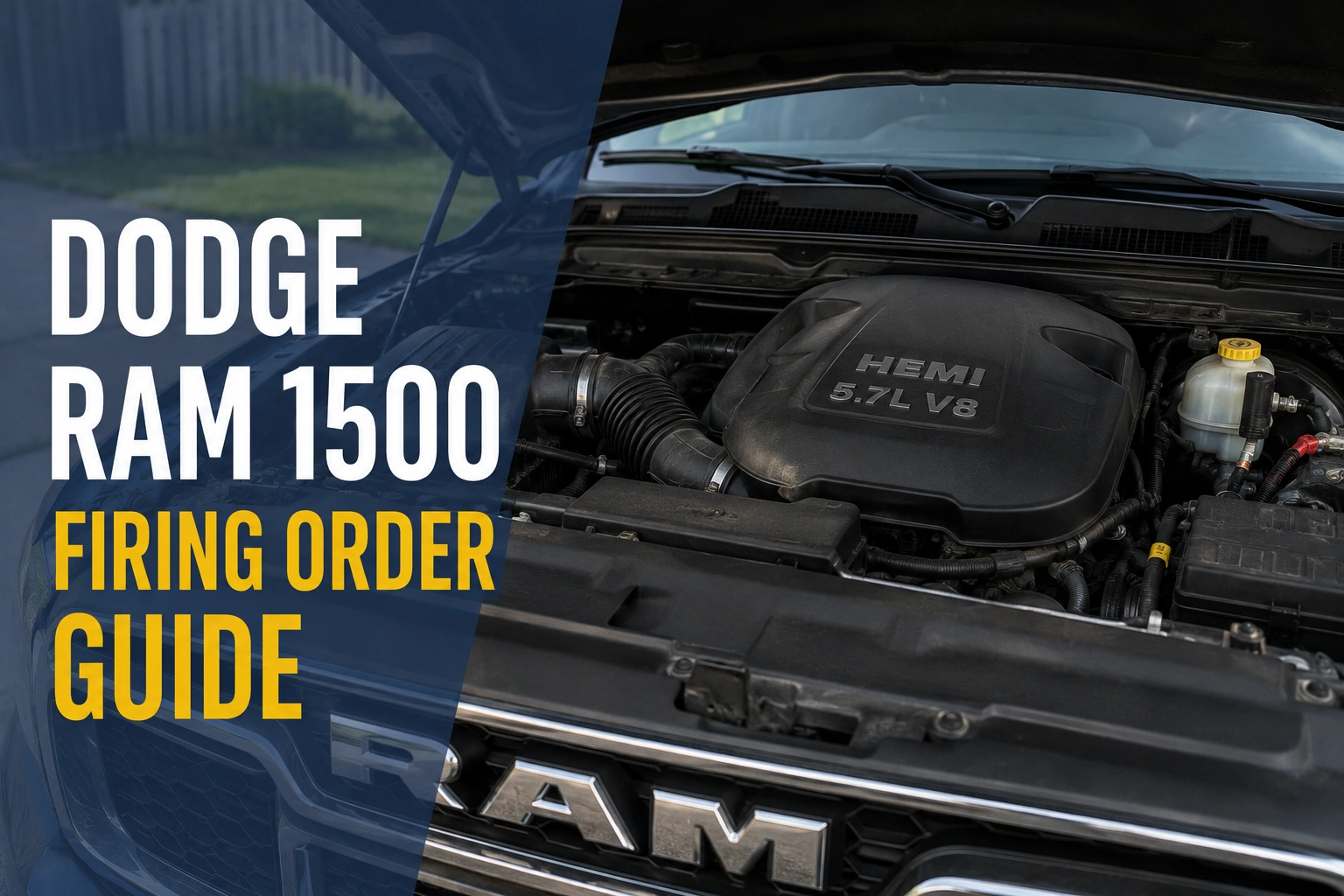
The 5.7L Hemi’s 2003 Debut
Chrysler introduced the modern 5.7-liter Hemi V8 for the 2003 model year, replacing the outgoing Magnum entirely and setting the stage for what would become the single most recognizable engine in this truck’s entire history.
This new design brought genuinely modern architecture, including multiple spark plugs per cylinder in early versions, while keeping displacement close to the outgoing 5.9-liter it replaced.
Its firing order runs 1-8-4-3-6-5-7-2, identical to every Magnum and PowerTech V8 that came before it. That continuity reflects a deliberate engineering choice, since Chrysler’s V8 firing order convention had remained essentially unchanged across generations of pushrod and overhead-cam designs alike going back decades.
Cylinder one sits at the front of the driver’s side bank on the Hemi, exactly as it does on every V8 covered in this section, making this one of the more consistent, dependable pieces of information available about this truck’s entire engine history.
A technician comfortable with a 1995 5.9-liter Magnum can apply identical cylinder logic to a brand-new Hemi without any adjustment.
Here’s how the second and third-generation lineup compares:
| Engine | Model Years | Type | Firing Order |
| 3.9L / 3.7L V6 | 1994-2008 | Base | 1-6-5-4-3-2 |
| 5.2L / 5.9L Magnum V8 | 1994-2002 | Standard / upgrade | 1-8-4-3-6-5-7-2 |
| 8.0L Magnum V10 | 1994-2001 | Rare top-tier | 1-10-9-4-3-6-5-8-7-2 |
| 4.7L PowerTech V8 | 2002-2009 | Mid-range | 1-8-4-3-6-5-7-2 |
| 5.7L Hemi V8 | 2003-present | Primary V8 | 1-8-4-3-6-5-7-2 |
Fourth And Fifth Generation Firing Order From 2009 To 2024
Ram’s split from Dodge as an independent brand in 2010 coincided with a genuinely significant powertrain expansion that eventually brought two entirely new engine architectures to this lineup.
Both remained core parts of the truck’s identity for well over a decade afterward.
Understanding these two additions explains most of what a shopper researching a 2009 through 2024 Ram 1500 actually needs to know.
3.6L Pentastar Firing Order And Cylinder Layout
Chrysler’s all-new 3.6-liter Pentastar V6 replaced the outgoing 3.7-liter partway through the fourth generation, bringing a dramatic technical leap in refinement and output over the engine it succeeded.
This modern, dual-overhead-cam design remains the standard engine across current Ram 1500 trims today, now paired with an optional eTorque mild-hybrid system that adds a belt-driven motor generator for smoother stop-start and brief torque assistance.
Its firing order runs 1-2-3-4-5-6, a completely different pattern from either older truck V6 covered in the previous section. The Pentastar’s 60-degree bank angle allows this simple, sequential pattern, and cylinder one sits at the front of the passenger-side bank rather than the driver’s side convention used by the 3.9-liter and 3.7-liter engines it replaced.
This reversal in cylinder-one placement between the older and newer V6 generations trips up plenty of DIY mechanics assuming both trucks work identically. A Bank 1 designation genuinely means opposite physical sides of the engine depending on which V6 generation is actually installed.
This same Pentastar and firing order pattern powers an enormous range of other Stellantis vehicles, from the Jeep Wrangler to the Chrysler Pacifica minivan, making parts and diagnostic knowledge highly transferable across brands for anyone comfortable with this specific engine family.
The EcoDiesel’s Genuinely Different Sequence
Ram introduced the 3.0-liter EcoDiesel V6 for the 2014 model year, marking the first diesel engine offered in a half-ton pickup in more than a decade.
Built by VM Motori, an Italian manufacturer under the same corporate umbrella as Chrysler, this engine prioritized fuel economy and towing capability over the raw output of the gas V8 options.
Its firing order runs 1-4-2-5-3-6, a sequence that shares nothing in common with either the Pentastar or the older truck V6 engines covered earlier. Diesel combustion timing and injection requirements differ enough from gasoline engines that manufacturers frequently land on entirely separate firing sequences even within the same general V6 configuration.
Cylinder numbering also follows a somewhat different convention than most gasoline V6 engines in this lineup, grouping cylinders one through three together on the passenger side and four through six together on the driver’s side, rather than alternating odd and even numbers between banks.
This distinction matters enormously for anyone used to the alternating pattern found on the Pentastar or older truck engines.
Stellantis discontinued the EcoDiesel across the Ram 1500 lineup early in the 2023 model year, ending what had been a genuinely popular option among buyers prioritizing highway fuel economy and extended range.
Surviving examples remain common enough in the used market to keep this specific firing order question relevant for years to come.
The 2025 And 2026 Hemi Versus Hurricane Reversal
Nothing in this truck’s engine history prepared owners for the whiplash of the past two model years. A brand-new engine architecture arrived, an old favorite disappeared, and public reaction forced a genuinely rare corporate reversal within a single year.
This recent chapter offers a useful lesson in why checking the specific model year matters more now than at almost any other point in this nameplate’s history.
How The V8 Briefly Disappeared
Ram shifted its entire 1500 lineup to six-cylinder power for the 2025 model year, discontinuing the 5.7-liter Hemi V8 entirely alongside the already-departed EcoDiesel.
A brand-new twin-turbocharged inline-six, badged Hurricane, took over as the range-topping engine choice, developed largely from scratch over more than a decade of engineering work.
Reaction from longtime Ram buyers proved swift and vocal, with executives publicly acknowledging that customer demand for the traditional V8 experience never materialized as expected for an all-six-cylinder lineup.
Sales data reportedly played a direct role in the decision that followed, rather than any change in engineering capability or emissions requirements.
Ram brought the 5.7-liter Hemi back for the 2026 model year, now offered alongside the Hurricane rather than replacing it, giving buyers a genuine choice between traditional V8 character and the newer turbocharged six-cylinder architecture.
This reversal happened remarkably quickly by automotive industry standards, spanning barely a single model year from discontinuation to return.
None of this back-and-forth changed the actual firing order for either engine even slightly. The returning 5.7-liter Hemi still fires 1-8-4-3-6-5-7-2 exactly as it always had, proving once again that marketing and availability decisions operate on a completely different timeline than the underlying mechanical specifications.
The Hurricane’s Sequence And What’s Still Coming
The Hurricane inline-six comes in two distinct tunes for the current Ram 1500 lineup: a Standard Output version producing 420 horsepower, and a High Output version producing 540 horsepower, both exceeding the returning Hemi’s 395-horsepower rating.
Its firing order runs 1-5-3-6-2-4, the standard pattern for most inline-six engines across the industry, reflecting this engine’s naturally balanced single-bank design.
Cylinder numbering follows a simple front-to-rear line rather than splitting across two banks, since there’s only one row of cylinders to consider.
This single-bank simplicity removes an entire category of bank-confusion mistakes that affect the V6 and V8 engines covered throughout the rest of this piece.
Beyond the current gas lineup, Ram’s electrification plans remain genuinely unsettled as of this writing. The fully electric Ram 1500 REV has been delayed multiple times, most recently pushed to summer 2027, effectively making it a 2028 model-year vehicle despite originally being planned for 2024.
A plug-in hybrid Ramcharger, using a gas engine purely as a generator, has faced its own repeated delays targeting early 2026 availability.
Neither the REV nor the Ramcharger changes anything covered in this piece for buyers of a conventional gasoline Ram 1500 today.
Electric motors have no cylinders or firing order at all, and a plug-in hybrid’s generator engine represents an entirely separate research question from the naturally aspirated and turbocharged options covered throughout this guide.
Practical Diagnosis Across Three Decades Of Ram Trucks
None of this technical and historical detail matters much until a check engine light appears or an engine starts running rough. Firing order and cylinder position knowledge turns that vague warning into a specific, targeted repair.
The sections below apply everything covered so far to real diagnostic work across this nameplate’s unusually long and varied history.
Matching A Misfire Code To The Right Engine Family
A scan tool reading a P0301 through P0306 code identifies a misfiring cylinder by its physical position, never by where that cylinder falls within the firing sequence itself.
Confirming which engine family sits under the hood comes first, since the same cylinder number occupies a genuinely different physical location depending on whether a V6, V8, V10, diesel, or the newer Hurricane inline-six is involved.
Once that’s settled, matching the engine against the correct chart from earlier sections points straight to the affected coil, plug, or injector. Swapping a suspect coil with a known-good unit from another cylinder remains a reliable confirmation test across every spark-ignited engine covered here, though this trick doesn’t apply to the compression-ignited EcoDiesel.
Bank-specific codes deserve particular attention given how many times cylinder-one placement flips across this truck’s history.
A Bank 1 designation means the driver’s side on the older 3.9-liter, 3.7-liter, and every V8 covered here, but points to the passenger side instead on the Pentastar V6, a distinction worth double-checking before ordering a replacement sensor.
A VIN decode remains the fastest way to confirm exactly which engine sits under a specific truck’s hood, particularly valuable given how many engine choices sometimes coexisted within the same model year. Most auto parts stores can pull this information within minutes at no charge.
Maintenance Habits That Matter Most By Engine Type
Spark plugs and coils on the modern Pentastar and Hemi engines typically last well beyond 60,000 miles under normal conditions, a maintenance interval that has held steady across recent model years.
Earlier distributor-equipped engines from the second and early third generation benefit from periodic cap, rotor, and wire inspection instead, components that simply don’t exist on later coil-on-plug applications.
EcoDiesel owners face an entirely different maintenance conversation centered on fuel injectors, glow plugs, and emissions system components rather than anything resembling spark-based ignition service.
Diesel-specific misfires almost always trace back to fuel delivery rather than the firing order itself, since that sequence stays fixed by the engine’s mechanical timing regardless of fuel system condition.
Cylinder deactivation, standard on the Hemi V8 since its multi-displacement system debuted, occasionally produces symptoms resembling a misfire when a lifter or solenoid begins failing.
This concern sits entirely separate from firing order, since deactivation only pauses combustion in specific cylinders under light load rather than altering the sequence in which active cylinders fire.
Keeping the exact engine code, not just generation or model year, documented in any service record prevents the single most relevant mistake given this truck’s recent history: assuming a specific Ram 1500’s engine based on model year alone when the same year genuinely offered multiple, mechanically unrelated choices.
A quick reference for common symptoms across this lineup:
| Symptom | Likely Cause | Applies To |
| Rough idle, specific cylinder code | Failing coil, plug, or injector | All spark-ignited engines |
| Backfire after ignition work | Plug wires out of sequence | Pre-2003 distributor-equipped engines |
| Misfire tied to cylinder deactivation | Lifter or solenoid wear | 5.7L Hemi V8 with multi-displacement |
| Rough running unrelated to spark | Fuel delivery or injector issue | 3.0L EcoDiesel |
Frequently Asked Questions
What is the firing order of a Ram 1500 5.7 Hemi V8?
The Hemi fires in a 1-8-4-3-6-5-7-2 sequence, the same pattern shared by every Magnum, PowerTech, and Hemi V8 this nameplate has used since 1994. This applies whether the Hemi came from a 2003 truck or the returning 2026 lineup.
What is the firing order of the Ram 1500 EcoDiesel?
The 3.0-liter EcoDiesel fires in a 1-4-2-5-3-6 sequence, completely different from every gasoline engine covered in this guide. Cylinder numbering also groups differently, with cylinders one through three together on the passenger side.
Does the new Hurricane inline-six use the same firing order as the Hemi?
No, the Hurricane fires in a 1-5-3-6-2-4 sequence, standard for most inline-six engines industry-wide. This reflects its single-bank layout rather than the two-bank arrangement used by any V6, V8, or V10 in this lineup.
Is the V10 Ram 1500 engine’s firing order different from the V8?
Yes, the 8.0-liter V10 fires in a 1-10-9-4-3-6-5-8-7-2 sequence, a genuinely unique pattern not shared by any other engine covered here, reflecting its ten-cylinder configuration.
Can I still buy a V8 Ram 1500 today?
Yes, Ram brought the 5.7-liter Hemi back for the 2026 model year after briefly discontinuing it for 2025, now offered alongside the newer Hurricane inline-six options.
Where can I confirm the exact firing order for my specific Ram 1500?
A factory service manual matched to the exact model year and engine code remains the most reliable source. Most auto parts stores can also pull a firing order reference free of charge once given the vehicle’s VIN.
Three decades, three body generations, and a genuinely unmatched spread of engine architecture still resolve into six dependable sequences once the correct engine gets identified. Every truck V6 fires 1-6-5-4-3-2, every V8 fires 1-8-4-3-6-5-7-2, the V10 fires 1-10-9-4-3-6-5-8-7-2, the Pentastar fires 1-2-3-4-5-6, the EcoDiesel fires 1-4-2-5-3-6, and the new Hurricane fires 1-5-3-6-2-4.
Confirming the exact engine code, rather than trusting generation or model year alone, remains the only real starting point for applying any of this information correctly on a truck with this much engineering history behind it.