The Chevrolet Impala ran for two full decades in its modern revival, and across those twenty years it wore a surprising number of different engines under the hood.
From the original 3.4-liter V6 that launched the 2000 model all the way through the 3.6-liter LFX that closed out production in 2020, each powerplant had its own firing sequence, its own cylinder layout, and its own ignition architecture. That variety is exactly what makes a clear firing order reference so valuable.
A mechanic who knows the 3.4-liter cold but has never opened the hood of a ninth-generation 5.3-liter SS will find the LS4’s firing order and cylinder layout genuinely unfamiliar.
Get the sequence right and the engine runs as it was built to. Get it wrong and you are chasing misfires, rough idle, and diagnostic codes that change nothing until the root cause is corrected. Every Impala engine from every generation is covered here.
The Eighth Generation Impala (2000–2005) — Two V6 Engines And Their Firing Sequences
The eighth-generation Impala came back in 2000 after a decade-long absence, and it launched on the W-body platform with a choice between two V6 engines. Both were transversely mounted — meaning the engine sits sideways in the engine bay relative to the car’s length — which is the standard layout for front-wheel-drive vehicles.
This transverse orientation changes how cylinder locations are described compared to a rear-wheel-drive vehicle.
For any transversely mounted V6 Impala, “front bank” means the cylinder bank facing toward the front of the car and visible easily when you lift the hood. “Rear bank” is the one sitting closer to the firewall.
This distinction is what causes the most cylinder identification confusion on Impala models, and getting it straight before touching anything is the single most important step.
3.4-Liter LA1 V6 (2000–2005) — The Base Engine Firing Order
The 3.4-liter LA1 V6 was the base engine from 2000 through 2005. It produced 180 horsepower and was paired with a four-speed automatic transmission.
- Firing Order: 1-2-3-4-5-6
- Engine Type: 60-degree transverse V6
- Ignition System: Coil pack (distributorless ignition, DIS)
- Cylinder 1 Location: Rear bank, closest to the passenger side of the car
- Rear bank (firewall side): Cylinders 1, 3, 5 — left to right
- Front bank (visible from above): Cylinders 2, 4, 6 — left to right
- Spark Plug Gap: 0.060 inches
The rear bank is the critical starting point for anyone working on this engine. Cylinder 1 is in the rear bank on the passenger side — it is the cylinder closest to the right side of the car when you stand at the front bumper. From there, cylinders 3 and 5 follow to the left across the same bank.
The front bank (the one you see clearly when the hood is open) holds cylinders 2, 4, and 6, also running left to right.
The DIS coil pack setup on the 3.4-liter groups the cylinders into three pairs. Each coil fires two cylinders simultaneously using the waste-spark principle.
The coil pack is typically labeled with cylinder pairs, but if labels are missing or unclear, the firing order of 1-2-3-4-5-6 and the bank layout above will allow you to trace the correct connections.
A misfire on this engine frequently shows as a P0300 (random misfire) or a specific cylinder code P0301 through P0306. Because the coil pack fires pairs, a failed coil segment typically produces misfires on both cylinders it serves rather than one.
3.8-Liter Series II V6 (2000–2005) — Different Firing Order, Different Bank Layout
The 3.8-liter was the upgrade engine for the 2000–2005 Impala and was also used in the supercharged SS model introduced for 2004. It produced between 200 and 240 horsepower depending on the variant.
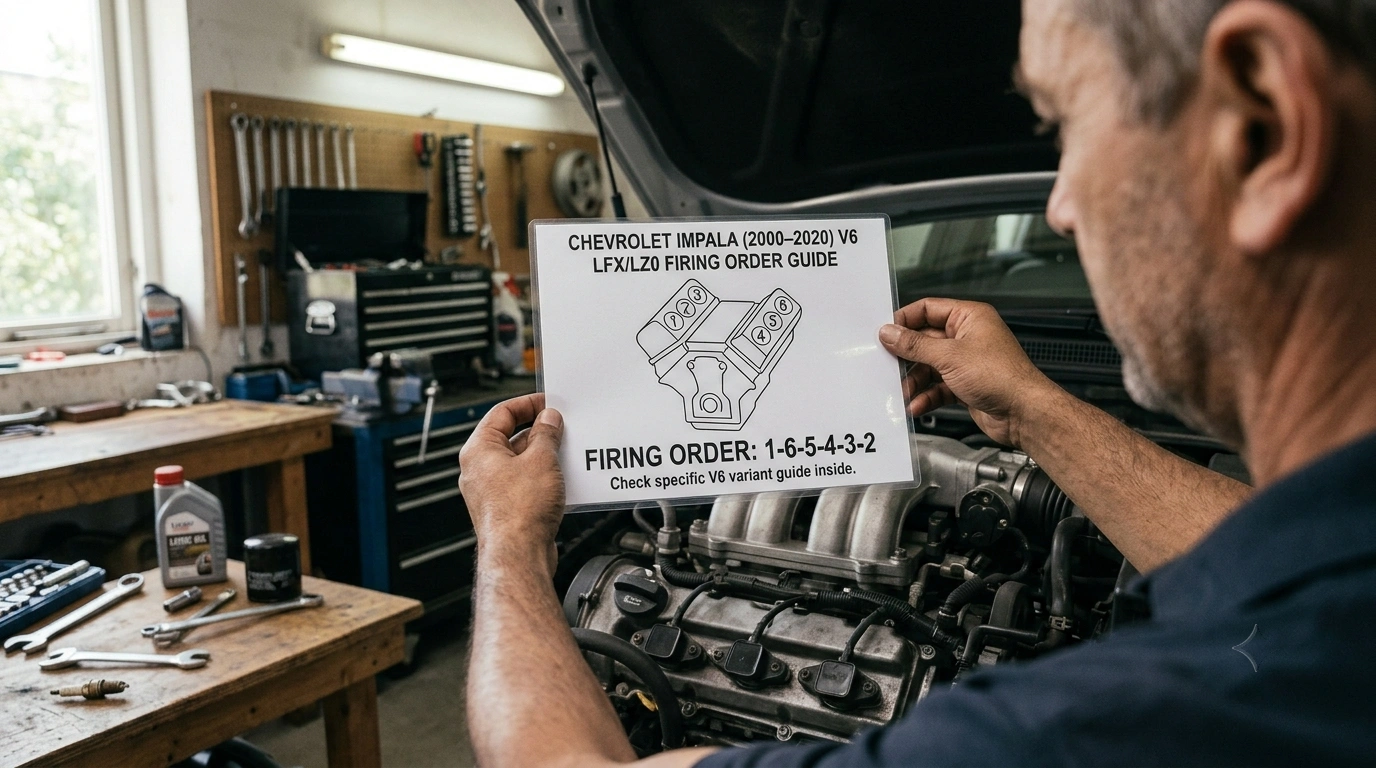
- Firing Order: 1-6-5-4-3-2
- Engine Type: 90-degree transverse V6
- Ignition System: Coil pack (DIS)
- Cylinder 1 Location: Front bank, passenger side
- Front bank (facing forward in engine bay): Cylinders 1, 3, 5 — passenger to driver
- Rear bank (toward firewall): Cylinders 2, 4, 6 — passenger to driver
The first and most important thing about the 3.8-liter: the firing order is completely different from the 3.4-liter. The 3.4-liter uses 1-2-3-4-5-6. The 3.8-liter uses 1-6-5-4-3-2. They are not interchangeable, and applying the wrong sequence to either engine produces immediate misfires.
The cylinder layout also flips. On the 3.8-liter, cylinder 1 moves to the front bank on the passenger side — the bank that faces the radiator. Cylinders 3 and 5 continue across that same bank toward the driver side. The rear bank (firewall side) holds 2, 4, and 6, again running from passenger to driver.
This layout inversion between the 3.4-liter and 3.8-liter confuses owners who have worked on one and then face the other for the first time. Always confirm which engine is under the hood before applying any cylinder numbering from memory.
The 3.8-liter also uses a DIS coil pack, but its three paired coil groups fire in the sequence dictated by the 1-6-5-4-3-2 order. The coil pairs are: 1 and 4, 2 and 5, 3 and 6 — each pair fired by one coil segment.
The Ninth Generation Impala (2006–2013) — Three V6 Options And The LS4 V8
The ninth-generation Impala ran from 2006 through 2013 and brought the most powertrain variety the model had ever offered in its modern history.
Three V6 engines appeared across those years, plus a 5.3-liter LS4 V8 that made the 2006–2009 Impala SS one of the most powerful front-wheel-drive cars sold in North America.
3.5-Liter LZE V6 (2006–2011) — Base Engine Firing Order
The 3.5-liter LZE replaced the 3.4-liter as the base engine for the ninth generation. It produced 211 horsepower.
- Firing Order: 1-2-3-4-5-6
- Engine Type: 60-degree transverse V6
- Ignition System: Coil-on-plug (no separate coil pack)
- Cylinder 1 Location: Rear bank, passenger side
- Rear bank: Cylinders 1, 3, 5 — passenger to driver
- Front bank: Cylinders 2, 4, 6 — passenger to driver
- Spark Plug Gap: 0.040 inches
The 3.5-liter LZE follows the same 1-2-3-4-5-6 sequence as the older 3.4-liter LA1, and the cylinder bank layout is identical. Cylinder 1 is in the rear bank on the passenger side. This consistency makes transitioning between 3.4-liter and 3.5-liter service fairly straightforward.
The ignition system, however, changed meaningfully. The ninth-gen 3.5-liter uses coil-on-plug ignition rather than the coil pack of the eighth-gen engines. Each cylinder has its own individual coil mounted directly on the spark plug.
This eliminates the spark plug wires entirely, and it means a coil failure produces a misfire on only one specific cylinder rather than two cylinders sharing the same coil segment.
Diagnosis becomes simpler — pull the misfire code, identify the cylinder, swap the coil to a known-good position and confirm whether the code moves with it.
3.9-Liter LZ9 V6 (2006–2011) — The Mid-Range Engine With A Different Sequence
The 3.9-liter LZ9 was the optional upgrade V6 for the ninth-generation Impala. It produced 224 to 240 horsepower depending on the model year. Some 2007 and later versions received Active Fuel Management, which deactivated one bank of cylinders under light loads.
- Firing Order: 1-6-5-4-3-2
- Engine Type: 60-degree transverse V6
- Ignition System: Coil-on-plug
- Cylinder 1 Location: Rear bank, passenger side
- Rear bank: Cylinders 1, 3, 5 — passenger to driver
- Front bank: Cylinders 2, 4, 6 — passenger to driver
The 3.9-liter returns to the 1-6-5-4-3-2 firing order — the same sequence used by the 3.8-liter in the eighth generation. However, the cylinder bank layout changes.
On the 3.9-liter, cylinder 1 sits in the rear bank (toward the firewall) on the passenger side. This is the opposite of the 3.8-liter, which placed cylinder 1 in the front bank.
This is a meaningful difference. If someone applies the 3.8-liter’s front-bank cylinder 1 position to the 3.9-liter while using the same firing sequence, the coil connections will be in the wrong locations even though the sequence itself is correct.
Always confirm cylinder location independently rather than assuming it carries over between engines that share the same firing sequence number.
Active Fuel Management on the 3.9-liter deactivates cylinders 1, 4, 6, and 7 — though the 3.9-liter being a V6 follows its own deactivation pattern deactivating one bank under light load. The AFM system does not change the firing order.
It simply bypasses specific cylinders within the existing sequence during low-demand conditions.
3.6-Liter LFX V6 (2012–2013 For Ninth Gen, Continued In Tenth Gen) — The Modern Sequence
The 3.6-liter LFX replaced both older V6 options for 2012 and carried through into the tenth generation. It was a significant upgrade at 300 horsepower and produced the smoothest power delivery of any Impala V6 up to that point.
- Firing Order: 1-2-3-4-5-6
- Engine Type: 60-degree DOHC transverse V6
- Ignition System: Coil-on-plug
- Cylinder 1 Location: Rear bank, passenger side
- Rear bank: Cylinders 1, 3, 5 — passenger to driver
- Front bank: Cylinders 2, 4, 6 — passenger to driver
- Spark Plug Type: Iridium (do not regap)
The LFX returns to the 1-2-3-4-5-6 sequence with the rear-bank cylinder 1 passenger-side layout. For anyone who serviced a ninth-generation 3.5-liter LZE, the LFX’s cylinder identification and firing sequence will feel familiar.
The coil-on-plug arrangement is the same, though the LFX uses DOHC cylinder heads and direct injection, making it a considerably more complex engine internally.
Intake valve carbon deposits are the dominant long-term maintenance concern on the LFX. Direct injection bypasses the intake valves entirely — fuel is sprayed directly into the combustion chamber, so oil vapors from the PCV system deposit on the valve backs without the fuel-wash cleaning action that port injection provides.
Carbon buildup begins to affect combustion quality on LFX engines around 60,000 to 80,000 miles, showing up as rough idle, hesitation under throttle, and reduced fuel economy. Walnut shell blasting with the intake manifold removed is the established professional remedy.
5.3-Liter LS4 V8 (2006–2009) — The Rarest And Most Powerful Impala Engine
The LS4 is one of the most unusual engines in American automotive history. It is a 5.3-liter V8 derived from the truck-duty LS engine family — but mounted transversely in a front-wheel-drive platform, driving the front wheels through a dedicated six-speed automatic transmission. No other LS-based V8 was ever installed this way.
- Firing Order: 1-8-7-2-6-5-4-3
- Engine Type: 90-degree transverse V8 (based on Gen IV LS)
- Output: 303 horsepower, 323 lb-ft torque
- Ignition System: Coil-on-plug
- Cylinder 1 Location: Upper bank, right side (passenger side) when viewed from front
- Upper bank (right to left from front): Cylinders 1, 3, 5, 7
- Lower bank (right to left from front): Cylinders 2, 4, 6, 8
The LS4’s firing order of 1-8-7-2-6-5-4-3 matches the standard Gen III and Gen IV LS firing sequence used across all of GM’s V8 truck and performance engines of that era — the same sequence as the Silverado’s 5.3-liter, the Corvette’s LS2, and the Camaro’s LS3. The sequence itself is not unusual.
What is unusual is the cylinder layout. Because the LS4 is mounted transversely in a front-wheel-drive Impala rather than longitudinally in a rear-wheel-drive application, the description of which cylinders are where requires a different reference frame.
Looking at the engine from the front of the car, the upper bank contains cylinders 1, 3, 5, and 7 running from right (passenger side) to left (driver side). The lower bank contains 2, 4, 6, and 8 in the same right-to-left direction.
The LS4 also used Active Fuel Management. Under light throttle conditions at highway speeds, the system deactivated cylinders 1, 4, 6, and 7, turning the V8 into an effective V4 to reduce fuel consumption.
The firing order did not change during this deactivation — the ECM simply skipped those cylinders within the existing sequence.
The Tenth Generation Impala (2014–2020) — Three Engines, Two Firing Sequences
The tenth-generation Impala launched for 2014 and ran through final production in 2020. It brought the Impala onto a new Alpha-derived platform, dramatically improved interior quality, and offered three engine options: a 2.5-liter naturally aspirated four-cylinder, a 2.4-liter hybrid four-cylinder (discontinued early), and the 3.6-liter LFX/LGX V6.
2.5-Liter LKW I4 (2014–2019) — The First Four-Cylinder Impala Engine
The 2.5-liter LKW was the first four-cylinder engine ever offered in an Impala. It produced 195 to 197 horsepower depending on the year.
- Firing Order: 1-3-4-2
- Engine Type: Naturally aspirated DOHC inline-four
- Ignition System: Coil-on-plug
- Cylinder 1 Location: Frontmost cylinder, closest to accessory belt
- Cylinder Layout: Sequential front to rear, 1-2-3-4
- Spark Plug Type: Iridium (pre-gapped, do not adjust)
The inline-four has no banks to manage — all four cylinders sit in a straight row. Cylinder 1 is at the front, nearest the serpentine belt and drive pulleys. Cylinder 4 is at the rear.
The firing order 1-3-4-2 alternates between front and rear positions to distribute combustion events evenly around the crankshaft. Misfire code P0301 through P0304 corresponds directly to cylinders 1 through 4 in their physical sequential order.
3.6-Liter LFX And LGX V6 (2014–2020) — The Primary Tenth-Gen Engine
The 3.6-liter V6 carried over from the ninth generation in LFX form through 2016, then transitioned to the updated LGX for 2017 onward.
- Firing Order: 1-2-3-4-5-6 (both LFX and LGX)
- Engine Type: 60-degree DOHC transverse V6
- LFX Output: 305 horsepower
- LGX Output: 305 horsepower with updated internal hardware
- Ignition System: Coil-on-plug
- Cylinder 1: Rear bank, passenger side
- Rear bank: 1, 3, 5 — passenger to driver
- Front bank: 2, 4, 6 — passenger to driver
The LGX updated the LFX with improved timing chain hardware, revised VVT cam phasers, and better oil consumption characteristics. The firing sequence and cylinder layout are identical between the two engines.
Complete Firing Order Reference Table — All Impala Engines 2000–2020
| Generation | Years | Engine | Displacement | Firing Order | Cylinder 1 Location | Ignition Type |
| 8th Gen | 2000–2005 | LA1 V6 | 3.4L | 1-2-3-4-5-6 | Rear bank, passenger side | Coil pack (DIS) |
| 8th Gen | 2000–2005 | Series II V6 | 3.8L | 1-6-5-4-3-2 | Front bank, passenger side | Coil pack (DIS) |
| 8th Gen | 2004–2005 | Supercharged 3.8L | 3.8L | 1-6-5-4-3-2 | Front bank, passenger side | Coil pack (DIS) |
| 9th Gen | 2006–2011 | LZE V6 | 3.5L | 1-2-3-4-5-6 | Rear bank, passenger side | Coil-on-plug |
| 9th Gen | 2006–2011 | LZ9 V6 | 3.9L | 1-6-5-4-3-2 | Rear bank, passenger side | Coil-on-plug |
| 9th Gen | 2006–2009 | LS4 V8 | 5.3L | 1-8-7-2-6-5-4-3 | Upper bank, passenger side | Coil-on-plug |
| 9th Gen | 2012–2013 | LFX V6 | 3.6L | 1-2-3-4-5-6 | Rear bank, passenger side | Coil-on-plug |
| 10th Gen | 2014–2019 | LKW I4 | 2.5L | 1-3-4-2 | Front cylinder (inline) | Coil-on-plug |
| 10th Gen | 2014–2016 | LFX V6 | 3.6L | 1-2-3-4-5-6 | Rear bank, passenger side | Coil-on-plug |
| 10th Gen | 2017–2020 | LGX V6 | 3.6L | 1-2-3-4-5-6 | Rear bank, passenger side | Coil-on-plug |
Ignition System Evolution — From Coil Packs To Coil-On-Plug
The eighth-generation Impala (2000–2005) used distributorless ignition with coil packs. A coil pack is a single housing containing three separate coil segments, each firing two cylinders in a waste-spark arrangement. One coil segment fires cylinders 1 and 4 simultaneously.
Another fires 2 and 5. The third fires 3 and 6. Only one of those two firings does useful work — the other happens on the exhaust stroke and wastes its spark, which is where the “waste-spark” name comes from.
This arrangement means a failed coil segment on an eighth-gen Impala always produces misfires on two cylinders, never one. If an OBD-II scan shows misfires on cylinders 1 and 4 simultaneously, the coil segment serving that pair has failed.
Replacing the entire coil pack assembly is the standard fix rather than attempting to replace individual segments.
From 2006 onward with the ninth-generation engines, the Impala moved to coil-on-plug ignition. Each cylinder received its own dedicated coil mounted directly above its spark plug.
The advantages are significant: higher voltage output per coil, longer plug life, easier single-cylinder misfire diagnosis, and no routing of spark plug wires that can deteriorate and cause misfires from insulation breakdown.
The diagnostic test for a coil-on-plug failure is the coil swap. Move the suspect coil to a different cylinder position and clear the fault codes. If the misfire code moves to the new cylinder position, the coil has confirmed failed.
If the misfire code stays on the original cylinder, the spark plug or injector on that cylinder is the more likely cause.
Spark Plug Specifications By Engine
| Engine | Code | Socket | OEM Plug | Gap | Torque | Interval |
| 3.4L V6 | LA1 | 5/8″ | ACDelco 41-932 | 0.060 in | 11–15 ft-lb | 30,000 mi |
| 3.8L V6 Series II | L36 | 5/8″ | ACDelco 41-932 | 0.060 in | 11–15 ft-lb | 30,000 mi |
| 3.5L V6 | LZE | 5/8″ | ACDelco 41-985 | 0.040 in | 11–15 ft-lb | 30,000 mi |
| 3.9L V6 | LZ9 | 5/8″ | ACDelco 41-985 | 0.040 in | 11–15 ft-lb | 30,000 mi |
| 5.3L V8 LS4 | LS4 | 5/8″ | ACDelco 41-985 | 0.040 in | 11–15 ft-lb | 100,000 mi (iridium) |
| 3.6L V6 | LFX/LGX | 5/8″ | ACDelco 41-110 | Pre-gapped | 13 ft-lb | 97,500 mi |
| 2.5L I4 | LKW | 5/8″ | ACDelco 41-110 | Pre-gapped | 13 ft-lb | 97,500 mi |
Important note on iridium plugs: the LS4, LFX, LGX, and LKW all use iridium-tipped plugs from the factory. Never manually adjust the gap on an iridium plug.
The center electrode is extremely fine and brittle — bending it to change the gap can fracture it internally, with fragments entering the combustion chamber. If a plug appears out of gap specification, return and replace it.
Frequently Asked Questions
What is the firing order for a 2000 Chevrolet Impala 3.8L?
The 2000 Impala with the 3.8-liter V6 uses a firing order of 1-6-5-4-3-2. Cylinder 1 is located in the front bank on the passenger side — the bank facing the radiator. Cylinders 3 and 5 continue across the front bank toward the driver side. The rear bank holds cylinders 2, 4, and 6 in the same direction. The ignition system is a coil pack with three segments firing cylinder pairs 1-4, 2-5, and 3-6.
Is the 3.4L and 3.8L Impala firing order the same?
No. The 3.4-liter LA1 uses 1-2-3-4-5-6 and the 3.8-liter Series II uses 1-6-5-4-3-2. The cylinder bank layout also differs between the two engines. The 3.4-liter places cylinder 1 in the rear bank (firewall side) while the 3.8-liter places it in the front bank (radiator side). Always confirm which engine is installed before applying any cylinder numbering or firing sequence.
What is the firing order for the Impala SS 5.3L V8?
The 5.3-liter LS4 V8 in the 2006–2009 Impala SS uses a firing order of 1-8-7-2-6-5-4-3. This is the standard LS-architecture V8 sequence used across all Gen III and Gen IV GM V8 engines. Because this engine is transversely mounted, the upper bank contains cylinders 1, 3, 5, and 7 from passenger to driver side. The lower bank contains 2, 4, 6, and 8 in the same direction.
What happens if the firing order is incorrect on an Impala engine?
An incorrect firing order produces immediate misfires. The engine will run very rough, the check engine light will illuminate, and specific misfire codes (P0301 through P0306 on V6 engines, P0301 through P0308 on the LS4 V8) will appear in OBD-II diagnostics. In some cases, the engine will not idle smoothly enough to remain running. On coil pack engines, swapping two spark plug wire connections causes both affected cylinders to misfire. On coil-on-plug engines, connecting a coil to the wrong cylinder produces a single-cylinder misfire on the incorrect position.
Does Active Fuel Management change the firing order on the 3.9L or LS4?
No. Active Fuel Management deactivates specific cylinders under light load conditions, but it does not resequence the firing order for the remaining cylinders. The system simply suspends fuel injection and valve operation on the deactivated cylinders while the others continue firing in the same sequence as always. When AFM exits and returns to full cylinder operation, all cylinders resume their standard positions within the unchanged firing sequence.
How do I identify cylinder 1 on a transverse Impala V6?
On all 3.4-liter, 3.5-liter, 3.9-liter, and 3.6-liter Impala V6 engines except the 3.8-liter: cylinder 1 is in the rear bank (closest to the firewall) on the passenger side. On the 3.8-liter specifically, cylinder 1 is in the front bank (facing the radiator) on the passenger side. The service documentation for each specific engine is the definitive reference when any doubt exists, as the bank assignment for cylinder 1 differs between the 3.8-liter and every other Impala V6.