Only one American engine family switched its fundamental firing sequence mid-production run without changing the car around it. The Chevrolet Camaro happened to be sitting right on top of it when that switch occurred.
A 1997 Z28 and a 1998 Z28 look nearly identical, share a badge, and even share a basic 5.7-liter displacement. Yet their V8s fire in completely different orders.
That’s just one chapter in a much longer story spanning four separate Camaro generations and a handful of production gaps most owners never think about. Six-cylinder engines, small block V8s, a supercharged monster, and even a turbocharged four-cylinder have all worn the Camaro badge since 1993.
Every one of those engines fires its cylinders differently, and sorting out which sequence applies to which car gets covered here in complete detail.
Firing Order Basics And Why The Camaro Has Such A Layered History
Firing order describes the exact sequence in which an engine ignites fuel inside each cylinder. That sequence gets engineered around crankshaft geometry, not chosen arbitrarily by whoever designed the intake manifold.
Few nameplates changed engine architecture as often as the Camaro did across three decades of on-and-off production. That variety makes this a genuinely more complicated topic than most single-generation vehicles.
What Firing Order Actually Does Inside An Engine
Every cylinder fires at a specific point in crankshaft rotation, not randomly or in numerical order. A V6 completes one firing event every 120 degrees of rotation, while a V8 packs a firing event into every 90 degrees.
Engineers space these events out deliberately across the crankshaft. Even spacing keeps vibration low and spreads mechanical stress evenly across bearings, mounts, and the crank itself.
Older Camaros routed this sequence through a physical distributor, sending spark down individual plug wires in the exact firing order. Getting that wrong meant an engine that ran rough, backfired, or refused to start entirely.
Newer Camaros handle this electronically instead, using individual ignition coils controlled by the engine computer. Firing order still matters just as much, just in the form of programmed logic rather than a distributor cap and wires.
Anyone chasing a misfire code benefits from knowing exactly where a specific cylinder sits. That knowledge turns a vague dashboard warning into a five-minute inspection instead of a guessing game.
Shared Engines Across The Wider GM Lineup
None of these Camaro engines existed in isolation. The LT1 also powered the C4 Corvette and full-size Impala SS, while the LS1 debuted in the 1997 Corvette a full year before reaching the Camaro.
The 3.6-liter High Feature V6 found in fifth and sixth-generation Camaros powered Cadillac sedans, Buick crossovers, and even vehicles built by Holden in Australia.
That shared architecture means firing order knowledge gained from working on a Camaro often transfers directly to a surprising range of other GM products.
The 6.2-liter small block tells a similar story, appearing across Corvettes, Silverado and Sierra trucks, and Cadillac’s CTS-V and Escalade lineup with only minor internal differences.
A technician comfortable with a Camaro SS engine bay can walk into most GM performance and truck applications from the same era with minimal relearning.
This cross-pollination isn’t accidental. GM has long favored spreading engineering costs across as many vehicles as possible, which is precisely why so few genuinely unique firing order patterns exist across the company’s entire modern lineup.
Four Distinct Eras And Four Different Combustion Sequences
Fourth-generation Camaros, built from 1993 through 2002, used two separate V6 engines and two separate V8 architectures across that single decade. That’s already more variety than most vehicles see across their entire lifespan.
Fifth-generation cars, sold from 2010 through 2015, brought back a modernized V6 alongside GM’s LS-family small block V8, eventually adding a supercharged monster and a race-bred naturally aspirated option. Sixth-generation Camaros, built 2016 through 2024, added a turbocharged four-cylinder to the mix for the first time in the nameplate’s history.
None of these engine families share an identical firing order with each other. A technician grabbing the wrong reference sheet can waste real time hunting for a cylinder that simply isn’t where they expect it to be.
Treating each generation, and in one notable case each half of a single generation, as its own distinct research question avoids that entire headache.
Fourth Generation Firing Order From 1993 Through 2002
The original fourth-generation Camaro offered four completely different engines across its ten-year run. Two were V6 options and two were V8 options, split roughly down the middle of the generation’s timeline.
Sorting these out means looking at both cylinder count and the specific years each engine actually appeared under the hood.
V6 Firing Order For The 3.4L And 3800 Series Engines
Base Camaros from 1993 through 1995 came standard with a 3.4-liter V6, producing a modest 160 horsepower. This engine used a 1-6-5-4-3-2 firing order, a pattern rooted in GM’s small-block-derived V6 architecture from that era.
Starting in 1995, Chevrolet added the 3800 Series II V6 as a second, more refined option, and by 1996 it had fully replaced the 3.4-liter as the sole base engine.
Despite coming from a completely different design lineage, tracing back to the Buick V6 rather than a small block, the 3800 also uses a 1-6-5-4-3-2 firing order.
That shared numerical sequence hides a real difference worth knowing about. Cylinder bank placement differs between the two engines, and this specific detail has confused enough Camaro owners over the years to generate its own small pile of forum threads and misdiagnosed misfires.
Getting a coil or plug wire on the wrong cylinder during a DIY repair on either V6 produces an immediate, obvious rough-running result. A written reference specific to the exact engine, not just the word “V6,” avoids that mistake entirely.
Why The V8 Firing Order Changed Mid-Generation
Z28 models from 1993 through 1997 came with the 5.7-liter LT1, a Corvette-derived small block using a distinctive reverse-flow cooling system and a front-mounted Optispark distributor.
This engine retained the traditional 1-8-4-3-6-5-7-2 firing order used by Chevrolet small blocks since the 1950s.
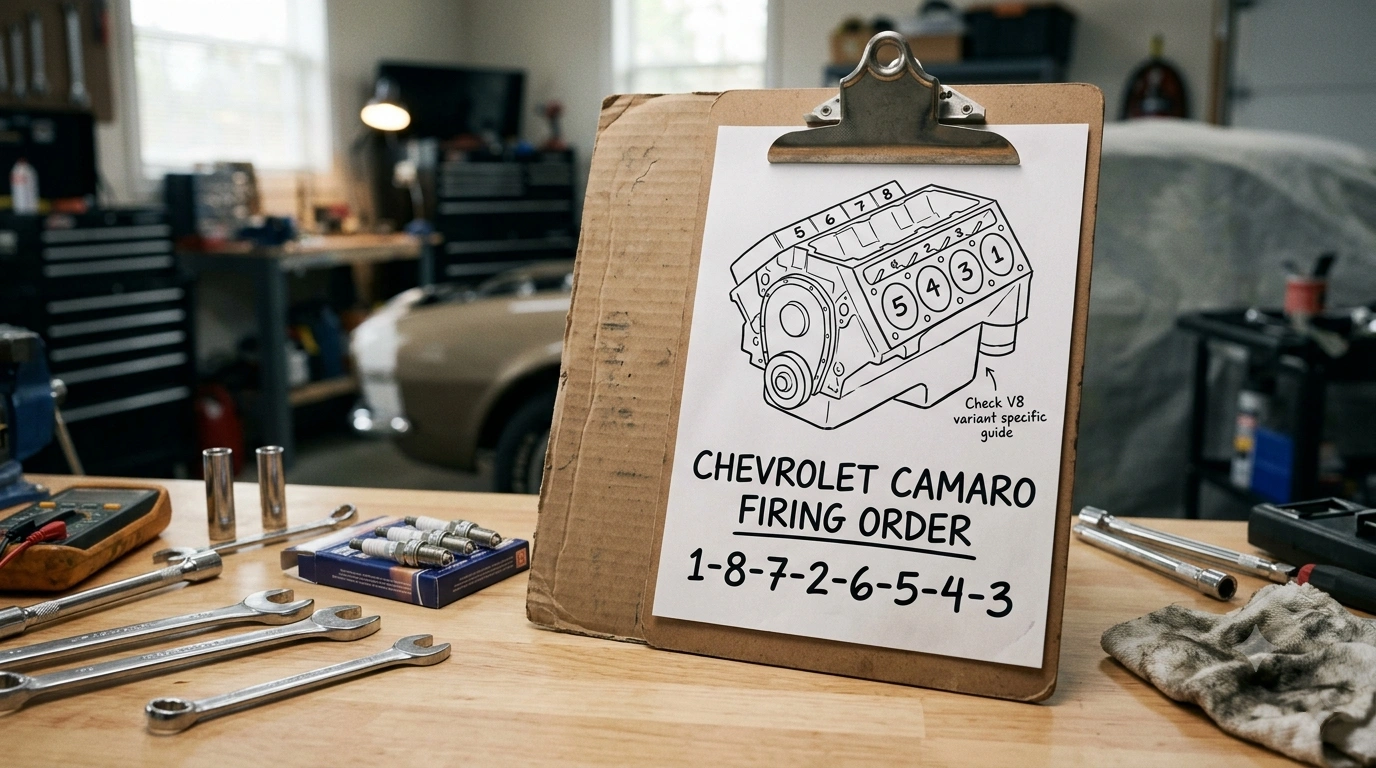
Everything changed for 1998. GM replaced the LT1 with the all-new LS1, part of the Gen III small block family that would go on to power Camaros, Corvettes, and countless GM trucks for decades afterward. This new engine switched to a firing order of 1-8-7-2-6-5-4-3.
Engineers made this change specifically to reduce torsional stress on the crankshaft, swapping the firing position of two cylinder pairs from the old pattern. It’s a small-sounding change with a real mechanical purpose behind it, not an arbitrary redesign.
A vanishingly rare exception exists too. Just over 100 examples of the 1997 Camaro SS came with the LT4, a hand-built, high-performance version of the outgoing LT1, meaning even that final pre-LS1 model year included one last engine sharing the older firing order.
Here’s how the complete fourth-generation lineup breaks down:
| Engine | Model Years | Type | Firing Order |
| 3.4L V6 | 1993-1995 | Base | 1-6-5-4-3-2 |
| 3800 Series II V6 | 1995-2002 | Base | 1-6-5-4-3-2 |
| 5.7L LT1 V8 | 1993-1997 | Z28 | 1-8-4-3-6-5-7-2 |
| 5.7L LS1 V8 | 1998-2002 | Z28, SS | 1-8-7-2-6-5-4-3 |
Fifth And Sixth Generation Firing Order From 2010 Through 2024
Chevrolet revived the Camaro for 2010 after a seven-year hiatus, and the engine lineup that followed looked completely different from anything the fourth generation offered. Every single engine across both of these later generations traces back to GM’s modern High Feature and Gen III/IV/V small block families.
That shared lineage actually simplifies this section considerably compared to the fourth generation’s split-personality V8 story.
3.6L V6 Firing Order Across Both Generations
Every V6 Camaro built from 2010 through 2024 used some version of GM’s 3.6-liter High Feature engine, badged LLT for 2010 and 2011, then LFX from 2012 through 2015, and finally LGX for the entire sixth-generation run. All three variants share an identical 1-2-3-4-5-6 firing order.
This High Feature architecture is a completely different engine family from either the old 3.4-liter or the 3800 Series used in the fourth generation. Cylinder banks split into odd and even numbers exactly as they do on the older V6 engines, but the physical bank arrangement differs enough that a fourth-generation diagram offers no shortcuts here.
Output climbed steadily across this run, starting around 304 horsepower on the LLT and eventually reaching 335 horsepower with the LGX in later sixth-generation trims. None of those power gains touched the underlying firing sequence, which stayed identical across all three engine codes.
Owners cross-shopping a fifth-generation V6 against a sixth-generation V6 can use the same firing order reference without hesitation. The generation gap that mattered so much for the fourth-generation V8 story simply doesn’t apply here.
6.2L V8 Firing Order From SS To ZL1 And Z/28
Every 6.2-liter V8 offered across the fifth and sixth generations shares the same 1-8-7-2-6-5-4-3 firing order established back with the 1998 LS1. That includes the L99 and LS3 versions of the fifth-generation SS, split by transmission choice, along with the sixth-generation LT1 that replaced both.
Forced-induction variants follow the identical pattern despite their dramatically higher output. The supercharged LSA powering the 2012 through 2015 ZL1 and the supercharged LT4 powering the 2017 through 2024 ZL1 both fire in the same 1-8-7-2-6-5-4-3 sequence as the naturally aspirated engines sharing showroom space with them.
The 7.0-liter LS7, reserved for the track-focused 2014 and 2015 Z/28, stands out for its displacement and race-bred pedigree rather than any firing order quirk.
It uses the same 1-8-7-2-6-5-4-3 pattern as every other engine in this section, proving displacement and power output have no bearing on the underlying sequence.
This consistency traces directly back to GM’s decision to standardize Gen III, Gen IV, and Gen V small block engines around one firing order for over two decades. A technician comfortable with a base SS can walk up to a ZL1 or Z/28 and use identical cylinder logic without missing a beat.
Where The 2.0L Turbo Four-Cylinder Fits In
Sixth-generation Camaros introduced something the nameplate had never offered before: a turbocharged four-cylinder as the entry-level engine. This 2.0-liter LTG, shared with the Cadillac ATS and CTS of the same era, produced a genuinely competitive 275 horsepower.
Its firing order runs 1-3-4-2, the standard pattern for the vast majority of inline-four engines on the road. Cylinder numbering follows a simple front-to-back line, with cylinder one sitting nearest the drive belt and cylinder four closest to the transmission.
Skeptics dismissed this engine at launch given the Camaro’s V8-heavy reputation, yet it delivered genuinely quick acceleration thanks to a wide torque band and a relatively light curb weight up front.
It remained available across the entire 2016 through 2024 production run without a major redesign.
Anyone servicing this specific engine benefits from remembering it shares nothing mechanically with the V6 or V8 options in the same generation.
Ignition components, cylinder count, and firing sequence all differ completely from its six- and eight-cylinder showroom neighbors.
Here’s the full fifth and sixth-generation lineup at a glance:
| Engine | Model Years | Trim | Firing Order |
| 2.0L Turbo LTG | 2016-2024 | Base | 1-3-4-2 |
| 3.6L V6 (LLT/LFX/LGX) | 2010-2024 | V6 | 1-2-3-4-5-6 |
| 6.2L V8 (L99/LS3/LT1) | 2010-2024 | SS | 1-8-7-2-6-5-4-3 |
| 6.2L Supercharged (LSA/LT4) | 2012-2024 | ZL1 | 1-8-7-2-6-5-4-3 |
| 7.0L LS7 | 2014-2015 | Z/28 | 1-8-7-2-6-5-4-3 |
Where The Camaro Nameplate Actually Stands In 2026
A firing order guide covering a specific year range only stays useful if it’s honest about what actually existed during that span. The Camaro’s history includes real gaps that catch plenty of people off guard.
This section exists specifically to clear up confusion around the later end of that range.
Two Production Gaps Most Owners Never Think About
Chevrolet stopped building the Camaro entirely after the 2002 model year, and no replacement arrived until the fifth generation launched for 2010. That seven-year gap means no Camaro exists from 2003 through 2009, regardless of how a firing order search might be phrased.
A second gap opened more recently. Sixth-generation production ended in January 2024 at the Lansing Grand River plant in Michigan, and Chevrolet has not built a Camaro since.
As of mid-2026, no current-production Camaro exists on dealer lots, despite ongoing speculation and reporting about a future replacement.
Chevrolet’s own leadership has been clear that this pause isn’t necessarily permanent. Reports throughout 2026 point toward a next-generation model built on a rear-wheel-drive Alpha-based platform, though production isn’t expected to begin before late 2027 at the earliest, arriving as a 2028 model at best.
Anyone searching for a “2026 Camaro” firing order should understand there’s currently no such vehicle to reference. The most recent Camaro engines remain the 2.0-liter turbo, 3.6-liter V6, and 6.2-liter V8 family covered in the previous section, all tied to the 2024 model year and earlier.
Chevrolet has kept the nameplate alive in other ways during this pause. The company renewed the Camaro trademark in late 2025, and an updated Camaro ZL1 body continues racing in the NASCAR Cup Series for the 2026 season, even though no matching street car currently exists.
What A Future Camaro Could Mean For This Topic
Early reporting on a seventh-generation Camaro suggests GM has approved internal combustion power rather than committing to an electric-only approach, a reversal from earlier speculation about a fully electric successor.
A rear-wheel-drive platform derived from the current Cadillac Alpha architecture also points toward continuity with familiar V8 and V6 layouts rather than a completely foreign engineering approach.
If that combustion-engine direction holds, a future Camaro would likely continue using some version of GM’s existing small block or High Feature V6 family, given how thoroughly those architectures already serve trucks, SUVs, and remaining performance cars across the lineup. That would mean familiar firing order patterns rather than an entirely new sequence to learn.
Nothing here is confirmed, and GM has not released technical specifications for any future model. Treating current reporting as a preview rather than a settled fact avoids getting ahead of information that hasn’t been officially released.
Until an actual production vehicle arrives, the firing order information covering 1993 through 2024 remains the complete, accurate picture for this nameplate.
Using Firing Order Knowledge For Real Camaro Work
None of this stays theoretical once a check engine light appears or an engine starts running rough. Firing order and cylinder position knowledge turns a vague symptom into a specific, targeted repair.
The next two sections apply everything covered so far to real diagnostic and maintenance situations.
Diagnosing A Misfire By Generation And Engine
A scan tool reading a P0301 through P0308 code identifies a misfiring cylinder by its physical position, never by where that cylinder falls in the firing sequence itself.
Confirming the exact engine code first matters enormously, since the same cylinder number sits in a different physical spot depending on which of these engine families is involved.
Once the engine is confirmed, matching it against the correct chart from earlier in this piece points straight to the affected coil, plug, or injector. Swapping a suspect coil or injector with a known-good unit from another cylinder remains one of the simplest confirmation tests available across every generation covered here.
Pre-1998 LT1 owners face one additional wrinkle worth flagging. The Optispark distributor on these engines developed a reputation for internal moisture and wear issues, and a failing unit can produce symptoms that mimic a firing order problem even though the underlying sequence never actually changes on a healthy engine.
Direct-injected engines like the LFX, LGX, and LT1 small block face a different challenge: carbon buildup on intake valves, since fuel no longer washes over them the way it does on older port-injected designs like the LS1 or LS3.
Maintenance Habits That Matter Most On These Engines
Spark plugs and ignition coils on any Camaro V6 or V8 benefit from inspection before symptoms appear, particularly on high-mileage fourth-generation cars where original ignition components are now decades old.
Extended-life plugs on the newer LS-family and High Feature engines typically last well beyond 60,000 miles under normal use.
Optispark-equipped LT1 engines deserve special attention during routine service. Water intrusion around the water pump area has historically caused premature Optispark failure, so addressing any coolant leak near that component quickly prevents a much larger ignition repair down the road.
Timing chain wear affects every LS-family and High Feature V6 engine covered here at high mileage. A stretched chain won’t alter the programmed firing order, but it can throw crank and cam sensor signals out of sync enough to trigger stored misfire codes or a rough idle.
Keeping the exact engine code, not just displacement or generation, noted in any service record prevents the single most common mistake across this entire thirty-year lineup: assuming two Camaros sharing a similar badge also share identical parts and specifications.
Confirming An Engine Before Ordering Parts
Displacement alone rarely tells the whole story on a Camaro with this much engine history behind it. Two different V6 engines share a 3.6-liter badge across the fifth and sixth generations, and two completely different V8 architectures both wore a 5.7-liter label during the fourth generation alone.
The engine code stamped on the block, combined with a VIN decode available through most parts stores, settles any doubt within minutes.
RPO codes on a build sheet or door jamb sticker offer another reliable confirmation point, particularly on fourth-generation cars where the LT1 and LS1 look deceptively similar from a distance.
Ordering ignition coils, plugs, or a distributor cap based on model year and displacement alone remains one of the most common mistakes among Camaro owners tackling their own repairs.
A five-minute VIN check before any parts order prevents a wasted trip back to the counter and a second round of research.
A quick reference for common symptoms across this lineup:
| Symptom | Likely Cause | Applies To |
| Rough idle, specific cylinder code | Failing coil, plug, or injector | All Camaro engines |
| Backfire or no-start after ignition work | Plug wires out of sequence | Pre-1998 LT1, 3800, 3.4L |
| Moisture-related misfire | Failing Optispark distributor | 1993-1997 LT1 |
| Misfire only after cold start | Carbon buildup on intake valves | LFX, LGX, LT1 small block |
Frequently Asked Questions
What is the firing order of a 1993-1997 Camaro LT1 V8?
The LT1 uses a 1-8-4-3-6-5-7-2 firing order, the same traditional sequence Chevrolet small blocks used since the 1950s. This applies to every Z28 built between 1993 and 1997, including the rare 1997 LT4 version.
What is the firing order of a 1998-2002 Camaro LS1 V8?
The LS1 switched to a 1-8-7-2-6-5-4-3 firing order when it replaced the LT1 for the 1998 model year. This same sequence carried forward into every LS-family V8 used in later Camaro generations.
Why did the Camaro V8 firing order change in 1998?
GM’s engineers revised the sequence to reduce torsional stress on the crankshaft, swapping the firing position of two cylinder pairs from the older pattern. This change accompanied the broader shift to the all-new Gen III small block architecture.
What is the firing order of the Camaro’s 3800 V6?
The 3800 Series II V6, used from 1995 through 2002, fires in a 1-6-5-4-3-2 sequence. This matches the earlier 3.4-liter V6’s firing order despite the two engines coming from different design lineages.
Is the 3.4L V6 firing order different from the 3800 V6?
No, both the 1993-1995 3.4-liter and the 1995-2002 3800 Series II share an identical 1-6-5-4-3-2 firing order. Cylinder bank placement differs slightly between the two, which has caused real confusion during DIY ignition repairs over the years.
What is the firing order of a fifth-generation Camaro 3.6 V6?
The 3.6-liter High Feature V6, badged LLT and later LFX, uses a 1-2-3-4-5-6 firing order. This same sequence continued unchanged into the sixth generation’s LGX version.
Does the ZL1’s supercharged V8 use a different firing order than the SS?
No, both the supercharged LSA and LT4 engines share the identical 1-8-7-2-6-5-4-3 firing order used by the naturally aspirated SS engines. Supercharging changes airflow and boost pressure, not the underlying combustion sequence.
What is the firing order of the Camaro’s 2.0 turbo four-cylinder?
The LTG turbo four, offered exclusively in the sixth generation, fires in a 1-3-4-2 sequence. This is standard for most GM inline-four engines and shares nothing with the V6 or V8 firing patterns used elsewhere in the same generation.
Is there a 2026 Chevrolet Camaro currently in production?
No, Chevrolet has not built a Camaro since sixth-generation production ended in January 2024. Reports point toward a future model arriving no earlier than the 2028 model year, but nothing has been confirmed as of mid-2026.
Did the Camaro ever stop production before 2024?
Yes, Chevrolet paused Camaro production entirely between the 2002 and 2010 model years, a seven-year gap between the fourth and fifth generations. No Camaro exists from the 2003 through 2009 model years.
What is the firing order of the LS7 in the Z/28?
The 7.0-liter LS7, offered only for 2014 and 2015, uses the same 1-8-7-2-6-5-4-3 firing order as every other LS-family V8 in the Camaro lineup. Its larger displacement and race-derived internals don’t change the underlying sequence.
Which cylinder is number one on a Camaro V8?
On every LS-family V8 from 1998 onward, cylinder one sits at the front of the driver’s side bank. The earlier LT1, despite sharing the same physical bank layout, uses a completely different firing sequence starting from that same cylinder.
Can I use a fourth-generation firing order diagram on a fifth or sixth-generation car?
No, none of the modern High Feature V6 or Gen III through Gen V small block engines share a firing order with the older 3.4L, 3800, LT1, or even the early LS1 generation’s specific cylinder mapping conventions. Always confirm the exact engine code before referencing a chart.
Where can I confirm the exact firing order for my specific Camaro?
A factory service manual matched to the exact model year and engine code remains the most reliable source. Most auto parts stores can also pull a firing order reference for free once given the vehicle’s VIN.
Will a future Camaro use the same firing order patterns?
Nothing is confirmed yet, though early reporting suggests a future model would use internal combustion power on a platform related to GM’s current rear-wheel-drive architecture. That would likely mean continuity with existing small block or V6 firing order families rather than an entirely new pattern.
Does the LT1 and LS1 look similar even though they fire differently?
Yes, both are 5.7-liter V8s sharing a similar general layout, which makes visual identification tricky for anyone unfamiliar with the two designs. The Optispark distributor at the front of the LT1 is the clearest visual giveaway, since the LS1 has no distributor at all.
Did the Camaro ever share an engine with the Corvette?
Yes, both the LT1 and LS1 debuted in the Corvette before reaching the Camaro, and the 6.2-liter small block family used in later SS and ZL1 models shares core architecture with Corvette engines of the same era.
Is the Camaro’s engine history unusual compared to other muscle cars?
Somewhat, since few competitors packed two distinct V8 firing order patterns and two distinct V6 designs into a single continuous production run the way the fourth-generation Camaro did between 1993 and 2002.
Three decades, four generations, and a firing order that genuinely changed partway through one of them still boil down to a manageable set of numbers once the correct engine gets identified. A 3.4L or 3800 V6 fires 1-6-5-4-3-2, an LT1 fires 1-8-4-3-6-5-7-2, and every LS-family V8 since 1998 fires 1-8-7-2-6-5-4-3.
Add the 2.0-liter turbo four’s 1-3-4-2 sequence, and that covers every Camaro built between 1993 and the nameplate’s current pause. That range of engineering, spread across engines shared with everything from the Corvette to Cadillac’s luxury lineup, is part of what makes this particular nameplate such a genuinely layered case study.