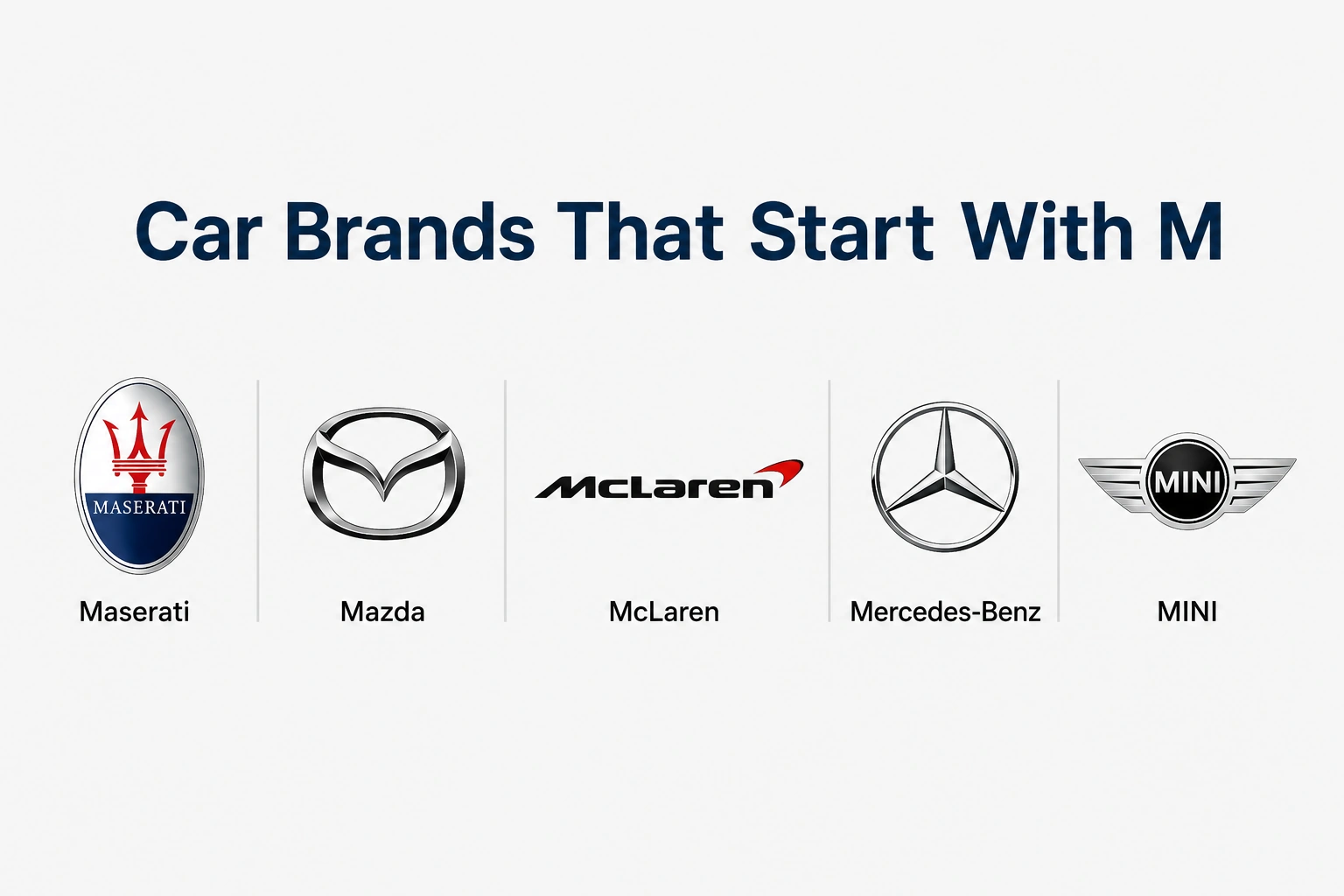
No letter in the automotive alphabet carries quite the same weight as M. Mercedes-Benz invented the modern automobile and still sets the benchmark for luxury sedans. Mazda remains one of the last holdouts building genuinely engaging combustion engines while quietly developing rotary-hybrid technology nobody else dares touch.
McLaren and Maserati represent two completely different versions of Italian and British speed, and MINI somehow still feels like a go-kart decades after BMW took over the badge. Then there’s the model side — Mustang, Model 3, Model Y, M3, M5 — names so culturally loaded that they’ve outgrown the cars themselves and become shorthand for entire categories of vehicle.
What makes M genuinely interesting in 2026 is the sheer range packed into one letter. Mahindra is exporting electric SUVs from India at price points that would be unthinkable from a European brand.
Maserati has gone all-in on its electric Folgore range while still building V8s. MG, once a quintessentially British roadster maker, is now a Chinese-owned sales juggernaut across Europe and Asia.
This guide covers the brands and the models — separately, broadly, and with the specifics that actually matter when you’re deciding what to drive or simply settling a curiosity.
Car Brands That Start With M
1. Mercedes-Benz
Mercedes-Benz traces its roots to 1926, formed from the merger of Karl Benz’s and Gottlieb Daimler’s separate companies — and Karl Benz’s 1886 Patent-Motorwagen is widely credited as the first true automobile. Few brands carry that kind of literal founding-father status in an entire industry, and Mercedes has spent the century since reinforcing it through the S-Class, which remains the reference point for what a luxury sedan should feel like.
- Key Models: S-Class, E-Class, C-Class, GLE, EQS, CLE, G-Class
- Price Range: From roughly $45,000 (A-Class/CLA equivalents in some markets) to over $250,000 (Maybach and AMG GT variants)
- Known For: Engineering pedigree, Burmester/Mark Levinson-tier audio options, MBUX infotainment with AI integration
- 2026 Status: Active; expanding electric lineup (EQS, EQE, electric G-Class) alongside continued combustion and hybrid models
- Sub-brands: Mercedes-AMG (performance), Mercedes-Maybach (ultra-luxury)
2. Mazda
Mazda is the quintessential five-letter car brand starting with M, founded in 1920 in Hiroshima, Japan. Known globally for its “Zoom-Zoom” philosophy — a marketing phrase that genuinely reflects an engineering priority — Mazda has built its identity around making even affordable cars feel rewarding to drive, a position few mass-market brands bother defending anymore.
- Key Models: Mazda3, CX-5, CX-50, CX-70, CX-90, MX-5 Miata
- 2026 CX-5 (redesigned): All-wheel drive standard across all five trims (2.5 S, Select, Preferred, Premium, Premium Plus); 2.5L 4-cylinder, 187 hp / 185 lb-ft torque; fuel economy 24/30/26 mpg city/highway/combined; 4.5-inch increase in length and wheelbase over the previous generation; seven-color ambient lighting; “MAZDA” lettering replaces traditional badge
- 2026 CX-90 Plug-In Hybrid: MSRP ranging from approximately $49,500 to $61,800 depending on trim (Preferred through Premium Plus)
- Known For: Rotary-hybrid technology development continuing into 2026; among the few manufacturers still committed to genuinely engaging combustion-engine driving dynamics
- MX-5 Miata: Best-selling two-seat roadster of all time, prized for lightweight design
3. Maserati
Founded in 1914 in Bologna, Italy, Maserati blends luxury and performance in a way that’s distinctly Italian — loud, emotionally driven, and visually dramatic even when parked. The brand’s Trident logo is inspired by the Fountain of Neptune in Bologna, a detail that captures how deeply Maserati’s identity is tied to its home city.
- Key Models: Ghibli, Quattroporte, Levante, GranTurismo, MC20, Grecale
- 2026 Lineup: Features the fully electric Folgore range alongside continued V6 and V8 combustion models — proof that Maserati is hedging rather than abandoning its traditional engine character
- Price Range: Generally from approximately $80,000 (Grecale) to well over $200,000 (MC20 and high-spec GranTurismo variants)
- Known For: Distinctive engine sound (historically tuned with input from Ferrari-derived engineering), Italian interior craftsmanship
- Rivalry Context: Frequently cross-shopped against Mercedes-AMG and Porsche in the high-end sports sedan and SUV market
4. McLaren
McLaren Automotive, founded in 1963 (with its road car division established far more recently), represents the pinnacle of British performance engineering, drawing directly on the company’s Formula 1 heritage. Models like the Artura, 720S, and the legendary hybrid hypercar P1 define the cutting edge of what a road-going supercar can do.
- Key Models: Artura (hybrid), 720S, 750S, GT, P1 (discontinued, now a collector’s icon)
- Price Range: Generally starting around $230,000 (Artura) and extending well past $300,000 for flagship and limited-edition models
- Used Market Reference: A used 2020 McLaren 600LT Spider has been listed at approximately $245,000
- Known For: Carbon-fiber monocoque construction across the lineup (a rarity even among supercar rivals), F1-derived aerodynamics
- 2026 Status: Active; Artura represents the brand’s hybrid future while V8-powered models continue alongside it.
5. Mitsubishi
Mitsubishi Motors, part of the larger Mitsubishi Group, is a Japanese automaker that became predominantly owned by Nissan in June 2016, placing it within the Renault-Nissan-Mitsubishi Alliance. Once celebrated for its rally pedigree through the Lancer Evolution series, the brand has pivoted decisively toward practical SUVs and plug-in hybrids in the 2020s.
- Key Models: Outlander, Outlander PHEV, Eclipse Cross, Mirage, Pajero/Montero (international markets)
- Known For: Super All-Wheel Control (S-AWC) — a torque-vectoring AWD system found across the Outlander lineup, offering genuinely capable all-weather performance for the price point
- Price Range: Among the most affordable in the segment; the Mirage has historically been one of the lowest-priced new cars sold in the US
- 2026 Status: Active; continued focus on PHEV technology in the Outlander, leveraging Alliance-shared platforms with Nissan and Renault
6. MINI
MINI, stylized as “MINI,” has been owned by BMW since 2000, though the Mini name has been associated with car models since 1959 — originally as the separate Austin Mini and Morris Mini badges before becoming an independent marque in 1969. BMW’s 1994 acquisition of Rover Group brought the Mini badge into BMW’s portfolio, and the brand has operated as BMW’s compact-car division ever since.
- Key Models: Cooper, Cooper S, Countryman, Aceman (electric)
- Known For: Go-kart-like handling in a genuinely compact footprint — a character BMW has preserved even as the cars have grown larger over successive generations
- 2026 Status: Active; expanding electric lineup with Cooper Electric and Aceman alongside continued combustion Cooper models
- Historical Note: Originally conceived as a compact, fuel-efficient response to the 1950s fuel crisis — a positioning that has come full circle with its current electric models
7. Maybach
Maybach Motorenbau was founded in 1909 by Wilhelm Maybach and his son, originally as a subsidiary of Luftschiffbau Zeppelin GmbH (the Zeppelin airship company) under the name Luftfahrzeug-Motorenbau GmbH until 1912. The original Maybach company became defunct as an independent automaker decades ago, but the name now operates as Mercedes-Benz’s ultra-luxury sub-brand.
- Key Models: Mercedes-Maybach S-Class, Mercedes-Maybach GLS
- Known For: Representing the absolute pinnacle of Mercedes-Benz’s luxury offerings — extended wheelbases, reclining rear seats, and bespoke interior materials beyond even top-trim S-Class specifications
- Comparison Context: Frequently discussed in the “Maybach vs Rolls-Royce” debate as the benchmark for ultra-luxury sedan comparisons
- 2026 Status: Active as a Mercedes-Benz sub-brand; positioned directly against Rolls-Royce and Bentley
8. Mahindra
Mahindra is an Indian manufacturer founded in 1945, producing everything from rugged off-roaders to tractors and, increasingly, electric vehicles. The brand has expanded its global ambitions significantly in the 2020s, with electric SUVs designed to compete on price while offering genuinely modern specifications.
- Key Models: XEV 9e, BE 6 (electric SUVs), Scorpio, Thar (off-road models)
- Known For: Aggressive value positioning combined with rugged off-road capability; expanding EV lineup aimed at both domestic Indian and export markets
- 2026 Status: Active and expanding; positioning itself as a genuine global EV player from a non-traditional manufacturing base
- Market Position: One of the most significant non-European, non-East-Asian automakers pushing into electrified mobility at scale
9. MG
The story of MG is genuinely a tale of two eras. Originally a British sports car manufacturer founded in 1924, famous for small, affordable roadsters, the brand is now owned by China’s SAIC Motor. In 2026, MG is a sales juggernaut across Europe and Asia, producing affordable EVs alongside the Cyberster — an electric roadster that deliberately pays homage to the brand’s British sports car heritage.
- Key Models: MG4, MG ZS EV, Cyberster (electric roadster)
- Known For: Aggressive pricing on EVs in European and Asian markets, combined with styling that nods to MG’s sports car past
- 2026 Status: Active and expanding rapidly; one of the fastest-growing brands by volume in markets where Chinese-owned manufacturers have gained significant traction
- Origin Note: Country of origin remains listed as the United Kingdom for branding purposes, despite Chinese ownership since 2007
10. Morgan
Morgan Motor Company, founded in 1910 in Malvern, England, is a British automaker producing hand-crafted, retro-styled sports cars using construction techniques — including wood-framed bodies on certain models — that have barely changed in decades, blended with genuinely modern engines and technology underneath.
- Key Models: Plus Four, Super 3, Aero 8 (discontinued, now a sought-after model)
- Known For: Combining classic, almost anachronistic design with modern BMW-sourced engines for a driving experience unlike anything else on sale
- Production Scale: Extremely low volume; each car effectively hand-built
- 2026 Status: Active; continues as one of the last genuinely traditional small-batch sports car manufacturers in Europe
11. Mosler
Mosler Automotive was an American supercar manufacturer active from 1985 to 2013, known for extreme, track-focused vehicles like the Mosler MT900. The company’s cars were stripped-down, purpose-built performance machines that prioritized lap times over comfort or luxury in a way few road-legal cars have matched before or since.
- Key Models: MT900, Consulier GTP (early model)
- Known For: Extreme power-to-weight ratios and motorsport-derived construction
- Status: Defunct since 2013; remains a cult name among track-day enthusiasts and supercar historians
12. Mazzanti
Mazzanti Automobili is an Italian supercar manufacturer founded in 2002, producing extremely limited-production, high-performance vehicles characterized by exclusive specifications and distinctive design. The company represents the boutique end of Italian supercar manufacturing — far smaller in scale than Ferrari or Lamborghini but operating in the same performance-obsessed tradition.
- Key Models: Evantra (limited-production V8 supercar)
- Known For: Extremely low production numbers, often built to individual customer specification
- 2026 Status: Active, ultra-low volume
13. MAN and MAZ — Commercial Vehicle Giants
Two industrial M-brands deserve mention even though they don’t produce passenger cars. MAN, a German truck and bus manufacturer, traces its origins back to 1758, making it one of the oldest continuously operating industrial names in the automotive world in any form. MAZ (Minsk Automobile Plant) is a Belarusian truck and bus manufacturer founded in 1944, historically significant across the former Soviet Union’s commercial vehicle sector.
- MAN: Active; major European heavy-truck and bus manufacturer
- MAZ: Active; significant commercial vehicle presence in Eastern Europe and former Soviet states
- Relevance: Both illustrate how the M-letter automotive landscape extends well beyond passenger cars into the industrial infrastructure that keeps goods and people moving
Car Models That Start With M
1. Ford Mustang
The Ford Mustang needs little introduction — it created the pony car category in 1964 and remains one of the last affordable, rear-wheel-drive V8 sports cars sold new in America. The 2026 model year delivers exhilarating performance across six dynamic trims, with bespoke seatbelt color options and continued personalization that has become a Mustang hallmark.
- 2026 Starting Price: Approximately $38,540 MSRP (Premium trim, as listed)
- Engine Options: 2.3L turbocharged 4-cylinder (EcoBoost); 5.0L naturally aspirated V8 (GT and above)
- Transmission: 10-speed automatic or 6-speed manual depending on trim
- Fuel Economy (EcoBoost): 21 city / 32 highway mpg
- Drivetrain: Rear-wheel drive
- Body Styles: Coupe and Convertible
- Trim Levels: Six trims for 2026, ranging from EcoBoost through GT, Dark Horse, and beyond
- Notable Features: Backup camera, blind spot monitor, automatic parking, Apple CarPlay/Android Auto, customizable digital instrument cluster
2. Tesla Model 3
The Tesla Model 3 remains one of the most significant electric sedans on the market, and the 2026 model year brings a meaningful restructuring of the US lineup with revised trim names and a new entry-level option designed to undercut its own previous starting price.
- New for 2026: Tesla introduced the Model 3 Standard — an entry-level trim costing thousands less than the Long Range Rear-Wheel Drive variant, positioning it among the least expensive EVs on the market
- Range (Model 3 Standard): 321 miles EPA-estimated; achieved 339 miles in real-world Edmunds testing
- Range (Long Range RWD): 363 miles EPA-estimated
- Range (Long Range AWD): 346 miles EPA-estimated
- 0-60 mph (AWD): 4.2 seconds
- 0-60 mph (Performance): 3.0 seconds
- Efficiency: 23.0 kWh per 100 miles (Model 3 Standard, Edmunds tested) — notably better than a Nissan Leaf’s 27.8 kWh over the same distance
- Fast Charging: Approximately 100 miles of range added in 15.5 minutes via Supercharger network
- Key Competitors: Hyundai Ioniq 6, BMW i4/i5, Audi A6 Sportback e-tron
3. Tesla Model Y
The Tesla Model Y remains America’s best-selling EV, but the 2026 pricing landscape has shifted considerably, with the Model Y’s price increase opening the door for rivals to compete more directly on value than at any point in recent memory.
- 2026 Model Y RWD: Starting from $41,630 MSRP; 321 miles EPA-estimated range
- Pricing Context: Previously stable for two years, the Model Y’s price has now increased, narrowing the value gap against rivals
- Key Rival Comparison: The 2026 Hyundai Ioniq 5 SE Standard Range starts from $36,600 with 245 miles of range — lower price but shorter range than the Model Y
- Another Rival: Ford Mustang Mach-E Premium AWD starts from $51,580 with 300 miles range; base Select trim offers 260 miles for $40,535
- Manufacturer Discounts: Rival manufacturer incentives have reached as high as $8,750 off MSRP in some cases, further narrowing the gap against Tesla’s pricing
- Market Position: Despite increased pricing, the Model Y retains a range advantage over most direct rivals at comparable price points
4. BMW M3 and M5
The “M” designation on BMW models represents one of the most globally recognized performance sub-brands in the industry — BMW’s M Performance division, producing the M3 (compact performance sedan) and M5 (midsize performance sedan) among others. While M technically stands for “Motorsport” rather than being a standalone brand name, the M3 and M5 nameplates themselves begin with M and have become shorthand worldwide for high-performance sedans.
- BMW M3: Twin-turbocharged inline-6 engine; available with manual transmission in certain markets — increasingly rare among performance sedans; xDrive AWD available alongside rear-wheel-drive Competition variants
- BMW M5: Plug-in hybrid powertrain in its current generation, combining a V8 engine with electric motor assistance for substantial combined output
- Known For: Setting the benchmark that rivals (Mercedes-AMG, Audi RS) are consistently measured against in performance sedan comparisons
- Cultural Significance: The M3 and M5 nameplates are old enough and consistent enough that “M-car” has become a generic descriptor for any high-performance BMW, regardless of the specific model
5. Nissan Murano
The Nissan Murano is a midsize crossover SUV that has occupied a distinct niche within Nissan’s lineup for two decades — positioned as a more design-forward, comfort-oriented alternative to the more utilitarian Pathfinder, with styling that has consistently stood out in a segment often dominated by conservative shapes.
- Body Style: Two-row midsize crossover SUV
- Known For: CVT-based powertrains tuned for smooth, quiet cruising rather than outright performance; distinctive curved roofline and design language
- Positioning: Sits between the compact Rogue and the three-row Pathfinder in Nissan’s SUV lineup
- Typical Buyer: Buyers prioritizing comfort, styling, and a more premium cabin feel within a mainstream price bracket
6. Chevrolet Malibu
The Chevrolet Malibu has been one of General Motors’ longest-running nameplates, historically serving as Chevrolet’s midsize sedan competitor against the Toyota Camry and Honda Accord. The Malibu’s history reflects the broader sedan market’s volatility — having been discontinued and revived multiple times across its decades-long history as GM’s product strategy shifted between sedans and SUVs.
- Body Style: Midsize sedan
- Historical Engines: Naturally aspirated and turbocharged four-cylinder options across various generations
- Market Position: Traditionally priced competitively against the Camry and Accord, often undercutting both on MSRP while offering comparable feature content
- Status Context: Sedan segment volatility has affected the Malibu’s long-term lineup position within GM’s broader strategic shift toward SUVs and electric vehicles
7. Nissan Maxima
The Nissan Maxima long carried the “4-Door Sports Car” tagline — a positioning that captured its identity as a more performance-oriented alternative within Nissan’s sedan lineup, sitting above the Altima with a more powerful V6 engine and sportier chassis tuning.
- Body Style: Full-size sedan
- Historical Engine: 3.5L V6, paired with a CVT in later generations
- Known For: Distinctive “floating roof” design language and a sportier driving character relative to mainstream full-size sedan competitors
- Market Context: Existed in a shrinking segment as full-size sedans generally lost ground to SUVs across the US market over the past decade
8. Mitsubishi Mirage
The Mitsubishi Mirage has long held a position as one of the most affordable new cars sold in the United States — a subcompact hatchback and sedan (Mirage G4) prioritizing low purchase price and fuel efficiency above nearly every other consideration.
- Body Styles: Hatchback and sedan (Mirage G4)
- Engine: Small-displacement naturally aspirated four-cylinder, tuned primarily for fuel economy
- Known For: Entry-level pricing that consistently ranks among the lowest of any new car sold in its market
- Warranty: Mitsubishi has historically backed the Mirage with one of the longer warranty packages in its class, partially offsetting its more basic feature set
- Typical Buyer: Budget-conscious buyers prioritizing low monthly payments and fuel costs over performance or premium features
9. Porsche Macan
The Porsche Macan is a compact luxury SUV that has become one of Porsche’s best-selling models by volume, demonstrating that genuine sports car dynamics can be successfully translated into a smaller SUV format without diluting the brand’s performance identity.
- Body Style: Compact luxury SUV
- Electric Transition: Porsche has moved the Macan to a fully electric platform in its current generation, built on the Premium Platform Electric (PPE) architecture shared with Audi
- Known For: Handling characteristics that consistently outperform rivals in its segment, a hallmark Porsche has maintained through the transition to electric power
- Market Position: Competes directly against the Audi Q5/Q6 e-tron, BMW iX3, and Mercedes-Benz GLC
M Brand And Model Quick Reference Table
| Name | Type | Country | Founded/Era | Status | Best Known For |
| Mercedes-Benz | Brand | Germany | 1926 | Active | S-Class, founding father of the automobile |
| Mazda | Brand | Japan | 1920 | Active | CX-5, MX-5 Miata, Zoom-Zoom philosophy |
| Maserati | Brand | Italy | 1914 | Active | Folgore EVs, GranTurismo, Trident logo |
| McLaren | Brand | UK | 1963 | Active | Artura, 720S, F1-derived engineering |
| Mitsubishi | Brand | Japan | 1970 (modern era) | Active | Outlander, S-AWC, Nissan Alliance |
| MINI | Brand | UK (BMW-owned) | 1959 | Active | Cooper, go-kart handling |
| Maybach | Sub-brand | Germany | 1909 | Active (Mercedes sub-brand) | Ultra-luxury S-Class/GLS |
| Mahindra | Brand | India | 1945 | Active, expanding | XEV 9e, BE 6, Thar |
| MG | Brand | UK/China (SAIC) | 1924 | Active, expanding | MG4, Cyberster |
| Morgan | Brand | UK | 1910 | Active, low volume | Plus Four, hand-built sports cars |
| Mosler | Brand | USA | 1985–2013 | Defunct | MT900 track supercars |
| Mazzanti | Brand | Italy | 2002 | Active, ultra-low volume | Evantra supercar |
| Ford Mustang | Model | USA | 1964–present | Active | Pony car category creator |
| Tesla Model 3 | Model | USA | 2017–present | Active | Best-selling electric sedan |
| Tesla Model Y | Model | USA | 2020–present | Active | Best-selling EV overall |
| BMW M3/M5 | Model | Germany | 1985/1984–present | Active | Performance sedan benchmark |
| Nissan Murano | Model | Japan | 2002–present | Active | Design-forward midsize crossover |
| Chevrolet Malibu | Model | USA | 1964–present (intermittent) | Active/variable | Midsize sedan competitor |
| Nissan Maxima | Model | Japan | 1981–present (variable) | Variable | “4-Door Sports Car” |
| Mitsubishi Mirage | Model | Japan | 2012–present (current gen) | Active | Budget subcompact |
| Porsche Macan | Model | Germany | 2014–present | Active | Electric compact luxury SUV |
| MG Cyberster | Model | UK/China | 2023–present | Active | Electric roadster with scissor doors |
Frequently Asked Questions
What are the most well-known car brands that start with M?
The most recognized M-brands span a wide spectrum: Mercedes-Benz and Maybach represent ultra-luxury, Mazda and Mitsubishi represent mainstream Japanese engineering, Maserati and McLaren represent Italian and British performance respectively, MINI represents compact and characterful driving, and MG and Mahindra represent rapidly growing value-oriented brands from Chinese and Indian ownership. Morgan and Mazzanti represent the boutique, hand-built end of the spectrum, while Mosler exists today only as a defunct cult name among enthusiasts.
Is Maybach a separate company from Mercedes-Benz?
Not anymore. Maybach Motorenbau was founded as an independent German manufacturer in 1909 by Wilhelm Maybach, originally as a subsidiary of the Zeppelin airship company. The original Maybach brand became defunct as a standalone automaker decades ago. Since 2002 (and more formally restructured in subsequent years), Maybach has operated as Mercedes-Benz’s ultra-luxury sub-brand, applied to the most exclusive versions of the S-Class and GLS, competing directly with Rolls-Royce and Bentley.
Why does Mazda still focus on combustion engines when most brands are going electric?
Mazda has positioned itself deliberately as one of the few mainstream manufacturers continuing meaningful investment in internal combustion technology, including continued development of rotary-hybrid powertrains for 2026 and beyond. This isn’t a rejection of electrification — Mazda offers hybrid and plug-in hybrid models including the CX-90 PHEV — but reflects a brand identity built around driving engagement, where Mazda’s engineers have argued that combustion engines, particularly when paired with hybrid assistance, can still deliver a character that pure EVs haven’t fully replicated for enthusiast drivers.
What’s the difference between the Tesla Model 3 Standard and Long Range trims for 2026?
The Model 3 Standard, new for 2026, is the entry-level trim positioned to cost thousands less than the Long Range Rear-Wheel Drive variant, with an EPA-estimated range of 321 miles (and 339 miles achieved in real-world Edmunds testing). The Long Range RWD offers 363 miles EPA-estimated range, while the Long Range AWD offers 346 miles with notably quicker acceleration (4.2 seconds 0-60 mph). The Performance trim sacrifices some range for a 3.0-second 0-60 time. The Standard trim represents Tesla’s response to increasingly competitive pricing from rivals like the Hyundai Ioniq 6.
Is MG still a British company?
In terms of branding and historical identity, MG continues to present itself with British heritage — the Cyberster roadster, for example, deliberately references MG’s sports car past. However, MG has been owned by China’s SAIC Motor since 2007. In 2026, MG operates as a major global brand under Chinese ownership, with significant sales volume across European and Asian markets, producing both affordable EVs (MG4, ZS EV) and the heritage-styled Cyberster.
Which M-brand makes the most powerful production car?
Among the brands covered here, McLaren consistently produces some of the most powerful road-legal production cars, with models like the 750S and the hybrid Artura offering combined outputs that place them at the top of the performance hierarchy. Maserati’s MC20 and Folgore-badged electric models also compete at a high power level, while Mazzanti’s extremely limited-production Evantra represents a boutique extreme. For mainstream-accessible performance, BMW’s M5 — with its plug-in hybrid V8 powertrain — represents one of the most powerful sedans available from a non-exotic manufacturer.
What does “M” stand for in BMW M3 and M5?
BMW’s “M” designation stands for Motorsport, referring to BMW M GmbH, the company’s performance division responsible for developing the M3, M5, and other M-badged vehicles. While M itself isn’t a separate brand in the way Mercedes-AMG or Mercedes-Maybach are sub-brands, the M3 and M5 model names — both beginning with M — have become globally recognized shorthand for high-performance BMW sedans, to the point where “M-car” is often used generically to describe any BMW M Performance vehicle.
Are there any fully electric car brands that start with M?
Several M-brands now offer or are built primarily around electric vehicles. Maserati’s Folgore range represents the brand’s fully electric lineup alongside continued combustion models. Mahindra’s XEV 9e and BE 6 are built on a dedicated electric platform (INGLO) from the ground up. MG’s Cyberster is a fully electric roadster, and the brand’s broader lineup (MG4, ZS EV) is heavily EV-focused in European and Asian markets. Mercedes-Benz’s EQ lineup (EQS, EQE, electric G-Class) represents the brand’s electric expansion alongside its traditional combustion and hybrid models.