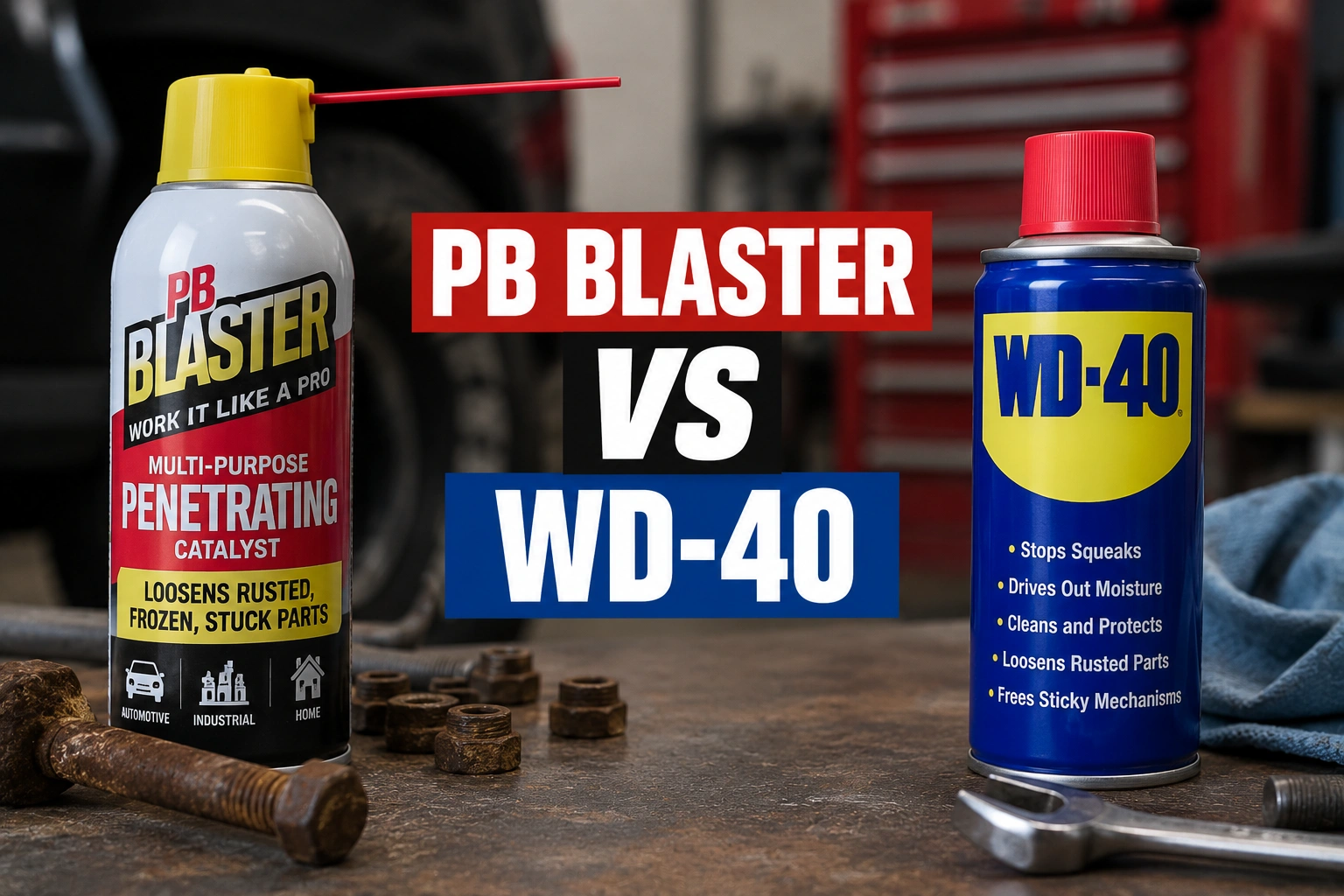
PB Blaster and WD-40 are both familiar names in garages, workshops, and toolboxes, but they are not designed to do exactly the same job. Their similar appearance and overlapping uses often lead people to treat them as interchangeable products.
The important difference is what you want the product to accomplish. A penetrating oil is formulated to help loosen seized or corroded fasteners, while a general-purpose water-displacing spray is often better suited to moisture protection, light lubrication, cleaning, and everyday maintenance.
That distinction becomes especially important around rusted bolts, nuts, hinges, tools, electrical connections, and moving mechanisms. Choosing the wrong product may not cause immediate damage, but it can make a difficult repair take longer than necessary.
PB Blaster has developed a strong reputation for penetrating stubborn corrosion, while WD-40 has become widely known as a multipurpose maintenance spray. Comparing them by their actual purpose rather than brand popularity makes the choice much easier.
PB Blaster Vs WD-40: The Main Difference
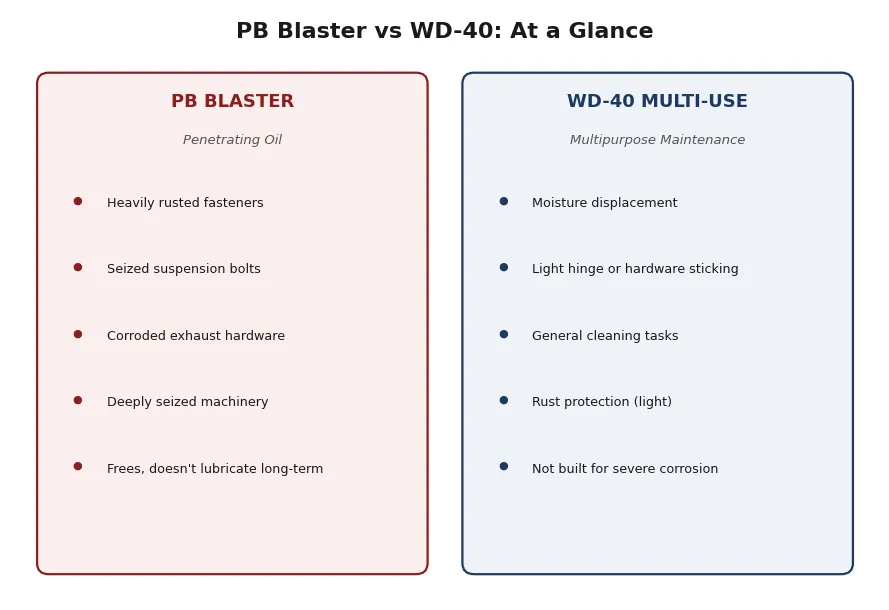
The simplest way to separate the two products is to look at their intended roles. PB Blaster is primarily associated with penetrating oil applications, particularly where corrosion has caused fasteners or mechanical parts to become difficult to move.
WD-40 Multi-Use Product is designed as a multipurpose maintenance product. Its well-known functions include water displacement, corrosion protection, light lubrication, cleaning, and freeing certain stuck components.
That means neither product is automatically “better” in every situation.
If the job involves a rusty exhaust fastener that has not moved for years, a penetrating oil is usually the more appropriate starting point. If the goal is to displace moisture from a surface or provide light lubrication to a household mechanism, WD-40 Multi-Use Product may be the more practical choice.
What Makes A Penetrating Oil Different?
Penetrating oils are designed to move into narrow spaces around threads, corrosion, and closely fitted metal components. The goal is to reduce the resistance between surfaces so a seized fastener or mechanical part can be loosened.
Rust creates an especially difficult problem because corrosion products can effectively lock two metal surfaces together. A penetrating product needs to reach those small interfaces rather than simply coating the exposed outside of the fastener.
PB Blaster is marketed specifically as a penetrating catalyst for loosening rusted and corroded parts. That makes it particularly relevant for automotive repair, machinery maintenance, plumbing work, and other applications where corrosion is the main obstacle.
Penetrating oil does not magically dissolve every rusted connection. The severity of corrosion, material type, thread condition, heat, mechanical shock, and time allowed for penetration can all affect the result.
What WD-40 Multi-Use Product Is Designed To Do
WD-40 Multi-Use Product has a broader maintenance role.
The manufacturer describes it as a product intended to lubricate, protect against rust, penetrate, remove moisture, and clean. This makes it useful for a wide range of general maintenance tasks.
It can help free some lightly stuck components, but that does not mean it should automatically replace a dedicated penetrating oil when corrosion is severe.
This distinction is one of the biggest reasons people disagree about PB Blaster versus WD-40. Someone using WD-40 on a mildly stuck household hinge may have excellent results, while someone attempting to remove a heavily rusted suspension bolt may need a more specialized penetrating product.
Both experiences can be valid because the jobs are different.
PB Blaster Vs WD-40 At A Glance
| Feature | PB Blaster | WD-40 Multi-Use Product |
| Primary Role | Penetrating Corrosion | Multipurpose Maintenance |
| Rusted Fasteners | Strong Choice | Can Help With Light Sticking |
| Water Displacement | Yes | Major Intended Use |
| Light Lubrication | Yes | Yes |
| Rust Protection | Yes | Yes |
| Cleaning | Limited/Secondary | Common Use |
| Heavy Corrosion | Better Suited | Usually Not First Choice |
| General Household Maintenance | Useful | Very Versatile |
| Seized Automotive Hardware | Strong Choice | Not Usually The First Choice |
| Long-Term Specialized Lubrication | Application Dependent | Not Ideal For Every Lubrication Job |
The table should not be interpreted as saying one product can never perform a task associated with the other. There is overlap between their capabilities.
The more useful question is which product is optimized for the specific problem in front of you.
PB Blaster For Rusted And Seized Fasteners
PB Blaster is particularly useful when corrosion is preventing a threaded connection from moving. Automotive fasteners exposed to road salt, water, mud, heat, and temperature changes are common examples.
Brake hardware, suspension bolts, exhaust fasteners, engine brackets, clamps, and older machinery can develop significant corrosion over time. In these situations, the exposed part of the bolt may look manageable while the threads deeper inside are heavily affected.
A penetrating product works by getting into the small spaces where corrosion and metal surfaces meet. Once it reaches those areas, it can help reduce resistance and make mechanical removal easier.
When PB Blaster Makes More Sense
PB Blaster is a logical choice when the primary problem is corrosion preventing movement.
A rusted nut on a suspension component is a good example. The nut may appear accessible, but corrosion can bind its threads to the bolt. Spraying the exposed area and allowing time for the penetrating product to work can improve the chances of successful removal.
The same principle applies to rusty exhaust hardware, machinery fasteners, pipe fittings, and older mechanical assemblies.
However, the spray should be viewed as one part of the process rather than a complete solution.
Heavy corrosion may require repeated applications, mechanical vibration, controlled heat, specialized tools, or replacement of the fastener.
Why Time Matters With Penetrating Oil
One of the most common mistakes is spraying a seized bolt and immediately applying maximum force.
Penetrating products need time to reach the affected interface. How long that takes depends on the condition of the connection and how much corrosion is present.
A lightly stuck fastener may respond relatively quickly. A heavily corroded connection can require repeated applications over a longer period.
Applying the product to both sides of an accessible connection can sometimes improve penetration.
Mechanical vibration can also help break up corrosion and allow the liquid to move deeper into the joint.
The goal is not simply to make the outside of the fastener wet. The goal is to give the penetrating product an opportunity to reach the surfaces creating the resistance.
How PB Blaster Compares With Heat
Heat can be extremely effective on certain seized fasteners because metal expands when heated.
However, heat introduces significant risks.
Nearby rubber components, plastic parts, wiring, fuel systems, brake components, coatings, and flammable materials can be damaged or ignited.
Penetrating oil can also be flammable, so applying heat immediately after spraying a petroleum-based product requires particular care.
The correct sequence depends on the repair and manufacturer’s procedures.
For professional mechanical work, penetrating oil, controlled mechanical force, vibration, and carefully selected heat are often considered as separate tools rather than assuming one method will solve every seized fastener.
Where PB Blaster Is Not The Best Choice
A penetrating oil is not automatically the correct lubricant for every moving component.
For example, a precision bearing, chain, high-temperature mechanism, or component requiring a specific grease may need a purpose-designed lubricant instead.
Penetrating oil can help free a stuck mechanism, but freeing something and providing long-term lubrication are different tasks.
After a component has been loosened, the correct service lubricant may still need to be applied.
This distinction prevents a common maintenance mistake: assuming that because a product made a part move, it is necessarily the right product for keeping that part moving for years.
WD-40 For General Maintenance, Moisture And Light Lubrication
WD-40 Multi-Use Product has a broader role than simply loosening stuck bolts. It is commonly used for moisture displacement, light lubrication, cleaning, corrosion protection, and freeing components that are only mildly stuck.
The product’s versatility is one reason it has remained a familiar household and workshop product for decades.
It can be useful around tools, hinges, locks, hardware, metal surfaces, garden equipment, and various general maintenance applications.
For automotive work, it can also be useful for certain cleaning and moisture-related tasks, provided the product is appropriate for the material and component.
Where WD-40 Is A Better Fit
WD-40 Multi-Use Product is particularly convenient when the job involves moisture, light surface contamination, or general maintenance rather than severe corrosion.
For example, it can help displace moisture from appropriate metal surfaces and provide temporary corrosion protection.
It can also help loosen lightly stuck hardware.
If a hinge is squeaking or a metal mechanism has developed minor resistance, a multipurpose maintenance spray may be sufficient.
The key word is light.
A badly rusted fastener is a different mechanical problem from a hinge that has become slightly dry.
Using a specialized penetrating oil for severe corrosion is usually more sensible than expecting a multipurpose spray to perform like a dedicated penetrant.
WD-40 Is Not A Universal Lubricant
The name WD-40 is often used as if it describes an entire category of products.
The company actually sells different formulations for different jobs, including specialist lubricants, degreasers, rust removers, and other maintenance products.
Therefore, saying “WD-40” without identifying the specific product can create confusion.
WD-40 Multi-Use Product is different from WD-40 Specialist Silicone Lubricant, WD-40 Specialist White Lithium Grease, and other products in the range.
This matters because different components require different lubrication characteristics.
A sliding mechanism may benefit from silicone.
A load-bearing mechanical joint may require grease.
A high-temperature component may need a lubricant specifically engineered for elevated temperatures.
The correct product should be selected according to the component manufacturer’s requirements.
WD-40 For Water And Moisture
Water displacement is one of the defining characteristics associated with WD-40 Multi-Use Product.
Moisture can contribute to corrosion, particularly on exposed metal surfaces.
A water-displacing product can help remove moisture from suitable surfaces and leave behind a protective film.
This can be useful for tools, metal hardware, hinges, and certain equipment.
However, moisture displacement should not be confused with waterproofing.
A spray coating is not a permanent barrier against every environmental condition.
Outdoor equipment exposed to rain, salt, humidity, or chemicals may require more durable corrosion protection depending on the application.
WD-40 For Light Cleaning
WD-40 Multi-Use Product can also help remove certain types of grime, adhesive residue, grease, and other contaminants from appropriate surfaces.
This is useful when a component needs light cleaning as part of general maintenance.
Surface compatibility matters.
Some plastics, painted surfaces, rubber components, and specialty coatings may react differently to petroleum-based products.
When working on a visible or sensitive surface, testing a small inconspicuous area first is a sensible precaution.
The same rule applies to aftermarket accessories and specialty finishes where the material manufacturer’s recommendations take priority.
PB Blaster Vs WD-40 For Common Automotive Jobs
Automotive repair is where the difference between the two products becomes particularly useful.
Cars contain hundreds of fasteners, many of which are exposed to water, dirt, road salt, engine heat, exhaust heat, and repeated temperature cycles.
A bolt underneath a vehicle can develop a completely different level of corrosion from a bolt inside a clean engine compartment.
The right product depends on the type of resistance involved.
Which One Is Better For Rusty Bolts?
For heavily rusted or seized bolts, PB Blaster is generally the more appropriate first choice.
Its primary purpose is penetrating corroded connections.
Apply it to the affected area and allow adequate time for penetration. If possible, clean loose rust from the joint before application so the product has a better opportunity to reach the threaded interface.
For severe corrosion, repeated applications may be necessary.
Mechanical techniques such as tapping the fastener lightly can sometimes help disrupt corrosion, but care must be taken not to deform the bolt or damage surrounding components.
WD-40 Multi-Use Product may help with lightly stuck hardware, but a dedicated penetrant is usually the more logical choice when corrosion is the main reason the fastener will not move.
Which One Is Better For Brake Components?
Neither product should be sprayed indiscriminately around brake friction surfaces.
Brake rotors, pads, and friction material need to remain free from inappropriate oils and contaminants.
If either product gets onto a brake rotor or pad, it should be treated as contamination rather than assuming the brake will work normally.
Certain brake components may have manufacturer-approved lubrication requirements, but those are usually specific points and products.
For example, some caliper hardware may require a particular high-temperature lubricant, while brake pad friction surfaces should remain clean.
The important distinction is that a penetrating spray can be useful for removing a corroded fastener near a brake system, but it should not be treated as a general brake lubricant.
Which One Is Better For Exhaust Bolts?
Exhaust fasteners are often among the most difficult bolts to remove because they experience repeated heating and cooling cycles.
They can become heavily oxidized and may develop severe thread corrosion.
PB Blaster is generally better suited to this type of problem because penetration is the primary requirement.
However, exhaust work also involves extreme temperatures.
Never assume that spraying a flammable penetrating product onto a hot exhaust component is safe.
Allow components to cool appropriately and follow safe workshop practices.
In severely corroded exhaust systems, the fastener may be damaged beyond practical reuse even with penetrating oil. Cutting, drilling, heating, or replacement may eventually be required.
Which One Is Better For Door Hinges?
For a lightly squeaking or stiff metal hinge, WD-40 Multi-Use Product can be useful as a general maintenance spray.
It can help displace moisture and reduce friction temporarily.
For a hinge that requires long-term lubrication, however, a dedicated hinge lubricant or grease may provide better durability.
If the hinge is severely rusted and physically seized, a penetrating oil may be more appropriate for freeing it first.
Afterward, the correct long-term lubricant can be applied.
This illustrates an important maintenance principle: the product that frees a component is not necessarily the product that should remain on it permanently.
Which One Is Better For Removing Rust?
Neither PB Blaster nor WD-40 Multi-Use Product should be considered a complete rust-removal solution.
They can assist with freeing corroded hardware, but removing established rust is a different task.
Mechanical abrasion, dedicated rust removers, rust converters, blasting, or replacement may be appropriate depending on the component.
WD-40 can provide corrosion protection after cleaning, while penetrating oil can help loosen rust-bound threads.
For significant structural corrosion, surface treatment should not replace inspection.
A rusty suspension component or brake component may have lost material strength, and simply making the surface look cleaner does not restore the metal.
Automotive Applications Compared
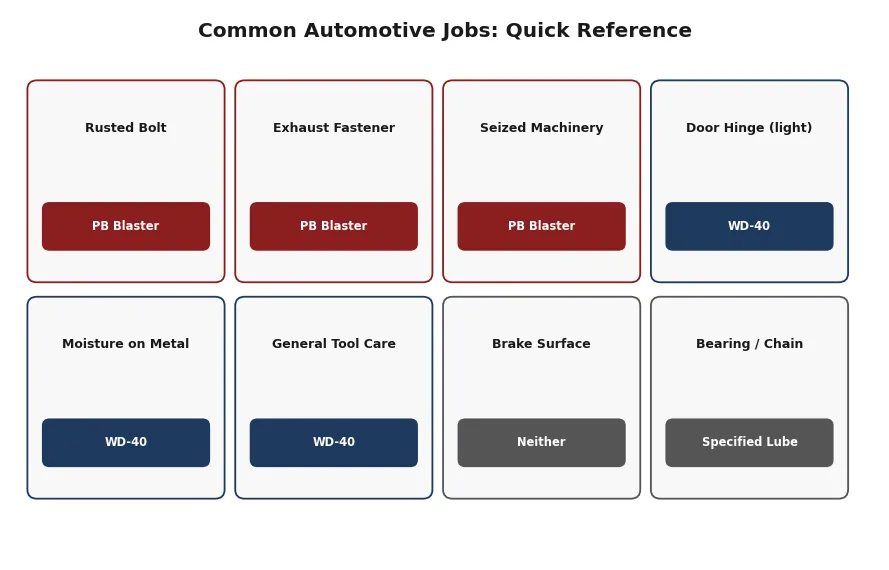
| Job | Better Starting Choice | Reason |
| Heavily Rusted Bolt | PB Blaster | Designed For Penetration |
| Lightly Stuck Hardware | WD-40 Or PB Blaster | Depends On Corrosion |
| Rusted Exhaust Fastener | PB Blaster | Strong Penetrating Focus |
| Moisture Displacement | WD-40 | Core Multipurpose Function |
| Light Hinge Lubrication | WD-40 | Convenient General Maintenance |
| Severe Corrosion | PB Blaster | Better Suited To Penetrating Rust |
| Brake Friction Surface | Neither | Keep Free From Oil |
| Long-Term Bearing Lubrication | Neither By Default | Use Specified Bearing Lubricant |
| General Tool Protection | WD-40 | Useful For Light Protection |
| Deeply Seized Machinery | PB Blaster | Penetration Is The Priority |
Choosing Between PB Blaster And WD-40 Without Guesswork
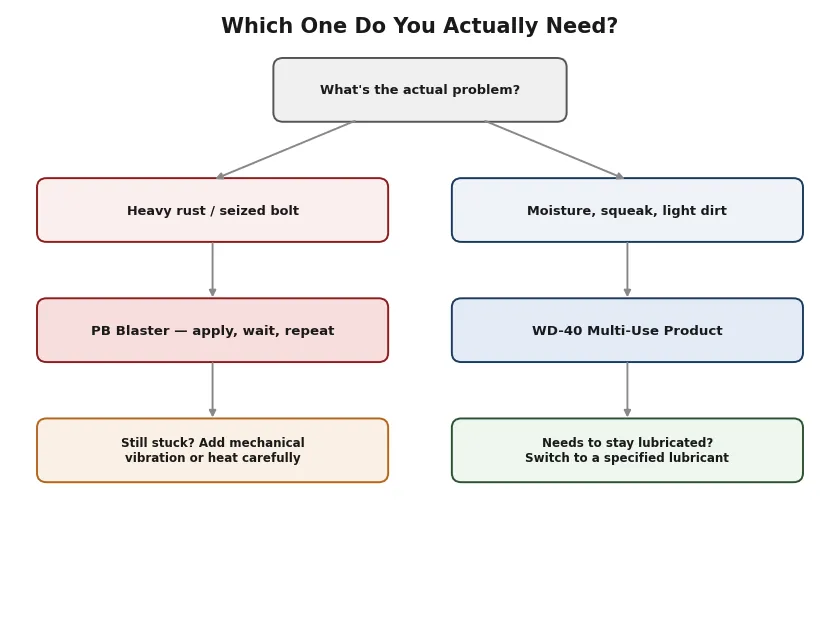
The easiest way to choose between these products is to identify the actual problem before reaching for the can.
If the problem is severe corrosion preventing movement, start with a penetrating oil.
If the problem is moisture, light lubrication, cleaning, or general maintenance, WD-40 Multi-Use Product may be the better fit.
If the component requires a specialized lubricant, neither should automatically be selected just because they are available.
This approach is more reliable than treating one product as universally superior.
A Practical Decision Guide
| Your Main Problem | Recommended Direction |
| Rusted Nut Won’t Move | Penetrating Oil |
| Bolt Seized By Corrosion | PB Blaster |
| Moisture On Metal | WD-40 Multi-Use Product |
| Light General Lubrication | WD-40 Multi-Use Product |
| Extremely Corroded Hardware | Penetrating Oil Plus Mechanical Methods |
| Need Permanent Grease | Use Specified Grease |
| Need High-Temperature Lubrication | Use High-Temperature Product |
| Cleaning Adhesive Residue | Appropriate Cleaning Product |
| Brake Friction Material | Avoid Both |
| Electrical Connector | Follow Vehicle Or Component Guidance |
The most useful insight is that penetration and lubrication are not the same job.
A penetrating oil is designed to get into tight interfaces and help release stuck parts.
A general maintenance spray can perform several useful functions, but its versatility does not make it the best choice for every specialized mechanical problem.
How To Get Better Results From Penetrating Products
Preparation can make a major difference.
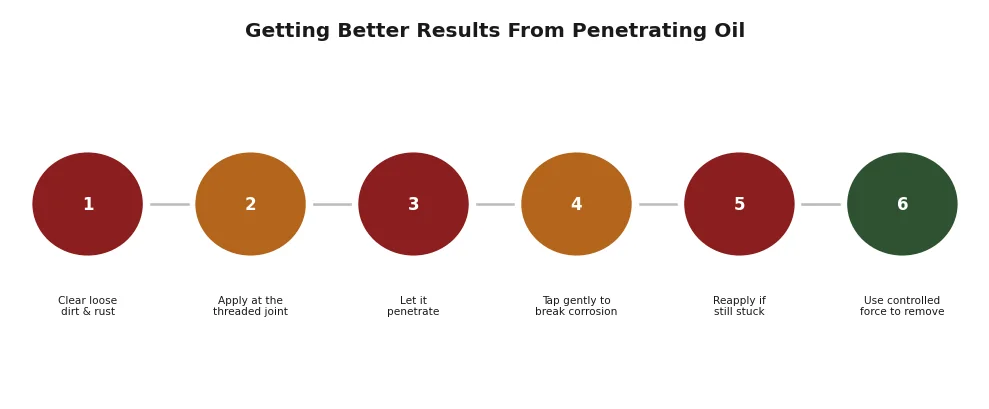
Remove loose dirt and flaky corrosion where practical.
Apply the product around the threaded joint rather than simply coating the exposed head of the bolt.
Allow time for penetration.
If the fastener remains stuck, apply another treatment and reassess the mechanical condition.
Use the correct socket so the fastener is not damaged during removal.
If a fastener is severely corroded, consider whether removal force could damage the component it is attached to.
For example, breaking a rusted bolt inside an aluminum engine component can create a much bigger repair than replacing the original fastener.
Controlled force is usually better than simply using a longer breaker bar.
Why More Spray Does Not Always Mean Better Results
Flooding a fastener with penetrating oil is not necessarily more effective than applying it strategically.
The important factor is getting the product to the interface where corrosion is creating resistance.
Repeated applications with adequate dwell time can be more useful than one heavy application followed immediately by extreme torque.
Mechanical vibration can also help.
Lightly tapping an appropriate fastener can disturb corrosion and potentially help the penetrating liquid move into the joint.
This should be done carefully because fragile components, aluminum housings, brake parts, and thin brackets can be damaged by excessive impact.
Safety Considerations
Both products should be used according to their labels and safety instructions.
Avoid spraying near flames, sparks, hot surfaces, or other ignition sources unless the product’s instructions specifically allow the application.
Good ventilation is also important.
Do not assume that because a product is sold for automotive maintenance it is safe on every vehicle component.
Avoid contaminating brake friction surfaces, belts, tires, or other components where petroleum-based residue could create a problem.
Use eye protection when working underneath a vehicle because spray, rust particles, and debris can fall from overhead components.
A penetrating spray can make a fastener easier to remove, but it cannot compensate for an unsafe lifting setup or inadequate support.
The Real Winner Depends On The Job
There is no meaningful answer to “Is PB Blaster better than WD-40?” without identifying what the product needs to do.
For stubborn rusted fasteners, PB Blaster is generally the stronger choice because penetrating corrosion is its primary purpose.
For moisture displacement, light lubrication, general cleaning, and everyday maintenance, WD-40 Multi-Use Product offers broader versatility.
Neither product should be treated as a universal solution.
A professional-quality repair often uses several products at different stages. A penetrant may free a seized fastener, a cleaner may remove residue, and a specified lubricant may be applied after the component is repaired.
That is more effective than expecting one aerosol product to handle every mechanical requirement.
The biggest practical advantage comes from matching the chemistry and purpose of the product to the problem.
A rusted suspension bolt needs penetration.
A damp metal tool needs moisture displacement and protection.
A bearing needs the lubricant specified for its load and operating temperature.
A brake rotor needs to remain clean.
Once those differences are considered, choosing between PB Blaster and WD-40 becomes much simpler.
Is PB Blaster Better Than WD-40 For Rusted Bolts?
For heavily rusted or seized bolts, PB Blaster is generally the better starting choice because it is specifically designed to penetrate corrosion and help loosen stuck components. WD-40 Multi-Use Product can help with lightly stuck hardware, but severe corrosion usually calls for a dedicated penetrating product.
Can WD-40 Loosen A Rusted Bolt?
Yes, WD-40 Multi-Use Product can help loosen some rusted or stuck fasteners. Its effectiveness depends heavily on the severity of the corrosion. For a badly seized automotive fastener, a dedicated penetrating oil such as PB Blaster is generally a more suitable choice.
Can I Use PB Blaster As A Lubricant?
PB Blaster can provide lubrication while helping free corroded components, but that does not mean it is the correct long-term lubricant for every application. Bearings, high-temperature components, chains, and other specialized parts may require a specific grease or lubricant designed for their operating conditions.
Which Is Better For Exhaust Bolts, PB Blaster Or WD-40?
PB Blaster is generally the more appropriate choice for severely corroded exhaust fasteners because penetration is the primary requirement. Exhaust components can become extremely hot, so the product should be applied only under appropriate conditions and according to its safety instructions.
Can I Spray PB Blaster On Brake Rotors?
No. Penetrating oil should not be intentionally applied to brake friction surfaces. Oil contamination can reduce the friction available between brake pads and rotors. If a penetrating product accidentally reaches a brake rotor or pad, the contaminated components should be addressed properly rather than assuming normal braking performance will continue.
Does WD-40 Remove Rust?
WD-40 Multi-Use Product can help with certain rust-related maintenance tasks and provide corrosion protection, but it is not a complete heavy-rust removal system. Significant rust may require mechanical cleaning, a dedicated rust remover, rust treatment, or replacement depending on the condition of the component.
How Long Should PB Blaster Sit Before Removing A Bolt?
There is no single waiting period that works for every fastener. Light corrosion may respond relatively quickly, while severe corrosion can require repeated applications and more time. Applying the product strategically and allowing it to penetrate before using controlled mechanical force can improve the chances of successful removal.
Can I Use WD-40 Instead Of PB Blaster?
You can use WD-40 Multi-Use Product for some stuck hardware, particularly where corrosion is minor. However, if the main problem is a heavily rusted or seized fastener, PB Blaster or another dedicated penetrating oil is generally the more appropriate product for the job.
Is PB Blaster Safe On Car Parts?
PB Blaster is intended for penetrating and freeing mechanical components, but it should not be sprayed indiscriminately on every vehicle surface. Keep it away from brake friction surfaces, hot components, ignition sources, and materials that may be incompatible with the product. Always follow the product label and vehicle manufacturer’s recommendations.
What Is The Main Difference Between PB Blaster And WD-40?
The main difference is their emphasis. PB Blaster is primarily a penetrating product intended to help free rusted and corroded components, while WD-40 Multi-Use Product is a broader maintenance spray associated with moisture displacement, light lubrication, cleaning, and corrosion protection. There is some overlap, but their primary uses are different.