More than 52 million North American households went camping last year, pushing outdoor hospitality past a $66 billion economic footprint.
Behind nearly every one of those trips sits an SUV, loaded with gear, parked at a trailhead, or working as a rolling basecamp for the weekend.
Picking the right one in 2026 means looking past horsepower figures and touchscreen sizes toward details that matter on a rutted forest road.
Ground clearance, locking differentials, real cargo volume, and a roof rack strong enough to carry a tent without groaning matter more than trim badges ever will.
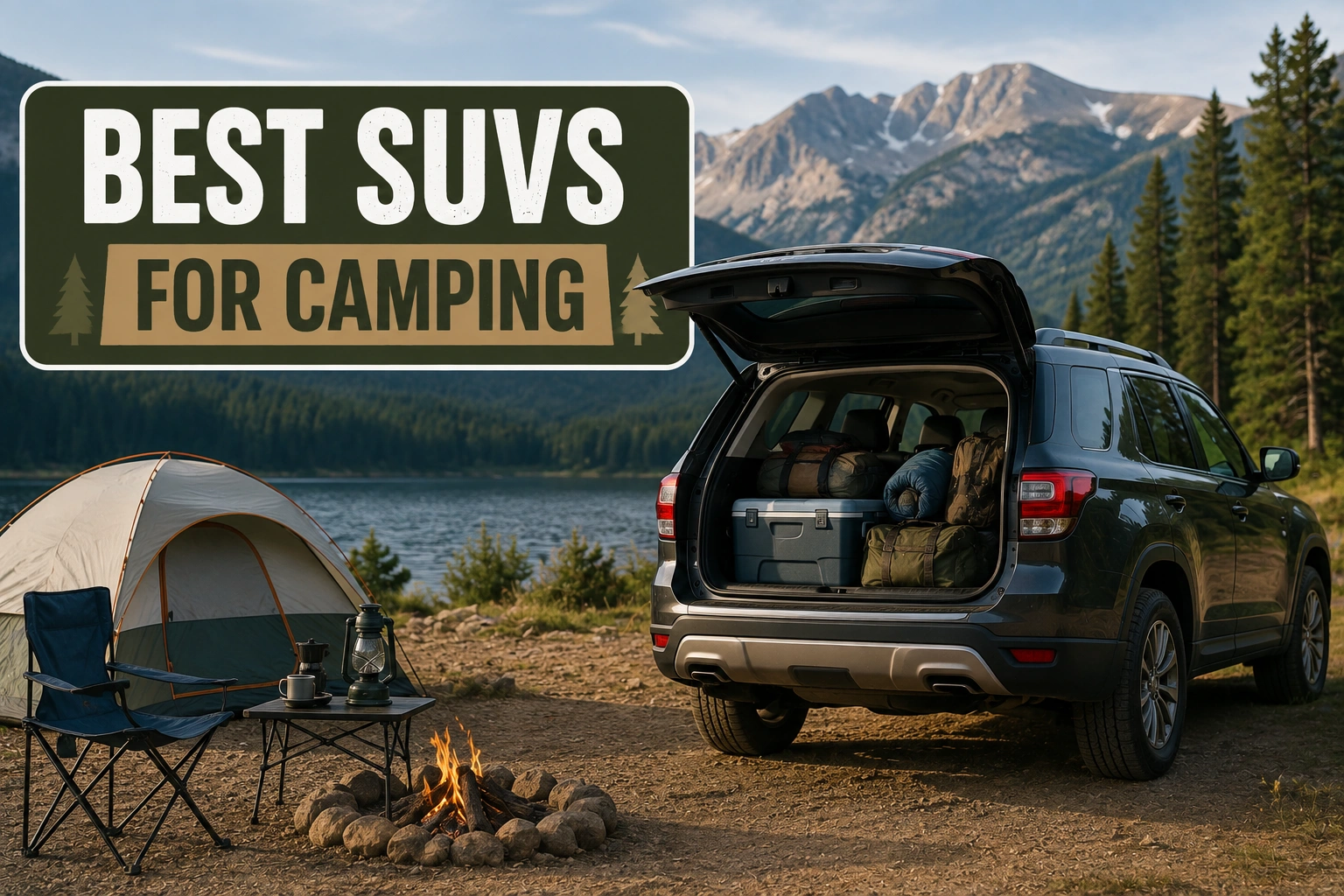
This year’s lineup spans genuine range, from body-on-frame veterans built for rock crawling to electric SUVs that run a camp kitchen off their own battery pack.
Nine models stand out for blending trail capability with everyday comfort, and each one earns its place for a different kind of camper, budget, and adventure style.
What Makes An SUV Great For Camping
Ground clearance decides which roads stay open to you. Anything under 8 inches limits you to maintained gravel, while 9 inches or more opens up rutted forest service roads.
Four-wheel drive with a real low-range transfer case beats all-wheel drive on loose or steep terrain. A locking rear differential adds traction once a wheel lifts off the ground.
Cargo volume matters less than shape. A flat load floor and folding second-row seats swallow coolers and gear totes far better than a tall, narrow trunk.
Roof rack capacity decides whether a rooftop tent is realistic. Static weight ratings above 600 pounds handle most hardshell and soft-shell tents; dynamic ratings while driving run lower.
Towing capacity matters if a small trailer or teardrop camper is coming along. Most midsize SUVs handle 3,500 to 5,000 pounds, while body-on-frame and electric models often clear 6,000.
Fuel range or battery range decides how far you can stray from a gas station or charger, which matters more on a backcountry loop than a paved state park road.
Interior materials matter after the first muddy dog or sandy cooler. Rubberized floors and washable seats hold up far better than plush cloth over a season of trips.
Driver assistance features like adaptive cruise control earn their keep on the long highway haul to the trailhead, even once they switch off completely past the pavement.
Price does not always track with capability, either. Some of the toughest trail rigs here cost less than plush family crossovers with none of the same hardware underneath.
Legendary Off-Roaders For Remote Camping Adventures
These three SUVs share a formula: body-on-frame or near body-on-frame construction, low-range gearing, and locking differentials borrowed from genuine expedition vehicles.
Comfort and technology take a back seat to reaching a campsite that most SUVs simply cannot get near.
They cost more than the family-friendly options later in this guide, and two of them ride rougher on pavement because of it.
For campers who prioritize the destination over the commute, that trade-off is the entire point.
1. Toyota 4Runner
Toyota rebuilt the 4Runner from the ground up for its sixth generation, and the body-on-frame formula that made it a camping favorite for three decades survived intact.
The two-wheel-drive SR5 opens the lineup at $43,065, and the number climbs past $68,600 once you reach the hybrid TRD Pro or Trailhunter.
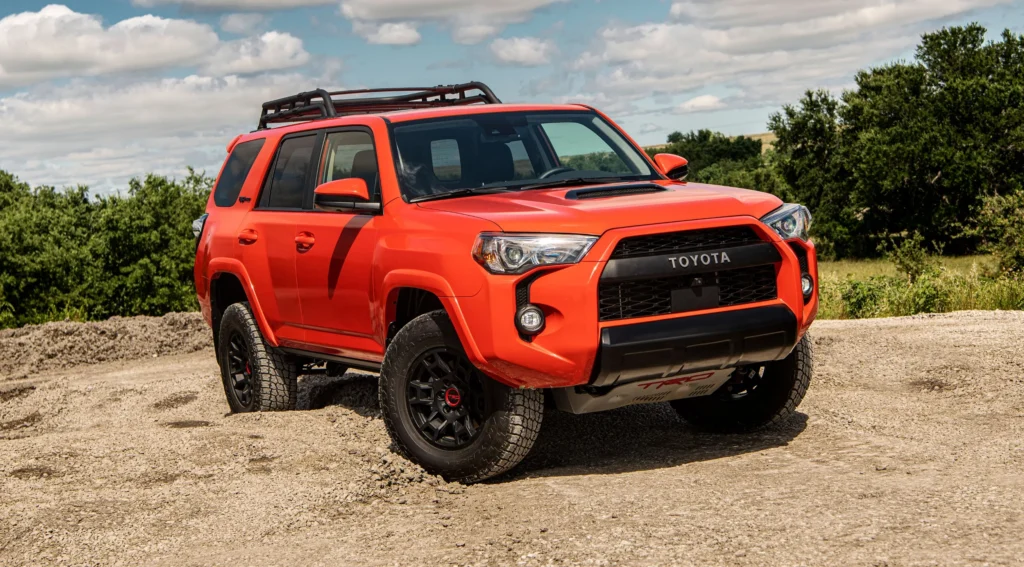
That hybrid setup pairs a turbocharged 2.4-liter four-cylinder with an electric motor for 326 horsepower and 465 pound-feet of torque, noticeably stronger than the standard 278-horsepower gas engine.
TRD Off-Road trims clear 9.1 inches of ground clearance, while the Pro and Trailhunter reach 10.1 inches on 33-inch all-terrain tires.
A locking rear differential and disconnecting front sway bar, standard on the top two trims, keep wheels planted on broken terrain.
Cargo space runs up to 90.2 cubic feet with the rear seats folded in two-row models.
A power rear window drops down for ventilation or loading long items, and TRD models add a small onboard air compressor for topping off tires or an inflatable kayak after the trail.
Maximum towing reaches close to 6,000 pounds on hybrid trims, enough for a small travel trailer.
2. Toyota Land Cruiser
Toyota brought the Land Cruiser back to American driveways in 2024 after a three-year absence, and the 2026 version keeps the formula unchanged.
Heritage looks sit over a proper off-road chassis, not a soft crossover platform wearing a tough costume.
Toyota keeps the lineup to two trims: the retro-styled 1958 near $59,095, and the better-equipped Land Cruiser trim at $63,540.
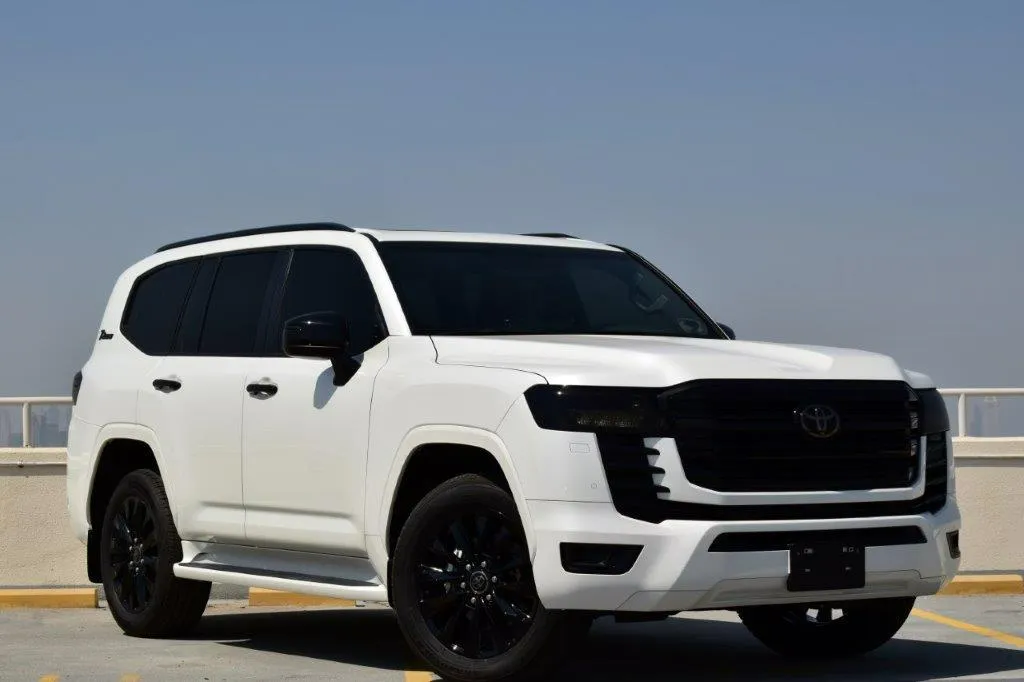
Both share the same i-Force Max hybrid powertrain, a turbocharged 2.4-liter four-cylinder paired with an electric motor for 326 horsepower and 465 pound-feet of torque.
Full-time four-wheel drive comes standard, complete with a two-speed transfer case and locking center and rear differentials, hardware many rivals reserve for pricier trims.
Ground clearance sits at 8.7 inches, and maximum towing reaches 6,000 pounds.
Fuel economy lands at 23 mpg combined, respectable for a body-on-frame SUV with low-range gearing.
Toyota Safety Sense 3.0 comes standard, bundling adaptive cruise control and lane-centering assist for the long highway stretches between campgrounds.
The two-row cabin seats five, and the low-rpm torque from the electric motor makes it noticeably more composed crawling over rocks than a pure gas engine of similar output.
3. Land Rover Defender 110
Land Rover’s Defender wears its farm-and-military heritage well, and the 2026 model backs that image with numbers few rivals can match.
The 110 S opens at $65,350, though pricing climbs sharply from there, topping out near $158,300 on the 626-horsepower OCTA.
Most camping-focused buyers land in the middle, on the X or V8 trims with useful off-road electronics included.
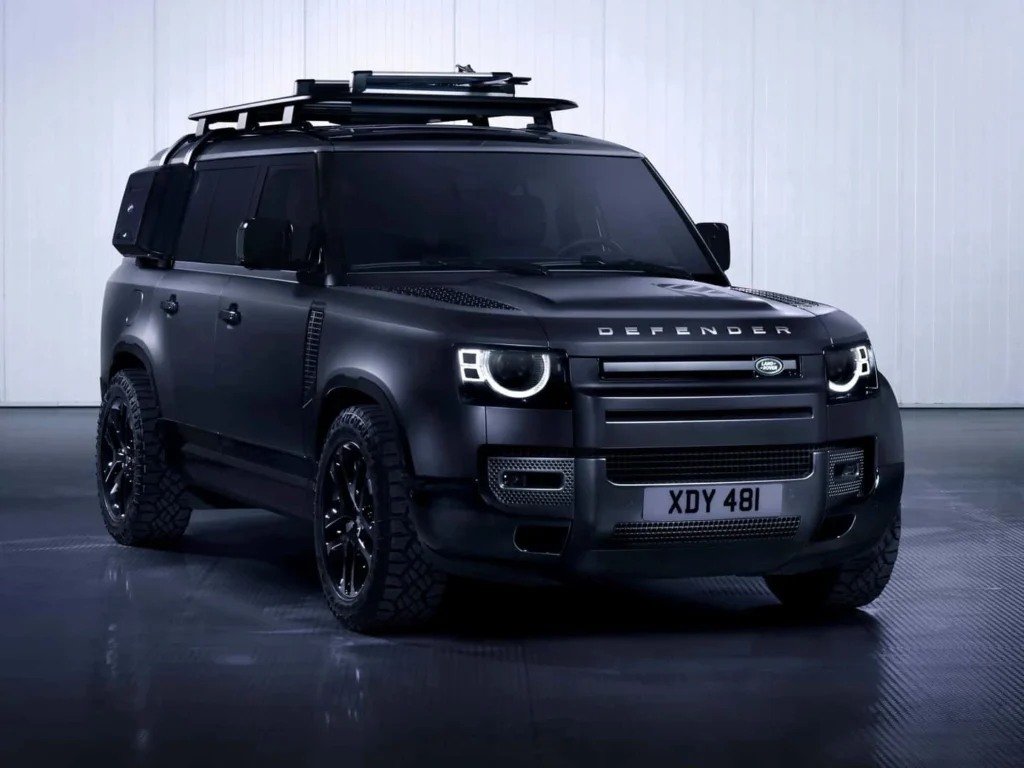
Standard air suspension raises ground clearance to 11.5 inches at its tallest setting, and wading depth reaches 35 inches, deep enough to cross a stream that would strand most crossovers.
Approach and departure angles of about 31.5 and 40 degrees clear steep entry and exit points without scraping the bumpers.
Terrain Response 2 automatically adjusts throttle mapping for sand, mud, rock, or snow, while a twin-speed transfer case and locking center differential handle the mechanical side.
Maximum towing reaches 8,200 pounds, the highest figure on this entire list, enough for a mid-size travel trailer.
Wade Sensing, standard on the X, V8, and OCTA trims, uses ultrasonic mirror sensors to show live water depth on the touchscreen before committing to a crossing.
Trail Ready SUVs That Still Work As Daily Drivers
The next three trade a little outright rock-crawling ability for lower prices and friendlier daily driving.
In two cases, the doors and roof come off entirely, yet real four-wheel-drive hardware still sits underneath the fun factor.
They suit campers who also commute in their SUV five days a week and don’t want a stiff, truck-like ride the other 360 days of the year.
All three can still handle a rutted forest road without drama.
4. Jeep Wrangler
No SUV on this list turns a campsite into an open-air lounge faster than a Wrangler with its doors off and roof panels stowed at home.
Jeep simplified the lineup for 2026, dropping the plug-in hybrid 4xe entirely and running the range on gas power alone.
That means a 3.6-liter V6 across most trims, a turbocharged four-cylinder on select models, and a 6.4-liter HEMI V8 back from the dead in the new Moab and Willys 392 trims.
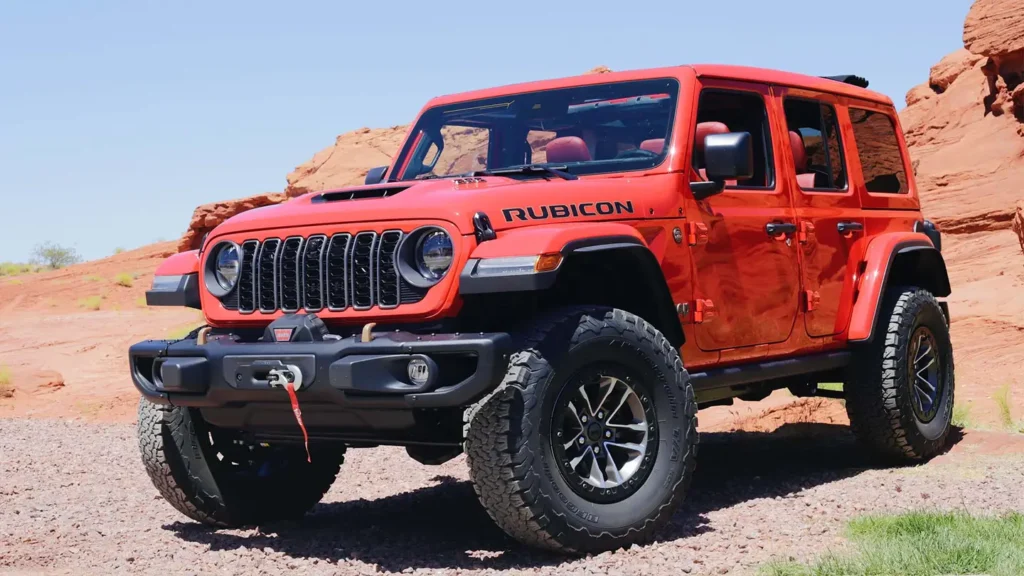
A four-door Sport runs about $39,000 before options, and a well-equipped Rubicon typically lands in the mid-$50,000s.
Every trim comes standard with four-wheel drive, and the Rubicon adds a heavy-duty Dana 44 full-float rear axle plus front and rear locking differentials.
An electronically disconnecting front sway bar adds extra wheel articulation on uneven ground, and a factory-available 8,000-pound winch handles genuine recovery situations.
Ground clearance reaches 11.1 inches on the Rubicon, among the best of any factory SUV sold today.
Cargo space behind the folded rear seats tops out at 72.4 cubic feet in four-door models, and towing tops out around 5,000 pounds on select Rubicon builds.
The reward for all that hardware is an accessory catalog larger than almost any other vehicle sold in America.
5. Ford Bronco
Ford designed the Bronco’s body panels to come apart almost as easily as the Wrangler’s, with removable doors, a modular roof, and fender flares that pop off for extra tire clearance.
Money-wise, the lineup spans $38,995 for a base model up to $79,995 for the Raptor, Ford’s most extreme off-road trim.
The standard engine is a turbocharged 2.3-liter four-cylinder making 300 horsepower, with a 2.7-liter twin-turbo V6 available for 330 horsepower and 415 pound-feet of torque.
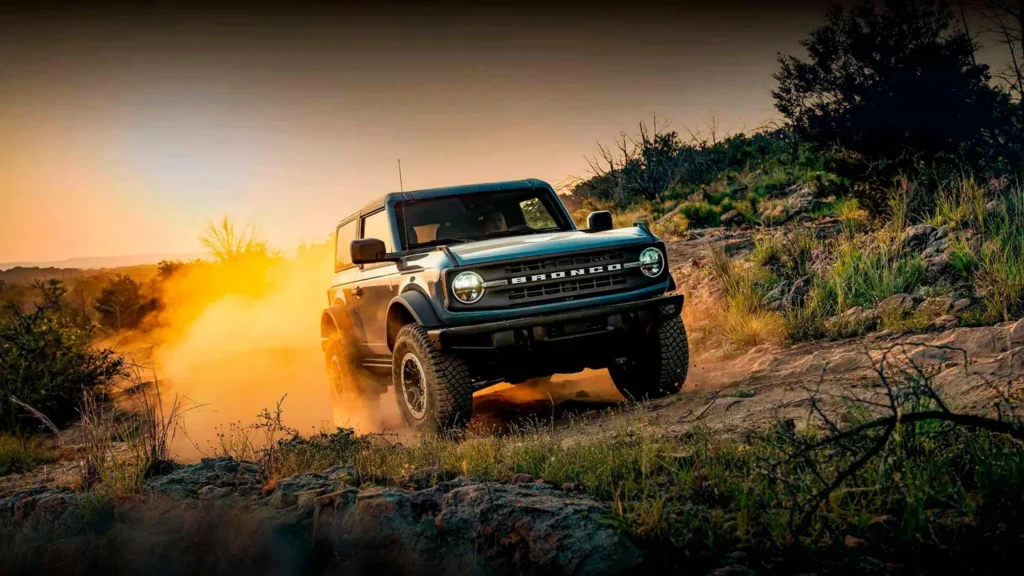
The optional Sasquatch Package adds 35-inch tires, front and rear locking differentials, and an upgraded suspension to qualifying trims, pushing ground clearance to about 11.5 inches.
The Raptor pushes further still, to 13.1 inches, riding on FOX Live Valve dampers borrowed from Ford’s off-road truck program.
Seven G.O.A.T. drive modes adjust throttle response and traction control for sand, mud, rock, or snow with a single dial turn.
Cargo space in four-door models expands to around 83 cubic feet with the rear seats folded, edging out the Wrangler by a meaningful margin.
Maximum towing sits at 3,500 pounds on most trims, and washable rubber flooring shrugs off muddy boots far better than carpet ever could.
6. Honda Passport TrailSport
Honda spent decades building comfortable, capable-looking SUVs that quietly avoided real off-road hardware. The redesigned Passport finally changes that story.
Three price points cover the lineup: $46,200 for the base RTL, $49,900 for TrailSport, and $53,900 for the loaded TrailSport Elite.
Every trim shares the same 3.5-liter V6, producing 285 horsepower and 262 pound-feet of torque through a 10-speed automatic, a refreshing alternative to the turbocharged four-cylinders common in this class.
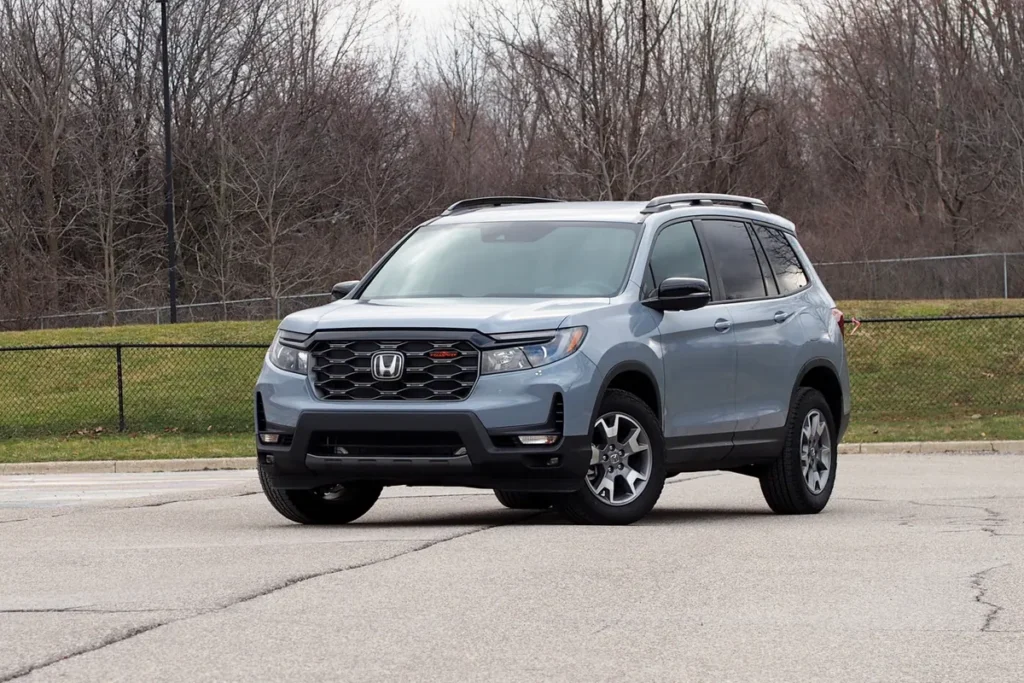
Honda’s torque-vectoring all-wheel-drive system can send up to 70 percent of engine output rearward, then shift it further between the left and right rear wheels for grip on loose campsite access roads.
TrailSport models ride on 31-inch all-terrain tires with steel skid plates and front tow hooks protecting the underbody.
The TrailSport Elite adds TrailWatch, a camera system that shows the front wheels and underbody on the center screen for placing tires precisely on tricky terrain.
Ground clearance reaches 8.3 inches, towing tops out at 5,000 pounds, and cargo space expands to 83.8 cubic feet with the rear seats folded.
One trade-off worth knowing: the Passport carries only two rows and seats five, so families needing a third row should look toward the Telluride instead.
Family Space And Smart Value Picks
The final three balance space, price, and everyday usability better than anything else on this list, without giving up meaningful off-road ability.
One seats eight, one drinks less fuel than nearly every SUV here, and one runs a full camp kitchen off its own battery.
None demands a body-on-frame chassis or a six-figure budget, which makes this group the most realistic starting point for a first camping SUV.
7. Kia Telluride
Kia rebuilt the Telluride for 2026 with a boxier, more upright look borrowed from its EV9 electric SUV, and the changes go well beyond the sheet metal.
At $39,190 for the front-wheel-drive LX, it undercuts nearly every three-row rival with this much cabin space.
A new turbocharged 2.5-liter four-cylinder replaces the outgoing 3.8-liter V6, and a hybrid version arriving later in the year should push combined output past 300 horsepower.
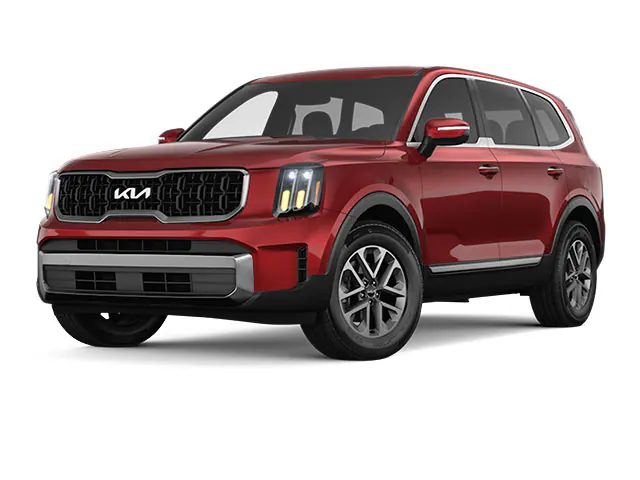
The trail-focused X-Pro trim adds all-wheel drive with a center locking differential plus dedicated sand, mud, and snow drive modes.
Ground clearance on the X-Pro reaches 8.4 inches, enough for moderate forest roads without venturing into serious rock-crawling territory.
Towing reaches 5,000 pounds on standard models and 5,500 pounds on the X-Pro, which adds heavy-duty cooling and trailer stability assist.
Cargo space runs from 21 cubic feet behind the third row to 87 cubic feet with both rear rows folded flat.
Seating for up to eight spreads across three rows, with second-row captain’s chairs available for families who prefer a walk-through aisle.
Kia backs the lineup with a 10-year, 100,000-mile powertrain warranty, longer than anything else on this list.
8. Subaru Outback Wilderness
Calling the Outback Wilderness a wagon undersells what Subaru built here. Its 9.5 inches of ground clearance beats several body-on-frame SUVs on this list.
It carries a $44,995 sticker, reasonable for what sits underneath the sheet metal.
The completely redesigned 2026 model pairs a standard turbocharged 2.4-liter Boxer engine, making 260 horsepower, with Subaru’s Symmetrical all-wheel drive.
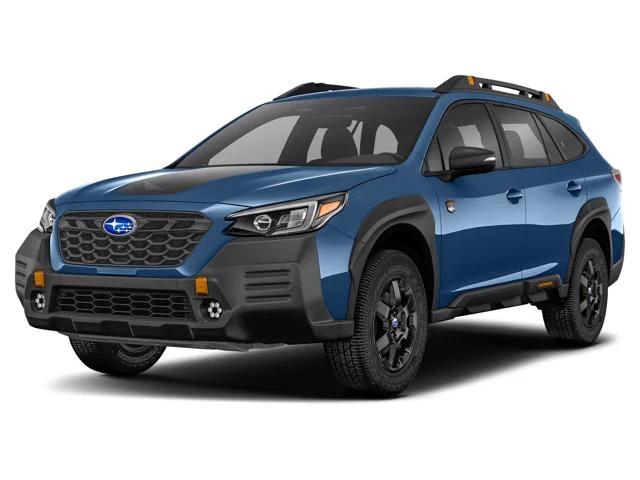
A driver-selectable X-MODE traction system handles snow, mud, and deep gravel without much driver input required.
Because the Outback rides lower and wider than a traditional SUV, its load floor sits closer to the ground, making it easier to slide in a cooler without lifting to shoulder height.
The roof rack rating tells its own story: up to 800 pounds while parked and 100 pounds while driving, enough for a hardshell rooftop tent that would overwhelm lighter-duty racks.
Bridgestone Dueler all-terrain tires and a standard front skid plate round out the off-road hardware.
Fuel economy reaches up to 27 mpg combined, meaningfully better than every body-on-frame SUV in this guide.
Towing capacity tops out at 3,500 pounds, plenty for a small utility or teardrop trailer.
9. Rivian R1S
Electric SUVs used to mean range anxiety on remote roads. The R1S flips that worry into a genuine camping advantage.
Figure close to $77,000 to step into the Dual Standard trim, climbing to about $122,000 for the 1,025-horsepower Quad version.
Range spans from 270 miles on the smallest battery pack to 410 miles on the Max pack, and every trim tows up to 7,700 pounds, more than most gas-powered midsize SUVs manage.
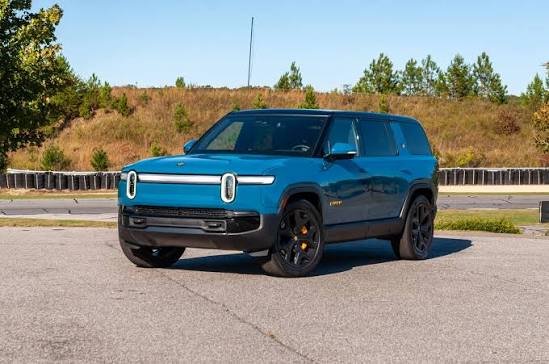
Camp Mode is the real party trick. It auto-levels the SUV on air suspension, then keeps climate control and lighting running for hours directly off the main battery.
Multiple 120-volt, 12-volt, and USB outlets stay powered too, no idling engine or generator fumes required at the campsite.
A Camp Courtesy setting dims exterior lights and quiets the climate system so a 2 a.m. bathroom trip doesn’t wake the entire campground.
Cargo space totals 104.7 cubic feet with all seats folded, plus an 11.1-cubic-foot front trunk that keeps dry gear separate from muddy boots in back.
Three rows seat up to seven, and standard NACS compatibility with Tesla Superchargers makes longer road trips between campgrounds far more practical than they were two years ago.
How To Choose The Right Camping SUV For Your Next Trip
Start with where you actually camp, not where you’d like to camp someday.
A paved state park loop needs none of the hardware that a rutted BLM road demands, and paying for capability you’ll never use is money better spent on gear.
Match the drivetrain to the terrain. All-wheel-drive systems like Subaru’s Symmetrical AWD or Honda’s i-VTM4 handle rain, snow, and moderate gravel with ease.
Genuine four-wheel drive with low range and locking differentials, found on the 4Runner, Wrangler, Bronco, Land Cruiser, and Defender, earns its keep once trails turn rocky or steep.
Think about how you’ll sleep before you buy. Rooftop tent shoppers need a roof rack with a high static weight rating, which points toward the Outback Wilderness or 4Runner.
Sleep-in-the-back campers should prioritize a flat load floor and rear seats that fold nearly level, favoring the Telluride and R1S.
Consider total trip cost, not just the sticker price. A body-on-frame SUV averaging 18 to 20 mpg costs meaningfully more in fuel over a season of long trips than the Outback Wilderness or a hybrid Land Cruiser.
Below is a side-by-side of pricing and the specs that matter most for camping duty.
| SUV | Starting Price | Powertrain | Max Towing | Max Cargo Space |
| Toyota 4Runner | $43,065 | 2.4L Turbo I4 (Hybrid Available) | 6,000 lbs | 90.2 cu ft |
| Toyota Land Cruiser | $59,095 | 2.4L Turbo Hybrid, Standard | 6,000 lbs | 82.1 cu ft |
| Land Rover Defender 110 | $65,350 | 2.0L Turbo I4 To 4.4L Twin-Turbo V8 | 8,200 lbs | 78.8 cu ft |
| Jeep Wrangler | $39,040 | 3.6L V6 (Turbo I4, V8 Available) | 5,000 lbs | 72.4 cu ft |
| Ford Bronco | $38,995 | 2.3L Turbo I4 (V6 Available) | 3,500 lbs | 83 cu ft |
| Honda Passport TrailSport | $49,900 | 3.5L V6 | 5,000 lbs | 83.8 cu ft |
| Kia Telluride | $39,190 | 2.5L Turbo I4 (Hybrid Coming) | 5,500 lbs | 87 cu ft |
| Subaru Outback Wilderness | $44,995 | 2.4L Turbo Boxer | 3,500 lbs | 80.5 cu ft |
| Rivian R1S | $76,990 | Dual, Tri, Or Quad Electric Motor | 7,700 lbs | 104.7 cu ft |
Prices reflect approximate base MSRP for the trim discussed and can shift by region, season, and options.
For a first camping SUV on a moderate budget, the Outback Wilderness or Telluride covers the widest range of trips without stretching finances thin.
Buyers headed toward serious backcountry access should lean toward the 4Runner, Land Cruiser, or Defender instead.
Those chasing the quietest, most self-sufficient basecamp setup will find little to match the R1S.
The table below matches camping style to the strongest pick from this list.
| Camping Style | Best Match | Why It Fits |
| First Rooftop Tent Build | Subaru Outback Wilderness | High static roof rating, low load floor, strong fuel economy |
| Deep Backcountry, No Cell Signal | Toyota Land Cruiser | Full-time 4WD, standard locking differentials, proven Toyota durability |
| Big Family, Three Rows Needed | Kia Telluride | Eight seats, strong towing, 10-year powertrain warranty |
| Weekend Trips On A Tighter Budget | Ford Bronco | Lower entry price, huge accessory catalog, removable roof |
| Quiet, Tech-Forward Basecamp | Rivian R1S | Camp Mode, silent power outlets, no idling engine |
A few quick questions worth answering before you buy:
What ground clearance do I actually need for forest service roads?
Most maintained forest service and BLM roads are manageable with 8 to 9 inches of clearance and all-wheel drive. Rutted, rocky, or washed-out routes call for 9.5 inches or more, along with a locking differential and genuine low-range gearing.
Is all-wheel drive enough, or do I need real four-wheel drive?
AWD handles rain, snow, sand, and light gravel without any driver input, which covers most established campgrounds just fine. Four-wheel drive with low range and locking differentials becomes necessary once trails turn steep, rocky, or deeply rutted.
Can an electric SUV like the Rivian R1S handle remote camping trips?
Yes, within reason. A full battery covers 270 to 410 miles depending on trim, and Camp Mode runs climate control and outlets for a full night without meaningfully draining the pack. Areas without charging access for 200-plus miles still favor a gas or hybrid SUV.
Do I need a rooftop tent, or is cargo space enough for regular gear?
Most weekend campers do just fine with a spacious cargo area and a quality ground tent. Rooftop tents make more sense for frequent overlanders who want to camp on uneven or rocky ground where a ground tent struggles to sit level.
Which of these SUVs costs the least to maintain over time?
The Outback Wilderness and Toyota’s 4Runner and Land Cruiser typically post the lowest long-term maintenance and repair costs in independent reliability studies, thanks to simpler drivetrains and strong parts availability nationwide.
Should I buy a body-on-frame SUV or a unibody crossover for camping?
Body-on-frame SUVs like the 4Runner, Wrangler, Bronco, and Land Cruiser tolerate rough trails and heavy towing better over time. Unibody options like the Outback Wilderness and Telluride ride smoother and still handle most established campgrounds without issue.