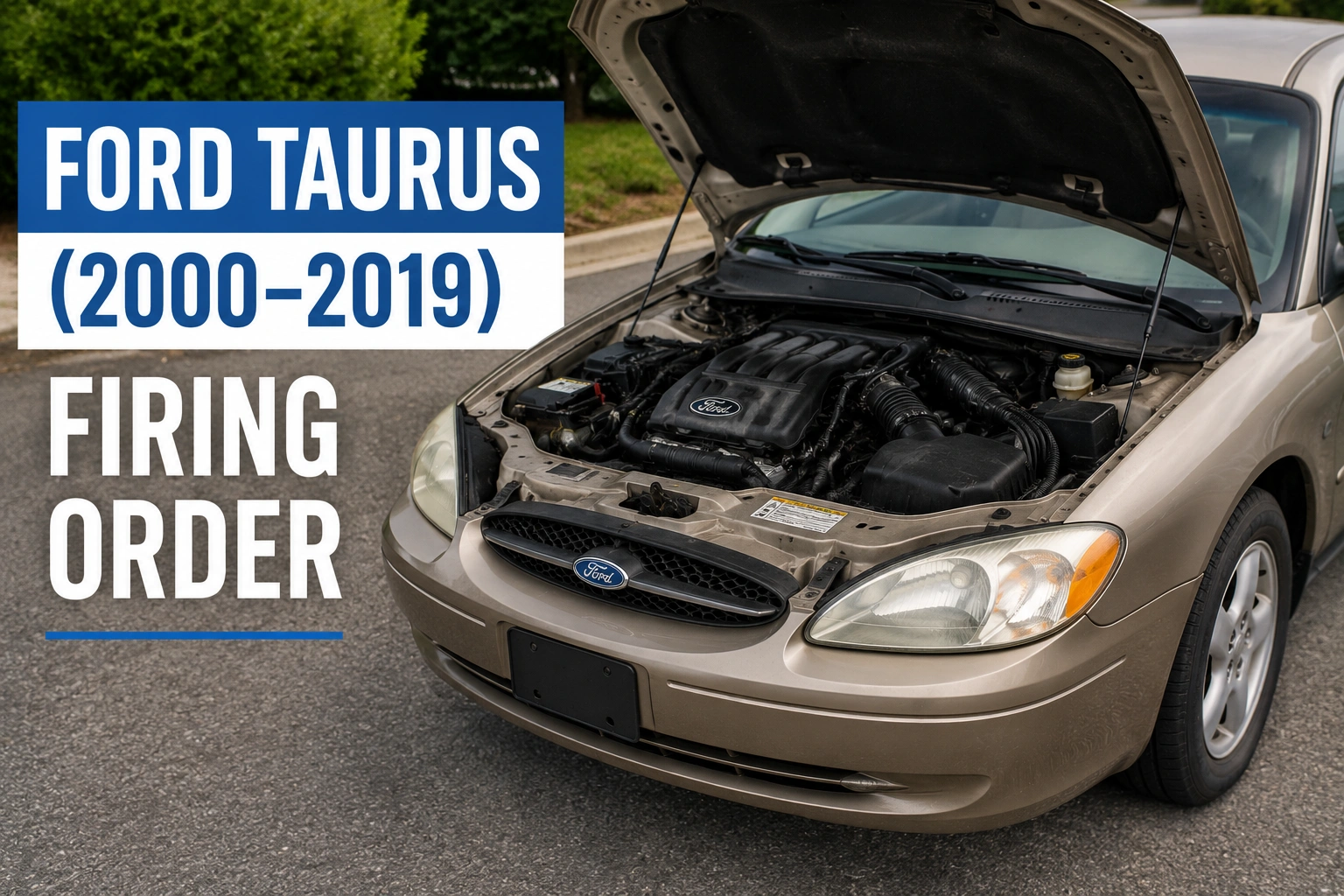
The Ford Taurus spent two full decades as one of the most common cars on American roads — and across those twenty years it went through enough engine changes to genuinely confuse anyone who assumes the firing order is the same throughout.
It is not. The fourth-generation Taurus from 2000 through 2007 used a transversely mounted 3.0-liter V6. The sixth generation from 2010 onward brought a completely different 3.5-liter V6 in naturally aspirated and twin-turbocharged forms, plus a 2.0-liter EcoBoost four-cylinder.
Each of those engines sits differently in the engine bay, numbers its cylinders from a different starting point, and fires in its own sequence.
Getting the firing order right matters every time someone touches the ignition system — a spark plug wire on the wrong tower or a coil connector on the wrong cylinder produces misfires that no amount of mechanical inspection will resolve until the sequence itself is corrected.
The 3.0-Liter V6 Taurus (2000–2007) — Firing Order And Cylinder Layout
The fourth-generation and fifth-generation Ford Taurus used a 3.0-liter V6 as its primary powertrain. Two versions of this engine appeared across those years — the Vulcan (overhead valve) and the Duratec (dual overhead cam) — and both share the same firing sequence.
- Firing Order: 1-4-2-5-3-6
- Engine Orientation: Transverse (sideways in the engine bay)
- Ignition System: Distributor-less ignition (DIS) with coil pack
- Cylinder 1 Location: Rear bank, driver’s side (left when facing front of car)
The transverse mounting is the most important detail for anyone working on these engines.
Because the engine sits sideways, the standard “front-to-rear” cylinder description does not apply the way it does on a rear-wheel-drive vehicle.
The rear bank — the one closest to the firewall — contains cylinders 1, 2, and 3. The front bank — the one facing the radiator and visible from above — contains cylinders 4, 5, and 6.
Within each bank, the numbering runs from the driver’s side to the passenger’s side.
Rear bank (firewall side): 1, 2, 3 — driver to passenger
Front bank (radiator side): 4, 5, 6 — driver to passenger
The 3.0L Vulcan (Overhead Valve) — 2000 Through 2007
The Vulcan was the base 3.0-liter option throughout the fourth and fifth-generation Taurus. It used pushrods, a single camshaft inside the block, and a coil pack ignition system with individual spark plug wires running from the coil to each cylinder.
The coil pack on this engine is a single assembly with three pairs of posts. Each pair serves two cylinders in a waste-spark arrangement. The pairs are: cylinders 1 and 4, cylinders 2 and 5, and cylinders 3 and 6.
When one coil segment fails, both cylinders in that pair misfire simultaneously — which is the identifying symptom of a coil failure versus a single-cylinder issue like a bad plug or wire.
Spark plug wires on the Vulcan must be routed correctly from the coil pack to each cylinder. With the firing order of 1-4-2-5-3-6, the wires cross between the front and rear banks on each successive firing event. A wire moved to the wrong tower creates an immediate misfire on the two cylinders affected.
- Spark Plug Gap: 0.052–0.056 inches
- Spark Plug Torque: 11–15 ft-lb
- Service Interval: 30,000 miles (standard plugs)
The 3.0L Duratec (Dual Overhead Cam) — 2001 Through 2007
The Duratec version produced more power than the Vulcan and was optional on higher-trim Taurus models. The firing sequence is identical — 1-4-2-5-3-6 — and the cylinder layout is the same.
The mechanical difference is the valvetrain: the Duratec uses two overhead camshafts per bank (four total) rather than the single block-mounted cam of the Vulcan.
The ignition system on the Duratec also uses a coil pack, but the Duratec moved to a distributorless ignition with individual coil-on-plug or coil-near-plug configurations on some variants.
The wasted-spark principle is the same, but the physical arrangement of the coils differs from the Vulcan. Confirm the specific configuration on the vehicle before purchasing replacement ignition components.
The 3.5-Liter V6 Taurus (2010–2019) — A Different Layout Entirely
When the sixth-generation Taurus debuted for 2010, the transverse 3.0-liter was replaced by the 3.5-liter Ti-VCT V6 — and the engine orientation changed with it.
The 3.5-liter is mounted longitudinally — front to rear rather than sideways. This completely changes which side of the engine houses which cylinders compared to the 3.0-liter that came before it.
- Firing Order: 1-4-2-5-3-6 (same sequence as 3.0-liter, different physical layout)
- Engine Orientation: Longitudinal (front-to-rear in engine bay)
- Ignition System: Coil-on-plug (no spark plug wires)
- Cylinder 1 Location: Front of passenger-side bank
Passenger-side bank (right side, front to rear): Cylinders 1, 3, 5
Driver-side bank (left side, front to rear): Cylinders 2, 4, 6
This layout is the standard Ford V6 longitudinal convention. Cylinder 1 is the frontmost cylinder on the right (passenger) side. Cylinders 3 and 5 follow rearward on the same bank. Cylinders 2, 4, and 6 run front to rear on the left (driver) side.
The 3.5-liter uses coil-on-plug ignition — one coil per cylinder, mounted directly on the spark plug.
There are no spark plug wires. A firing order error on this engine cannot occur from misrouted wires because there are no wires. If any ignition work was performed and misfires followed, the cause is a coil connector on the wrong cylinder, not wiring sequence.
Spark Plug Service Interval: Up to 60,000 miles with iridium plugs (do not regap iridium plugs)
The 3.5-Liter EcoBoost Taurus SHO (2010–2019)
The Taurus SHO used the turbocharged 3.5-liter EcoBoost V6 — the same engine found in the F-150 EcoBoost and the Lincoln MKS. It produces significantly more power than the naturally aspirated 3.5-liter, but shares the same firing sequence and cylinder layout.
- Firing Order: 1-4-2-5-3-6
- Engine Orientation: Longitudinal
- Cylinder 1: Front of passenger-side bank
- Ignition System: Coil-on-plug
- Cylinders 1, 3, 5: Passenger side, front to rear
- Cylinders 2, 4, 6: Driver side, front to rear
The turbochargers sit outboard of each cylinder bank. The firing sequence does not change with turbocharged operation — the turbos simply increase the pressure of the incoming air charge, not when each cylinder fires.
Carbon deposit buildup on intake valves is a known long-term concern on the EcoBoost. The direct injection system bypasses the intake valves, so oil vapors from the PCV system deposit on the valve backs without being washed away by fuel.
This creates rough idle and hesitation at high mileage that mimics ignition faults but clears after walnut shell blasting.
The 2.0-Liter EcoBoost Taurus (2013–2019)
From 2013, Ford added the 2.0-liter turbocharged four-cylinder EcoBoost as a base engine option.
- Firing Order: 1-3-4-2
- Engine Architecture: Inline-four cylinder
- Cylinder Layout: Sequential — 1, 2, 3, 4 front to rear
- Cylinder 1: Front of engine (nearest the belt/pulley end)
- Ignition System: Coil-on-plug
The inline-four has no banks. All four cylinders run in a straight line, numbered front to rear. The 1-3-4-2 sequence spaces the combustion events as far apart as possible on the crankshaft — cylinder 1 at the front, then cylinder 3 in the middle, then cylinder 4 at the rear, then cylinder 2 near the front again.
OBD-II codes P0301 through P0304 map directly to the physical front-to-rear position of each cylinder.
Complete Reference Table — All Taurus Engines 2000–2019
| Engine | Years | Displacement | Type | Firing Order | Cylinder 1 | Ignition |
| 3.0L Vulcan | 2000–2007 | V6 OHV | Transverse | 1-4-2-5-3-6 | Rear bank, driver’s side | Coil pack + wires |
| 3.0L Duratec | 2001–2007 | V6 DOHC | Transverse | 1-4-2-5-3-6 | Rear bank, driver’s side | Coil near/on plug |
| 3.5L Ti-VCT | 2010–2019 | V6 DOHC | Longitudinal | 1-4-2-5-3-6 | Front, passenger side | Coil-on-plug |
| 3.5L EcoBoost | 2010–2019 | V6 Twin-Turbo | Longitudinal | 1-4-2-5-3-6 | Front, passenger side | Coil-on-plug |
| 2.0L EcoBoost | 2013–2019 | I4 Turbo | Inline | 1-3-4-2 | Front (belt end) | Coil-on-plug |
Frequently Asked Questions
What is the firing order for a 2003 Ford Taurus 3.0?
The 2003 Ford Taurus with either the 3.0-liter Vulcan or Duratec V6 uses a firing order of 1-4-2-5-3-6. Cylinder 1 is in the rear bank (firewall side) on the driver’s side. The rear bank runs cylinders 1, 2, 3 from driver to passenger. The front bank (radiator side) runs cylinders 4, 5, 6 from driver to passenger. The ignition system is a coil pack with spark plug wires on the Vulcan, and coil-near-plug on the Duratec variant.
Is the firing order different on the 2013 Taurus compared to the 2003?
Yes, if comparing the V6 engines, the sequence is the same — 1-4-2-5-3-6 — but the cylinder layout is completely different. The 2003 Taurus uses a transverse 3.0-liter where cylinder 1 is in the rear bank on the driver’s side. The 2013 Taurus with the 3.5-liter uses a longitudinal mounting where cylinder 1 is at the front of the passenger-side bank. The physical location of each numbered cylinder flipped entirely between these generations. If a 2013 also has the 2.0-liter four-cylinder, its firing order is 1-3-4-2.
What firing order does the Ford Taurus SHO use?
The Ford Taurus SHO used the 3.5-liter EcoBoost twin-turbocharged V6 from 2010 through 2019. The firing order is 1-4-2-5-3-6, identical to the naturally aspirated 3.5-liter Ti-VCT. The cylinder layout is also the same — cylinders 1, 3, 5 on the passenger side front to rear, and cylinders 2, 4, 6 on the driver side front to rear. The coil-on-plug ignition system eliminates spark plug wires entirely.
Why does the firing order matter for diagnosing a misfire?
When an OBD-II scanner returns a misfire code — P0301 for cylinder 1, P0302 for cylinder 2, and so on — the firing order and cylinder layout tell you exactly where that cylinder is in the engine bay. A P0303 on a 2003 Taurus sends you to the rear bank, middle position, passenger side. The same code P0303 on a 2013 Taurus sends you to the passenger-side bank, second cylinder back. Without knowing the layout for that specific generation, you inspect the wrong cylinder.
Can I use a 12-point socket on the Ford Taurus spark plugs?
A six-point socket is always preferred for spark plug removal. Twelve-point sockets have more contact points but each contact area is smaller, which increases the risk of rounding the plug hex during removal — particularly on plugs that have been in place for long service intervals and have accumulated corrosion around the seat. For iridium plugs on the 3.5-liter engines, always use the correct 5/8-inch six-point spark plug socket with a rubber insert to prevent cracking the ceramic insulator during installation.
What happens if the firing order is wrong on a Ford Taurus?
An incorrect firing order produces immediate misfires. The engine runs very rough, the check engine light illuminates, and specific misfire codes (P030X) appear. On coil pack engines with spark plug wires (2000–2007 Vulcan), two transposed wires create misfires on both affected cylinders simultaneously — the signature of crossed wires rather than a component failure. On coil-on-plug engines (2010–2019), a misrouted coil connector produces a misfire on only the cylinder where the wrong coil was installed.