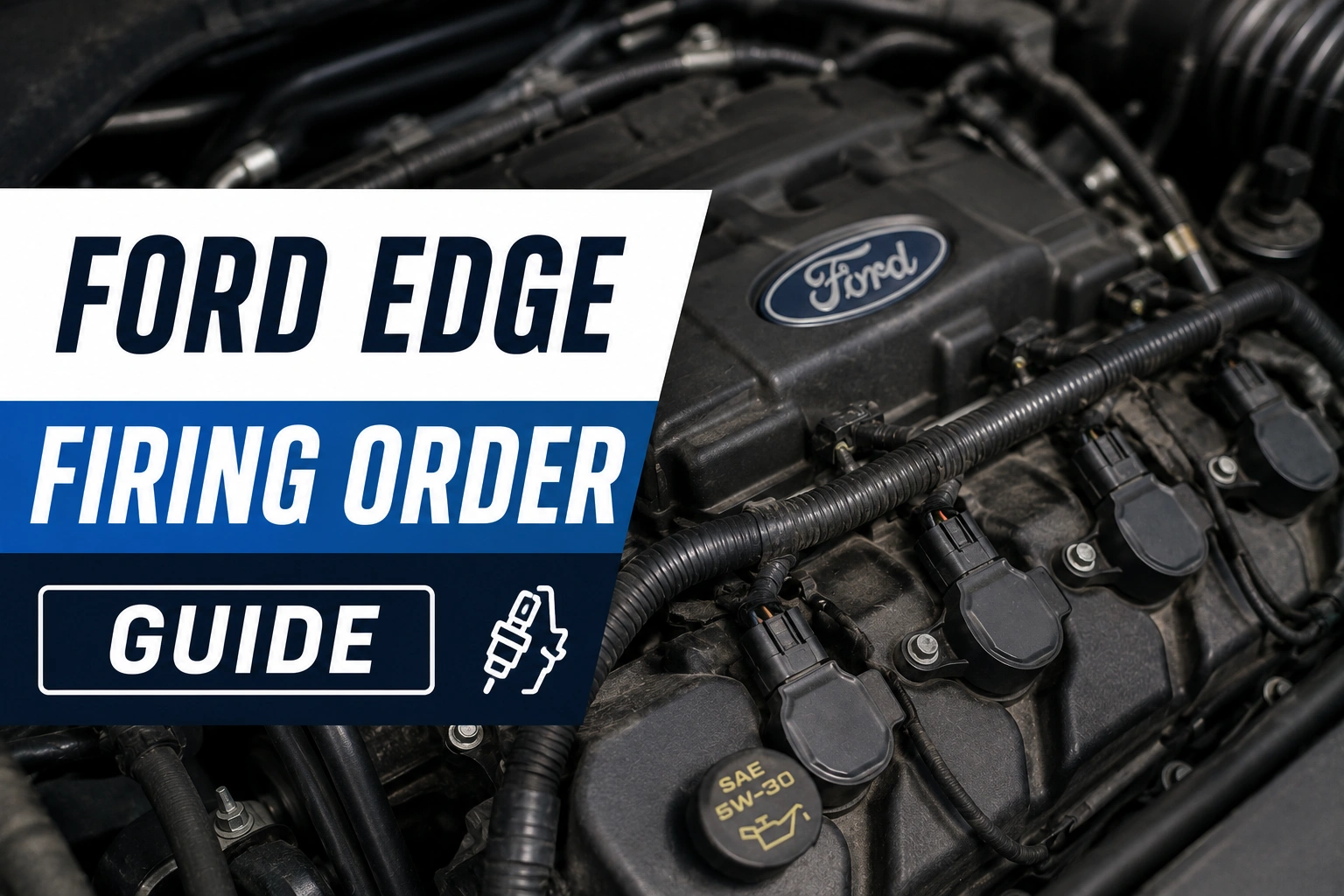
A single V6 engine handled every Ford Edge sold for its entire first year on the market, a level of simplicity this crossover would never quite return to.
By the time production wound down nearly two decades later, four genuinely different engines had shared space under that same hood badge across two full body generations.
That expansion tells a story about how Ford’s midsize crossover segment evolved, chasing efficiency with turbocharged four-cylinders one year and genuine performance credibility with a twin-turbo V6 the next.
Both paths left their own distinct mark on this nameplate’s firing order history.
Every engine the Edge offered across its production run, along with an honest look at why no 2027 model exists despite steady sales right up until the end, gets covered here in complete detail.
Firing Order Basics And Two Body Generations
Firing order describes the exact sequence in which an engine ignites fuel inside each cylinder. Engineers space these combustion events out deliberately around crankshaft rotation, a fixed design decision rather than something that shifts with trim level or model year.
Two distinct body generations carried this nameplate from its 2007 launch through its final 2023 production run. That relatively compact history makes the Edge a genuinely approachable firing order topic once the engine lineup gets sorted by generation.
What Firing Order Actually Controls Inside An Engine
Every cylinder fires at a specific point in crankshaft rotation rather than simple numerical order. A four-cylinder engine completes one firing event every 180 degrees of rotation, while a V6 fires every 120 degrees, spacing power strokes evenly across a full combustion cycle.
That even spacing keeps vibration low and distributes mechanical stress evenly across bearings, mounts, and the crankshaft itself.
Getting this sequence wrong, whether through a genuine mechanical fault or a damaged component, produces rough running, wasted fuel, and accelerated wear over time.
Every Edge engine uses coil-on-plug ignition rather than a distributor and plug wires, with the engine control module firing each coil individually based on crankshaft and camshaft sensor data. Firing order still matters enormously for hands-on repair work, since a stored misfire code always points to a specific physical cylinder location.
Diagnostic trouble codes follow the same predictable pattern regardless of engine type or generation. P0301 identifies cylinder one, P0302 identifies cylinder two, and the pattern continues through the highest cylinder count present, always referring to physical position rather than firing sequence.
One Crossover, Two Generations, And A 2023 Ending
Ford introduced the Edge for the 2007 model year, built on a platform shared with the Ford Fusion sedan and positioned as an on-road-focused alternative to more truck-like midsize SUVs of that era. A significant mid-cycle refresh arrived for 2011, bringing revised styling and two brand-new engine options alongside the carried-over base V6.
The second generation launched for 2015, riding on an all-new platform while keeping the same general engine philosophy of offering a turbocharged four-cylinder alongside more powerful V6 choices.
This generation eventually added a genuine performance variant, badged ST, built around a twin-turbocharged V6 producing well over 300 horsepower.
Four distinct engines served across these two generations: two different Duratec V6 displacements limited mostly to the first generation, a 2.0-liter EcoBoost four-cylinder spanning both generations, and a 2.7-liter twin-turbo EcoBoost V6 exclusive to the second generation’s Sport and ST trims. Sorting out which applies to a specific Edge starts with confirming the exact model year and trim level.
Production ended after the 2023 model year, a development covered in full detail further below, closing out a genuinely successful run that outlasted many direct competitors from the same original launch era, including the Nissan Murano’s original body style and the first-generation Hyundai Santa Fe entirely.
V6 Firing Order From The 3.5L Launch Engine To The 3.7L Upgrade
Every V6 engine Ford ever installed in an Edge shares an identical firing order, despite spanning two different displacements and roughly a decade of availability. That consistency traces back to engineering decisions Ford made long before this crossover existed.
Sorting these two V6 options by their exact production windows clears up most of the confusion buyers encounter when researching a first-generation Edge specifically.
The 3.5L Duratec’s Consistent Sequence
A 3.5-liter Duratec V6 served as the sole engine when the Edge launched for 2007, producing 265 horsepower and remaining the standard choice throughout the entire first generation.
Output climbed to 285 horsepower with the 2011 refresh, and this same basic engine carried forward into the second generation as well, continuing to serve buyers who didn’t need the added performance of the turbocharged alternatives.
Its firing order runs 1-4-2-5-3-6, a sequence Ford has used continuously across its entire 60-degree V6 family dating back to the 1966 Essex V6. That same pattern extends through the 3.0-liter Duratec used in the Ford Escape, the larger 3.7-liter version covered next, and even the modern turbocharged EcoBoost V6 family developed decades later.
Cylinder numbering on this engine follows a sequential grouping rather than the alternating pattern found on many competing V6 designs. Cylinders one through three sit together on the passenger-side bank, running front to rear, while cylinders four through six occupy the driver’s side in the same front-to-rear order.
That sequential grouping, rather than an alternating odd-and-even split between banks, represents a genuinely distinct convention compared to many Chrysler and General Motors V6 engines of the same era.
Anyone used to working on those competing designs benefits from double-checking this specific difference before assuming cylinder locations on a Ford product.
How The 3.7L Sport Engine Fits The Same Pattern
Ford introduced a larger 3.7-liter version of this same basic Duratec architecture alongside the 2011 refresh, offering 305 horsepower as the performance-oriented choice on Sport trim models.
This engine shared its fundamental block design and bore spacing with the 3.5-liter, essentially representing an enlarged version rather than a genuinely new architecture.
Its firing order remains identical at 1-4-2-5-3-6, and cylinder numbering follows the exact same sequential bank grouping as the smaller 3.5-liter. Cylinder one still sits at the front of the passenger-side bank, with the pattern continuing exactly as it does on every other Duratec V6 covered here.
A build sheet or VIN decode settles which of these two displacements sits under a specific first-generation Edge’s hood, since both share nearly identical exterior badging that rarely distinguishes 3.5-liter from 3.7-liter at a glance.
This 3.7-liter engine had a comparatively brief run in the Edge specifically, disappearing when the second generation launched for 2015 in favor of the all-new turbocharged 2.7-liter EcoBoost covered in the next section.
That short window makes 3.7-liter-equipped Edge models somewhat less common today relative to the longer-running 3.5-liter.
Here’s how the first-generation V6 lineup compares:
| Engine | Model Years | Trim | Firing Order |
| 3.5L Duratec V6 | 2007-2014 | Standard | 1-4-2-5-3-6 |
| 3.7L Duratec V6 | 2011-2014 | Sport | 1-4-2-5-3-6 |
| 3.5L Duratec V6 | 2015-2023 | Standard, second gen | 1-4-2-5-3-6 |
EcoBoost Turbo Firing Order Across Both Generations
Turbocharged power reached the Edge lineup partway through the first generation and eventually became the dominant choice across the redesigned second generation. Two genuinely different EcoBoost engines, a four-cylinder and a V6, tell separate but related firing order stories.
Both share Ford’s broader commitment to keeping firing order consistent within each cylinder-count family, regardless of forced induction or displacement changes.
2.0L EcoBoost Four-Cylinder Firing Order
Ford added a turbocharged 2.0-liter four-cylinder to the Edge lineup for the 2012 model year, producing 240 horsepower while delivering meaningfully better fuel economy than the standard V6.
This engine became the standard base choice once the second generation launched for 2015, eventually gaining a modest power bump to 245 and then 250 horsepower across subsequent updates.
Its firing order runs 1-3-4-2, the standard pattern used by the overwhelming majority of inline-four engines across the industry regardless of manufacturer.
Cylinder one sits at the far left of the engine as viewed from outside the vehicle, with cylinders two through four following in a straight line toward the right side.
This same basic firing order and cylinder arrangement applies to every EcoBoost four-cylinder Ford has produced across its broader lineup, including the related engines found in the Ford Escape and Fusion of the same era.
A technician comfortable with any of these siblings can apply identical cylinder logic to an Edge without hesitation.
Turbocharging adds considerable mechanical complexity elsewhere in the engine, from boost control to intercooling, without touching the underlying combustion sequence in any way.
That separation between forced induction hardware and firing order holds true across every turbocharged engine on the market today.
European-market second-generation Edge models also briefly offered a 2.0-liter turbodiesel four-cylinder never sold in North America, part of Ford’s broader European diesel strategy during that period.
Any North American Edge owner encountering diesel-specific firing order information online can safely disregard it as inapplicable to their vehicle.
The Twin-Turbo 2.7L V6 And The ST’s Firing Order
Ford introduced a twin-turbocharged 2.7-liter EcoBoost V6 for the redesigned 2015 Edge, initially offered on the Sport trim before becoming the core engine for the new ST performance variant introduced with the 2019 refresh.
Output climbed from an initial 315 horsepower to 335 horsepower once the ST arrived, making this the most powerful engine ever offered in this nameplate’s history.
This engine belongs to Ford’s separate “Nano” EcoBoost V6 family, architecturally distinct from the older Duratec-based 3.5-liter and 3.7-liter engines covered earlier, sharing more in common with the larger 3.0-liter EcoBoost V6 used elsewhere in Ford’s lineup.
Despite that architectural difference, it maintains the same 1-4-2-5-3-6 firing order established decades earlier by the original Essex V6.
That continuity extends Ford’s remarkable firing order consistency across genuinely separate engineering generations, from a 1966 cast-iron design through a modern, twin-turbocharged, direct-injected performance engine producing well over 300 horsepower.
Few manufacturers can claim this level of sustained mechanical philosophy across such dramatically different underlying technology.
Owners of ST and Sport-trim Edge models benefit from this consistency directly, since diagnostic and repair knowledge gained from any other Ford Duratec or EcoBoost V6 transfers cleanly to this twin-turbo engine without needing to relearn cylinder locations from scratch.
Where The Ford Edge Actually Stands Today
A firing order guide covering a range extending into the near future only stays useful if it reflects what actually happened rather than outdated assumptions. This nameplate’s story took a genuinely definitive turn a few years back worth addressing directly.
Being clear about current availability matters just as much as getting the technical specifications right.
Why Production Ended At The Oakville Plant
Ford discontinued the Edge after the 2023 model year, ending production at its Oakville, Ontario assembly plant as part of a broader shift toward electric vehicle manufacturing at that same facility.
This decision came despite genuinely steady demand, with Ford executives attributing the discontinuation to strategic realignment rather than any lack of consumer interest in the vehicle itself.
Oakville’s retooling reflects Ford’s wider North American strategy of concentrating traditional gasoline crossover production at fewer plants while converting other facilities toward battery-electric vehicle manufacturing.
This mirrors decisions made across several other Ford nameplates during the same general period, as the company worked to balance its existing lineup against long-term electrification goals.
No 2027 Ford Edge exists, and none has been announced as a future product. Ford has not confirmed any direct successor carrying this specific nameplate forward, leaving the Edge Sport and ST as the final expression of Ford’s midsize, performance-capable crossover lineage under this particular badge.
Buyers researching a “2027 Ford Edge” online should understand this simply isn’t a real vehicle, a distinction worth making clearly given how outdated or speculative content circulates for discontinued nameplates still searched frequently by curious shoppers and existing owners alike.
What This Means For Owners And Parts Availability
None of this discontinuation news changes any firing order information covered throughout this section. Every Edge built between 2007 and the final 2023 model year shares the specifications already detailed here, and that information remains just as relevant for the substantial number of these vehicles still in daily service today.
Ford’s standard parts support commitment typically extends at least a decade beyond a nameplate’s final production year, meaning ignition components, diagnostic references, and factory documentation should remain reasonably accessible well into the early 2030s.
Shared engine architecture with other Ford products further supports long-term parts availability beyond what Edge-specific sourcing alone might suggest.
The Edge’s platform-mate relationship with the Ford Fusion, along with its shared EcoBoost engine family connections to the Escape, Explorer, and other Ford crossovers, means most ignition and engine components remain in active production for other applications even after Edge-specific manufacturing ended. That cross-platform parts ecosystem should keep repair costs reasonable for years to come.
Owners planning to keep an Edge long-term can reasonably expect the same fundamental service knowledge that applies today to remain accurate and useful for the foreseeable future, regardless of whether Ford ever revives this specific nameplate.
Practical Diagnosis Across Every Edge Generation
None of this technical and historical detail matters much until a check engine light appears or an engine starts running rough. Firing order and cylinder position knowledge turns that vague warning into a specific, targeted repair.
The sections below apply everything covered so far to real diagnostic work across both generations this nameplate produced.
Matching A Misfire Code To The Right Engine
A scan tool reading a P0301 through P0306 code identifies a misfiring cylinder by its physical position, never by where that cylinder falls within the firing sequence itself. Confirming which engine sits under the hood comes first, particularly important given how many Edge model years offered two or three simultaneous engine choices.
Once that’s settled, matching the engine against the correct chart from earlier sections points straight to the affected coil, plug, or injector. Swapping a suspect coil with a known-good unit from another cylinder remains a reliable confirmation test across every engine covered here, from the original 3.5-liter through the twin-turbo ST.
Bank-specific diagnostic codes benefit from extra care given the sequential, rather than alternating, cylinder numbering used across every Duratec and EcoBoost V6 in this lineup.
A Bank 1 designation corresponds to the passenger-side bank holding cylinders one through three, while Bank 2 covers the driver’s side and cylinders four through six.
Direct-injected EcoBoost engines, including both the four-cylinder and twin-turbo V6, can develop carbon buildup on intake valves over time, since fuel no longer washes over the valves the way it does on the older port-injected 3.5-liter and 3.7-liter engines.
A misfire that only appears after a cold start, improving as the engine warms, often points toward this specific concern.
A compression test at the affected cylinder helps rule out deeper mechanical trouble once ignition components and carbon buildup have both been eliminated as possibilities. This step matters especially on higher-mileage examples, where a persistent misfire surviving a fresh coil and plug replacement sometimes signals a genuine internal engine issue rather than anything tied to firing order.
Maintenance Habits That Matter Most By Engine Type
Spark plugs and coils on the EcoBoost-era engines typically last well beyond 60,000 miles under normal conditions, while the naturally aspirated Duratec V6 engines often tolerated slightly longer intervals given their simpler, less thermally stressed design.
Replacing ignition components proactively before symptoms appear costs considerably less than diagnosing a mystery rough idle months later.
Twin-turbo ST and Sport models place additional demands on cooling and lubrication systems given their considerably higher output relative to the standard lineup.
Owners of these performance-oriented variants benefit from closer attention to fluid condition and change intervals than a base four-cylinder or naturally aspirated V6 model typically requires.
Timing chain health deserves attention across every engine family covered here, since a stretched chain won’t alter the programmed firing order but can throw crankshaft and camshaft sensor signals out of sync enough to trigger stored misfire codes.
This concern applies more to high-mileage examples than to a well-maintained Edge still within its expected service life.
Keeping the exact engine code, not just generation or trim name, documented in any service record prevents the most likely mistake on this nameplate: assuming a specific Edge’s engine based on trim badge alone when Sport and later ST designations covered genuinely different engines across the model’s history.
A quick reference for common symptoms across this lineup:
| Symptom | Likely Cause | Applies To |
| Rough idle, specific cylinder code | Failing coil, plug, or injector | All engines, both generations |
| Misfire only after cold start | Carbon buildup on intake valves | EcoBoost, direct-injected |
| Rattle at startup, quiets quickly | Early timing chain wear | High-mileage examples, any engine |
| Reduced boost, sluggish acceleration | Turbocharger or wastegate issue | 2.0L and 2.7L EcoBoost |
Frequently Asked Questions
What is the firing order of a Ford Edge 3.5 or 3.7 V6?
Both engines share an identical 1-4-2-5-3-6 firing order, part of Ford’s long-running Duratec V6 family. Cylinder one sits at the front of the passenger-side bank on either displacement.
What is the firing order of the Ford Edge 2.0 EcoBoost engine?
The 2.0-liter EcoBoost four-cylinder fires in a 1-3-4-2 sequence, the standard pattern shared by most turbocharged and naturally aspirated four-cylinder engines across the industry.
Does the twin-turbo 2.7L ST engine use a different firing order than the other V6 options?
No, despite coming from a genuinely different engine architecture than the older Duratec V6 family, the 2.7-liter EcoBoost still fires in the same 1-4-2-5-3-6 sequence used across Ford’s entire modern V6 lineup.
Is there a 2027 Ford Edge?
No, Ford discontinued the Edge after the 2023 model year, and no successor carrying this specific nameplate has been announced. Production ended at the Oakville, Ontario plant as part of a shift toward electric vehicle manufacturing.
Which cylinder is number one on a Ford Edge V6?
Cylinder one sits at the front of the passenger-side bank on every V6 this nameplate has used. Cylinders two and three continue on that same side, while four through six occupy the driver’s side in matching front-to-rear order.
Where can I confirm the exact firing order for my specific Ford Edge?
A factory service manual matched to the exact model year and engine code remains the most reliable source. Most auto parts stores can also pull a firing order reference free of charge once given the vehicle’s VIN.
Two body generations, four distinct engines, and a firing order legacy stretching back to 1966 still resolve into two dependable answers once the correct engine gets identified.
Every V6 this nameplate has ever used fires 1-4-2-5-3-6, while every four-cylinder fires 1-3-4-2.
Confirming the exact engine code, rather than relying on trim badge or model year alone, remains the only real starting point for applying any of this information correctly on a nameplate whose production run has now fully concluded.
That single habit turns what could be a confusing search across overlapping trims and generations into a straightforward, five-minute answer.