Three distinct engine families powered the Cadillac CTS across its 2003 to 2019 run, and each one fires its cylinders in a completely different sequence.
A base sedan built around a naturally aspirated V6 shares almost nothing internally with the supercharged CTS-V sitting a few trims higher, yet both rely on the same basic principle underneath.
Anyone chasing a misfire code, replacing ignition coils, or simply curious about what happens under the hood eventually runs into this exact question.
The good news is that Cadillac, along with parent company General Motors, kept things fairly consistent within each engine family across three full generations.
From the original 3.2-liter V6 to the 640-horsepower LT4 V8 that closed out production, every firing sequence, cylinder position, and diagnostic shortcut gets covered here in plain terms anyone can follow.
What Firing Order Means And Why It Matters On A CTS
Firing order simply describes the exact sequence in which an engine’s cylinders ignite their fuel-air mixture. Instead of firing cylinder one, then two, then three down the line, most engines jump around the cylinder bank in a pattern engineers worked out decades ago.
That pattern isn’t random. It’s chosen specifically to spread combustion forces evenly across the crankshaft, cutting vibration and helping the engine run smoothly at idle and under load.
How Cylinder Numbers Are Assigned On These Engines
Every cylinder gets a fixed number built into the engine’s design, and that numbering never changes no matter how many owners the car has had. Manufacturers assign these numbers based on physical position within the block, not the order they fire in.
On a V6 or V8, the block splits into two banks set at an angle to each other, commonly labeled Bank 1 and Bank 2. Cylinders get numbered front to back on each bank, with odd numbers typically grouped on one side and even numbers on the other.
An inline-four engine skips this complexity entirely since there’s only one bank to deal with. Cylinder one sits closest to the front of the engine, usually nearest the drive belt, with two, three, and four following in a straight line toward the firewall.
Knowing this layout matters the moment a diagnostic code points to a specific cylinder. Without knowing where cylinder three physically sits, a misfire code becomes far harder to chase down.
Why An Even Firing Sequence Keeps The Engine Smooth
Every time a cylinder fires, it sends a small shock through the crankshaft. Space those shocks unevenly, and the engine shakes and feels rough even at a steady idle.
Engineers solve this by spacing firing events at equal crankshaft-degree intervals, which is exactly what a proper firing order accomplishes. A six-cylinder engine fires every 120 degrees of crankshaft rotation, while a V8 fires every 90 degrees.
This even spacing explains why swapping ignition wiring on an older, wire-based engine caused such an obvious, rough-running result. Modern coil-on-plug systems on the CTS remove most of that particular risk, but the underlying physics never changed.
A correctly firing engine also lasts longer over time. Uneven combustion forces place extra stress on bearings, the crankshaft, and engine mounts across hundreds of thousands of miles, so firing order genuinely affects long-term durability, not just smoothness.
How The Engine Control Module Manages Firing Order
Every CTS built after 2003 relies on an engine control module, sometimes labeled a powertrain control module, to actually execute the firing order in real time. Crankshaft and camshaft position sensors feed constant data back to this module thousands of times per minute.
That data tells the computer exactly where each piston sits at any given instant, letting it fire the correct ignition coil and open the correct fuel injector at precisely the right moment. Sequential fuel injection, standard on every CTS engine, depends entirely on this same positional data.
Older engines relied on a mechanical distributor to physically route spark to each cylinder in order, making firing order a fixed, physical trait of the ignition wiring itself.
On a CTS, firing order instead lives inside software, checked against a stored table the module references constantly while the engine runs.
This also explains why a failed crankshaft position sensor tends to cause a no-start condition rather than just a rough idle. Without accurate position data, the control module has no reliable way to know when to fire any cylinder at all, let alone in the correct sequence.
Firing Order For Every Cadillac CTS Engine From 2003 To 2019
Three separate engine families found their way into the CTS across sixteen model years, and each one keeps a consistent firing order throughout its entire production run. That consistency makes life considerably easier for anyone working on one of these cars.
Below is a full breakdown by engine type, along with the exact model years each one covers.
3.6L V6 Firing Order Across All Three Generations
The 3.6-liter V6, known internally by codes like LY7, LLT, LFX, and LGX depending on the model year, uses a firing order of 1-2-3-4-5-6. This same sequence applies whether the engine sits under the hood of a 2004 sedan or a 2019 model closing out CTS production.
This engine family actually made its global debut in the 2004 Cadillac CTS, developed jointly with GM’s Australian arm Holden for the VZ Commodore sold overseas.
GM called it the High Feature V6, and it went on to power dozens of vehicles worldwide over the following two decades.
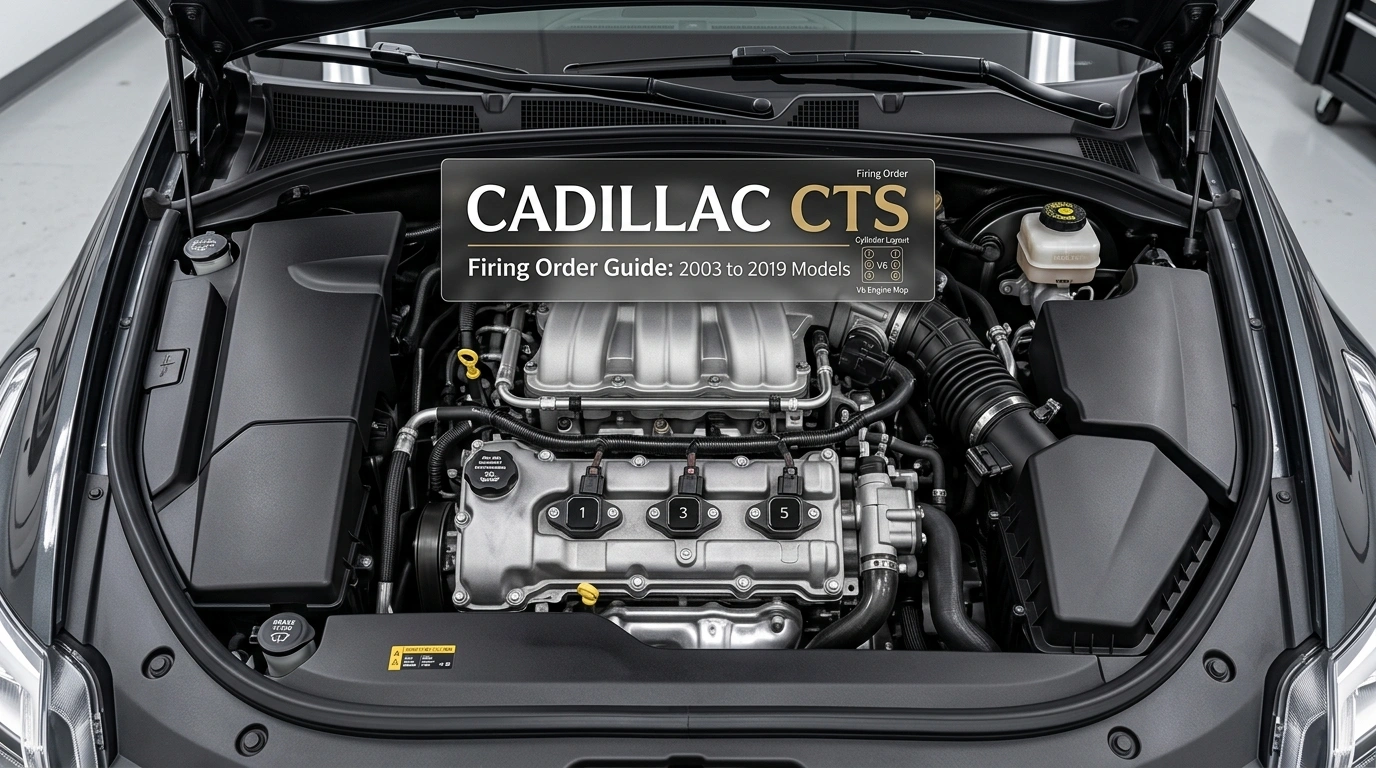
Cylinder numbering follows a straightforward pattern: cylinders one, three, and five sit on one bank running front to back, while two, four, and six occupy the opposite bank in the same front-to-back order. Factory service documentation consistently lists this exact 1-2-3-4-5-6 sequence for the 3.6-liter engine across every trim and model year it appeared in.
The direct-injected LLT introduced for 2008 and the later LFX and LGX updates changed fuel delivery, compression, and output significantly, climbing from roughly 255 horsepower to over 300.
None of those changes touched the firing order itself, since that gets dictated by the crankshaft and block architecture rather than the fuel system.
Where The Smaller 2.8L And 3.0L V6 Engines Fit In
Base-trim CTS models occasionally came with smaller-displacement V6 engines rather than the full 3.6-liter unit, and both share the exact same firing order as their larger sibling. The 2.8-liter LP1, sold mainly on entry-level first-generation trims starting in 2005, uses the identical 1-2-3-4-5-6 sequence.
Second-generation CTS models built for 2010 through 2013 offered a 3.0-liter LF1 as the standard engine, again firing in that same 1-2-3-4-5-6 order.
Both smaller engines share the same fundamental High Feature architecture as the 3.6-liter version, just with a shorter stroke and reduced displacement.
A far less common 3.2-liter LA3 V6, used only during the 2003 model year and on some 2004 manual-transmission cars, actually differs mechanically from the rest of this engine family in bank angle and origin.
Factory service documentation still lists an identical 1-2-3-4-5-6 firing order for this engine, so the pattern holds true even for this early outlier.
Owners rarely need to worry about which specific displacement sits under the hood when it comes to firing order alone, since GM kept this one detail consistent across every V6 variant offered in the CTS.
V8 Firing Order For Every CTS-V Model
Every high-performance CTS-V built between 2004 and 2019 relied on some version of GM’s LS or LT small-block V8 family, and all of them share the same 1-8-7-2-6-5-4-3 firing order. That sequence looks unusual at first glance next to older Chevrolet V8s, and there’s a good reason for that.
Traditional small-block Chevy engines built before the late 1990s used a 1-8-4-3-6-5-7-2 firing order. When GM engineered the LS1 for the C5 Corvette, they revised the sequence to 1-8-7-2-6-5-4-3, and every LS and LT engine since has kept that same pattern for consistency.
The 2004 and 2005 CTS-V used the 5.7-liter LS6, borrowed directly from the Corvette Z06, producing 400 horsepower through a six-speed manual transmission only.
That same 400-horsepower rating carried into 2006 and 2007 once GM switched to the larger 6.0-liter LS2, though the firing order never changed between the two.
The second-generation CTS-V, sold from 2009 through 2015 across sedan, coupe, and wagon body styles, stepped up to a supercharged 6.2-liter LSA producing 556 horsepower.
By the time the third generation arrived, the supercharged 6.2-liter LT4 pushed output to 640 horsepower for 2016 through 2019, making it the most powerful engine Cadillac had ever put into production.
Cylinder numbering on all these V8s follows the classic small-block layout: cylinders one, three, five, and seven run front to back on the driver’s side, while two, four, six, and eight occupy the passenger side in the same order.
2.0L Turbo Four-Cylinder Firing Order Explained
Third-generation CTS models sold from 2014 through 2019 offered a turbocharged 2.0-liter four-cylinder as the entry-level engine, internally coded LTG. This engine uses a firing order of 1-3-4-2, standard for the vast majority of inline-four engines on the road today.
Cylinder numbering couldn’t be simpler on this layout, since there’s only a single row to consider. Cylinder one sits at the front of the engine nearest the drive belt, with two, three, and four following in a straight line back toward the transmission.
A twin-scroll turbocharger adds an interesting wrinkle to this otherwise simple engine. Exhaust gases from cylinders one and four route through one scroll passage, while cylinders two and three share a separate scroll, reducing lag by keeping exhaust pulses from interfering with each other.
Output on the LTG landed around 268 to 272 horsepower depending on the exact model year and application, respectable numbers for a four-cylinder holding down base-model duty in a rear-wheel-drive luxury sedan.
A twin-turbocharged version of the 3.6-liter V6, badged LF3 and reserved for the CTS Vsport trim, shared the same 1-2-3-4-5-6 firing order as its naturally aspirated sibling despite the added turbochargers.
Here’s how every engine option lines up across the full lineup:
| Generation | Model Years | Engine Option | Firing Order |
| First Gen | 2003-2007 | 3.2L, 2.8L, 3.6L V6 | 1-2-3-4-5-6 |
| First Gen CTS-V | 2004-2007 | 5.7L LS6, 6.0L LS2 V8 | 1-8-7-2-6-5-4-3 |
| Second Gen | 2008-2013 | 3.6L, 3.0L V6 | 1-2-3-4-5-6 |
| Second Gen CTS-V | 2009-2015 | 6.2L LSA V8 | 1-8-7-2-6-5-4-3 |
| Third Gen | 2014-2019 | 2.0L Turbo I4 | 1-3-4-2 |
| Third Gen | 2014-2019 | 3.6L V6 (LFX/LGX) | 1-2-3-4-5-6 |
| Third Gen CTS-V | 2016-2019 | 6.2L LT4 V8 | 1-8-7-2-6-5-4-3 |
How Ignition Coils Took Over From Spark Plug Wires
Anyone picturing a distributor cap and a bundle of spark plug wires under the hood of a CTS will be searching for parts that simply don’t exist on these engines. Every engine used across all three generations relies on individual ignition coils instead.
That shift changes how firing order actually gets applied during real-world repairs, even though the underlying sequence matters just as much as it always did.
GM had largely phased out distributor-based ignition industry-wide by the early 2000s, right around when the first CTS launched.
Every engine offered in this car, from the very first 3.2-liter V6 to the final LT4 V8, arrived with some version of individual coil ignition already built in.
Coil-On-Plug Design And What It Means For Repairs
Coil-on-plug ignition places a small, dedicated coil directly above each spark plug, eliminating the long plug wires that once ran from a distributor to every cylinder.
The engine control module fires each coil individually, at precisely the right moment, based on signals from the crankshaft and camshaft position sensors.
This setup removes almost all risk of accidentally crossing wires during a repair, since there’s no shared harness to mix up between cylinders. Each coil connects to its own cylinder through a short, dedicated electrical connector rather than a length of high-voltage cable.
Firing order still matters enormously here, just in a different way. The ECM’s internal programming, not a mechanical distributor, determines the sequence, and that programming gets built around the exact 1-2-3-4-5-6, 1-8-7-2-6-5-4-3, or 1-3-4-2 pattern specific to whichever engine sits under the hood.
Replacing a coil pack still requires knowing cylinder positions accurately, particularly when diagnosing which specific coil has failed. Labeling connectors during removal, rather than relying on memory, avoids reinstallation mistakes that can trigger new fault codes after the repair wraps up.
Reading Misfire Codes Using Firing Order Knowledge
Modern onboard diagnostics assign a specific trouble code to each cylinder once a misfire gets detected, following a simple numbering convention.
Code P0301 points to cylinder one, P0302 points to cylinder two, and the pattern continues straight through to the highest cylinder number on that particular engine.
Cylinder numbers in these codes always refer to physical position, never the firing order sequence itself. A P0303 code on a CTS-V points to cylinder three’s physical location on the driver’s side bank, not the third cylinder to fire in sequence.
This distinction trips up plenty of first-time DIY mechanics who assume the firing order and the code numbering are the same thing. Knowing the actual cylinder layout, not just the firing sequence, turns a confusing code into a five-minute visual inspection.
Scan tools available at most auto parts stores display these codes instantly, and cross-referencing them against the cylinder map for the specific CTS engine narrows a rough-running complaint down to one coil, one plug, or one injector almost immediately.
Putting Firing Order Knowledge To Practical Use
None of this stays purely academic once a check engine light comes on or the engine starts idling roughly. Firing order and cylinder position knowledge turns a vague symptom into a specific, targeted repair.
The next two sections walk through exactly how that process plays out in a real driveway or shop setting.
Diagnosing A Rough Idle Or Misfire Step By Step
A rough idle almost always traces back to one or two cylinders not contributing their full share of power, rather than a problem affecting the entire engine evenly. Pulling stored codes with a scan tool is always the fastest starting point.
Once a specific cylinder number comes back from the scanner, locating that cylinder on the engine becomes the next task. Cross-referencing the cylinder map covered earlier tells a technician exactly which coil, plug, and injector to inspect first rather than guessing at random.
Swapping that cylinder’s ignition coil with a known-good coil from another cylinder is one of the oldest and most reliable diagnostic tricks available. If the misfire code follows the coil to its new cylinder, the coil itself is the problem; if the code stays put on the original cylinder, the issue lies elsewhere.
A compression test at that same cylinder rules out deeper mechanical trouble like a burnt valve or worn piston ring.
Because cylinder position and firing order stay fixed and well documented for every CTS engine, none of this diagnostic work requires guesswork once the code and cylinder map are in hand.
Spark Plug And Ignition Coil Tips By Engine Type
The 3.6-liter V6 uses six individual coils, one per cylinder, typically accessed by removing the engine cover and, on some model years, a portion of the intake manifold to reach the rear bank comfortably.
Working through them in the 1-2-3-4-5-6 order keeps track of which cylinder has already been serviced.
V8-powered CTS-V models offer easier access in some respects, since the engine bay sits lower and wider, though reaching the rear-most coils on cylinders seven and eight still takes a bit of patience.
Extended-life spark plugs on these engines typically last well beyond 60,000 miles under normal driving conditions.
The 2.0-liter turbo four benefits most from sheer simplicity, with all four coils lined up in a single accessible row. Direct injection on this engine does make spark plugs slightly more sensitive to carbon buildup over time, so gap and condition are worth checking a little sooner than on the port-injected V6.
Always torque coil bolts and spark plugs to factory specification rather than estimating by feel. Overtightening a spark plug in an aluminum cylinder head remains a common, entirely avoidable mistake that turns a simple maintenance job into a much bigger repair.
Common Reasons A Misfire Returns After Repair
A misfire that comes back within days of a coil or plug replacement usually points to a mistake made during reassembly rather than a coincidental second failure.
Reconnecting a coil connector to the wrong cylinder, though difficult on factory-keyed connectors, becomes more possible when aftermarket parts or damaged clips get involved.
Carbon buildup on intake valves affects the direct-injected LLT, LFX, LGX, and LTG engines more than older port-injected versions, since fuel no longer washes over the valves on its way into the cylinder.
This buildup can produce a misfire that looks electrical at first but actually stems from restricted airflow into one or two cylinders.
Vacuum leaks near a specific intake runner can mimic a single-cylinder misfire almost perfectly, especially on the V6’s composite intake manifold as it ages.
A smoke test or controlled propane test around the intake often catches this before anyone replaces an expensive coil or injector unnecessarily.
Checking torque specs and connector seating carefully after any ignition repair prevents the vast majority of repeat comebacks, regardless of which of the three engine families sits under the hood.
Frequently Asked Questions
What is the firing order of a Cadillac CTS 3.6 V6?
Every 3.6-liter V6 used in the CTS, including the LY7, LLT, LFX, and LGX versions, fires in a 1-2-3-4-5-6 sequence. This same order applies across all three generations of the car, regardless of horsepower or fuel delivery differences between the variants.
What is the firing order of the CTS-V’s V8 engine?
All CTS-V V8 engines, from the 2004 LS6 through the 2019 LT4, use a 1-8-7-2-6-5-4-3 firing order. This sequence is standard across GM’s entire LS and LT small-block family, not something unique to the CTS-V specifically.
Does the 2.0 turbo four-cylinder CTS use a different firing order?
Yes, the LTG turbo four-cylinder found in 2014 through 2019 base models fires in a 1-3-4-2 sequence. That’s the standard pattern for most inline-four engines, differing completely from the V6 and V8 sequences used elsewhere in the lineup.
Which cylinder is number one on a Cadillac CTS V6?
Cylinder one sits at the front of one bank, commonly documented as the passenger side, with cylinders three and five continuing back along that same bank. The opposite bank holds cylinders two, four, and six in the same front-to-back order.
Can a wrong firing order cause a misfire?
A firing order itself cannot become wrong on these engines since it’s built into the ECM’s programming rather than physical wiring that could be reversed by accident. Misfires almost always trace back to a failed coil, worn plug, fuel injector issue, or low compression instead.
Does the CTS use spark plug wires or coil packs?
Every engine across all three CTS generations uses individual coil-on-plug ignition rather than a distributor with plug wires. Each cylinder gets its own small coil mounted directly above the spark plug, controlled electronically by the engine computer.
How do I know which cylinder is misfiring?
A scan tool reading a P0301 through P0308 code identifies the exact cylinder by number, with the last digit corresponding directly to that cylinder’s physical position. Matching that number against the cylinder map for the specific engine points straight to the affected coil, plug, or injector.
Is the firing order the same for LY7, LLT, LFX, and LGX engines?
Yes, every version of the 3.6-liter High Feature V6 shares the identical 1-2-3-4-5-6 firing order, confirmed across factory service documentation for each variant. Only power output, fuel delivery, and compression ratio changed between these versions, not the firing sequence.
Did the CTS-V’s LS6 and LT4 use the same firing order?
Yes, despite being separated by more than a decade of development and a jump from 400 to 640 horsepower, both engines fire in the identical 1-8-7-2-6-5-4-3 sequence. GM kept this firing order consistent across every small-block V8 since the original LS1 debuted.
Why do V6 and V8 CTS engines number cylinders differently?
The V6’s High Feature family places cylinder one on the passenger-side bank, while the V8’s small-block family places cylinder one on the driver’s side. This comes down to each engine family originating from separate design teams decades apart, rather than any deliberate CTS-specific choice.
Does firing order change if I replace ignition coils?
No, firing order is fixed by the engine’s mechanical design and ECM programming, completely independent of which physical coils happen to be installed. Installing new or aftermarket coils in the correct cylinder positions has no effect on the underlying sequence.
Where can I find the exact firing order diagram for my specific CTS?
A factory service manual for the exact model year and engine combination remains the most reliable source, though the sequences covered here apply consistently across every CTS variant sold between 2003 and 2019. Most auto parts stores can also print a firing order reference free of charge when looking up a specific VIN.
Do CTS-V engines and base CTS engines share anything related to firing order?
No meaningful hardware gets shared between the V6 and V8 lineups, since they come from entirely separate engine families with different block designs, bank angles, and cylinder counts. The only shared idea is a fixed, ECM-controlled firing sequence rather than any physical component.
Did the smaller 2.8L and 3.0L V6 engines use a different firing order than the 3.6L?
No, both the 2.8-liter LP1 and 3.0-liter LF1 use the identical 1-2-3-4-5-6 firing order as the standard 3.6-liter engine. All three share the same basic High Feature architecture, just with different bore and stroke dimensions affecting displacement and output.
Is a misfire always related to firing order?
Not directly, since firing order itself is a fixed design constant rather than something that can fail or degrade over time. A misfire almost always comes from a failing component like a coil, plug, injector, or vacuum leak, with firing order knowledge simply helping locate which cylinder needs attention.
Sixteen model years and three completely different engine families later, the Cadillac CTS still boils down to a fairly simple set of rules once the guesswork gets removed. A V6 fires 1-2-3-4-5-6, a CTS-V’s V8 fires 1-8-7-2-6-5-4-3, and the later turbo four fires 1-3-4-2, full stop.
Every misfire code, every coil replacement, and every diagnostic shortcut flows from that same handful of numbers. Keeping a cylinder map handy for the specific engine under the hood turns what feels like a mystery into a five-minute job almost every time.
None of these numbers change with mileage, aftermarket parts, or a fresh set of coils, which is precisely what makes firing order one of the more dependable facts available about any of these engines. Whatever else needs attention on a CTS approaching two decades of age, the firing sequence itself was never the problem.