Most people can name two or three car brands that start with “O” before going blank. But the full picture is far richer than that. The letter O covers a century-old German automaker that helped define everyday European motoring, an American brand that practically invented the muscle car, a Chinese electric upstart rewriting what an affordable EV can look like, and a handful of historical names that deserve far more attention than they typically receive.
Beyond the brands themselves, dozens of individual car models from manufacturers all over the world carry names beginning with O — from minivans that defined family travel to sedans that set luxury benchmarks, from rally-bred European hatches to rugged all-wheel-drive wagons still selling in their millions.
This guide covers all of it — every brand, every significant model — organized clearly so whether you’re researching a purchase, satisfying curiosity, or building automotive knowledge, you have everything in one place.
All Car Brands That Start With O
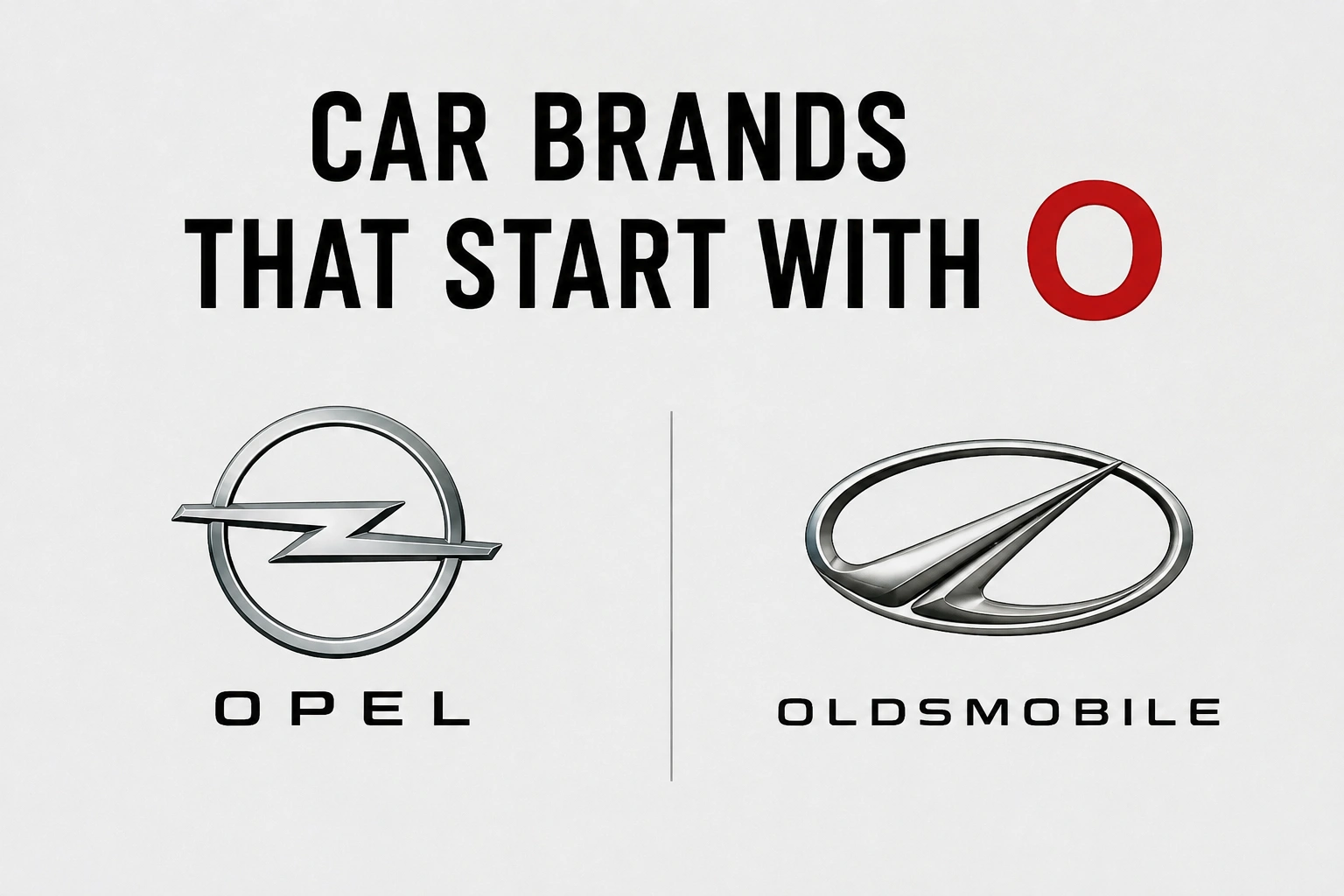
1. Opel
- Country: Germany
- Founded: 1862 (automobiles from 1899)
- Status: Active
- Parent Company: Stellantis
- Known For: Affordable European family cars, GSi/OPC performance heritage, full electrification push
- Sister Brand: Vauxhall (UK market)
Opel is the cornerstone of this entire category. Founded by Adam Opel in Rüsselsheim, Germany, originally as a sewing machine manufacturer, the company pivoted to bicycles and eventually automobiles at the turn of the 20th century.
By the 1970s Opel had grown into Europe’s largest car manufacturer by annual production — a staggering achievement for a brand that most people today associate primarily with compact hatchbacks.
Decades under General Motors gave it the engineering resources of a global giant while keeping its German identity intact. Stellantis acquired the brand in 2017, and the transformation since then has been dramatic: every nameplate in the current lineup now offers a battery-electric or plug-in hybrid variant, and Opel has committed to full electrification across its core European markets.
The brand’s design language has also sharpened considerably, with the Vizor front-end design and Intelli-Lux LED matrix headlights appearing across the range as a unifying signature.
2. Oldsmobile
- Country: United States
- Founded: 1897
- Status: Discontinued 2004
- Parent Company: General Motors
- Known For: American muscle cars, technological firsts, premium mid-size sedans
- Legacy Milestone: One of the oldest American automobile brands in history
Oldsmobile traces its lineage back to Ransom Eli Olds and the Curved Dash Runabout of 1901 — widely regarded as the first mass-produced gasoline-powered automobile in the United States.
The brand spent more than a century as General Motors’ mid-tier nameplate, positioned above Chevrolet but below Buick and Cadillac, serving tens of millions of American buyers across the full range of body styles and price points.
At its commercial peak in the 1970s, Oldsmobile was moving over a million units annually. Its shutdown in 2004 was not the result of bad cars but of brand overlap within GM’s own portfolio — models like the Alero and Aurora were genuinely praised by critics yet could not justify a separate dealer network when Chevrolet and Buick were offering similar products. The brand’s cultural legacy, particularly around the 442 muscle car, remains very much alive in the collector community.
3. ORA
- Country: China
- Founded: 2018
- Status: Active
- Parent Company: Great Wall Motors (GWM)
- Known For: Retro-futurist electric vehicles, affordable city EVs, global EV expansion
- Historic First: The ORA Good Cat was the first Chinese-brand EV mass-produced outside China (GWM Thailand, January 2024)
ORA is the electric vehicle marque of Great Wall Motors, one of China’s largest and most internationally active automakers. Unlike many Chinese EV brands that emerged as offshoots of combustion-era companies, ORA was built from the beginning as a standalone electric-only brand with its own identity — characterised by rounded silhouettes, retro-inspired interiors, and animal-themed model names.
The brand’s approach has proven commercially effective: the Good Cat (sold as the Funky Cat in some early European markets and now as the GWM Ora 03) has been received warmly in Australia, Thailand, South Africa, and parts of Europe.
ORA’s 2025 expansion into the crossover SUV segment with the Ora 5 signals a maturing brand moving beyond city car positioning into the volume crossover space.
4. Omoda
- Country: China
- Founded: 2022
- Status: Active
- Parent Company: Chery Automobile
- Known For: Fashion-forward crossover SUVs, export-focused positioning, strong European and UK launch
- Name Meaning: “O” from Oxygen + “Moda” meaning modern/fashion
Omoda is one of the most aggressively expanding new brands in the global car market. Born as a standalone export marque from Chery — China’s largest car exporter for over two decades — Omoda was initially launched in Russia and Kazakhstan in late 2022 before being elevated to a full global brand in April 2023.
The brand’s positioning is deliberate: it sits above the base Chery nameplate and targets buyers who want European-style design, modern tech, and competitive pricing in a package that does not feel like a budget compromise.
Omoda entered the UK in May 2024 and Italy in July 2024, selling the Omoda 5 alongside its electric sibling the E5. The company also struck a joint venture deal with Spanish firm EV Motors to produce Omoda vehicles at a former Nissan factory in Barcelona, making it one of the first Chinese brands to establish European manufacturing. By 2030, Chery’s combined O&J brands (Omoda and Jaecoo) are targeting 1.4 million annual sales outside China.
5. Oakland
- Country: United States
- Founded: 1907
- Status: Discontinued 1931
- Parent Company: General Motors (from 1909)
- Known For: Birthing the Pontiac brand, early American premium automobiles
- Legacy: Every Pontiac GTO, Firebird, and Trans Am owes its existence to Oakland
Oakland is automotive history’s most consequential footnote. Founded in Pontiac, Michigan in 1907 and absorbed into General Motors just two years later, the brand occupied the tier above Chevrolet in GM’s early lineup.
Its most significant contribution came not from any particular vehicle it built but from what it created: in 1926, GM introduced the Pontiac as a lower-priced companion model to Oakland. Pontiac sold so well that it rapidly overtook its own parent brand in volume, leaving Oakland without a clear reason to exist.
GM discontinued Oakland in 1931, handing the factory floor entirely to Pontiac. The irony is that Oakland’s factory, Oakland’s dealer network, and Oakland’s town name became the permanent home of a brand that outlived it by more than 70 years.
6. Overland
- Country: United States
- Founded: 1903
- Status: Discontinued 1939
- Parent Company: Willys-Overland Motor Company (from 1912)
- Known For: Early affordable American automobiles, forerunner to Willys Jeep heritage
Overland is one of the less-celebrated chapters of early American motoring, but its story touches the roots of what would eventually become the Jeep. The Overland Automotive Division was acquired by John North Willys in 1908, and by 1912 had been renamed Willys-Overland Motor Company.
Under Willys’ aggressive management, the company briefly became the second-largest automobile manufacturer in the United States after Ford — a remarkable achievement for a brand that had barely existed a decade earlier.
The Overland name continued to be used on certain models until 1939, when it was quietly retired. What matters historically is that Willys-Overland’s industrial infrastructure and engineering culture later produced the wartime Jeep, making Overland an indirect ancestor of one of the most iconic vehicles ever built.
7. Oltcit
- Country: Romania
- Founded: 1981
- Status: Discontinued 1995
- Parent Company: Joint venture between Citroën and the Romanian state
- Known For: Communist-era compact hatchbacks, Citroën-derived front-wheel-drive technology for Eastern Europe
Oltcit was Romania’s answer to a specific Cold War-era problem: how to give ordinary citizens access to a modern, front-wheel-drive compact car without fully opening the economy to Western imports. The solution was a joint venture between the Romanian government and Citroën, with production centred at a large factory in Craiova.
The primary product was the Oltcit Club, a front-wheel-drive hatchback sharing architecture with the Citroën Axel. It was not the most refined vehicle by Western standards, but it gave Romanian families something more contemporary than the ageing Dacia 1300 platform that otherwise dominated the domestic market.
After the transition away from communism, the Craiova plant passed through several hands — including Daewoo — and today operates as a Stellantis facility building the Jeep Avenger and Fiat 600e, making it one of the longest-serving automotive production sites in Eastern Europe.
8. OSCA (Officine Specializzate Costruzione Automobili)
- Country: Italy
- Founded: 1947
- Status: Discontinued 1967
- Known For: Lightweight Italian racing and sports cars, exceptional engineering for small displacement
- Founded By: Ernesto, Ettore, and Bindo Maserati — the brothers who built Maserati
OSCA stands apart from everything else on this list. It was not a mass-market brand, not a corporate entity backed by shareholders, and not a commercial venture in the conventional sense. It was the creative outlet of three brothers who had already built one of Italy’s greatest racing marques and could not stop doing what they loved.
The Maserati brothers founded OSCA in Bologna in 1947 after their post-sale non-compete restrictions from Maserati had expired, and they immediately returned to building small, exquisitely engineered sports and racing cars. Their engineering philosophy — achieving maximum performance from minimal displacement — yielded a remarkable racing record.
An OSCA took the Index of Thermal Efficiency at Le Mans in 1954, competing against cars with far larger engines and winning on pure efficiency. Production numbers were tiny but the quality and ingenuity were exceptional, and well-preserved OSCA examples now occupy the rarest tier of Italian motorsport collectibles.
9. Oka
- Country: Russia / Soviet Union
- Founded: 1988
- Status: Discontinued 2008
- Produced By: SeAZ and KamAZ (under AvtoVAZ / VAZ-1111 platform)
- Known For: Soviet-era budget microcar, cultural icon in post-Soviet Russia and Eastern Europe
The Oka is one of the most unusual vehicles in automotive history. Conceived as a Soviet “people’s car” — a stripped-down, ultra-affordable city microcar that ordinary Soviet citizens could actually obtain — the VAZ-1111 Oka was produced from 1988 onward at plants in Serpukhov and later Naberezhnye Chelny.
The car was extraordinarily small, powered by a 0.65-litre two-cylinder engine, and offered only the most basic features, but it served a genuine purpose in a country where private car ownership was still a privilege rather than an expectation.
Production continued until 2008, and the Oka remains a beloved cultural object in Russia and the former Soviet republics, popular with enthusiasts who modify them for everything from city commuting to surprisingly capable off-road builds. Few vehicles better illustrate how different the automotive needs of different societies can be.
10. Owen Magnetic
- Country: United States
- Founded: 1915
- Status: Discontinued 1922
- Known For: Electromagnetic transmission technology, luxury pre-war automobiles, marketed as “The Car of a Thousand Speeds”
The Owen Magnetic occupies a genuinely remarkable place in automotive history as a car that was, in technological terms, ahead of almost everything around it.
Produced between 1915 and 1922 in New York, the Owen Magnetic used an electromagnetic transmission designed by engineer Justus Entz — a system where there was no mechanical connection between the engine and the driveshaft, with power transmitted entirely through a magnetic field.
This gave the car an effectively infinite number of gear ratios, which is precisely where its marketing slogan came from. It was expensive and mechanically complex, limiting ownership to celebrities and the very wealthy, and its technological sophistication ultimately worked against it in a market that needed simplicity and affordability above all else.
But as an early proof that drivetrains could be fundamentally reimagined, the Owen Magnetic prefigured electric and hybrid powertrains by nearly a century.
Quick Reference: Car Brands Starting With O
| Brand | Country | Active Years | Current Status | Notable For |
| Opel | Germany | 1899–present | Active (Stellantis) | European family & electric cars |
| Oldsmobile | USA | 1897–2004 | Discontinued | Muscle cars, American sedans |
| ORA | China | 2018–present | Active (GWM) | Retro EV design, city electrics |
| Omoda | China | 2022–present | Active (Chery) | Fashion-forward crossover SUVs |
| Oakland | USA | 1907–1931 | Discontinued | Parent brand of Pontiac |
| Overland | USA | 1903–1939 | Discontinued | Early US mass-market cars |
| Oltcit | Romania | 1981–1995 | Discontinued | Communist-era compact hatchbacks |
| OSCA | Italy | 1947–1967 | Discontinued | Italian racing and sports cars |
| Oka | Russia | 1988–2008 | Discontinued | Soviet-era budget microcar |
| Owen Magnetic | USA | 1915–1922 | Discontinued | Electromagnetic transmission pioneer |
Car Models That Start With O (Across All Brands)
This section covers the most significant, widely-known, and historically interesting car models whose names begin with the letter O — regardless of which manufacturer built them. These range from million-selling family favourites to rare collector pieces and discontinued models that deserve to be remembered.
1. Octavia — Škoda
- Produced By: Škoda Auto (Volkswagen Group)
- Type: Small family car / compact liftback and estate
- In Production: 1996–present (modern generation); earlier from 1959–1971
- Key Fact: Accounts for approximately 40% of all new Škoda vehicles produced
The Škoda Octavia is one of the best-value propositions in the entire European car market and has been for nearly three decades. The modern Octavia nameplate relaunched in 1996 after Škoda joined the Volkswagen Group, and it has been built on successive VW Group platforms ever since, giving buyers Golf-level engineering at consistently lower prices.
Four generations have been produced, and around five million units have sold across the modern era alone. The current fourth-generation Octavia is available as a five-door liftback or estate, with petrol, diesel, plug-in hybrid, and CNG variants.
The RS performance version, with its turbocharged engines and sport-tuned chassis, represents remarkable performance for the money. The Octavia’s estate version in particular has built a loyal following among buyers who need genuine load-carrying capacity without moving to a van. The car’s longevity reflects how well it has balanced practicality, quality, and competitive pricing generation after generation.
2. Odyssey — Honda
- Produced By: Honda
- Type: Minivan / people carrier
- In Production: 1994–present (North America); various generations for Asian markets
- Key Fact: One of the best-selling minivans in North American history
The Honda Odyssey set the standard for what a family minivan should be and then kept raising it. Launched in 1994 and now in its fifth generation for the North American market, the Odyssey combined Honda’s reputation for mechanical reliability with intelligent interior packaging, comfortable ride quality, and a cabin layout specifically designed around the reality of family life — not just the marketing version of it.
Features like the Magic Slide second-row seats, the fold-flat third row, and an in-floor storage compartment made it genuinely more useful than competitors in day-to-day use. Safety ratings have been consistently strong across generations.
The current fifth-generation model, offered with a 3.5-litre V6 producing 280 horsepower paired with a ten-speed automatic transmission, remains one of the benchmark minivans in its segment, competing directly with the Toyota Sienna and Chrysler Pacifica.
3. Outlander — Mitsubishi
- Produced By: Mitsubishi Motors
- Type: Compact crossover SUV (two and three-row)
- In Production: 2001–present
- Key Fact: The Outlander PHEV was one of the world’s best-selling plug-in hybrid SUVs
The Mitsubishi Outlander has had a longer and more consequential run than most people give it credit for. First launched in 2001 as the Airtrek in Japan before taking the Outlander name globally, it has now gone through four generations and established itself as a genuinely competitive mid-size crossover.
The third generation in particular, offered as the Outlander PHEV (Plug-in Hybrid Electric Vehicle), became one of the most commercially successful plug-in hybrid SUVs in the world during the mid-2010s — a significant achievement for a brand that was otherwise struggling for volume in several key markets.
The fourth-generation Outlander, launched in 2021 and refreshed for 2024, brought substantially upgraded interior quality, a much more premium feel, and an updated PHEV system, earning strong reviews in markets including North America, Australia, and Japan.
4. Outback — Subaru
- Produced By: Subaru
- Type: Crossover wagon / lifted all-wheel-drive estate
- In Production: 1994–present
- Key Fact: Created the crossover wagon segment before “crossover” was a mainstream term
The Subaru Outback is one of those vehicles that arrived before the market category it now occupies had a proper name. When it launched in 1994 as a raised, all-wheel-drive variant of the Legacy wagon, there was no widely accepted term for what it was. It has since become the defining example of the crossover wagon — more capable than a conventional estate, more car-like than an SUV, and more practical than either.
The Outback’s reputation for reliability, the effectiveness of Subaru’s Symmetrical All-Wheel Drive system, and its genuine ability to handle light off-road terrain without pretension have built it one of the most passionate owner communities of any car in its price bracket.
The current sixth-generation model, available with a 2.5-litre naturally aspirated flat-four or an optional 2.4-litre turbocharged engine in the Onyx and XT variants, continues this legacy with improved ride quality, a larger touchscreen, and enhanced driver assistance systems.
5. Optima — Kia
- Produced By: Kia (Hyundai Motor Group)
- Type: Midsize sedan
- Produced: 2000–2021 (replaced by the K5)
- Key Fact: The third-generation Optima, designed under Peter Schreyer, became a landmark in Korean automotive design
The Kia Optima’s importance to the story of Korean automotive design cannot be overstated. For most of its first two generations, it was a competent but visually unremarkable mid-size sedan that competed in one of the most crowded segments of the market without making a strong case for itself on anything other than value. The third generation of 2010, arriving under the creative direction of designer Peter Schreyer, changed everything.
Its swept lines, pronounced chrome grille, and distinctly European proportions proved that a Korean family sedan did not have to look like a pale imitation of Japanese or American rivals. Sales surged, and the Optima’s design influence spread throughout the Kia range. The car was rebranded as the K5 in 2020 for global markets, but the Optima name remains the nameplate that turned Kia’s design reputation around.
6. Ocean — Fisker
- Produced By: Fisker Inc.
- Type: Mid-size electric crossover SUV
- Produced: 2022–2024 (Fisker filed for bankruptcy in June 2024)
- Key Fact: Top-trim Extreme version offered up to 360 miles (EPA) of range from a 106.5 kWh usable battery
The Fisker Ocean is a fascinating vehicle to assess because it is simultaneously one of the most thoughtfully designed electric SUVs ever made and one of the more cautionary tales in the recent history of EV startups.
Designed by Henrik Fisker — whose automotive design resume includes the BMW Z8 and the Aston Martin DB9 — the Ocean brought a genuinely distinctive exterior, a sustainability-first interior using recycled and vegan materials, and several inventive features including “California Mode,” which opens all windows and roof panels simultaneously at the press of a button.
The entry-level Sport used a 75 kWh LFP battery with a single motor producing 275 hp and a 231-mile EPA range; the flagship Extreme trim used a 113 kWh battery with dual motors producing 560 hp and a 360-mile EPA range. Assembly was contracted to Magna Steyr in Graz, Austria. Fisker Inc. filed for bankruptcy in June 2024, leaving owners without manufacturer support, but the Ocean’s hardware remains impressive and it has attracted significant attention in the used market.
7. Omega — Opel / Vauxhall / Lotus
- Produced By: Opel (as family sedan); Lotus (as the Lotus Omega/Carlton performance version)
- Type: Executive sedan (Opel); High-performance supercar-saloon (Lotus)
- Produced: Opel Omega: 1986–2003; Lotus Omega/Carlton: 1990–1992
- Key Fact: The Lotus Omega/Carlton was, when launched, the fastest production saloon car in the world
The Omega name carried two very different identities at the same time. As the Opel Omega, it was a well-regarded large executive sedan that competed against the BMW 5 Series and Mercedes E-Class with a more accessible price tag, offering a refined ride and a practical interior that made it a genuine choice for company car users across Europe.
The second generation Omega ran from 1994 to 2003 and is well-regarded by enthusiasts who appreciate its clean styling and available V6 engines. The Lotus Omega — sold as the Lotus Carlton in the UK — was an entirely different proposition.
General Motors gave Lotus Engineering a base Omega/Carlton, and what Lotus returned was a twin-turbocharged 3.6-litre straight-six producing 377 hp, mated to a six-speed ZF manual gearbox. Top speed was claimed at 176 mph — making it the fastest production saloon in the world at its 1990 launch. Only 950 units were built, and the Lotus Omega/Carlton is now one of the most collectible performance sedans from that era.
8. Onix — Chevrolet
- Produced By: General Motors (Brazil, Colombia, China)
- Type: Subcompact hatchback and sedan
- In Production: 2012–present
- Key Fact: One of Brazil’s best-selling cars for multiple consecutive years; the sedan version, Onix Plus, received a 5-star Latin NCAP rating
The Chevrolet Onix is proof that significant automotive products can exist largely outside the awareness of buyers in North America or Western Europe. Launched in 2012 to replace the Corsa and related models in the South American market, the Onix rapidly became one of Brazil’s top-selling cars — a position it has maintained year after year.
The second generation, arriving in 2019, brought a substantially upgraded interior, a choice of naturally aspirated and turbocharged 1.0-litre engines (producing 82 hp and 116 hp respectively), and a new Onix Plus sedan variant that went on to earn a five-star rating from Latin NCAP.
The car is also produced and sold in China and Colombia, giving it a genuinely global footprint that the Chevrolet name rarely achieves outside of North America. Its engineering is solid, its pricing is competitive, and its sales figures tell the story better than any review could.
9. Orion — Ford
- Produced By: Ford Europe
- Type: Compact notchback sedan (saloon)
- Produced: 1983–1993
- Key Fact: Among the top 10 best-selling cars in the UK every year from 1984 to 1990
The Ford Orion is a vehicle that played a more significant role in European automotive history than its modest profile might suggest. Launched in 1983 as a notchback saloon variant of the Ford Escort, the Orion gave European buyers — particularly British buyers — who preferred a traditional three-box sedan body style over the Escort’s hatchback a compelling and competitively priced option.
It was assembled at Halewood in the UK and Saarlouis in Germany, and its sales success in Britain from 1984 to 1990 directly influenced other manufacturers to develop their own saloon variants of popular hatchbacks.
The Vauxhall Belmont, for instance, was a direct competitive response to the Orion’s success. The Orion was discontinued in 1993 and replaced by a saloon variant of the new Escort, but its decade in the market left a lasting imprint on how European manufacturers thought about offering body style choice in the compact segment.
10. Orlando — Chevrolet
- Produced By: General Motors (South Korea / global)
- Type: Compact MPV / family car
- Produced: 2011–2019
- Key Fact: Offered seven seats in a compact-car footprint, sold in Europe, Australia, Latin America, and South Korea
The Chevrolet Orlando was one of General Motors’ more thoughtfully engineered people carriers — a compact MPV that managed to package three rows of seating into a vehicle footprint not much larger than a standard family hatchback.
Built on GM’s Delta II platform, which it shared with the Chevrolet Cruze, the Orlando offered a 1.8-litre naturally aspirated petrol engine or a 2.0-litre turbodiesel, both paired with either a six-speed manual or automatic transmission.
In markets like the UK and Australia where compact MPVs had a genuine following, the Orlando was well-received for its flexibility and competitive pricing. It never achieved the volume to be considered a major commercial success in any single market, but across its combined global sales territories it served as a practical and reliable choice for families who needed three-row versatility without the bulk of a minivan or the cost of a larger SUV.
11. Oxford — Morris
- Produced By: Morris Motors (UK)
- Type: Compact / mid-size family saloon
- Produced: Various generations from 1913–1971 under the Oxford name
- Key Fact: The Morris Oxford Series V was exported globally and formed the basis of the Hindustan Ambassador, which was produced in India until 2014
The Morris Oxford is one of the most geographically far-reaching nameplates in automotive history. The Oxford name was applied to various Morris vehicles across multiple decades, but its most consequential version was the Series II through V of the 1950s and 1960s — a conventionally engineered, unibody British family saloon that sold in volume across the UK, Commonwealth markets, and beyond.
When the Morris Oxford Series III design was licensed to Hindustan Motors in India in 1957, it became the Hindustan Ambassador — a vehicle that went on to be produced virtually unchanged for 57 years until 2014, making it one of the longest-running production runs of any car model in history.
The Oxford’s design proved so well-suited to Indian road conditions and so deeply embedded in Indian cultural identity — as a taxi, a government vehicle, and a family car — that it outlived the original by more than four decades.
Key Car Models Starting With O: At A Glance
| Model | Brand | Type | Years Active | Key Spec / Fact |
| Octavia | Škoda | Compact liftback/estate | 1996–present | ~5 million sold; 40% of Škoda’s volume |
| Odyssey | Honda | Minivan | 1994–present | Benchmark family minivan in North America |
| Outlander | Mitsubishi | Compact/mid SUV | 2001–present | Outlander PHEV: global bestselling plug-in hybrid SUV |
| Outback | Subaru | Crossover wagon | 1994–present | Defined the raised AWD wagon category |
| Optima | Kia | Midsize sedan | 2000–2021 | Redesigned Korean auto aesthetics globally |
| Ocean | Fisker | Electric mid-size SUV | 2022–2024 | Up to 360 mi EPA range; Fisker went bankrupt 2024 |
| Omega | Opel/Lotus | Exec sedan / supercar saloon | 1986–2003 | Lotus version: world’s fastest saloon at launch |
| Onix | Chevrolet | Subcompact hatch/sedan | 2012–present | Brazil’s top-selling car multiple years running |
| Orion | Ford | Compact notchback sedan | 1983–1993 | Top 10 UK bestseller every year 1984–1990 |
| Orlando | Chevrolet | Compact 7-seat MPV | 2011–2019 | Three rows in a compact footprint |
| Oxford | Morris | Family saloon | 1913–1971 | Basis of Hindustan Ambassador, made until 2014 |
FAQs
What are all the car brands that start with O?
The main car brands starting with O include Opel (Germany, active), Oldsmobile (USA, discontinued 2004), ORA (China, active), Omoda (China, active), Oakland (USA, discontinued 1931), Overland (USA, discontinued 1939), Oltcit (Romania, discontinued 1995), OSCA (Italy, discontinued 1967), Oka (Russia, discontinued 2008), and Owen Magnetic (USA, discontinued 1922).
What car models start with the letter O?
Notable car models starting with O include the Škoda Octavia, Honda Odyssey, Mitsubishi Outlander, Subaru Outback, Kia Optima, Fisker Ocean, Opel Omega, Lotus Omega/Carlton, Chevrolet Onix, Ford Orion, Chevrolet Orlando, and Morris Oxford, among others.
Is Opel the same as Vauxhall?
Yes. Opel and Vauxhall are sister brands under the Stellantis group selling identical vehicles under different names. Opel badging is used across mainland Europe; Vauxhall is used in the United Kingdom. The cars share the same platforms, engines, and factory production lines.
Why did Oldsmobile shut down?
General Motors discontinued Oldsmobile in 2004 during a broader restructuring to eliminate brand overlap within its portfolio. Oldsmobile’s lineup had become too similar to Chevrolet and Buick, making a separate dealer network and marketing spend difficult to justify. The last Oldsmobile — an Alero — was built on April 29, 2004, in Lansing, Michigan.
What is ORA Cars?
ORA is a battery electric vehicle brand owned by Great Wall Motors (GWM) of China. Founded in 2018, it specialises in retro-styled EVs including the Good Cat/Ora 03, Ballet Cat, Lightning Cat, and the newer Ora 5 crossover SUV. ORA sells in Europe, Southeast Asia, Australia, South Africa, and South America.
What is the Omoda car brand?
Omoda is an export-only SUV brand created by Chery Automobile in 2022. It does not sell cars in China under its own name but markets vehicles in Russia, Europe, the UK, Australia, Africa, and Latin America. The name combines “O” (from Oxygen) with “Moda” (meaning modern/fashion). Its main models are the Omoda 5, Omoda E5, and Omoda 7.
What is the Lotus Omega?
The Lotus Omega — sold as the Lotus Carlton in the UK — was a modified Opel Omega/Vauxhall Carlton produced between 1990 and 1992. Lotus Engineering fitted a twin-turbocharged 3.6-litre straight-six engine producing 377 hp, making it the fastest production saloon car in the world at launch, with a claimed top speed of 176 mph. Only 950 were built.
What car became the Hindustan Ambassador?
The Morris Oxford Series III — a compact British family saloon produced from the late 1950s — was licensed to Hindustan Motors in India and became the Hindustan Ambassador. While Morris discontinued the Oxford in 1971, Hindustan continued producing the Ambassador with minimal changes until 2014, giving the design a 57-year production run across both countries.
Is the Subaru Outback a car or an SUV?
The Subaru Outback is technically a crossover wagon — it is built on a car platform (shared with the Legacy sedan) rather than a truck-based SUV platform, but raised ride height, all-wheel drive as standard, and SUV-adjacent styling have led most buyers and reviewers to treat it functionally as a crossover. Subaru itself calls it a “crossover SUV” in most markets.
What was the first Chinese EV built outside China?
The ORA Good Cat (sold as the GWM Ora 03) became the first electric vehicle from a Chinese manufacturer to be mass-produced outside of China when it rolled off the production line at GWM’s Rayong factory in Thailand on January 12, 2024, marking a milestone in Chinese automotive industry’s global expansion.