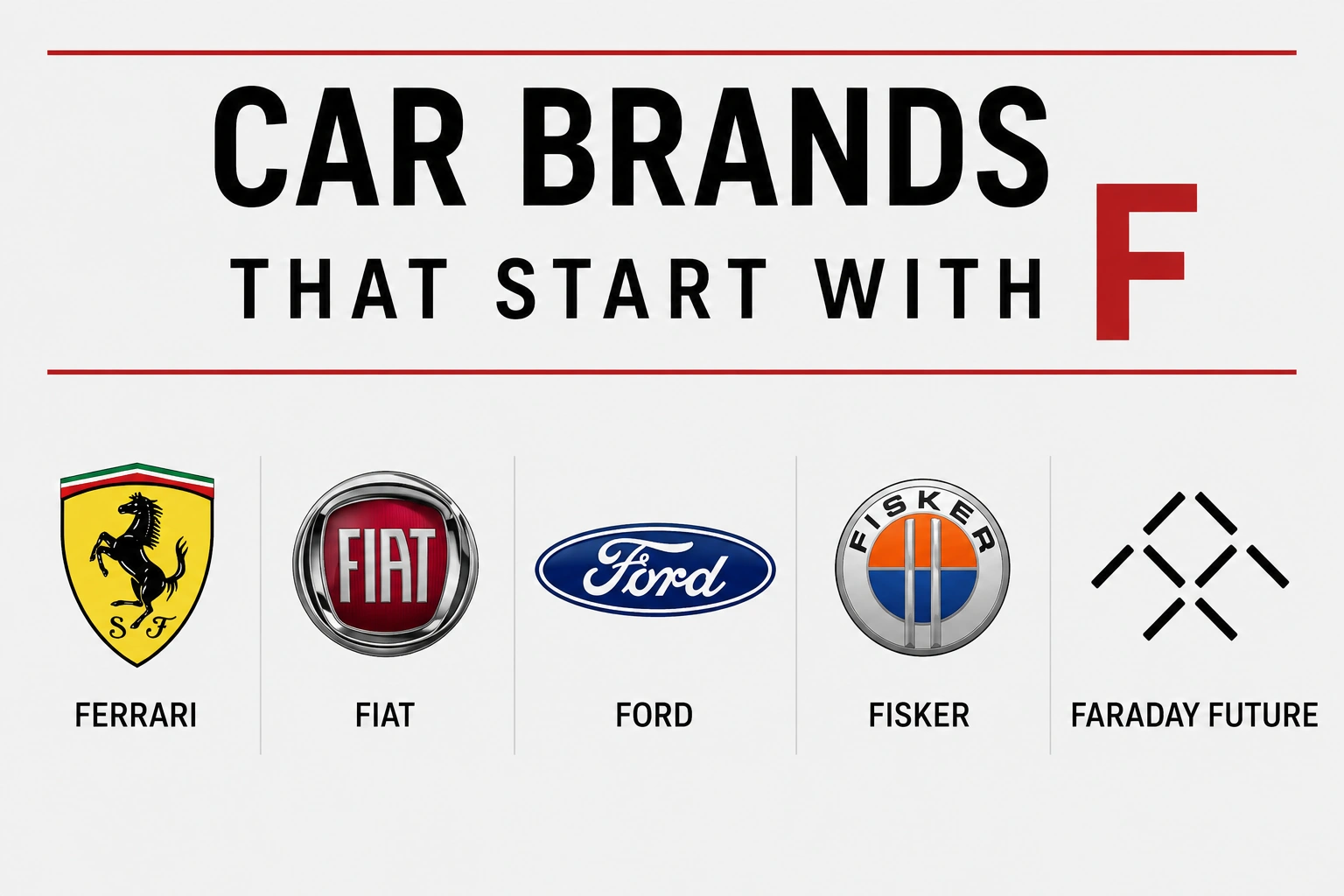
Few letters in the automotive alphabet carry as much emotional range as F. On one end sits Ferrari — a name that single-handedly defines what most people picture when they imagine a supercar, backed by 75-plus years of Formula 1 obsession and Maranello craftsmanship.
On the other end sits Ford, the company that put America on wheels through mass production and has sold more F-150 pickup trucks than any other vehicle in US history for over four decades running.
In between, F covers Italian small-car charm through Fiat, two high-profile American EV startups that both collapsed in spectacular fashion within years of each other, and a scattering of niche manufacturers building everything from heavy trucks to track-day specials.
This guide brings together every notable F-brand and F-model worth knowing in 2026 — the legends, the survivors, the cautionary tales, and the everyday vehicles that quietly outsell almost everything else on the road.
Car Brands That Start With F
1. Ferrari
Ferrari needs no introduction, but its specific position in 2026 deserves one. Founded in 1939 by Enzo Ferrari in Maranello, Italy, the brand has spent over eight decades building road cars largely to fund its Formula 1 racing program — a relationship that remains central to its identity even as the company has grown into one of the most profitable automakers per unit sold anywhere in the world.
The current lineup represents what Ferrari itself describes as its strongest in years, spanning the final naturally aspirated V12 grand tourers, hybrid mid-engine supercars, its first-ever SUV, and a hybrid hypercar halo model.
Key Models (2025/2026):
- 12Cilindri / 12Cilindri Spider — V12 grand tourer; from ~$412,000 (coupe); convertible adds ~$100,000; successor to the 812 Superfast; last of the naturally aspirated front-engine V12s
- Purosangue — Ferrari’s first SUV; 6.5L naturally aspirated V12; 715 hp; AWD; 8-speed automatic; 11 city / 15 highway mpg; pricing from ~$430,000 new, with used examples trading at $570,000–$630,000
- 296 GTB / GTS — Mid-engine plug-in hybrid V6; 819 hp combined; coupe (GTB) and targa (GTS)
- Roma / Roma Spider / Amalfi / Amalfi Spider — Front-engine V8 grand tourers; Amalfi is the newly renamed/updated Roma successor
- F80 — New hybrid hypercar halo model; successor to LaFerrari; extremely limited production
- SF90 Stradale / Spider, SF90 XX Stradale / Spider — Plug-in hybrid flagship supercars
- 812 Competizione / Competizione A — Track-focused V12 special series
- Electric Ferrari — Confirmed for 2026 at earliest; volume production model intended to expand the brand’s customer base
Brand facts:
- Founded: 1939 (cars from 1947), Maranello, Italy
- Founder: Enzo Ferrari
- Current ownership: Publicly traded (NYSE: RACE); Exor (Agnelli family) majority shareholder
- Known for: F1 heritage, V12/V8 supercars, exclusivity-driven production caps
2. Ford
Ford Motor Company, founded by Henry Ford in 1903, remains one of the most consequential companies in industrial history — the pioneer of the moving assembly line that made automobiles affordable for ordinary families for the first time. Over 120 years later, Ford remains a top-three global automaker and the F-Series pickup has been the best-selling vehicle in the United States for more than 40 consecutive years.
Ford’s 2026 strategy splits clearly between its enormously profitable truck and SUV business and its more turbulent EV division, which has faced production delays and cost overruns on the Mustang Mach-E and F-150 Lightning programs even as Ford continues investing in next-generation electric architectures.
Key Models (2025/2026):
- F-150 — America’s best-selling vehicle; from $39,330 (XL); up to $113,525 (Raptor R); engines include 2.7L EcoBoost V6, 5.0L V8, 3.5L EcoBoost V6, and PowerBoost full hybrid (430 hp / 570 lb-ft, ~21 mpg real-world combined); 9 trim levels; BlueCruise hands-free driving now a one-time purchase good for 7 years
- Mustang — Iconic muscle car; GT trim from ~$44,330; V8 GT and Dark Horse retain naturally aspirated power; 2026 Build & Price now live
- Explorer — 3-row SUV; from ~$39,200; 2.3L EcoBoost (300 hp) standard; ST gets 400 hp twin-turbo V6
- Bronco / Bronco Sport — Off-road SUVs; strong sales momentum continuing into 2026
- Maverick — Compact hybrid pickup; among the most fuel-efficient trucks sold in the US
- F-150 Lightning — Electric F-150 variant
- Mustang Mach-E — Electric crossover; continues with updates
Brand facts:
- Founded: 1903, Dearborn, Michigan, USA
- Founder: Henry Ford
- Notable record: F-Series best-selling US vehicle for 40+ consecutive years
- Sub-brands: Lincoln (luxury division)
3. Fiat
Fiat (Fabbrica Italiana Automobili Torino) was founded in 1899 in Turin, Italy, making it one of the oldest continuously operating car manufacturers in the world — narrowly older than Ford. For over a century, Fiat has specialised in small, affordable, characterful city cars, with the Fiat 500 being perhaps the most internationally recognised “cute car” badge in the world. Fiat became part of Fiat Chrysler Automobiles (FCA) in 2014 and, following the 2021 merger with the PSA Group, is now part of Stellantis.
Fiat’s modern identity is increasingly tied to electrification in Europe, where the Fiat 500e has become one of the brand’s most important products, while the brand maintains a significant presence in Latin American markets (particularly Brazil and Argentina) with the Fiat Pulse, Strada, and Argo lineups that don’t typically reach European or US showrooms.
Key Models (2025/2026):
- Fiat 500e — All-electric reinterpretation of the iconic 500; available in hatchback and convertible (Cabrio) forms; 42 kWh battery; approximately 199 miles WLTP range (24 kWh version offers shorter range, ~118 miles); starting price around €29,000–€32,000 in Europe; not currently sold in the US
- Fiat Panda — Long-running budget hatchback; latest generation (2024+) available with hybrid powertrains; one of Europe’s best-selling city cars for decades
- Fiat 600e — Electric compact crossover; shares platform with Jeep Avenger; from ~€35,000
- Fiat Topolino — Ultra-compact two-seat quadricycle EV; targets urban micromobility buyers; no driving licence required in some European jurisdictions for the lowest-powered version
- Fiat Pulse / Fastback / Strada — Latin American market models; Strada is a top-selling compact pickup in Brazil
Brand facts:
- Founded: 1899, Turin, Italy
- Current owner: Stellantis
- Known for: Fiat 500 / 500e, Panda, small affordable cars
- US availability: Currently no Fiat models officially sold in the US (Fiat 500e and Fiat 500X were withdrawn from the US market)
4. Fisker
Fisker is one of the most-discussed cautionary tales in the modern EV industry — and a brand that has now effectively ended twice under the same founder. Henrik Fisker, a respected automotive designer who previously worked on the BMW Z8 and Aston Martin DB9, founded the original Fisker Automotive in 2007, which produced the Fisker Karma plug-in hybrid before going bankrupt in 2014. Fisker relaunched as Fisker Inc. in 2016, went public via SPAC in 2020, and brought its second vehicle — the Fisker Ocean electric SUV — to market in 2023.
The Ocean’s launch was troubled by software glitches, production shortfalls, and financial mismanagement. Fisker filed for Chapter 11 bankruptcy in June 2024, with its liquidation plan approved by a Delaware bankruptcy court in October 2024. The remaining inventory of 3,231 Ocean SUVs was sold to American Lease, a ride-share leasing company, for between $2,500 and $16,500 per vehicle — a staggering collapse from original prices of $40,000 to over $70,000. The SEC investigation into Fisker’s conduct was opened in late 2024 and formally closed in September 2025, with no enforcement action taken. As of 2026, Fisker Inc. no longer produces vehicles.
Historic/Final Models:
- Fisker Karma (2011–2012) — Plug-in hybrid luxury sedan; original Fisker Automotive’s only product before its first bankruptcy
- Fisker Ocean (2023–2024) — Electric SUV; up to 360 miles range claimed (Ocean Extreme); production ended with company’s 2024 bankruptcy; remaining units sold off in bulk to a leasing company
Brand facts:
- Founded: 2007 (original); relaunched 2016
- Founder: Henrik Fisker
- Status: Defunct (Chapter 11 bankruptcy approved October 2024)
- SEC investigation: Opened late 2024, closed September 2025, no action taken
5. Faraday Future
Faraday Future is an American EV startup founded in 2014 in Los Angeles by Chinese entrepreneur Jia Yueting, who at the time ran the LeEco technology conglomerate. The company spent years positioned as a potential “Tesla killer,” recruiting talent from Tesla, Apple, and established automakers, and unveiling a concept at CES 2016 that generated significant buzz. Its first production vehicle, the luxury electric SUV FF 91, finally began deliveries in early 2023 — seven years after the company’s founding.
Unlike Fisker, Faraday Future has survived into 2026, though under significant financial strain and ongoing SEC scrutiny. A used 2023 FF 91 2.0 Alliance sold at auction on Bring a Trailer for $235,000 — a 76% residual value against its $309,000 original MSRP, which the company has publicised as evidence of strong demand. Faraday Future has pivoted part of its strategy toward “Embodied AI” (EAI) robotics, with its FX Super One model rolling off the line at its Hanford, California facility in early 2026.
Key Models:
- FF 91 (2.0 / Futurist / Alliance) — Ultra-luxury electric SUV; 1,050 hp; 381 miles EPA range; original MSRP $309,000
- FX Super One — New model line; pre-production units rolling off the line in early 2026; positioned around Faraday’s pivot toward AI-integrated mobility products
Brand facts:
- Founded: 2014, Los Angeles, California
- Founder: Jia Yueting
- Status: Active but financially strained; SEC Wells notices issued July 2025, no action taken as of 2026
- Stock ticker: FFAI (Nasdaq)
6. Foton
Foton (Beiqi Foton Motor) is a major Chinese manufacturer specialising in commercial vehicles — trucks, vans, and buses — founded in 1996 and headquartered in Beijing. It is one of China’s largest commercial vehicle exporters, with significant presence across Africa, Southeast Asia, the Middle East, and Latin America through both direct sales and local assembly partnerships.
While Foton is not a major passenger car brand in Western markets, its global manufacturing footprint is substantial, and the company has expanded into light commercial EVs as Chinese manufacturers increasingly target international fleet customers.
Key Models:
- Foton Tunland — Pickup truck; sold across Asia, Africa, Australia, and South America
- Foton View / Toano — Light commercial vans
- Foton iBlue — Electric light commercial vehicle range
Brand facts:
- Founded: 1996, Beijing, China
- Status: Active; major commercial vehicle exporter
- Market: Primarily commercial/fleet; limited passenger car presence in Western markets
7. Freightliner
Freightliner is one of North America’s leading heavy-duty truck manufacturers, founded in 1942 and now owned by Daimler Truck (a separate entity from Mercedes-Benz Group since Daimler’s 2021 split). While not a passenger car brand, Freightliner’s trucks are a ubiquitous sight on American highways, and the brand holds a dominant position in the Class 8 heavy truck segment.
Brand facts:
- Founded: 1942, USA
- Current owner: Daimler Truck Holding AG
- Market: Heavy-duty commercial trucks (Class 6-8)
8. FAW (First Automobile Works)
FAW Group is one of China’s oldest and largest state-owned automakers, founded in 1953 as the country’s first dedicated automotive manufacturing plant. FAW operates joint ventures with Toyota and Volkswagen (FAW-Volkswagen is one of China’s largest car manufacturers by volume) and also produces vehicles under its own Hongqi luxury brand and FAW Jiefang commercial truck brand.
Key Sub-brands:
- Hongqi — FAW’s premium/luxury marque, historically used for Chinese state vehicles, now expanding into EVs and luxury SUVs for domestic and limited export markets
- FAW Jiefang — Commercial trucks, founded 2003 as a dedicated truck division
- FAW-Volkswagen / FAW-Toyota — Major joint ventures producing VW and Toyota-badged vehicles for the Chinese market
Brand facts:
- Founded: 1953, Changchun, China
- Status: Active; one of China’s “Big Four” state-owned automakers
- Western presence: Minimal direct sales; Hongqi exploring limited export markets
9. FSO (Fabryka Samochodów Osobowych)
FSO was Poland’s primary state-owned car manufacturer, founded in 1948 in Warsaw. For decades it produced the Polski Fiat and later FSO Polonez models, often based on licensed Fiat designs, supplying much of the Eastern Bloc with affordable family cars during the Cold War era. FSO’s passenger car production effectively ended in the mid-2000s, though the company continued limited operations producing components and commercial vehicles for a period afterward before becoming largely dormant.
Brand facts:
- Founded: 1948, Warsaw, Poland
- Status: Passenger car production ended ~2007; largely dormant
- Legacy: FSO Polonez was a common sight across Eastern Europe through the 1990s
10. Facel Vega
Facel Vega was a French luxury car manufacturer active from 1939 to 1964 (passenger cars primarily 1954–1964), known for combining elegant French coachbuilt bodies with powerful American V8 engines — a formula that made its cars genuinely fast and genuinely beautiful grand tourers favoured by celebrities and aristocrats of the era, including writer Albert Camus, who died in a Facel Vega crash in 1960. The company collapsed in 1964 after the commercial failure of its smaller Facellia model, which used an unreliable in-house engine rather than a proven American unit.
Brand facts:
- Founded: 1939 (cars from 1954), France
- Defunct: 1964
- Known for: French/American hybrid grand tourers; Facel Vega HK500
11. Franklin
The Franklin Automobile Company was an American luxury car manufacturer active from 1902 to 1934, based in Syracuse, New York. Franklin’s defining engineering feature was its air-cooled engines — at a time when virtually every competitor used water cooling — which the company marketed as simpler, lighter, and less prone to freezing or boiling over. Franklin built a reputation for engineering quality among a loyal, affluent customer base before succumbing to the Great Depression in 1934.
Brand facts:
- Founded: 1902, Syracuse, New York, USA
- Defunct: 1934
- Known for: Air-cooled engine technology; pre-Depression American luxury
- Fenomenon
Fenomenon is a niche concept and design studio rather than a traditional production manufacturer, known for producing striking, unconventional concept vehicles that push automotive design boundaries — typically shown at design exhibitions rather than entering production. It represents the experimental, design-led end of the automotive spectrum that exists alongside mainstream manufacturing.
Brand facts:
- Status: Concept/design studio
- Market: Design exhibitions, automotive design discourse
Car Models That Start With F
1. Ford F-150
The Ford F-150 is the best-selling vehicle in the United States and has held that position for over four decades — a level of sustained market dominance that no other vehicle, in any category, has matched. The 2026 model continues with its current generation (introduced 2021, refreshed 2024), with an all-new generation expected within the next one to two years.
- Trim levels: XL, STX, XLT, Tremor, Lariat, King Ranch, Platinum, Raptor, Raptor R (9 total)
- Starting MSRP: $39,330 (XL)
- Top trim: $113,525 (Raptor R)
- Engines: 2.7L EcoBoost V6 (19/25/21 mpg); 5.0L V8; 3.5L EcoBoost V6; 3.5L PowerBoost full hybrid (430 hp / 570 lb-ft, ~21 mpg real-world combined)
- 0–60 mph (PowerBoost): 5.6 seconds
- Standard safety: Adaptive cruise, lane-keeping, blind-spot monitoring, automatic emergency braking (front and rear)
- Infotainment: 12-inch touchscreen standard; wireless Apple CarPlay/Android Auto
- BlueCruise: Now a one-time purchase valid for 7 years (previously subscription-based)
- 2026 changes: 4WD no longer standard on Lariat/King Ranch/Platinum; King Ranch and Platinum lose V8 option; new XLT Chrome Package and Platinum Satin Appearance Package
2. Ford Mustang
The Ford Mustang created the “pony car” category in 1964 and remains, six decades later, one of the last genuinely affordable V8-powered rear-wheel-drive sports cars sold new in America. The current S650 generation continues for 2025/2026 with its 2026 Build & Price configurator now live.
- Starting MSRP (Premium trim): ~$40,755
- GT trim: From ~$44,330; 5.0L Coyote V8, naturally aspirated
- Dark Horse: Performance flagship; upgraded suspension, brakes, and aerodynamics; pricing roughly $6,200 below the discontinued GT500’s final base price
- Drivetrain: RWD; 6-speed manual or 10-speed automatic depending on trim
- Body styles: Coupe and Convertible
- EcoBoost: Turbocharged 4-cylinder option remains available for buyers prioritising efficiency over V8 character
3. Fiat 500e
The Fiat 500e represents the electric reinvention of one of the most beloved small car designs in automotive history — the original 1957 Fiat 500 that motorised post-war Italy. The current generation 500e, sold primarily in European markets, retains the charm of the original silhouette while running on an entirely electric platform.
- Body styles: Hatchback and Cabrio (convertible)
- Battery options: 24 kWh (shorter range, ~118 miles WLTP) or 42 kWh (~199 miles WLTP)
- Starting price (Europe): Approximately €29,000–€32,000
- Charging: Up to 85 kW DC fast charging on the larger battery
- US availability: Not currently sold; the previous-generation Fiat 500e and 500X were withdrawn from the US market
4. Subaru Forester
The Subaru Forester is one of the most consistently well-regarded compact SUVs in the industry, prized for its standard symmetrical all-wheel drive, strong safety ratings, and practical, unfussy approach to the crossover format. It has built a loyal following particularly in regions with challenging winter driving conditions.
- Drivetrain: Symmetrical AWD standard across the entire lineup — no FWD option
- Engine: 2.5L naturally aspirated 4-cylinder (180 hp); hybrid variant available in some markets
- Safety: Consistently earns IIHS Top Safety Pick+ ratings
- Cargo: Generous for the class; flat-folding rear seats
- Ground clearance: 8.7 inches — competitive with dedicated off-road-oriented rivals
5. Toyota Fortuner
The Toyota Fortuner is a midsize, body-on-frame SUV built on the same platform as the Hilux pickup truck, and it is one of the best-selling SUVs across Asia, Africa, Australia, and Latin America — markets where durability and off-road capability often matter more than refinement. It is not sold in the US or most of Europe.
- Platform: Toyota IMV (shared with Hilux pickup)
- Engines: 2.4L and 2.8L turbo-diesel options in most markets; petrol variants in some regions
- Drivetrain: RWD standard; 4WD available with low-range transfer case
- Seating: 7 passengers
- Reputation: Renowned for durability and resale value in markets where it’s sold
6. Mitsubishi FTO
The Mitsubishi FTO was a front-wheel-drive sports coupe produced from 1994 to 2000, sold primarily in Japan and a handful of export markets (notably the UK via grey imports). With a naturally aspirated V6 engine, sharp handling for a front-driver, and distinctive styling, the FTO developed a strong enthusiast following — particularly in the UK used import scene — that persists today among JDM (Japanese Domestic Market) collectors.
- Production: 1994–2000
- Engine: 1.8L or 2.0L V6 (naturally aspirated)
- Drivetrain: FWD
- Notable: Popular UK grey import; active owner community decades after production ended
7. Honda Fit
The Honda Fit (sold as the Jazz in many international markets) was a subcompact hatchback renowned for class-leading interior packaging efficiency — Honda’s “Magic Seat” rear seating system allowed for cargo configurations that out-performed vehicles a class larger. The Fit was discontinued in the US market after the 2020 model year but continues in other global markets in updated form.
- US production: 2006–2020 (then discontinued for US market)
- Engine: 1.5L naturally aspirated 4-cylinder
- Cargo flexibility: “Magic Seat” folding system — among the most space-efficient subcompacts ever sold
- Global status: Continues as Honda Jazz/Fit in other international markets with hybrid powertrain options
8. Ford Focus
The Ford Focus was one of the most internationally significant compact cars of the 2000s and 2010s, known for genuinely engaging handling that set a benchmark in the compact segment — particularly in its ST and RS performance variants, the latter producing over 350 hp with all-wheel drive in its final generation. Ford discontinued the Focus for the North American market in 2018 (alongside most of its passenger car lineup) to focus on trucks and SUVs, though production continued in Europe until 2025.
- US production: Ended 2018
- European production: Continued until 2025 before discontinuation
- Performance variants: Focus ST (turbo 4-cylinder); Focus RS (AWD, 350+ hp, final generation)
- Legacy: Widely regarded as a benchmark for compact car handling dynamics during its production run
9. Ford Fiesta
The Ford Fiesta was a global subcompact car produced for over four decades (1976–2023), and for much of its life was one of Europe’s best-selling cars, prized for its agile handling, efficient engines, and the cult-favourite Fiesta ST performance variant. Ford ended Fiesta production entirely in 2023, marking the end of an era for affordable, fun-to-drive small cars from a mainstream manufacturer.
- Production: 1976–2023
- Performance variant: Fiesta ST — turbocharged 3-cylinder in its final generation, widely praised for handling
- Status: Discontinued globally; no direct replacement
- Legacy: One of the best-selling cars in European history
10. Ferrari F40
The Ferrari F40 deserves its own entry as one of the most significant cars in Ferrari’s history — built from 1987 to 1992 to celebrate the company’s 40th anniversary, it was the last Ferrari personally approved by Enzo Ferrari before his death in 1988. With a twin-turbocharged V8 producing 471 hp in a car weighing just over 2,400 lbs, and a top speed exceeding 200 mph, the F40 was the fastest production car in the world at its launch and remains one of the most collectible Ferraris ever made.
- Production: 1987–1992 (1,311 units)
- Engine: 2.9L twin-turbocharged V8; 471 hp
- Weight: ~2,425 lbs
- Top speed: 201 mph at launch — fastest production car of its era
- Current values: Well into seven figures at auction; among the most desirable Ferraris of any era
Complete Reference Table
| Brand / Model | Type | Country | Status | Price (approx.) | Notable Feature |
| Ferrari | Luxury sports/supercar | Italy | Active | From ~$412,000 (12Cilindri) | F1 heritage; first SUV (Purosangue) |
| Ford | Mass market / trucks | USA | Active | From $39,330 (F-150) | F-Series: #1 US vehicle 40+ years |
| Fiat | Small / city cars | Italy | Active (not in US) | From ~€29,000 (500e) | Oldest brand on this list (1899) |
| Fisker | EV startup | USA | Defunct (2024) | — | Ocean SUVs sold for $2,500–$16,500 |
| Faraday Future | EV / robotics | USA | Active (strained) | $309,000 (FF 91) | 76% residual value at auction |
| Foton | Commercial vehicles | China | Active | Varies | Major global truck/van exporter |
| Freightliner | Heavy trucks | USA | Active | Varies | Daimler Truck subsidiary |
| FAW | State automaker | China | Active | Varies | Owns Hongqi; VW/Toyota JVs |
| FSO | Historic automaker | Poland | Dormant (~2007) | — | Eastern Bloc Fiat-based cars |
| Facel Vega | Luxury GT (historic) | France | Defunct (1964) | — | French body + American V8 |
| Franklin | Luxury (historic) | USA | Defunct (1934) | — | Air-cooled engine pioneer |
| Ford F-150 | Pickup truck | USA | Active | $39,330–$113,525 | Best-selling US vehicle |
| Ford Mustang | Muscle/sports car | USA | Active | From ~$40,755 | Created pony car category 1964 |
| Fiat 500e | Electric city car | Italy | Active (EU) | ~€29,000–€32,000 | Iconic 500 design, electrified |
| Subaru Forester | Compact SUV | Japan | Active | Varies | Standard AWD; Top Safety Pick+ |
| Toyota Fortuner | Midsize SUV | Japan | Active (not US/EU) | Varies | Hilux-based; global durability icon |
| Mitsubishi FTO | Sports coupe (historic) | Japan | Defunct (2000) | — | JDM cult classic V6 coupe |
| Honda Fit | Subcompact hatchback | Japan | Discontinued (US 2020) | — | Magic Seat packaging innovation |
| Ford Focus | Compact car | USA/Europe | Discontinued (2025 EU) | — | RS: 350+ hp AWD hot hatch |
| Ford Fiesta | Subcompact car | USA/Europe | Discontinued (2023) | — | Best-selling European car for decades |
| Ferrari F40 | Supercar (historic) | Italy | Defunct (1992) | 7-figure auction values | Fastest production car at launch (1987) |
Frequently Asked Questions
What car brands start with the letter F?
The major active brands starting with F include Ferrari, Ford, Fiat, Faraday Future, Foton, Freightliner, and FAW. Fisker was a notable EV brand that filed for Chapter 11 bankruptcy in June 2024 and is now defunct. Historic/defunct F-brands include Facel Vega (France, 1939–1964), Franklin (USA, 1902–1934), and FSO (Poland, largely dormant since the mid-2000s). Fenomenon operates as a concept/design studio rather than a production manufacturer.
Is Fisker completely out of business in 2026?
Yes. Fisker filed for Chapter 11 bankruptcy in June 2024, and its liquidation plan was approved by a Delaware bankruptcy court in October 2024. The company sold its remaining inventory of 3,231 Ocean SUVs to American Lease, a ride-share leasing company, for between $2,500 and $16,500 per vehicle — a dramatic drop from original prices ranging from $40,000 to over $70,000. The SEC investigation into Fisker’s conduct, opened in late 2024, was closed in September 2025 with no enforcement action taken. Fisker Inc. does not produce vehicles as of 2026, though existing Ocean owners can continue driving and servicing their vehicles under the terms of the bankruptcy plan.
Is Faraday Future still operating?
Yes, though under significant financial pressure. Faraday Future delivered its first FF 91 SUVs in early 2023, nearly a decade after the company’s 2014 founding. The SEC issued Wells notices (indicating potential enforcement action) to Faraday Future and several executives in July 2025, but no formal action had been taken as of the SEC’s investigation closure in March 2026. The company has pivoted part of its strategy toward “Embodied AI” robotics, with its FX Super One model entering pre-production at its Hanford, California facility in early 2026. A used 2023 FF 91 sold for $235,000 at auction — a 76% residual value the company has cited as evidence of demand.
What is the oldest car brand starting with F?
Fiat, founded in 1899 in Turin, Italy, is the oldest car brand starting with F — narrowly older than Ford, which was founded in 1903. Both remain active manufacturers in 2026, though Fiat’s current product range is significantly smaller than Ford’s and the brand is not currently sold in the US market.
Is the Ford Focus or Fiesta still available new in 2026?
No. The Ford Fiesta ended global production entirely in 2023 after 47 years on sale, including its run as one of Europe’s best-selling cars. The Ford Focus was discontinued in North America in 2018, and European production continued until 2025 before also ending. Neither model has a confirmed direct replacement, reflecting Ford’s broader strategic shift away from traditional compact and subcompact passenger cars toward SUVs, trucks, and electric crossovers.
Which F-brand makes the most powerful car?
Among currently active brands, Faraday Future’s FF 91 produces 1,050 hp from its electric powertrain — the highest figure of any F-branded production vehicle on sale in 2026. Among Ferrari’s lineup, the F80 hypercar (hybrid) and SF90 XX variants represent the brand’s most powerful current offerings, though exact figures for the F80 are reserved for an extremely limited clientele. Historically, the Ferrari F40 was the most powerful production car in the world at its 1987 launch with 471 hp from a twin-turbo V8 — a figure that seems modest by 2026 standards but represented the absolute limit of production car performance at the time.
Why did Ford discontinue most of its passenger cars?
Starting around 2018, Ford made a strategic decision to phase out most traditional sedans and compact cars (including the Focus, Fiesta, Fusion, and Taurus in North America) to concentrate resources on trucks, SUVs, and electric vehicles — segments with significantly higher profit margins per unit. This decision reflected a broader industry trend, but Ford moved more aggressively than most competitors. The F-150’s continued dominance, alongside strong sales for the Explorer, Bronco, and Maverick, has validated the strategy financially, even as it has reduced consumer choice for buyers seeking affordable, smaller Ford vehicles.