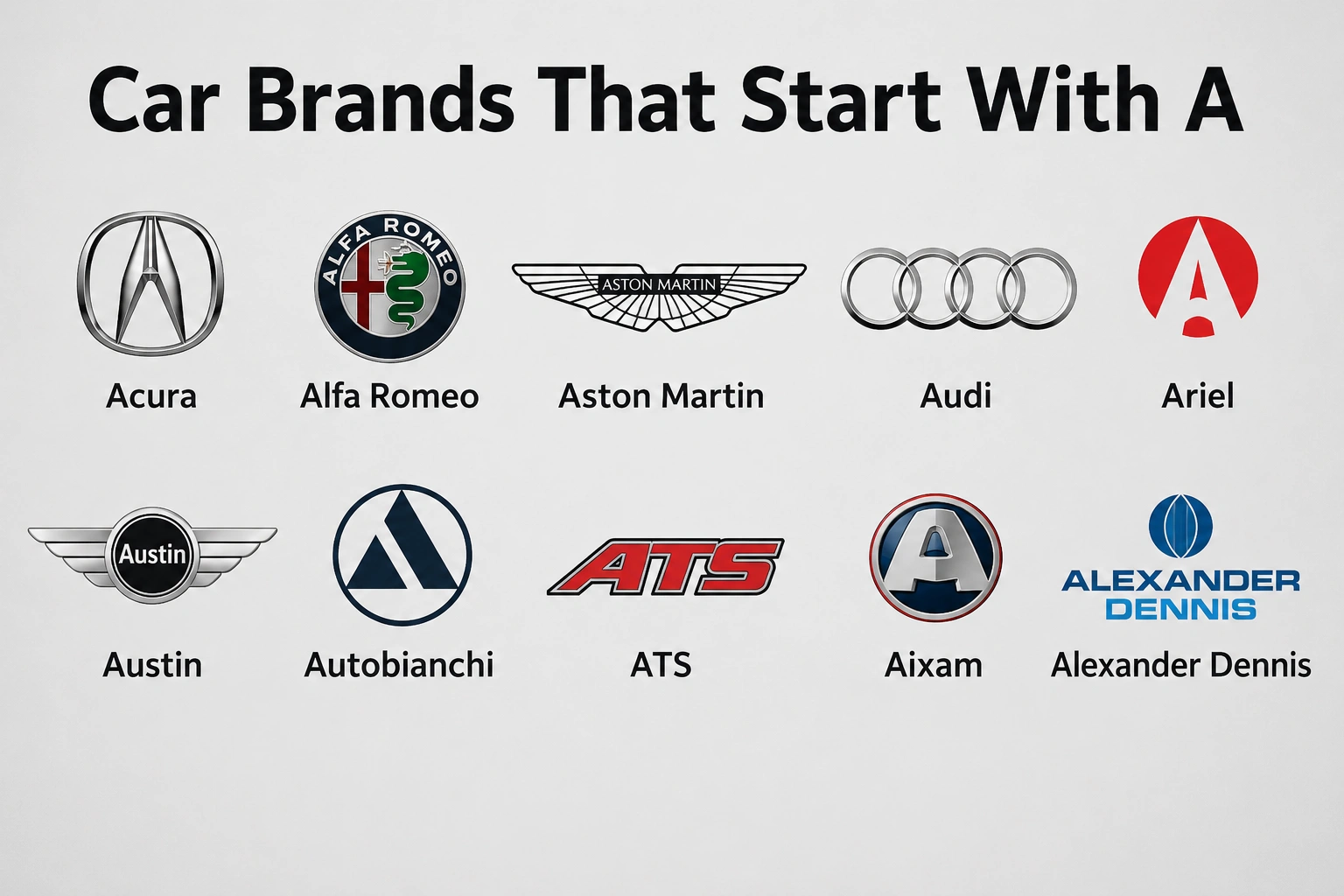
There is something quietly striking about the letter A in the automotive world. More car brands begin with it than any other letter — and not just any brands. Some of the most decorated names in automotive history sit right there at the top of the alphabet.
Audi. Alfa Romeo. Aston Martin. Acura. Each one carries a story that stretches back decades, sometimes over a century, and each one has shaped the industry in ways that still echo through modern engineering and design philosophy.
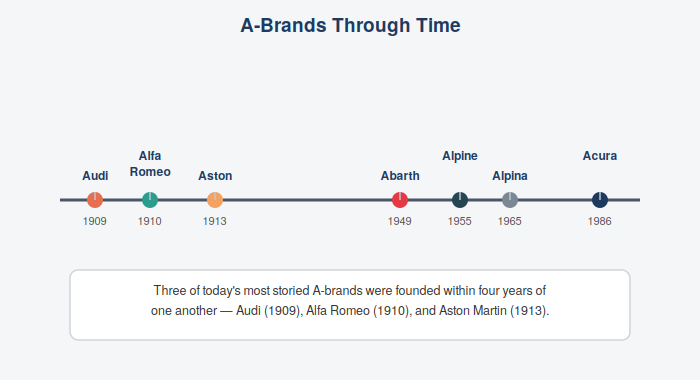
What makes the A-brands particularly fascinating is how diverse they are. You have a German luxury powerhouse that started making engine components in 1909. An Italian racing brand founded in 1910 that treats emotion as an engineering specification.
A British grand tourer builder so closely tied to James Bond that even people who have never sat inside one can picture the silhouette immediately.
A Japanese luxury brand that proved to the world that premium engineering did not have to originate in Europe. And a scorpion-badged Italian hot-hatch specialist that turns ordinary city cars into something genuinely memorable.
Covered here are the major, currently active A-brands — their histories, their notable models, their 2025 and 2026 lineups, the specs that matter, and the unique angles that most automotive guides skip over entirely.
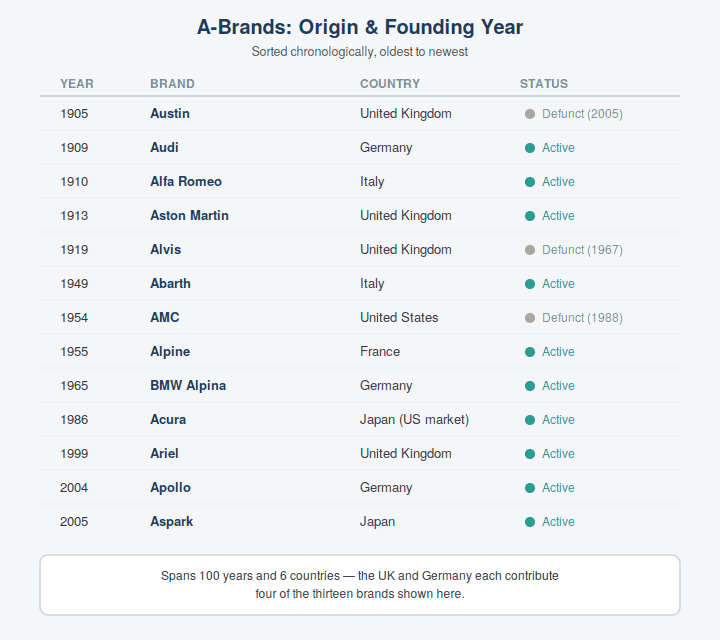
List Of Car Brands That Begin With A
1. Audi
Ask most people to name a car brand beginning with A, and Audi comes first almost every time. That instinctive recognition is not accidental — it reflects over a century of consistent engineering quality, a distinctive visual language, and a marketing identity built on the idea that premium motoring can also be practical and sensible rather than theatrical.
Audi’s origins are more complicated than most buyers realise. The current company traces directly to the 1932 merger of four separate German manufacturers — Audi, DKW, Horch, and Wanderer — into Auto Union.
The four interlocking rings on every Audi badge represent those four founding companies, not four cylinders or four wheels as many people assume.
After World War II the company reorganised as Auto Union GmbH and was eventually acquired by Volkswagen Group, which used the Audi name to relaunch the brand in 1965.
The quattro all-wheel-drive system arrived in 1980 and fundamentally changed what production cars were capable of in adverse conditions — its dominance in Group B rally racing through the 1980s is still studied in motorsport history.
The 2025 And 2026 Audi Lineup — What’s Changed And What’s New
Audi has been executing one of the most ambitious naming transitions in its history through 2024 and 2025. The brand has officially adopted a new naming convention: even-numbered models represent electric vehicles, while odd-numbered models retain internal combustion engines.
So the A6 e-tron is electric, while the A5 (effectively the new A4 replacement) is petrol-powered. This transition has caused some confusion in dealer showrooms and among returning customers, but it reflects a coherent strategy rather than an arbitrary shuffle.
2025 Audi Q6 e-tron — Key Specifications
- Starting MSRP: $63,800 (base RWD) / $67,095 (Premium AWD)
- Engine/Motor: Dual electric motors (AWD) or single motor (RWD)
- Power (AWD): 456 hp / 339 lb-ft torque
- Range (AWD Premium+): 307 miles EPA estimated
- Battery: 100 kWh
- 0–60 mph (AWD): 4.9 seconds
- Charging: 800V architecture — 270 kW DC fast charging; approximately 10 minutes for 62 miles
- Platform: Premium Platform Electric (PPE), shared with Porsche Macan EV
- Cargo: 60.2 cubic feet
- Towing: 4,400 lbs
2025 Audi Q8 e-tron — Key Specifications
- Starting MSRP: $76,095
- Power: 402 hp (standard) / 496 hp (SQ8 e-tron)
- Range: 272 miles (Q8) / 265 miles (SQ8)
- Battery: 114 kWh
- 0–60 mph: 5.4 seconds (Q8) / 4.5 seconds (SQ8)
- Towing capacity: 4,000 lbs
The 2025 Audi A6 e-tron is the first electric sedan in the A6 line, arriving alongside the gas-powered A6 which will be renamed with its next redesign. Anticipated starting price exceeds $65,000, placing it outside the federal EV tax credit threshold.
The A6 e-tron represents something more symbolically significant than just another electric model — it marks Audi finally electrifying the car that arguably defined the brand’s identity in America more than any other.
The Audi Lineup At A Glance — 2025/2026
| Model | Type | Power | Starting MSRP | Fuel |
| A5 | Luxury Sedan | TurboI4 | ~$48,000 | Petrol |
| A7 | Sportback | Mild Hybrid V6 | ~$75,000 | Petrol |
| Q5 | Compact SUV | TurboI4 | ~$52,900 | Petrol/PHEV |
| Q6 e-tron | Electric SUV | Dual Motor | $63,800+ | Electric |
| Q7 | 3-Row SUV | Mild Hybrid V6 | ~$63,500 | Petrol |
| Q8 e-tron | Electric SUV | Dual Motor | $76,095+ | Electric |
| e-tron GT | Electric Sedan | Dual Motor | ~$106,000 | Electric |
| RS e-tron GT | Performance EV | Dual Motor | ~$148,000 | Electric |
What Separates Audi From Its German Rivals
BMW leads on driver engagement. Mercedes-Benz leads on perceived luxury and comfort. Audi has historically occupied the middle ground — more driver-focused than Mercedes, more interior-focused than BMW — and that positioning has served it well commercially.
The brand’s cabin quality has long been a reference point for the segment. Even when competing brands matched Audi’s mechanical performance, the interior materials, switchgear, and screen integration of the Audi MMI system kept the brand’s products feeling a generation ahead.
The 800V electrical architecture on the Q6 e-tron and e-tron GT is a technical achievement worth understanding. Most electric vehicles charge at 400V, meaning DC fast charging speeds are capped at around 150–200 kW.
Audi’s 800V system accepts up to 270 kW of charging power, meaning a 10-minute stop can add over 60 miles of range — genuinely comparable to refuelling a petrol car in terms of time invested per mile gained on a long journey. It’s a detail that rarely appears in headlines but matters enormously in real-world ownership.
2. Acura
Acura holds a specific, quietly significant place in automotive history. When it launched in the United States in March 1986, it became the first Japanese luxury brand to enter the US market — beating Lexus and Infiniti by three full years.
That timing mattered enormously. Acura established that Japanese automakers could compete not just on reliability and value but in the premium tier previously owned entirely by European brands.
The original Acura Legend was a revelation — a front-wheel-drive luxury sedan built with attention to detail that left reviewers reaching for comparisons well above its price class. The NSX supercar, introduced for 1991, went further still: a mid-engine aluminium sports car that challenged the Ferrari 348 on performance while offering Honda’s legendary everyday usability. No turbos, no forced induction, no drama — just a naturally aspirated 270 hp V6 that sang to its 8,000 rpm redline with something close to mechanical perfection.
The modern Acura lineup has moved decisively toward SUVs, which now account for the bulk of the brand’s US sales. The 2024 MDX was the top-selling Acura in America, followed by the compact RDX. The brand’s newest model, the ADX, launched for 2025 as an entry-level subcompact SUV positioned below the RDX.
The 2025 And 2026 Acura Lineup In Full
2026 Acura MDX
- Starting MSRP: $53,250
- Engine (standard): 3.5L naturally aspirated V6, 290 hp
- Engine (Type S): 3.0L turbocharged V6, 355 hp
- Transmission: 10-speed automatic
- Seating: 7 passengers (standard) or 6 (with second-row captain’s chairs)
- Drivetrain: FWD standard / SH-AWD optional (Super Handling All-Wheel Drive)
- Fuel economy: 22 mpg combined (SH-AWD)
- Notable technology: ELS Studio 3D 25-speaker audio (Type S Advance), panoramic roof, 12.3-inch infotainment
- KBB Expert Rating: 4.5/5
2026 Acura RDX
- Starting MSRP: $46,550
- Engine: 2.0L turbocharged inline-4, 272 hp
- Transmission: 10-speed automatic
- Drivetrain: FWD / SH-AWD optional
- Fuel economy: 23 mpg combined (SH-AWD)
- Key features: 10.2-inch touchscreen, AcuraWatch standard, wireless Apple CarPlay and Android Auto
- Class position: #4 ranked luxury compact SUV per KBB
2025 Acura ADX
- Starting MSRP: $36,450
- Engine: 1.5L turbocharged inline-4 (Honda platform)
- Power: 190 hp / 179 lb-ft torque
- Drivetrain: FWD standard / AWD available ($2,000)
- Available trims: Base, A-Spec (red interior option, flat-bottom wheel), Advance Package
- KBB Expert Rating: 4.2/5
2026 Acura Integra
- Starting MSRP: $34,695
- Engine: 1.5L turbocharged inline-4, 200 hp (standard) / 320 hp (Type S)
- Type S MSRP: $55,195
- Transmission: 6-speed manual (Type S) or CVT
- Fuel economy: 32 mpg combined (standard)
- Body style: 5-door hatchback with liftback styling
- KBB Expert Rating: 4.5/5
The Integra’s revival is worth examining more closely. The nameplate was last used in 2001 — its return for 2023 was met with genuine enthusiasm from long-time Acura followers. The Type S variant, producing 320 hp and offering a proper 6-speed manual transmission in an era when most performance cars have moved exclusively to dual-clutch automatics, has become one of the more honest enthusiast options in the compact luxury segment.
Used examples of the 1997 Integra Type R — essentially the same car but earlier — recently sold at auction for $82,000, reflecting how deeply that original model resonated with a specific generation of car buyers.
Why Acura’s SH-AWD System Stands Out
Super Handling All-Wheel Drive is not a marketing term. It describes a system that does something technically distinct from conventional AWD: it doesn’t just distribute power front-to-rear but also side-to-side across the rear axle, actively sending more torque to the outside rear wheel during cornering.
This creates a mild yaw moment that tightens the vehicle’s line through a corner rather than understeering (pushing wide) as front-heavy AWD cars commonly do. The effect is subtle in daily driving but noticeable to anyone who explores the car’s limits on a winding road. For a luxury SUV, it represents genuine handling engineering rather than the traction-focused AWD found in most competitors.
3. Alfa Romeo
Alfa Romeo occupies a category all its own. Founded in Milan in 1910 — originally as ALFA, short for Anonima Lombarda Fabbrica Automobili — the brand spent its formative decades racing as seriously as it sold road cars.
Enzo Ferrari was an Alfa Romeo factory driver before starting his own company. The brand won the first two official Formula 1 World Championships in 1950 and 1951. Its road cars from the Giulietta and Giulia eras of the 1950s through 1970s defined what a sporty European saloon could be.
The modern story is more complicated. Alfa Romeo is now part of Stellantis and has spent the past decade attempting to rebuild a credible luxury presence in North America after a decade-long absence.
The Giulia sedan and Stelvio SUV — both launched in the US in 2017 and 2018 respectively — were genuine attempts to recapture what made the brand special: rear-wheel drive dynamics, Italian styling that photographs unlike anything German, and an emotional quality to the way the engines rev and respond.
The Quadrifoglio variants of both, featuring a Ferrari-derived twin-turbo V6 producing 505 hp, were universally praised as among the best-handling sports cars of their respective classes regardless of price.
The 2025 And 2026 Alfa Romeo Lineup
The Quadrifoglio variants were discontinued after 2024, leaving the 2025 and 2026 lineup centred around a more accessible but less stratospheric range.
2026 Alfa Romeo Giulia
- Starting MSRP: ~$43,000 (Sprint base) / $49,995 (Intensa special series)
- Engine: 2.0L turbocharged inline-4, 280 hp / 306 lb-ft torque
- Transmission: 8-speed automatic (ZF unit)
- Drivetrain: RWD standard / Q4 AWD optional
- Fuel economy: 24 city / 33 highway mpg (RWD)
- 0–60 mph: 5.1 seconds (RWD)
- Interior: Harman Kardon 14-speaker audio (Intensa), available red leather
2025/2026 Alfa Romeo Stelvio
- Starting MSRP: $48,995 (base Sprint)
- Engine: 2.0L turbocharged inline-4, 280 hp
- Transmission: 8-speed automatic
- Drivetrain: RWD standard / Q4 AWD optional
- Fuel economy: 22 city / 28 highway (AWD)
- Available special editions: Veloce ($48,995 + package), Tributo Italiano ($50,995), Intensa ($55,395)
- Ground clearance: 7.7 inches
- Consumer Guide review: “So much fun to drive, we really don’t mind the aforementioned demerits.”
2026 Alfa Romeo Tonale
- Starting MSRP: $38,900–$44,995 (trim dependent)
- Engine: 2.0L turbocharged inline-4, 268 hp (after PHEV discontinuation)
- Transmission: 9-speed automatic
- Drivetrain: AWD standard
- Fuel economy: 21 city / 29 highway mpg
- Cargo: Smaller than segment average (6.1-inch ground clearance limits off-road use)
- Towing capacity: 3,307 lbs
| Model | Segment | RWD Available | AWD Available | Starting MSRP |
| Giulia | Compact luxury sedan | Yes (standard) | Optional (Q4) | ~$43,000 |
| Stelvio | Compact luxury SUV | Yes (base) | Optional (Q4) | $48,995 |
| Tonale | Subcompact luxury SUV | No | Standard | ~$38,900 |
The Honest Assessment Of Alfa Romeo In 2026
There is a real tension at the heart of the Alfa Romeo proposition. The brand’s emotional appeal is undeniable — the sound of the 2.0L at high revs, the rear-wheel-drive balance of the Giulia, and the styling across the lineup remain genuinely distinctive in a segment dominated by competent but characterless German alternatives.
The Stelvio’s comparison with the BMW X3 is instructive: the BMW has better technology, more cargo space, and a more polished overall experience, but many owners who have driven both report that the Stelvio is simply more rewarding on a good road.
The honest trade-offs are real too. Both the Giulia and Stelvio are aging platforms — significant redesigns are expected for the 2027 model year. The infotainment technology on current models is a genuine weak point compared to the latest systems from Audi, BMW, and Mercedes.
And the discontinuation of the Quadrifoglio variants removed the models that made the clearest case for why someone should choose Alfa over its competitors at any price point. What remains is still enjoyable and genuinely beautiful, but the brand is navigating a difficult transition period in 2025 and 2026.
4. Aston Martin
Aston Martin’s history reads more like a survival narrative than a business success story. Founded in 1913 by Lionel Martin and Robert Bamford, the company has faced receivership or administration approximately seven times across its history.
It has been owned by an American company, a Kuwaiti consortium, a Ford subsidiary, a Canadian racing entrepreneur, and is currently majority-backed by Saudi Arabia’s Public Investment Fund and Mercedes-Benz. That the brand has survived all of it — and still produces cars as beautiful and compelling as the current DB12 and Vantage — is either a testament to its cultural value or evidence that some objects are simply too desirable to be allowed to disappear.
The James Bond association, consistent since Sean Connery drove the original DB5 in Goldfinger (1964), has given Aston Martin a global recognition that far exceeds the company’s actual sales volumes. The brand builds approximately 7,000 cars per year.
Ferrari builds roughly 13,000. Porsche builds over 300,000. Yet Aston Martin’s cultural resonance rivals all of them — because what the DB5 represented, and what every DB-series car has represented since, is a very specific and very British idea about what a beautiful, fast machine should look and feel like.
The 2025 And 2026 Aston Martin Lineup
2025/2026 Aston Martin DB12
- Starting MSRP: $255,000 (Coupe) / $295,000 (Volante convertible)
- New 2026 DB12 Coupe: $350,500 (dealer pricing)
- Engine: 4.0L twin-turbocharged V8 (AMG-sourced, significantly modified)
- Power: 671 hp / 590 lb-ft torque
- Transmission: 8-speed automatic (ZF unit with bespoke calibration)
- Drivetrain: Rear-wheel drive
- 0–60 mph: 3.5 seconds
- Top speed: 202 mph
- Fuel economy: 15 city / 22 highway
- Body styles: Coupe and Volante (convertible)
- Interior: Hand-stitched leather, bespoke Alcantara headlining options, 10.25-inch central touchscreen
2025 Aston Martin DBX707
- Starting MSRP: $274,600–$320,200 (depending on specification)
- Engine: 4.0L twin-turbo V8, 697 hp / 663 lb-ft torque
- Transmission: 9-speed automatic (wet clutch)
- Drivetrain: Full-time AWD
- 0–60 mph: 3.3 seconds
- Top speed: 193 mph
- Fuel economy: 15 city / 20 highway
- Notes: The DBX707 is the fastest SUV ever tested on the Nürburgring at the time of its launch
2025 Aston Martin DBX S (New)
- Power: 717 hp — 2 hp more than a Ferrari Purosangue at launch
- Key additions: Carbon fibre roof, unique grille, exclusive interior trim
- Note: Technology borrowed from the Valhalla hypercar
2025/2026 Aston Martin Vantage
- Starting MSRP: ~$185,000
- Engine: 4.0L twin-turbo V8, 656 hp
- 0–60 mph: 3.4 seconds
- Character: More focused and driver-oriented than the DB12; harder-edged dynamics
Aston Martin Valhalla (Expected Late 2025/2026)
- Powertrain: 4.0L twin-turbo V8 flat-plane crank + three electric motors
- System output: 1,064 hp / 811 lb-ft torque
- 0–60 mph: Under 2.5 seconds
- Top speed: 217 mph (electronically limited)
- Weight: 3,650 lbs
- Battery: 560-cell high-performance unit with dielectric liquid cooling
- Configuration: Mid-engine, rear-wheel drive
The Valhalla represents something genuinely significant for Aston Martin — the brand’s first series-production hybrid hypercar, and a vehicle that demonstrates the company can execute leading-edge electrified performance technology rather than simply reskin existing platforms.
With over $40,000 in engineering going into the battery cooling system alone, this is not a hybridised grand tourer — it’s a rethinking of what a modern performance car can be.
The Mercedes Connection And What It Actually Means For Buyers
Many buyers are unaware that since 2013, Aston Martin’s engines, transmissions, and infotainment systems have been sourced primarily from Mercedes-AMG. The 4.0L twin-turbo V8 in the DB12, DBX707, and Vantage is the same fundamental engine block found in the Mercedes-AMG GT and numerous AMG-badged products. Aston Martin modifies it substantially — different camshafts, revised turbocharger sizing, unique exhaust manifolds, bespoke engine control software — but the fundamental unit is shared.
This partnership has two important implications. First, it resolved Aston Martin’s long-running quality and reliability problems. The brand’s engines and electronics in the post-2013 era are dramatically more dependable than those of the pre-Mercedes period, which was plagued by electrical gremlins and premature wear.
Second, it gives Aston Martin access to proven, efficient powertrains without the enormous capital cost of developing them internally — capital that can be redirected toward the hand-built bodywork, bespoke chassis tuning, and cabin craftsmanship that differentiate the product.
5. Abarth
Abarth is perhaps the most misunderstood brand on this list. Outside European markets, most people either haven’t heard of it or know it only vaguely as “the sporty Fiat badge.” The actual story is considerably more interesting.
Carlo Abarth was an Austrian-born engineer and racing driver who founded his company in Bologna in March 1949 — the same month, ironically, that he turned 37. His birth sign was Scorpio, which is why the scorpion became the company’s logo and has remained so for over 75 years.
In its early years, Abarth produced its own cars and racing machines, but its most commercially successful work was exhaust systems, engine tuning kits, and record-breaking attempts with modified Fiat products. The company became the world’s most successful record-setter for small-displacement cars, holding over 130 speed records at various points.
Fiat acquired the company in 1971, and since then Abarth has functioned as Fiat’s performance division — essentially doing for Fiat what AMG does for Mercedes-Benz, though at considerably more accessible price points.
Notable Abarth Models Through History And In 2025/2026
Abarth 500 (2008–2019) — The model that reintroduced the brand to modern buyers. A Fiat 500 with a 1.4L turbocharged engine producing 135–160 hp in various states of tune, stiffened suspension, Brembo brakes, upgraded interior with Sabelt seats, and the distinctive crackling exhaust note that became Abarth’s modern trademark. In the US, it was sold briefly as the Fiat 500 Abarth from 2012 to 2019.
Fiat 124 Spider Abarth — Based on the Mazda MX-5 Miata platform but fitted with a turbocharged 1.4L engine producing 164 hp, the Spider Abarth was the more powerful version of Fiat’s open-top sports car. The platform sharing meant it inherited the MX-5’s near-perfect front-mid-engine, rear-wheel-drive balance, while the Abarth tuning added performance and Italian visual character. Available in the US from 2016 to 2020.
Abarth 600e (2024–present) — The brand’s most significant new product in decades. An electric performance version of the Fiat 600 crossover, the 600e produces 240 hp in standard form and 280 hp in top-spec Scorpionissima trim.
It produces 254 lb-ft of torque, uses a 54 kWh battery pack, and covers 0–62 mph in under 5.9 seconds. The Scorpionissima edition adds 40 hp and features Abarth-specific suspension tuning. Range is approximately 250 miles WLTP. This is Abarth’s first electric vehicle and a clear signal that the brand intends to survive the industry’s transition rather than fade with combustion engines.
Abarth Classiche 1000 SP (2021–2022) — A limited production (5 units) sports car based on the Alfa Romeo 4C chassis and powered by a 1.75L turbocharged 4-cylinder. An explicit homage to the original 1966 Fiat Abarth 1000SP racing car, this model demonstrates that Abarth’s identity runs deeper than just hot hatchbacks — the company has a genuine motorsport heritage it is actively trying to honour.
Key Abarth Facts:
- Founded: March 31, 1949, Bologna, Italy
- Founder: Carlo Abarth
- Logo meaning: Scorpion (Carlo’s birth sign, Scorpio)
- World speed records held: 133+ at peak
- Current ownership: Stellantis (through Fiat acquisition, 1971)
- Current focus: Performance versions of Fiat electric platforms
- US market availability: Limited; primarily Europe-focused
6. Alpine
Alpine is the least famous of the major A-brands in North America but arguably the most beloved in Europe among people who appreciate sports car history. Founded in 1955 by Jean Rédélé, a Dieppe-based Renault dealer who started racing modified Renault 4CVs, Alpine became France’s answer to Porsche — a small, focused manufacturer of lightweight, rear-engine sports cars that competed successfully in rallying and circuit racing far above their displacement class.
The A110, produced from 1961 to 1977, is the car most associated with Alpine’s golden era. Weighing under 700 kg in competition trim, with a mid-rear-mounted engine and all-around independent suspension at a time when most rally competitors were using live axles, the A110 was fast not because of power but because of lightness and precision.
It won the inaugural World Rally Championship season in 1973 and remains a reference point for the principle that a car does not need to be heavy or powerful to be fast.
Renault revived the Alpine brand in 2017 with the modern A110 — a spiritual successor that maintained the original’s principles: a 1,080 kg weight, mid-engine layout, and an emphasis on feel over outright speed figures. The 2017–present A110 has been consistently praised as one of the most rewarding sports cars produced in the past decade, regardless of price.
Alpine In 2025 And 2026 — The Electric Transition
Alpine announced in 2023 that it would become exclusively electric, with the 2024 Alpine A290 marking the first step. The A290 is a performance electric hot hatch based on the Renault 5 platform, producing 218 hp in GT trim — a significant shift from the lightweight, rear-engine sports cars of the brand’s heritage.
2024/2025 Alpine A110 (Final petrol generation)
- Engine: 1.8L turbocharged inline-4, 300 hp (GT4 edition)
- Weight: ~1,100 kg
- 0–62 mph: Under 4.2 seconds
- Layout: Mid-rear engine, rear-wheel drive
- Distinctive feature: Double-wishbone suspension front and rear; no mechanical differential — uses brake-based torque vectoring
2024/2025 Alpine A290 (First electric model)
- Platform: Renault 5 (AmpR Small)
- Power: Up to 218 hp (GT trim)
- Range: Up to 252 miles WLTP
- Battery: 52 kWh
- Production: 4,585 vehicles built in 2024 total across Alpine range
- North America availability: Planned for 2027 with a midsize EV crossover and large EV SUV
Alpine’s transition to electric is philosophically fascinating. The brand was built on the principle that less is more — remove weight, sharpen feedback, prioritise the human connection over raw horsepower. Electric vehicles can align with that principle or completely contradict it depending on execution.
The A290, which uses the Renault 5 platform and weighs considerably more than the iconic A110, is not an obvious continuation of what made Alpine special. The upcoming North American models — a midsize crossover and large SUV — are even further from the lightweight sports car heritage. Whether Alpine can maintain its identity through this transition is one of the more interesting questions in the premium segment right now.
7. Alpina
BMW Alpina is a genuinely unusual organisation in the automotive world. It is officially recognised by the German Ministry of Transport as a vehicle manufacturer — not a tuner, not a conversion company, but a legally distinct automobile manufacturer.
This distinction matters because Alpina vehicles are stamped with their own VINs and classified as their own models by regulators, despite being built on BMW platforms.
The company was founded by Burkard Bovensiepen in 1965, initially building Weber carburettor kits and performance equipment for BMW vehicles. It evolved into a full vehicle manufacturer over subsequent decades, producing hand-assembled versions of BMW models with hand-built engines, unique tuning, and exclusive specification levels.
In 2022, BMW announced the formal acquisition of Alpina as a brand, completing a process that was formalised in 2025 when Alpina Burkard Bovensiepen was officially renamed BMW Alpina and integrated into BMW’s structure.
Notable Alpina Models:
- Alpina B7: Based on BMW 7 Series; features a hand-assembled 4.4L twin-turbo V8 producing over 600 hp. Built at the Dingolfing factory on the same production line as the standard 7 Series, but the engine is assembled by hand at Alpina’s Buchloe facility before being shipped to BMW for installation. The finished vehicle then returns to Buchloe for final finishing touches and quality inspection.
- Alpina B5: Based on BMW 5 Series; produced from 2005 to 2024 across three generations, serving as the performance alternative to the BMW M5 with greater emphasis on long-distance comfort alongside high performance.
- Alpina XB7: Based on BMW X7; one of the fastest full-size luxury SUVs ever produced.
The BMW Alpina distinction is meaningful: these are not cars modified after leaving the factory. They are built to Alpina’s specifications from the outset, and the engineering differences — from camshaft profiles to suspension geometry to transmission mapping — are substantial enough that comparing them to the equivalent BMW M model is not straightforward.
Lesser-Known But Noteworthy: Apollo, Ariel, And Aspark
Beyond the headline brands, several other A-named manufacturers produce vehicles that deserve recognition even if their production volumes are measured in dozens rather than thousands per year.
8. Apollo (formerly Gumpert)
A German sports car manufacturer that produces the Apollo IE (Intensa Emozione), a 1,000 hp naturally aspirated track car that has completed the Nürburgring in under 7 minutes. Founded in 2004 as Gumpert Sportwagenmanufaktur, it was acquired and rebranded as Apollo Automobil in 2016. Production is extremely limited.
9. Ariel (UK)
Produces the Atom and Nomad, open-wheel-style lightweight sports cars built around a spaceframe chassis with minimal bodywork. The Ariel Atom has been referenced as one of the fastest cars from 0–60 mph regardless of price — not because of power, but because of weight reduction taken to an almost philosophical extreme.
In 2021, Ariel launched the Hipercar, an electric track car producing 1,180 hp using a gas turbine range-extender. A genuinely unusual approach to performance EV engineering.
10. Aspark (Japan)
A Japanese engineering services company that produced the Aspark Owl, a fully electric hypercar claiming a 0–60 mph time of 1.69 seconds. While Aspark is primarily an electronics and automotive engineering consultant, the Owl represents a serious attempt to demonstrate Japanese capability in the hypercar segment. Only 50 units were planned; pricing exceeded $3.3 million.
Complete Reference Table: All Major A-Brand Manufacturers
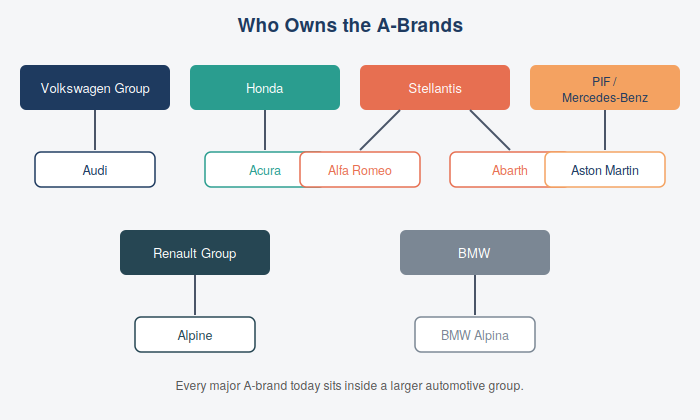
| Brand | Country | Founded | Current Owner | Market Focus | Still Active |
| Audi | Germany | 1909 | Volkswagen Group | Luxury / Electric | Yes |
| Acura | Japan (US market) | 1986 | Honda | Luxury SUV / Sedan | Yes |
| Alfa Romeo | Italy | 1910 | Stellantis | Sport Luxury | Yes |
| Aston Martin | UK | 1913 | PIF / Mercedes-Benz | Luxury GT | Yes |
| Abarth | Italy | 1949 | Stellantis | Performance / EV | Yes |
| Alpine | France | 1955 | Renault Group | Sports / EV | Yes |
| BMW Alpina | Germany | 1965 | BMW | Ultra-premium | Yes |
| Apollo | Germany | 2004 | Private | Track Hypercars | Yes |
| Ariel | UK | 1999 | Private | Lightweight Track | Yes |
| Aspark | Japan | 2005 | Private | EV Hypercar | Yes |
| AMC (American Motors) | USA | 1954 | Defunct (1988) | Mass Market | No |
| Austin | UK | 1905 | Defunct | Mass Market | No |
| Alvis | UK | 1919 | Defunct (1967) | Luxury / Military | No |
What Buying An “A-Brand” Actually Means In 2026
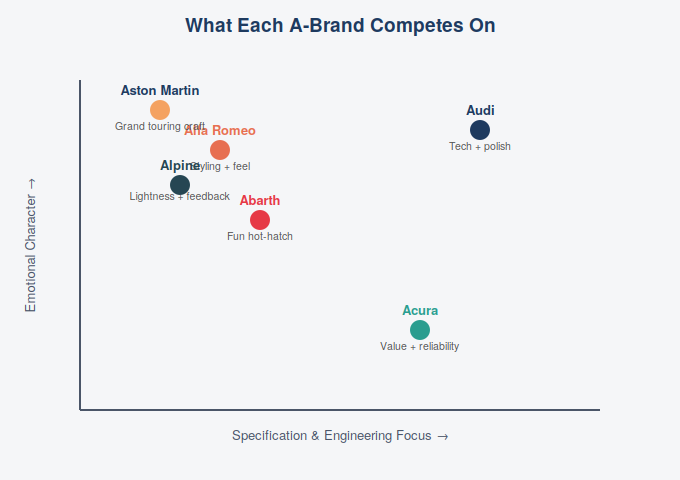
There is a common thread worth pulling at when you look at the A-brands collectively. The ones with the strongest identities — Aston Martin, Alfa Romeo, Alpine — share a willingness to prioritise emotional character over specification-sheet dominance.
None of them leads their respective segments on cargo volume, fuel economy, technology integration, or reliability statistics. All of them consistently produce cars that generate more conversation, more enthusiasm, and more loyalty among the people who choose them than the rationally superior alternatives.
That gap — between what is objectively better and what people actually prefer — is what makes the A-brand segment persistently interesting. Audi competes on specifications and wins on engineering substance.
Acura competes on value within premium and wins consistently on that ground. Alfa Romeo and Aston Martin compete on character and feeling, which are harder to quantify and easier to dismiss but ultimately more resistant to competitive erosion.
The practical implications for buyers:
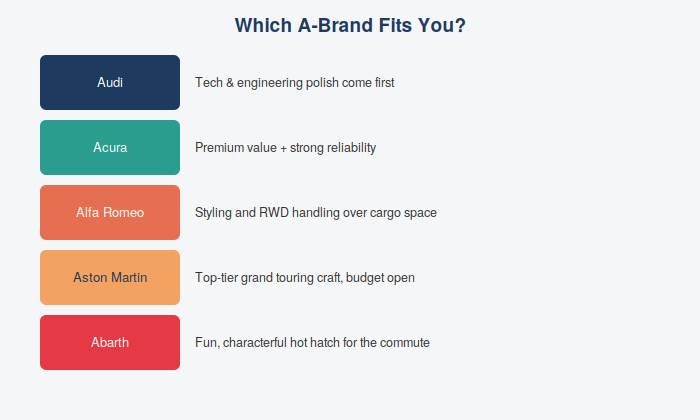
Choose Audi if: Technology integration and engineering polish are priorities. The 800V charging architecture in the Q6 e-tron and e-tron GT is genuinely ahead of most competitors.
Choose Acura if: Premium quality at a relative value is the goal. The MDX and RDX routinely outperform competitors at similar price points on equipment level and long-term reliability data. The SH-AWD system is a genuine technical differentiator.
Choose Alfa Romeo if: Styling and rear-wheel-drive dynamics matter more than cargo space and infotainment. The Giulia remains one of the best-handling compact luxury sedans regardless of price, and the Stelvio delivers real Italian design character in a practical SUV footprint.
Choose Aston Martin if: Grand touring at the highest level of aesthetic and mechanical craft is the requirement, and budget is not a constraint. The DB12 is genuinely among the most beautiful production cars on sale in 2026.
Choose Abarth if: A fun, characterful hot hatch with genuine performance heritage is what the daily commute needs. The 600e’s 280 hp electric performance in a compact package is something genuinely new.
Frequently Asked Questions
How many car brands start with the letter A?
Based on the most comprehensive databases, approximately 30 to 34 distinct car brands — both active and defunct — begin with the letter A. The active mainstream brands in 2026 include Audi, Acura, Alfa Romeo, Aston Martin, Abarth, Alpine, BMW Alpina, Ariel, Apollo, Aspark, Arcfox, Aiways, and Aixam. Defunct notable A-brands include AMC (American Motors Corporation, ceased 1988), Austin (UK, ceased 2005 in modified form), and Alvis (UK, ceased 1967).
Which A-brand car has the best reliability in 2026?
Acura consistently leads among A-brand manufacturers on long-term reliability metrics. RepairPal gives the brand an above-average reliability rating, and annual maintenance costs average around $500 — lower than Audi, Alfa Romeo, and significantly lower than Aston Martin. The MDX and RDX in particular have strong multi-year owner satisfaction records. Audi’s reliability has improved considerably in the past decade, particularly on its newer electric platform vehicles. Alfa Romeo has made progress but remains below average for the segment on some J.D. Power reliability metrics.
What is the most affordable car from an A-brand in 2026?
Among the major A-brands with US market presence, the Acura ADX starts at $36,450, making it the most accessible entry point. The 2026 Acura Integra starts at $34,695. For Alfa Romeo, the Tonale begins at approximately $38,900. Audi’s US lineup starts around $48,000 for the A5. Abarth’s 600e is not officially sold in the US in 2026 but carries a European starting price equivalent to approximately $40,000.
Is Alpina the same as BMW?
No — BMW Alpina is a legally distinct vehicle manufacturer that happens to use BMW platforms. Since 1965, Alpina has hand-built modified versions of BMW models with unique engines, suspension tuning, and specifications that make them genuinely different vehicles rather than factory-option BMWs. The German Ministry of Transport classifies Alpina as a separate manufacturer, which is a rare and meaningful distinction. In 2022, BMW Group formally acquired Alpina as a brand, and it was officially renamed BMW Alpina in 2025, but the hand-assembly process and bespoke engineering philosophy continue.
Why did Aston Martin change its engine supplier?
Before 2013, Aston Martin developed its own engines, including the legendary naturally aspirated 6.0L V12. Those engines were expensive to develop and maintain, and the brand was too small to amortise that cost effectively. The partnership with Mercedes-AMG — announced in 2013 — gave Aston Martin access to the AMG 4.0L twin-turbo V8, which is among the best performance engines currently in production. Aston Martin modifies it significantly with unique camshafts, turbochargers, and software, but the fundamental unit is shared. The deal also gave Aston Martin access to Mercedes infotainment technology and electrical architecture, resolving long-standing quality issues in those areas.
Is Alpine coming to the United States?
Yes, but not until 2027. Alpine announced in 2023 that it would enter the North American market with a midsize electric crossover and a large electric SUV. The US market has not had official Alpine sales since the original A310 era in the 1970s. The upcoming models represent a significant expansion, though their crossover/SUV format is a considerable departure from the lightweight sports car character that defines Alpine’s European reputation.
What does the Audi four-ring logo actually represent?
The four interlocking rings represent the four companies that merged in 1932 to form Auto Union: Audi, DKW, Horch, and Wanderer. They are not symbolic of four cylinders, four wheels, or quattro all-wheel drive, though that association is a common misconception. The rings have remained as Audi’s logo since the brand was relaunched under Volkswagen Group ownership in the 1960s.
Which A-brand is best for a first-time luxury car buyer?
Acura is the most commonly recommended A-brand for buyers entering the luxury segment for the first time. The combination of relative value compared to European luxury brands, Honda-derived reliability, strong warranty and dealer network support, and accessible pricing — particularly on the ADX and Integra — makes it the most forgiving entry point. Audi is a strong second option, particularly the Q5, which offers strong technology and build quality at competitive pricing for the class.