
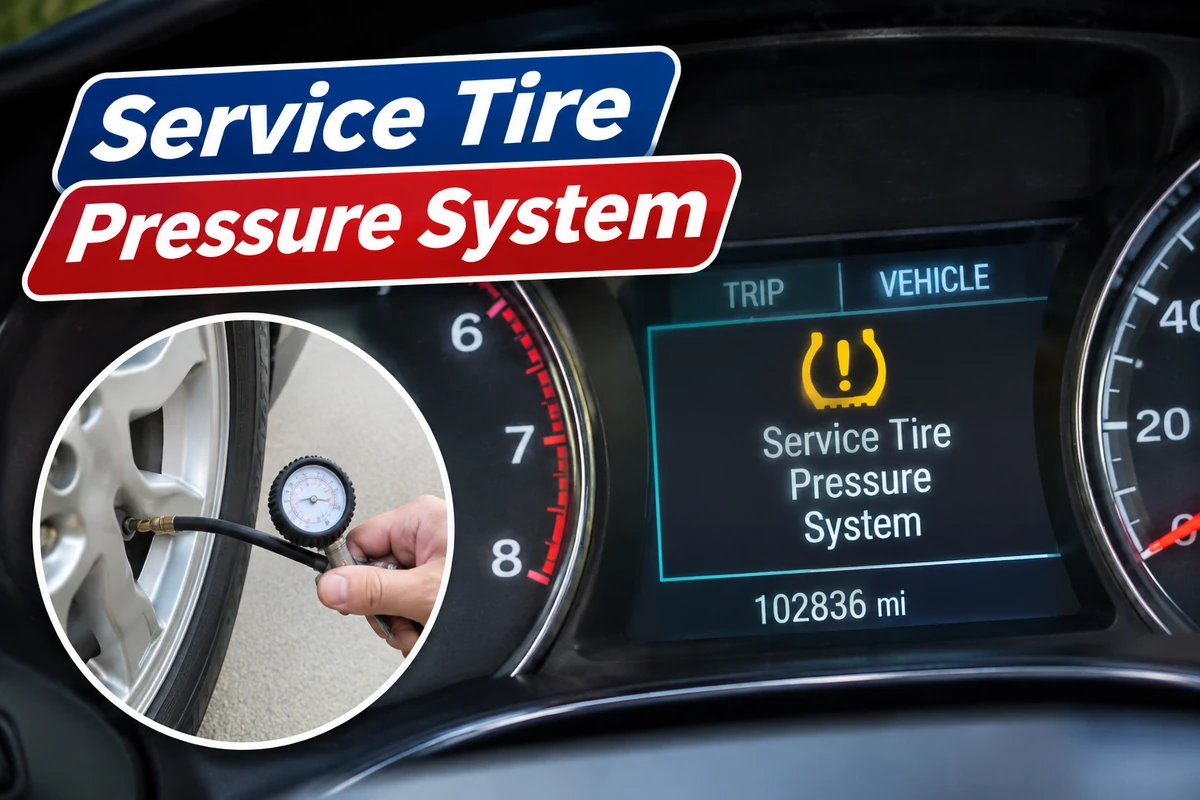
A tire can be perfectly inflated and your dashboard can still complain. That is the odd thing about the Service Tire Pressure System message.
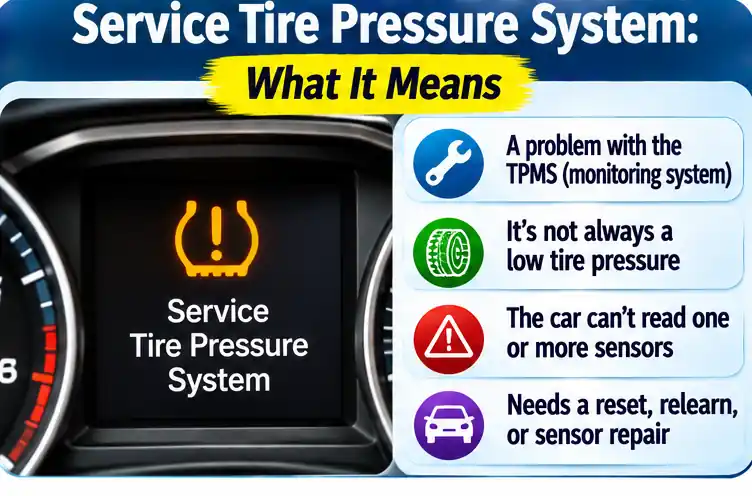
It does not say a tire is low. It says the monitoring system itself has a problem. The watchdog, not the wheel, needs attention.
That difference changes everything about how you respond. Pumping air into a healthy tire will not clear the message, and ignoring it leaves you without the early warning that the system was built to give.
Here is a clear guide to what the message means, how it differs from the normal low-pressure light, and the common causes behind it. You will find a step-by-step troubleshooting path, a realistic look at repair costs, and practical tips for keeping the system healthy.
The advice fits most modern cars, though the exact wording and reset steps vary by brand, so your owner’s manual always has the final say on your model.
What The Service Tire Pressure System Message Really Means
A Warning Versus A Fault: Two Different Alerts
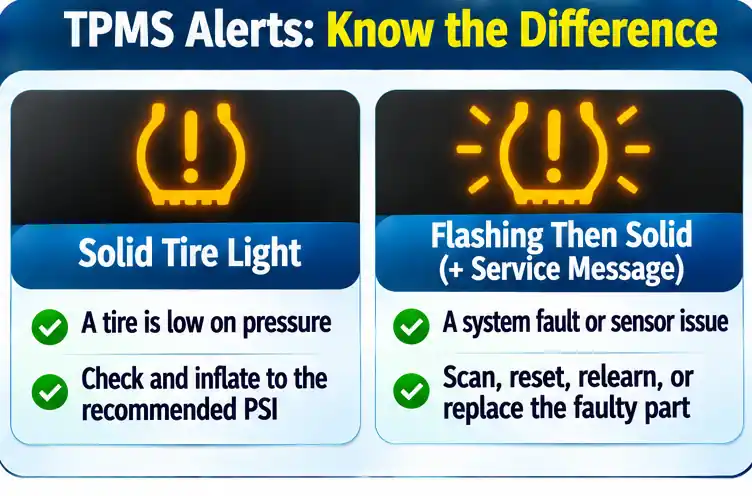
The tire pressure monitoring system, or TPMS, can show two kinds of alert. They look similar but point to different problems.
A solid tire-shaped light usually means one or more tires are low. Federal rules require the light to come on when a tire drops about 25 percent below the recommended pressure.
A flashing light, which turns solid after roughly a minute or so, usually signals a system fault. On many cars, a text message such as Service Tire Pressure System or Check TPMS appears at the same time.
In this case, the car cannot read one or more sensors, or the system needs service. Pressure may be fine, but the monitoring is offline.
| Alert Behavior | Usual Meaning | First Action |
|---|---|---|
| Solid Tire Light | A tire is low on pressure | Check and inflate to the door-jamb number |
| Flashes, Then Stays On | System fault or sensor problem | Check pressure, then diagnose the system |
| Service Message With Light | Monitoring system needs repair | Scan, relearn, or replace the faulty part |
| Light Returns After Inflating | Leak or failing sensor | Inspect tire and sensor |
How Direct And Indirect Systems Work
There are two main designs. A direct system has a small sensor inside each wheel, often attached to the valve stem, that measures pressure and sends a radio signal to the car.
An indirect system uses the anti-lock brake sensors. It watches wheel speed, and a tire with low pressure spins faster than the others, which triggers the warning.
Direct systems give actual pressure readings for each tire. They also carry batteries inside the sensors, which is where most service messages begin.
Indirect systems have no batteries to replace, but they need to be reset after tire changes or inflation. They also cannot tell you the exact pressure.
Both types became standard on new US cars in the late 2000s, so most vehicles built since then have one.
Common Causes Behind The Message
Dead Sensor Batteries
The most common cause is a worn-out sensor battery. These small batteries are sealed inside the sensor, and they usually last about five to ten years.
When a battery dies, the sensor stops talking. The car sees one wheel missing from its list and triggers the service message.
The pattern is easy to spot. One tire may show no reading, or a dashes symbol, while the other three display normal values.
Another clue is age. If your car is eight years old and the message appeared out of the blue, a dying sensor is the top suspect.
Because the battery is sealed, the fix is usually a new sensor, not a new battery. And when one fails, the others are often close behind.
Tire Service Mistakes And Missing Relearns
Tire work can upset the system. During a rotation or replacement, the technician may bump a sensor, damage a valve stem, or forget to reset the system.
The car has to learn which sensor sits at which wheel. If that relearn step is skipped after rotating or swapping tires, the system may mislabel positions or fail to recognize the sensors at all.
A service message that shows up soon after tire work is a strong hint of this kind of problem. It is often a quick fix at the same shop.
If you recently changed tires, call the shop first. A free reset or relearn may be all you need.
Winter Wheels, Spares, And Cold Weather
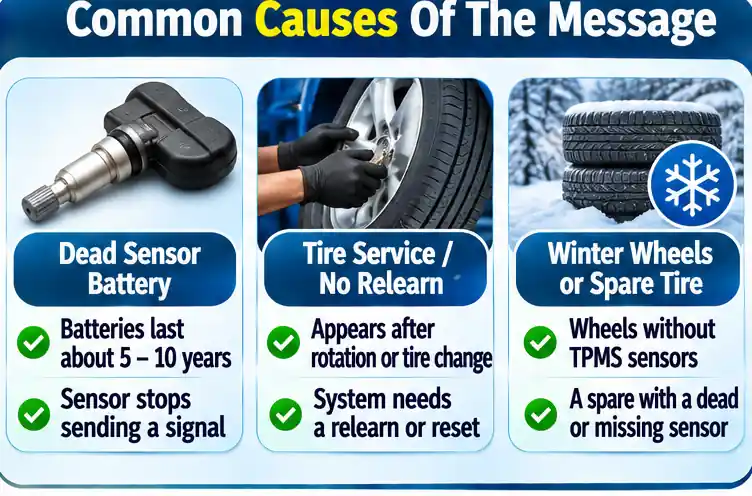
Seasonal wheel swaps are a classic trigger. A set of winter wheels without sensors, or with sensors that were never programmed to your car, will set off a fault.
Some cars also monitor the spare tire. A spare with a dead or missing sensor can cause the warning to appear even when all four main tires are fine.
Cold weather adds another twist. Pressure drops roughly one pound per square inch for every ten-degree drop in air temperature, so a cold snap can trigger a real low-pressure warning.
Extreme cold can also make sensors slow to wake up, causing a brief fault that clears once the car warms up.
| Cause | Typical Clue |
|---|---|
| Dead Sensor Battery | One wheel shows no reading, car is 5 to 10 years old |
| Skipped Relearn | Message appears after rotation or tire change |
| Damaged Sensor Or Valve Stem | Slow leak at one wheel, fault after service |
| Unprogrammed Winter Wheels | Message appears after a wheel swap |
| Spare Tire Sensor Problem | All four tires normal, fault persists |
| Faulty Receiver Or Module | Multiple sensors fail at once |
Step-By-Step Troubleshooting You Can Do Today
Check Pressure The Right Way
Start with a reliable gauge, not the dashboard. Check all four tires, and the spare if your car monitors it, when the tires are cold.
Find the correct number on the sticker inside the driver’s door jamb. Do not use the maximum pressure printed on the tire sidewall.
Inflate or release air until each tire matches the placard. Then drive for ten to twenty minutes so the system can read the new values.
If the message clears, you had a pressure issue. If it stays, the fault is in the system itself.
Try A Relearn Or Reset
Many cars can run a relearn on their own after a short drive at steady speed. Others need a manual procedure, such as holding a reset button or using a menu in the dashboard.
The steps differ by brand, so check your owner’s manual for the exact sequence. A wrong move can leave the system confused.
Some systems also need a scan tool that triggers each sensor and writes its ID to the car. Tire shops and repair centers have these tools.
After a reset, drive normally for a while. If the message returns, a sensor or the receiver likely needs repair.
When A Scan Tool Is Needed
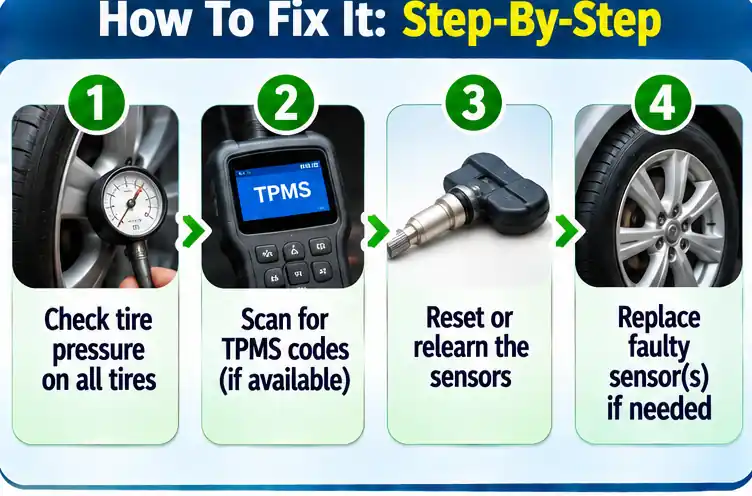
A TPMS-capable scan tool reads each sensor’s ID, battery status, pressure, and signal strength. It shows which wheel is not responding and why.
Codes in the C1210 to C1213 range, depending on the make, often point to sensor, signal, or battery problems. Your shop can read the exact code for your car.
The tool can also tell whether a sensor is merely unpaired or truly dead. That saves you from paying for parts you do not need.
If a warning light stays on and you cannot find the cause, a scan is the quickest way to get a clear answer.
Repair Costs And Smart Buying
What You Can Expect To Pay
Costs vary widely based on the cause. A simple inflation or reset can cost nothing, while replacing all four sensors can reach several hundred dollars.
A single OEM sensor usually costs about $50 to $150, and a universal aftermarket sensor runs about $25 to $70. Labor, which includes removing the tire from the wheel, adds roughly $25 to $50 per wheel.
A TPMS relearn at a shop often costs a modest fee, with some estimates in the $50 to $70 range. Repair guides place total sensor service for one wheel at about $80 to $145 on many models.
Treat these as estimates and ask for a written quote, including programming or relearn work.
| Service | Typical Cost |
|---|---|
| Inflation Or Simple Reset | Often free |
| TPMS Relearn At A Shop | About $50 To $70 |
| Universal Sensor, Per Wheel | About $25 To $70 |
| OEM Sensor, Per Wheel | About $50 To $150 |
| Labor, Per Wheel | About $25 To $50 |
| Full Replacement, One Wheel | About $80 To $145 |
OEM, Aftermarket, And Programmable Sensors
OEM sensors match your car exactly and usually plug into the system with little fuss. They cost more, but they are the safest bet for newer or luxury vehicles.
Universal, programmable sensors can cover many makes. A shop writes your car’s protocol onto the sensor, which makes them flexible and often cheaper.
Watch out for bargain sensors bought online. They may not match your car’s frequency or need special tools to program, and some owners find the light stays on even with new parts.
Replace sensors in sets if the car is eight years old or more. Batteries age together, and doing them at once saves repeated labor charges.
Always have the system relearned after installation.
Is It Safe To Drive And How To Prevent Repeats
The Safety Reality
Driving with a service message is not an emergency, but it is not a free pass either. The system that would warn you about a flat or a slow leak is offline.
Underinflated tires wear unevenly, burn more fuel, run hotter, and take longer to stop. In the worst case, they can fail at speed.
So check your pressure by hand each week until the system is repaired. A cheap gauge in the glovebox does the job.
If the light is flashing and a tire also looks low or feels odd, stop and check it right away.
Habits That Keep The System Healthy
Prevention is simple. Check pressure monthly with a gauge, and always set it to the placard number when the tires are cold.
Ask for a TPMS check at every tire change. Make sure the shop reseals the valve stems, replaces the valve cores or seals, and performs the relearn.
If you swap seasonal wheels, put sensors in both sets and have them programmed to your car.
When you replace tires, ask about the sensor age. Replacing a tired sensor at the same time is cheaper than coming back later.
Keep a record of sensor ages and tire work. It makes diagnosis much faster the next time a message shows up.
Questions people ask most often:
What does Service Tire Pressure System mean?
It means the tire pressure monitoring system has a fault, not that a tire is necessarily low. A sensor may be dead, unpaired, or damaged, or the receiver may not be getting signals.
Can I drive with the Service Tire Pressure System message on?
Yes, for a short time, but check your tire pressures by hand since the system cannot warn you. Fix the fault soon, because underinflated tires wear faster and are less safe.
Why does the message appear after a tire change?
It often means a relearn was skipped or a sensor was damaged during the work. Ask the shop to check and reset the system, which is usually a quick fix.
How long do TPMS sensors last?
Most last about five to ten years because the sealed battery wears out. Age matters more than mileage. Replacing sensors in sets can save on labor.
How much does it cost to fix a TPMS fault?
It ranges from free for a simple reset to a few hundred dollars for multiple sensors. A single sensor service often costs about $80 to $145, plus programming if needed.
Can I reset the TPMS system myself?
Sometimes. Many cars have a reset button or menu, or relearn after a short drive at steady speed. Steps vary by model, so follow your owner’s manual or visit a shop for a scan tool relearn.