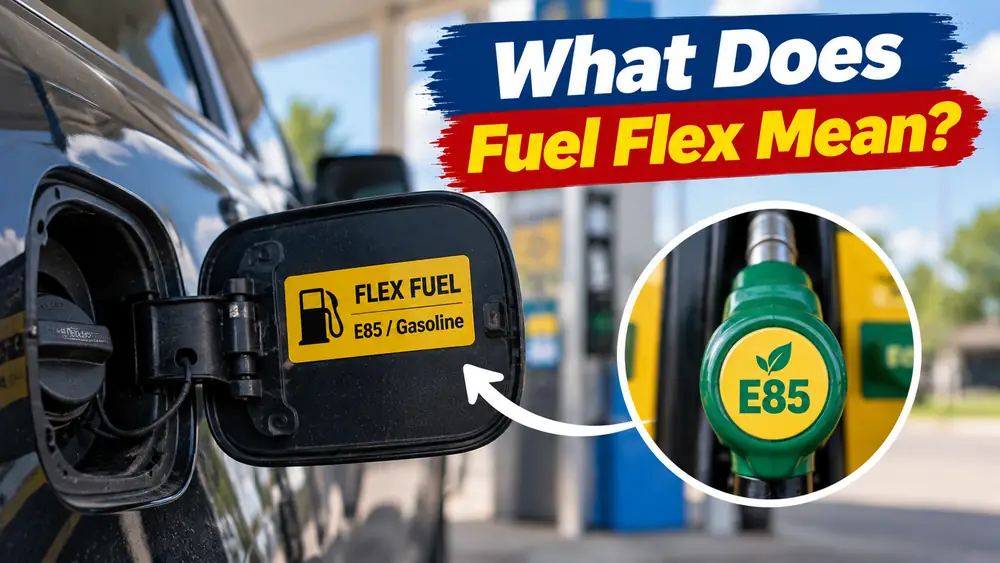
The term fuel flex is commonly seen on vehicle specifications, badges, registration documents, and used-car listings, but many owners are not sure what it actually means. In simple terms, a fuel-flex vehicle is designed to operate on gasoline or a gasoline-ethanol blend containing a relatively high percentage of ethanol.
The most common fuel associated with these vehicles is E85, a blend containing up to about 85% ethanol and gasoline, although the exact ethanol percentage can vary depending on season and fuel availability.
Flex-fuel technology gives a vehicle more than one approved fueling option without requiring the driver to manually change the engine’s basic settings. Sensors and engine-control software adjust fuel delivery and ignition-related parameters according to the fuel mixture being used.
The technology has been available in passenger vehicles and trucks for decades, but it is still frequently misunderstood. Fuel flex does not simply mean that any car can safely use E85, nor does it mean that ethanol fuel is automatically cheaper or better for every owner. The engine’s design, fuel system, local fuel prices, availability, fuel economy, and manufacturer’s specifications all matter.
What Does Fuel Flex Mean In A Vehicle?
Fuel flex means a vehicle is designed and certified to operate on gasoline and approved gasoline-ethanol blends, including high-ethanol fuel such as E85 when specified by the manufacturer. The term is short for flexible fuel, and vehicles equipped for this purpose are commonly called flex-fuel vehicles, or FFVs.
A conventional gasoline vehicle is generally calibrated around gasoline and approved gasoline blends. A flex-fuel vehicle, by contrast, is engineered with fuel-system components, engine calibration, sensors, and software capable of handling substantially different ethanol concentrations.
The important point is that the word “flex” refers to fuel compatibility, not to a special driving mode. You do not normally press a button to switch from gasoline to ethanol. You fill the tank with an approved fuel, and the vehicle’s control system adjusts operation accordingly.
What Is E85 Fuel?
E85 is the fuel most closely associated with flex-fuel vehicles. The name refers to a fuel blend containing a high proportion of ethanol, commonly described as containing up to 85% ethanol with gasoline making up the remainder.
However, E85 is not always exactly 85% ethanol at every fuel station or throughout the year. Fuel specifications can allow the blend to vary, and seasonal requirements can influence the actual ethanol content. This matters because ethanol concentration affects the amount of fuel required by the engine.
Ethanol contains less energy per gallon than gasoline. As a result, a flex-fuel vehicle typically consumes more gallons of E85 to travel the same distance compared with gasoline. The exact difference varies according to the vehicle, fuel composition, engine calibration, driving conditions, and operating environment.
That means the price displayed at the pump should not be the only number considered when comparing gasoline and E85. Cost per gallon and cost per mile are different calculations.
How Is A Flex-Fuel Vehicle Different From A Regular Gasoline Vehicle?
A flex-fuel vehicle has components and calibration intended to tolerate and operate with higher ethanol concentrations. The fuel system may use materials and components designed to resist ethanol-related effects, while the engine-management system can adapt to changes in fuel composition.
One of the most important systems is the electronic engine control system. Depending on the vehicle design, the system can use information from fuel-composition sensing and oxygen sensors, along with other engine data, to adjust fuel delivery and ignition parameters.
The exact technology varies by manufacturer and vehicle generation. Some systems use a dedicated fuel composition sensor, while others use control strategies that estimate ethanol content from engine operating information.
This is why an FFV can automatically operate on different approved fuel mixtures without requiring the driver to manually reprogram the vehicle.
What Does The Flex-Fuel Badge Mean?
A badge marked Flex Fuel, FlexFuel, E85, or a similar designation generally indicates that the vehicle was designed to accept approved ethanol blends in addition to gasoline.
Some vehicles have a yellow fuel cap or a label near the fuel filler that provides additional information. Others display the information on the fuel door, owner’s manual, dashboard, or vehicle identification documentation.
The badge itself should not be treated as a universal permission to use any alternative fuel. Always follow the fuel requirements listed in the owner’s manual or the manufacturer’s official documentation.
A vehicle that does not have FFV capability should not be assumed to be compatible with E85 simply because it is a modern gasoline vehicle.
Fuel Flex Does Not Mean Any Ethanol Percentage Is Safe
This is one of the most important distinctions for vehicle owners. Gasoline sold in many markets can already contain some ethanol, such as E10, and certain vehicles may be approved for blends with higher ethanol concentrations.
But E85 is substantially different from ordinary gasoline containing a modest amount of ethanol.
Higher ethanol concentrations can require different fuel delivery rates and can affect materials, seals, fuel-system components, cold-start behavior, and engine calibration. FFVs are specifically engineered to accommodate these differences.
A vehicle owner’s manual is therefore the final authority. If the manufacturer does not approve E85 or another high-ethanol blend for a particular vehicle, it should not be used merely because the engine is gasoline-powered.
How Flex-Fuel Technology Works
The engineering behind flexible fuel is more sophisticated than simply putting ethanol into the fuel tank. Ethanol and gasoline have different chemical and combustion characteristics, so the engine must be able to compensate for changes in the fuel mixture.
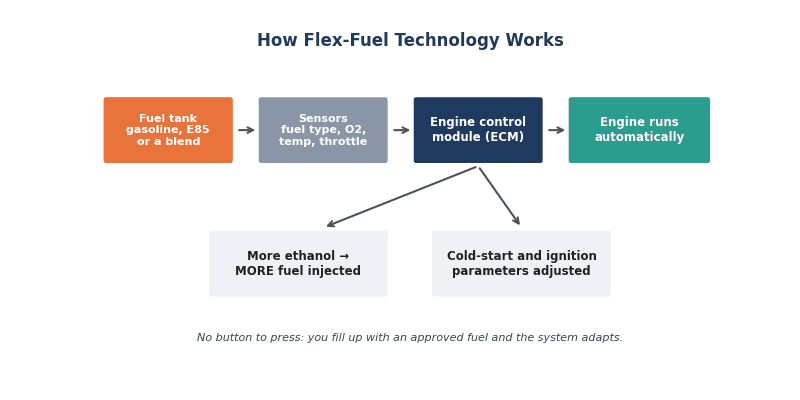
Modern flex-fuel systems rely heavily on electronic engine management. The engine control module continuously monitors operating conditions and adjusts fuel delivery to maintain the appropriate air-fuel mixture.
Ethanol Requires More Fuel By Volume
One of the fundamental differences between gasoline and ethanol is energy density. Ethanol contains less chemical energy per unit of volume than gasoline.
This means an engine generally needs to consume a greater volume of ethanol-containing fuel to produce the same amount of energy. In a flex-fuel vehicle, the fuel injectors and engine-management system are designed to accommodate this requirement.
The system can increase fuel delivery when the ethanol concentration is higher. This is one reason FFVs can operate on gasoline and high-ethanol blends without requiring the driver to make manual adjustments.
The result is convenient for the owner, but there is a tradeoff: fuel economy measured in miles per gallon generally decreases as ethanol concentration increases, especially when comparing gasoline with high-ethanol E85.
Engine Control Software Handles Fuel Changes
The engine control module is effectively the vehicle’s electronic decision center. It receives information from multiple sensors and uses that information to determine how much fuel should be injected and how the engine should operate.
Depending on the vehicle, relevant information may include oxygen-sensor feedback, fuel composition information, engine temperature, intake conditions, throttle position, engine speed, and other operating parameters.
When the fuel contains more ethanol, the control system can compensate by changing fuel delivery and other calibration parameters. The system is designed so the driver does not need to make these changes manually.
This automatic adjustment is a major reason the term “flexible fuel” is appropriate. The vehicle is flexible because its engine-management system can accommodate approved variations in fuel composition.
Fuel Injectors And Fuel-System Components
The fuel system must also be designed for higher ethanol exposure. Ethanol can interact differently with certain materials than gasoline does, which is why FFV fuel-system components are selected with ethanol compatibility in mind.
Fuel injectors, fuel lines, seals, gaskets, pumps, tanks, and other components may use materials suitable for the approved fuel range.
This does not mean flex-fuel systems are immune to fuel-system problems. Components can still wear out, become contaminated, or fail due to age. Ethanol-containing fuel can also absorb moisture, which is one reason proper storage and normal vehicle use matter.
The important difference is that an FFV’s fuel system is engineered with the expected fuel composition in mind.
Cold Starts Can Be More Challenging With High Ethanol Content
Ethanol has different vaporization characteristics from gasoline, particularly at lower temperatures. Starting an engine on a high-ethanol blend in cold conditions can therefore require different fuel-management strategies.
Flex-fuel vehicles are designed to compensate for these conditions. Some systems use additional strategies to improve cold starting, depending on the vehicle and generation.
This is another reason an ordinary gasoline vehicle should not simply be treated as a flex-fuel vehicle. The ability to burn ethanol is not the only requirement. The entire fuel and engine-control system must operate correctly across different temperatures and fuel concentrations.
Flex-Fuel Vehicles Are Not Hybrid Vehicles
Fuel flex and hybrid technology are completely different concepts.
A hybrid vehicle combines an internal combustion engine with one or more electric motors and a battery system. A flex-fuel vehicle uses an internal combustion engine designed to operate with approved gasoline-ethanol blends.
A vehicle can technically combine technologies. For example, a manufacturer could develop a vehicle with both hybrid and flexible-fuel capabilities. But one term does not automatically imply the other.
Flex-fuel technology is primarily about what fuel the engine can use, while hybrid technology is about how the vehicle produces and manages propulsion energy.
Gasoline Vs E85 In A Flex-Fuel Vehicle
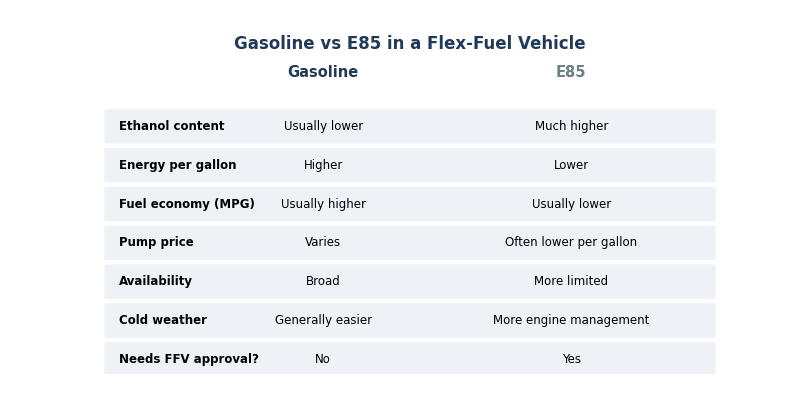
A major reason people search for the meaning of fuel flex is that they want to know whether they should use gasoline or E85. The answer depends on local fuel pricing, availability, vehicle specifications, and how much the owner values fuel economy versus alternative-fuel use.
A flex-fuel vehicle can generally operate on gasoline, E85, or approved blends between them. The engine-management system is designed to adapt.
| Factor | Gasoline | E85 |
|---|---|---|
| Ethanol Content | Usually Lower | Much Higher |
| Energy Per Gallon | Higher | Lower |
| Fuel Economy | Usually Higher | Usually Lower |
| Pump Price | Varies | Often Lower Per Gallon, But Not Always |
| Availability | Generally Broad | More Limited In Many Areas |
| Engine Compatibility | Standard Gasoline Vehicles | Requires FFV Approval |
| Renewable Fuel Component | Depends On Blend | High |
| Fuel Consumption | Lower Volume For Same Distance | Higher Volume For Same Distance |
| Cold-Weather Behavior | Generally Easier | Can Require More Engine Management |
The table illustrates why simply comparing the two pump prices can produce the wrong conclusion. A lower E85 price does not necessarily mean lower transportation cost.
Why E85 Usually Produces Lower MPG
The lower fuel economy associated with E85 is primarily related to energy density. A gallon of ethanol contains less usable energy than a gallon of gasoline.
Consequently, an engine generally needs more E85 by volume to travel the same distance. Depending on the vehicle and conditions, the reduction in miles per gallon can be noticeable.
The exact percentage should not be treated as a fixed number for every vehicle. Engine efficiency, fuel blend, transmission, vehicle weight, tires, temperature, driving conditions, and calibration all influence actual results.
This creates an important distinction between fuel economy and fuel cost. A vehicle can use more fuel per mile while still having a similar or even lower operating cost if the price difference at the pump is large enough.
How To Calculate E85 Cost Per Mile
A simple calculation can help determine whether E85 makes financial sense.
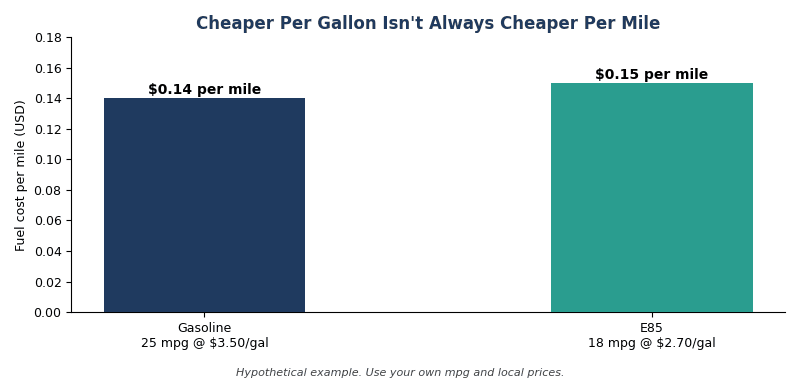
Suppose a vehicle gets 25 mpg on gasoline and gasoline costs $3.50 per gallon. Its approximate fuel cost is:
$3.50 ÷ 25 = $0.14 per mile
Now suppose the same vehicle gets 18 mpg on E85 and E85 costs $2.70 per gallon:
$2.70 ÷ 18 = $0.15 per mile
In this hypothetical example, E85 is cheaper per gallon but slightly more expensive per mile.
The calculation should be repeated using your actual fuel economy and local pump prices. That gives a much more useful comparison than looking only at the displayed price per gallon.
Can You Mix Gasoline And E85?
Flex-fuel vehicles are generally designed to handle varying concentrations of ethanol within their approved fuel range. This means an FFV can normally use gasoline, E85, or a mixture of approved fuels without requiring the driver to drain the tank.
The vehicle’s engine-management system adjusts to the resulting fuel composition.
However, the exact approved fuel range should always be confirmed in the owner’s manual. The word “flex” does not remove the need to follow manufacturer specifications.
If the vehicle is not an FFV, mixing high concentrations of ethanol into ordinary gasoline can create compatibility and operating problems. A conventional gasoline vehicle should only use fuel blends approved by its manufacturer.
Does E85 Damage A Flex-Fuel Engine?
E85 is not inherently damaging to an engine that was specifically designed and certified for that fuel. Flex-fuel vehicles are engineered with appropriate fuel-system components and engine-management strategies.
Problems can arise when high-ethanol fuel is used in a vehicle that was not designed for it. Fuel-system materials, calibration, injector capacity, cold-start strategy, and emissions controls may not be suitable.
Even in an FFV, fuel quality matters. Contaminated fuel, water contamination, stale fuel, or neglected maintenance can create problems regardless of whether the vehicle runs on gasoline or ethanol-containing fuel.
The correct distinction is therefore not “Is E85 bad?” but rather “Is E85 approved for this specific vehicle?”
Advantages And Disadvantages Of Flex-Fuel Vehicles
Flexible-fuel technology offers several practical advantages, but it also involves tradeoffs. Looking at both sides is important because fuel flexibility is not automatically an economic or environmental advantage in every situation.
Main Benefits Of Fuel Flex Technology
One major advantage is fuel choice. An FFV can use gasoline or approved high-ethanol blends, giving the owner another option when E85 is available.
Another benefit is reduced dependence on a single fuel source. Ethanol is produced from biological feedstocks, with corn being a major feedstock for ethanol production in the United States. Depending on production methods and supply chains, ethanol can contribute to a diversified transportation-fuel system.
Fuel flexibility can also be useful in areas where E85 is widely available and competitively priced.
From a vehicle-design perspective, the technology provides this flexibility without requiring the driver to manually adjust the engine. The vehicle automatically manages the fuel mixture within its approved operating range.
Lower Pump Price Does Not Always Mean Lower Cost
One of the most useful ownership insights is that price per gallon and cost per mile should never be treated as the same thing.
E85 can sometimes be significantly cheaper per gallon than gasoline because its energy content is lower and because market pricing can reflect regional supply, production, taxes, and demand.
However, the vehicle consumes more gallons per mile. If E85 is only slightly cheaper than gasoline, the fuel economy penalty may eliminate the apparent savings.
This is why owners should track actual miles per gallon over several tanks. Real-world measurements are more useful than assumptions.
Environmental Considerations Are More Complicated Than A Simple “Green Fuel” Label
Ethanol is often associated with renewable fuel because much of it is produced from crops or other biological sources. However, the environmental impact of ethanol depends on the entire production and distribution system.
Factors can include agricultural inputs, land use, fertilizer, processing energy, transportation, blending, and the source of the ethanol feedstock.
The environmental comparison between gasoline and ethanol therefore cannot be reduced to one universal statement. Different production methods and regional conditions can produce different results.
For consumers, the practical takeaway is simple: flex-fuel capability provides another fuel option, but it should not automatically be interpreted as meaning the vehicle has zero or minimal environmental impact.
Potential Drawbacks Of Flex-Fuel Vehicles
The biggest practical disadvantage is often fuel economy. Because high-ethanol fuel contains less energy per gallon, the vehicle normally travels fewer miles on a gallon of E85.
Availability can also be a problem. Gasoline stations are widespread in many regions, while E85 availability is much more limited.
If an owner rarely encounters E85, the practical value of the flex-fuel capability may be small. On the other hand, someone living near several E85 stations may find the feature much more useful.
Another consideration is long-term fuel storage. Ethanol can absorb moisture from the surrounding environment, which can matter when fuel is stored for extended periods. Vehicle owners who regularly leave a vehicle unused for long periods should follow the manufacturer’s storage recommendations.
How To Tell If Your Vehicle Is Flex-Fuel
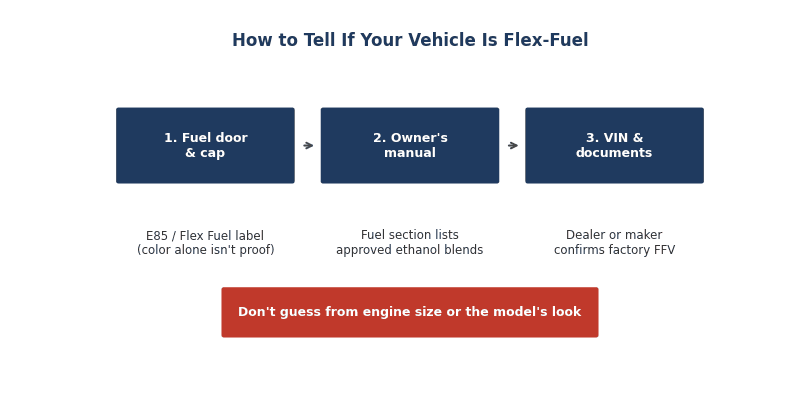
Knowing whether a vehicle is genuinely an FFV is important before putting E85 into the tank. Fortunately, several reliable methods can help confirm compatibility.
Check The Fuel Door And Fuel Cap
The first place to look is the fuel filler area. Some FFVs have a label stating E85, Flex Fuel, or another approved fuel designation.
A yellow fuel cap has also been used on some vehicles to identify flexible-fuel capability, although visual details vary by manufacturer and model year.
Do not rely on color alone. Labels can change between generations, and replacement fuel caps may not retain the original markings.
Check The Owner’s Manual
The owner’s manual is one of the most reliable sources for fuel compatibility. Look for sections covering fuel requirements, gasoline specifications, ethanol blends, E85, and fuel quality.
The manual should identify which ethanol concentrations are approved for the vehicle.
If the manual says the vehicle can use E85, it is designed for that fuel. If it specifies only lower ethanol blends, follow those limits.
Check The VIN And Vehicle Documentation
The vehicle identification number can sometimes be used to determine factory configuration. Dealerships, manufacturer databases, vehicle documentation, and certain vehicle-history services may provide information about whether a vehicle was originally equipped as a flex-fuel model.
This can be particularly useful when buying a used truck or SUV because badges and fuel caps can be replaced.
A VIN-based confirmation is more dependable than assuming that a vehicle is flex-fuel because it looks similar to another FFV model.
Do Not Guess From The Engine Size
A common mistake is assuming that a certain engine automatically supports E85 because another vehicle with the same engine family does.
Manufacturers can offer different fuel-system configurations, calibrations, emissions equipment, and fuel compatibility across model years, markets, and trims.
Engine displacement alone therefore does not establish FFV capability.
Is A Flex-Fuel Vehicle Worth Having?
Whether flex-fuel capability is useful depends heavily on fuel availability and ownership habits. For an owner who regularly has access to E85, the feature can provide meaningful flexibility.
For someone who rarely sees E85 at local stations, the capability may have little practical impact. The vehicle will still operate on gasoline if gasoline is approved, so the owner does not lose normal usability.
The most important factor is not the badge itself but whether the available fuel choices fit your location and budget.
Who Can Benefit Most From Flex Fuel?
Flex-fuel capability can be particularly useful for drivers who live in areas with widespread E85 availability. It can also make sense for owners who monitor fuel prices and are willing to calculate cost per mile rather than simply choosing the cheapest pump price.
Some high-mileage users may find the ability to switch between fuels useful when the price difference becomes significant.
Fleet operators can also evaluate E85 based on local station access, vehicle utilization, fuel contracts, and operating costs. For large fleets, even relatively small differences in fuel cost per mile can become meaningful over thousands or millions of miles.
Who May Not Gain Much From It?
Someone who drives relatively little or has no convenient E85 station may receive little practical benefit from flex-fuel capability.
Likewise, drivers who prioritize maximum miles per gallon may prefer gasoline because high-ethanol blends generally reduce fuel economy.
This does not make flex-fuel vehicles unsuitable. It simply means that the feature should be evaluated based on actual usage rather than treated as an automatic advantage.
A Useful Long-Term Ownership Calculation
When evaluating a used flex-fuel vehicle, look beyond the purchase price.
Consider:
- Local gasoline price
- Local E85 price
- Actual fuel economy on both fuels
- Annual mileage
- E85 station availability
- Typical highway and city driving
- Maintenance history
- Vehicle condition
- Expected ownership period
For example, a driver covering 15,000 miles per year may notice fuel-price differences much more than someone driving 4,000 miles annually.
The calculation becomes particularly useful when comparing two vehicles with different fuel systems. Instead of asking which fuel is “better,” calculate the expected annual fuel cost using realistic local prices and observed fuel economy.
Common Myths About Fuel Flex
Fuel-flex technology has been around for many years, yet several misconceptions continue to cause confusion.
Myth 1: Every gasoline car can use E85.
False. E85 is intended for vehicles specifically approved for high-ethanol fuel. A normal gasoline vehicle should not be assumed to be compatible.
Myth 2: E85 always saves money.
Not necessarily. E85 may have a lower price per gallon but also provides fewer miles per gallon. Cost per mile is the better measurement.
Myth 3: Flex-fuel vehicles require the driver to change settings.
Generally, no. The vehicle’s engine-control system is designed to adapt automatically to approved fuel compositions.
Myth 4: Flex fuel means the engine is a special type of diesel engine.
No. Flex-fuel vehicles are generally gasoline-based internal combustion vehicles designed to operate with approved ethanol-gasoline blends.
Myth 5: E85 always contains exactly 85% ethanol.
No. The ethanol content of E85 can vary within applicable fuel specifications, and seasonal fuel requirements can affect the actual blend.
Myth 6: A flex-fuel vehicle must use E85.
No. A properly equipped FFV is designed to operate on gasoline and approved ethanol blends. The owner does not have to use E85 simply because the vehicle is capable of doing so.
Final Takeaway
Fuel flex means a vehicle is designed to operate on gasoline and approved gasoline-ethanol blends, including high-ethanol fuel such as E85 when specifically supported by the manufacturer. The technology depends on compatible fuel-system components and engine-management software that can adjust operation as the fuel composition changes.
The biggest practical difference between gasoline and E85 is energy content. E85 generally provides fewer miles per gallon, which means its lower pump price must be compared against the additional fuel consumed. A cheaper gallon does not automatically produce cheaper transportation.
For owners, the smartest approach is to verify the vehicle’s exact fuel requirements, check local E85 availability, track real-world fuel economy, and calculate cost per mile. The owner’s manual remains the final authority on approved fuels.
Flex-fuel technology is best viewed as additional fuel flexibility, not as a guarantee of better economy or performance. For the right driver and location, it can be useful. For others, its biggest benefit may simply be knowing that another approved fuel option is available when needed.
Frequently Asked Questions
What Does Fuel Flex Mean On A Car?
Fuel flex means the vehicle is designed to operate on gasoline and approved gasoline-ethanol blends, including E85 when the manufacturer specifies it. The engine-management system adjusts fuel delivery and other operating parameters according to the fuel being used.
Can A Flex-Fuel Vehicle Run On Regular Gasoline?
Yes, flex-fuel vehicles are generally designed to operate on regular gasoline as well as approved ethanol blends. The exact gasoline specification should still be checked in the owner’s manual because fuel requirements can vary between vehicles.
Is E85 Better Than Regular Gasoline?
Neither fuel is universally better for every owner. E85 contains more ethanol but less energy per gallon, so fuel economy is generally lower. Whether it makes financial sense depends on local prices, actual fuel economy, and E85 availability.
Does Flex Fuel Increase Engine Performance?
E85 has a high octane rating and can provide certain combustion advantages, but a vehicle’s actual performance depends on its engine design and calibration. A flex-fuel vehicle is not automatically more powerful simply because it can use E85.
How Do I Know If My Car Is Flex-Fuel?
Check the fuel cap and fuel door for E85 or Flex Fuel markings, then verify the information in the owner’s manual. You can also use the vehicle’s VIN and manufacturer documentation to confirm its factory fuel configuration.
Can I Put E85 In A Regular Gasoline Car?
You should not put E85 into a vehicle unless the manufacturer specifically approves that fuel. High ethanol concentrations require compatible fuel-system components and appropriate engine calibration. If your vehicle is not certified for E85, use only the fuel blends listed in its owner’s manual.